Review of the leafhopper tribe Deltocephalini Dallas, 1870 (Hemiptera, Cicadellidae, Deltocephalinae) in Pakistan with description of a new species of Paramesodes

Abstract
Genes, proteins, chemicals, diseases, species, mutations and cell lines named across the full text — each resolved to its canonical identifier and authoritative record.
Click any figure to enlarge with its caption.
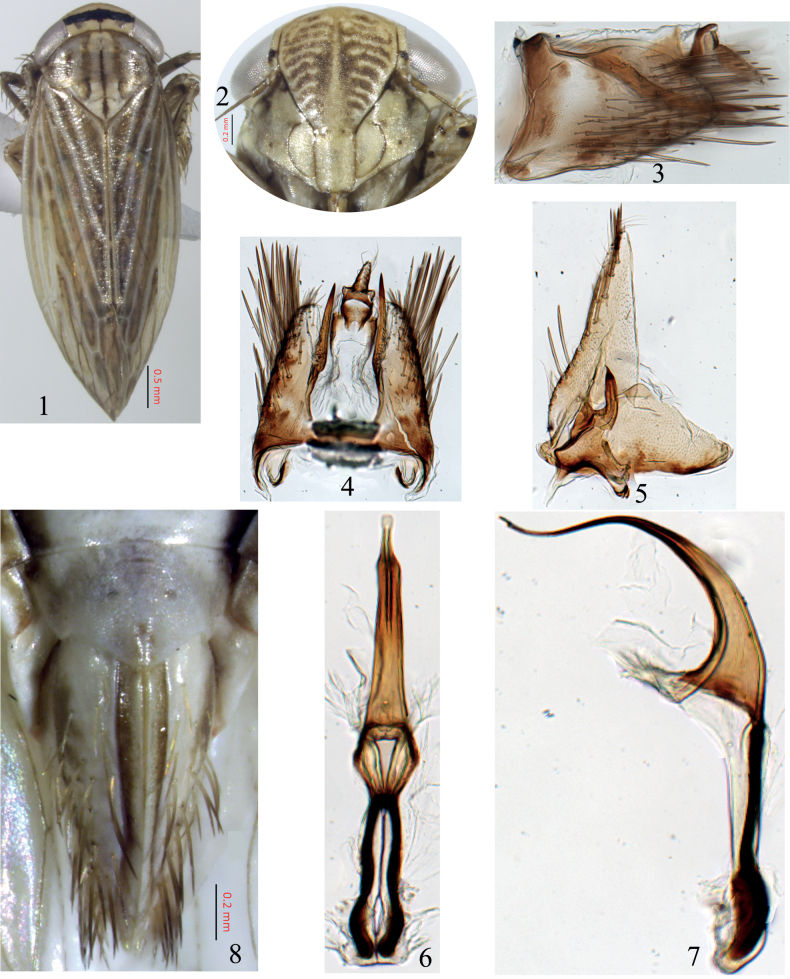 Figures 1–8
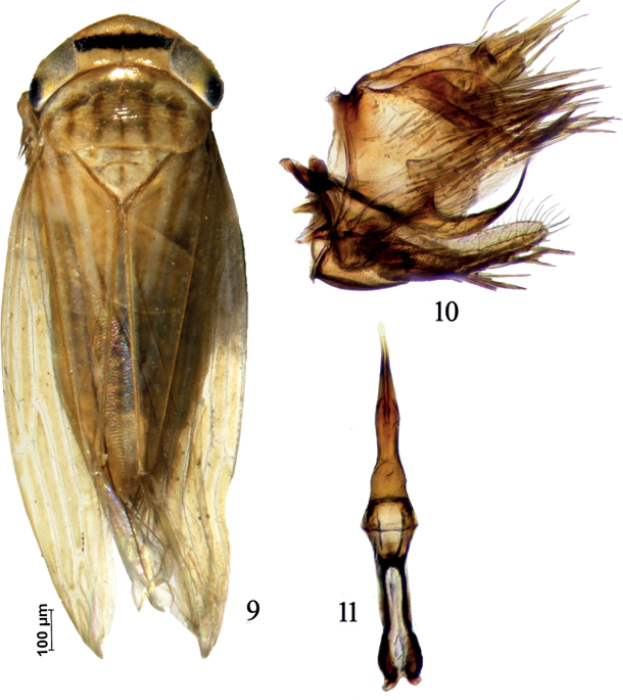 Figures 9–11
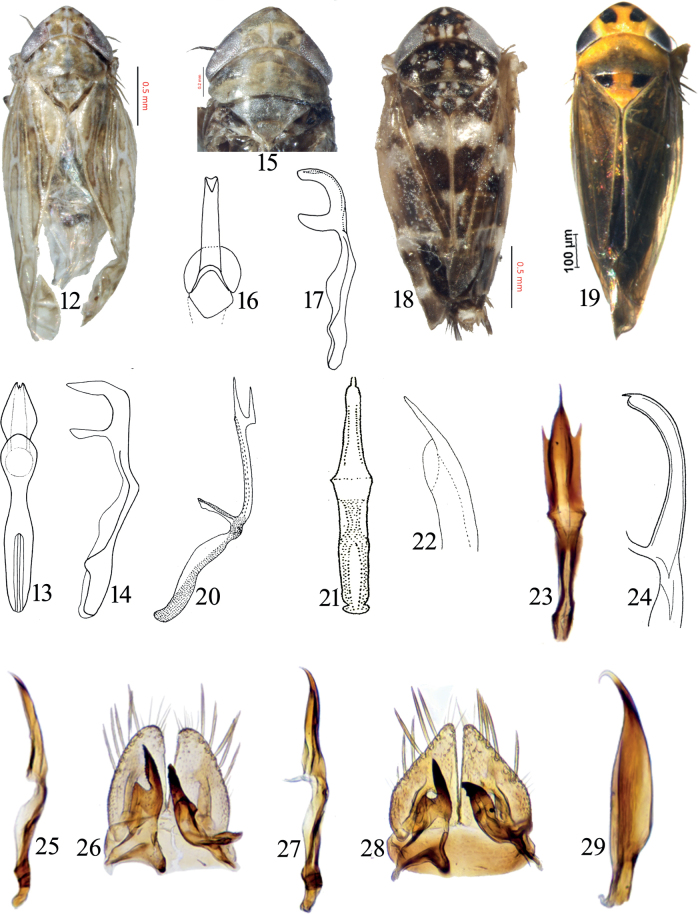 Figures 12–29
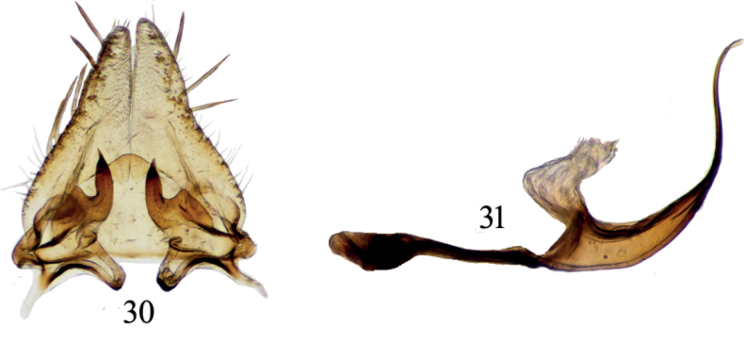 Figures 30, 31
| 1 | Crown with broad black transverse submarginal band between eyes (Figs |
|
| – | Crown without black transverse band between eyes (Figs |
|
| 2 | Aedeagal shaft short, robust, strongly curved dorsally, gonopore apical (Figs |
|
| – | Aedeagal shaft long, slightly curved dorsally, with gonopore indistinct (Figs |
|
| 1 | Crown with six brown spots on anterior margin (Fig. |
|
| – | Crown with single brown spot on anterior margin adjacent to eyes (Fig. |
|
| 1 | Overall color dark brown; forewing with sub basal and subapical irregular white transverse band (Fig. |
|
| – | Color not as above (Fig. |
|
| 2 | Crown, face, and thorax with black patches (Fig. |
|
| – | Crown, face, and thorax without black patches |
|
| 3 | Forewing with extra cross-veins, at least in clavus |
|
| – | Forewing without extra cross-veins |
|
| 4 | Aedeagus with a large subapical ventral process (Fig. |
|
| – | Aedeagus with a short apical ventral process (Figs |
|
| 5 | Aedeagus with pair of short lateral processes (Fig. |
|
| – | Aedeagus without lateral processes |
|
| 6 | Aedeagus in lateral view similar in width in distal half (Fig. |
|
| – | Aedeagus in lateral view evenly tapered from base to apex |
|
| 7 | Style apophysis broadest sub basally (Fig. |
|
| – | Style apophysis broadest at base (Fig. |
|
| 1 | Pale yellowish species (Fig. |
|
| – | Dark yellowish species (Fig. |
|
- —National Natural Science Foundation of China 501100001809 http://doi.org/10.13039/501100001809
Peer Reviews
No public reviews on file for this paper yet. If you reviewed it on a platform where reviews are public (OpenReview, ICLR, NeurIPS, ICML), you can paste yours below so the community can read it here.
Videos
No videos yet. Explain this paper in a talk, walkthrough, or lecture? Add one.
Taxonomy
TopicsPhytoplasmas and Hemiptera pathogens · Hymenoptera taxonomy and phylogeny · Orthoptera Research and Taxonomy
Introduction
Leafhoppers of the tribe Deltocephalini can be identified by their small to moderate size, tapering or parallel-sided clypellus, narrow lorum, linear connective with closely appressed anterior arms, connective fused to the aedeagus, and dorsal sculpturing of the first valvula imbricate. This tribe includes 74 genera and over 600 species distributed worldwide (Duan et al. 2020; Zhang et al. 2023). Until now, 12 species of Deltocephalini have been known from Pakistan (Naveed et al. 2021; Shah et al. 2021).
The genus Paramesodes Ishihara, comprising 16 Old World species, is poorly represented in Pakistan, with only a single previous species, P.lineaticollis (Distant), known. Wilson (1983) revised the genus and recognized one species from Europe and the Middle East, one species from Africa, and nine species from Asia. Five other species were subsequently included: P.montanus Rao, (1989) from India, P.wilsoni Rao & Ramakrishnan, (1990) from India, P.iraniensis Webb & Viraktamath, (2009) from Iran, and P.menghaiensis Li, Dai & Xing, (2011) and P.cangshanae Duan & Zhang, (2012) from China. Paramesodes is externally similar to Paramesus Fieber, Exitianus Ball, and Ctenurellina McKamey but they can be differentiated by having the forewing with the inner anteapical cell open basally (closed in Paramesus and Ctenurella), and the veins are always pale or white (usually brown in Exitianus). In the male genitalia the connective and aedeagus are fused (free in Paramesus and Exitianus), and the pygofer side has a dense covering of long, stout, pale macrosetae (2–6 dark or black macrosetae along apical margin in Exitianus) and the pygofer side has a large process (lower edge of pygofer pectinate in Ctenurella). This, together with the aedeagus, is the most important character for species identification (Duan and Zhang 2012).
In this paper, we provide a list of leafhoppers of the tribe Deltocephalini from Pakistan, illustrated keys to genera and species with their diagnostic characters, and a description and illustration of a new species, P.dirensis sp. nov.
Material and methods
All specimens were examined with a Leica ZOOM2000 stereomicroscope. Drawings were made using an Olympus drawing tube. Photos were taken by a ZEISS SteREO Discovery.V20 stereomicroscope equipped with a ZEISS AxiocamICc 5 camera that also provided measurements. Adobe Photoshop CS was used to compile photographs. Specimens from Pakistan are deposited in the various collections as indicated in the published records. Type specimens of the new species, examined and figured for this study, are deposited in the Entomological Museum, Northwest A&F University, Yangling, Shaanxi, China.
Taxonomy
Family Cicadellidae Latreille, 1802
Subfamily Deltocephalinae Dallas, 1870
Tribe Deltocephalini Dallas, 1870
Key to genera of Deltocephalini from Pakistan
**: **
Genus Deltocephalus Burmeister
Key to species of Deltocephalus from Pakistan (male)
**: **
Deltocephalus
vulgaris
Taxon classificationAnimaliaHemipteraCicadellidae
Dash & Viraktamath
03ABBA5E-7CB4-5FB4-8A20-19CD71DD9DCE
Deltocephalus (Deltocephalus) vulgaris Dash & Viraktamath, 1998: 4, figs 1–11 (India); Zhang and Duan 2011: 3, fig. 3A–H (China); Naveed et al. 2019: 285, figs 1A, B, 3A–D (Pakistan).
Diagnosis.
This species can easily be identified by the color pattern and the aedeagus with a shallow apical notch.
Distribution.
China, India, Pakistan.
Deltocephalus
infirmus
Taxon classificationAnimaliaHemipteraCicadellidae
Melichar
AA36E19E-AC1B-5093-94B5-4D3EF381BDC1
Deltocephalus infirmus Melichar, 1903: 203, pl. 5 fig. 11 (Sri Lanka); Jassargusinfirmus: Ishihara 1961: 244, figs 53–58 (misidentification); Deltocephalusinfirmus: Webb and Viraktamath 2009: 13, fig. 10; Naveed et al. 2019: 285, figs 1C, 3D–G (Pakistan).
Diagnosis.
A similar species to D.vulgaris but differs by having the crown with only a single brown spot and the aedeagal shaft without an apical notch.
Distribution.
India, Pakistan, Sri Lanka, Thailand.
Genus Maiestas Distant
Key to species of Maiestas from Pakistan (males)
**: **
Maiestas
albomaculata
Taxon classificationAnimaliaHemipteraCicadellidae
(Dash & Viraktamath)
F913A654-EB9C-5FCF-A6BB-6705D95C63C1
Deltocephalus (Recilia) albomaculatus Dash & Viraktamath, 1998: 12, figs 29–34 (India); Maiestasalbomaculata: Webb and Viraktamath 2009: 21; Maiestasalbomaculata: Naveed et al. 2019: 287, figs 1E–I, 3H, I (Pakistan); Shah et al. 2021: 403, fig. 1A–D (Pakistan).
Diagnosis.
This species differs from other species of Maiestas in color and male genitalia, including the dorsolateral, laminate serrations of the aedeagal shaft.
Distribution.
Pakistan, India.
Maiestas
indica
Taxon classificationAnimaliaHemipteraCicadellidae
(Singh-Pruthi)
24DD79D6-266A-5A56-9408-D64DBB8A5EB5
Allophleps indica Singh-Pruthi, 1936: 120, fig. 132; pl. 9 fig. 3 (Pakistan); Allophlepsdelhiensis Rao & Ramakrishnan, 1990: 111, figs 1–9 (India), synonymized by Dash and Viraktamath 1998: 35; Deltocephalus (Recilia) indicus: Dash and Viraktamath 1998: 35–36, fig. 305 (India); Maiestasindica: Webb and Viraktamath 2009: 21; Naveed et al. 2019: 287; Shah et al. 2021: 403, fig. 1E (Pakistan).
Diagnosis.
This species can be identified by the aedeagus, which has a distinctive, large, subapical ventral process, the forewings which have accessory cross-veins, and the shorter head.
Distribution.
Pakistan, India.
Maiestas
maculata
Taxon classificationAnimaliaHemipteraCicadellidae
(Singh-Pruthi)
F7C0F730-7BA9-5A13-9168-98391CD4F16E
Cicadula maculata Singh-Pruthi, 1930: 58–59, figs 80, 81, pl. 5 fig. 2 (India); Thamnotettixprabha Singh-Pruthi, 1930: 62, figs 85, 86, pl. 5 figs 6, 6a (India), synonymized by Webb and Viraktamath 2009: 41; Reciliaprabha: Ghauri 1980: 166–169, figs 1, 3–11; Deltocephalus (Recilia) maculata: Dash and Viraktamath 1998: 32, figs 260–269 (India); Maiestasmaculata: Webb and Viraktamath 2009: 22; Maiestasmaculata: Zhang and Duan 2011: 37–39, figs 33–35, pl. 4 fig. E, pl. 5 fig. P, pl. 6 fig. P (China); Shah et al. 2021: 404, fig. 2A–I (Pakistan).
Diagnosis.
This species can be distinguished from other Maiestas species by its habitus, which has variable black patches on the head and thorax, and the shape of its aedeagus and style.
Distribution.
China, India, Pakistan.
Maiestas
pruthii
Taxon classificationAnimaliaHemipteraCicadellidae
(Metcalf)
1A88C146-2B57-5AC2-9D08-26A8D3D575AC
Deltocephlaus notatus Singh-Pruthi, 1936: 128–129, fig. 139, pl. 9 fig. 10 (Pakistan) (primary homonym: Deltocephalusnotatus Melichar, 1896); Deltocephaluspruthii Metcalf, 1967: 1173 (nom. nov. pro D.notatus Singh-Pruthi, 1936); Deltocephalus (Recilia) pruthii: Dash and Viraktamath 1998: 22, 23, figs 150–158 (India); Maiestaspruthii: Webb and Viraktamath 2009: 20, new combination; Khatri and Webb 2010: 11, pl. 2a fig. 13, misidentification; Naveed et al. 2019: 286, fig. 2A–C (incorrectly cited as M.subviridis; H. Naveed pers. comm.), Fig. 3i, misidentification; Shah et al. 2021: 406, fig. 4F–L (Pakistan).
Diagnosis.
This species has a relatively long, acute head, with a pair of inverted U-shaped markings basally, and forewings with extra cross veins. The identity of this species is based on the figures of Dash and Viraktamath (1998).
Distribution.
India, Pakistan.
Maiestas
setosa
Taxon classificationAnimaliaHemipteraCicadellidae
(Ahmed, Murtaza & Malik)
7F8F210F-3844-58B0-9C87-9322E95184B8
Recilia setosa
Ahmed et al., 1988: 412, fig. 2 (Pakistan); Maiestassetosa: Webb and Viraktamath 2009: 20; Naveed et al. 2019: 287; Shah et al. 2021: 406 (Pakistan).
Diagnosis.
The identity of this species remains uncertain due to the limitations of the original description and the accompanying figures. Additionally, the type series from Karachi, which was indicated in the original account as deposited in the Zoological Museum of the University of Karachi (Ahmed et al. 1988), is unavailable (Khatri and Webb 2010: 11). Until the type material can be studied, pinpointing the precise classification of this species will be challenging.
Distribution.
Pakistan.
Maiestas
sinuata
Taxon classificationAnimaliaHemipteraCicadellidae
Shah & Duan
A67B45D0-BAFE-5AB2-BFF9-9912013D5548
Maiestas sinuata Shah & Duan in Shah et al., 2021: 406, fig. 3A–H (Pakistan).
Diagnosis.
This species differs in appearance of its habitus, presence of fine, apical setae on the subgenital plate, the style having a thicker apical process than other species, and the aedeagus lacking a ventrobasal “heel”.
Distribution.
Pakistan.
Maiestas
subviridis
Taxon classificationAnimaliaHemipteraCicadellidae
(Metcalf)
50D9A92C-7DF9-57FD-A796-22DEBE569D56
Stirellus subviridis Metcalf, 1946: 125; Deltocephalus (Recilia) subviridis: Dash and Viraktamath 1998: 24, figs 166–172 (India); Maiestassubviridis: Webb and Viraktamath 2009: 19, fig. 40; Maiestassubviridis: Khatri and Webb 2010: 11, pl. 2b, c, fig. 12 (Pakistan); Zhang and Duan 2011: 19, fig. 17, pl. 2 fig. H (China); Naveed et al. 2019: 287; Shah et al. 2021: 408, fig. 4A–E (Pakistan).
Diagnosis.
This species can be distinguished by the rounded apex of the aedeagus which bears a very short apical spine.
Distribution.
China, India, Pakistan, Pacific.
Maiestas
tareni
Taxon classificationAnimaliaHemipteraCicadellidae
(Dash & Viraktamath)
7925FAB6-B0F7-540B-846E-EA98B2B43A96
Deltocephalus (Recilia) tareni Dash & Viraktamath, 1995: 74–76, figs 1–15; Dash and Viraktamath 1998: 16, figs 78–84 (India); Maiestastareni: Webb and Viraktamath 2009: 22; Khatri and Webb 2010: 11, pl. 2d, fig. 11 (Pakistan); Zhang and Duan 2011: 20 (China); Naveed et al. 2019: 290, figs 2G–I, 3N, O; Shah et al. 2021: 408, fig. 5A–Z (Pakistan).
Diagnosis.
This species can be identified by its relatively straight and stout style, apophysis with a serrated inner margin, and the aedeagus in lateral view evenly tapered from base to apex and relatively straight.
Distribution.
China, India, Pakistan.
Maiestas
trispinosa
Taxon classificationAnimaliaHemipteraCicadellidae
(Dash & Viraktamath)
4B351AAC-875C-5F94-96F8-DE09ECA87068
Deltocephalus (Recilia) trispinosus Dash & Viraktamath, 1998: 35, figs 296–304 (India); Maiestastrispinosa: Webb and Viraktamath 2009: 38; MaiestastrispinosaShah et al., 2021: 408, fig. 6A–I (Pakistan).
Diagnosis.
This species can easily be distinguished from the others by the lateral, spine-like processes of the aedeagus.
Distribution.
India, Pakistan.
Parasmesodes
Taxon classificationAnimaliaHemipteraCicadellidae
Genus
Ishihara
B05D2E66-D20C-561A-9DE1-B4268326F378
Paramesodes Ishihara, 1953: 45. Type species: Athysanusalbinervosus Matsumura, 1902.
Distribution.
Palearctic, Oriental, and Ethiopian regions.
Remarks.
Previously, only 1 species was recorded from Pakistan. This study adds one more new species to the genus, bringing the total to two for the country.
Key to species of Paramesodes from Pakistan (males)
**: **
Paramesodes
dirensis
sp. nov.
Taxon classificationAnimaliaHemipteraCicadellidae
2C6398CA-B87E-5181-81A4-564F8E236F76
https://zoobank.org/158C20E7-3752-4E06-A4CE-AED5721D0A7D
Description.
Length: male 5.2–6.1 mm, female 6.1–6.4 mm. Coloration: pale, with brown markings (Fig. 1). Crown with broad, black, transverse submarginal band between eyes (Fig. 1). Face pale yellow, with brown, transverse striations on clypeus (Fig. 2). Pronotum with medial dark brown longitudinal marking as well as three brown longitudinal markings on each side (Fig. 1). Scutellum with median, longitudinal, dark brown markings and pale brown lateral markings (Fig. 1). Forewings with variable brown markings; veins prominent and white (Fig. 1). Legs pale, with brown markings.
Male genitalia: pygofer lobe broad basally, narrowing apically, forming a rounded-oval apex, with long, yellowish-brown spines extending beyond apical margin, a large process arising near medial dorsal margin and straight apically, surpassing pygofer lobe, without any bend (Figs 3, 4). Subgenital plates triangulate; macrosetae uniseriate laterally (Fig. 5). Valve triangular (Fig. 5). Style as in Figure 5. Connective fused to aedeagus, with arms closely appressed distally (Figs 6, 7). Aedeagus tubular, tapering apically, recurved in lateral view, constricted preapically in ventral view; gonopore apical (Figs 6, 7).
Female. Same in appearance as male. Seventh sternum with lateral margins not extended, posterior margin with median projection, rounded (Fig. 8).
Materials examined.
Holotype ♂, Pakistan: Khyber Pakhtunkhwa: Upper Dir, 35°9'55.89"N, 72°2'48.54"E, 1840 m, 24.07.2019, Hassan Naveed leg., sweep net. Paratypes 8♂, 5♀, same data as holotype.
Etymology.
This species is named after type locality, the Upper Dir in Khyber Pakhtunkhwa.
Remarks.
Paramesodesdirensis sp. nov. is similar to its congeners in general appearance, but it differs from those species in the combination of male genitalia features, i.e., the pygofer is oval posteriorly with a relatively straight process distally and the aedeagal shaft is distally recurved in lateral view and constricted preapically in ventral view. In the Wilson’s (1983) key, the new species runs to couplet 7 along with P.lineaticollis.
Paramesodesdirensis sp. nov. 1 habitus, dorsal view 2 face 3 male pygofer, lateral view 4 male pygofer, dorsal view 5 subgenital plate, valve and style, dorsal view 6 connective and aedeagus, dorsal view 7 connective and aedeagus, lateral view 8 female abdominal tip and 7th sternum, dorsal view.
Paramesodes
lineaticollis
Taxon classificationAnimaliaHemipteraCicadellidae
(Distant)
053D31F1-B00C-5C58-96A9-C0855E0A97B2
Paramesodes lineaticollis (Distant, 1908: 294, Paramesus) (India); Wilson 1983: 21, 22, figs 23–29. Paramesodes ishurdii Mahmood & Meher, 1973: 135 (Pakistan), synonymized by Wilson 1983: 21.
Materials examined.
♂, Pakistan: Khyber Pakhtunkhwa: Shinkiari, 34°28'19.1064"N, 73°16'14.3004"E, 22.07.2018, Bismillah Shah leg., sweep net.
Distribution.
Bangladesh, China, India, Indonesia, Pakistan, Philippines, Taiwan, Turkey.
Diagnosis.
The male pygofer processes is distinct, directed ventrally or postero-ventrally over basal half, and turned abruptly posteriorly immediately distad of its midlength. Mahmood and Meher (1973) reported this species as P.ishurdii for the first time from Pakistan, but that species was later synonymized by Wilson (1983).
Paramesodeslineaticollis9 habitus, dorsal view 10 male pygofer, lateral view 11 connective and aedeagus, dorsal view.
12–14Deltocephalusvulgaris Dash & Viraktamath: 12 habitus, dorsal view 13 aedeagus and connective, dorsal view 14 aedeagus and connective, lateral view 15–17D.infirmus (Melichar): 15 habitus, dorsal view 16 aedeagus and connective, dorsal view 17 aedeagus and connective, lateral view 18Maiestasalbomaculata (Dash & Viraktamath) habitus, dorsal view 19M.maculata (Singh-Pruthi) habitus, dorsal view 20M.indica (Singh-Pruthi) aedeagus and connective, lateral view (after Dash & Viraktamath, 1998) 21, 22M.pruthii (Metcalf): 21 aedeagus and connective, dorsal view (after Dash & Viraktamath, 1998) 22 apex of aedeagus, lateral view 23M.trispinosa (Dash & Viraktamath) aedeagus and connective, dorsal view 24M.subviridis (Metcalf) aedeagus, lateral view (after Khatri & Webb, 2010) 25, 26M.tareni (Dash & Viraktamath): 25 aedeagus and connective, lateral view 26 subgenital plate, valve and styles, dorsal view 27, 28M.sinuata Shah & Duan: 27 aedeagus and connective, lateral view 28 subgenital plate, valve and styles, dorsal view 29M.maculata (Singh-Pruthi) aedeagus, lateral view.
Paramesodeslineaticollis30 subgenital plates, valve and styles, dorsal view 31 aedeagus and connective, lateral view.
Supplementary Material
XML Treatment for Deltocephalus vulgaris
XML Treatment for Deltocephalus infirmus
XML Treatment for Maiestas albomaculata
XML Treatment for Maiestas indica
XML Treatment for Maiestas maculata
XML Treatment for Maiestas pruthii
XML Treatment for Maiestas setosa
XML Treatment for Maiestas sinuata
XML Treatment for Maiestas subviridis
XML Treatment for Maiestas tareni
XML Treatment for Maiestas trispinosa
XML Treatment for Parasmesodes
XML Treatment for Paramesodes dirensis
XML Treatment for Paramesodes lineaticollis
The reference list from the paper itself. Each links out to its DOI / PubMed record.
- 1Ahmed M Murtaza B Malik KF (1988) Some new aphrodine leafhoppers from grasslands of Karachi, Pakistan.Pakistan Journal of Zoology 20: 409–421.
- 2Dash PC Viraktamath CA (1995) Two new species of grass feeding leafhopper genus Deltocephalus (Recilia) (Homoptera, Cicadellidae) from Orissa, India.Hexapoda, Insecta Indica 10: 1–59.
- 3Dash PC Viraktamath CA (1998) A review of the Indian and Nepalese grass feeding leafhopper genus Deltocephalus (Homoptera, Cicadellidae) with description of new species.Hexapoda, Insecta Indica 10: 1–59.
- 4Distant WL (1908) Rhynchota-Homoptera. In: Bingham CT (Ed.) The Fauna of British India, including Ceylon and Burma 4, 501 pp.
- 5Duan YN Zhang YL (2012) Review of the grass feeding leafhopper genus Paramesodes Ishihara (Hemiptera: Cicadellidae: Deltocephalinae: Deltocephalini) from China.Zootaxa 3151(1): 53–62. 10.11646/zootaxa.3151.1.4 · doi ↗
- 6Duan YN Gao Y Dietrich CH (2020) Pascoia, a new Deltocephalini leafhopper genus (Hemiptera: Cicadellidae: Deltocephalinae) from Peru.Zootaxa 4801(1): 185–190. 10.11646/zootaxa.4801.1.1133056680 · doi ↗ · pubmed ↗
- 7Ghauri MSK (1980) Illustrated redescription of two of Pruthi’s species of Cicadelloidea from India.Reichenbachia Staatliches Museum für Tierkunde in Dresden 18: 165–171. https://www.zobodat.at/publikation_articles.php?id=314312
- 8Ishihara T (1953) A tentative check list of the superfamily Cicadelloidea of Japan (Homoptera).Scientific Report of the Matsuyama Agricultural College 11: 1–72.