Nursing performance and occupational risks in family health strategy: an integrative review
Francisco Werbeson Alves Pereira, Douglas Vieira Braga, Samyra Paula Lustoza Xavier, Moziane Mendonça de Araújo, Rosely Leyliane dos Santos, John Carlos de Souza Leite

TL;DR
This review explores the occupational risks faced by nursing professionals in primary health care, particularly within the Family Health Strategy, and highlights the need for better risk management and training.
Contribution
The study provides an integrative review of occupational risks in nursing within primary health care, emphasizing the lack of research and training on this topic.
Findings
Occupational risks in nursing are often not perceptible except for biological risks.
Few studies have addressed risk mapping in the Family Health Strategy.
Training and biosafety standards are needed to address these risks.
Abstract
Primary health care is one of the different fields of nursing practice. The COVID-19 pandemic has caused a series of questions regarding exposure that nursing professionals face in terms of occupational risks in primary health care. The aim of this study was to discuss to discuss, based on scientific evidence, the occupational risks experienced by the nursing team in the Family Health Strategy. This integrative literature review was conducted in the Latin American and Caribbean Health Sciences Literature (LILACS) database and the Nursing Database (BDENF) between June and October 2020. The descriptors used in the search were: nursing, occupational risks, and primary health care. Inclusion criteria were original, open access articles published between 2005 and 2019 with the full text available. Of the 37 articles initially found, 6 were included in the analysis and after screening.…
Genes, proteins, chemicals, diseases, species, mutations and cell lines named across the full text — each resolved to its canonical identifier and authoritative record.
Click any figure to enlarge with its caption.
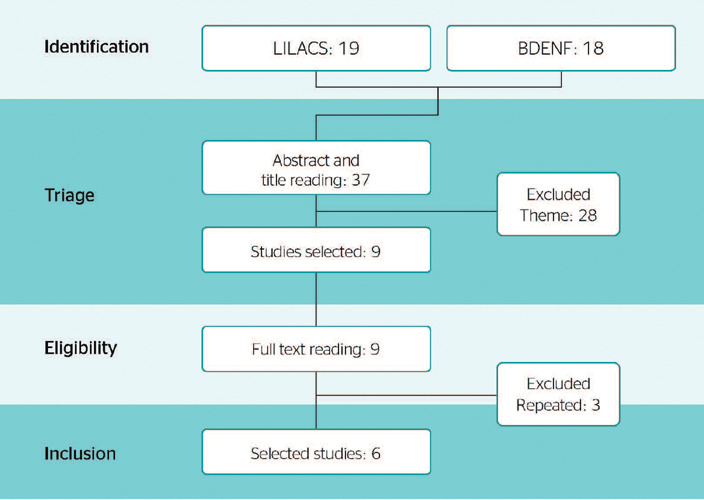 Figure 1
| Elements | Descriptor | |
|---|---|---|
| P - Population | Nurses | Nursing |
| V - Variable | Occupational risks | Occupational risks |
| O - Outcomes | PHC work | PHC |
| Authors | Title | Objective | Study type | Sample | Country/year |
|---|---|---|---|---|---|
| Arcanjo RVG, Chistovam BP, Braga ALS, Silvino
ZR | Gerenciamento dos riscos ocupacionais da enfermagem na atenção básica: estudo exploratório descritivo | To identify the occupational risks to which nursing professionals are exposed in primary health care; to describe the risk factors present in health units and correlate them with safety conditions. | Exploratory and descriptive study with a quantitative approach | 8 nursing professionals | Brazil/2018 |
| Melo FMS, Oliveira BB, Oliveira RKL, Bezerra JC,
Silva MJN, Joventino ES | Conhecimentos de enfermeiros sobre acidentes de trabalho | To determine nurses’ knowledge about work accidents. | Qualitative research | 10 nurses | Brazil/2017 |
| De Sousa ÁFL, Queiroz AAFLN, Oliveira LB,
Moura ME, Batista OMA, Andrade D | Representações sociais da enfermagem sobre biossegurança: saúde ocupacional e o cuidar prevencionista | To understand the social representations of biosafety among nursing professionals in primary care and analyze how they are associated with care quality. | Exploratory study with a qualitative approach | 36 nursing professionals | Brazil/2016 |
| Silva CCS, Rodrigues LMC, Silva VKBA, Silva ACO,
Silva VLA, Martins MO | Percepção da enfermagem sobre condições de trabalho em unidades de saúde da família na Paraíba – Brasil | To describe and characterize the perceptions of nursing professionals about accidents and work conditions at family health units in João Pessoa, Paraíba. | Descriptive study with a qualitative approach | 12 nursing professionals | Brazil/2013 |
| Santos SR, Virgolino JLB, Brito SS, Bezerra EP,
Dantas UIB, Costa MML | Risco ocupacional enfrentado pelos enfermeiros que atuam na atenção primária à saúde | To analyze the perceptions of primary health care nurses about biosafety measures in their work process. | Descriptive and exploratory study with a quantitative and qualitative approach | 53 nurses | Brazil/2013 |
| David HMSL, Mauro MYC, Silva VG, Pinheiro MAS, Silva
FH | Organização do trabalho de enfermagem na atenção básica: uma questão para a saúde do trabalhador | To determine the impact of the work organization of nurses, technicians, and nursing assistants in primary care and its relationship with their health. | Quantitative, cross-sectional, descriptive, and inferential study | 171 nursing professionals | Brazil/2009 |
Peer Reviews
No public reviews on file for this paper yet. If you reviewed it on a platform where reviews are public (OpenReview, ICLR, NeurIPS, ICML), you can paste yours below so the community can read it here.
Videos
No videos yet. Explain this paper in a talk, walkthrough, or lecture? Add one.
Taxonomy
TopicsCOVID-19 and Mental Health · Healthcare during COVID-19 Pandemic · Resilience and Mental Health
INTRODUCTION
Since the Brazilian Unified Health System was created in 1988, the health situation of Brazilians has changed, and the possibilities for professional nursing activities have expanded significantly. Since that time, the profession’s core axis has become the planning, implementation, and evaluation of policies and actions in the field of public and collective health, bringing greater resolution, quality, and efficiency to the provided care, from large centers to the most remote locations in the country.^1,2^
Among the contexts of action, the Family Health Strategy (Estratégia Saúde da Família: ESF), a gateway to primary health care, characterizes the essence of nursing work as the promotion, protection, maintenance, and rehabilitation of the health of individuals and families and the community based on care, management, and educational actions, which must conform to the principles and assumptions of the Unified Health System, as well as to the demands of the population.^2^
The work environment has a significant influence on quality of life and health,^3^ As the complexity of nursing work in the ESF has increased, it is clear that these professionals have increasingly become the anchor of primary health care, and concern about the occupational risks to which they are exposed has also increased. Several ESF activities expose nursing professionals to risks, including vaccination, wound dressing, cervical smear, heel prick test, reprocessing of personal items, waste disposal, provision of care in the home environment, etc.^1,2^ Interpersonal conflicts, work overload, occupational stress, and exposure to social vulnerabilities, such as violence, can impact their physical and mental health.
Prolonged exposure to occupational hazards contributes to accidents at work.^4^ In 2018 in Brazil, there were 2,472 reports of occupational exposure to risk factors and 576,951 notifications of work accidents, of which 71,496 were related to human health care activities.^5^ Despite such data, scientific production on occupational risks is still incipient, and the number of publications has not increased significantly over time.^6^
However, the pandemic has added COVID-19 to the list of work-related diseases^7^ and highlighted the work of the nursing team, focusing debate about the occupational risks to which they are exposed. However, these discussions are mainly about hospital-level care practices^8,9^; debate about the risks to which ESF professionals are exposed must be expanded.^10^
The present study’s relevance is to stimulate discussion about the occupational risks to which nursing workers in the ESF are exposed, since it can indicate measures to help guarantee injury prevention and promote the safety and health of these workers. Based on the above, this study aims to discuss, based on scientific evidence, the occupational risks experienced by nursing teams in the ESF.
METHODS
Mendes et al.^11^ considered the following steps for developing a literature review: define the guiding question, search for and select primary studies, extract the data, assess the included studies, interpret the results, and present the review. This review was conducted between June and October 2020. The research question was developed using the Population, Variable, and Outcomes framework,^12^ which determined its components and the corresponding descriptors, as shown in Table 1.
Table 1: Descriptors used in the research question according to the Population, Variable and Outcomes strategy
Thus, the following research question was defined: “What occupational risks are nursing professionals exposed to while working in primary health care?” The search was performed in the Latin American and Caribbean Health Sciences Literature (LILACS) database and the Ministry of Health’s Nursing Database (BDENF). These databases were selected due to their relevance in the academic and scientific environment and because they contained the highest number of documents related to the study. The following descriptors (in Portuguese) were used: enfermagem/nursing, riscos ocupacionais/occupational risks, and atenção primária à saúde/primary health care.
The inclusion criteria were original, open access articles published between 2005 and 2019 with the full text available. This time frame was selected since it coincided with the passing of worker safety Regulatory Norm 32 on November 11, 2005. This legislation, which established basic guidelines for measures to protect the health and safety of health service workers,^13^ was an important milestone in occupational health in Brazil, stimulating discussion about the subject. The exclusion criteria were review articles, monographs, dissertations, theses, and studies that did not consider the occupational health of nursing professionals in the primary health care context.
The database searches were conducted by cross-referencing the descriptors with the Boolean operator “AND”. Initially, 37 studies were identified: 19 in LILACS and 18 in BDENF. The first stage of the screening process involved title and abstract reading, in which 28 studies were excluded due to lack of relevance (15 from LILACS and 13 from BDENF). In the second phase of screening, the full texts of the 9 remaining studies were read, 3 of which were duplicate publications and were excluded. Thus, 6 studies met the eligibility criteria and were included in the analysis. The study selection process, which followed the Preferred Reporting Items for Systematic Reviews and Meta-Analysis checklist, is presented in Figure 1.
Figure 1. Article search and selection process. BDENF = Base de Dados de Enfermagem (Nursing Database); LILACS = Latin American and Caribbean Health Sciences Literature.
Data extraction was based on an instrument by Ursi,^14^ which was adapted to collect the variables of interest: (1) bibliographic aspects, such as authorship, title, study type, year of publication, and country, and (2) occupational risk aspects involved in nursing work in the primary health care context. The study evaluation stage was based on the pyramid of scientific evidence proposed by Galvão,^15^ which indicated that all 6 included studies are descriptive, thus ranking at the sixth level.
The results were organized based on a summary of the findings, which allowed the analysis and interpretation of the data by identifying converging and diverging aspects, which are presented below descriptively.
RESULTS AND DISCUSSION
It should be pointed out that only two articles, David et al.^16^ and Santos et al.,^17^ described the professional profiles of the authors, and only Santos et al.^17^ included an occupational health specialist. The samples of only 2 articles consisted exclusively of nurses.^17,18^ The others aimed to encompass all nursing professionals, ie, nurses and nursing technicians/assistants.^16,19,20,21^ Table 2 presents the titles, authors, objectives, study types, samples, country, and year of publication of the 6 articles included in this review.
Occupational hazards are classified into 5 categories: physical, chemical, biological, ergonomic, and mechanical/accidental.^16,17,18,19,20,21^ Among occupational risks in the context of primary health care, the biological type was the most discussed in the included studies, mainly due to the handling of biological agents, eg, contaminated needles and sharp objects. However, the high biological risk among nurses is not only due to contaminated sharp objects, but to contact with blood, tissue, and body fluids while performing their activities.^18,19^
This review showed that biological risk is responsible for most of the work accidents in the ESF.^17^ Thus, it is common for professionals to only associate work accidents with biological risk because it is the most common and visible type in their professional activities, as well as due to the lack of training they receive about it.
Physical risk is present mainly in home visits, during which professionals either do not use or are not provided sunscreen, which requires managers to be more committed to their protection.^19^ Mechanical risk is related to falls, physical aggression, stress, pressure from patients, and job dissatisfaction. Chemical risk is mainly related to medications. Ergonomic risks are related to walking, repetitive movements, and inadequate workplace furnishings.^18^
Another point worth mentioning is that violence and psychosocial risks are not directly covered in the Regulatory Norms, although they appear separately within other topics or are included in mechanical risks.^18^ None of the studies addressed the risk map or its importance in health services, which would be essential for more comprehensive identification of occupational risks and their causes for nursing professionals in the ESF.
Studies indicate that this theme has a higher prevalence at the hospital level, which exposes a weakness by researchers and professionals in the ESF context, ie, the constant division between actions of a curative nature and those of health promotion and risk control. Thus, the greatest difficulty is for researchers and health professionals to understand that work accidents and occupational risks are inherent to any level of health care, including the ESF.^16,20^
Knowledge of the occupational risks to which workers are exposed in the ESF is one of the main ways of preventing accidents. Health managers must devise strategies to improve working conditions and change the behavior of the nursing team, which can be achieved through permanent education programs.^21^
Preparation about the types and definitions of occupational risks is still inadequate.^18^ The knowledge that these professionals have about occupational risks comes from daily practice, not from research and/or qualification/training. This can lead to misidentification of risk or ineffective prevention measures.^18^
Another factor that entails risk is unhealthy working conditions related to the unavailability of equipment and instruments, financial hardship, and instability of the employment relationship, which predisposes workers to physical, ergonomic, and psychosocial occupational risks, thus increasing their vulnerability in the workplace. It is important to highlight that, even when personal protective equipment is provided, training must also be provided and awareness raised.^17,21^
Some factors influence the inappropriate use of personal protective equipment, such as discomfort or inconvenience, carelessness, forgetfulness, lack of habit or discipline, inadequate equipment, insufficient quantity, and ignoring it because it seems unnecessary. New meaning must be given to the continuous education process, connecting it with occupational health, thus enabling the proper use of personal protective equipment.^21^
Therefore, it is necessary to follow the recommendations of the NRs. The main NR dealing with health professionals is Regulatory Norm 32, which delineates measures to protect their safety and health. In this context, the use of personal protective equipment, hand hygiene, vaccination against hepatitis B, tetanus, and diphtheria, etc., are recommended. According to Regulatory Norm 32, it is the duty of health services to provide personal protective equipment in adequate quantity and quality, in addition to being responsible for its conservation. Another important point is that workers must report any changes that makes the equipment unsuitable for use.^17,21^
Actions such as occupational risk training and the establishment of prevention and notification measures can lead to a considerable reduction in work accident rates in the ESF. However, correct reporting of work accidents due to risk exposure is still a major challenge, since a lack of knowledge contributes to underreporting.^20^
Since notification is the main means of learning about work-related accidents and illnesses, it is critical for the development of risk prevention and control strategies. However, the perceived importance of notifying occupational health is still weak among nursing professionals. Incomplete implementation of occupational health policies in the ESF impacts these workers, who end up being unaware of risk issues and work accidents.^21^
It is known that strategies to prevent or reduce the occupational risks to which nursing professionals are exposed guarantees an adequate work model. Such strategies are mainly implemented through policies, standard operating procedures, and the control and assessment of risks and adverse events that affect safety, health, professional integrity, the environment, and the institution’s image.^18^
CONCLUSIONS
The results of this study show how incipient scientific production is on the occupational risks to which nursing professionals are exposed while performing their ESF duties. It also allowed an overview of health services management in this context, since these professionals often do not have the support or training they need to identify or deal with work accidents due to occupational risks.
It is important to point out that the mitigating factors for occupational risks are mainly associated with management, which is responsible for training these professionals on the subject. Therefore, health managers should be more sensitive to the issue, offering training courses, permanent education, and subsidies for these professionals to carry out their activities safely, thus ensuring that public policies are effective.
Although this study contributes to the field of occupational health among nursing professionals, it involves certain limitations, such as scarce literature about the theme and studies that focus on specific regions of the country, that, while hindering generalization of the findings, also serve as recommendations for more in-depth studies about this situation.
The reference list from the paper itself. Each links out to its DOI / PubMed record.
- 1Da Silva MCN Machado MH Sistema de saúde e trabalho: desafios para a Enfermagem no Brasil Cienc Saude Colet 202025171310.1590/1413-81232020251.2757201931859850 · doi ↗ · pubmed ↗
- 2Ferreira SRS Périco LAD Dias VRFG A complexidade do trabalho do enfermeiro na Atenção Básica à Saúde Rev Bras Enferm 201871 Sup 1704709
- 3Sampaio CL De Almeida PC Alves e Souza AM Neri MFS Da Silva LA Caetano JÁ Diferenças entre qualidade de vida e enfrentamento ocupacional de enfermeiros efetivos e terceirizados Rev Bras Enferm 202073 Supl 1e 201904623266748310.1590/0034-7167-2019-0462 · doi ↗ · pubmed ↗
- 4Fonseca EC Sousa KHJF Nascimento FPB Tracera GMP Dos Santos KM Zeitoune RCG Riscos ocupacionais na sala de vacinação e suas implicações à saúde do trabalhador de enfermagem Rev Enferm UERJ 202028 e 45920 e 45920
- 5Ministério da Fazenda Anuário Estatístico de Acidentes do Trabalho: AEAT 2017. Vol. 1 (2009)Brasília MF 20189969961 set. 2020 Anual. Disponível em: https://www.gov.br/previdencia/pt-br/assuntos/previdencia-social/saude-e-seguranca-do-trabalhador/acidente_trabalho_incapacidade/arquivos/aeat-2018.pdf
- 6Chiodi MB Marziale MHP Riscos ocupacionais para trabalhadores de Unidades Básicas de Saúde: revisão bibliográfica Acta Paul Enferm 2006192212217
- 7Silva LS Machado El L De Oliveira HN Ribeiro AP Condições de trabalho e falta de informações sobre o impacto da COVID-19 entre trabalhadores da saúde Rev Bras Saude Ocup 202045 e 24e 24
- 8Belarmino AC De Mendonça KM Rodrigues MENG Ferreira Junior AR Saúde ocupacional da equipe de enfermagem obstétrica intensiva durante a pandemia da Covid-19Av Enferm 202038 Supl 14451