Rapid growth in a large Cambrian apex predator
Yu Wu, Stephen Pates, Daniel Pauly, Xingliang Zhang, Dongjing Fu

TL;DR
This study reveals that a 520-million-year-old Cambrian predator grew extremely fast, suggesting a unique life strategy during the Cambrian explosion.
Contribution
The paper provides the first quantitative analysis of the post-embryonic growth of a Cambrian apex predator.
Findings
Appendages of Amplectobelua symbrachiata grew isometrically with an estimated maximum size of 90 cm.
The species exhibited rapid growth compared to modern arthropods.
The growth pattern supports the idea of an evolutionary 'arms race' during the Cambrian explosion.
Abstract
Despite the importance of ontogenetic data on early diverging euarthropods to our understanding of the ecology and evolution of past life, the data are distinctly lacking, as reconstructing life histories of fossil animals is often challenging. Here we report the growth trajectory of frontal appendages of the apex predator Amplectobelua symbrachiata, one of the most common radiodont arthropods from the early Cambrian Chengjiang biota (c. 520 Ma) of China. Analysis of 432 specimens (9.1–137.1 mm length; 1.3–25.6 mm height) reveals that appendages grew isometrically, with an estimated maximum size of the whole animal of c. 90 cm. Individuals grew rapidly compared to extant arthropods, as assessed using the electronic length-frequency analysis (ELEFAN) approach. Therefore, we show that the Cambrian apex predator A. symbrachiata was an extremely fast-growing arthropod, with an unusual life…
Genes, proteins, chemicals, diseases, species, mutations and cell lines named across the full text — each resolved to its canonical identifier and authoritative record.
Click any figure to enlarge with its caption.
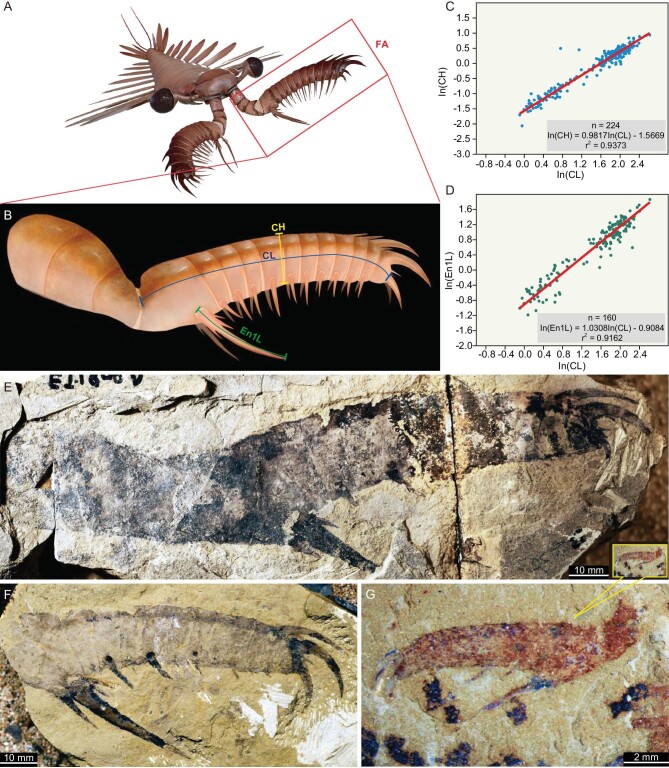 Figure 1
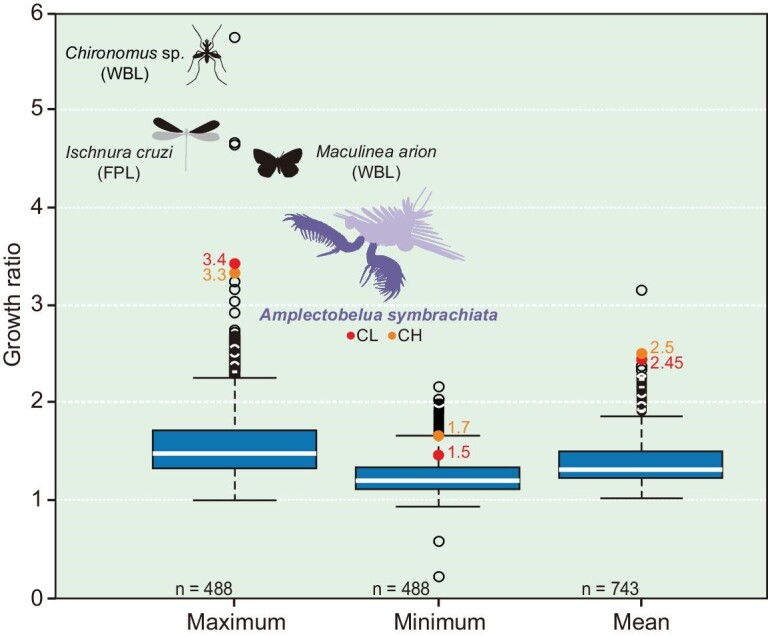 Figure 2
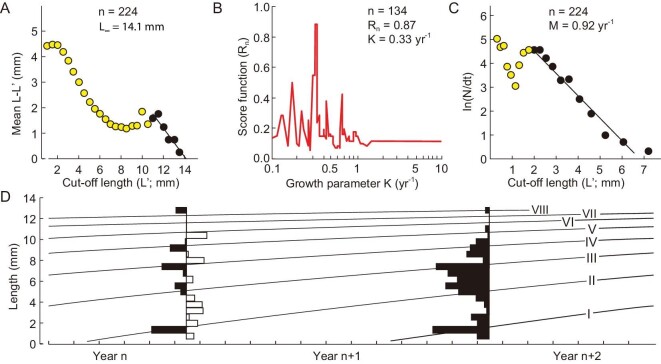 Figure 3
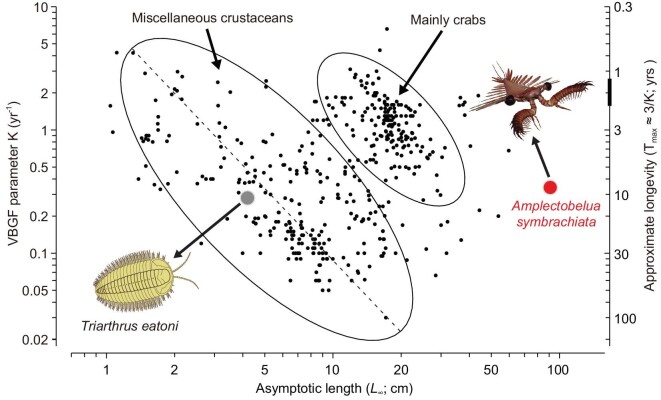 Figure 4
Peer Reviews
No public reviews on file for this paper yet. If you reviewed it on a platform where reviews are public (OpenReview, ICLR, NeurIPS, ICML), you can paste yours below so the community can read it here.
Videos
No videos yet. Explain this paper in a talk, walkthrough, or lecture? Add one.
Taxonomy
TopicsEmployment, Labor, and Gender Studies · Social Sciences and Policies