Prevalence of helmintic infections in Brazilian Maxakali indigenous: a repeated cross-sectional design
Maria Beatriz Pena e Silva Leite Nacife, Liliane Maria Vidal Siqueira, Keila Furbino Barbosa, Valeska Natiely Vianna, Cássio Zumerle Masioli, Jaime Costa da Silva, Fábio Zicker, Paulo Marcos Zech Coelho, Naftale Katz, George Luiz Lins Machado-Coelho

TL;DR
This study compares the prevalence of intestinal parasites in the Maxakali indigenous group in Brazil between 1972 and 2014, showing a decline but still high infection rates.
Contribution
The study provides a longitudinal comparison of helminthic infections in an indigenous group over 40 years, highlighting persistent neglect in public health.
Findings
Schistosoma mansoni positivity dropped from 67.4% in 1972 to 45.7% in 2014.
Hookworm positivity decreased from 72.9% in 1972 to 22.8% in 2014.
The Maxakali population remains neglected by health authorities, with high infection rates compared to Brazil's current epidemiology.
Abstract
The prevalence of intestinal parasites is known to be high among Amerindian populations; further, there are serious problems in the healthcare of these populations in Brazil. The Maxakali, located in the northeastern region of Minas Gerais, Brazil, is an indigenous group that still preserves many of its cultural aspects. This study aimed to compare the positivity rate of schistosomiasis and soil-transmitted helminths in this ethnic group in epidemiological surveys conducted in 1972 and 2014. Stool parasitological examinations were performed by the Kato-Katz technique during both periods in this population. In 2014, the parasitological diagnosis was also realized with the TF-Test® technique. In 1972, 270 inhabitants were examined. The positivity rates were 67.4% for Schistosoma mansoni, 72.9% for hookworms, 43.7% for Ascaris lumbricoides, and 23.7% for Trichuris trichiura. In 2014, 545…
Genes, proteins, chemicals, diseases, species, mutations and cell lines named across the full text — each resolved to its canonical identifier and authoritative record.
Click any figure to enlarge with its caption.
 Figure 1
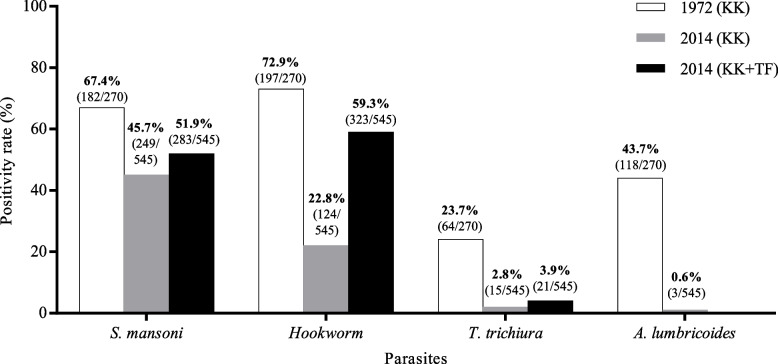 Figure 2
 Figure 3
Peer Reviews
No public reviews on file for this paper yet. If you reviewed it on a platform where reviews are public (OpenReview, ICLR, NeurIPS, ICML), you can paste yours below so the community can read it here.
Videos
No videos yet. Explain this paper in a talk, walkthrough, or lecture? Add one.
Taxonomy
TopicsParasites and Host Interactions · Child Nutrition and Water Access · Parasite Biology and Host Interactions