Mode of birth in subsequent pregnancy when first birth was vacuum extraction or second stage cesarean section at a tertiary referral hospital in Uganda
Assen Kamwesigye, Barbara Nolens, Herbert Kayiga, Moses Muriuki, Wani Muzeyi, Jolly Beyeza-Kashesya

TL;DR
Women who had a vacuum extraction in their first birth are more likely to have a vaginal birth in subsequent pregnancies compared to those who had a cesarean section.
Contribution
The study provides evidence that vacuum extraction in the first birth increases the likelihood of vaginal birth in subsequent pregnancies compared to second stage cesarean section.
Findings
Women with a first birth by vacuum extraction had a 78.4% rate of subsequent vaginal birth.
Women with a first birth by second stage cesarean section had a 38.6% rate of subsequent vaginal birth.
Vacuum extraction is associated with higher chances of spontaneous vaginal birth in subsequent pregnancies.
Abstract
The trends of increasing use of cesarean section (CS) with a decrease in assisted vaginal birth (vacuum extraction or forceps) is a major concern in health care systems all over the world, particularly in low-resource settings. Studies show that a first birth by CS is associated with an increased risk of repeat CS in subsequent births. In addition, CS compared to assisted vaginal birth (AVB), attracts higher health service costs. Resource-constrained countries have low rates of AVB compared to high-income countries. The aim of this study was to compare mode of birth in the subsequent pregnancy among women who previously gave birth by vacuum extraction or second stage CS in their first pregnancy at Mulago National Referral Hospital, Uganda. This was a retrospective cohort study that involved interviews of 81 mothers who had a vacuum extraction or second stage CS in their first pregnancy…
Genes, proteins, chemicals, diseases, species, mutations and cell lines named across the full text — each resolved to its canonical identifier and authoritative record.
Click any figure to enlarge with its caption.
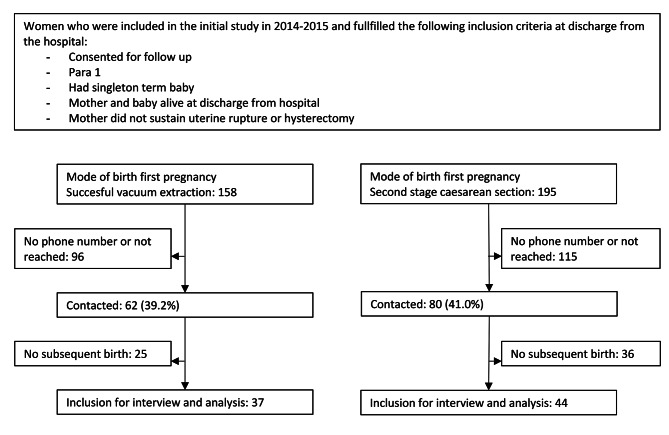 Figure 1
Peer Reviews
No public reviews on file for this paper yet. If you reviewed it on a platform where reviews are public (OpenReview, ICLR, NeurIPS, ICML), you can paste yours below so the community can read it here.
Videos
No videos yet. Explain this paper in a talk, walkthrough, or lecture? Add one.
Taxonomy
TopicsMaternal and Perinatal Health Interventions · Global Maternal and Child Health · Maternal and fetal healthcare