The Proportion of Normalized Hips with Growth in Japanese Adolescents Aged > 10 years with Acetabular Dysplasia who Presented with Suspected Scoliosis
Takahiro Nishimura, Hideaki Watanabe, Naoya Taki, Ichiro Kikkawa

TL;DR
This study examines how often acetabular dysplasia normalizes in Japanese adolescents with suspected scoliosis, finding higher normalization rates in younger patients.
Contribution
The study provides new insights into acetabular dysplasia normalization rates in adolescents based on age at diagnosis.
Findings
31.6% of acetabular dysplasia cases diagnosed before age 12 normalized by age 15.
Only 5.6% of cases diagnosed at or after age 12 normalized by age 15.
AD in adolescence predicted AD at growth completion in 95% of cases diagnosed at ≥12 years.
Abstract
If asymptomatic acetabular dysplasia (AD) is incidentally identified in adolescence, it is difficult to determine the appropriate follow-up or treatment strategy because the acetabulum is still developing. We investigated the rate of AD normalization at the end of acetabular growth. This cross-sectional study involved 653 patients (1306 hips) aged 10–14 years with scoliosis or suspected scoliosis. All patients underwent plain standing whole-spine radiography (with the pelvis included) at the first visit. We measured the lateral center–edge angle, Sharp angle, Tönnis angle, and acetabular head index on radiographs. The criterion for AD was a lateral center–edge angle of < 20°. We extracted the data of patients aged < 12 (10–11) years and ≥ 12 (12–14) years with AD. Furthermore, we analyzed the radiographic follow-up data at 15 years of age to identify the AD normalization rate. AD was…
Genes, proteins, chemicals, diseases, species, mutations and cell lines named across the full text — each resolved to its canonical identifier and authoritative record.
Click any figure to enlarge with its caption.
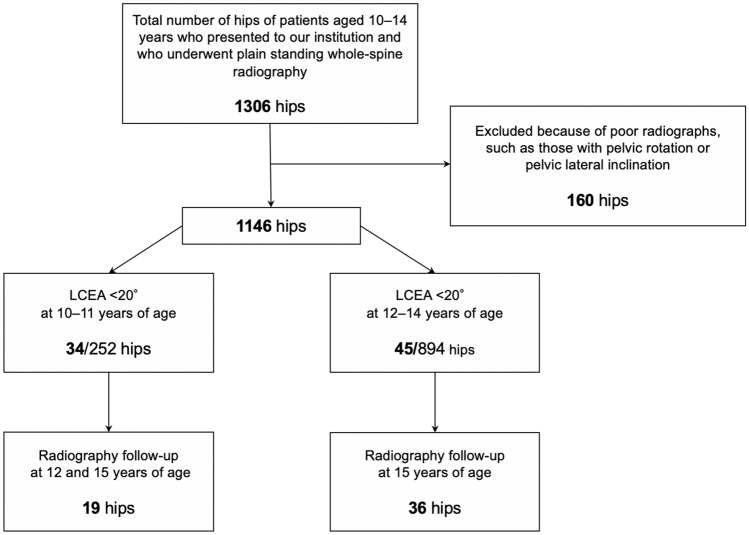 Figure 1
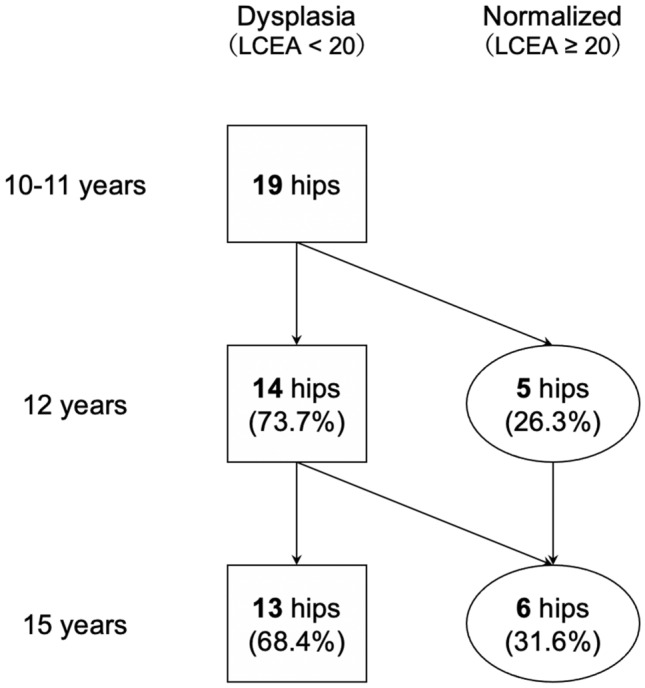 Figure 2
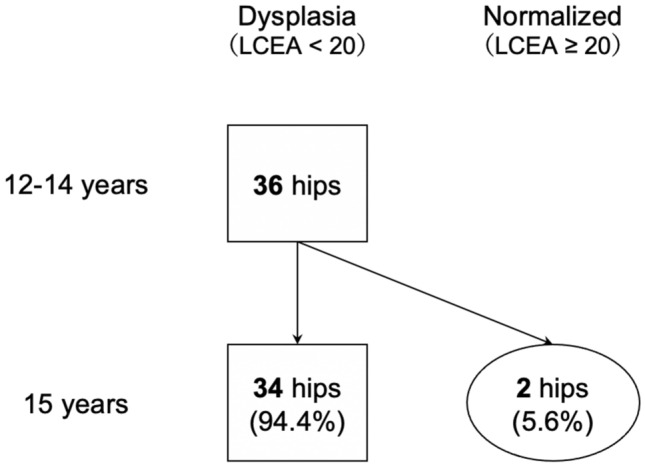 Figure 3
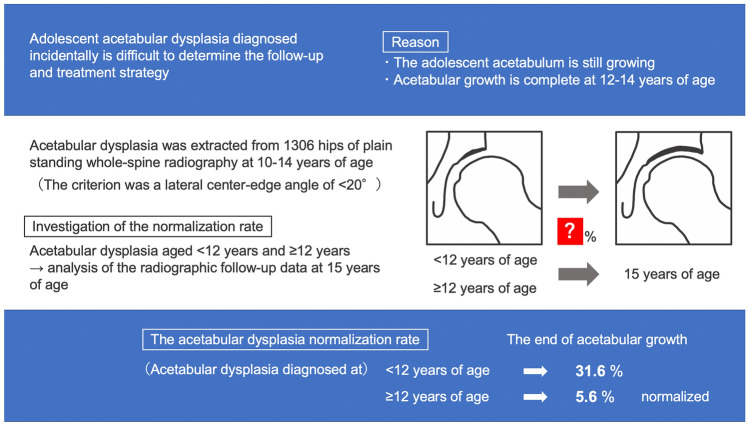 Figure 4
Peer Reviews
No public reviews on file for this paper yet. If you reviewed it on a platform where reviews are public (OpenReview, ICLR, NeurIPS, ICML), you can paste yours below so the community can read it here.
Videos
No videos yet. Explain this paper in a talk, walkthrough, or lecture? Add one.
Taxonomy
TopicsHip disorders and treatments · Orthopaedic implants and arthroplasty · Pelvic and Acetabular Injuries