Low bleeding acceptance is associated with increased death risk in patients with atrial fibrillation on oral anticoagulation
Gabriela Rusin, Małgorzata Konieczyńska, Joanna Natorska, Krzysztof Piotr Malinowski, Anetta Undas

TL;DR
Patients with atrial fibrillation who are less willing to accept bleeding risks while on anticoagulation face higher chances of stroke, death, or non-persistence with treatment.
Contribution
This study introduces bleeding risk acceptance as a novel prognostic factor in atrial fibrillation patients on anticoagulation.
Findings
Low bleeding acceptance is linked to higher mortality and cerebrovascular events.
Patients with low bleeding acceptance are more likely to discontinue anticoagulant therapy.
Bleeding acceptance, along with age and CHA2DS2-VASc score, predicts poor outcomes in AF patients.
Abstract
Bleeding is the most feared complication of anticoagulation. We sought to investigate whether the bleeding risk acceptance has a prognostic value during long-term follow-up in the era of direct oral anticoagulants (DOACs) among patients with atrial fibrillation (AF). We studied 167 consecutive AF outpatients [aged 68.8 SD 10.6 years; 141 (84.4%) on DOACs]. The bleeding acceptance was assessed based on the Bleeding Ratio defined as the declared maximum number of major bleedings that a patient would be willing to accept to prevent one major stroke. We recorded cerebrovascular ischemic events, major or clinically relevant non-major bleeds (CRNMB), and mortality. A median Bleeding Ratio was 4 (IQR 2–5). During follow-up of 946 patient-years, cerebrovascular ischemic events and/or death were observed in 28 patients (3.3%/ year) and major bleeding or CRNMB in 33 (4.6%/ year). The Bleeding…
Genes, proteins, chemicals, diseases, species, mutations and cell lines named across the full text — each resolved to its canonical identifier and authoritative record.
Click any figure to enlarge with its caption.
 Figure 1
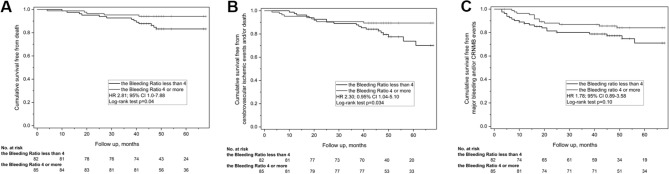 Figure 2
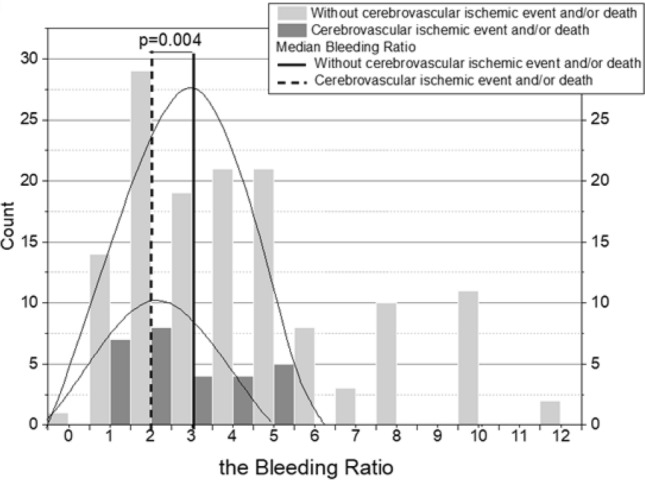 Figure 3
Peer Reviews
No public reviews on file for this paper yet. If you reviewed it on a platform where reviews are public (OpenReview, ICLR, NeurIPS, ICML), you can paste yours below so the community can read it here.
Videos
No videos yet. Explain this paper in a talk, walkthrough, or lecture? Add one.
Taxonomy
TopicsAtrial Fibrillation Management and Outcomes · Acute Ischemic Stroke Management · Intracerebral and Subarachnoid Hemorrhage Research