Corrigendum: State-resolved studies of CO2 sticking to CO2 ice
Charlotte Jansen, Ludo B. F. Juurlink

Abstract
Genes, proteins, chemicals, diseases, species, mutations and cell lines named across the full text — each resolved to its canonical identifier and authoritative record.
Click any figure to enlarge with its caption.
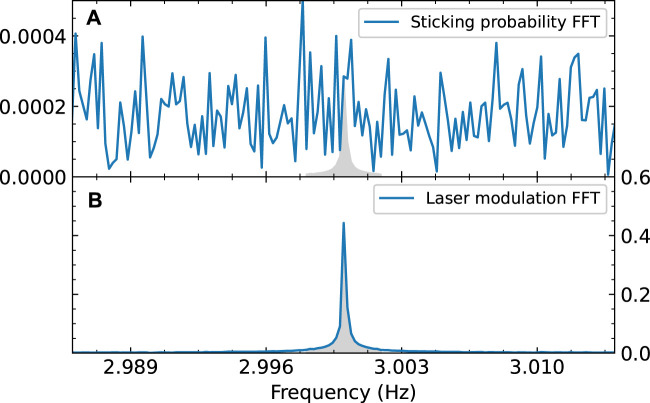 Figure 1
Peer Reviews
No public reviews on file for this paper yet. If you reviewed it on a platform where reviews are public (OpenReview, ICLR, NeurIPS, ICML), you can paste yours below so the community can read it here.
Videos
No videos yet. Explain this paper in a talk, walkthrough, or lecture? Add one.
Taxonomy
TopicsCarbon Dioxide Capture Technologies · Methane Hydrates and Related Phenomena · CO2 Sequestration and Geologic Interactions
In the published article, there was an error in Figure 5 as published. The wrong dataset was used, see text correction. The corrected Figure 5 and its caption appear below.
In the published article, there was an error. The King and Wells measurements were done with a cold cathode pressure gauge (Pfeiffer IKR 270). This pressure gauge was found to have a relatively slow response time. A test measurement showed that the sensitivity at 3 Hz is approximately 300 times lower than the maximum sensitivity at 0 Hz. As our measurements were done with a modulating input (laser excitation) at 3 Hz, the upper limit for the effect of laser excitation on sticking probability was overestimated by a factor of 300. However, we have another dataset of the same measurement, but measured with a quadrupole mass spectrometer (QMS, Pfeiffer QMA 200). The change in sensitivity of the QMS between 0 Hz and 3 Hz is negligible. While the overall noise level of the QMS is higher than that of the pressure gauge, it is still much more sensitive at 3 Hz and it is therefore better to use the QMS data.
A correction has been made to Abstract. This sentence previously stated:
“Based on our detection limit, we quantify the weighted average sticking probability at approximately 0.9 and the difference between the state-resolved and weighted average sticking probability as below 0.03%.”
The corrected sentence appears below:
“Based on our detection limit, we quantify the weighted average sticking probability at approximately 0.9 and the difference between the state-resolved and weighted average sticking probability as below 0.5%.”
A correction has been made to Experimental, 8. This sentence previously stated:
“Hence, we measure the sticking probability of CO_2_ onto CO_2_ ice at 80 K with a modulated version of the King and Wells method (King and Wells, 1972) and a cold cathode pressure gauge (Pfeiffer IKR 270). The absolute pressure changes in the UHV chamber are dominated by the molecular beam, which consists (nearly) only of CO_2_. As the ion gauge signal yields considerably better signal-to-noise than our QMS tuned to m/z 44, and it allows for higher detection frequency, it is easier to detect small differences in the sticking probability. The use of an ion gauge instead of a QMS was inspired by prior O_2_ state-resolved measurements (Kurahashi, 2016; Cao et al., 2019).”
The corrected sentence appears below:
“Hence, we measure the sticking probability of CO_2_ onto CO_2_ ice at 80 K with a modulated version of the King and Wells method (King and Wells, 1972) and a quadrupole mass spectrometer (QMS, Pfeiffer QMA 200) tuned to m/z 44.”
A correction has been made to Experimental, 9. This sentence previously stated:
“This causes a rise in the CO_2_ partial pressure in the vacuum chamber, which is continuously monitored with the pressure gauge.”
The corrected sentence appears below:
“This causes a rise in the CO_2_ partial pressure in the vacuum chamber, which is continuously monitored with the QMS.”
A correction has been made to Results and discussion, Sticking probability of CO _ 2 _ on CO _ 2 _ ice, 3. This sentence previously stated:
“The integral of the peak, which corresponds to our detection limit for the sticking probability, is calculated to be 3 × 10^−5^ whereas the sticking probability itself is near unity.”
The corrected sentence appears below:
“The integral of the peak, which corresponds to our detection limit for the sticking probability, is calculated to be 6 × 10^−4^ whereas the sticking probability itself is near unity.”
A correction has been made to Results and discussion, Sticking probability of CO _ 2 _ on CO _ 2 _ ice, 4. This sentence previously stated:
“Applying these corrections to our detection limit, we find that the upper limit for the change in the CO_2_ sticking probability on CO_2_ ice due to the asymmetric stretch vibration is approximately 3 × 10^−4^.”
The corrected sentence appears below:
“Applying these corrections to our detection limit, we find that the upper limit for the change in the CO_2_ sticking probability on CO_2_ ice due to the asymmetric stretch vibration is approximately 5 × 10^−3^.”
The authors apologize for these errors and state that this does not change the scientific conclusions of the article in any way. The original article has been updated.