Insight into the antioxidant activities of ten Fabaceae plant species that are medicinally used by the Aucan Tribal Peoples from the Republic of Suriname (South America)
Dennis R.A. Mans, Nicholaas M. Pinas, Meryll Djotaroeno, Priscilla Friperson, Jennifer Pawirodihardjo, Maureen Y. Lichtveld

TL;DR
This study evaluates antioxidant and phenolic properties of ten Fabaceae plants used by the Aucan people in Suriname, finding significant variation in their health benefits.
Contribution
The study identifies four Fabaceae species with high antioxidant and phenolic content, suggesting their potential therapeutic value.
Findings
Four Fabaceae species (I. stipularis, C. guyanensis, A. jupunba, M. urens) showed high antioxidant activity and phenolic content.
Other species had antioxidant and phenolic values more than tenfold lower.
Antioxidant activity, total phenolics, flavonoids, and selenium content correlated strongly with each other.
Abstract
Fabaceae are associated with a high antioxidant activity (AA) and a high total phenolic (TPC), total flavonoid (TFC), and selenium content (SeC). In this study, the aqueous extracts from ten Fabaceae species that are medicinally used by the Aucan Tribal Peoples from Suriname (South America), were evaluated for AA using a DPPH and a FRAP assay, and for TPC, TFC, and SeC using Folin-Ciocalteu’s, an AlCl3 colorimetric, and an azure B-based method. Associations between pairs of these variables were determined by Pearson correlation coefficient. One-way ANOVA with post-hoc Tukey’s test was used to evaluate the data for statistically significant differences (p < 0.05). The I. stipularis (bark), C. guyanensis (bark), A. jupunba (twigs), and M. urens (fruit) extracts had the highest DPPH IC50 values (36 – 70 μg/mL) and FRAP values (346 – 573 μM FeE/100 μg) and the highest TPC (25 – 41 GAEq/100…
Genes, proteins, chemicals, diseases, species, mutations and cell lines named across the full text — each resolved to its canonical identifier and authoritative record.
Click any figure to enlarge with its caption.
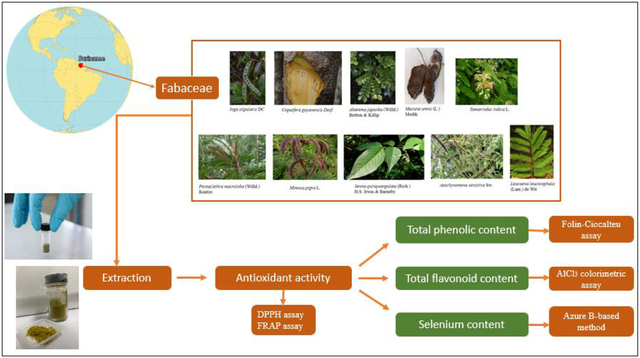 Figure 1
Peer Reviews
No public reviews on file for this paper yet. If you reviewed it on a platform where reviews are public (OpenReview, ICLR, NeurIPS, ICML), you can paste yours below so the community can read it here.
Videos
No videos yet. Explain this paper in a talk, walkthrough, or lecture? Add one.
Taxonomy
TopicsPhytochemicals and Antioxidant Activities · Ethnobotanical and Medicinal Plants Studies · Natural Antidiabetic Agents Studies