An invasion deep into the nucleus: stripe rust effector Pst21674 inhibits transcription factor TaASR3 in wheat
Yee-Shan Ku

Abstract
Genes, proteins, chemicals, diseases, species, mutations and cell lines named across the full text — each resolved to its canonical identifier and authoritative record.
Click any figure to enlarge with its caption.
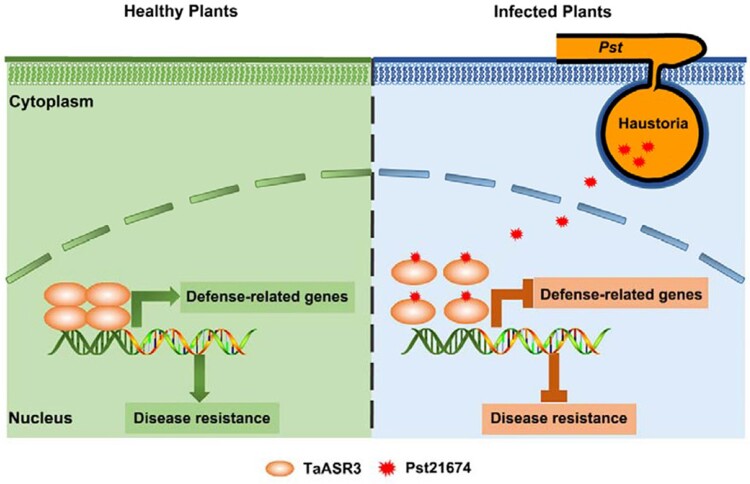 Figure 1
Peer Reviews
No public reviews on file for this paper yet. If you reviewed it on a platform where reviews are public (OpenReview, ICLR, NeurIPS, ICML), you can paste yours below so the community can read it here.
Videos
No videos yet. Explain this paper in a talk, walkthrough, or lecture? Add one.
Taxonomy
TopicsMycotoxins in Agriculture and Food · Wheat and Barley Genetics and Pathology · Plant-Microbe Interactions and Immunity
In the natural environment, plants are constantly challenged by pathogens, including bacteria and fungi. Plants have evolved defenses against pathogens, and pathogens have evolved strategies, including the production of effectors, through which to suppress plant defenses. Understanding the interplay between plant defenses and pathogen effectors is important for designing strategies to promote plant immunity.
Pathogenic effectors can be proteins, metabolites, or small RNA molecules (Jaswal et al. 2020). Fungal effectors are typically secreted from the fungal haustorium and therefore include a signal peptide at their N terminus. They also frequently include organelle localization signals to mediate the proper subcellular localization in the host cell (e.g. nucleus, mitochondria). Although effector proteins have long been shown to be essential for pathogenicity, the mechanism behind their action is still unclear.
Puccinia striiformis f. sp. tritici (Pst) is the causal agent of wheat stripe rust. In this issue of Plant Physiology, Zheng et al. (Zheng et al. 2023) investigated the mechanism of action of Pst21674, previously identified as a haustorium-secreted protein that interfered with plant defenses. Pst21674 has an N-terminal signal sequence and a C-terminal nuclear-localization signal.
The authors first used a yeast-two-hybrid library to screen for wheat proteins that interact with Pst21674. Subcellular localization, in vitro pulldown, and co-immunoprecipitation assays revealed that Pst21674 interacts with a wheat transcription factor, TaASR3, in the nucleus of the host cell (Zheng et al. 2023). The authors next carried out a series of assays to demonstrate the functional roles of Pst21674 and TaASR3 in the infection. The authors showed that host-induced gene silencing of Pst21674 reduced the virulence of Pst. The positive role of TaASR3 in immunity was demonstrated by the enhanced resistance when TaASR3 was overexpressed in wheat and enhanced susceptibility when it was silenced.
RNA-seq was employed to search for genes regulated by TaASR3. Overexpression of TaASR3 was associated with the elevated expressions of defense-related genes. However, when Pst21674 was coexpressed with TaASR3, the expressions of these defense-related genes were suppressed. The authors also investigated the mechanism behind the inhibitory effect of Pst21674 on TaASR3. Size exclusion chromatography, bimolecular fluorescence complementation, and luciferase complementation imaging revealed that TaASR3 proteins form a functional tetramer. However, when Pst21674 was coexpressed with TaASR3, self-multimerization of TaASR3 proteins was reduced. Such a reduction of self-multimerization was coupled with the suppressed expressions of defense-related genes. Based on these results, the authors concluded that TaASR3 proteins form a functional tetramer to promote the expressions of defense-related genes. However, upon the invasion of Pst21674 into the nucleus, the self-multimerization of TaASR3 proteins is reduced. As a result, the abundance of functional TaASR3 tetramer and the expressions of the target defense-related genes are suppressed.
This study opens possibilities for future research. For example, the characterization of the defense-related genes regulated by TaASR3 and the functional roles of these genes will improve the understanding of host immunity in wheat, and understanding the pathogenic mechanism of Pst21674 could point to strategies to promote the host immunity, including by expression of antisense Pst21647 RNA in the host wheat to silence Pst21647 and promote resistance to Pst (Zheng et al. 2023).
The reference list from the paper itself. Each links out to its DOI / PubMed record.
- 1Jaswal R , Kiran K, Rajarammohan S, Dubey H, Singh PK, Sharma Y, Deshmukh R, Sonah H, Gupta N, Sharma TR. Effector biology of biotrophic plant fungal pathogens: current advances and future prospects. Microbiol Res. 2020:241:126567. 10.1016/j.micres.2020.12656733080488 · doi ↗ · pubmed ↗
- 2Zheng P , Liu M, Pang L, Sun R, Yao M, Wang X, Kang Z, Liu J. Stripe rust effector Pst 21674 compromises wheat resistance by targeting transcription factor Ta ASR 3. Plant Physiol. 2023:193(4):2806–2824. 10.1093/plphys/kiad 49737706535 · doi ↗ · pubmed ↗