Endoscopic ultrasound-guided drainage using a forward-viewing echoendoscope for peripancreatic fluid collection after Child resection
Takuya Ishikawa, Kentaro Yamao, Yasuyuki Mizutani, Tadashi Iida, Kota Uetsuki, Masanao Nakamura, Hiroki Kawashima

Abstract
Genes, proteins, chemicals, diseases, species, mutations and cell lines named across the full text — each resolved to its canonical identifier and authoritative record.
Click any figure to enlarge with its caption.
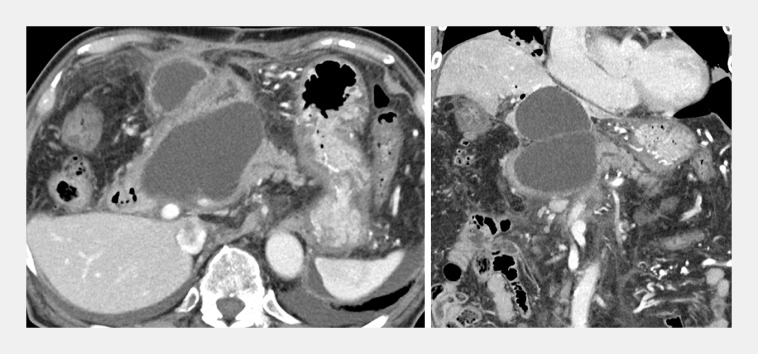 Fig. 1
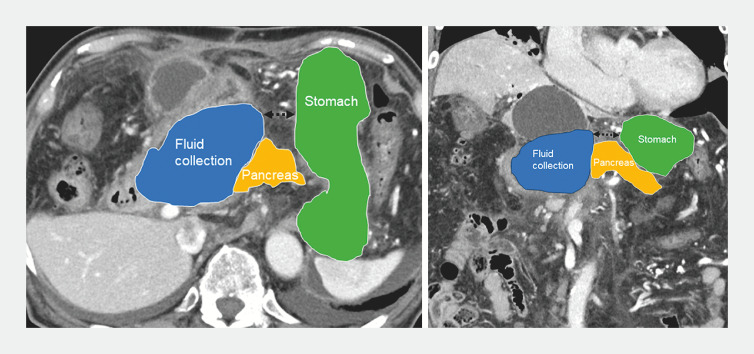 Fig. 2
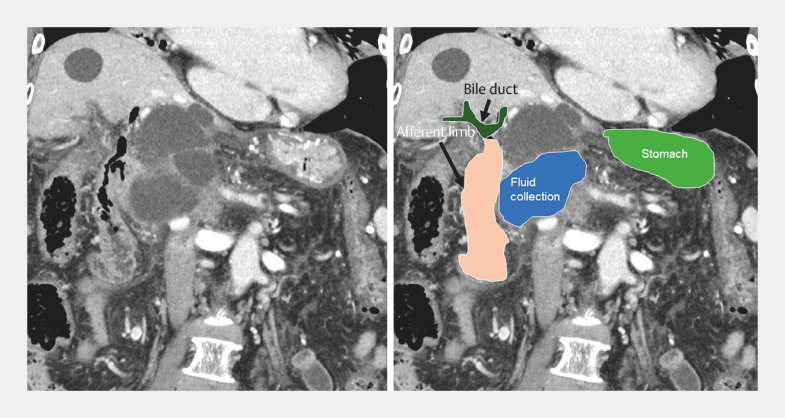 Fig. 3
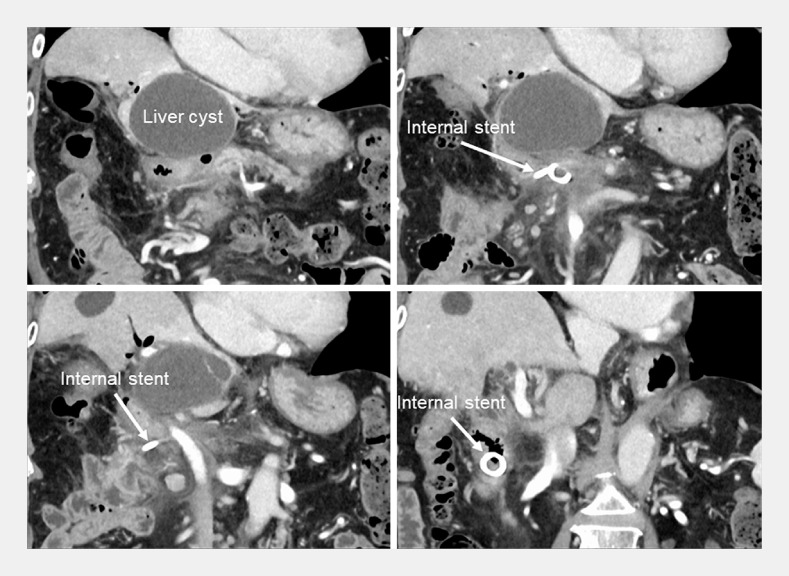 Fig. 4
Peer Reviews
No public reviews on file for this paper yet. If you reviewed it on a platform where reviews are public (OpenReview, ICLR, NeurIPS, ICML), you can paste yours below so the community can read it here.
Videos
No videos yet. Explain this paper in a talk, walkthrough, or lecture? Add one.
Taxonomy
TopicsPancreatic and Hepatic Oncology Research · Pancreatitis Pathology and Treatment · Gastrointestinal disorders and treatments
Peripancreatic fluid collection (PFC) due to pancreatic leakage is one of the significant complications arising following pancreatic surgery. Although endoscopic ultrasound (EUS)-guided drainage is less invasive than other methods in treating PFCs, it requires the drainage area to be in contact with the gastrointestinal tract accessible by the echoendoscope 1 . In patients with surgically altered anatomy, an oblique-viewing echoendoscope, which is mainly used for EUS-guided drainage, encounters technical difficulties in the jejunum. Recently, the usefulness of a forward-viewing echoendoscope in such cases has been reported 2 3 .
We experienced a case of afferent limb syndrome due to postoperative PFC at the pancreaticojejunal anastomosis following a modified Child resection in a 70-year-old man ( Fig. 1 ). As the fluid collection was remotely located from the stomach ( Fig. 2 ), and the afferent limb was in close proximity ( Fig. 3 ), EUS-guided drainage was attempted using a forward-viewing echoendoscope (TGF-UC260J; Olympus Optical, Tokyo, Japan) ( Video 1 ). Confirming the direction to reach the afferent limb was made relatively easy using the forward-viewing echoendoscope. Based on computed tomography (CT) findings, the target fluid collection could be confirmed by EUS observation where the scope was withdrawn a few centimeters from the choledochojejunal anastomosis. A 19G needle was used for puncture, a guidewire was placed, and the puncture site was dilated using a 4-mm tapered balloon. For double-wire indwelling, a double-lumen catheter was used, and the procedure was completed with placement of both internal and external stents. Immediately following the procedure, the patient showed symptom improvement, and 2 months later CT confirmed complete disappearance of the PFC ( Fig. 4 ).
Computed tomography (CT) showing a large pancreatic fluid collection at the pancreaticojejunal anastomosis site following modified Child resection in a 70-year-old man.
CT with overlaid schema showing the distance between the fluid collection and the stomach. As the fluid collection developed at the pancreaticojejunal anastomosis site, it was remotely located from the stomach.
CT and the same image with overlaid schema showing the afferent limb and the fluid collection in close proximity.
CT taken 2 months following drainage showing complete disappearance of the fluid collection.
Endoscopic ultrasound-guided drainage using a forward-viewing echoendoscope for peripancreatic fluid collection following modified Child resection.Video 1
Conventional EUS-guided drainage predominantly employs an oblique-viewing echoendoscope, which presents considerable challenges and perforation risks when intubating in the afferent limb. In contrast, the forward-viewing echoendoscope provides a superior and safer approach, offering precise echo-guided puncture determination.
Endoscopy_UCTN_Code_TTT_1AS_2AD
The reference list from the paper itself. Each links out to its DOI / PubMed record.
- 1Voermans RP Ponchon T Schumacher B Forward-viewing versus oblique-viewing echoendoscopes in transluminal drainage of pancreatic fluid collections: a multicenter, randomized, controlled trial Gastrointest Endosc 2011741285129310.1016/j.gie.2011.07.05921981813 · doi ↗ · pubmed ↗
- 2Itoi T Itokawa F Sofuni A Late bleeding after EUS-guided transjejunal drainage of a pancreatic pseudocyst in a Roux-en-Y patient Dig Endosc 20111515310.1111/j.1443-1661.2011.01141.x 21535202 · doi ↗ · pubmed ↗
- 3Tomoda T Kato H Akimoto Y Endoscopic ultrasonography-guided transjejunal drainage for postoperative pancreatic fistula using forward-viewing echoendoscope Clin J Gastroenterol 2015822823110.1007/s 12328-015-0580-026155955 · doi ↗ · pubmed ↗