Endoscopic submucosal dissection for diverticulum using combination of countertraction and circumferential-inversion method
Hiroshi Takayama, Yoshinori Morita, Toshitatsu Takao, Douglas Motomura, Madoka Takao, Takashi Toyonaga, Yuzo Kodama

Abstract
Genes, proteins, chemicals, diseases, species, mutations and cell lines named across the full text — each resolved to its canonical identifier and authoritative record.
Click any figure to enlarge with its caption.
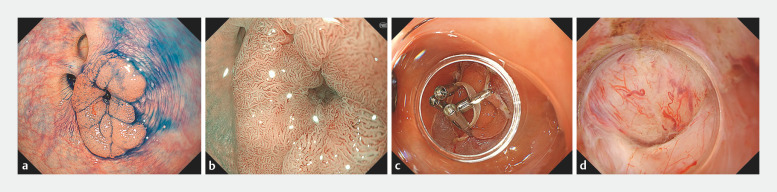 Fig. 1
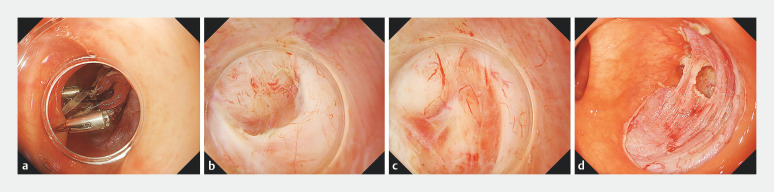 Fig. 2
Peer Reviews
No public reviews on file for this paper yet. If you reviewed it on a platform where reviews are public (OpenReview, ICLR, NeurIPS, ICML), you can paste yours below so the community can read it here.
Videos
No videos yet. Explain this paper in a talk, walkthrough, or lecture? Add one.
Taxonomy
TopicsGastric Cancer Management and Outcomes · Metastasis and carcinoma case studies · Gastrointestinal Tumor Research and Treatment
Endoscopic submucosal dissection (ESD) has been attempted in colorectal tumors involving diverticula, which lack a muscularis propria 1 . However, the R0 resection rate in tumors infiltrating the interior of the diverticulum remains low, and there is a risk of perforation 2 3 4 . We recently reported a novel traction method called the circumferential-inversion method, which inverts the lesion circumferentially 5 . Here, we describe the effectiveness of an innovative ESD approach combining countertraction and the circumferential-inversion method for a diverticulum-infiltrating tumor ( Video 1 ).
Endoscopic submucosal dissection using a novel approach that combines the countertraction and circumferential-inversion method for diverticulum-infiltrating tumors.Video 1
The case was an 18-mm 0–IIa tumor involving a diverticulum in the sigmoid colon ( Fig. 1 a ). The tumor infiltrated and fully covered a diverticulum in its center ( Fig. 1 b ). Following complete circumferential incision and trimming, the specimen was grasped at four points using an 8-mm diameter orthodontic rubber band and clips (SureClip 8 mm; Micro-Tech, Nanjing, China) ( Fig. 1 c ). By combining a water pressure method and the circumferential-inversion method, we were able to sufficiently dissect fibrotic submucosa around the central diverticulum. However, dissection of the submucosa inside the diverticulum remained challenging ( Fig. 1 d ). Therefore, we fixed the rubber band to the contralateral mucosa using an additional clip for countertraction ( Fig. 2 a ). As a result, the tumor inside the diverticulum was pulled into the lumen by the clips, which held the specimen circumferentially ( Fig. 2 b ). Additional dissection facilitated complete separation of the tumor from the diverticulum ( Fig. 2 c ) and R0 resection was completed without complications ( Fig. 2 d ).
Endoscopic submucosal dissection using the circumferential-inversion method. a An 18-mm 0–IIa tumor involving the diverticulum in the sigmoid colon. b The tumor infiltrated and fully covered a diverticulum in its center. c After a complete circumferential incision and trimming were performed, the specimen was grasped at four points using an 8-mm diameter orthodontic rubber band and clips. d By combining a water pressure method and the circumferential-inversion method, we were able to sufficiently dissect fibrotic submucosa around the central diverticulum. However, dissection of the submucosa inside the diverticulum remained challenging.
Endoscopic submucosal dissection using a novel approach that combines the countertraction and circumferential-inversion method. a We fixed the rubber band to the contralateral mucosa using an additional clip for countertraction. b The tumor inside the diverticulum was pulled into the lumen by the clips, which held the specimen circumferentially. c Additional dissection facilitated complete separation of the tumor from the diverticulum. d R0 resection was completed without complications.
In summary, the circumferential-inversion method is an inversion traction method that simplifies tumor dissection around the central diverticulum from all directions. Additionally, the data reported here demonstrate that the combination of countertraction and the circumferential-inversion method enable successful removal of a tumor from inside the diverticulum in the correct direction. We propose that the circumferential-inversion method facilitates ESD for diverticulum-infiltrating tumors.
Endoscopy_UCTN_Code_TTT_1AO_2AG
The reference list from the paper itself. Each links out to its DOI / PubMed record.
- 1Kato M Uraoka T Wada M Laterally spreading tumor involving a colon diverticulum successfully resected by endoscopic submucosal dissection Gastrointest Endosc 20168419119210.1016/j.gie.2016.01.00426772893 · doi ↗ · pubmed ↗
- 2Jimenez-Garcia VA Yamada M Ikematsu H Endoscopic submucosal dissection in management of colorectal tumors near or involving a diverticulum: a retrospective case series Endosc Int Open 20197 E 664E 67110.1055/a-0848-804831061878 PMC 6499619 · doi ↗ · pubmed ↗
- 3Muramoto T Ohata K Sakai E Endoscopic submucosal dissection for colorectal neoplasms in proximity or extending to a diverticulum Surg Endosc 2021353479348710.1007/s 00464-020-07795-y 32671524 · doi ↗ · pubmed ↗
- 4Ikezawa N Toyonaga T Tanaka S Feasibility and safety of endoscopic submucosal dissection for lesions in proximity to a colonic diverticulum Clin Endosc 20225541742510.5946/ce.2021.24535545214 PMC 9178129 · doi ↗ · pubmed ↗
- 5Takayama H Toyonaga T Kodama Y Endoscopic submucosal dissection for a large cecal lesion using the circumferential-inversion method Dig Endosc 202335 e 138e 13910.1111/den.1465837608680 · doi ↗ · pubmed ↗