One stone, two birds: The barley NLR protein MLA3 recognizes the rice blast fungus effector Pwl2 in addition to its cognate effector AVRa3 from barley powdery mildew
Leiyun Yang

Abstract
Genes, proteins, chemicals, diseases, species, mutations and cell lines named across the full text — each resolved to its canonical identifier and authoritative record.
Click any figure to enlarge with its caption.
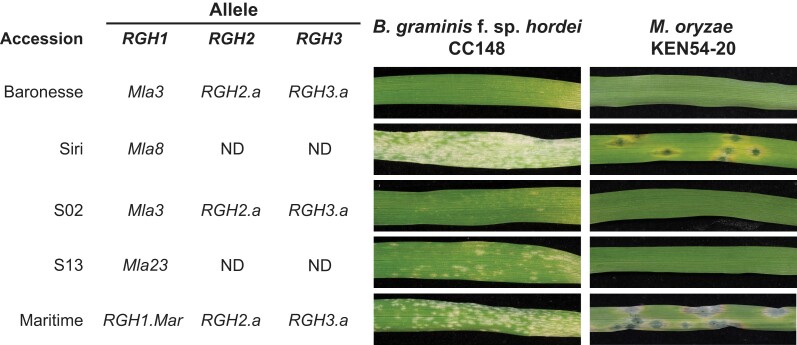 Figure 1
- —Natural Science Foundation of China10.13039/501100001809
Peer Reviews
No public reviews on file for this paper yet. If you reviewed it on a platform where reviews are public (OpenReview, ICLR, NeurIPS, ICML), you can paste yours below so the community can read it here.
Videos
No videos yet. Explain this paper in a talk, walkthrough, or lecture? Add one.
Taxonomy
TopicsPlant-Microbe Interactions and Immunity · Plant Pathogens and Fungal Diseases · Plant Pathogenic Bacteria Studies
Plant nucleotide-binding leucine-rich repeat (NLR) proteins are intracellular immune receptors that recognize effector proteins secreted by pathogens to initiate robust immune responses. The majority of characterized NLRs recognize specific effectors from a single pathogen species, conferring plant resistance with high specificity (Kourelis and van der Hoorn 2018). To broaden the pathogen recognition spectrum, a subset of NLRs surveil common host proteins targeted by effectors from multiple pathogens (Kim et al. 2023). Previous examples of this phenomenon have involved indirect effector recognition by distinct host NLRs. The recognition of multiple pathogens by a single NLR protein is rarely reported.
In new work, Helen Brabham, Diana Gómez De La Cruz, and colleagues (Brabham et al. 2023) show that the NLR protein MLA3 encoded by the barley Mildew locus a (Mla) locus recognizes multiple pathogens. This NLR protein recognizes two structurally distinct effector proteins: AVR_a3_ from the barley powdery mildew Blumeria graminis f. sp. Hordei (Bgh) and Pathogenicity toward Weeping Lovegrass2 (Pwl2) from the blast pathogen Magnaporthe oryzae.
The barley Mla locus is known to contain three NLR gene families: RGH1/Mla3, RGH2, and RGH3, with the ability to detect a wide array of pathogens including Bgh (Wei et al. 2002). The barley cultivar Baronesse also confers resistance to M. oryzae through the NLR gene Reaction to Magnaporthe oryzae1 (Rmo1), which had been genetically mapped to the Mla locus, known as Mla3 in Baronesse (Inukai et al. 2006). To pinpoint the causal gene within the Mla3 locus, the authors conducted a high-resolution recombination screen and found a strong genetic linkage between Rmo1 and Mla3. Combinatory genomic analyses, such as RenSeq-PacBio and chromosome sequencing, revealed that the Mla3 locus contains all three NLR families: RGH1/Mla3, RGH2, and RGH3, with four copies of Mla3 and one copy each of RGH2 and RGH3. Transcriptome analysis from the first leaf of Baronesse revealed that Mla3, Mla3Δ6 with a six-base pair deletion, RGH2, and RGH3 were expressed, suggesting that these four genes were potential candidate genes for conferring Rmo1 resistance.
To identify the causal gene, the authors took advantage of the diverse natural variation within the Mla locus in barley. They discovered that the Maritime accession contained identical RGH2 and RGH3 but a different Mla compared to Baronesse. A disease resistance assay confirmed the expected resistance of Baronesse to the M. oryzae isolate KEN54-20, which contains the AVR-Rmo1 effector. However, Maritime exhibited a susceptibility phenotype, indicating that RGH2 and RGH3 were not causal genes. They further found 11 near-isogenic lines in the Siri accession background that only differed in their Mla genes (Kølster and Stølen 1987). The disease resistance assay showed that line S02 containing Mla3 and line S13, which carries Mla23 with 98% sequence similarity at the DNA and protein levels to Mla3, exhibited resistance to the M. oryzae isolate KEN54-20 (see Fig. 1). This suggested Mla3 was the causal gene for resistance. To validate this, the authors individually transformed all four candidate genes into a susceptible accession and assessed disease resistance in the transgenic T1 plants against the Bgh isolate CC148 (AVR_a3_) and the M. oryzae isolate KEN54-20. Only the Mla3 transgenic plants exhibited resistance to both pathogens. Therefore, the gene responsible for resistance to M. oryzae is Mla3, which recognizes AVR_a3_ in Bgh and AVR-Rmo1 in M. oryzae.
To identify the effector AVR-Rmo1, the authors mutagenized spores of the M. oryzae isolate KEN54-20 using UV light and screened for gain-of-virulence mutants on Baronesse, and 12 such mutants were found. Whole-genome sequencing revealed that all of these mutants contained a deletion of the known effector gene PWL2. Structural analysis showed that Pwl2 belongs to the group of MAX (Magnaporthe oryzae Avrs and ToxB) effectors, which is structurally different from AVR_a3_, potentially containing RNAse-like folds. Transforming the PWL2 gene into the mutants restored the resistance of Baronesse to the M. oryzae isolate KEN54-20, confirming that PWL2 is AVR-Rmo1.
This led the authors to test whether the Mla3 gene triggers cell death, a typical immune response in effector-triggered immunity, upon its recognition of Pwl2. As expected, coexpression of MLA3 with Pwl2 caused cell death in Nicotiana benthamiana leaves. The authors further explored whether this recognition involved an interaction between MLA3 and Pwl2 using a co-immunoprecipitation assay. A successful co-immunoprecipitation of MLA3 and Pwl2 was observed, marking the first report of an MLA allele co-immunoprecipitating with its cognate effector in planta.
In summary, this study unveils the molecular mechanism underlying the resistance of barley Baronesse to M. oryzae. The NLR MLA3 from Baronesse directly recognizes the Pwl2 effector from M. oryzae, resolving the long-standing question of Baronesse's resistance to M. oryzae. It also showcases the capability of a single NLR protein to recognize structurally distinct effector proteins from taxonomically different pathogens. Future work is needed to unravel the mechanisms by which MLA3 recognizes AVR_a3_ and Pwl2. The knowledge gained from this study advances our understanding of plant-microbe interactions and has practical implications for crop improvement.
The reference list from the paper itself. Each links out to its DOI / PubMed record.
- 1Brabham HJ , De La Cruz DG, Were V, Shimizu M, Saitoh H, Hernández-Pinzón I, Green P, Lorang J, Fujisaki K, Sato K, et al Barley MLA 3 recognizes the host-specificity effector Pwl 2 from Magnaporthe oryzae. Plant Cell. 2024:36(2):447–470. 10.1093/plcell/koad 266PMC 1082732437820736 · doi ↗ · pubmed ↗
- 2Inukai T , Vales MI, Hori K, Sato K, Hayes PM. R Mo 1 confers blast resistance in barley and is located within the complex of resistance genes containing Mla, a powdery mildew resistance gene. Mol Plant Microbe Interact. 2006:19(9):1034–1041. 10.1094/MPMI-19-103416941907 · doi ↗ · pubmed ↗
- 3Kølster P , Stølen O. Barley isolines with genes for resistance to Erysiphe graminis f. sp. hordei in the recurrent parent ‘Siri’. Plant Breed. 1987:98(1):79–82. 10.1111/j.1439-0523.1987.tb 01096.x · doi ↗
- 4Kourelis J , van der Hoorn RAL. Defended to the nines: 25 years of resistance gene cloning identifies nine mechanisms for R protein function. Plant Cell. 2018:30(2):285–299. 10.1105/tpc.17.0057929382771 PMC 5868693 · doi ↗ · pubmed ↗
- 5Kim H , Ahn YJ, Lee H, Chung EH, Segonzac C, Sohn KH. Diversified host target families mediate convergently evolved effector recognition across plant species. Curr Opin Plant Biol. 2023:74:102398. 10.1016/j.pbi.2023.10239837295296 · doi ↗ · pubmed ↗
- 6Wei F , Wing RA, Wise RP. Genome dynamics and evolution of the Mla (powdery mildew) resistance locus in barley. Plant Cell. 2002:14(8):1903–1917. 10.1105/tpc.00223812172030 PMC 151473 · doi ↗ · pubmed ↗