Etymologia: Ring Vaccination
Vijay Sharma, Rajnish Sharma, Balbir B. Singh

Abstract
Click any figure to enlarge with its caption.
 Figure
Peer Reviews
No public reviews on file for this paper yet. If you reviewed it on a platform where reviews are public (OpenReview, ICLR, NeurIPS, ICML), you can paste yours below so the community can read it here.
Videos
No videos yet. Explain this paper in a talk, walkthrough, or lecture? Add one.
Taxonomy
TopicsHepatitis B Virus Studies
Ring Vaccination [rɪŋ-væk-sɪ′-neɪ-ʃn]
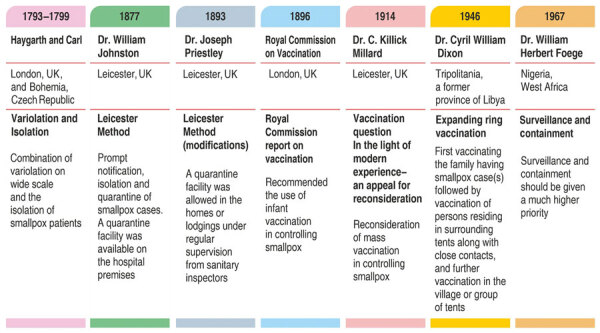
Ring vaccination (expanding ring, surveillance and containment) is a public health measure designed to prevent spread of disease from infected persons to others. This approach targets persons who have had close contact with confirmed or suspected cases and are at a higher risk of infection by vaccinating them first (Figure).
Historical concepts and persons associated with development of ring vaccination strategy.
This strategy has shown remarkable success in combating smallpox caused by respiratory droplet/direct contact–based transmission and shortened incubation for the vaccine. The concept of protecting persons closely exposed to smallpox cases might have its origins in the late 18th century, when the London Small-Pox and Inoculation Hospital was established in 1746. Haygarth (1793) and Carl (1799) suggested systematic variolation of the population and isolation of smallpox cases. In 1877, the Leicester Method, which involved prompt notification, isolation, and quarantine of smallpox cases, was introduced in Leicester (a town in East Midlands, England), and was advocated by local anticompulsory vaccinationists. In 1896, the Royal Commission on Vaccination recommended infant vaccination to control smallpox, although C. Killick Millard, Medical Officer of the Health, appealed for reconsideration. The Leicester method was later supplemented with vaccination or revaccination of contacts in the early 20th century.
After World War II in 1946, despite limited vaccine supplies, Dixon eliminated a smallpox outbreak in the Tripolitania (a former province of Libya) using a method termed expanding ring vaccination. In 1967, Foege and colleagues introduced this concept as surveillance and containment in the smallpox eradication campaign in Nigeria. The strategy proved successful for smallpox because of the disease’s relatively slow spread, mostly through face-to-face contact. The term ring vaccination is now universally used for this process.
The reference list from the paper itself. Each links out to its DOI / PubMed record.
- 1Dixon CW. Smallpox in Tripolitania, 1946; an epidemiological and clinical study of 500 cases, including trials of penicillin treatment. J Hyg (Lond). 1948;46:351–77. 18129313 10.1017/s 0022172400036536 PMC 2235158 · doi ↗ · pubmed ↗
- 2Fenner F, Henderson DA, Arita I, Jezek Z, Ladnyi ID. Chapter VI: Early efforts at control: variolation, vaccination and isolation and quarantine. In: Fenner F, Henderson DA, Arita I, Jezek Z, Ladnyi ID, editors. Smallpox and its eradication. Geneva: World Health Organization; 1988. p. 245–75.
- 3Foege WH, Millar JD, Henderson DA. Smallpox eradication in West and Central Africa. Bull World Health Organ. 1975;52:209–22.1083309 PMC 2366358 · pubmed ↗
- 4Fraser SM. Leicester and smallpox: the Leicester method. Med Hist. 1980;24:315–32. 10.1017/S 00257273000403456997656 PMC 1082657 · doi ↗ · pubmed ↗
- 5Millard CK. Chapter XII: Conclusions. In: Millard CK, editor. The vaccination question in the light of modern experience: an appeal for reconsideration. London: H.K. Lewis and Company; 1914. p. 185–92.