The complete chloroplast genome sequence of Pinus bhutanica (Pinaceae) and its phylogenetic implications
Shiqi Lv, Jiao Chen, Bingbing Li, Taotao Fu, Mingliang Song, Pengtao Zhang, Kang Liu, Yixuan Kou, Jing Wang

TL;DR
Researchers sequenced the complete chloroplast genome of the critically endangered Pinus bhutanica and found its closest relative within the pine genus.
Contribution
The first complete chloroplast genome sequence of Pinus bhutanica is assembled and analyzed for phylogenetic relationships.
Findings
The chloroplast genome of Pinus bhutanica is 116,919 bp long with a GC content of 38.75%.
The genome contains 106 functional genes, including 72 protein-coding genes and 30 tRNA genes.
Phylogenetic analysis shows P. bhutanica is most closely related to Pinus wangii in subsection Strobus.
Abstract
Pinus bhutanica is a critically endangered conifer and occurs only in central Bhutan, northwestern Yunnan and southeastern Xizang in China. In this study, the complete chloroplast genome of Pinus bhutanica was first assembled based on next-generation sequencing. The genome sequence was 116,919 bp in length with an overall GC content of 38.75%. A total of 106 functional genes were detected in the genome, including 72 protein-coding genes (PCGs), 30 transfer RNA (tRNA) genes, and four ribosomal RNA (rRNA) genes. The phylogenetic tree reconstructed by 12 chloroplast genomes revealed that P. bhutanica is most closely related to Pinus wangii in subsection Strobus of Pinus.
Genes, proteins, chemicals, diseases, species, mutations and cell lines named across the full text — each resolved to its canonical identifier and authoritative record.
Click any figure to enlarge with its caption.
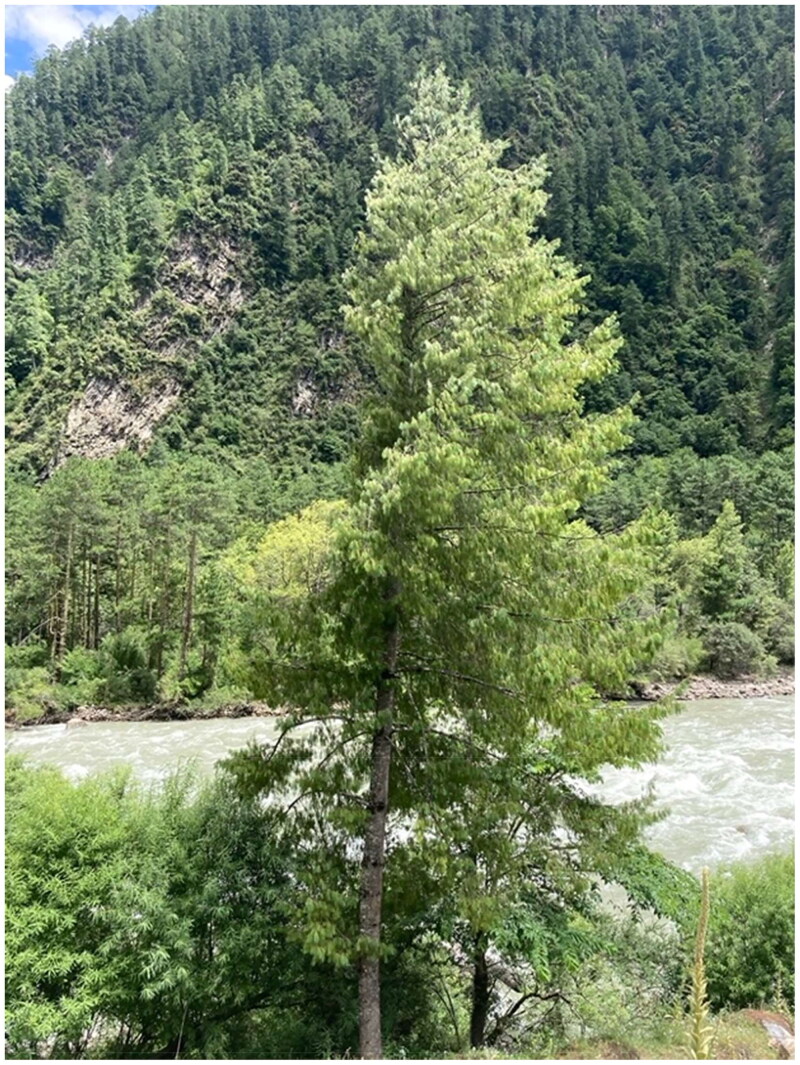 Figure 1
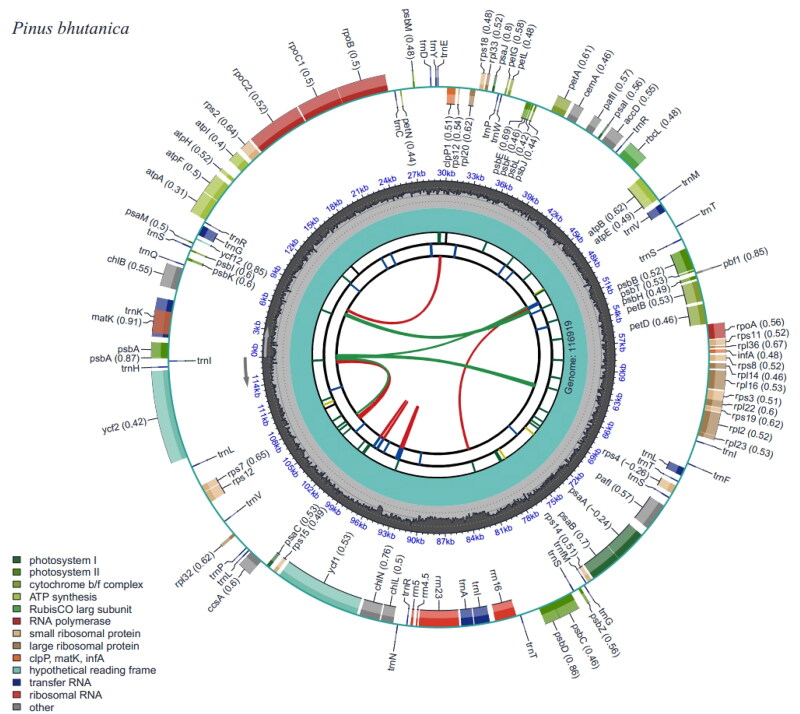 Figure 2
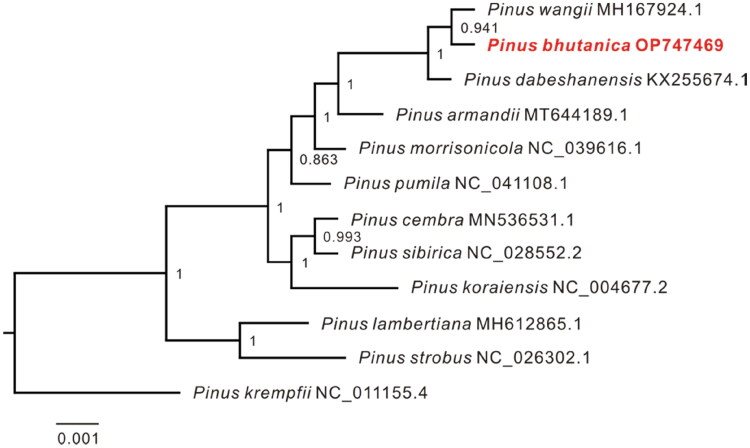 Figure 3
- —National Natural Science Foundation of China10.13039/501100001809
Peer Reviews
No public reviews on file for this paper yet. If you reviewed it on a platform where reviews are public (OpenReview, ICLR, NeurIPS, ICML), you can paste yours below so the community can read it here.
Videos
No videos yet. Explain this paper in a talk, walkthrough, or lecture? Add one.
Taxonomy
TopicsGenomics and Phylogenetic Studies · Plant and Fungal Species Descriptions · Plant Pathogens and Fungal Diseases
Introduction
Pinus bhutanica Grierson, D. G. Long & C. N. Page 1980 belongs to the subsection Strobus in Pinus (Gernandt et al. 2005). This species has an extremely narrow distribution and occurs only in central Bhutan, northwestern Yunnan, and southeastern Xizang in China (Farjon 1998). Although phylogenetic analyses have reconstructed a fully resolved phylogeny of the species in the subsection Strobus based on thousands of nuclear genes (Liu et al. 2022), the interspecific relationships of these species, and including P. bhutanica, are still unclear. The chloroplast genome is maternally inherited in coniferous trees (Mogensen 1996), making it an important resource for exploring the phylogenetic relationships of these species (Kress et al. 2005). However, a complete chloroplast genome of P. bhutanica is lacking. In this study, we sequenced and analyzed the complete chloroplast genome sequence of P. bhutanica, and inferred the phylogenetic relationships of this species in the subsection Strobus.
Materials and methods
Fresh leaves of P. bhutanica were collected from a single individual living in Linzhi, Xizang, China (geographic coordinates: 29°13′27″ N, 95°11′3″ E) (Figure 1, Figure S1). Total genomic DNA was extracted from approximately 20 mg of dried leaves using a modified CTAB procedure (Doyle and Doyle 1987). A voucher specimen (2021-PB-1A) and an associated DNA sample were stored in the Herbarium of Jiangxi Agricultural University, Nanchang, China. Whole-genome sequencing was conducted on the DNBseq platform (BGI, Shenzhen, China) with paired-end reads of 150 bp. A total of 6.4 Gb clean data (∼20 million reads) with a Q20 of 97.87% were obtained and subsequently used for chloroplast genome assembly. The assembly was performed using NOVOPlasty 4.3.1 (Dierckxsens et al. 2016), and annotation of the assembled genome was performed by Plastid Genome Annotator (PGA) (Qu et al. 2019) with default parameters and the closely related species Pinus koraiensis Siebold et Zuccarini (NC_0046772.2) as the reference. The detailed chloroplast genome structure was visualized using CPGView (Liu et al. 2023). To verify the accuracy of the assembly, we mapped clean reads to the assembled chloroplast genome to assess the depth of coverage using a python script (Ni et al. 2023).
The reference image of Pinus bhutanica living in Linzhi, Xizang, China (geographic coordinates: 29°13′27″ N, 95°11′3″ E; photography by Yixuan Kou and Jing Wang).
The phylogenetic relationships of P. bhutanica in subsection Strobus were explored based on chloroplast genome datasets. The chloroplast genome sequences of 10 species in subsection Strobus were downloaded and aligned with the genome of P. bhutanica using MAFFT v7.310 (Katoh and Standley 2013). Pinus krempfii Lecomte was used as the outgroup. A maximum-likelihood (ML) tree was constructed by FastTree 2.1.11 (Price et al. 2009) with the GTR substitution model.
Results
The complete chloroplast genome of P. bhutanica was deposited in the GenBank database under accession number OP747469. It was circular and 116,919 bp in length with an overall GC content of 38.75% and an average coverage of 312.62× (Figure 2, Figure S2). A total of 106 functional genes were annotated in the genome, including 72 protein-coding genes (PCGs), 30 transfer RNA (tRNA) genes, and four ribosomal RNA (rRNA) genes. Most of these genes occurred as a single copy and had no introns, except that psbA, trnR-ACG, trnS-GCU, and trnT-GGU had two copies, trnI-GAU had three copies, and 12 genes (atpF, petB, petD, rpl16, rpl2, rpoC1, trnA-UGC, trnG-UCC, trnI-GAU, trnK-UUU, trnL-UAA, and trnV-UAC) had one intron and two genes (rps12 and pafI) had two introns (Figure 2). In addition, seven cis-splicing genes (atpF, rpoC1, petB, petD, rpl16, rpl2, and pafI) and one trans-splicing gene (rps12) were detected (Figure S3). The phylogenetic analyses showed that all species in subsection Strobus had high support, and P. bhutanica was most closely related to P. wangii Hu et Cheng (Figure 3).
Genomic map of overall features of Pinus bhutanica chloroplast genome, generated by CPGView (Liu et al. 2023). The map contains six tracks by default. From the center outward, the first track shows the dispersed repeats. The dispersed repeats consist of direct and palindromic repeats, connected with red and green arcs. The second track shows the long tandem repeats as short blue bars. The third track shows the short tandem repeats or microsatellite sequences as short bars with different colors. The genome length and the GC content along the genome are shown on the fourth and fifth track, respectively. The genes are shown on the sixth track. Genes are color-coded by their functional classification.
Maximum-likelihood (ML) tree inferred by FastTree with the GTR substitution model based on the complete chloroplast genome sequences of P. bhutanica and 10 other species in subsection Strobus. The numbers on the nodes represent the support values. The following sequences were used: Pinus wangii MH167924.1 (Yang et al. 2018), Pinus dabeshanensis KX255674.1 (Duan et al. 2016), Pinus armandii MT644189.1 (Jia et al. 2020), Pinus morrisonicola NC_039616.1 (Zeb et al. 2020), Pinus pumila NC_041108.1 (Zeb et al. 2019), Pinus cembra MN536531.1 (Schott et al. 2019), Pinus sibirica NC_028552.2 (Baturina et al. 2019), Pinus koraiensis NC_004677.2 (available in the GenBank of NCBI), Pinus lambertiana MH612865.1 (Gernandt et al. 2018), Pinus strobus NC_026302.1 (Zhu et al. 2016), and Pinus krempfii NC_011155.4 (Cronn et al. 2008).
Discussion and conclusions
The chloroplast genome of Pinus bhutanica provides valuable information for understanding chloroplast genome evolution and phylogenetic inference in subsection Strobus in genus Pinus. In this study, the complete chloroplast genome of P. bhutanica was first reported and found to exhibit a total length of 116,919 bp. A total of 106 functional genes were annotated in the genome, including 72 PCGs, 30 tRNA genes, and four rRNA genes. The genome size and gene content of Pinus bhutanica is not significantly different from those of most chloroplast genomes in the subsection Strobus (Zeb et al. 2020), indicating that the genome evolution was relatively conservative in the subsection. The phylogenetic analysis revealed that P. bhutanica is most closely related to Pinus wangii in subsection Strobus. However, the discordance among the phylogenies from different publications was found for P. bhutanica and some other taxa in the subsection (Duan et al. 2016; Yang et al. 2018; Baturina et al. 2019; Schott et al. 2019; Zeb et al. 2019, 2020), suggesting that incomplete lineage sorting of chloroplast genome and/or introgressive hybridization among species might occur in the subsection. Therefore, more complete chloroplast genomes from subsection Strobus are necessary for further research on phylogenetic relationships in the subsection.
Supplementary Material
Supplemental MaterialClick here for additional data file.
Supplemental MaterialClick here for additional data file.
The reference list from the paper itself. Each links out to its DOI / PubMed record.
- 1Baturina OA, Tupikin AE, Goroshkevich SN, Petrova EA, Kabilov MR. 2019. The complete chloroplast genome sequences of Pinus sibirica Du Tour. Mitochondrial DNA B. 4(1):286–287. doi:10.1080/23802359.2018.1542983. · doi ↗
- 2Cronn R, Liston A, Parks M, Gernandt DS, Shen R, Mockler T. 2008. Multiplex sequencing of plant chloroplast genomes using Solexa sequencing-by-synthesis technology. Nucleic Acids Res. 36(19):e 122. doi:10.1093/nar/gkn 502.18753151 PMC 2577356 · doi ↗ · pubmed ↗
- 3Dierckxsens N, Mardulyn P, Smits G. 2016. NOVO Plasty: de novo assembly of organelle genomes from whole genome data. Nucleic Acids Res. 45(4):e 18. doi:10.1093/nar/gkw 955.PMC 538951228204566 · doi ↗ · pubmed ↗
- 4Doyle JJ, Doyle JL. 1987. A rapid DNA isolation procedure for small quantities of fresh leaf tissue. Phytochem Bull. 19(1):11–15.
- 5Duan RY, Yang LM, Lv T, Wu GL, Huang MY. 2016. The complete chloroplast genome sequence of Pinus dabeshanensis. Conserv Genet Resour. 8(4):395–397. doi:10.1007/s 12686-016-0567-2. · doi ↗
- 6Farjon A. 1998. World checklist and bibliography of conifers. Kew, Richmond: Royal Botanical Gardens.
- 7Gernandt DS, López GG, García SO, Liston A. 2005. Phylogeny and classification of Pinus. Taxon. 54(1):29–42. doi:10.2307/25065300. · doi ↗
- 8Gernandt DS, Reséndiz Arias C, Terrazas T, Aguirre Dugua X, Willyard A. 2018. Incorporating fossils into the Pinaceae tree of life. Am J Bot. 105(8):1329–1344. doi:10.1002/ajb 2.1139.30091785 · doi ↗ · pubmed ↗