Recent Origin and Cultural Reversion of a Hunter–Gatherer Group
Hiroki Oota, Brigitte Pakendorf, Gunter Weiss, Arndt von Haeseler, Surin Pookajorn, Wannapa Settheetham-Ishida, Danai Tiwawech, Takafumi Ishida, Mark Stoneking

TL;DR
The Mlabri hunter-gatherer group in Thailand recently originated from an agricultural population and adopted a hunter-gatherer lifestyle, showing that not all such groups reflect ancient human lifestyles.
Contribution
The study provides genetic and cultural evidence that the Mlabri hunter-gatherers originated recently from an agricultural group, challenging assumptions about pre-agricultural human lifestyles.
Findings
The Mlabri have extremely low genetic diversity in mtDNA, Y-chromosome, and autosomal loci.
Genetic, linguistic, and cultural data suggest the Mlabri were founded 500–800 years ago from a small number of individuals.
The Mlabri likely originated from an agricultural group and later reverted to a hunter-gatherer subsistence mode.
Abstract
Contemporary hunter–gatherer groups are often thought to serve as models of an ancient lifestyle that was typical of human populations prior to the development of agriculture. Patterns of genetic variation in hunter–gatherer groups such as the !Kung and African Pygmies are consistent with this view, as they exhibit low genetic diversity coupled with high frequencies of divergent mtDNA types not found in surrounding agricultural groups, suggesting long-term isolation and small population sizes. We report here genetic evidence concerning the origins of the Mlabri, an enigmatic hunter–gatherer group from northern Thailand. The Mlabri have no mtDNA diversity, and the genetic diversity at Y-chromosome and autosomal loci are also extraordinarily reduced in the Mlabri. Genetic, linguistic, and cultural data all suggest that the Mlabri were recently founded, 500–800 y ago, from a very small…
Genes, proteins, chemicals, diseases, species, mutations and cell lines named across the full text — each resolved to its canonical identifier and authoritative record.
Click any figure to enlarge with its caption.
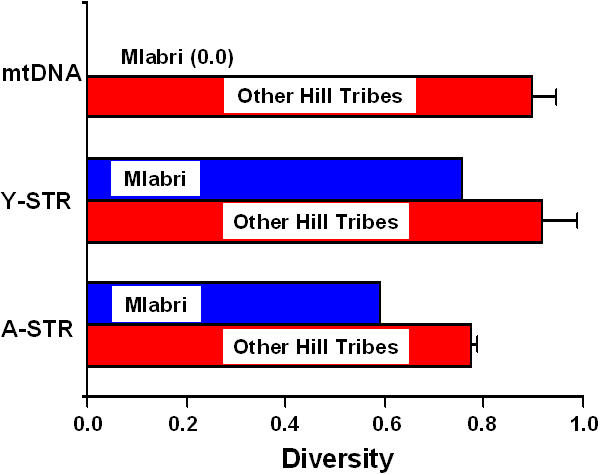 Figure 1
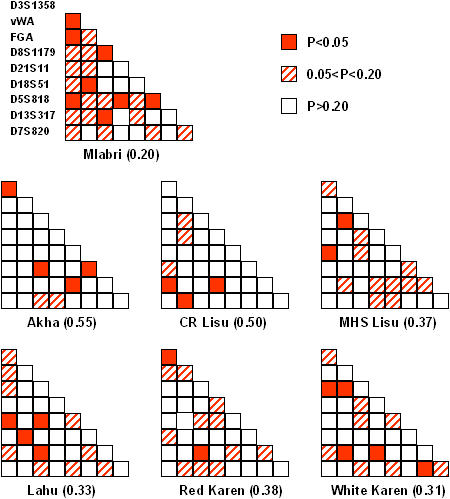 Figure 2
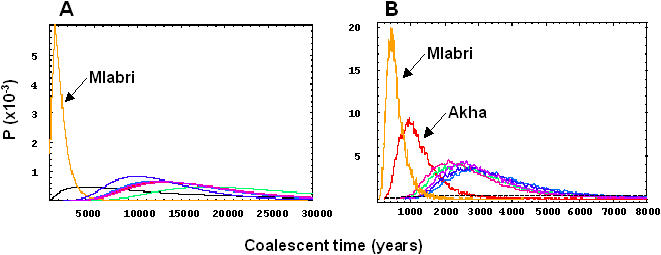 Figure 3
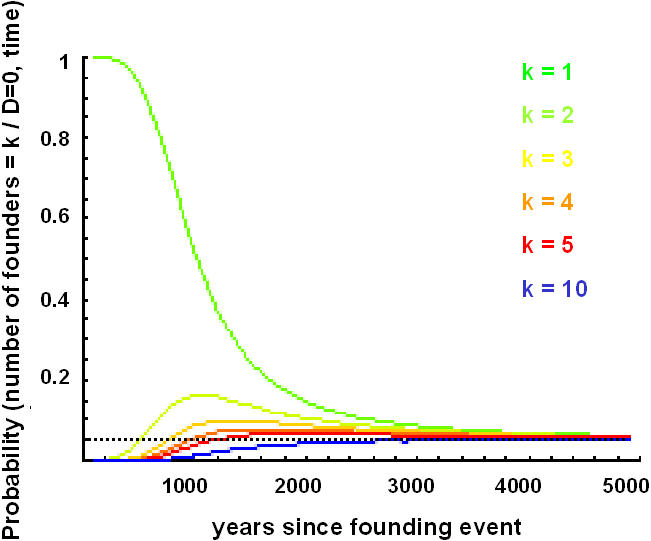 Figure 4
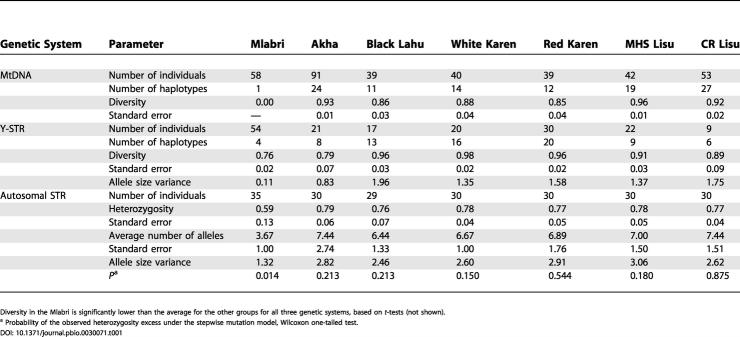 Figure 5
 Figure 6
Peer Reviews
No public reviews on file for this paper yet. If you reviewed it on a platform where reviews are public (OpenReview, ICLR, NeurIPS, ICML), you can paste yours below so the community can read it here.
Videos
No videos yet. Explain this paper in a talk, walkthrough, or lecture? Add one.
Taxonomy
TopicsForensic and Genetic Research · Genetic diversity and population structure · Identification and Quantification in Food