Hydrodynamic effects on spin polarization along the beam direction in Au+Au and p+Pb collisions
Cong Yi, Xiang-Yu Wu, Jie Zhu, Shi Pu, Guang-You Qin

TL;DR
This study explores how hydrodynamic effects influence the longitudinal spin polarization of $\\Lambda$ hyperons in high-energy nuclear collisions, analyzing the roles of thermal vorticity and shear tensor across different equilibrium assumptions.
Contribution
It provides a detailed numerical analysis of spin polarization in Au+Au and p+Pb collisions using the CLVisc hydrodynamic model, considering multiple equilibrium scenarios.
Findings
Thermal vorticity significantly affects spin polarization.
The thermal-shear tensor also contributes to polarization.
Results vary with collision system and equilibrium assumptions.
Abstract
We investigate hydrodynamic effects on the spin polarization of hyperons in Au+Au collisions at GeV and p+Pb collisions at TeV using the CLVisc hydrodynamic framework. We present numerical results for the second Fourier sine coefficient of the longitudinal spin polarization, , as a function of multiplicity (centrality) under three equilibrium scenarios: equilibrium, -quark equilibrium, and isothermal equilibrium. We highlight the respective roles of thermal vorticity and the thermal-shear tensor in generating across collision systems and scenarios.
Click any figure to enlarge with its caption.
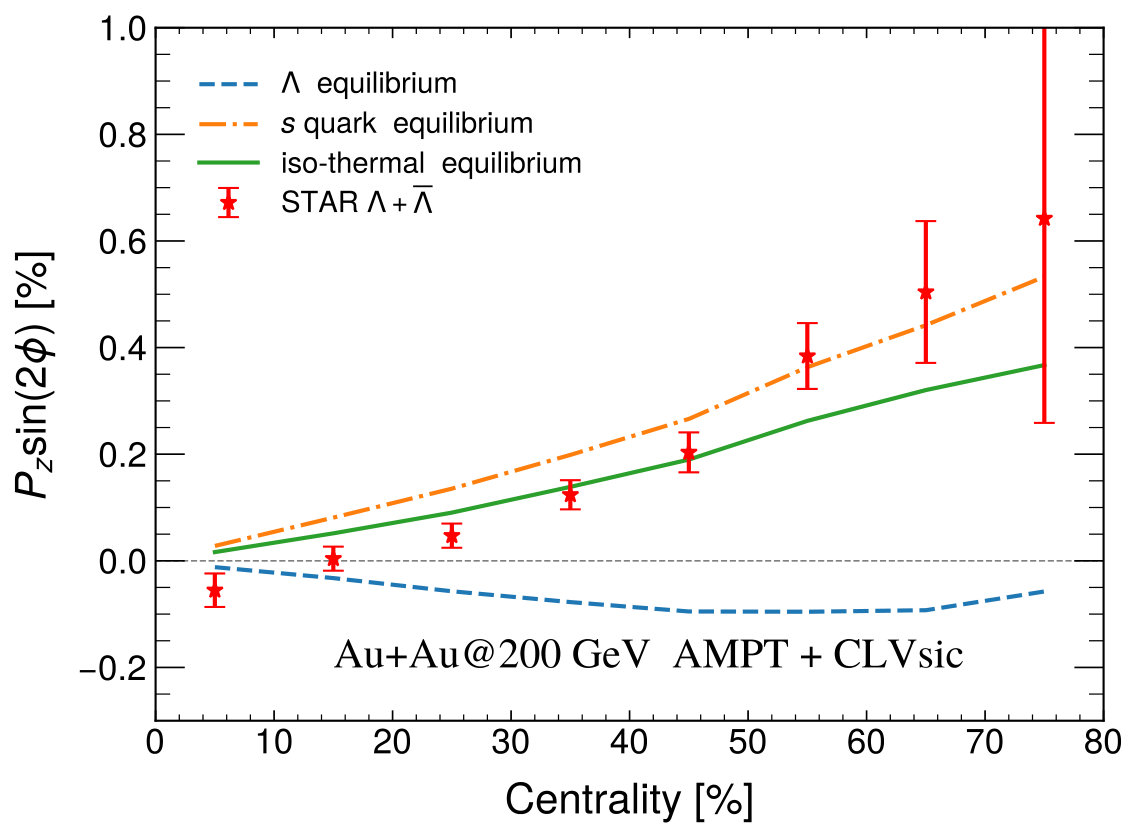 Figure 1
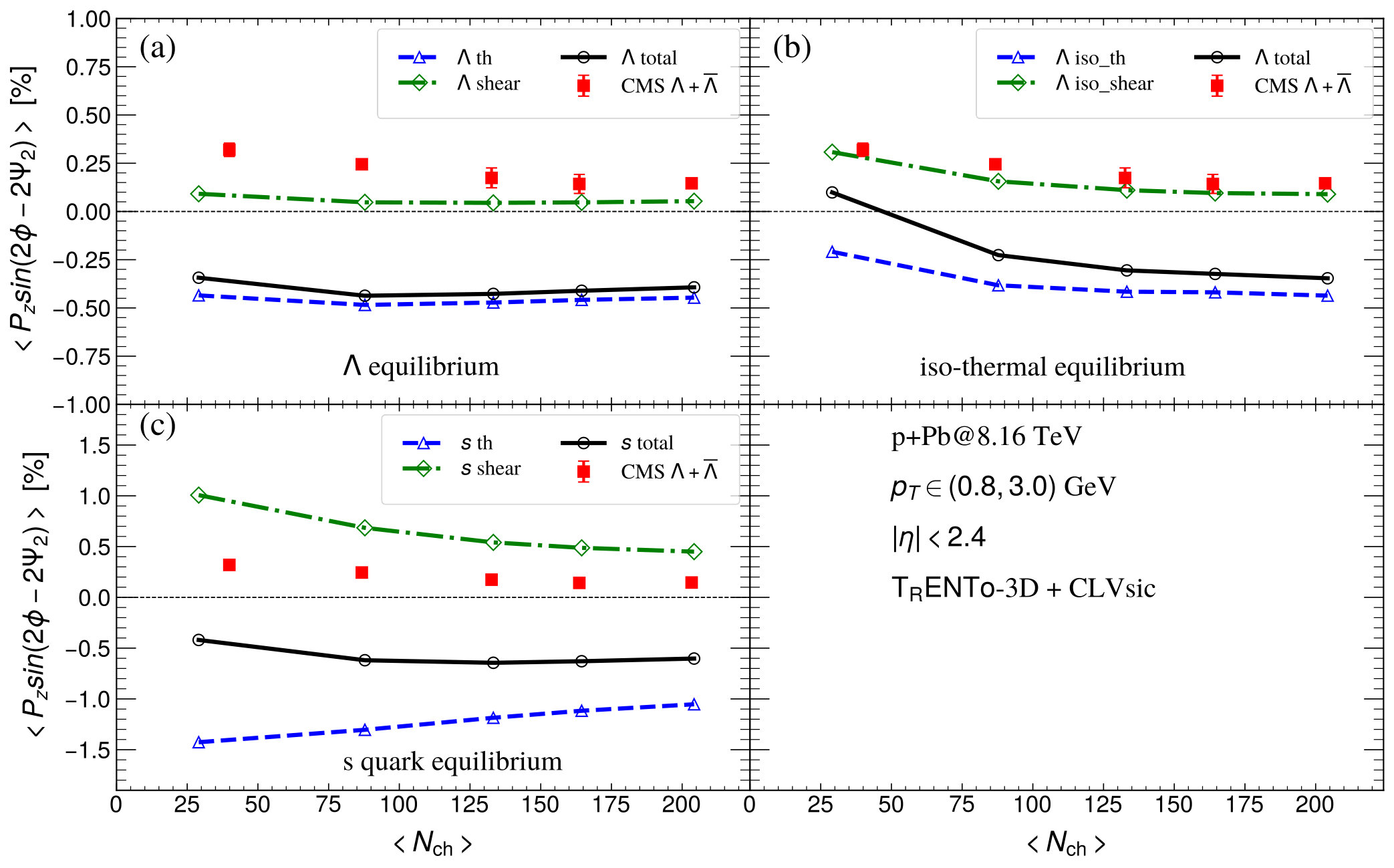 Figure 2
 Figure 3
 Figure 4
 Figure 5
Peer Reviews
No public reviews on file for this paper yet. If you reviewed it on a platform where reviews are public (OpenReview, ICLR, NeurIPS, ICML), you can paste yours below so the community can read it here.
Videos
No videos yet. Explain this paper in a talk, walkthrough, or lecture? Add one.
Taxonomy
TopicsHigh-Energy Particle Collisions Research · Dust and Plasma Wave Phenomena · Particle physics theoretical and experimental studies
11institutetext: Institute of Particle Physics and Key Laboratory of Quark and Lepton Physics (MOE), Central China Normal University, Wuhan 430079, China 22institutetext: Department of Physics, McGill University, Montreal, QC, Canada H3A 2T8 33institutetext: Fakultät für Physik, Universität Bielefeld, D-33615 Bielefeld, Germany 44institutetext: Department of Modern Physics, University of Science and Technology of China, Hefei, Anhui 230026, China
Hydrodynamic effects on spin polarization along the beam direction in Au+Au and p+Pb collisions
\firstnameCong \lastnameYi\fnsep Speaker: [email protected]
\firstnameXiang-Yu \lastnameWu 1122
\firstnameJie \lastnameZhu 1133
\firstnameShi \lastnamePu 44
\firstnameGuang-You \lastnameQin 11
Abstract
We investigate hydrodynamic effects on the spin polarization of hyperons in Au+Au collisions at GeV and p+Pb collisions at TeV using the CLVisc hydrodynamic framework. We present numerical results for the second Fourier sine coefficient of the longitudinal spin polarization, , as a function of multiplicity (centrality) under three equilibrium scenarios: equilibrium, -quark equilibrium, and isothermal equilibrium. We highlight the respective roles of thermal vorticity and the thermal-shear tensor in generating across collision systems and scenarios.
1 Introduction
The huge angular momentum and transverse anisotropic expansion generated in peripheral heavy ion collisions can lead to global polarization (Liang:2004ph, ; STAR:2017ckg, ) and spin polarization along the beam direction (STAR:2019erd, ; Becattini:2017gcx, ), respectively. It has been found that in addition to thermal vorticity, other hydrodynamic effects including the shear viscous tensor and gradient of chemical potential can also contribute to local spin polarization (Hidaka:2017auj, ; Becattini:2021suc, ; Liu:2021uhn, ). These hydrodynamic contributions to spin polarization have been extensively investigated in nucleus-nucleus collisions (Fu:2021pok, ; Becattini:2021iol, ; Yi:2021ryh, ; Alzhrani:2022dpi, ; Wu:2022mkr, ). Recently, the CMS collaboration has measured spin polarization along the beam direction in p+Pb collisions at TeV (CMS:2025nqr, ) . However, theoretical calculations of spin polarization for small collision systems remain limited. In this work, we extend the study of these hydrodynamic effects to small collision systems and compare their roles across different collision systems.
2 Theoretical Framework
Based on the theoretical approaches, such as the Kubo formula Fu:2021pok , quantum kinetic theory (Yi:2021ryh, ) or quantum statistics model (Becattini:2021iol, ), the fermion spin polarization vector at local thermal equilibrium can be decomposed as in absence of electromagnetic field and baryon chemical potential. Here the and are the spin polarization induced by the thermal vorticity and the thermal-shear tensor, , respectively.
To better capture the bulk properties of different collision systems, we adopt AMPT and Trento-3D initial conditions for GeV Au+Au and TeV p+Pb collisions, respectively. We then employ the (3+1)-D hydrodynamic model CLVisc (Pang:2012he, ; Wu:2021fjf, ) to simulate the evolution of the collision system and obtain the hydrodynamic gradient profiles on the freeze-out hypersurface. The subsequent hadronic scattering process is described by the SMASH model (SMASH:2016zqf, ). The parameters used in our simulations can successfully reproduce the multiplicity and of charged particles. Assuming that the hadronic scattering has little effect on spin polarization, we use the modified Cooper-Frye formula to calculate the second Fourier coefficient of the spin polarization along the beam direction, , in the ’s rest frame. Additionally, we consider three widely used scenarios: equilibrium, -quark equilibrium, and iso-thermal equilibrium. In the numerical simulation, we use the particle masses and in the modified Cooper-Frye formula for the equilibrium and -quark equilibrium scenarios, respectively. In the iso-thermal equilibrium scenario, all temperature gradients are neglected. More details can be found in our previous works (Yi:2021ryh, ; Yi:2024kwu, ).
3 Numerical Results
We present our numerical results for , under three equilibrium scenarios at GeV Au+Au collisions in Fig. 1. Our calculations indicate that results for -quark equilibrium (orange, dash-dot line) and iso-thermal equilibrium (green, solid line) agree with experimental data, while those for -equilibrium (blue, dashed line) are inconsistent with measurements. These findings align with the results in Refs. (Fu:2021pok, ; Becattini:2021iol, ).
In Fig. 2, we show the charged-particle multiplicity dependence of for hyperons in p+Pb collisions at TeV under three scenarios. We observe that the shear-induced polarization provides a positive contribution to the , while thermal vorticity consistently yields a negative contribution that opposes the shear term. These behaviors are consistent with those observed in Au+Au collisions. However, the competition between these two mechanisms in p+Pb collisions produces an overall negative across all scenarios. This net negative signal contradicts available experimental data (CMS:2025nqr, ), revealing a significant discrepancy between theoretical calculation and measurements in small collision systems. These findings indicate that current hydrodynamic effects alone cannot explain the spin polarization in p+Pb collisions, highlighting the need for new polarization mechanisms in small systems for the future research.
It should be noted that our polarization results at lowest multiplicities are unreliable due to the limitations of hydrodynamic applicability. Nevertheless, our model can successfully describe the multiplicities and in the high-multiplicity regime. Therefore, we provide more detailed discussions on the beam-direction spin polarization as functions of azimuthal angle and rapidity for high-multiplicity p+Pb events in Ref. (Yi:2024kwu, ), which are not presented here due to space constraints.
4 Summary
In this work, we have employed the relativistic hydrodynamic model CLVisc to investigate the second Fourier coefficient of the beam-direction spin polarization of hyperons in both Au+Au and p+Pb collisions. We found that the shear-induced polarization consistently provides a positive contribution to , while the thermal vorticity effect always yields a negative contribution in both collision systems. The combined effects of hydrodynamic gradients can successfully describe the centrality dependence of the beam-direction spin polarization for hyperons in GeV Au+Au collisions. However, these hydrodynamic effects fail to account for the spin polarization data in p+Pb collisions. Our findings imply that the spin polarization in small collision systems cannot be explained solely by current hydrodynamic mechanisms and new physical mechanisms need to be explored in future studies.
Acknowledgements:
This work is supported in part by the National Key Research and Development Program of China under Contract No. 2022YFA1605500, by the Chinese Academy of Sciences (CAS) under Grants No. YSBR-088 and by National Natural Science Foundation of China (NSFC) under Grant Nos. 12075235, 12225503, 11890710, 11890711, 11935007, 12175122, 2021-867, 11221504, 11861131009 and 11890714. X-Y.W was supported in part by the Natural Sciences and Engineering Research Council of Canada (NSERC) [SAPIN-2020-00048 and SAPIN-2024-00026], and in part by US National Science Foundation (NSF) under grant number OAC-2004571. J.Z. was supported in part by China Scholarship Council (CSC) under Grant No. 202306770009.
The reference list from the paper itself. Each links out to its DOI / PubMed record.
- 1(1) Z. T. Liang and X. N. Wang, Phys. Rev. Lett. 94 , 102301 (2005) [erratum: Phys. Rev. Lett. 96 , 039901 (2006)] doi:10.1103/Phys Rev Lett.94.102301 [ar Xiv:nucl-th/0410079 [nucl-th]].
- 2(2) L. Adamczyk et al. [STAR], Nature 548 , 62-65 (2017) doi:10.1038/nature 23004 [ar Xiv:1701.06657 [nucl-ex]].
- 3(3) J. Adam et al. [STAR], Phys. Rev. Lett. 123 , no.13, 132301 (2019) doi:10.1103/Phys Rev Lett.123.132301 [ar Xiv:1905.11917 [nucl-ex]].
- 4(4) F. Becattini and I. Karpenko, Phys. Rev. Lett. 120 , no.1, 012302 (2018) doi:10.1103/Phys Rev Lett.120.012302 [ar Xiv:1707.07984 [nucl-th]].
- 5(5) Y. Hidaka, S. Pu and D. L. Yang, Phys. Rev. D 97 , no.1, 016004 (2018) doi:10.1103/Phys Rev D.97.016004 [ar Xiv:1710.00278 [hep-th]].
- 6(6) F. Becattini, M. Buzzegoli and A. Palermo, Phys. Lett. B 820 , 136519 (2021) doi:10.1016/j.physletb.2021.136519 [ar Xiv:2103.10917 [nucl-th]].
- 7(7) S. Y. F. Liu and Y. Yin, JHEP 07 , 188 (2021) doi:10.1007/JHEP 07(2021)188 [ar Xiv:2103.09200 [hep-ph]].
- 8(8) B. Fu, S. Y. F. Liu, L. Pang, H. Song and Y. Yin, Phys. Rev. Lett. 127 , no.14, 142301 (2021) doi:10.1103/Phys Rev Lett.127.142301 [ar Xiv:2103.10403 [hep-ph]].