New hyperfinite subfactors with infinite depth
Dietmar Bisch, Julio C\'aceres

TL;DR
This paper constructs new hyperfinite subfactors with TLJ standard invariant at all indices between 4 and 5, including the first example with index 5, revealing surprising structures in subfactor theory.
Contribution
It introduces explicit constructions of hyperfinite subfactors with TLJ invariants at indices between 4 and 5, including the first with index 5, expanding understanding of subfactor indices.
Findings
Existence of hyperfinite subfactors with TLJ invariant at all indices between 4 and 5.
First example of hyperfinite subfactor with trivial invariant and index 5.
Multiple hyperfinite subfactors with index 3 + √5, showing rich structure.
Abstract
We construct new hyperfinite subfactors with Temperley-Lieb-Jones (TLJ) standard invariant and Jones indices between and . Our subfactors occur at all indices between and at which finite depth, hyperfinite subfactors exist. The presence of hyperfinite subfactors with TLJ standard invariant, and hence of infinite depth, at these special indices comes as a surprise. In particular, we obtain the first example of a hyperfinite subfactor with ``trivial'' (i.e. TLJ) standard invariant and integer index , namely with index . This is achieved by constructing explicit families of nondegenerate commuting squares of multi-matrix algebras based on exotic inclusion graphs with appropriate norms. We employ our graph planar algebra embedding theorem [BC25], a result of Kawahigashi [Kaw23] and other techniques to determine that the resulting commuting square subfactors…
Click any figure to enlarge with its caption.
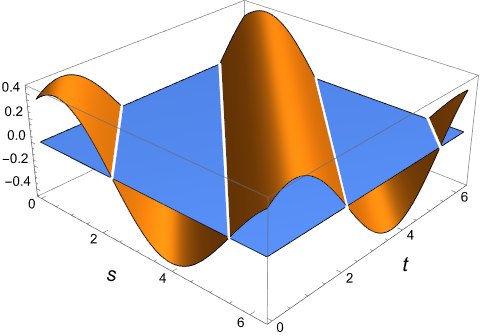 Figure 1
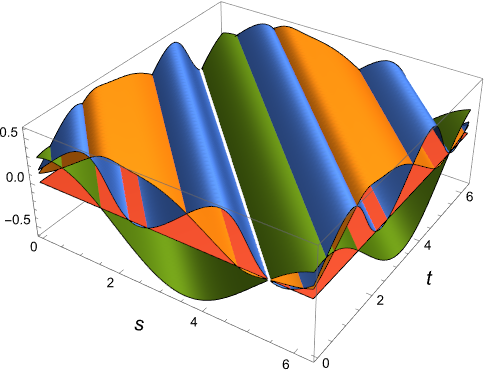 Figure 2
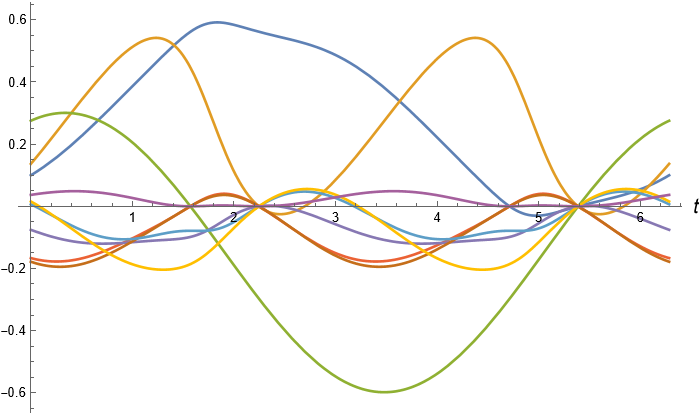 Figure 3
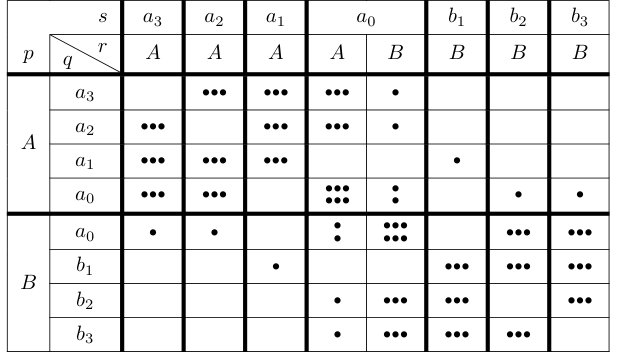 Figure 4
Peer Reviews
No public reviews on file for this paper yet. If you reviewed it on a platform where reviews are public (OpenReview, ICLR, NeurIPS, ICML), you can paste yours below so the community can read it here.
Videos
No videos yet. Explain this paper in a talk, walkthrough, or lecture? Add one.
Taxonomy
TopicsAdvanced Operator Algebra Research · Algebraic structures and combinatorial models · Advanced Topics in Algebra