Quasar Radiative Feedback May Suppress Galaxy Growth on Intergalactic Scales at $z = 6.3$
Yongda Zhu, Eiichi Egami, Xiaohui Fan, Fengwu Sun, George D. Becker, Christopher Cain, Huanqing Chen, Anna-Christina Eilers, Yoshinobu Fudamoto, Jakob M. Helton, Xiangyu Jin, Maria Pudoka, Andrew J. Bunker, Zheng Cai, Jaclyn B. Champagne, Zhiyuan Ji, Xiaojing Lin, Weizhe Liu

TL;DR
This study provides observational evidence that intense quasar radiation at high redshift suppresses nebular emission in nearby galaxies, indicating a significant radiative feedback effect on galaxy growth on intergalactic scales.
Contribution
First observational detection of large-scale quasar radiative feedback effects on galaxy emission at high redshift, constraining quasar lifetime and feedback mechanisms.
Findings
Suppression of [O III] luminosity near the quasar
Suppression radius of approximately 7 comoving Mpc
Radiative episode duration estimated at about 3.1 million years
Abstract
We present observational evidence that intense ionizing radiation from a luminous quasar suppresses nebular emission in nearby galaxies on intergalactic scales at . Using JWST/NIRCam grism spectroscopy from the SAPPHIRES and EIGER programs, we identify a moderate but statistically significant decline in [O\,\textsc{iii}]\, luminosity relative to the UV continuum () among galaxies within 7 comoving Mpc (cMpc) of the quasar J01002802, the most UV-luminous quasar known at this epoch (). While remains roughly constant with transverse distance, increases significantly, suggesting suppression of very recent star formation toward the quasar. The effect persists after controlling for completeness, local density, and UV luminosity, and correlates with the projected photoionization-rate profile…
Click any figure to enlarge with its caption.
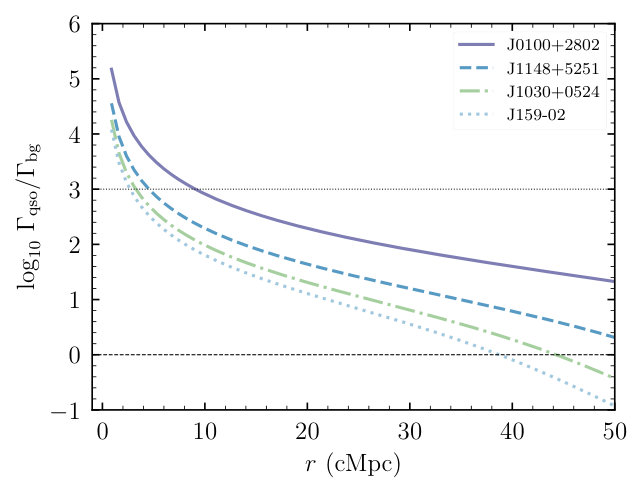 Figure 1
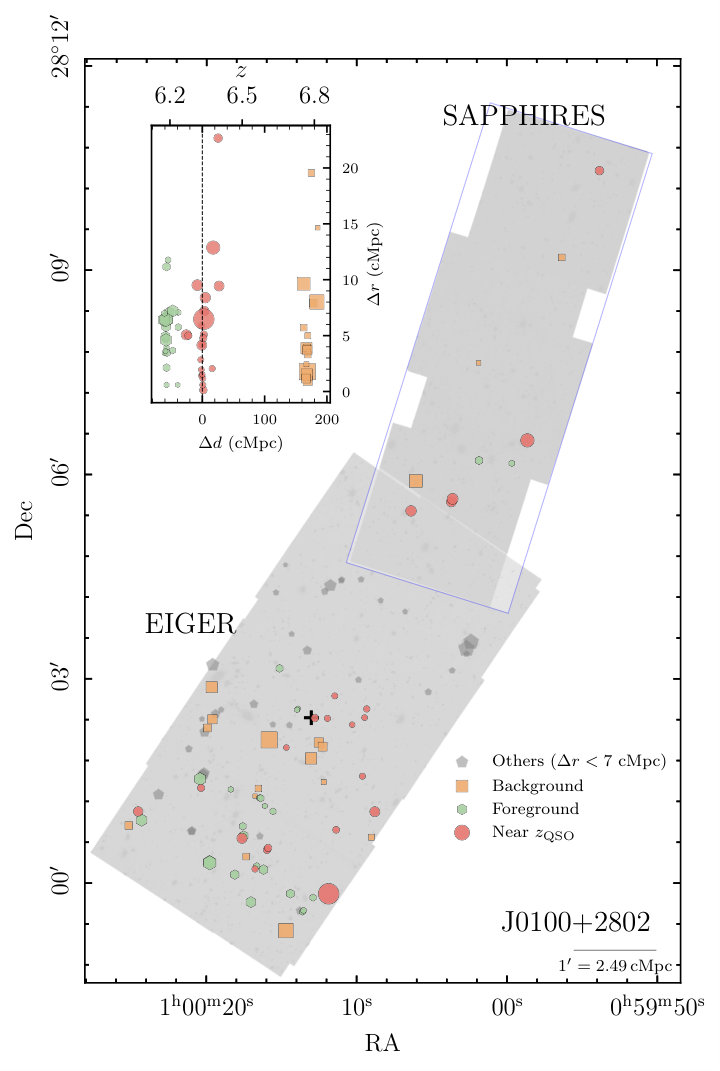 Figure 2
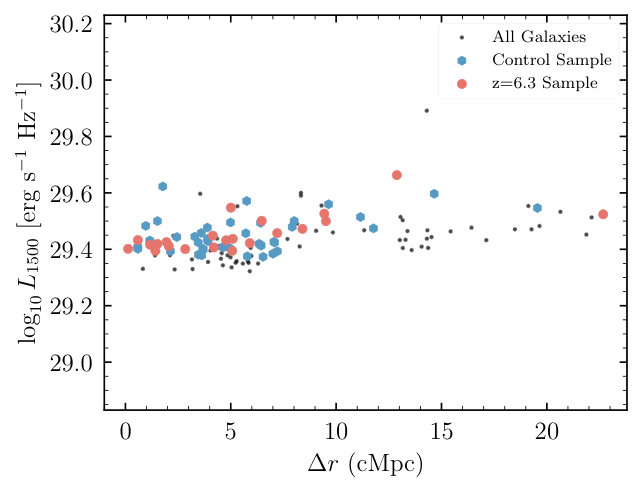 Figure 3
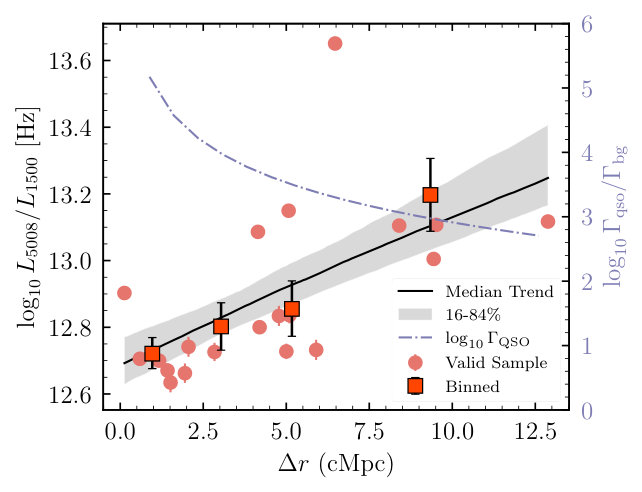 Figure 4
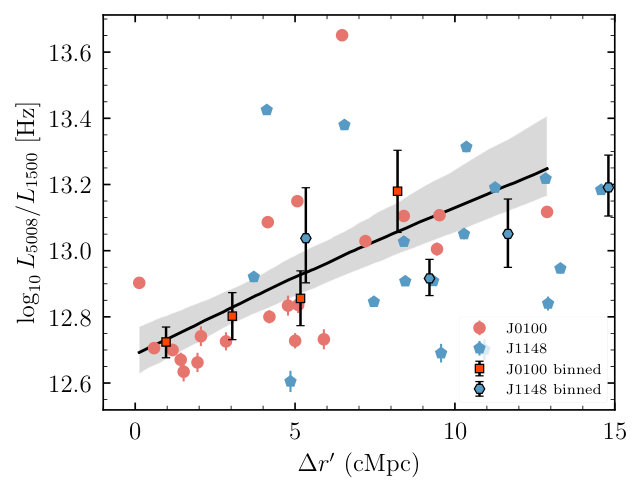 Figure 5
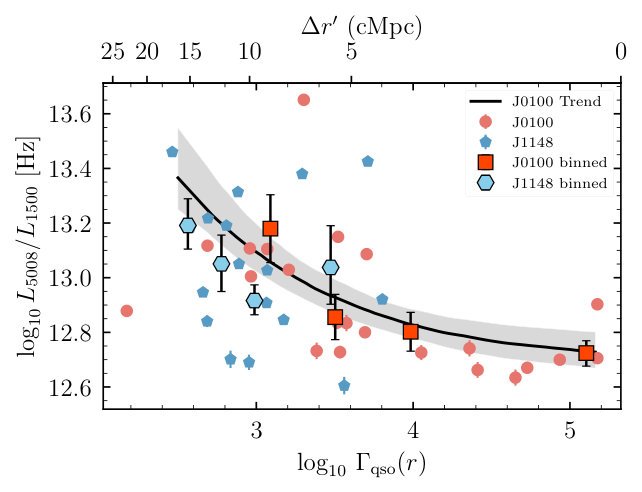 Figure 6
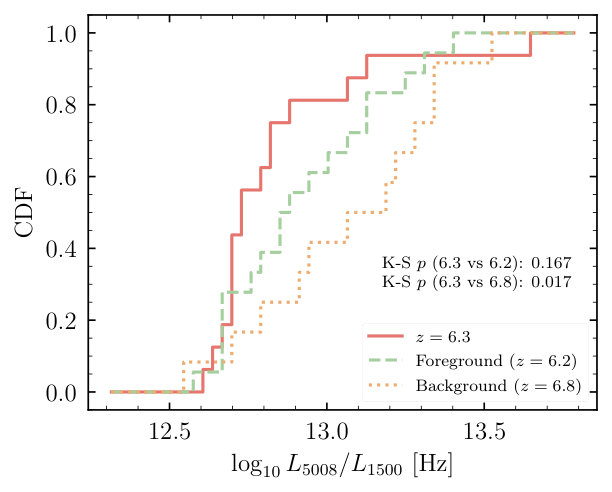 Figure 7
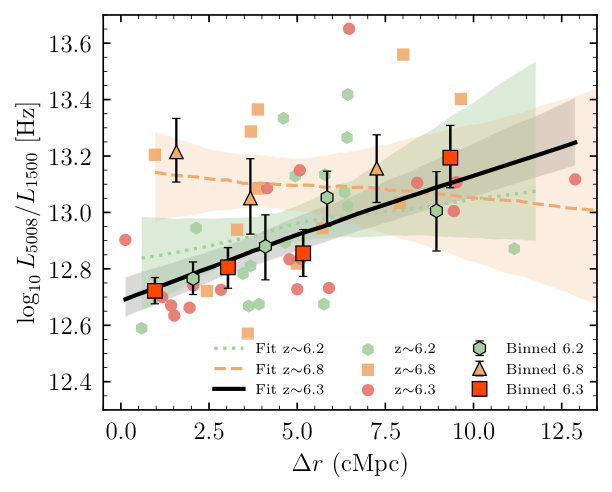 Figure 8
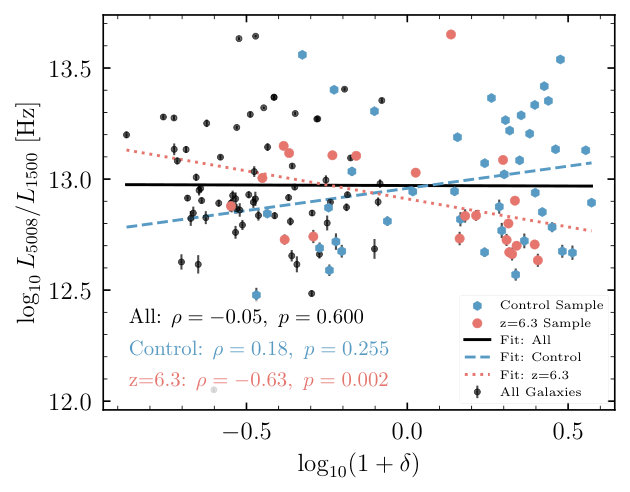 Figure 9
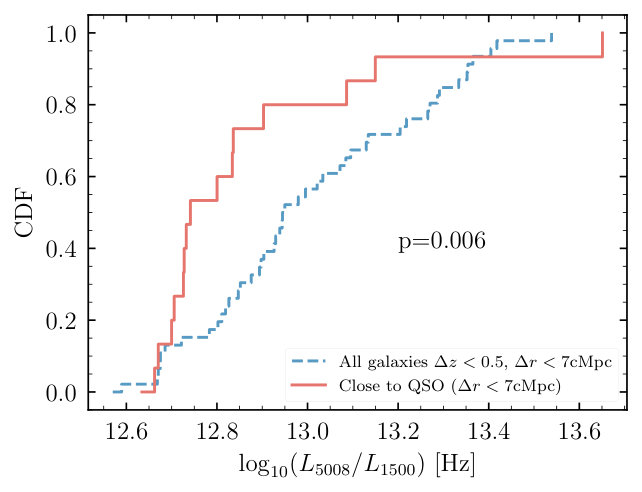 Figure 10
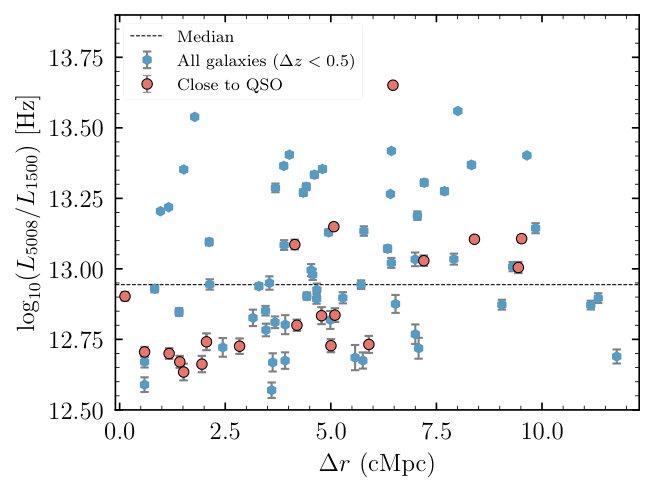 Figure 11
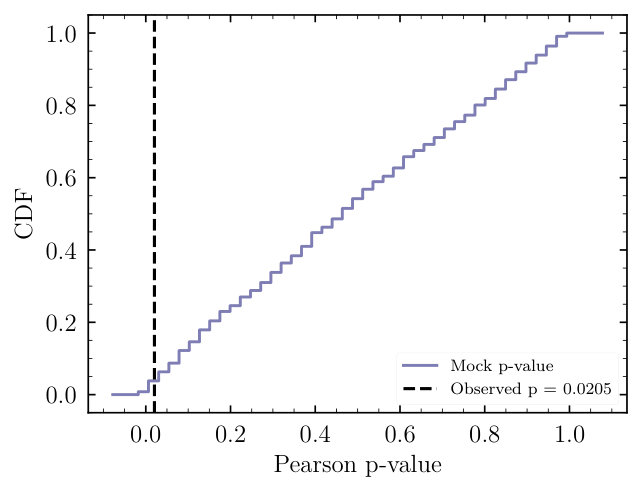 Figure 12
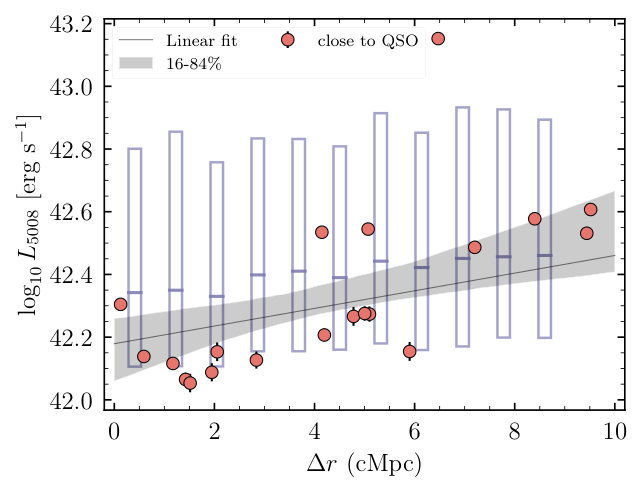 Figure 13
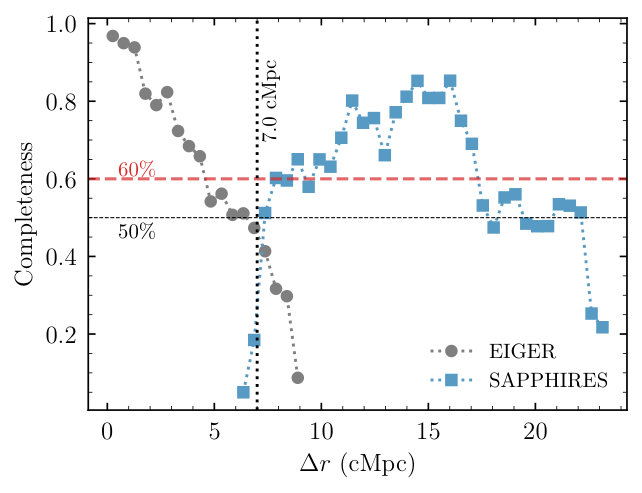 Figure 14
 Figure 15
Peer Reviews
No public reviews on file for this paper yet. If you reviewed it on a platform where reviews are public (OpenReview, ICLR, NeurIPS, ICML), you can paste yours below so the community can read it here.
Videos
No videos yet. Explain this paper in a talk, walkthrough, or lecture? Add one.
Taxonomy
TopicsGalaxies: Formation, Evolution, Phenomena · Astronomy and Astrophysical Research · Astrophysical Phenomena and Observations
Quasar Radiative Feedback May Suppress Galaxy Growth on Intergalactic Scales at
Steward Observatory, University of Arizona, 933 North Cherry Avenue, Tucson, AZ 85721, USA
Steward Observatory, University of Arizona, 933 North Cherry Avenue, Tucson, AZ 85721, USA
Steward Observatory, University of Arizona, 933 North Cherry Avenue, Tucson, AZ 85721, USA
Center for Astrophysics Harvard & Smithsonian, 60 Garden St., Cambridge, MA 02138, USA
Department of Physics & Astronomy, University of California, Riverside, CA 92521, USA
School of Earth and Space Exploration, Arizona State University, Tempe, AZ 85287-6004, USA
Augustana Campus, University of Alberta, Camrose, AB T4V2R3, Canada
MIT Kavli Institute for Astrophysics and Space Research, 77 Massachusetts Avenue, Cambridge, MA 02139, USA
Department of Physics, Massachusetts Institute of Technology, Cambridge, MA 02139, USA
Center for Frontier Science, Chiba University, 1-33 Yayoi-cho, Inage-ku, Chiba 263-8522, Japan
Department of Astronomy & Astrophysics, The Pennsylvania State University, University Park, PA 16802, USA
Steward Observatory, University of Arizona, 933 North Cherry Avenue, Tucson, AZ 85721, USA
Steward Observatory, University of Arizona, 933 North Cherry Avenue, Tucson, AZ 85721, USA
Steward Observatory, University of Arizona, 933 North Cherry Avenue, Tucson, AZ 85721, USA
Department of Physics, University of Oxford, Denys Wilkinson Building, Keble Road, Oxford OX1 3RH, UK
Department of Astronomy, Tsinghua University, Beijing 100084, China
Steward Observatory, University of Arizona, 933 North Cherry Avenue, Tucson, AZ 85721, USA
Steward Observatory, University of Arizona, 933 North Cherry Avenue, Tucson, AZ 85721, USA
Department of Astronomy, Tsinghua University, Beijing 100084, China
Steward Observatory, University of Arizona, 933 North Cherry Avenue, Tucson, AZ 85721, USA
Division of Particle and Astrophysical Science, Nagoya University, Furo-cho, Chikusa-ku, Nagoya 464-8602, Japan
Steward Observatory, University of Arizona, 933 North Cherry Avenue, Tucson, AZ 85721, USA
Kavli Institute for Cosmology, University of Cambridge, Madingley Road, Cambridge, CB3 OHA, UK
Cavendish Laboratory - Astrophysics Group, University of Cambridge, 19 JJ Thomson Avenue, Cambridge, CB3 OHE, UK
Department of Physics and Astronomy, University College London, Gower Street, London WC1E 6BT, UK
Steward Observatory, University of Arizona, 933 North Cherry Avenue, Tucson, AZ 85721, USA
Steward Observatory, University of Arizona, 933 North Cherry Avenue, Tucson, AZ 85721, USA
AURA for the European Space Agency (ESA), Space Telescope Science Institute, 3700 San Martin Dr., Baltimore, MD 21218, USA
Steward Observatory, University of Arizona, 933 North Cherry Avenue, Tucson, AZ 85721, USA
Steward Observatory, University of Arizona, 933 North Cherry Avenue, Tucson, AZ 85721, USA
Steward Observatory, University of Arizona, 933 North Cherry Avenue, Tucson, AZ 85721, USA
Department of Astronomy, University of Michigan, 1085 S. University Ave., Ann Arbor, MI 48109, USA
Department of Astronomy, University of Michigan, 1085 S. University Ave., Ann Arbor, MI 48109, USA
Steward Observatory, University of Arizona, 933 North Cherry Avenue, Tucson, AZ 85721, USA
MIT Kavli Institute for Astrophysics and Space Research, 77 Massachusetts Avenue, Cambridge, MA 02139, USA
Steward Observatory, University of Arizona, 933 North Cherry Avenue, Tucson, AZ 85721, USA
Abstract
We present observational evidence that intense ionizing radiation from a luminous quasar suppresses nebular emission in nearby galaxies on intergalactic scales at . Using JWST/NIRCam grism spectroscopy from the SAPPHIRES and EIGER programs, we identify a in [O iii] luminosity relative to the UV continuum () among galaxies within comoving Mpc (cMpc) of the quasar J01002802, the most UV-luminous quasar known at this epoch (). While remains roughly constant with transverse distance, increases significantly, suggesting suppression of very recent star formation toward the quasar. The effect persists after controlling for completeness, local density, and UV luminosity, and correlates with the projected photoionization-rate profile . A weaker but directionally consistent suppression in is also observed along the line of sight. The transverse suppression radius ( cMpc) implies a recent radiative episode with a cumulative duration , shorter than required for thermal photoheating to dominate and thus more naturally explained by rapid H2 photodissociation and related radiative processes. Environmental effects alone appear insufficient to explain the signal. Our results provide direct, geometry-based constraints on large-scale quasar radiative feedback and recent quasar lifetimes.
\uatQuasars1319, \uatHigh-redshift galaxies734, \uatIntergalactic medium813
††facilities: JWST, MAST††software: astropy (Astropy Collaboration et al., 2022), JWST Calibration Pipeline (H. Bushouse et al., 2022) ††thanks: JASPER Scholar
show][email protected]
††thanks: JASPER Scholar††thanks: JASPER Scholar
1 Introduction
During the epoch of reionization, luminous quasars (QSOs) serve as natural laboratories for studying the interplay between intense radiation fields and early galaxy formation (e.g., X. Fan et al., 2023; F. Wang et al., 2021; S. E. I. Bosman et al., 2024). These quasars illuminate their surroundings over intergalactic ( cMpc) scales (e.g., A.-C. Eilers et al., 2020), raising a key question: can quasar radiation directly suppress star formation and metal-line cooling in nearby galaxies, beyond what is expected from standard environmental clustering?
Reionization-era quasars could be the signposts of protoclusters. Observationally, galaxies in dense environments, even at high redshift, exhibit accelerated evolution and more diverse properties (A. Dressler, 1980; J. M. Helton et al., 2024a, b; T. Morishita et al., 2025; Q. Li et al., 2025b; C. Witten et al., 2025). On average, protoclusters at –3 host more evolved, massive galaxies than the field, supporting an “environmental bias” scenario (e.g., C. C. Steidel et al., 2005; Y. Harikane et al., 2019; X. Lin et al., 2025). Galaxies at cosmic noon () located in high-density regions also tend to show elevated ionizing photon production efficiency (Y. Zhu et al., 2025a, see also Q. Li et al., 2025a). At higher redshift (), prior to the launch of JWST, quasar environments were primarily studied using Lyman- emitters (LAEs) and Lyman-break galaxies (LBGs) (e.g., N. Kashikawa et al., 2007; S. Kim et al., 2009; Y. Utsumi et al., 2010; E. Bañados et al., 2013; T. Goto et al., 2017; S. Kikuta et al., 2017; C. Mazzucchelli et al., 2017; K. Ota et al., 2018; J. B. Champagne et al., 2023; M. Pudoka et al., 2024; M. Yue et al., 2025). Both tracers are sensitive to environment, but LAEs are additionally affected by radiative transfer and residual neutral hydrogen (M. Dijkstra, 2017). Interestingly, several lower-redshift studies have found that LAEs either avoid overdense regions (P. J. Francis & J. Bland-Hawthorn, 2004; N. Kashikawa et al., 2007; Y. Huang et al., 2022) or tend to populate lower-density environments (J. Cooke et al., 2013; J. Witstok et al., 2024, 2025). This behavior has been attributed to suppression of star formation in low-mass halos by an enhanced ultraviolet background (UVB; N. Kashikawa et al., 2007; L. R. Bruns et al., 2012; S. E. I. Bosman et al., 2020), and to modifications in the circumgalactic medium (CGM) structure in dense environments where the CGM is truncated or stripped (J. H. Yoon & M. E. Putman, 2013).
The launch of JWST (J. P. Gardner et al., 2006), and particularly the NIRCam (M. J. Rieke et al., 2023) grism mode (e.g., T. P. Greene et al., 2017; F. Sun et al., 2023), enables a robust alternative for measuring galaxy density via rest-frame optical emission lines, especially [O iii] , which is largely immune to Ly radiative transfer effects (e.g., D. E. Osterbrock & G. J. Ferland, 2006; J. M. Helton et al., 2023; J. B. Champagne et al., 2025a, b; X. Jin et al., 2024; Y. Fudamoto et al., 2025; M. A. Stone et al., 2025). Radiation-hydrodynamic simulations of massive halos at –7 predict significant impacts on nearby galaxy populations via quasar winds and radiation (T. Costa et al., 2019; J.-h. Kim et al., 2019; Y. Ni et al., 2018). On larger scales, cosmological radiative transfer simulations quantify quasar radiative feedback and show that intense proximity-zone illumination can suppress star formation in small halos out to 10 cMpc by photodissociating molecular hydrogen (H2) and heating the gas (H. Chen, 2020).
In this Letter, we investigate whether high-redshift quasars can suppress star formation in neighboring galaxies through radiative feedback beyond their host halos, using a rest-frame optical tracer for the first time. We focus on J01002802 (X.-B. Wu et al., 2015) at (), the most UV-luminous quasar known at . This quasar hosts a large Ly proximity zone and lies within a large-scale overdensity traced by LBGs and LAEs (e.g., A.-C. Eilers et al., 2017; M. Pudoka et al., 2024; S. Hashemi et al., 2025). Using deep JWST/NIRCam imaging and grism spectroscopy from the Slitless Areal Pure-Parallel High-Redshift Emission Survey (SAPPHIRES; F. Sun et al., 2025) and Emission-line galaxies and Intergalactic Gas in the Epoch of Reionization (EIGER; D. Kashino et al., 2022) surveys, we identify [O iii]-emitting galaxies within approximately 20 cMpc of the quasar.
The remainder of this Letter is organized as follows: Section 2 describes the observations; Section 3 presents the main results and tests; Section 4 discusses implications for quasar radiative feedback and lifetimes; Section 5 concludes. Throughout this letter, we adopt the Planck18 cosmology (Planck Collaboration et al., 2020) and quote comoving distances unless otherwise noted.
2 Observations and Analysis
2.1 JWST Imaging and Spectroscopy
We use deep JWST/NIRCam imaging and grism spectroscopy of the quasar J01002802 from the SAPPHIRES program (PID 6434; PI: E. Egami) and the EIGER survey (PID 1243; PI: S. J. Lilly). 111 J01002802 is among the most UV-luminous quasars known at (; X.-B. Wu et al., 2015), making it an ideal target for investigating radiative feedback on intergalactic scales. The SAPPHIRES observations were obtained in parallel to a NIRSpec (P. Jakobsen et al., 2022) multi-object spectroscopy (MOS; P. Ferruit et al., 2022) observation from program 4713 (PI: A.-C. Eilers) and consist of two overlapping NIRCam WFSS tiles. Each tile includes three dithered integrations with the GRISMR grism and F356W filter (paired with F200W for direct imaging), totaling 13,335 s per tile. These were followed by three dithered exposures in direct imaging mode using F115W and F356W (CLEAR), also totaling 13,335 s per tile. The combined on-source exposure time is 7.4 hours per filter and mode, including F356W/GRISMR, F356W imaging, F200W, and F115W. EIGER observations centered on the quasar (see D. Kashino et al. 2022) were independently reprocessed and included in our analysis to increase the effective survey area and enable direct comparisons between quasar environments. In EIGER, the nominal exposure time in a single tile (visit) is 4380 seconds per filter for the short-wavelength (SW) imaging and 8760 seconds for the WFSS.
We reduced all imaging data using a custom pipeline based on the JWST Calibration Pipeline (v1.11.3), with additional corrections for instrumental artifacts including noise and snowballs. WFSS reductions were performed using the open-source pipeline from F. Sun et al. (2023),222https://github.com/fengwusun/nircam_grism with updated F356W trace and wavelength calibrations (see F. Sun et al., 2025). For each exposure we generated 2D dispersed spectra for all cataloged sources, accounting for geometric distortion and spectral tilt, interpolated them onto a common wavelength-spatial grid, and stacked. One-dimensional spectra were extracted with a fixed 5-pixel (03) boxcar. Background and continuum were removed locally using median-filter windows. Emission-line candidates were identified by visual inspection and confirmed by the [O iii] doublet: the line must be detected at with a corresponding detection at at the expected separation. Redshifts were measured from [O iii].
We define three redshift subsamples within the J0100 field: a proximity sample within of the quasar redshift (), a foreground control at (about 60 cMpc toward lower redshift), and a background control at (about 170 cMpc toward higher redshift). Because the observed [O iii] lines fall within a narrow wavelength range in F356W over -6.8, the depth across the three slices is very similar. After quality cuts and artifact removal, the final catalog contains 24 galaxies in the foreground sample, 22 near , and 17 in the background sample, out of 130 emitters over . Figure 1 shows the SAPPHIRES and EIGER footprints with the detected [O iii] emitters in each slice. [O iii]
2.2 Derived Quantities
[O iii] emission-line fluxes were measured from the one-dimensional, continuum-subtracted spectra by fitting a single Gaussian profile and integrating the model. Typical uncertainties on [O iii] fluxes are approximately 4% based on propagated fitting errors. Rest-frame UV continuum luminosities () were estimated from F115W photometry, assuming a flat spectrum. All fluxes were measured within a circular aperture of radius 015, matching the spectral extraction aperture, using the sep package (K. Barbary, 2016). We define the ratio as a proxy for the ionized-gas cooling efficiency normalized by star formation rate (see Appendix A for results based on ). Uncertainties on this ratio are dominated by the [O iii] flux error; the contribution from F115W photometric uncertainty is negligible.
To interpret the observed trends in [O iii]/UV ratios in the context of quasar radiative feedback, we model the local ionizing radiation field using a physically motivated prescription for the quasar photoionization rate . Rather than assuming pure geometric dilution, we follow the formalism developed by G. D. Becker et al. (2021) and implemented in Y. Zhu et al. (2023), in which attenuation of Lyman-continuum (LyC) photons by the IGM is included via a locally modified opacity . This relation is based on stacked rest-UV spectroscopic observations of bright high- quasars from ground-based telescopes (see also J. X. Prochaska et al., 2009; A. P. Calverley et al., 2011). The opacity is parameterized as a function of total ionizing flux as:
[TABLE]
where is the background photoionization rate and is the power-law index describing how LyC opacity scales with the radiation field intensity . This model captures the reduced opacity within the quasar proximity zone due to enhanced ionizing flux.
To compute , we adopt an ionizing spectral energy distribution (SED) with a power-law index of and normalize the quasar luminosity at 1450 Å to its observed . We then calculate the ionizing luminosity at 912 Å, , assuming a broken power-law SED with for Å (see G. D. Becker et al., 2021 and references therein). The geometrically attenuated profile of is computed iteratively in radial steps , starting with:
[TABLE]
and propagating outward via:
[TABLE]
where is the characteristic distance at which in the absence of attenuation, given by:
[TABLE]
as defined in A. P. Calverley et al. (2011). Here, is the hydrogen ionization cross section at 912 Å, is the reduced Planck constant, and is the spectral slope of the quasar ionizing continuum (for Å) in the frequency domain. We adopt at , based on recent constraints from P. Gaikwad et al. (2023) (see also F. B. Davies et al., 2023). This model enables a more accurate representation of quasar radiation profiles on intergalactic scales, which we compare to observed trends in [O iii]/UV ratios as a function of distance.
Finally, we assess the detection completeness of [O iii] sources as a joint function of and transverse distance from the quasar. We inject synthetic line emitters into the 3D error cubes over a grid in redshift and sky position, assuming a fixed line width of 350 km s*-1* and a range of line fluxes, and recover them with the same pipeline (see Y. Zhu et al., 2025b). The resulting completeness map for the J0100 field is consistent with D. Kashino et al. (2025). Completeness is computed as a function of and sky position and then averaged in bins of transverse distance from the quasar . We adopt as a detection threshold, for which completeness is at least 40% in both the EIGER and SAPPHIRES fields. For the science analyses we further require 50% completeness within each radial bin, and for bootstrap tests we downsample to a uniform 60% completeness. Only galaxies in regions meeting these criteria are included in the trend analyses and regression fits; in the sample, 20 of 22 sources pass these cuts. Raising the local completeness requirement to 75% yields the same qualitative suppression in .
3 Results and Discussion
3.1 Suppression with Transverse Distance
Figure 2 (left) shows the field-averaged detection completeness for galaxies with as a function of projected transverse distance from J01002802. Completeness peaks near the center of the EIGER mosaic, declines toward its edges where exposure time is lower, and rises again in the overlap region near the center of the SAPPHIRES field. The vertical dotted line at cMpc marks the approximate transition between the two mosaics, where both reach about 50% completeness. To assess systematics, we also perform forward modeling of the observed [O iii] luminosity distribution by convolving a published [O iii] luminosity function with the position-dependent completeness; results are shown in Appendix A and confirm that the measured trends are not driven by completeness gradients. Here we present the empirical completeness profiles used for the main selection and fits.
In the right panel of Figure 2, we present the central result of this study: decrease in with decreasing projected distance from the quasar, consistent with radiative feedback that suppresses recent star formation (see Section 4). Red points indicate individual galaxies that meet a local completeness threshold of at their respective ; only these galaxies are included in the regression analysis. Binned averages (five galaxies per bin) are shown as orange squares with error bars and are broadly consistent with the fitted trend. The solid black line indicates the best-fit linear trend, with the shaded region representing the 16th to 84th percentile range from 500 bootstrap realizations. Each bootstrap draws a completeness-matched mock sample assuming a uniform 60% detection probability. We find a slope of - of . Given the limited radial range probed and sky coverage, we refer to this as a trend over the observed scales rather than a universal relation.
The dot-dashed purple curve in Figure 2 shows the predicted photoionization rate as a function of distance from the quasar, normalized by the metagalactic ionizing background . The observed trend in increases with distance from the quasar, in contrast to the declining profile. A more detailed discussion of the physical interpretation is deferred to Section 4.
3.2 Line-of-Sight Trends in [O iii] Luminosity
To assess whether quasar radiative feedback manifests along the line of sight (LOS), we compare galaxies at similar projected separations but offset in redshift. Figure 3 now shows both the transverse trends and the LOS comparison: the left panel plots versus for the near- slice (; red), the foreground (; green), and the background overdensity (; orange), with completeness-matched fits and binned averages; the right panel presents cumulative distributions within cMpc.
The background sample lies systematically above the sequence at fixed and shows only a weak slope, whereas the slice exhibits the strong positive trend with distance seen in Section 3.1. Within cMpc, the CDFs confirm this offset: the background ratios are higher than those at (K–S ). By contrast, the foreground slice overlaps the sample in both normalization and slope, and its CDF is statistically consistent with (K–S ). A similar behavior is seen for alone (K–S for vs. , and for vs. ).
A natural explanation is that the slice resides within the extended LOS proximity zone of J01002802, which spans tens of cMpc due to light-travel delays and the high intrinsic luminosity of the quasar (e.g., A.-C. Eilers et al., 2017). In this geometry the LOS is effectively observed at a single quasar-on time, so a uniform suppression within the proximity zone would produce little residual correlation with LOS distance, consistent with the data. The galaxies may therefore experience ionization conditions similar to those at .
In contrast, transverse measurements are sensitive to finite light-travel time. The significant suppression with decreasing (Figure 2) implies that not all galaxies at large projected separations have yet been reached by the ionization front. This spatial anisotropy suggests a relatively recent turn-on, with an age shorter than the light-crossing time across the transverse separation, making the transverse direction a more temporally localized probe of quasar radiative feedback.
3.3 Independence from Environment and
To test whether the observed suppression in the [O iii]-to-UV luminosity ratio is driven by environmental effects or intrinsic galaxy properties, we compare against two control variables: local overdensity and UV continuum luminosity.
Figure 4 (left) shows the [O iii]/UV ratio as a function of local overdensity, defined as using a nearest-neighbor estimator in 3D comoving space, applied to the full sample of 130 [O iii] emitters () across both fields. The overdensity is normalized by the field-average number density. We caution that this is a rough estimate because peculiar velocities are unknown and the measurements cover a modest field. We find no significant correlation between and for the full sample (Spearman , ). The combined control sample (foreground plus background ; blue) shows a weak positive trend (, ), whereas the near- sample at (red) shows a negative trend (, ). Repeating this analysis with different values or using kernel density estimation (KDE) produces consistent results. The absence of a strong global trend with overdensity suggests that environment alone is unlikely to explain the drop in [O iii]/UV near the quasar, especially since galaxies in dense regions show diverse properties, as discussed in Section 1.
In Figure 4 (right), we examine as a function of transverse distance from J01002802. Both the near- sample () and the combined control sample exhibit similar distributions (K-S -value ) with no significant radial gradient and a typical scatter of 0.2 dex. This confirms that the underlying UV luminosity is effectively matched across the samples.
Together, these control tests indicate that the observed decline in the [O iii]/UV ratio near the quasar is not driven by local overdensity or variations (see, e.g., M. Pudoka et al., 2024; B. Balmaverde et al., 2017). Instead, it primarily reflects a decline in [O iii] emission and points to a distinct mechanism that selectively suppresses nebular line emission while leaving the stellar continuum relatively unaffected in the vicinity of this ultra-luminous quasar.
3.4 Cross-field Comparison of [Oiii] Suppression and Quasar Ionizing Output
Quasar radiative feedback is expected to depend on both the ionizing luminosity of the source and the distance to surrounding galaxies. To evaluate whether the [O iii] suppression observed near J01002802 is unique or part of a broader trend, we compare its impact with other luminous quasars from the EIGER survey (D. Kashino et al., 2025), using our own uniform data reduction for consistency. The comparison sample comprises J1148+5251 (catalog ) (, ; E. Bañados et al., 2016; Y. Shen et al., 2019), J1030+0524 (catalog ) (, ; V. D’Odorico et al., 2023; C. Mazzucchelli et al., 2023), and J15902 (catalog ) (, ; E. Bañados et al., 2016; E. P. Farina et al., 2022).
The left panel of Figure 5 shows the predicted quasar photoionization rate normalized by the metagalactic UV background for four luminous quasars in EIGER. These profiles are computed using the attenuation-based formalism described in Section 2.2, which incorporates LyC photon absorption via a locally modified opacity (G. D. Becker et al., 2021; Y. Zhu et al., 2023). Among the four, J01002802 (solid purple) exhibits the highest , exceeding by over three orders of magnitude within cMpc. This corresponds closely to the observed suppression radius in , where values fall below the field median. J11485251 (dashed blue), while less luminous (), still reaches within 5 cMpc, allowing a meaningful comparison of feedback strength across quasar luminosities.
In the right panel of Figure 5, we rescale the projected transverse distance for sources in the J11485251 field to a new variable , defined such that . This enables a direct comparison of [O iii]-to-UV ratios at fixed ionizing exposure across fields of differing quasar luminosity.
We find that galaxies around J11485251 are broadly consistent with the suppression trend observed in the J0100 field, though with increased scatter. Notably, they do not show elevated at fixed , implying that less luminous quasars may still induce detectable feedback when . In contrast, the fields around J10300524 and J15902 lack bright [O iii] emitters at small scaled distances ( cMpc; see also D. Kashino et al., 2025), where suppression would be expected if strong feedback were present. Taken together, the scarcity of bright emitters at small scaled radii across these fields supports the interpretation that radiative suppression is genuine (see also J. B. Champagne et al., 2025a; M. Pudoka et al., 2025).
4 Interpretation and Implications
The observed decline in with decreasing distance to J01002802, despite no corresponding trend in UV luminosity or in local galaxy density, suggests a mechanism that suppresses nebular line emission without immediately affecting the stellar continuum. The most plausible explanation is radiative feedback from the quasar acting on intergalactic scales, disrupting the ionization and cooling conditions needed for [O iii] excitation while leaving the legacy of recent star formation traced by intact.
Radiation-hydrodynamic simulations by H. Chen (2020) show that intense quasar radiation can rapidly suppress star formation in small galaxies, especially in low-mass halos that cannot self-shield, primarily through the photodissociation of H2. This suppression occurs within approximately 1 physical cMpc of the AGN, with star formation rates reduced by around 0.5 dex in low-mass to average satellites, while more massive satellites remain less affected. Although line emission is not explicitly modeled, the associated delays in star formation are consistent with our finding that remains stable while [O iii] declines near J0100. This supports a scenario in which nebular cooling and recent star formation are suppressed without erasing the established stellar population.
Meanwhile, thermal photoheating operates over much longer timescales (greater than yr), gradually increasing ISM thermal pressure and suppressing cold gas accretion (T. Costa et al., 2019). Proximity-zone measurements for J0100 indicate a short recent episode, yr (A.-C. Eilers et al., 2017). This is broadly consistent with a flickering scenario in which the cumulative on-time can reach a few Myr (as implied by the transverse suppression; Section 3.1), yet it remains far shorter than the yr required for thermal photoheating to dominate. Instead, more immediate radiative effects, such as H2 photodissociation by Lyman-Werner photons, are more plausible. These can suppress dense-gas formation and nebular emission on short timescales while preserving the UV-bright stellar component, consistent with analytic models of abrupt ISM phase transitions triggered by critical ionizing backgrounds (A. Sternberg et al., 2014).
The transition in spans nearly one dex in , potentially indicating a nonlinear, threshold-like response rather than a smooth scaling with ionizing flux. Alternatively, the apparent jump between the 5 and 8 cMpc bins could reflect a geometric effect, such as a drop in due to shielding by a residual neutral patch. However, such structures are expected to disappear quickly given the brightness of the quasar, unless they lie outside its ionization cone. Combined with the absence of a correlation between [O iii] suppression and galaxy overdensity (Figure 4), these results favor a direct radiative origin. That said, environmental mechanisms such as tidal interactions, ram pressure, or halo-related quenching could also modulate the specific star formation rate and line emission near the quasar (see Section 1). While difficult to isolate with current statistics, future surveys with larger fields and deeper spectroscopic coverage will be essential to disentangle radiative and environmental effects.
The J11485251 field radiative suppression when , [O iii] emitters near other luminous quasars in EIGER, particularly J10300524 and J15902. These fields show a deficit of [O iii] sources within scaled distances cMpc, where suppression would be expected if feedback were present. This could reflect a detection bias due to galaxies becoming too faint in [O iii] (i.e., ) to be identified in current observations (see, e.g., M. A. Stone et al., 2025), possibly due to older stellar populations or low specific star formation rates.
Finally, the suppression of [O iii] at cMpc corresponds to a light-travel distance of approximately proper Mpc, implying a lower bound on the quasar’s radiative lifetime of about . This is significantly longer than typical estimates based on Ly proximity-zone sizes and may indicate that the [O iii] suppression reflects the integrated impact of multiple episodic bursts, with the proximity zone tracing only the most recent active phase. The presence of an extended transverse suppression region, in contrast to a compact proximity zone, supports a scenario in which the quasar flickers on timescales shorter than the timescale on which [O iii] emission responds to photoionization. Because transverse distances are less affected by light-cone delays and IGM attenuation, this geometry enables a complementary and potentially more robust constraint on the cumulative radiative history of quasars. Future work may test this scenario by searching for systematic differences in ionization-sensitive line ratios between galaxies exposed to recent versus older quasar episodes. One related caveat is that intrinsic galaxy property gradients near the quasar, for example higher metallicity, could also weaken [O iii] at fixed sSFR; targeted NIRSpec MSA spectroscopy of diagnostic line ratios can test this.
5 Conclusions
We present observational evidence that radiative feedback from the luminous quasar J01002802 suppresses [O iii] emission in nearby galaxies on intergalactic scales. Using deep JWST/NIRCam grism spectroscopy from the SAPPHIRES and EIGER programs, we find:
- •
A decline in with decreasing transverse distance from the quasar, robust to variations in completeness, environment, and UV luminosity. The suppression radius of cMpc implies a recent radiative burst with a minimum duration of Myr from a light-travel time argument.
- •
A weaker trend along the line of sight, consistent with extended quasar influence but less pronounced, possibly due to anisotropic emission, IGM attenuation, or light-cone effects. If confirmed with a larger sample, the transverse suppression may provide a powerful constraint on quasar lifetimes and duty cycles.
- •
A comparison with other quasars shows that the suppression trend near J11485251 is broadly consistent with that of J0100, while the deficit of bright [O iii] emitters near J10300524 and J15902 suggests that such suppression may be widespread. These findings imply that emission-line-selected surveys (e.g., [O iii]) may underestimate galaxy densities around luminous quasars.
These results are consistent with a scenario in which quasar radiation rapidly alters ISM conditions, likely through H2 photodissociation or ionization, suppressing recent star formation without immediately affecting the UV-bright stellar population. JWST provides direct constraints on such radiative feedback during reionization, offering a window into quasar-galaxy interaction at the highest redshifts. Future wide-field NIRCam imaging and WFSS around luminous quasars will be essential for mapping the full extent of this suppression. NIRSpec follow-up can test this scenario by searching for weak nebular lines, low ionization parameters, or older stellar populations in continuum-selected galaxies near quasars.
Y.Z. and J.M.H. acknowledge support from the NIRCam Science Team contract to the University of Arizona, . J.M.H. is also supported by JWST Program 3215. G.D.B. is supported by JWST Program 4092. Support for programs #3215, #4092, and #6434 was provided by NASA through a grant from the Space Telescope Science Institute, which is operated by the Association of Universities for Research in Astronomy, Inc., under NASA contract NAS 5-03127. H.C. thanks the support by the Natural Sciences and Engineering Research Council of Canada (NSERC), funding reference #RGPIN-2025-04798 and #DGECR-2025-00136, and by the University of Alberta, Augustana Campus. C.C. was supported by the Beus Center for Cosmic Foundations. A.J.B. acknowledges funding from the “FirstGalaxies” Advanced Grant from the European Research Council (ERC) under the European Union’s Horizon 2020 research and innovation program (Grant agreement No. 789056). This work is based on observations made with the NASA/ESA/CSA James Webb Space Telescope. The data were obtained from the Mikulski Archive for Space Telescopes at the Space Telescope Science Institute, which is operated by the Association of Universities for Research in Astronomy, Inc., under NASA contract NAS 5-03127 for JWST. These observations are associated with programs #6434 and #1243. We respectfully acknowledge the University of Arizona is on the land and territories of Indigenous peoples. Today, Arizona is home to 22 federally recognized tribes, with Tucson being home to the O’odham and the Yaqui. The university strives to build sustainable relationships with sovereign Native Nations and Indigenous communities through education offerings, partnerships, and community service. This manuscript benefited from grammar checking and proofreading using ChatGPT (OpenAI, 2023). {contribution}YZ did the analysis and wrote this paper. EE, XF, and FS contributed to the observation design. GDB, YF, JMH, XJ and MP contributed to initial discussions and methodologies. CC and HC contributed to the theoretical interpretation. ACE and MY contributed to the primary observation as well as the EIGER observations. All authors contributed to discussions and interpretation of the results.
Appendix A Robustness Tests
An important concern is whether the apparent suppression of [O iii] emission near J01002802 could be driven by variations in survey depth across the field. In this section we test the robustness of our result against such observational biases. Because the jump in in Figure 2 coincides with the transition from EIGER to SAPPHIRES coverage, we restrict this test to the EIGER data and to cMpc.
First, we note that the sensitivity is higher toward the field center (Figure 2). If observational bias dominated, we would expect to recover both low- and high- galaxies close to the quasar. Instead, the opposite is observed. As shown in Figure A1(a), when selecting all galaxies within of the quasar, there exists a substantial population with high ratios. However, within cMpc of the quasar (red points), this high-ratio population is absent. The cumulative distributions in Figure A1(b) further highlight this effect: the close-to-QSO sample is significantly shifted toward lower compared to the rest of the galaxies within the same redshift window (blue points). A two-sample K–S test yields , confirming that the observed deficit of high galaxies near the quasar is statistically significant ().
In the main text (Section 3), we downsampled the galaxy sample to enforce uniform completeness. Here we carry out a more sophisticated test by explicitly forward modeling the survey selection function. We convolve the J. Matthee et al. (2023) [O iii] luminosity function with the two-dimensional completeness maps as a function of source luminosity, redshift, and position, thereby accounting for both the higher central sensitivity and geometric coverage variations. The resulting mock catalogs predict the distribution of detected [O iii] emitters under the null hypothesis of no environmental or quasar-induced suppression. As shown in Figure A1(c), the forward-modeled median values remain approximately flat with radius, with at most a weak increase ( dex) at large . The distribution of slopes and -values from 1000 mock realizations indicates that the probability of reproducing the observed positive correlation is less than 2% (Figure A1(d)).
Together, these tests demonstrate that the suppression of [O iii] luminosity near J01002802 is unlikely to be an artifact of varying sensitivity across the field. Instead, the deficit of bright [O iii] emitters close to the quasar is likely genuine and consistent with quasar-driven radiative feedback.
The reference list from the paper itself. Each links out to its DOI / PubMed record.
- 1Astropy Collaboration et al. (2022) Astropy Collaboration, Price-Whelan, A. M., Lim, P. L., et al. 2022, \bibinfo title The Astropy Project: Sustaining and Growing a Community-oriented Open-source Project and the Latest Major Release (v 5.0) of the Core Package, The Astrophysical Journal, 935, 167, doi: 10.3847/1538-4357/ac 7c 74 · doi ↗
- 2B. Balmaverde et al. (2017) Balmaverde, B., Gilli, R., Mignoli, M., et al. 2017, \bibinfo title Primordial environment of supermassive black holes. II. Deep Y- and J-band images around the z 6.3 quasar SDSS J 1030+0524, Astronomy and Astrophysics, 606, A 23, doi: 10.1051/0004-6361/201730683 · doi ↗
- 3K. Barbary (2016) Barbary, K. 2016, \bibinfo title SEP: Source Extractor as a library, The Journal of Open Source Software, 1, 58, doi: 10.21105/joss.00058 · doi ↗
- 4E. Bañados et al. (2013) Bañados, E., Venemans, B., Walter, F., et al. 2013, \bibinfo title The Galaxy Environment of a QSO at z ~ 5.7, The Astrophysical Journal, 773, 178, doi: 10.1088/0004-637X/773/2/178 · doi ↗
- 5E. Bañados et al. (2016) Bañados, E., Venemans, B. P., Decarli, R., et al. 2016, \bibinfo title The Pan-STARRS 1 Distant z > 5.6 Quasar Survey: More than 100 Quasars within the First Gyr of the Universe, The Astrophysical Journal Supplement Series, 227, 11, doi: 10.3847/0067-0049/227/1/11 · doi ↗
- 6G. D. Becker et al. (2021) Becker, G. D., D’Aloisio, A., Christenson, H. M., et al. 2021, \bibinfo title The mean free path of ionizing photons at 5 < z < 6: evidence for rapid evolution near reionization, Monthly Notices of the Royal Astronomical Society, 508, 1853, doi: 10.1093/mnras/stab 2696 · doi ↗
- 7S. E. I. Bosman et al. (2020) Bosman, S. E. I., Kakiichi, K., Meyer, R. A., et al. 2020, \bibinfo title Three Lyα Emitting Galaxies within a Quasar Proximity Zone at z ∼ 5.8, The Astrophysical Journal, 896, 49, doi: 10.3847/1538-4357/ab 85cd · doi ↗
- 8S. E. I. Bosman et al. (2024) Bosman, S. E. I., Álvarez Márquez, J., Colina, L., et al. 2024, \bibinfo title A mature quasar at cosmic dawn revealed by JWST rest-frame infrared spectroscopy, Nature Astronomy, 8, 1054, doi: 10.1038/s 41550-024-02273-0 · doi ↗