Comment on Garc\'ia-Donato et al. (2025) "Model uncertainty and missing data: An objective Bayesian perspective"
Joris Mulder

TL;DR
This paper discusses an alternative Bayesian approach for handling missing data in variable selection, using O'Hagan's fractional Bayes factor and Rubin's rules, demonstrating competitive results with prior methods.
Contribution
It introduces an alternative objective Bayesian method for variable selection with missing data, utilizing fractional Bayes factors and Rubin's rules, and provides a numerical comparison.
Findings
Method shows competitive performance in numerical experiments.
Utilizes fractional Bayes factor as a Savage-Dickey density ratio.
Offers a derivation for variable selection with missing data.
Abstract
Garcia-Donato et al. (2025) present a methodology for handling missing data in a model selection problem using an objective Bayesian approach. The current comment discusses an alternative, existing objective Bayesian method for this problem. First, rather than using the g prior, O'Hagan's fractional Bayes factor (O'Hagan, 1995) is utilized based on a minimal fraction. Second, and more importantly due to the focus on missing data, Rubin's rules for multiple imputation can directly be used as the fractional Bayes factor can be written as a Savage-Dickey density ratio for a variable selection problem. The current comment derives the methodology for a variable selection problem. Moreover, its implied behavior is illustrated in a numerical experiment, showing competitive results as the method of Garcia-Donato et al. (2025).
Click any figure to enlarge with its caption.
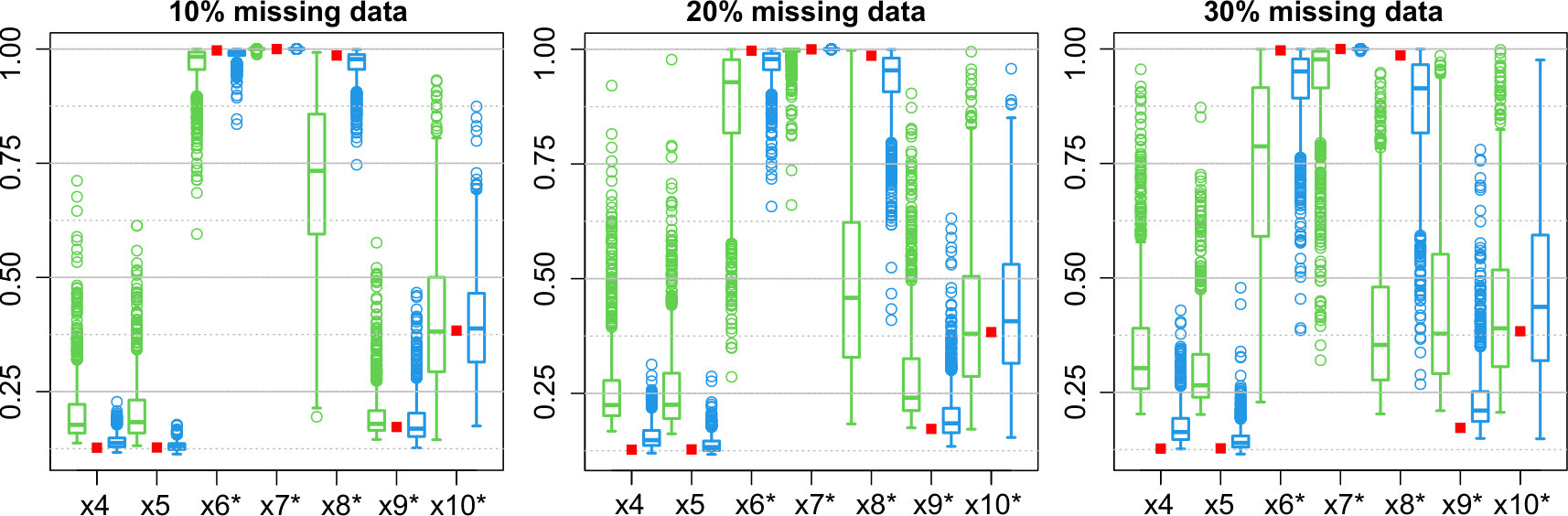 Figure 1
Peer Reviews
No public reviews on file for this paper yet. If you reviewed it on a platform where reviews are public (OpenReview, ICLR, NeurIPS, ICML), you can paste yours below so the community can read it here.
Videos
No videos yet. Explain this paper in a talk, walkthrough, or lecture? Add one.
Comment on García-Donato et al. (2025) “Model uncertainty and missing data: An objective Bayesian perspective”
Joris Mulder
García-Donato \BOthers. (\APACyear2025) present a methodology for handling missing data in a model selection problem using an objective Bayesian approach. The current comment discusses an alternative, existing objective Bayesian method for this problem. First, rather than using the prior, O’Hagan’s fractional Bayes factor (FBF; O’Hagan, \APACyear1995) is utilized based on a minimal fraction111Note that the implied fractional prior has a similar covariance structure as the prior (e.g., see Mulder, \APACyear2014).. Second, and more importantly due to the focus on missing data, Rubin’s rules for multiple imputation can directly be used as the fractional Bayes factor can be written as a Savage-Dickey density ratio for a variable selection problem. This attractive property of a Savage-Dickey density ratio was shown by Hoijtink \BOthers. (\APACyear2018). The use of (adjusted) fractional Bayes factors for a testing problem of a set of predefined equality and/or one-sided constrained hypotheses in the case of missing data was discussed by Mulder \BBA Gu (\APACyear2022). The current comment derives the methodology for a variable selection problem (which is a special case of the above testing problem). Moreover, its implied behavior is illustrated in a numerical experiment, showing competitive results as the method of García-Donato \BOthers. (\APACyear2025). Throughout this comment, the same notation is used as García-Donato \BOthers. (\APACyear2025).
The FBF of a model against the full model where can be written as a Savage-Dickey density ratio (e.g., Mulder \BBA Gu, \APACyear2022; Dickey, \APACyear1971)
[TABLE]
where denotes the vector of coefficients under the full model which are excluded in model , denotes the marginal likelihood of model when raising the likelihood to a fraction , and the numerator (denominator) on the right hand side denotes the marginal posterior (marginal fractional prior; e.g., see Gilks, \APACyear1995) under the full model evaluated at the null values of the excluded parameters, i.e., . Thus, the FBF can be written as a ratio of a posterior and a fractional prior quantity under the full model.
Hence, we can directly apply Rubin’s rules for multiple imputation under the full model. For the posterior, this implies
[TABLE]
where refers to the average based on repeated imputations drawn from the posterior predictive distribution of missing data given the observed data under the full model, (e.g., Rubin, \APACyear1996). For the fractional prior, we write
[TABLE]
Hence, similar as for the posterior quantity, the posterior predictive distribution based on all observed data, , is used to compute the fractional prior quantity. Note that if a minimal fraction of the observed data would have been used in the predictive distribution, the imputed missing data would be unrealistically heterogeneous. Moreover, by taking a fraction of the observed data and the missing data, i.e., , the fractional prior is again based on a fraction of the information in the observed data, similar as in the fractional Bayes factor. This construction also allows us to compute the posterior and fractional prior quantities using the same imputed data. Moreover, as the marginal posterior and marginal fractional prior of both have multivariate Student distributions (e.g., Mulder \BBA Gu, \APACyear2022), computation is straightforward. The R package BFpack (Mulder \BOthers., \APACyear2021) computes these quantities for fractional Bayes factors for any equality/one-sided constrained model, which also includes the model . Finally note that by separately computing the numerator and denominator in (1) for the observed data, the fractional Bayes factor is still coherent via this construction (see also O’Hagan, \APACyear1997).
I end this comment by illustrating the implied selection behavior of this method for Experiment 2 of García-Donato \BOthers. (\APACyear2025) using the Ozone35 dataset with 7 potential predictors and the same missing data mechanisms. Inclusion probabilities were obtained using FBFs after list-wise deletion and when using FBFs using the above methodology for handling missing data. The R package BFpack was used for computing the posterior probabilities for all possible models from which the inclusion probabilities can be computed222The R code can be found here: http://github.com/jomulder/missing-data-BFpack-FBFs.. Figure 1 shows the boxplots of the inclusion probabilities for all predictors based on proportions of missing values for the variables to of 10%, 20%, or 30% when using list-wise deletion (green plots) and the method discussed above (blue plots). Similar as García-Donato et al.’s method, the proposed method is clearly superior over list-wise deletion by better preserving the evidence. Moreover, the resulting inclusion probabilities using this method are very similar as compared to García-Donato et al.’s method (comparing Figure 1 here with Figure 1 of García-Donato et al.).
The reference list from the paper itself. Each links out to its DOI / PubMed record.
- 1Dickey ( \APA Cyear 1971) \APA Cinsertmetastar Dickey:1971 {APA Crefauthors} Dickey, J. \APA Cref Year Month Day 1971. \BBOQ \APA Crefatitle The Weighted Likelihood Ratio, Linear Hypotheses on Normal Location Parameters The weighted likelihood ratio, linear hypotheses on normal location parameters. \BBCQ \APA Cjournal Vol Num Pages The Annals of Statistics 421204–223. \Print Back Refs \Current Bib
- 2García-Donato \B Others . ( \APA Cyear 2025) \APA Cinsertmetastar garcia 2025 model {APA Crefauthors} García-Donato, G., Castellanos, M \BPBI E., Cabras, S., Quirós, A. \BCBL \BBA Forte, A. \APA Cref Year Month Day 2025. \BBOQ \APA Crefatitle Model Uncertainty and Missing Data: An Objective Bayesian Perspective Model uncertainty and missing data: An objective Bayesian perspective. \BBCQ \APA Cjournal Vol Num Pages Bayesian Analysis 111–26. \Print Back Refs \Current Bib
- 3Gilks ( \APA Cyear 1995) \APA Cinsertmetastar Gilks:1995 {APA Crefauthors} Gilks, W \BPBI R. \APA Cref Year Month Day 1995. \BBOQ \APA Crefatitle Discussion to fractional Bayes factors for model comparison (by O’Hagan) Discussion to fractional Bayes factors for model comparison (by O’Hagan). \BBCQ \APA Cjournal Vol Num Pages Journal of the Royal Statistical Society Series B 56118–120. \Print Back Refs \Current Bib
- 4Hoijtink \B Others . ( \APA Cyear 2018) \APA Cinsertmetastar Hoijtink:2018 b {APA Crefauthors} Hoijtink, H., Gu, X., Mulder, J. \BCBL \BBA Rosseel, Y. \APA Cref Year Month Day 2018. \BBOQ \APA Crefatitle Computing Bayes Factors From Data With Missing Values Computing Bayes factors from data with missing values. \BBCQ \APA Cjournal Vol Num Pages Psychological Methods 242253–268. {APA Cref DOI} \doi 10.1037/met 0000187 \Print Back Refs \Current Bib
- 5Mulder ( \APA Cyear 2014) \APA Cinsertmetastar Mulder:2014 b {APA Crefauthors} Mulder, J. \APA Cref Year Month Day 2014. \BBOQ \APA Crefatitle Prior Adjusted Default Bayes Factors for Testing (In)equality Constrained Hypotheses Prior adjusted default Bayes factors for testing (in)equality constrained hypotheses. \BBCQ \APA Cjournal Vol Num Pages Computational Statistics and Data Analysis 71448–463. {APA Cref DOI} \doi 10.1016/j.csda.2013.07.017 \Print Back Refs \Current Bib
- 6Mulder \BBA Gu ( \APA Cyear 2022) \APA Cinsertmetastar mulder 2022 bayesian {APA Crefauthors} Mulder, J. \BCBT \BBA Gu, X. \APA Cref Year Month Day 2022. \BBOQ \APA Crefatitle Bayesian testing of scientific expectations under multivariate normal linear models Bayesian testing of scientific expectations under multivariate normal linear models. \BBCQ \APA Cjournal Vol Num Pages Multivariate Behavioral Research 575767–783. {APA Cref DOI} \doi 10.1080/00273171.2021.1904809 \Print Back Refs
- 7Mulder \B Others . ( \APA Cyear 2021) \APA Cinsertmetastar mulder 2021 bfpack {APA Crefauthors} Mulder, J., Williams, D \BPBI R., Gu, X., Tomarken, A., Böing-Messing, F., Olsson-Collentine, A. \BDBL others \APA Cref Year Month Day 2021. \BBOQ \APA Crefatitle B Fpack: Flexible Bayes factor testing of scientific theories in R B Fpack: Flexible Bayes factor testing of scientific theories in r. \BBCQ \APA Cjournal Vol Num Pages Journal of Statistical Software 1001–63. \Print Back Refs \Current Bib
- 8O’Hagan ( \APA Cyear 1995) \APA Cinsertmetastar O Hagan:1995 {APA Crefauthors} O’Hagan, A. \APA Cref Year Month Day 1995. \BBOQ \APA Crefatitle Fractional Bayes Factors for Model Comparison (with discussion) Fractional Bayes factors for model comparison (with discussion). \BBCQ \APA Cjournal Vol Num Pages Journal of the Royal Statistical Society B 57199–138. {APA Cref DOI} \doi 10.1111/j.2517-6161.1995.tb 02017.x \Print Back Refs \Current Bib