Convergence of Leray Cosheaves for Decorated Mapper Graphs
Justin Curry, Washington Mio, Tom Needham, Osman Berat Okutan, Florian, Russold

TL;DR
This paper introduces decorated mapper graphs as a way to capture richer topological information from data sets, establishing their convergence to Leray cosheaves as covers become finer.
Contribution
It provides a theoretical foundation showing that decorated mapper graphs approximate Leray cosheaves, linking discrete structures to continuous topological invariants.
Findings
Decorated mapper graphs generalize standard mapper graphs.
The cellular Leray cosheaf converges to the actual Leray cosheaf with finer covers.
Theoretical proof of convergence as cover resolution approaches zero.
Abstract
We introduce decorated mapper graphs as a generalization of mapper graphs capable of capturing more topological information of a data set. A decorated mapper graph can be viewed as a discrete approximation of the cellular Leray cosheaf over the Reeb graph. We establish a theoretical foundation for this construction by showing that the cellular Leray cosheaf with respect to a sequence of covers converges to the actual Leray cosheaf as the resolution of the covers goes to zero.
Click any figure to enlarge with its caption.
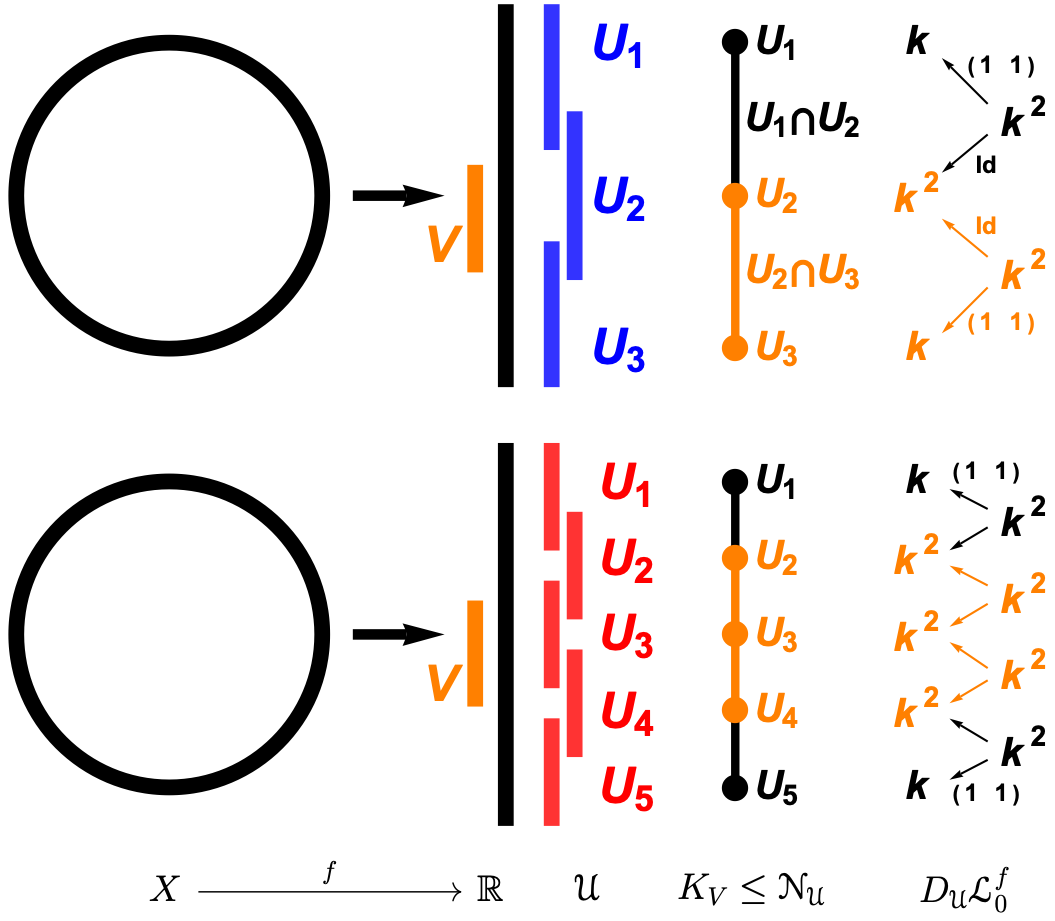 Figure 1
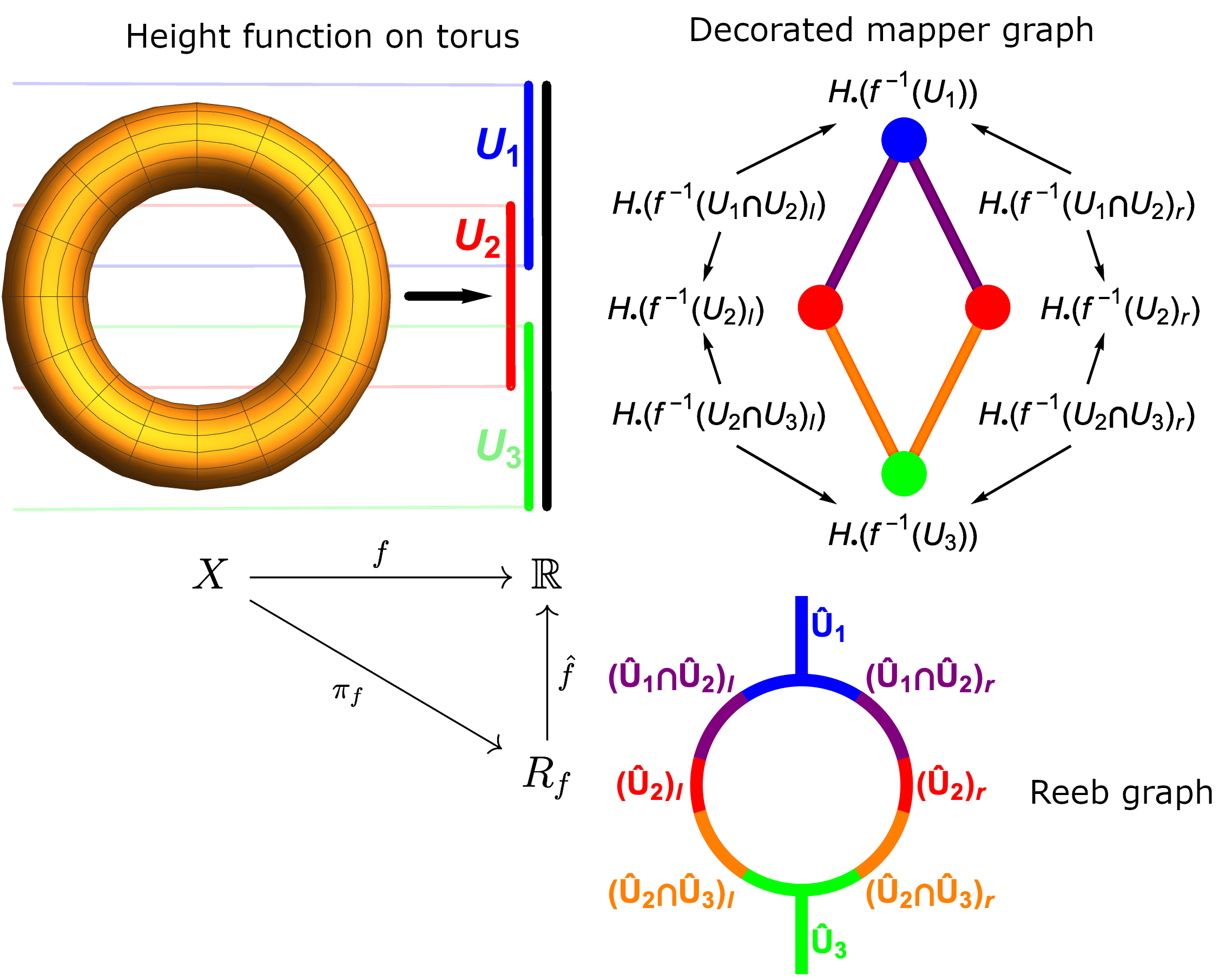 Figure 2
 Figure 3
 Figure 4
Peer Reviews
No public reviews on file for this paper yet. If you reviewed it on a platform where reviews are public (OpenReview, ICLR, NeurIPS, ICML), you can paste yours below so the community can read it here.
Videos
No videos yet. Explain this paper in a talk, walkthrough, or lecture? Add one.
Taxonomy
TopicsTopological and Geometric Data Analysis · Data Management and Algorithms · Digital Image Processing Techniques
\hideLIPIcs
University at Albany, State University of New York, USA [email protected]://orcid.org/ 0000-0003-2504-8388Supported by NSF CCF-1850052 and NASA 80GRC020C0016 Florida State University, Tallahassee, [email protected] by NSF grant DMS-1722995 Florida State University, Tallahassee, [email protected]://orcid.org/0000-0001-6165-3433Supported by NSF DMS-2107808 Max Planck Institute for Mathematics in the Sciences, Leipzig, [email protected] Graz University of Technology, [email protected] by the Austrian Science Fund (FWF): W1230 \CopyrightJustin Curry, Washington Mio, Tom Needham, Osman Okutan, Florian Russold\ccsdesc[300]Mathematics of computing Algebraic topology \ccsdesc[300]Theory of computation Computational geometry \funding
Convergence of Leray Cosheaves for Decorated Mapper Graphs
Justin Curry
Washington Mio
Tom Needham
Osman Berat Okutan
Florian Russold111Corresponding Author
Abstract
We introduce decorated mapper graphs as a generalization of mapper graphs capable of capturing more topological information of a data set. A decorated mapper graph can be viewed as a discrete approximation of the cellular Leray cosheaf over the Reeb graph. We establish a theoretical foundation for this construction by showing that the cellular Leray cosheaf with respect to a sequence of covers converges to the actual Leray cosheaf as the resolution of the covers goes to zero.
keywords:
Leray cosheaves, Reeb graphs, Mapper, convergence
1 Introduction
Reeb11footnotetext: This is an abstract of a presentation given at CG:YRF 2023. It has been made public for the benefit of the community and should be considered a preprint rather than a formally reviewed paper. Thus, this work is expected to appear in a conference with formal proceedings and/or in a journal. graphs and their discrete analogs—mapper graphs—are important tools in computational topology [3, 14, 8, 2]. They are used for data visualization [12, 10], for comparing scalar fields via distances between Reeb graphs [7, 1, 6], and data skeletonization [9], among other things. Given a continuous map , the Reeb graph summarizes the zero-dimensional connectedness of . In practice, we deal with maps on discrete data sets , where Reeb graphs are replaced by mapper graphs. A mapper graph is constructed by choosing a cover of or , taking the components or clustering the data points of , collapsing each of the obtained components to a single vertex and connecting two vertices if their corresponding components have common points. In [6, 11] it is shown that Reeb graphs can be viewed as cosheaves and that the cellular Reeb cosheaf w.r.t. a cover converges to the Reeb cosheaf if the resolution of the cover goes to zero, establishing a theoretical justification for working with finite covers. A limitation of this approach is that Reeb/mapper graphs fail to capture higher-dimensional topological features. To overcome these limitations we introduce decorated mapper graphs.
A decorated mapper graph collects the homology (possibly inferred from a point sample) in all degrees of the components of and on the corresponding vertices and edges of the mapper graph; see Figure 1. It can be viewed as a discrete approximation of the Leray cosheaf over the Reeb graph. In this abstract we show that the cellular Leray cosheaf w.r.t. a cover converges to the actual Leray cosheaf for any finite 1D cover as the resolution of the cover goes to zero.
2 Leray Cosheaves
The Leray (pre)cosheaf [4, 5, 15] parameterizes the homology of a space when viewed along a continuous map . It does this by recording for each pair of open subsets their homology and the induced map H_{\bullet}\big{(}f^{\minus 1}(V)\big{)}\xrightarrow{H_{\bullet}(f^{\minus 1}(V)\subseteq f^{\minus 1}(W))}H_{\bullet}\big{(}f^{\minus 1}(W)\big{)}. We further assume that is compact and H_{\bullet}\big{(}f^{\minus 1}(V)\big{)} is finite-dimensional for every .
Definition 2.1** (Leray (pre)cosheaf).**
We define the graded Leray (pre)cosheaf of a continuous map by the following assignments: For all open
[TABLE]
In practice, we can not access the whole Leray cosheaf. We can only get a cellular version [4, 4.1.6] given by its values on a finite cover of . An open cover of defines a simplicial complex , called the nerve complex of . We call a finite 1D cover if it is finite and has a one-dimensional nerve complex and denote by the face-relation of , i.e. .
Definition 2.2** (Cellular Leray cosheaf).**
We define the cellular Leray cosheaf w.r.t. a cover as the cosheaf on given by the following assignments: For all
[TABLE]
If is the quotient map from to the Reeb graph and a cover of , then we define a decorated mapper graph as ; see Figure 1.
3 Convergence
It is obvious that this process of discretization can lose information. This raises the question: How well is represented by ? To compare and , we define a process of transforming into a (pre)cosheaf on . We want to approximate the value of on any open set given only the information in . To this end, we define the subcomplex , which can be viewed as a simplicial approximation of ; see Figure 2. Moreover, if , we obtain an inclusion .
Definition 3.1** (Continuous extension).**
Let be a finite 1D cover of . We define the continuous extension of as a (pre)cosheaf on via the following assignments: For all open
[TABLE]
where H_{i}\big{(}K_{V};D_{\mathcal{U}}\mathcal{L}^{f}_{n}|_{K_{V}}\big{)} is the degree homology [4, 6.2.2] of the cosheaf restricted to and is the map induced on cosheaf homology by cf. [13, A.17].
As shown in [4, 5, 15], if is a finite 1D cover of the continuous extension yields C_{\mathcal{U}}D_{\mathcal{U}}\mathcal{L}^{f}(V)\cong\underset{n\in\mathbb{N}_{0}}{\bigoplus}H_{n}\Big{(}f^{\minus 1}\big{(}\underset{\sigma\in K_{V}}{\bigcup}U_{\sigma}\big{)}\Big{)} approximating H_{\bullet}\big{(}f^{\minus 1}(V)\big{)}; see Figure 2.
The following proposition shows that also gives us the correct induced map.
Proposition 3.2**.**
Let be a finite 1D cover of . Then, for all open, the following diagram commutes and the horizontal arrows are isomorphisms:
[TABLE]
To talk about convergence, we have to define a distance on (pre)cosheaves. Assume is a metric space and that all the involved (pre)cosheaves are constructible [4, 11.0.10]. For every define . To a (pre)cosheaf on we now associate , a parameterized family of (pre)cosheaves on , by setting . This allows us to define the distance of two (pre)cosheaves and as the interleaving distance of and , i.e. . Denote by the resolution of an open cover . We are now able to show that if the resolution of the cover goes to zero, converges to .
Theorem 3.3**.**
If is continuous and is a finite 1D cover of , then
[TABLE]
If we only consider , the degree-zero part of , the construction in Definition 3.1 and Theorem 3.3 specializes to an abelianization of the convergence result in [11].
4 Future Work
Theorem 3.3 guarantees that, if we choose a cover of resolution , the cellular Leray cosheaf is a -approximation of the continuous one. This result establishes a theoretical justification for working with finite covers. Since we have to deal with maps from finite point sets in practice, in future work we plan to investigate under what conditions we can infer the cellular Leray cosheaf of a map from a finite sample of ; cf. [2].
The reference list from the paper itself. Each links out to its DOI / PubMed record.
- 1[1] Ulrich Bauer, Xiaoyin Ge, and Yusu Wang. Measuring distance between reeb graphs. In Proceedings of the Thirtieth Annual Symposium on Computational Geometry , SOCG’14, page 464–473, New York, NY, USA, 2014. Association for Computing Machinery. doi:10.1145/2582112.2582169 . · doi ↗
- 2[2] Adam Brown, Omer Bobrowski, Elizabeth Munch, and Bei Wang. Probabilistic convergence and stability of random mapper graphs. Journal of Applied and Computational Topology , 5(1):99–140, 2021. doi:10.1007/s 41468-020-00063-x . · doi ↗
- 3[3] Hamish Carr, Jack Snoeyink, and Ulrike Axen. Computing contour trees in all dimensions. Computational Geometry , 24(2):75–94, 2003. Special Issue on the Fourth CGC Workshop on Computational Geometry. doi:https://doi.org/10.1016/S 0925-7721(02)00093-7 . · doi ↗
- 4[4] Justin Curry. Sheaves, Cosheaves and Applications . Ph D thesis, University of Pennsylvania, 2014. ar Xiv:1303.3255 .
- 5[5] Justin Curry, Robert Ghrist, and Vidit Nanda. Discrete morse theory for computing cellular sheaf cohomology. Foundations of Computational Mathematics , 16, 2013. doi:10.1007/s 10208-015-9266-8 . · doi ↗
- 6[6] Vin de Silva, Elizabeth Munch, and Amit Patel. Categorified reeb graphs. Discrete & Computational Geometry , 55(4):854–906, 2016. doi:10.1007/s 00454-016-9763-9 . · doi ↗
- 7[7] Barbara Di Fabio and Claudia Landi. The edit distance for reeb graphs of surfaces. Discrete & Computational Geometry , 55(2):423–461, 2016. doi:10.1007/s 00454-016-9758-6 . · doi ↗
- 8[8] Herbert Edelsbrunner, John Harer, and Amit K. Patel. Reeb spaces of piecewise linear mappings. In Proceedings of the Twenty-Fourth Annual Symposium on Computational Geometry , SCG ’08, page 242–250, New York, NY, USA, 2008. Association for Computing Machinery. doi:10.1145/1377676.1377720 . · doi ↗