Balanced Schnyder woods for planar triangulations: an experimental study with applications to graph drawing and graph separators
Luca Castelli Aleardi

TL;DR
This paper explores balanced Schnyder woods for planar graphs, introducing a linear-time heuristic that improves graph drawing quality and cycle separator computation, demonstrated through experimental results.
Contribution
It presents a simple heuristic for balanced Schnyder woods and shows their practical benefits in graph drawing and separator algorithms.
Findings
Balanced Schnyder woods improve layout quality in graph drawings.
The heuristic efficiently produces well-balanced Schnyder woods.
Experimental results show better cycle separators and graph layouts.
Abstract
In this work we consider balanced Schnyder woods for planar graphs, which are Schnyder woods where the number of incoming edges of each color at each vertex is balanced as much as possible. We provide a simple linear-time heuristic leading to obtain well balanced Schnyder woods in practice. As test applications we consider two important algorithmic problems: the computation of Schnyder drawings and of small cycle separators. While not being able to provide theoretical guarantees, our experimental results (on a wide collection of planar graphs) suggest that the use of balanced Schnyder woods leads to an improvement of the quality of the layout of Schnyder drawings, and provides an efficient tool for computing short and balanced cycle separators.
Click any figure to enlarge with its caption.
 Figure 1
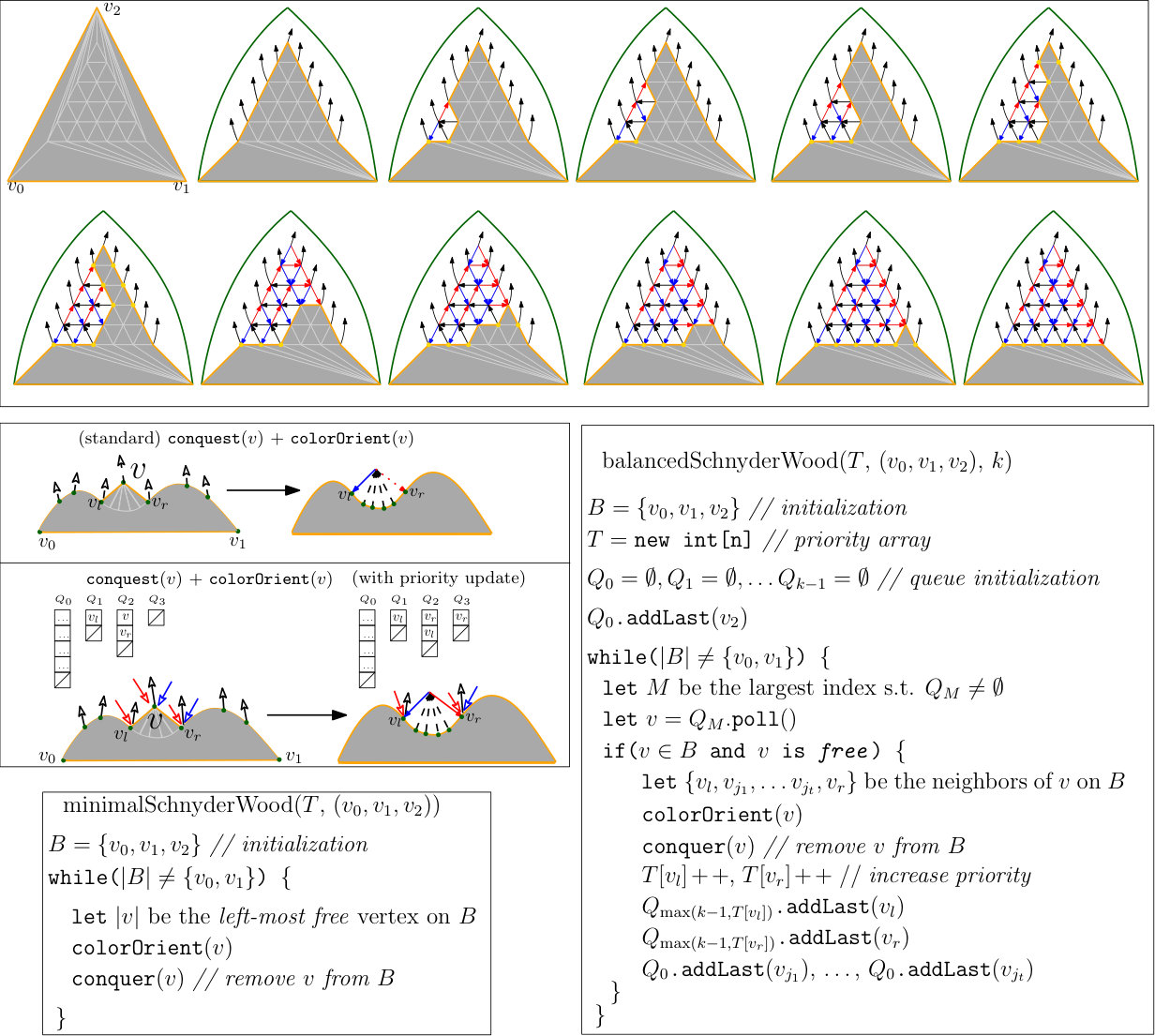 Figure 2
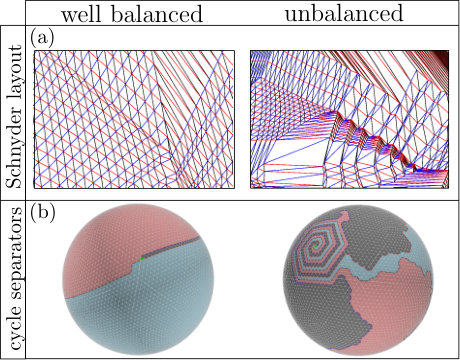 Figure 3
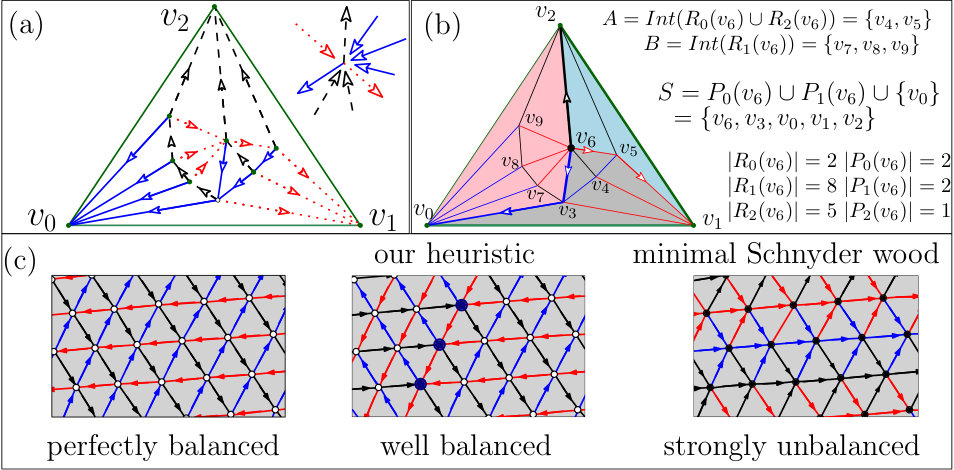 Figure 4
Peer Reviews
No public reviews on file for this paper yet. If you reviewed it on a platform where reviews are public (OpenReview, ICLR, NeurIPS, ICML), you can paste yours below so the community can read it here.
Videos
No videos yet. Explain this paper in a talk, walkthrough, or lecture? Add one.