Chromatic nonsymmetric polynomials of Dyck graphs are slide-positive
Vasu Tewari, Andrew Timothy Wilson, and Philip B. Zhang

TL;DR
This paper introduces a positive expansion for chromatic nonsymmetric polynomials of Dyck graphs in fundamental slide polynomials, connecting to Macdonald polynomials and extending known expansions of chromatic quasisymmetric functions.
Contribution
It provides a new positive expansion in fundamental slide polynomials for chromatic nonsymmetric polynomials of Dyck graphs, utilizing flagged $(P, ho)$-partitions and linking to existing expansions.
Findings
Positive expansion in fundamental slide polynomials
Connection to Macdonald polynomials
Backstable limit recovers known expansions
Abstract
Motivated by the study of Macdonald polynomials, J. Haglund and A. Wilson introduced a nonsymmetric polynomial analogue of the chromatic quasisymmetric function called the \emph{chromatic nonsymmetric polynomial} of a Dyck graph. We give a positive expansion for this polynomial in the basis of fundamental slide polynomials using recent work of Assaf-Bergeron on flagged -partitions. We then derive the known expansion for the chromatic quasisymmetric function of Dyck graphs in terms of Gessel's fundamental basis by taking a backstable limit of our expansion.
Click any figure to enlarge with its caption.
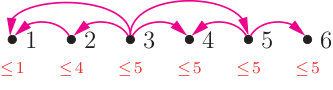 Figure 1
Peer Reviews
No public reviews on file for this paper yet. If you reviewed it on a platform where reviews are public (OpenReview, ICLR, NeurIPS, ICML), you can paste yours below so the community can read it here.
Videos
No videos yet. Explain this paper in a talk, walkthrough, or lecture? Add one.
Taxonomy
TopicsAdvanced Combinatorial Mathematics · Advanced Mathematical Identities · Molecular spectroscopy and chirality
Chromatic nonsymmetric polynomials of Dyck graphs are slide-positive
Vasu Tewari
Department of Mathematics, University of Pennsylvania, Philadelphia, PA 19104, USA
,
Andrew Timothy Wilson
Department of Mathematics, Portland State University, Portland, OR 97201, USA
and
Philip B. Zhang
College of Mathematical Science, Tianjin Normal University, Tianjin 300387, China
Abstract.
Motivated by the study of Macdonald polynomials, J. Haglund and A. Wilson introduced a nonsymmetric polynomial analogue of the chromatic quasisymmetric function called the chromatic nonsymmetric polynomial of a Dyck graph. We give a positive expansion for this polynomial in the basis of fundamental slide polynomials using recent work of Assaf-Bergeron on flagged -partitions. We then derive the known expansion for the chromatic quasisymmetric function of Dyck graphs in terms of Gessel’s fundamental basis by taking a backstable limit of our expansion.
2010 Mathematics Subject Classification:
Primary 05E05; Secondary 05A05, 05C15
1. Introduction
The chromatic polynomial was introduced by Birkhoff [7] in 1912 for planar graphs in an attempt to establish the four color theorem, and was generalized to arbitrary graphs by Whitney [20]. This polynomial and its various generalizations have proven to be fertile grounds for a host of interesting mathematics ever since. Stanley [18] introduced a symmetric function generalization of the chromatic polynomial called the chromatic symmetric function. This function was studied from the perspective of -partitions and quasisymmetric functions by Chow [9]. By introducing another parameter , this perspective gives a more refined function called the chromatic quasisymmetric function, which was introduced by Shareshian-Wachs [17]. They established that the chromatic quasisymmetric functions of incomparability graphs of posets expand in terms of Gessel’s fundamental quasisymmetric functions with coefficients in . For incomporability graphs of natural unit interval orders, the chromatic quasisymmetric function is in fact Schur positive. See [2, 5, 6, 11] for some remarkable aspects of these symmetric functions and related topics. Given the recent interest in polynomial analogues of combinatorially-defined quasisymmetric and symmetric functions [13], it is natural to investigate chromatic quasisymmetric functions. For the class of graphs mentioned earlier, a nonsymmetric polynomial analogue was proposed by Haglund-Wilson [10], and this is the chief object of our study.
These graphs are conveniently encoded via Dyck paths, and Novelli-Thibon [15], in their study of the attached chromatic quasisymmetric functions from the viewpoint of Hopf algebras, refer to them as Dyck graphs. To allow for a nonsymmetric polynomial analogue, Haglund-Wilson [10] attached Dyck graphs to partial Dyck paths and used squares that lie between and the line to impose restrictions on the colors allowed at each vertex. Thus, instead of having a common set of colors for all vertices, we use to obtain different restrictions on colors for different vertices. Taking the generating function of monomials attached to proper colorings with these restrictions along with appropriate -weights gives us the chromatic nonsymmetric polynomial .
Our central result is that expands in terms of fundamental slide polynomials with coefficients in . The fundamental slides [4] are polynomial analogues of fundamental quasisymmetric functions. By extending our partial Dyck path to an infinite path by prepending infinitely many east steps, we can obtain a formal power series as the stable limit. We then obtain as a corollary of our main result the expansion of the chromatic quasisymmetric function of Dyck graphs in terms of fundamental quasisymmetric functions by way of .
**Outline of the article: ** After setting up the necessary background, we introduce chromatic nonsymmetric polynomials at the end of Section 2.2. In Sections 2.4 and 2.5 we define restricted -partitions following Assaf-Bergeron [3] and introduce the polynomial analogue of the quasisymmetric function attached to usual -partitions, focusing in particular on labeled linear orders. In Section 3, we provide a positive expansion for the chromatic nonsymmetric polynomial in terms of fundamental slide polynomials in Theorem 3.3. We then proceed to study the backstable limit, drawing inspiration from work of Lam-Lee-Shimozono [12], and derive a known expansion of the chromatic quasisymmetric function for Dyck graphs in terms fundamental quasisymmetric functions as a corollary of our main result.
2. Background
For a nonnegative integer, we denote the set by . Throughout, we use to denote the natural order on integers. Given a positive integer , we denote by the commutative alphabet . For notions concerning symmetric/quasisymmetric functions and standard combinatorial constructions that are not defined here, we refer the reader to [14, 16, 19].
2.1. Graphs, colorings
We consider finite simple graphs where is an ordered set of vertices. We identify with with the order being the natural order on the integers. The set of edges is a subset of . A coloring of is a map . For the most part we will restrict to maps to , though we allow for ‘negative’ colors in Subsection 3.1. A coloring of is proper if for all edges . We call a descent of if and . We denote the number of descents in by . The chromatic quasisymmetric function introduced by Shareshian and Wachs [17, Definition 1.2] is defined as follows:
[TABLE]
where is the cardinality of and denotes the alphabet of commuting indeterminates . We remark here that the definition in (2.1) differs from that in [17] up to twisting by an involution defined on the ring of quasisymmetric functions. Since this is a minor point, we abuse notation and refer to the function in (2.1) as the chromatic quasisymmetric function of .
2.2. Partial Dyck paths and associated graphs
Let and be nonnegative integers. We define to be set of lattice paths that begin at , end at , take unit north and east steps, and stay weakly above the line . We refer to elements of as partial Dyck paths. We next discuss a procedure that assigns to each a graph and a function .
Given , assign the integers to the unit squares along the diagonal going from to , and the integers in the opposite direction. For , let refer the unique square in the plane directly north of the square labeled and directly west of the square labeled . We define by explicitly describing — if and only if and lies below . Following [15], we call a Dyck graph. Such graphs are characterized by the property that and implies for all . The restriction map is defined as follows: for every , find the largest such that lies above and set . Note in particular that .
Figure 1 shows a partial Dyck path in . Thus the vertex set of is . As the green square lies below , we infer that . Arguing in this manner, one can compute . As the square does not lie below while does, we infer that . Figure 2 shows as well as the restriction map . The latter is written with inequalities the meaning of which we now clarify.
Given , Haglund-Wilson [10, Section 5.6] introduce a polynomial by mimicking the definition of the chromatic quasisymmetric function. We have
[TABLE]
The polynomial is the chromatic nonsymmetric polynomial of . See Section 4 for more context on its definition.
6$$7$$8$$9$$10$$11[math]1$$2$$3$$4$$5
123456\leq\!1$$\leq\!4$$\leq\!5$$\leq\!5$$\leq\!5$$\leq\!5
2.3. Slide polynomials
We recall some notions before defining slide polynomials, a polynomial analogue of the fundamental quasisymmetric functions introduced in [4]. Our treatment is slightly nonstandard, but it will allow us to deal with stable limits in a uniform manner.
Given a sequence of nonnegative integers , we define the support of , denoted by to be the set . If is finite, then we call a weak composition. We denote the set of weak compositions by because we may interpret as the code111Recall that the code of a permutation of is defined by setting . of a permutation of that fixes all but finitely many integers. The weight of any sequence (finite or infinite) is the sum of its entries. There is a unique weak composition of weight [math]: the sequence consisting solely of [math]s. Given an integer , the set of all weak compositions that satisfy for all is denoted by . The (potentially empty) sequence obtained by omitting all zeros from a weak composition is called a strong composition. We denote the strong composition underlying by . The unique strong composition of weight 0 is denoted by . From this point onward, we reserve the term composition for weak compositions.
For two strong compositions and of the same weight, we say that refines if we can iteratively combine adjacent parts of to obtain . For instance, refines . Using the notion of refinement we define a total order on compositions of the same weight as follows: if refines and additionally, is smaller than in reverse lexicographic order. We denote the set of all by . Given a positive integer , a distinguished subset of , denoted by , comprises those that satisfy . Note that in contrast to which is infinite except when has weight zero, the set is finite.
Remark 2.1*.*
For the sake of clarity, when dealing with explicit instances of compositions we suppress leading and trailing zeros and furthermore place a bar between and to clearly show where the positively indexed terms in the sequence begin. If for all , we omit the bar and write as a finite sequence, which is the more conventional form.
Let . Then . In (2.3), we list all elements of after omitting brackets and commas for brevity.
[TABLE]
On the other hand, if , then is clearly empty as compositions cannot satisfy .
Given a positive integer and a composition , the fundamental slide polynomial [4, Definition 3.6] is defined as
[TABLE]
Henceforth we refer to fundamental slide polynomials as slide polynomials. The expansion of the slide polynomial indexed by is
[TABLE]
If , then .
A simple triangularity argument [4, Theorem 3.9] implies that the set of slide polynomials as ranges over compositions satisfying is a basis for the polynomial ring . We refer the reader to [4] for other aspects of slide polynomials, in particular the relation to Schubert polynomials.
2.4. Restricted -partitions
All our posets are finite. Given a poset , we always assume that its ground set is identified with . We depict using its Hasse diagram. We use to denote the order relation on , and cover relations are denoted by . A labeling of is a map where . We refer to the ordered pair as a labeled poset. A -partition is a map satisfying the conditions that
- (1)
if and , then . 2. (2)
if and , then .
Given a map , we refer to the datum as a -restricted labeled poset. Additionally, a -partition that satisfies for all is said to be a -restricted -partition [3]. We denote the set of -restricted -partitions by .
Remark 2.2*.*
Assaf-Bergeron [3] work under the assumption that the ground set of is identified with via the labeling . Since we will talk about graphs and posets arising from acyclic orientations thereon, the ground set of our posets will be vertex set of our graph (already identified with for some ); the labelings we employ might be different. Throughout this article, in our Hasse diagrams, the numbers within nodes correspond to the labeling .
Assaf-Bergeron [3, Section 3] associate a polynomial with the triple , mimicking the classical theory of quasisymmetric functions attached to -partitions. More specifically, define as
[TABLE]
It is possible that is empty, for instance if takes a value in . In such cases equals [math]. For the triple on the left in Figure 3, assume that the ground set of is identified with via . One can check that
[TABLE]
Observe that summands within the first pair of parentheses are from the linear order in the middle in Figure 3, whereas those within the second pair are from the linear order on the right.
It is worth remarking that even though in our earlier example is slide-positive, this is not true in general. See [3, Example 3.12] for a revealing example. We are especially interested in the fact that the rightmost linear order in Figure 3 contributes a single slide polynomial. To explore this aspect further, we need to introduce more notions attached to -restricted linear orders.
2.5. Linear order with restrictions
Consider a triple where is a linear order. Observe that in view of , some inequalities imposed by might be redundant. Figure 4, on the left, depicts a linear order given as . The labeling going from the minimal element in to the maximal gives the permutation in one-line notation. The restriction is defined by , , , , and . Since , we infer that a -restricted -partition must satisfy in addition to and . Clearly, the restriction can be replaced with the tighter version without altering the set of -restricted -partitions.
In general, by replacing each inequality imposed by with the tightest one, we obtain a new restriction map with the key property that . Observe that does depend on , but we suppress this dependence and hope that no confusion results. We next formalize this procedure of finding . Given a positive integer and a permutation , let be the linear order endowed with labeling and restriction . We define recursively top-down starting from the maximum element of . More precisely, for from down to , set
[TABLE]
Note in particular that depends on the descent set of the permutation , that is, the permutation obtained by reading the labels from the minimal element to the maximal element. For the linear order from Figure 4 encountered earlier, is the identity permutation, and the permutation is . The reader can check that is exactly as depicted in the linear order in the middle in Figure 4.
Remark 2.3*.*
Assaf-Bergeron [3, Definition 3.2] discuss the procedure of find the ‘tightest’ restriction map more generally for posets. Their definition is therefore a bit more involved, but in the case of linear orders one obtains the description in (2.11).
We use to generalize the notion of descent compositions to account for the restriction map. Define the reduced weak descent composition of , denoted by , as follows. Let be all the descents in . Consider the chains defined by setting
[TABLE]
where and . For , set , and define the -th part of to equal , and set all other parts to 0. Note that is the minimal element of the chain , so the values are obtained by simply evaluating at the minimal element of each chain from through . For the rightmost linear order in Figure 4, the dashed edges denote the descent edges whose removal results in the chains , and from bottom to top. Picking the smallest value of in each shaded region tells us that , , . Since and , we infer that . The reader may further verify that
[TABLE]
We remark here that we could have replaced the alphabet above with any for any .
Remark 2.4*.*
Recall the folklore bijective correspondence between strong compositions of a nonnegative integer and subsets of . Suppose that maps to the strong composition . If denotes the descent set of , then from the definition of , it follows that [3, Equation 3.4], which explains the name reduced weak descent composition.
In our example, we see that is a term in the expansion of in slide polynomials. We are particularly interested in case where it is the only term. To this end, we have the following result of Assaf-Bergeron [3, Proposition 3.10].
Proposition 2.5**.**
Consider a -restricted labeled poset where is a linear order on given by . Suppose that for all , we have that implies . Then we have that
[TABLE]
where .
Going back to the rightmost linear order in Figure 3, we see that equals the slide polynomial by Proposition 2.5.
3. Slide-positivity of
We proceed to establish our central result that expands in terms of slide polynomials with coefficients in . To this end, we need more terminology.
Consider any graph . For , define to be the number of -inversions of , that is,
[TABLE]
Given a poset on , we say that is a -descent of if . We denote the set of -descents of by . If and are comparable in , we denote this by . Otherwise, we write . Recall that the incomparability graph of a poset is the simple graph whose vertex set is and edges are given by where .
From this point onward, fix a partial Dyck path . Let be the corresponding Dyck graph, and let be the restriction induced by . Let denote the set of edges of . We realize as the incomparability graph of a poset on as follows: declare if and only if and . Given , let be the linear order on the vertices of given by . This linear order induces an acyclic orientation of obtained by directing for from to . Observe that gives rise to a poset on by taking the transitive closure of the relation given by if there is a directed edge from to in . Furthermore, and also inherit the restriction map . For the acyclic orientation in Figure 5, the is shown on the left in Figure 6. A permutation which induces this is .
We say that a coloring of is compatible with if for every directed edge we have . For , we are interested in the proper colorings that further satisfy . Since every proper coloring is compatible with a unique acyclic orientation, we can partition the set of -restricted proper colorings based on compatibility. This leads us to interpret such proper colorings as -restricted -partitions for an appropriate .
We seek a labeling that induces strict inequalities on all cover relations in . More precisely, since we are interested in colorings compatible with , our labeling must satisfy if . We construct as follows. Initialize to , to , and perform the following steps.
- (1)
Find the largest such that vertex in has indegree [math] with respect to . 2. (2)
Set , and subsequently increment by . 3. (3)
Remove the vertex along with all edges incident to it, and let be the new directed graph obtained with the acyclic orientation inherited from . If there is at least one vertex in , return to step , else terminate.
For the in Figure 5, this algorithm gives , , , , , and . The triple is depicted on the right in Figure 6. On the left, the numbers outside nodes represent the numbering inherited from the graph. On the right, the numbers within nodes represent the labeling .
We are ready to establish a key lemma that relates -descents of and ascents in .
Lemma 3.1**.**
For , we have that
[TABLE]
Proof.
We establish the forward implication first. Assume . From the definition of we infer the following two facts: first, , and second, .
We claim that . Indeed, if this is not the case, then there exists a directed path from to in , and thereby, a vertex where that lies on this path. Since there is a directed path from to , we infer that . On the other hand, the directed path from to implies . It follows that , which is clearly absurd.
Next we show that . Assume to the contrary that , and consider the instant in our labeling algorithm when is assigned a label. As and is unlabeled at that instant, there is an unlabeled vertex such that there is an edge in directed from to . Furthermore, . If not, the existence of a directed path from to would imply that , which is false. On the other hand, the existence of a directed path from to would contradict the fact that our labeling algorithm assigns a label to before .
Repeating this argument, we can construct a directed path with the property that for , each is unlabeled and satisfies . Consider a maximal such path. Then all vertices with edges directed towards are already labeled. This in turn implies that , as the opposite inequality implies that has a smaller label , which is not the case.
Now note that there must exist a such that but . Indeed, if such a did not exist, then the edge would imply that as is a Dyck graph. But we have already established that . Now pick any whose existence we just established. Again using the fact that is a Dyck graph, we conclude that , which in turn implies that , which is false. This completes the proof of the forward direction.
We keep our exposition on the reverse implication brief. Assuming , we need to show that . Once again, observe that . If not, we would infer the existence of a directed path from to in , which in turn would contradict our hypothesis that . To establish that , we proceed by contradiction. There are two possibilities if : either or . In the former, we have , which then is necessarily directed from to in . This implies , contrary to our assumption. Finally, the case remains. The argument for this is very similar to that presented in the proof of the forward direction. We omit the details. ∎
In view of the previous lemma, we now establish that is equal to a slide polynomial. To this end, we recast the reduced weak descent composition defined in Subsection 2.5 in terms of -descents of rather than the descent set of . Indeed, using Lemma 3.1, we can redefine as follows: For from down to , set
[TABLE]
The above formulation removes the dependence of the recursive definition of on . The procedure for computing is the same, except the role played by descents of is now essayed by -ascents of . To emphasize the suppression of , we write instead of . The following result explains how slide polynomials enter our picture.
Lemma 3.2**.**
The weight generating function equals the slide polynomial .
Proof.
By Proposition 2.5 and Lemma 3.1, it suffices to verify that implies . This is immediate as implies . The recursive description of in (3.5) implies the claim. Note that our choice of the alphabet is justified as for all . ∎
As an example, consider the graph coming from a partial Dyck path in Figure 7. The corresponding has only relation: . The six linear orders on the vertices of along with the modified restrictions are depicted in Figure 8. The corresponding to each linear order from left to right are: , , , , , and . Note that although the last three of these are in fact [math], they will acquire meaning in Subsection 3.1.
Theorem 3.3**.**
The polynomial is slide-positive and we have
[TABLE]
Proof.
Throughout this proof, denote by the set of proper colorings of that satisfy for all . Let be the set of acyclic orientations of . We have that
[TABLE]
Let denote the set of linear extensions of along with the inherited labeling and restriction . By [3, Corollary 3.15], we have that may be written as a sum over elements of :
[TABLE]
As described before, any linear order on the vertices of , say , induces a unique acyclic orientation , in addition to uniquely determining . This allows us to rewrite the sum on the right hand side of (3.7) as ranging over linear orders on the vertices of , or equivalently, permutations on . In this context, it is easily checked that is . Lemma 3.2 implies that we can replace in (3.7) with . The claim now follows. ∎
For the partial Dyck path in Figure 7, we have the following expansion:
[TABLE]
In writing our weak compositions we have omitted commas and parentheses. Recall also that the vertical bar separates the positively indexed parts from the rest. We proceed to address the question of how the expansion in terms of slides in the context of Dyck graphs relates to the expansion for chromatic quasisymmetric functions in terms of fundamental quasisymmetric functions. The contents of the next subsection are heavily inspired by the recent work of Lam-Lee-Shimozono [12].
3.1. The stable limit
For this subsection, let denote the set of commuting indeterminates endowed with the total order for all . Furthermore, set . In particular, . For we obtain a well-defined monomial
[TABLE]
Let be the -algebra of formal power series in the variables for such that has bounded total degree and there is an such that the variables do not appear in for . We say that is back-quasisymmetric if there exists a such that for any two sequences and and any strong composition , we have that the coefficient of in equals that of . Let denote the subset of back-quasisymmetric elements of .
For , consider the element defined as
[TABLE]
The reader should compare the definition of with that of slide polynomials in (2.4). Replacing the indexing set by allows us to obtain a formal power series rather than a polynomial. It is clear that , and we refer to it as the ‘backstable’ limit of the slide polynomial where is any integer such that .
At this stage, it should be clear how to define a backstable analogue of the chromatic nonsymmetric polynomial. Indeed, instead of partial Dyck paths starting at the coordinates , we consider infinite partial Dyck paths that begin at and take only east steps till . Then define the backstable limit as follows (cf. equation (2.2)).
[TABLE]
Note that the only deviation from the definition of the chromatic nonsymmetric polynomial is that we are allowing ‘nonpositive colors’. More importantly though, note that the negative colors do not play a role in determining the restriction map . It follows from definition that is back-quasisymmetric. In fact, one can replace each slide polynomial appearing in the expansion of in Theorem 3.3 by and thus obtain the following theorem.
Theorem 3.4**.**
The formal power series is backstable slide-positive and we have the expansion
[TABLE]
We now describe how to recover the expansion of the chromatic quasisymmetric function in terms of fundamental quasisymmetric functions [17, Theorem 3.1] from Theorem 3.4. Following [12, Section 3.4], consider the map on that sets for . Clearly, , where we have abused notation to denote the chromatic quasisymmetric function of by . Thus to understand the expansion in terms of fundamental quasisymmetric functions, it suffices to understand .
To this end, we introduce some notation and establish a general result. Let denote the ring of quasisymmetric functions in the variables . Given a strong composition , we denote by the fundamental quasisymmetric function indexed by in the ordered alphabet . Given strong compositions and , let denote concatenation and denote near-concatenation. For instance, if and , then and .
Returning to our interest in understanding , recall that belongs to . Furthermore, by the recursive definition of , we can show that possesses the following crucial property: if for some , then for all , we have . We refer to compositions with this property as tail-strong compositions. Given a tail-strong composition , our next lemma expresses explicitly as an element of . The proof of this lemma is simply a matter of unraveling the definitions and hence is omitted.
Lemma 3.5**.**
Let be tail-strong. Let and . A decomposition of as or naturally gives us two sequences and whose component-wise sum is . We have the following expansion:
[TABLE]
We illustrate the content of the preceding theorem with an example. Let be . Then and . The decomposition of as where and yields and . This decomposition contributes to . By Lemma 3.5, the complete expansion is
[TABLE]
From Lemma 3.5, we see that for any tail-strong composition. Applying to both sides of the expansion in Theorem 3.4, we obtain
[TABLE]
Clearly, only depends on , and from its definition we can show that it equals the strong composition of corresponding to the ; see Remark 2.4. Thus, , where denotes the strong composition obtained by reflecting the ribbon diagram (in French notation) representing across the line . In summary, we obtain the following result that the reader should compare to [17, Theorem 3.1].
Corollary 3.6**.**
The chromatic quasisymmetric function corresponding to Dyck graphs has the following expansion in the basis of fundamental quasisymmetric functions:
[TABLE]
4. Further remarks
We conclude our article with some additional remarks.
- (1)
The precise definition of is motivated by Carlsson and Mellit’s proof of the Shuffle Conjecture [8], in which the authors define and study the “characteristic function” of a partial Dyck path. This characteristic function contains a symmetric and a nonsymmetric component; the nonsymmetric component is equivalent to our chromatic nonsymmetric polynomial. Carlsson and Mellit briefly consider the case where the first entries receive a different labeling, leading to different restriction functions. It would be interesting to see if these polynomials still expand positively in the slide basis, or if they lead naturally into the theory of “basements” in nonsymmetric polynomials [1]. 2. (2)
Haglund and Wilson [10, Section 5.6] postulated that chromatic nonsymmetric polynomials are key-positive. Unfortunately, we found counterexamples with Dyck graphs on 6 vertices. That being said, a vast number of instances we considered were key-positive indeed. This raises the question: Characterize such that is key-positive. One can ask the same question with other interesting bases for the space of polynomials that are coarser than slide polynomials.
Acknowledgements
We are grateful to Sami Assaf, Jim Haglund, and Jongwon Kim for helpful discussions. The third author was supported by the National Science Foundation of China (No. 11701424).
The reference list from the paper itself. Each links out to its DOI / PubMed record.
- 1[1] P. Alexandersson , Non-symmetric Macdonald polynomials and Demazure-Lusztig operators , arxiv: https://arxiv.org/abs/1602.05153 .
- 2[2] P. Alexandersson and G. Panova , LLT polynomials, chromatic quasisymmetric functions and graphs with cycles , Disc. Math. 343 (2018) 3453–3482.
- 3[3] S. Assaf and N. Bergeron , Flagged ( P , ρ ) P 𝜌 (\pazocal{P},\rho) -partitions , arxiv: https://arxiv.org/abs/1904.06630 .
- 4[4] S. Assaf and D. Searles , Schubert polynomials, slide polynomials, Stanley symmetric functions and quasi-Yamanouchi pipe dreams , Adv. Math. 306 (2017) 89–122.
- 5[5] C. Athanasiadis , Power sum expansion of chromatic quasisymmetric functions , Electron. J. Combin. 22 (2015) 9pp.
- 6[6] P. Brosnan and T. Chow , Unit Interval Orders and the Dot Action on the Cohomology of Regular Semisimple Hessenberg Varieties , Adv. Math. 329 (2018) 955–1001.
- 7[7] G.D. Birkhoff , A determinant formula for the number of ways of coloring a map , Ann. Math. 14 (1912) 42–46.
- 8[8] E. Carlsson and A. Mellit , A proof of the shuffle conjecture , J. Amer. Math. Soc. 31 (2018) 661–697.