New physics and tau $g-2$ using LHC heavy ion collisions
Lydia Beresford, Jesse Liu

TL;DR
This paper proposes using ultraperipheral heavy ion collisions at the LHC to measure the tau lepton's magnetic and electric dipole moments, achieving constraints surpassing previous collider results and opening new physics exploration avenues.
Contribution
It introduces a novel method utilizing photon fusion events in heavy ion collisions to probe tau lepton dipole moments with improved sensitivity.
Findings
Current dataset could constrain $a_\tau$ to -0.0080 to 0.0046 at 68% CL.
Method surpasses 15-year-old lepton collider precision by a factor of three.
Potential to explore new physics through tau dipole moment measurements.
Abstract
The anomalous magnetic moment of the tau lepton strikingly evades measurement, but is highly sensitive to new physics such as compositeness or supersymmetry. We propose using ultraperipheral heavy ion collisions at the LHC to probe modified magnetic and electric dipole moments . We introduce a suite of one electron/muon plus track(s) analyses, leveraging the exceptionally clean photon fusion events to reconstruct both leptonic and hadronic tau decays sensitive to . Assuming 10% systematic uncertainties, the current 2 nb lead-lead dataset could already provide constraints of at 68% CL. This surpasses 15 year old lepton collider precision by a factor of three while opening novel avenues to new physics.
Click any figure to enlarge with its caption.
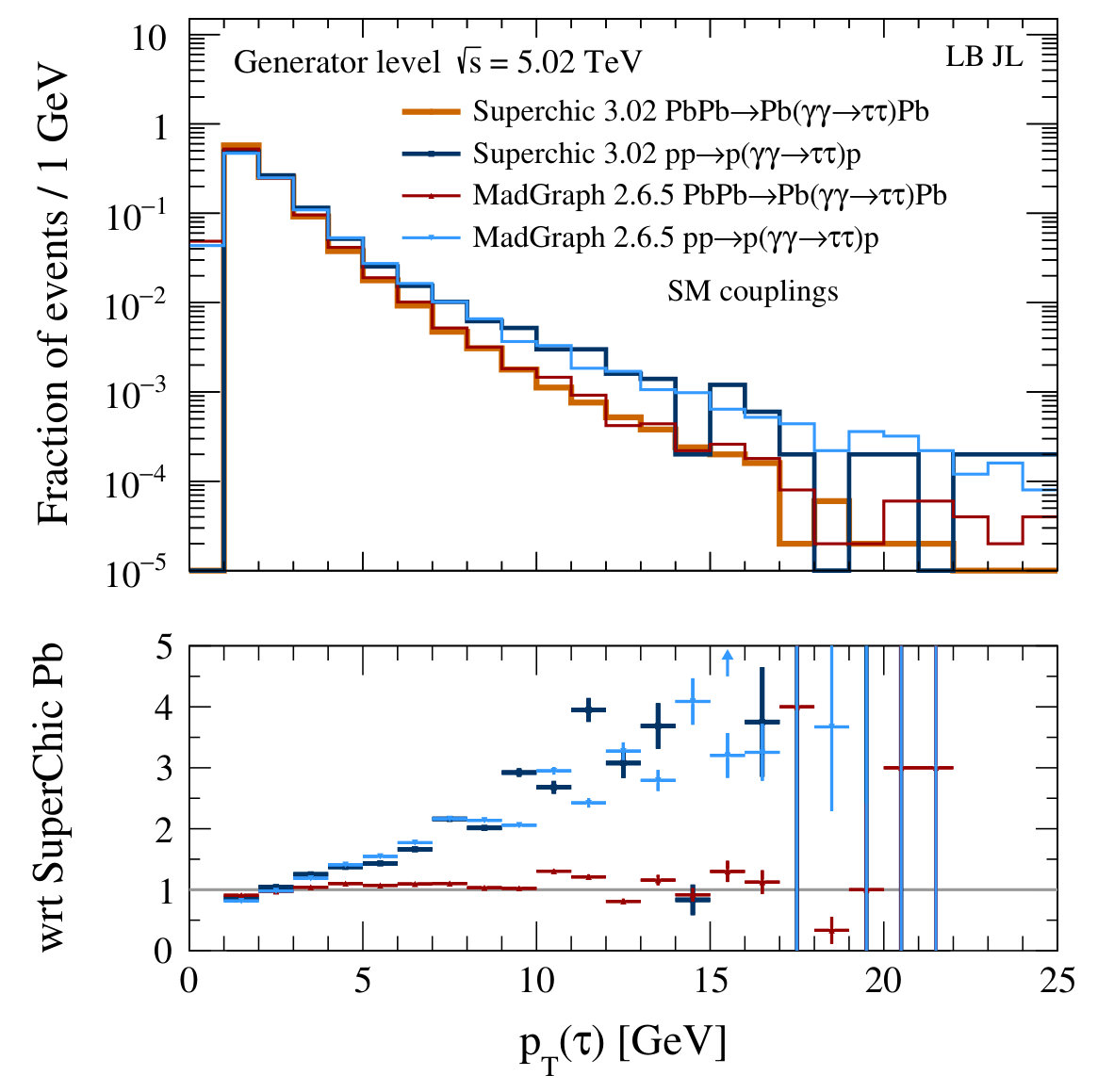 Figure 1
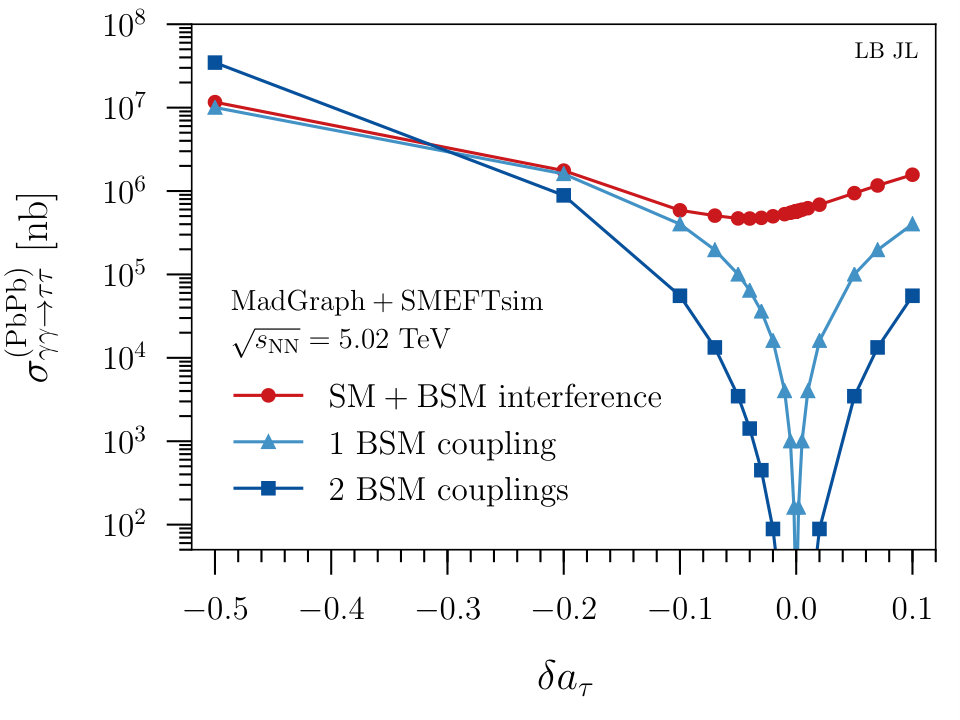 Figure 2
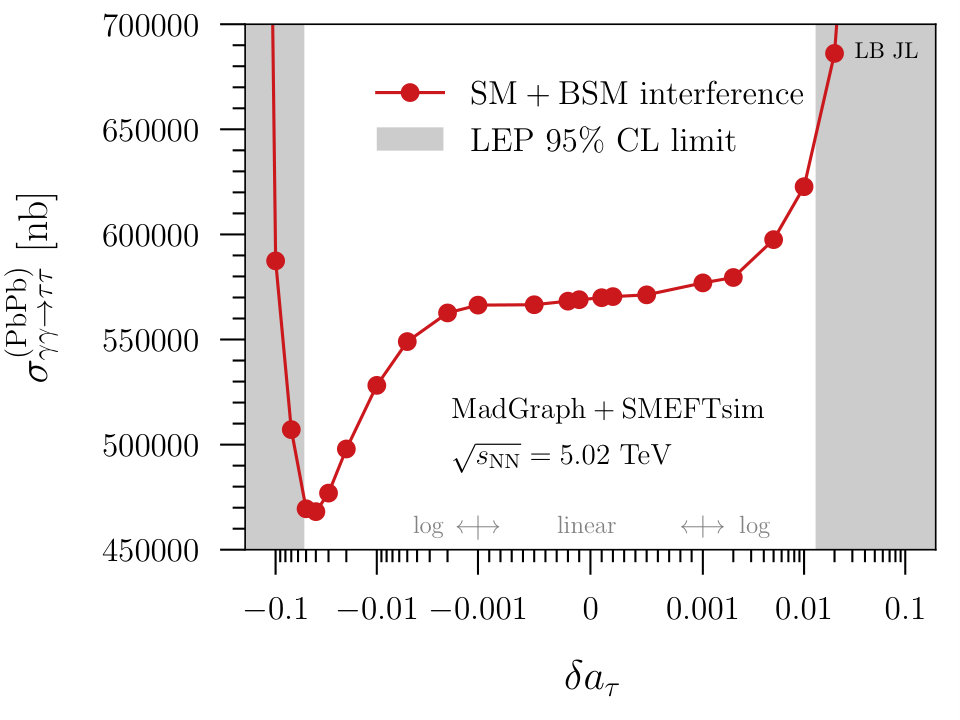 Figure 3
 Figure 4
 Figure 5
 Figure 6
 Figure 7
 Figure 8
 Figure 9
 Figure 10
 Figure 11
 Figure 12
 Figure 13
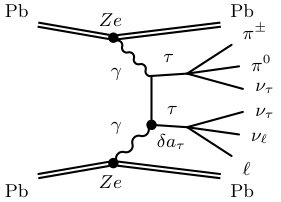 Figure 14
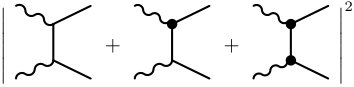 Figure 15
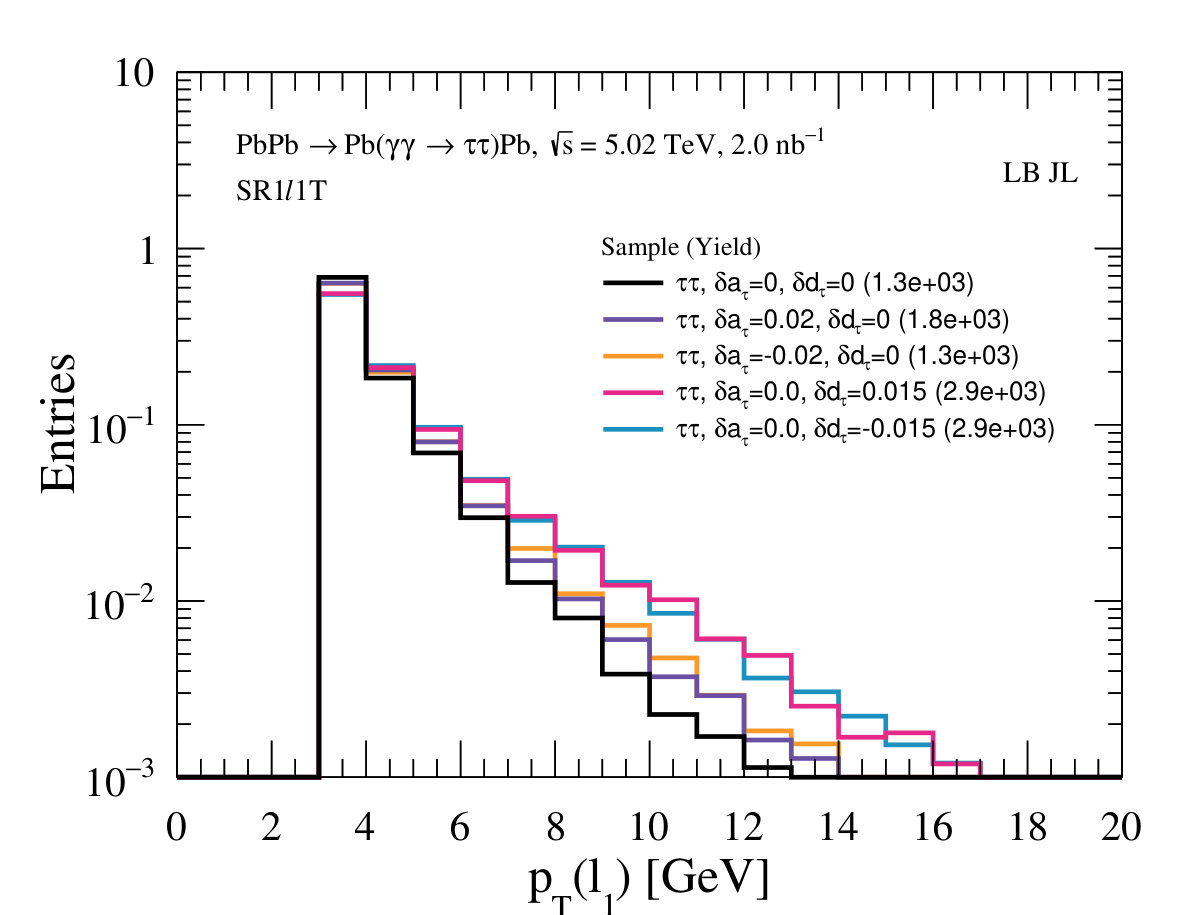 Figure 16
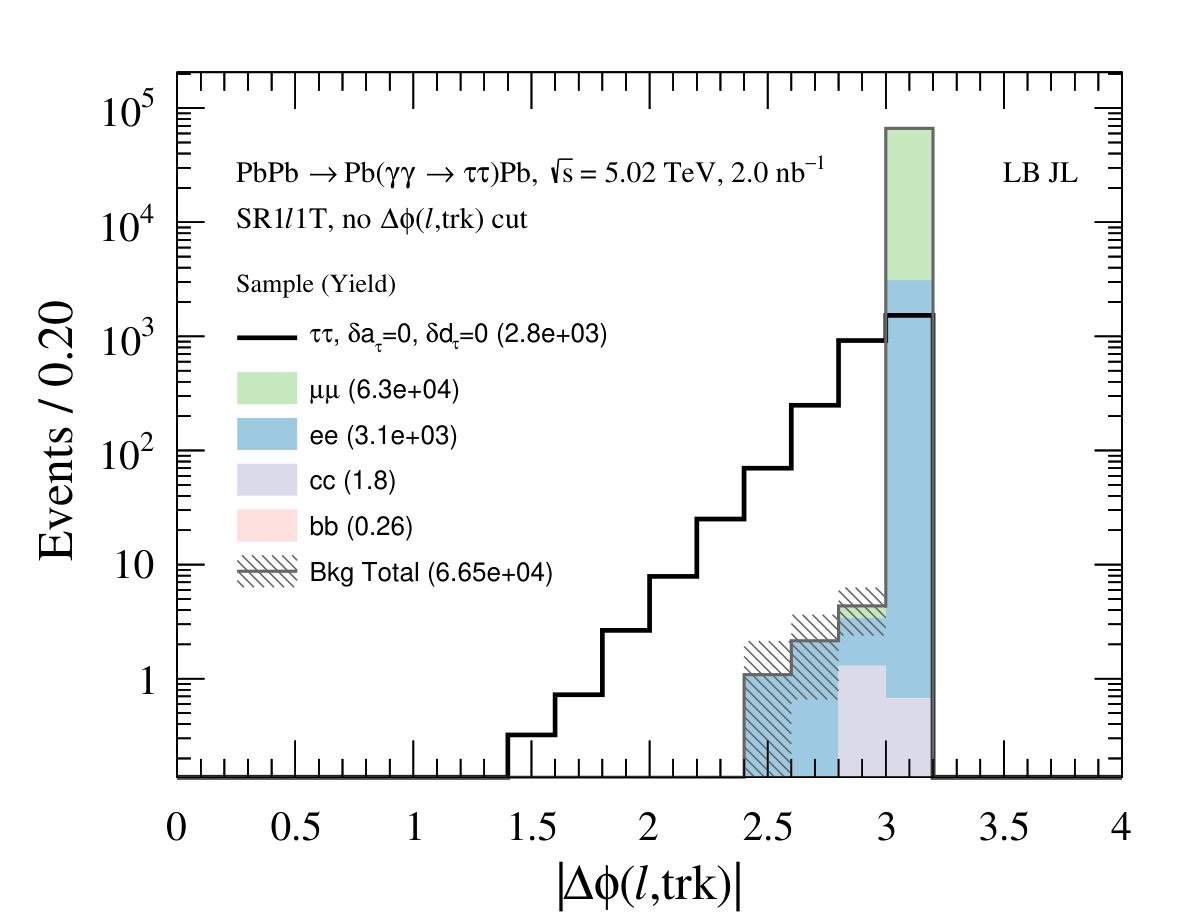 Figure 17
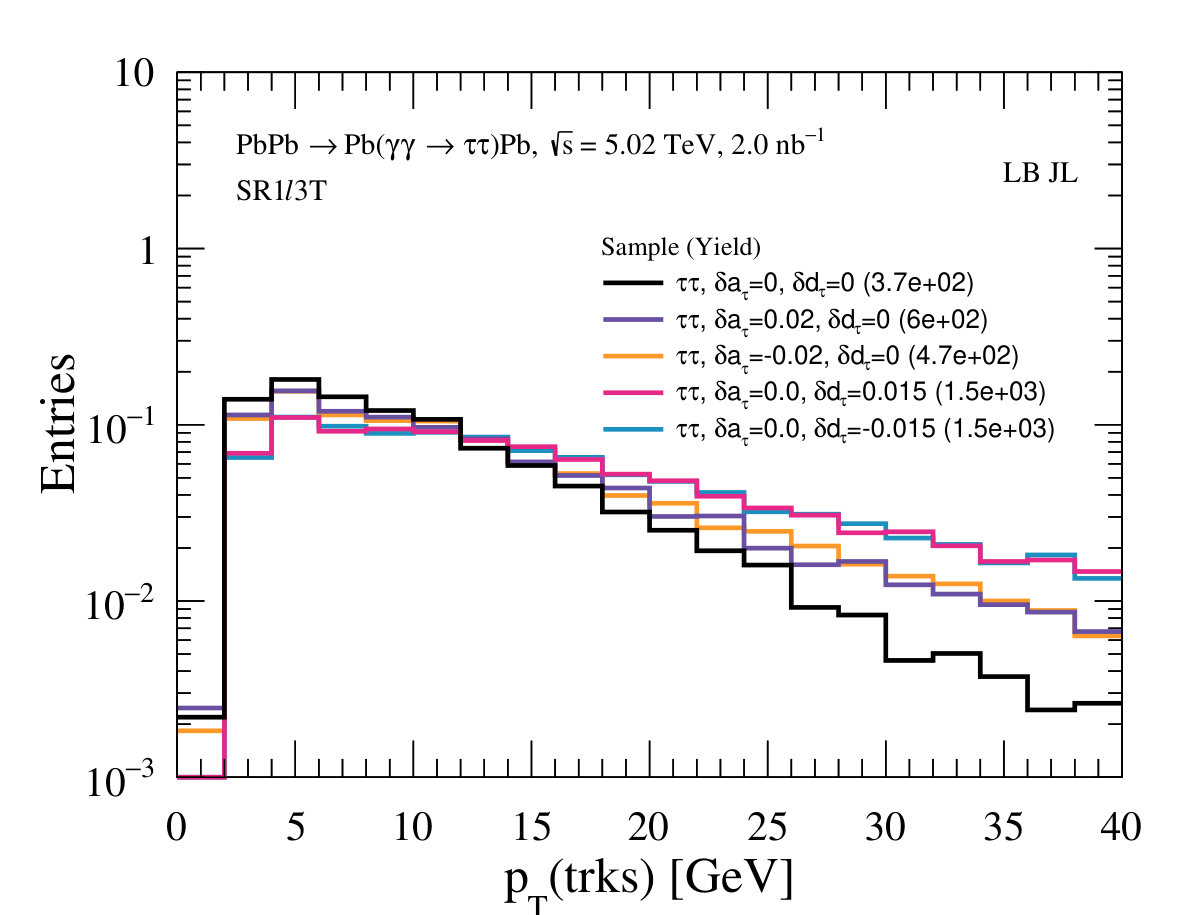 Figure 18
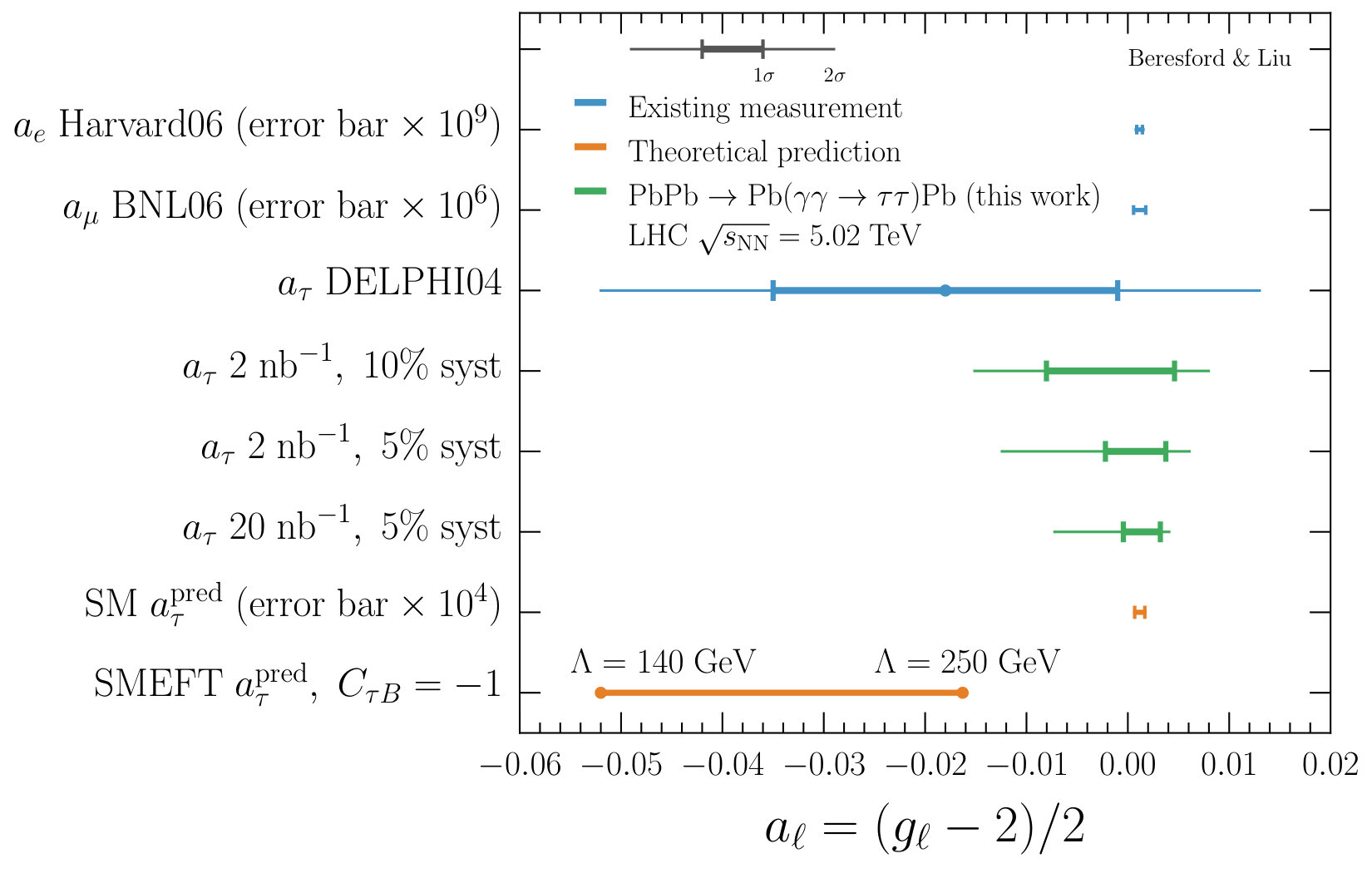 Figure 19
| Requirement | ||||||||||
| 1 lepton + 1 track analysis (SR1T) | ||||||||||
| plus 1 track | ||||||||||
| , | ||||||||||
| 2 tracks, , 2.5 | ||||||||||
| GeV | ||||||||||
| 1 lepton + multitrack analysis (SR2/3T) | ||||||||||
| plus 2 or 3 tracks | ||||||||||
| , | ||||||||||
| 3 tracks, , 2.5 | ||||||||||
| 4 tracks, , 2.5 | ||||||||||
Peer Reviews
No public reviews on file for this paper yet. If you reviewed it on a platform where reviews are public (OpenReview, ICLR, NeurIPS, ICML), you can paste yours below so the community can read it here.
Videos
No videos yet. Explain this paper in a talk, walkthrough, or lecture? Add one.
New physics and tau using LHC heavy ion collisions
Lydia Beresford
Department of Physics, University of Oxford, Oxford OX1 3RH, UK
Jesse Liu
Department of Physics, University of Oxford, Oxford OX1 3RH, UK
Department of Physics, University of Chicago, Chicago IL 60637, USA
Abstract
The anomalous magnetic moment of the tau lepton strikingly evades measurement, but is highly sensitive to new physics such as compositeness or supersymmetry. We propose using ultraperipheral heavy ion collisions at the LHC to probe modified magnetic and electric dipole moments . We introduce a suite of one electron/muon plus track(s) analyses, leveraging the exceptionally clean photon fusion events to reconstruct both leptonic and hadronic tau decays sensitive to . Assuming 10% systematic uncertainties, the current 2 nb*-1* lead–lead dataset could already provide constraints of at 68% CL. This surpasses 15 year old lepton collider precision by a factor of three while opening novel avenues to new physics.
I Introduction
Precision measurements of electromagnetic couplings are foundational tests of quantum electrodynamics (QED) and powerful probes of beyond the Standard Model (BSM) physics. The electron anomalous magnetic moment is among the most precisely known quantities in nature Odom et al. (2006); Hanneke et al. (2011); Bouchendira et al. (2011); Aoyama et al. (2012a); Parker et al. (2018). The muon counterpart is measured to precision Bennett et al. (2006) and reports a tension from SM predictions Aoyama et al. (2012b); Keshavarzi et al. (2018). This may indicate new physics Martin and Wells (2001); Czarnecki and Marciano (2001); Hagiwara et al. (2011); Ajaib et al. (2015), to be clarified at Fermilab Grange et al. (2015) and J–PARC Abe et al. (2019). Measuring generically tests lepton compositeness Silverman and Shaw (1983), while supersymmetry at energy scales induces radiative corrections for leptons with mass Martin and Wells (2001). Thus the tau can be times more sensitive to BSM physics than .
However, continues to evade measurement because the short tau proper lifetime s precludes use of spin precession methods Bennett et al. (2006). The most precise single-experiment measurement is from DELPHI Abdallah et al. (2004); Tanabashi et al. (2018) at the Large Electron Positron Collider (LEP), but is remarkably an order of magnitude away from the theoretical central value predicted to precision Eidelman and Passera (2007)
[TABLE]
The poor constraints on present striking room for BSM physics, especially given other lepton sector tensions Dutta and Mimura (2019); Davoudiasl and Marciano (2018); Bauer et al. (2019); LHCb Collaboration (2015); Belle Collaboration (2019); Allanach et al. (2016); Di Chiara et al. (2017); Biswas and Shaw (2019), and motivate new experimental strategies.
This Letter proposes a suite of analyses to probe using heavy ion beams at the LHC. We leverage ultraperipheral collisions (UPC) where only the electromagnetic fields surrounding lead (Pb) ions interact. Tau pairs are produced from photon fusion , illustrated in Fig. 1, whose sensitivity to was suggested in 1991 del Aguila et al. (1991). We introduce the strategy crucial for experimental realization and importantly show that the currently recorded dataset could already surpass LEP precision. The LHC cross-section enjoys a enhancement ( for Pb), with over one million events produced to date. Existing proposals using lepton beams require future datasets (Belle-II) or proposed facilities (CLIC, LHeC) Koksal et al. (2018); Howard et al. (2018); Koksal (2018); Gutiérrez-Rodríguez et al. (2019); Fael et al. (2014); Eidelman et al. (2016); Chen and Wu (2018), while LHC studies focus on high luminosity proton beams Samuel and Li (1994); Hayreter and Valencia (2013); Atag and Billur (2010); Hayreter and Valencia (2013); Galon et al. (2016); Fomin et al. (2019); Fu et al. (2019). No LHC analysis of exists as the taus have insufficient momentum for ATLAS/CMS to record or reconstruct.
Our proposal overcomes these obstructions in the clean UPC events ATLAS Collaboration (2018a), enabling selection of individual tracks from tau decays with no other detector activity akin to LEP Abdallah et al. (2004). We exploit recent advances in low momentum electron/muon identification ATLAS Collaboration (2018b); CMS Collaboration (2018a); ATLAS Collaboration (2019a) to suppress hadronic backgrounds. We then present a shape analysis sensitive to interfering SM and BSM amplitudes to enhance constraints. Our strategy also probes tau electric dipole moments induced by charge–parity (CP) violating new physics. This opens key new directions in the heavy ion program amid reviving interest in photon collisions Piotrzkowski (2001); Albrow et al. (2009); de Favereau de Jeneret et al. (2009) for light-by-light scattering d’Enterria and da Silveira (2013); ATLAS Collaboration (2017a); CMS Collaboration (2018b); ATLAS Collaboration (2019b), standard candle processes ATLAS Collaboration (2018c, 2016a); CMS Collaboration (2012, 2016); ATLAS Collaboration (2016b), and BSM dynamics Chapon et al. (2010); Fichet et al. (2014); Ellis et al. (2017); Knapen et al. (2017); Baldenegro et al. (2018); Ohnemus et al. (1994); Schul and Piotrzkowski (2008); Harland-Lang et al. (2012); Beresford and Liu (2018); Harland-Lang et al. (2019a); Bruce et al. (2018).
II Effective theory & photon flux
The anomalous magnetic moment is defined by the spin–magnetic Hamiltonian . In the Lagrangian formulation of QED, electromagnetic moments arise from the spinor tensor structure of the fermion current interacting with the photon field strength
[TABLE]
Here, satisfies the anticommutator , and are tau spinors with L,R denoting chirality.
To introduce BSM modifications of and , we use SM effective field theory (SMEFT) Escribano and Masso (1993). This assumes the scale of BSM physics is much higher than the probe momentum transfers i.e., . At scale , two dimension-six operators in the Warsaw basis Grzadkowski et al. (2010) modify and at tree level, as discussed in Ref. Escribano and Masso (1993)
[TABLE]
Here, and are the U(1) and SU(2) field strengths, () is the Higgs (tau lepton) doublet, and are dimensionless, complex Wilson coefficients. We fix to parameterize the two modified moments using two real parameters Eidelman et al. (2016)
[TABLE]
where is the complex phase of , we define , is the electroweak Weinberg angle, and GeV.
In the SM, pair production of electrically charged particles from photon fusion have analytic cross-sections Brodsky et al. (1971); Tupper and Samuel (1981); Harland-Lang et al. (2012). For BSM variations, we employ the flavour-general SMEFTsim package Brivio et al. (2017), which implements Eq. (3) in FeynRules Alloul et al. (2014). This allows a direct interface with MadGraph 2.6.5 Alwall et al. (2011, 2014) for cross-section calculation and Monte Carlo simulation. To model interference between SM and BSM diagrams, we generate events with up to two BSM couplings in the matrix element.
Turning to the source of photons, these are emitted coherently from electromagnetic fields surrounding the ultrarelativistic ions, which is known as the equivalent photon approximation Budnev et al. (1975). We follow the MadGraph implementation in Ref. d’Enterria and Lansberg (2010), which assumes the LHC exclusive cross-section is factorized into a convolution of with the ion photon fluxes
[TABLE]
where is the ratio of the emitted photon energy from ion with beam energy . In this factorized prescription, assumes an analytic form from classical field theory Jackson (1999); d’Enterria and Lansberg (2010)
[TABLE]
where , is the nucleon mass GeV, and for Pb. We set the minimum impact parameter to be the nuclear radius GeV*-1*, where is the mass number of Pb used at the LHC. We use Ref. Zhang and Jin (1996) to numerically evaluate the modified Bessel functions of the second kind of first and second order.
We modify MadGraph to use the photon flux Eq. (6) for evaluating . This prescription neglects a nonfactorizable term in Eq. (5), which models the probability of hadronic interactions , where is the impact parameter of ion . The Superchic 3.02 Harland-Lang et al. (2019b) program includes a complete treatment of , along with nuclear overlap and thickness. Using this, we validate that these simplifications in MadGraph do not majorly impact distributions relevant for this work, namely tau . We generate 3 million events for each coupling variation at TeV. For the SM, we find nb. To improve generator statistics, we impose GeV in MadGraph, which has a 21% efficiency. Due to destructive interference, falls to a minimum of nb at before returning to nb at . Further validation of these effects is in Appendix A. We employ Pythia 8.230 Sjostrand et al. (2008) for decay, shower and hadronization, then use Delphes 3.4.1 de Favereau et al. (2014) for detector emulation.
III Proposed analyses
To record events, dedicated UPC triggers are crucial for our proposal. With no other detector activity, the ditau system receives negligible transverse boost and each tau reaches a few to tens of GeV at most. Taus always decay to a neutrino , which further dilutes the visible momenta, rendering usual hadronic tau triggers p_{\text{T}}^{\text{\tau jet}}\gtrsim 20 GeV unfeasible Aaboud et al. (2017); ATLAS Collaboration (2017b). However, UPC events without pileup enable exceptionally low trigger thresholds by vetoing large sums over calorimeter transverse energy deposits GeV ATLAS Collaboration (2019b). Other minimum bias triggers are also possible ATLAS Collaboration (2012, 2013). A recent UPC dimuon analysis additionally requires at least one track and no explicit requirement for the trigger muon ATLAS Collaboration (2016b). The light-by-light observation also considers ultralow GeV calorimeter cluster thresholds at trigger level ATLAS Collaboration (2019b), which can similarly benefit electrons.
We design our event selection around two objectives. First, we consider standard objects already deployed by ATLAS/CMS to efficiently reconstruct tau decays with the following branching fractions Tanabashi et al. (2018):
[TABLE]
We develop signal regions (SR) targeting these decays based on expected signal rate and background mitigation strategies. We impose the lowest trigger and reconstruction thresholds GeV, supported by ATLAS/CMS ATLAS Collaboration (2018b); CMS Collaboration (2018a). Second, we optimize sensitivity to different couplings , where interfering SM and BSM amplitudes impact tau kinematics, which propagates to e.g. lepton .
Dilepton analysis. Requiring two leptons is expected to give the highest signal-to-background , with half being different flavor free of backgrounds. But even using low thresholds, we find insufficient signal yields at 2 nb*-1* to pursue this further.
*1 lepton + 1 track analysis * (SR1T). This requires exactly 1 lepton and 1 other track that is not ‘matched’ to the lepton (the matched track is the highest track with ). Tracks must satisfy the standard requirements MeV and 2.5. This topology targets the high branching ratio of the single charged pion decay mode and background suppression from lepton identification. The track also recovers events failing the dilepton analysis, in which a lepton is too soft to be reconstructed. We divide this SR into two bins GeV to exploit shape differences shown in Fig. 2 (left). We require nonplanar lepton–track system to suppress back-to-back processes, as demonstrated in Fig. 2 (right). We veto invariant masses GeV to reject dilepton decays of and resonances.
*1 lepton + multitrack analysis * (SR2/3T). We augment the previous analysis with 3 non-lepton-matched tracks. This targets the distinctive 3 charged pion decay. We also construct an orthogonal 2 tracks SR to recover misreconstructed 3-pion decays. The non-lepton-matched tracks are used to define the tau candidate as the vectorial sum of the tracks , whose distribution is shown in Fig. 2 (center) for SR3T. We find removing lepton identification significantly increases hadronic backgrounds.
Leptonic backgrounds are dominated by dielectron/dimuon production . The single flavor cross-section is sizable nb, which includes a generator level requirement. The back-to-back leptons are suppressed by the requirement, which we verify by generating 1 million events per flavor. Photon radiation from leptons is only expected to modify the tails marginally. Track impact parameters exploiting displaced tau decays could further suppress this background.
Hadronic backgrounds arise from diquark production and we generate 1 million events for each of the 5 flavors. For assuming massless quarks gives a cross-section () nb. Parton showering produces more tracks than tau decays, which we suppress using lepton isolation and requiring no more than 4 tracks at most. For , heavy flavor and mesons undergo semileptonic decays e.g. . The default MadGraph parameters assume massless charm quarks (which is conservative as a finite mass decreases cross-sections), yielding nb. Bottom quarks assume finite mass resulting in a smaller cross-section nb. The leptonic branching fraction is of order a few percent so is under control, and is further suppressed by isolation.
Smaller potential backgrounds include but the cross-section pb implies this is safely neglected. Exchange of digluon color singlets (Pomerons) also contributes to diquark backgrounds. These involve strong interactions and as the binding energy per nucleon is very small MeV d’Enterria and Lansberg (2010), the Pb ions emit more neutrons than QED processes, which can be vetoed by the Zero Degree Calorimeter ATLAS Collaboration (2007). Soft survival for Pomeron exchange is also lower d’Enterria and Lansberg (2010), which gives greater activity in the calorimeter and tracker, and are suppressed by our stringent exclusivity requirements.
Systematic uncertainties require LHC collaborations to reliably quantify, but we discuss expected sources and suggest control strategies. Experimental systematics from current UPC PbPb dimuon measurements have systematics of around 10%, dominated by luminosity and trigger ATLAS Collaboration (2016b). Systematics from lepton reconstruction are -dependent and thus sensitive to . These are most significant at low , but are currently determined in high luminosity proton collisions with challenging backgrounds from fakes ATLAS Collaboration (2019c, 2016c), and could be better controlled using clean events.
Theoretical uncertainties are expected to be dominated by modeling of the photon flux, nuclear form factors and nucleon dissociation. Fortunately, these initial state effects are independent of QED process and final state. So, experimentalists could use a control sample of events to constrain these universal nuclear systematics or eliminate them in a ratio analysis with dileptons . Hadronic backgrounds are susceptible to uncertainties from modeling the parton shower, but are subdominant given in our analyses.
IV Results & discussion
We now estimate the sensitivity of our analyses to modified tau moments . Assuming the observed data correspond to the SM expectation, we calculate
[TABLE]
Here, is the background rate, and () is the signal yield assuming SM couplings (nonzero ). At nb*-1*, we find for SR1T before binning in ; for SR2T; for SR3T. We denote the relative signal (background) systematic uncertainties by () and study as benchmarks. For simplicity, we assume identical for all couplings, and combine the four SRs (SR1T has two bins) using assuming uncorrelated systematics. We define the 68% CL (95% CL) regions as couplings satisfying (). Appendix B details cutflows for signals and backgrounds, and distributions.
Figure 3 summarizes our projected constraints (green) compared with existing measurements and predictions. Assuming the current dataset nb*-1* with 10% systematics, we find at 68% CL, surpassing DELPHI precision Abdallah et al. (2004) (blue) by a factor of three. Negative values of are more difficult to constrain given destructive interference. We estimate prospects assuming halved systematics giving (68% CL). A tenfold dataset increase for the High Luminosity LHC (HL-LHC) reduces this to (68% CL), an order of magnitude improvement beyond DELPHI. Importantly, these advances start constraining the sign of and becomes comparable to the predicted SM central value for the first time.
Such precision indirectly probes BSM physics. In nature, compositeness can induce large and negative magnetic moments e.g. the neutron Tanabashi et al. (2018). As a benchmark, we fix in Eq. 3 to recast the DELPHI limit into a 95% CL exclusion of GeV. The orange line in Fig. 3 shows GeV, where our 2 nb*-1*, 10% systematics proposal has CL sensitivity, surpassing DELPHI by 110 GeV. In suitable ultraviolet completions of SMEFT with composite leptons, one can interpret as the confinement scale of tau substructure Silverman and Shaw (1983). Nonetheless, our analyses are highly model-independent and we defer sensitivity to other BSM scenarios for future work. It would be interesting to correlate with models that simultaneously explain tensions in and Dutta and Mimura (2019); Davoudiasl and Marciano (2018); Bauer et al. (2019) or -physics lepton universality tests LHCb Collaboration (2015); Belle Collaboration (2019); Allanach et al. (2016); Di Chiara et al. (2017); Biswas and Shaw (2019).
Lepton electric dipole moments are highly suppressed in the SM, arising only at four-loop cm Pospelov and Khriplovich (1991). Additional CP violation in the lepton sector can enhance this, such as neutrino mixing Ng and Ng (1996), or other BSM physics parameterized by in Eq. 4. Our projected 95% CL sensitivity on is cm, assuming with 2 nb*-1*, 10% systematics. This is an order of magnitude better than DELPHI cm Abdallah et al. (2004) and competitive with Belle Inami et al. (2003).
Our proposal opens numerous avenues for extension. Lowering lepton/track thresholds to increase statistics would enable more optimized differential or multivariate analyses. Recently, ATLAS considered tracks matched to lepton candidates failing quality requirements, allowing GeV ATLAS Collaboration (2019a). Moreover the 500 MeV track threshold is conservative given MeV is successfully used in ATLAS ATLAS Collaboration (2019b). Reconstructing soft calorimeter clusters could enable hadron/electron identification, or using neutral pions to improve tau momentum resolution. Proposed timing detectors may offer more robust particle identification in ATLAS/CMS CMS Collaboration (2017) while ALICE already has such capabilities Yu (2013). Ultimate precision requires a coordinated worldwide program led by LHC efforts combined with proton–lead collisions at TeV, Relativistic Heavy Ion Collider (RHIC), and lepton colliders.
To summarize, we proposed a strategy of lepton plus track(s) analyses to surpass LEP constraints on tau electromagnetic moments using heavy ion data already recorded by the LHC. The clean photon collision events provide excellent opportunities to optimize low momentum reconstruction and control systematics further. We encourage LHC collaborations to open these cornerstone measurements and precision pathways to new physics.
Acknowledgements—We thank the hospitality of the LHC Forward and Diffractive Physics Workshop at CERN, where part of this work began. We are grateful to Luca Ambroz, Bill Balunas, Alan Barr, Mikkel Bjørn, Barak Gruberg, Lucian Harland-Lang, Simon Knapen, Santiago Paredes, Hannah Pullen, Hayden Smith, Beojan Stanislaus, Gabija Žemaitytė and Miha Zgubič for helpful discussions. LB is supported by a Junior Research Fellowship at St John’s College, Oxford. JL is supported by an STFC Postgraduate Studentship at Oxford, where this work started, and the Grainger Fellowship.
Appendix A Simulation validation
We present additional material to validate the technical implementation of our simulation setup models the intended physics effects within the scope of our work. This includes the photon flux we implemented in MadGraph 2.6.5 Alwall et al. (2011, 2014), and the interface with SMEFTsim Brivio et al. (2017) for BSM modifications and interference with the SM.
Figure 4 displays generator level differential distributions of for considering various photon fluxes from protons and lead (Pb) beams. The distribution generated in MadGraph with Pb uses our custom implementation of Pb ion photon flux. We validate this with the corresponding distribution generated in Superchic 3.02 Harland-Lang et al. (2019b). The latter includes a full treatment of nuclear effects that are neglected by the factorized prescription in MadGraph. These two distributions are in reasonable agreement for the scope of our work. Also shown are the corresponding distributions for proton beams. This illustrates that the impact of a nucleus with comparatively finite size is to soften the spectrum compared to using proton beams.
Figure 5 shows the impact of the interference behavior on the inclusive cross-sections of for coupling variations using SMEFTsim. We account for the interference between SM and BSM diagrams in the matrix element squared
[TABLE]
A BSM coupling is represented by in the matrix element diagrams. Cross-sections featuring just the diagrams with only 1 BSM coupling (blue triangle) and only 2 BSM couplings (blue square) are shown in Fig. 5, which correspond to the amplitudes and respectively. As deviates from zero in the negative direction, falls to a minimum at due to destructive interference from . Then, the constructively interfering term begins to dominate for more negative values and rises again.
Appendix B Cutflows and distributions
We provide technical material supporting the results presented in the main text. These include signal and background counts after sequentially applying kinematic requirements (cutflow), and distributions as functions of and used to derive the final constraints.
Table 1 presents the set of cutflows for the different analyses, sequentially displaying the yields normalized to 2 nb*-1* after each signal region requirement. Three benchmark signals are shown for the samples at the SM values and for values near the threshold of 68% CL sensitivity .
Figure 6 shows the distributions as a function of and assuming the other is zero for separate signal regions. These are shown assuming 10% systematics, 2 nb*-1* to allow comparison of constraining power between the different analyses presented in the main text.
Figure 7 displays the combined distributions. The combined distributions are shown for 10% systematics at 2 nb*-1* together with prospects using 5% systematics and extrapolation to 20 nb*-1*. The red lines show the results from combining the three track SRs. The final combined for the results in the main text take the green lines, which combine all four signal regions (SR1T is divided into two orthogonal bins). The final 68% CL and 95% CL intervals are defined by where the distributions intersect with and respectively.
The reference list from the paper itself. Each links out to its DOI / PubMed record.
- 1Odom et al. (2006) B. Odom, D. Hanneke, B. D’Urso, and G. Gabrielse, “New Measurement of the Electron Magnetic Moment Using a One-Electron Quantum Cyclotron,” Phys. Rev. Lett. 97 , 030801 (2006) . · doi ↗
- 2Hanneke et al. (2011) D. Hanneke, S. Fogwell Hoogerheide, and G. Gabrielse, “Cavity Control of a Single-Electron Quantum Cyclotron: Measuring the Electron Magnetic Moment,” Phys. Rev. A 83 , 052122 (2011) , ar Xiv:1009.4831 [physics.atom-ph] . · doi ↗
- 3Bouchendira et al. (2011) R. Bouchendira, P. Cladé, S. Guellati-Khélifa, F. Nez, and F. Biraben, “New Determination of the Fine Structure Constant and Test of the Quantum Electrodynamics,” Phys. Rev. Lett. 106 , 080801 (2011) . · doi ↗
- 4Aoyama et al. (2012 a) T. Aoyama, M. Hayakawa, T. Kinoshita, and M. Nio, “Tenth-Order QED Contribution to the Electron g-2 and an Improved Value of the Fine Structure Constant,” Phys. Rev. Lett. 109 , 111807 (2012 a) , ar Xiv:1205.5368 [hep-ph] . · doi ↗
- 5Parker et al. (2018) R. H. Parker, C. Yu, W. Zhong, B. Estey, and H. Müller, “Measurement of the fine-structure constant as a test of the Standard Model,” Science 360 , 191–195 (2018) . · doi ↗
- 6Bennett et al. (2006) G. W. Bennett et al. (Muon g-2), “Final Report of the Muon E 821 Anomalous Magnetic Moment Measurement at BNL,” Phys. Rev. D 73 , 072003 (2006) , ar Xiv:hep-ex/0602035 [hep-ex] . · doi ↗
- 7Aoyama et al. (2012 b) T. Aoyama, M. Hayakawa, T. Kinoshita, and M. Nio, “Complete Tenth-Order QED Contribution to the Muon g-2,” Phys. Rev. Lett. 109 , 111808 (2012 b) , ar Xiv:1205.5370 [hep-ph] . · doi ↗
- 8Keshavarzi et al. (2018) A. Keshavarzi, D. Nomura, and T. Teubner, “Muon g − 2 𝑔 2 g-2 and α ( M Z 2 ) 𝛼 superscript subscript 𝑀 𝑍 2 \alpha(M_{Z}^{2}) : a new data-based analysis,” Phys. Rev. D 97 , 114025 (2018) , ar Xiv:1802.02995 [hep-ph] . · doi ↗