Review of the AC Loss Computation for HTS using the H-formulation
Boyang Shen, Francesco Grilli, Tim Coombs

TL;DR
This review comprehensively discusses the $H$-formulation finite element method for calculating AC losses in high temperature superconductor devices, covering equations, modeling strategies, applications, and computational aspects.
Contribution
It provides a detailed overview of the $H$-formulation FEM model, including equations, implementation, modeling strategies, and applications in HTS AC loss calculations.
Findings
The $H$-formulation is widely used for AC loss modeling in HTS applications.
Modeling strategies like multi-scale and homogenization improve efficiency.
The $H$-formulation has advantages in ease of implementation but also some limitations.
Abstract
This article presents a review of the finite element method (FEM) model based on the formulation of Maxwell's equations used to calculate AC losses in high temperature superconductor (HTS) tapes, cables and windings for different applications. This model, which uses the components of the magnetic field as state variables, has been gaining a great popularity and has been in use in tens of research groups around the world. This contribution first reviews the equations on which the model is based and their implementation in finite element method programs for different cases, such 2D longitudinal and axis-symmetric geometries, 3D geometries. Modeling strategies to tackle large number of HTS tapes, such as multi-scale and homogenization methods, are also introduced. Then, the second part of the article reviews the applications for which the formulations has been used to calculate AC…
Click any figure to enlarge with its caption.
 Figure 1
 Figure 2
 Figure 3
 Figure 4
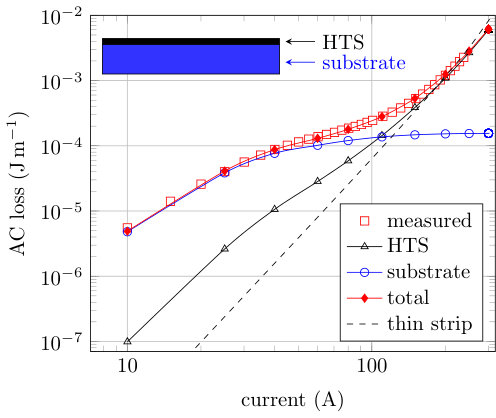 Figure 5
Peer Reviews
No public reviews on file for this paper yet. If you reviewed it on a platform where reviews are public (OpenReview, ICLR, NeurIPS, ICML), you can paste yours below so the community can read it here.
Videos
No videos yet. Explain this paper in a talk, walkthrough, or lecture? Add one.