Reconciling $H_0$ tension in a six parameter space?
Supriya Pan, Weiqiang Yang, Eleonora Di Valentino, Arman Shafieloo and, Subenoy Chakraborty

TL;DR
This paper investigates whether an emergent dark energy model with six parameters can alleviate the Hubble constant tension observed between local and global cosmological measurements, showing partial success in reducing the tension.
Contribution
It demonstrates that an emergent dark energy scenario can reduce the H_0 tension within a six-parameter framework, offering a potential resolution to current cosmological discrepancies.
Findings
H_0 tension is alleviated at 68% confidence level with the emergent dark energy model.
The model improves fit for CMB data compared to ΛCDM.
Alleviation of tension occurs at the cost of increased χ^2 for combined datasets.
Abstract
Consistent observations indicate that some of the important cosmological parameters measured through the local observations are in huge tension with their measurements from the global observations (within the minimal CDM cosmology). The tensions in those cosmological parameters have been found to be either weakened or reconciled with the introduction of new degrees of freedom that effectively increases the underlying parameter space compared to the minimal CDM cosmology. It might be interesting to investigate the above tensions within the context of an emergent dark energy scenario proposed recently by Li and Shafieloo~\cite{Li:2019yem}. We find that the tension on is clearly alleviated within 68\% confidence level with an improvement of the for CMB, for the above emergent dark energy model having only six free parameters similar to the spatially flat…
Click any figure to enlarge with its caption.
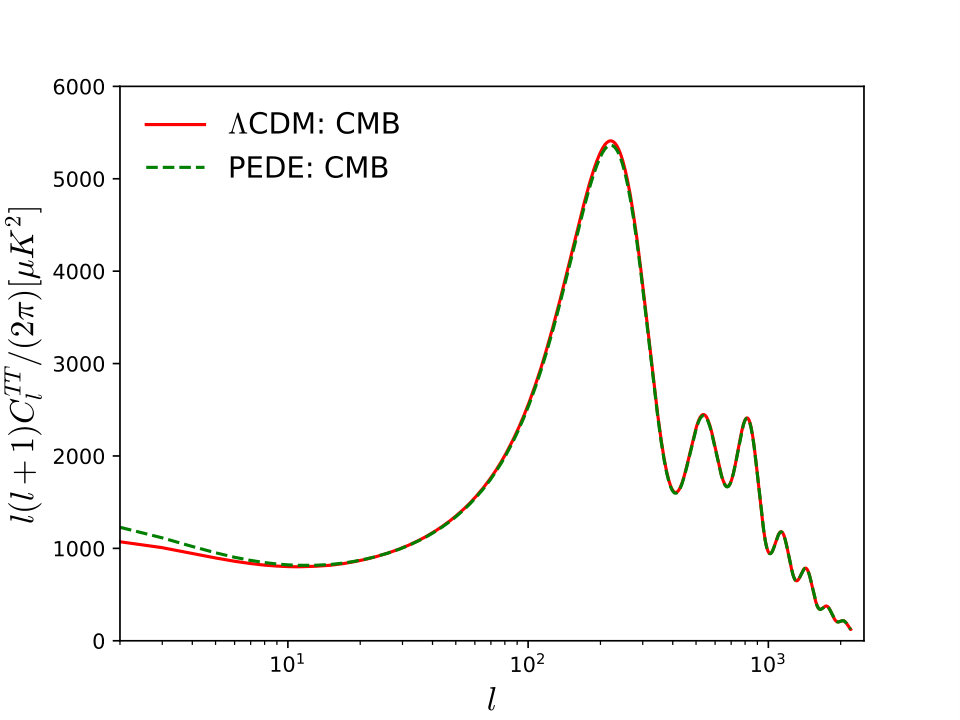 Figure 1
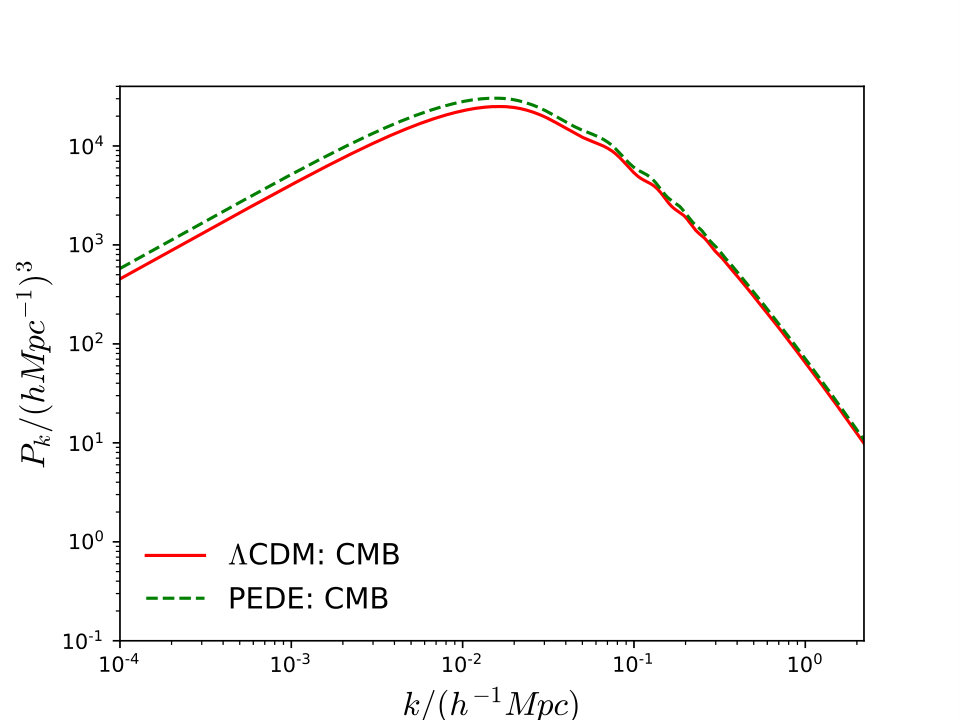 Figure 2
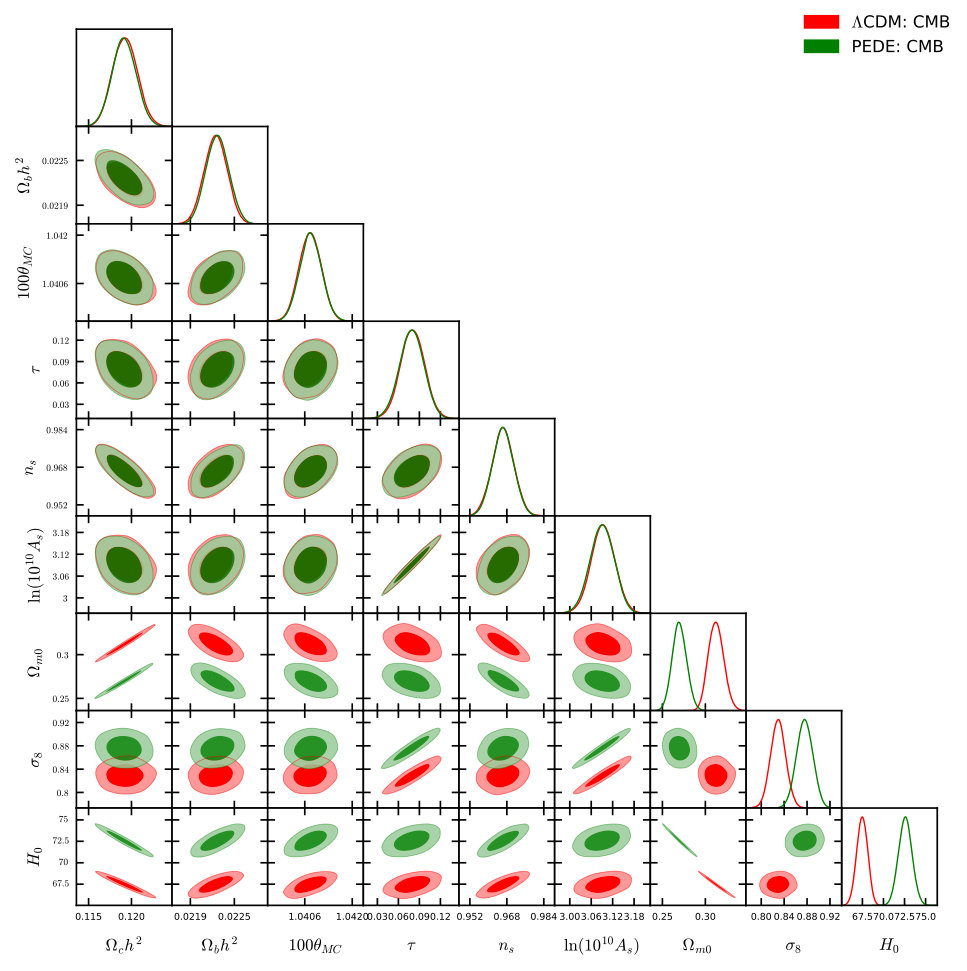 Figure 3
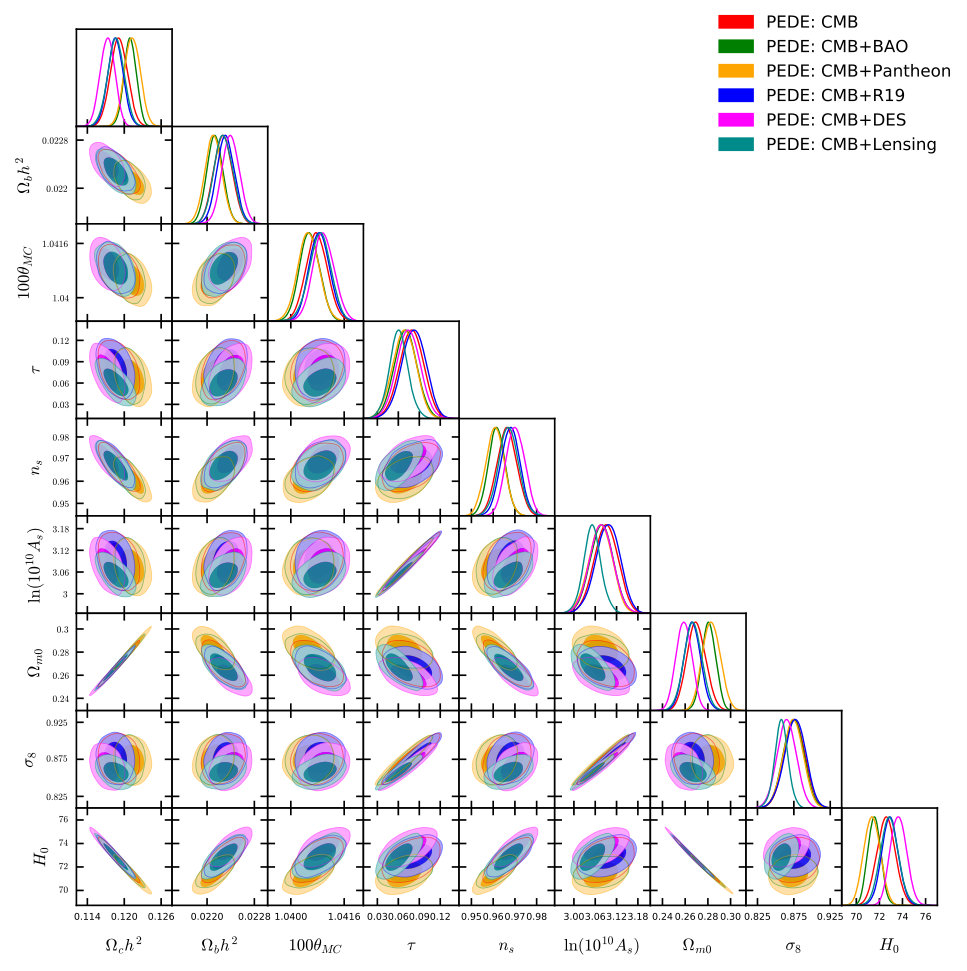 Figure 4
| Parameter | Prior |
|---|---|
| Parameters | CMB | CMB+BAO | CMB+Pantheon | CMB+R19 | CMB+DES | CMB+Lensing |
|---|---|---|---|---|---|---|
| 12962.468 | 12976.566 | 14010.266 | 12963.448 | 13485.282 | 12974.282 |
| Parameters | CMB | CMB+BAO | CMB+Pantheon | CMB+R19 | CMB+DES | CMB+Lensing |
|---|---|---|---|---|---|---|
| 12964.062 | 12969.178 | 13998.916 | 12980.808 | 13492.378 | 12973.924 |
| Parameters | CMB+BAO+Pantheon | CMB+BAO+Pantheon+R19+DES+Lensing | ||
|---|---|---|---|---|
| PEDE | CDM | PEDE | CDM | |
| 14020.478 | 14001.486 | 14563.008 | 14552.488 | |
| Strength of evidence for model | |
|---|---|
| Weak | |
| Definite/Positive | |
| Strong | |
| Very strong |
| Dataset | Strength of evidence | |
|---|---|---|
| CMB | Weak | |
| CMB+BAO | Strong | |
| CMB+Pantheon | Very Strong | |
| CMB+R19 | Definite/Positive | |
| CMB+DES | Definite/Positive | |
| CMB+Lensing | Weak | |
| CMB+BAO+Pantheon | Strong | |
| CMB+BAO+Pantheon+R19+DES+Lensing | Strong |
Peer Reviews
No public reviews on file for this paper yet. If you reviewed it on a platform where reviews are public (OpenReview, ICLR, NeurIPS, ICML), you can paste yours below so the community can read it here.
Videos
No videos yet. Explain this paper in a talk, walkthrough, or lecture? Add one.
Reconciling tension in a six parameter space?
Supriya Pan
Department of Mathematics, Presidency University, 86/1 College Street, Kolkata 700073, India
Weiqiang Yang
Department of Physics, Liaoning Normal University, Dalian, 116029, People’s Republic of China
Eleonora Di Valentino
Jodrell Bank Center for Astrophysics, School of Physics and Astronomy, University of Manchester, Oxford Road, Manchester, M13 9PL, United Kingdom
Arman Shafieloo
Korea Astronomy and Space Science Institute, Daejeon 34055, Korea
University of Science and Technology, Yuseong-gu 217 Gajeong-ro, Daejeon 34113, Korea
Subenoy Chakraborty
Department of Mathematics, Jadavpur University, Kolkata 700032, West Bengal, India
Abstract
Consistent observations indicate that some of the important cosmological parameters measured through the local observations are in huge tension with their measurements from the global observations (within the minimal CDM cosmology). The tensions in those cosmological parameters have been found to be either weakened or reconciled with the introduction of new degrees of freedom that effectively increases the underlying parameter space compared to the minimal CDM cosmology. It might be interesting to investigate the above tensions within the context of an emergent dark energy scenario proposed recently by Li and Shafieloo Li:2019yem . We find that the tension on is clearly alleviated within 68% confidence level with an improvement of the for CMB, for the above emergent dark energy model having only six free parameters similar to the spatially flat CDM model. The tension on is still alleviated for every combined datasets considered in the work, however, such alleviation occurs by worsening the compared to the for CDM model obtained for the same combined dataset.
pacs:
98.80.-k, 95.36.+x, 95.35.+d, 98.80.Es
I Introduction
According to a series of distinct observational data, such as cosmic microwave background (CMB) radiation Ade:2015xua ; Aghanim:2018eyx and baryon acoustic oscillations (BAO) distance measurements Beutler:2011hx ; Ross:2014qpa ; Alam:2016hwk , the -cold-dark-matter (CDM) cosmology is one of the best cosmological descriptions for the currently accelerated expansion of the universe, but on the other hand, it has been diagnosed with a number of severe problems. Apart from its inherent cosmological constant problem, the estimations of some important cosmological parameters in CDM based cosmological framework exhibit tensions with respect to their estimations by other measurements. For instance, the estimation of the Hubble constant from CDM based Planck’s mission Aghanim:2018eyx is more than apart from its estimation by the SH0ES collaboration Riess:2019cxk , more than if combined with the H0liCOW collaboration result Wong:2019kwg , and around for considering the cosmographic expansion of the luminosity distance Camarena:2019moy . In general, there is an tension between late time and early time estimations, ranging from to Riess:2020sih . On the other hand, also the estimation of the parameter from Planck in a CDM scenario Ade:2015xua is in tension at about 2.5 with the cosmic shear measurements by different missions, for instance, KiDS-450 Kuijken:2015vca ; Hildebrandt:2016iqg ; Conti:2016gav , DES-Y1 Abbott:2017wau ; Troxel:2017xyo and CFHTLenS Heymans:2012gg ; Erben:2012zw ; Joudaki:2016mvz , or Lyman- data Palanque-Delabrouille:2019iyz , and about tension with the combination of KiDS+VIKING-450 and DES-Y1 Asgari:2019fkq . However, it should be noted that there are many other measurements too in agreement with Planck about and , like for example the BAO or the Tip of the Red Giant Branch estimates of Freedman:2020dne , or the HSC collaboration value of Hamana:2019etx , and that these two tensions do not have the same level of statistical significance.
Whether such tensions call for a new physics Mortsell:2018mfj ; Vagnozzi:2019ezj or they are arising due to the systematics Efstathiou:2013via are not clearly understood at this stage. However, undoubtedly, the and tensions are two primary issues for modern cosmology and should be carefully investigated.
Since CDM is unable to explain these issues 111Obviously, although not very probable, these problems in CDM we are worried about might be due to undetected systematics in some of the experiments. , an usual approach is to consider the cosmological models beyond CDM. Following this motivation, several extensions of the CDM cosmology have been introduced with a possible solution to the tension DiValentino:2015ola ; DiValentino:2016hlg ; Kumar:2017dnp ; DiValentino:2017iww ; DiValentino:2017zyq ; Renk:2017rzu ; DiValentino:2017gzb ; DiValentino:2017oaw ; Fernandez-Arenas:2017isq ; DiValentino:2017rcr ; Khosravi:2017hfi ; Sola:2017znb ; Nunes:2018xbm ; Yang:2018euj ; Colgain:2018wgk ; DEramo:2018vss ; Yang:2018uae ; Guo:2018ans ; Yang:2018qmz ; Poulin:2018cxd ; Banihashemi:2018oxo ; Banihashemi:2018has ; Zhang:2018air ; Kreisch:2019yzn ; Martinelli:2019dau ; Vattis:2019efj ; Kumar:2019wfs ; Agrawal:2019lmo ; Yang:2019jwn ; Yang:2019qza ; Yang:2019uzo ; DiValentino:2019exe ; Desmond:2019ygn ; Yang:2019nhz ; Pan:2019gop ; Visinelli:2019qqu ; Martinelli:2019krf ; Cai:2019bdh ; Schoneberg:2019wmt ; Shafieloo:2016bpk ; Li:2019san and tension as well Pourtsidou:2016ico ; An:2017crg ; Gomez-Valent:2017idt ; DiValentino:2018gcu ; Kumar:2019wfs ; Gomez-Valent:2018nib ; Kazantzidis:2018rnb ; Hazra:2018opk ; Kazantzidis:2019dvk (also see Macaulay:2013swa where the authors reported lower compared to Planck). However, extended cosmological models naturally include extra free parameters compared to the six parameter CDM scenario, and are therefore disfavoured with respect to it. It has thus been a natural search for some alternative cosmological model having same number of free parameters as in CDM but having the ability to solve or reconcile the tension on of the two important parameters, namely, and .
In the present article we work with a dynamical emergent dark energy model, recently introduced in Li:2019yem , that has exactly same number of free parameters as in CDM model. We investigate the model considering its evolution at the level of background and perturbations and constrain it using the presently available cosmological datasets including Planck 2015 cosmic microwave background (CMB) radiation, Pantheon sample of the Supernovae Type Ia, Baryon acoustic oscillations distance measurements, and the recently released local estimation of the Hubble constant by Riess et al. Riess:2019cxk . Our analyses clearly show that the tension on is reconciled within 68% confidence-level for this model Li:2019yem . This is one of the key results of this paper because so far we are aware of the literature, probably this is the first time we are reporting the reconciliation of tension in a six parameter space, improving the for CMB.
The work has been organized in the following way. In section II we briefly discuss the basic governing equations for the introduced dynamical dark energy model in a spatially flat Friedmann-Lemaître-Robertson-Walker (FLRW) universe. In section III we present the observational data and the methodology for this paper. After that in section IV we discuss the main results extracted from this model. Finally, we close the work in section V with a short summary of entire results.
II Phenomenologically Emergent Dark Energy
We consider a spatially flat Friedmann-Lemaître-Robertson-Walker (FLRW) metric to describe the geometrical configuration of the universe. We also consider that the gravitational sector of the universe is well described by the Einstein gravity where matter is minimally coupled to it. Additionally, we further assume that none of the fluids are interacting with each other, at least non-gravitationally. So, if the content of the universe is comprised of radiation, pressureless matter sector (baryons+cold dark matter) and a dark energy fluid 222Let us note that here we fix the total neutrino mass to according to the Planck mission. This is certainly justified through the tight upper limits available on Palanque-Delabrouille:2015pga ; Giusarma:2016phn ; Vagnozzi:2017ovm ; Giusarma:2018jei ; Aghanim:2018eyx . , then in the background of a spatially flat FLRW universe, one can write down the Hubble equation as
[TABLE]
where is the Hubble parameter of the FLRW universe, is the density parameter for radiation, is the density parameter for matter (baryons+cold dark matter) and is the dark energy density parameter. The dark energy density parameter can be solved as
[TABLE]
where is the current value of ; , is the equation-of-state of the dark energy fluid. There are various ways to depict the evolution of the universe either by prescribing the equation-of-state of the dark energy, or by providing the density parameter for dark energy.
In this work we shall consider the second approach recently proposed in Li:2019yem :
[TABLE]
where and (without any loss of generality we set , the current value of the scale factor to be unity, i.e., ). As already argued in Li:2019yem this model is similar to the CDM one in the sense that both the models have six free parameters. So, from the statistical ground the models are same. Certainly, it will be interesting to investigate such phenomenological model having same number of free parameters in light of the latest observations.
We should mention here that although the model proposed in Li:2019yem might seems to be ad hoc, it has interesting phenomenological properties that dark energy acts as an emergent phenomena having a symmetrical behavior with respect to the logarithm of the scale factor. This model has already gained attention from the community as a competitor of other well known cosmological models Arendse:2019hev and might provide valuable hints for theoretical interpretations. While in Ref. Li:2019yem , the authors present its observational constraints at the level of background, its evolution at the level of perturbations is worth to understand. In the current work we therefore aim to extend this study by analysing its behaviour at the level of perturbations and the cosmological tensions which have already been a serious issue in the context of CDM cosmology.
Since there is no interaction between any two fluids under consideration, hence, using the conservation equation for dark energy, namely,
[TABLE]
one can derive the dark energy equation-of-state as
[TABLE]
which for the present model in (3) takes the form Li:2019yem
[TABLE]
Thus, for any prescribed one can derive the dark energy equation-of-state. As explained in Li:2019yem , the equation-of-state (4) has an interesting symmetrical feature. From (5) one can see that at early time, i.e. for , and for (far future), . And at preset time (i.e. ), we see , that means a phantom dark energy equation of state. Note that as described briefly in Li:2019yem , the pivot point of transition in this model can be considered to be the redshift of matter-dark energy densities equality. For the present model in (3), dark energy has no effective presence in the past as shown in Fig. 1 of Li:2019yem , while it emerges at present time, therefore, by the authors of Li:2019yem , this model has been named as Phenomenologically Emergent Dark Energy (PEDE) model and we use the same name throughout this article. So, having presented the equations above, the background evolution of the PEDE model is clearly understood. Concerning the perturbations equations for this model, our treatment is does not involve anything new because as the equation of state of DE under this PEDE model is less than and the cosmological scenario does not involve any non-gravitational interaction between any two fluids, hence, the perturbations equations will be exactly similar to the equations for a non-interacting phantom DE equation of state. We refer to the work Ma:1995ey for implementing the perturbations equations, specially eqn. (29) [for synchronous gauge] or eqn. (30) [for conformal Newtonian gauge].
III Observational data
In this section we describe the main observational data that are used to constrain the proposed dark energy model.
Cosmic Microwave Background (CMB): The Cosmic Microwave Background measurements are one of the potential data to unveil the nature of the dark universe. Here we make use of the Planck 2015 data Adam:2015rua ; Aghanim:2015xee that include both high- () TT and low- () TT likelihoods. We also consider the Planck polarization likelihood in the low- multipole regime () as well as the high-multipole () EE and TE likelihoods. 2. 2.
Baryon acoustic oscillation (BAO) distance measurements: We use 6dFGS Beutler:2011hx , SDSS-MGS Ross:2014qpa , and BOSS DR12 Alam:2016hwk surveys, as considered by the Planck collaboration Aghanim:2018eyx . 3. 3.
Supernovae Type Ia (Pantheon): The Supernovae Type Ia (SNIa) were the first standard candles that signaled for an accelerating universe. In this work we make use of the Pantheon sample, the latest compilation of SNIa, comprising 1048 data points in the redshift region Scolnic:2017caz . 4. 4.
Hubble constant (R19): We include the recent estimation of the Hubble constant, km/s/Mpc at CL Riess:2019cxk , which is in tension () with CMB estimation within the minimal cosmological model CDM. 5. 5.
Dark energy survey (DES): We consider the pt analysis of the first-year of the Dark Energy Survey measurements Troxel:2017xyo ; Abbott:2017wau ; Krause:2017ekm , as adopted by the Planck collaboration in Aghanim:2018eyx . 6. 6.
Lensing: We use the CMB lensing reconstruction power spectrum obtained from the CMB trispectrum analysis Ade:2015zua .
To perform the numerical analysis we use the markov Chain Monte Carlo (MCMC) package CosmoMC Lewis:2002ah ; Lewis:1999bs which is equipped with a convergence statistics by Gelman and Rubin. This CosmoMC package includes the support for Planck 2015 likelihood Aghanim:2015xee . The parameter space that we will consider has six parameters similarly to the CDM model. In particular we have the following parameter space
[TABLE]
where is the physical density for baryons, is the physical density for CDM, is the ratio of sound horizon to the angular diameter distance, denotes the reionization optical depth, is the scalar spectral index, and is the amplitude of the primordial scalar power spectrum. In Table 1 we display the priors that are imposed on various free parameters during the statistical analysis.
IV Results
The current PEDE model has the same number of free parameters as in spatially flat CDM model. So, statistically within the spatially flat FLRW background, the PEDE and CDM are on the same ground. We have constrained both the models using the same observational data (see section III) in order to perform a statistical comparison between them with the aim to focus on the tensions on both and .
In Table 2 we show the observational constraints on the PEDE model using a number of cosmological datasets such as CMB, CMB+BAO, CMB+Pantheon, CMB+R19, CMB+DES and CMB+Lensing. Fig. 1 shows the 1D posterior distributions of all parameters of this model together with 2D joint contours considering several combinations of the parameters at 68% and 95% CL. At the same time in order to make a comparison of the PEDE model with the CDM cosmology, in Table 3 we show the constraints on the CDM scenario using the same combination of data of the PEDE model. Our analyses clearly show that for the PEDE model, the Hubble constant , takes very high values compared to the values of obtained from CDM model. For the PEDE model one can see that CMB dataset alone estimate, km/s/Mpc (68% CL) while for the same dataset CDM model returns, km/s/Mpc (68% CL). One can notice that the difference in the error bars on for both the models are not much significant, but the values of for the PEDE model is perfectly in agreement with the Hubble constant estimate from R19: km/s/Mpc (68% CL). Moreover, there is an improvement of the of about for the PEDE model with respect to the CDM one for the same number of degrees of freedom. When external datasets, such as BAO, Pantheon, etc., are added to CMB dataset, the estimations of for all the observational combinations in the PEDE model (see Table 2), take significantly higher values compared to the estimations for CDM one (see Table 3). Moreover, also the error bars on for PEDE model are really stable for all the observational datasets, therefore the tension reconciled within 68% CL, for this PEDE model, is not due to a volume effect. This is a very interesting result because without using any additional degrees of freedom, only dynamical character of the dark energy density (equivalently, the dark energy equation of state) can reconcile the tension in a remarkable way. One should note the symmetrical form of the dark energy density in this model that appears due to setting the pivot of transition which refers to the epoch of matter-dark energy density equality, to zero 333However, the pivot of transition (matter-dark energy density equality), , can be considered as a derived parameter (depending on the value of matter density) by extending the present model (see the paragraph after eqn. (6) of Li:2019yem ) where the dark energy density parameter can be parametrized as, in which . . Additionally, when R19 and DES are added to the CMB dataset, we see a large improvement of the for PEDE model compared to the CDM model, for instance, 444Let us note that we define as: for CMB+R19 and for CMB+DES. This large improvement we see is due to the fact that for these cases the CMB data are more in agreement with the additional data in the PEDE model with respect to the CDM scenario. As one can see, for CMB alone case, for PEDE is less than the for CDM model. For all the other combinations of data (such as CMB+BAO, CMB+Pantheon and CMB+Lensing) the for PEDE gets worse compared to for CDM.
We present the comparisons between the CMB constraints of PEDE and CDM model in Fig. 2. We do not show other combinations because qualitatively they look similar. Here we can observe that all the cosmological parameters, with the exception of , and , perfectly coincide in the PEDE and CDM models. Instead, the Hubble constant and the clustering parameter shift towards higher values, while towards a smaller one. If we now compute the parameter, the PEDE model seems to be able to alleviate also this tension, shifting more in agreement with the cosmic shear data. In fact, we found that in PEDE model the DES alone estimates, at 68 CL, in agreement within with the CMB. However, the tension between these two datasets in the PEDE model is not completely solved, because is much higher for the CMB only than for DES only (for which at 68 CL), and is much lower compared to its estimation from DES only: ).
In Table 4, finally, we show the results for two different combinations, namely, the CMB+BAO+Pantheon combination and the full dataset CMB+BAO+Pantheon+R19+DES+Lensing, because, according to some recent works, see for example Martinelli:2019krf , it has been pointed out that the combination of all the three probes at the same time cannot alleviate the tension. We find that for CMB+BAO+Pantheon, moves from km/s/Mpc at 68% CL in the CDM model to km/s/Mpc at 68% CL in the PEDE model and for the CMB+BAO+Pantheon+R19+DES+Lensing combination, moves from km/s/Mpc at 68% CL in the CDM model to km/s/Mpc at 68% CL in the PEDE model. In other words, we can still alleviate the Hubble constant tension between CMB+BAO+Pantheon (CMB+BAO+Pantheon+R19+DES+Lensing) and R19, from 4.2 to 2 (from 3.6 to 1.4) standard deviations, compatible with a statistical fluke. However, this agreement happens by worsening the fit of the data, with a ().
We now discuss the behaviour of this emergent DE model in the large scales through Fig. 3 where we explicitly compare the PEDE and CDM models considering the CMB temperature anisotropy spectra and matter power spectra. The left and right graph of Fig. 3 respectively describe the CMB temperature anisotropy spectra and matter power spectra. From the left graph of Fig. 3 we notice that at the lower multipoles (around ), the PEDE has a slight deviation from the CDM but such deviation is very mild and completely hidden by the cosmic variance. However, one can note that (see Fig. 3) the amplitude of the first acoustic peak in the CMB power-spectrum for both the models does not change at all. Similar observation can be found from the matter power spectra shown in the right side of Fig. 3. So, PEDE has a mild deviation from the CDM and this is only detected from the CMB and matter power spectra.
Finally, we analyze the performance of the current PEDE model with respect to the standard CDM model. It is a very natural question to ask how efficient a new cosmological model is, since from the theoretical ground, the introduction of a new dark energy model is very easy. So, we close this section with the Bayesian evidences computed for the PEDE model with respect to CDM as the reference model. To calculate the Bayesian evidence for all the observational data we use a cosmological code MCEvidence originally developed by the authors of Heavens:2017afc ; Heavens:2017hkr . Let us note that the use of MCEvidence for computing the Bayesian evidences needs only the MCMC chains that are used to extract the cosmological parameters using the observational datasets (we also refer to Pan:2017zoh ; Yang:2018xah for the same discussions). The performance of a cosmological model (say ) with respect to some reference cosmological model (here CDM) is quantified through the Bayes factor of the model with respect to the reference model (or, the logarithm of the Bayes factor, namely, ). In Table 5 we display the revised Jeffreys scale that quantifies the observational support of the underlying cosmological model and in Table 6 we summarize the values of computed for the PEDE model, for all the observational datasets. From the analysis, we clearly see that except from CMB+R19 combination, all other observational datasets favour CDM over the PEDE. The interesting observation is the case with CMB+R19 where we see that PEDE is favored over CDM with a positive evidence. This is in agreement with the observations because for CMB+R19, the for PEDE is much improved of about compared to the for CDM. This is also in agreement with the analyses of Li:2019yem where the authors claim that the PEDE model can be favored compared to CDM when some hard cut priors on is implemented.
V Concluding remarks
Despite of having tremendous success to frame the presently ongoing accelerated expansion of the universe, the -cosmology is equally challenged for several unexplained issues associated with it. The cosmological constant problem is undoubtedly one of the biggest challenges to explain. Apart from that the tensions in some parameters have been another remarkable issue at current time. The measurements of and in CDM based framework do not agree with their measurements by other experimental missions known as tensions in the cosmological parameters. The parameter is in more than tension between (CDM-based) Planck and local observations by the SH0ES collaboration Riess:2019cxk . On the other hand, parameter is in tension between Planck and other observations, such as KiDS-450 Kuijken:2015vca ; Hildebrandt:2016iqg ; Conti:2016gav , DES Abbott:2017wau ; Troxel:2017xyo and CFHTLenS Heymans:2012gg ; Erben:2012zw ; Joudaki:2016mvz . Some recent literature investigating along this line found that an extended parameter space compared to CDM is able to ease such tensions, however, due to extra free parameters, from Bayesian point of view, CDM remains favored compared to the extended cosmological models. A natural inquiry, that forced us to look for an alternative cosmological model, having same number of parameters as in CDM but with the potentiality to address some of the above problems.
A model proposed in Li:2019yem seems to have such properties (having no degree of freedom for the dark energy sector) which influenced us to investigate this model further. In fact, in Li:2019yem the authors presented the analyses at the level of background. Since the evolution of the model considering the large scale inhomogeneities is worth to provide a better picture of the model, hence, it is necessary to consider the perturbations. Therefore, keeping this important issue, we have investigated this model in a more comprehensive way and analysed how the model is able to reconcile the and tensions.
In Table 2 we show the observational constraints on the PEDE model using various cosmological datasets. In particular, we have considered the analysis with CMB alone and the datasets in which one external dataset is included with CMB at a time. From Table 2 it is quite clear that takes considerably higher values compared to the estimations of for the CDM model (see Table 3). For CMB alone dataset, we see that at 68% CL, for the PEDE model which is pretty close to its local estimations by Riess et al. Riess:2019cxk and the estimations for other datasets remain almost same with stable error bars on . This clearly shows us that within 68% CL, the tension on is perfectly reconciled, with an improvement of the for some certain combinations of the cosmological probes. This is one of the very interesting findings because the PEDE model has exactly six parameters as in CDM model. In order to investigate further the ability of the model, we have constrained the PEDE (and also the CDM model) using more cosmological probes at a time, such as CMB+BAO+Pantheon and CMB+BAO+Pantheon+R19+DES+Lensing, the results of which are summarized in Table 4. Our results clearly show that the tension on is still alleviated within 68% CL, however, the alleviation in both the cases appear due to worsening the values compared to the CDM model. Now concerning the parameter, we fond that its value using DES alone is in agreement with the estimations from CMB for PEDE model, so it is able to reconcile this tension as well. However, the tension between these two datasets (i.e. DES and CMB from Planck) in the PEDE model is not completely solved because we find that is much higher for the CMB data alone compared to its estimation from DES alone, and additionally, is much lower for CMB alone compared to its estimation from DES only.
In summary, it is evident that the current PEDE model is a new appealing addition in the literature of dark energy models which, based on its present observational features, should be considered as a potential candidate for further investigations. In a forthcoming work we plan to extend the present work by including the non-gravitational interaction between dark matter and the dark energy having the equation of state explored in this work. The purpose to include the interaction within the present context is highly motivated because the interacting models have the ability to address some very important cosmological puzzles including the recently explored tensions in some cosmological parameters. We refer the readers to some of the works in this direction Yang:2018euj ; Yang:2019vni ; DiValentino:2019ffd ; DiValentino:2019jae . We aim to investigate the and tensions in order to see whether first of all the alleviation of tension is independent of the interaction. And secondly, if the tension on is much relaxed compared to the present case study.
Acknowledgments
The authors express their sincere thank to the referee for reading the work very carefully and for her/his comments and suggestions that certainly improved the quality of presentation of the article. SP has been supported by the Mathematical Research Impact-Centric Support Scheme (MATRICS), File No. MTR/2018/000940, given by the Science and Engineering Research Board (SERB), Govt. of India, as well as by the Faculty Research and Professional Development Fund (FRPDF) Scheme of Presidency University, Kolkata, India. WY acknowledges the support from the National Natural Science Foundation of China under Grants No. 11705079 and No. 11647153. EDV acknowledges support from the European Research Council in the form of a Consolidator Grant with number 681431. AS would like to acknowledge the support of the Korea Institute for Advanced Study (KIAS) grant funded by the Korea government. SC acknowledges the Mathematical Research Impact Centric Support (MATRICS), project reference no. MTR/2017/000407, by the Science and Engineering Research Board (SERB), Government of India.
The reference list from the paper itself. Each links out to its DOI / PubMed record.
- 1(1) X. Li and A. Shafieloo, Phenomenologically Emergent Dark Energy and Ruling Out Cosmological Constant, Astrophys. J. 883 , no. 1, L 3 (2019) ar Xiv:1906.08275 [astro-ph.CO].
- 2(2) P. A. R. Ade et al. [Planck Collaboration], Planck 2015 results. XIII. Cosmological parameters, Astron. Astrophys. 594 , A 13 (2016) [ar Xiv:1502.01589 [astro-ph.CO]].
- 3(3) N. Aghanim et al. [Planck Collaboration], Planck 2018 results. VI. Cosmological parameters, ar Xiv:1807.06209 [astro-ph.CO].
- 4(4) F. Beutler et al. , The 6d F Galaxy Survey: Baryon Acoustic Oscillations and the Local Hubble Constant, Mon. Not. Roy. Astron. Soc. 416 , 3017 (2011) [ar Xiv:1106.3366 [astro-ph.CO]].
- 5(5) A. J. Ross, L. Samushia, C. Howlett, W. J. Percival, A. Burden and M. Manera, The clustering of the SDSS DR 7 main Galaxy sample - I. A 4 per cent distance measure at z = 0.15 𝑧 0.15 z=0.15 , Mon. Not. Roy. Astron. Soc. 449 , no. 1, 835 (2015) [ar Xiv:1409.3242 [astro-ph.CO]].
- 6(6) S. Alam et al. [BOSS Collaboration], The clustering of galaxies in the completed SDSS-III Baryon Oscillation Spectroscopic Survey: cosmological analysis of the DR 12 galaxy sample, Mon. Not. Roy. Astron. Soc. 470 , no. 3, 2617 (2017) [ar Xiv:1607.03155 [astro-ph.CO]].
- 7(7) A. G. Riess, S. Casertano, W. Yuan, L. M. Macri and D. Scolnic, Large Magellanic Cloud Cepheid Standards Provide a 1% Foundation for the Determination of the Hubble Constant and Stronger Evidence for Physics beyond Λ Λ \Lambda CDM, Astrophys. J. 876 , no. 1, 85 (2019) [ar Xiv:1903.07603 [astro-ph.CO]].
- 8(8) K. C. Wong et al. , H 0Li COW XIII. A 2.4% measurement of H 0 subscript 𝐻 0 H_{0} from lensed quasars: 5.3 σ 5.3 𝜎 5.3\sigma tension between early and late-Universe probes, ar Xiv:1907.04869 [astro-ph.CO].