New physics from COHERENT data with improved Quenching Factor
Amir N. Khan, Werner Rodejohann

TL;DR
This paper demonstrates that an improved quenching factor measurement for CsI[Na] enhances the precision of COHERENT experiment results, leading to tighter constraints on neutrino properties and new physics scenarios.
Contribution
It introduces an updated quenching factor measurement and re-analyzes COHERENT data, significantly refining bounds on neutrino and new physics parameters.
Findings
Reduced uncertainty in COHERENT measurements.
Stronger constraints on neutrino magnetic moments.
Enhanced sensitivity to non-standard interactions.
Abstract
A recent new measurement and re-analysis of past measurements suggested an improved quenching factor value and uncertainty for CsI[Na]. This implies a measurement of the COHERENT experiment of coherent elastic neutrino-nucleus scattering that is closer to the Standard Model prediction and has less uncertainty. We illustrate the impact of this improvement by revisiting fits to the Weinberg angle, neutrino magnetic moments, neutron rms and neutrino charge radii, neutrino non-standard interactions (in particular those relevant for LMA-Dark) and new scalar as well as vector bosons. Significant improvement is observed, particularly for those scenarios coherently affecting the electroweak SM process.
Click any figure to enlarge with its caption.
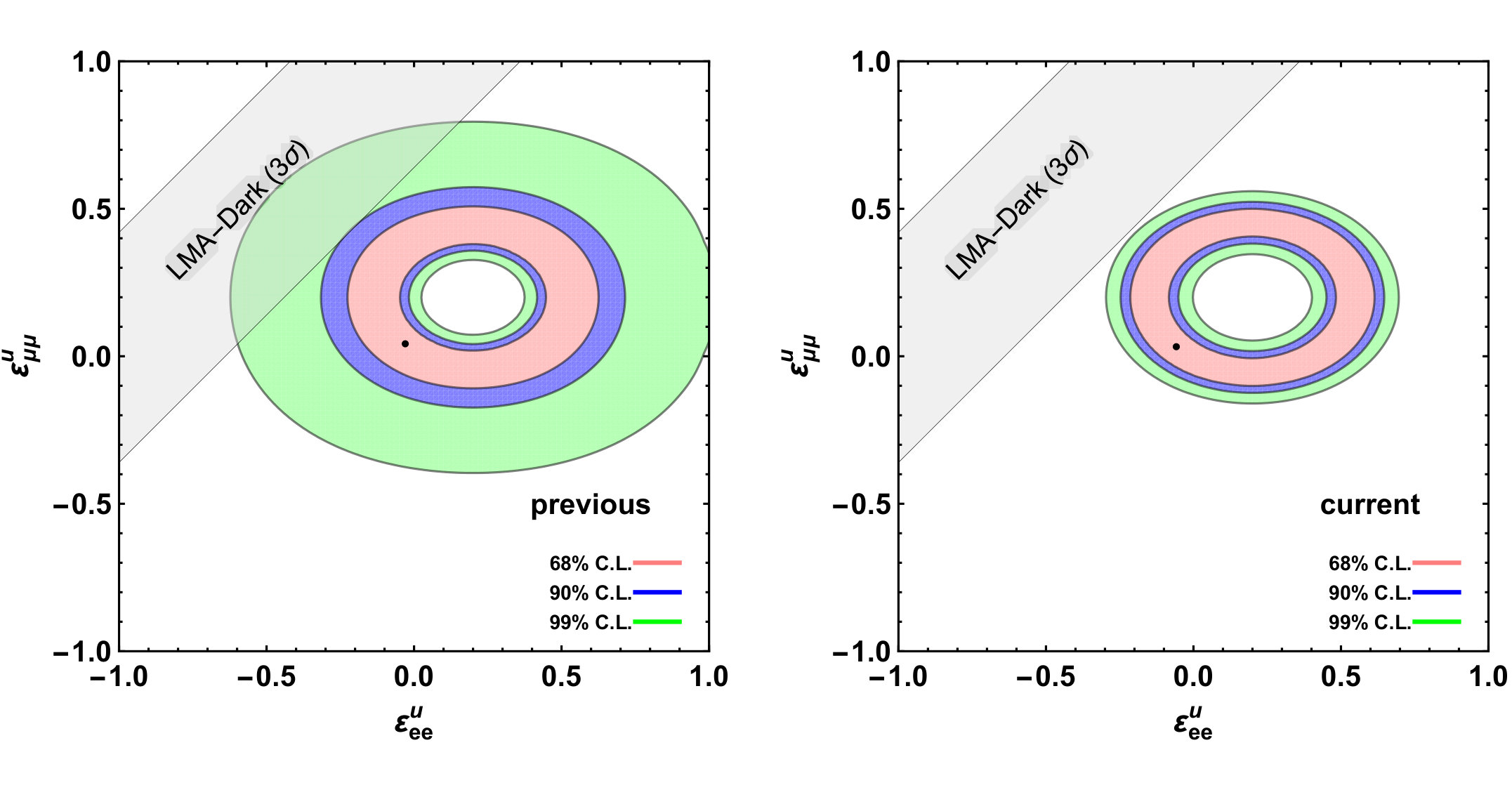 Figure 1
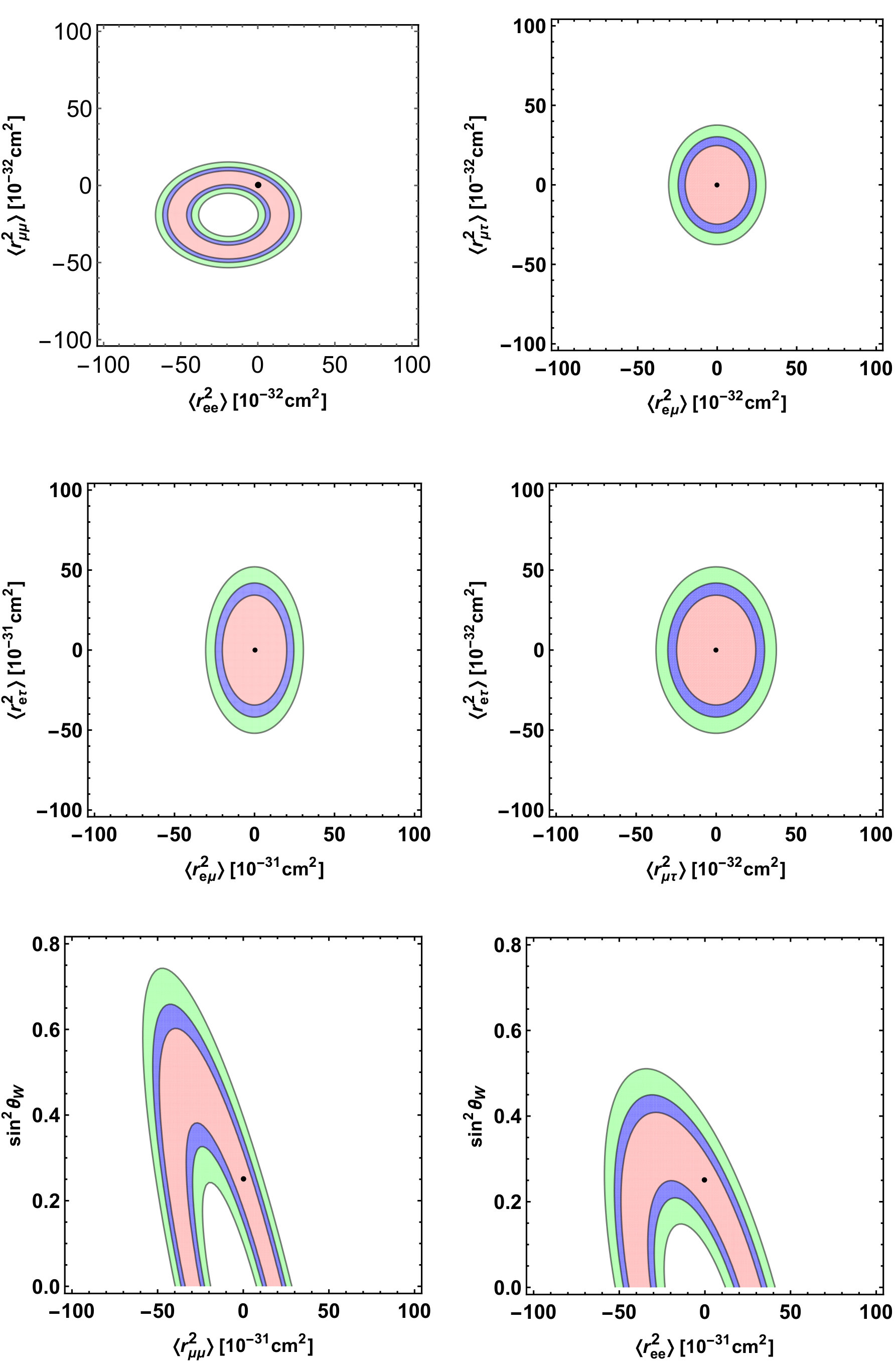 Figure 2
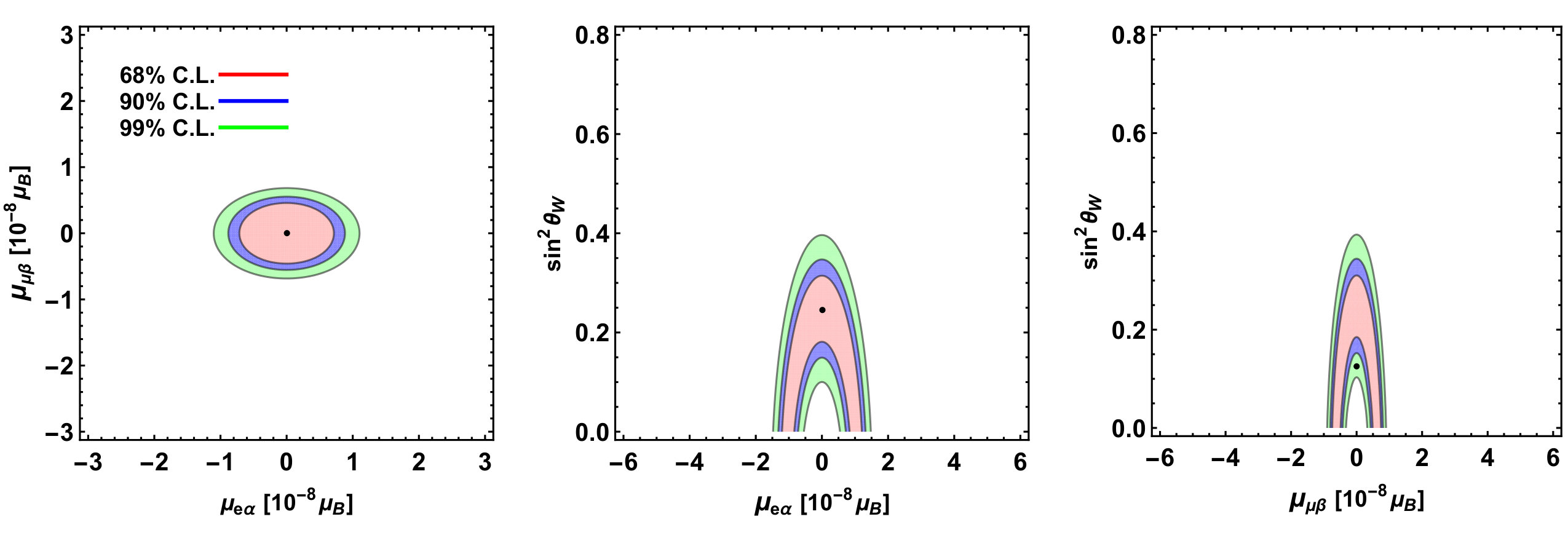 Figure 3
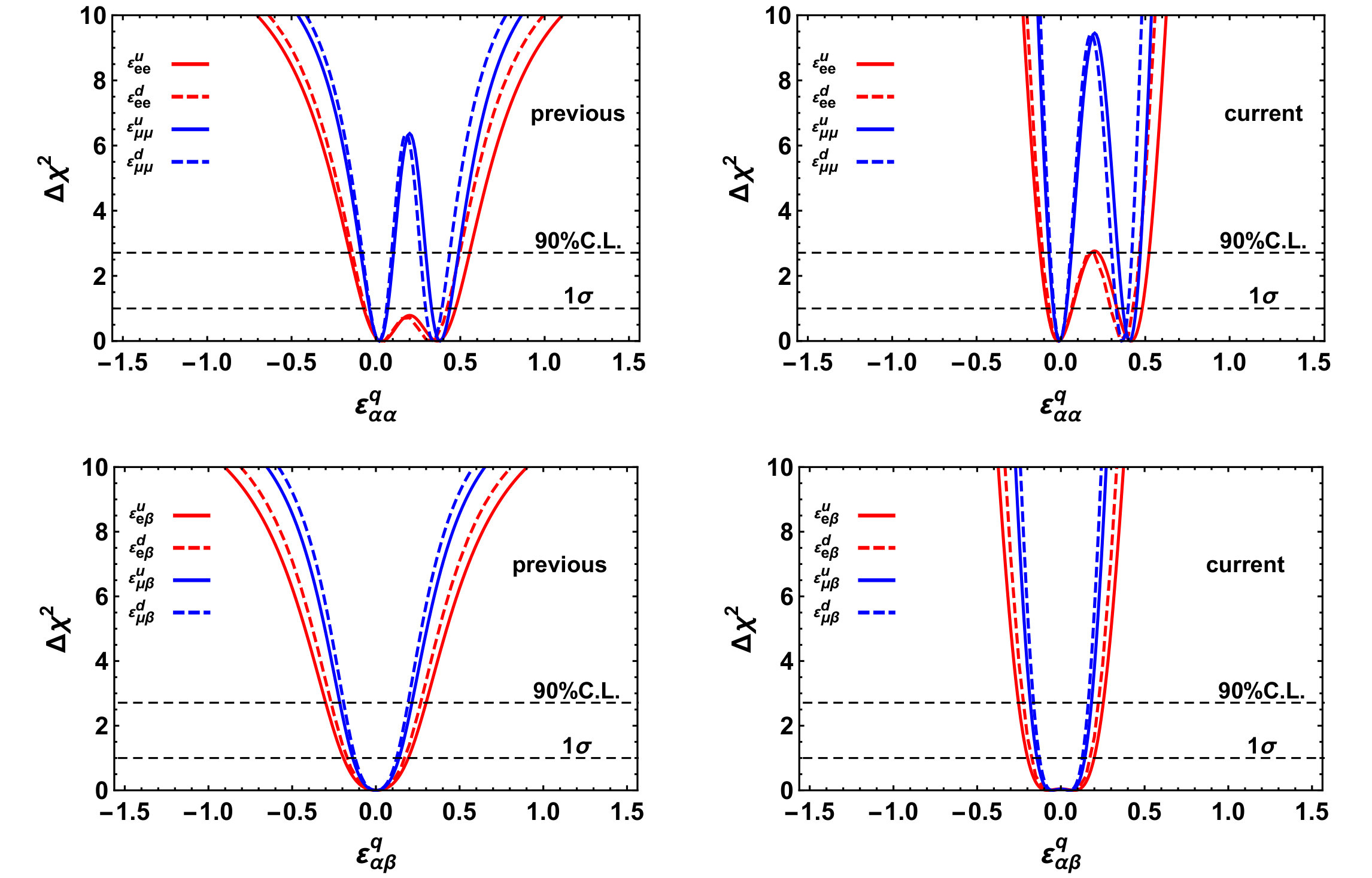 Figure 4
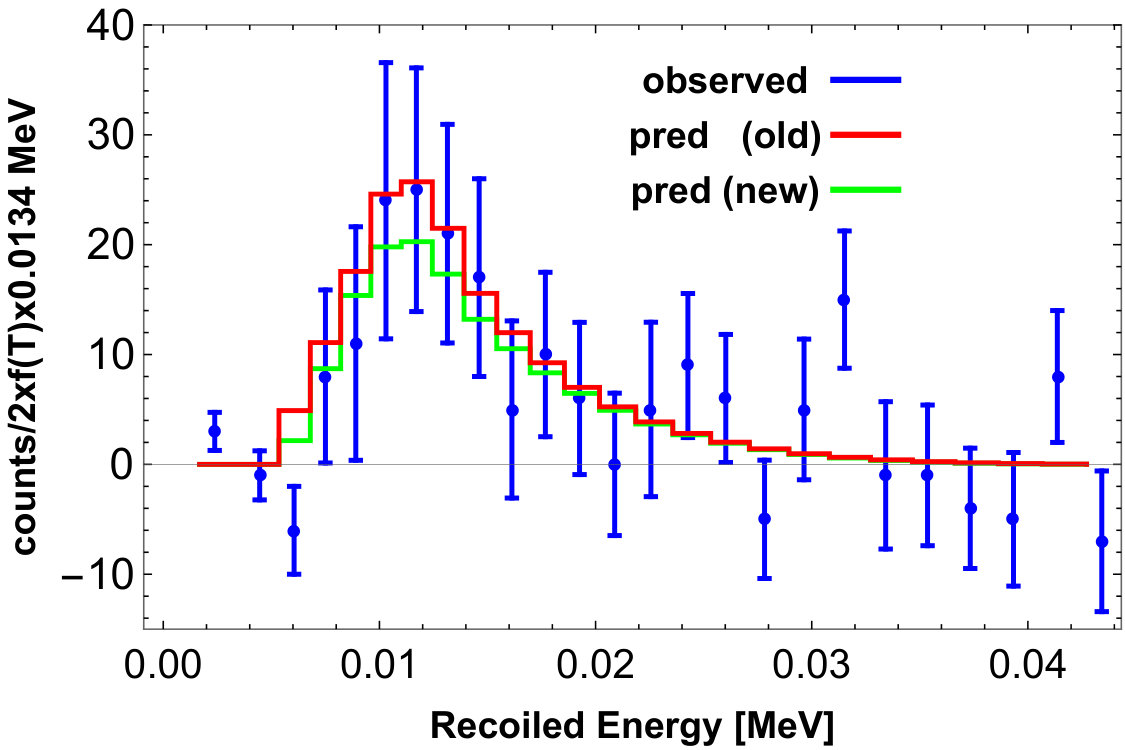 Figure 5
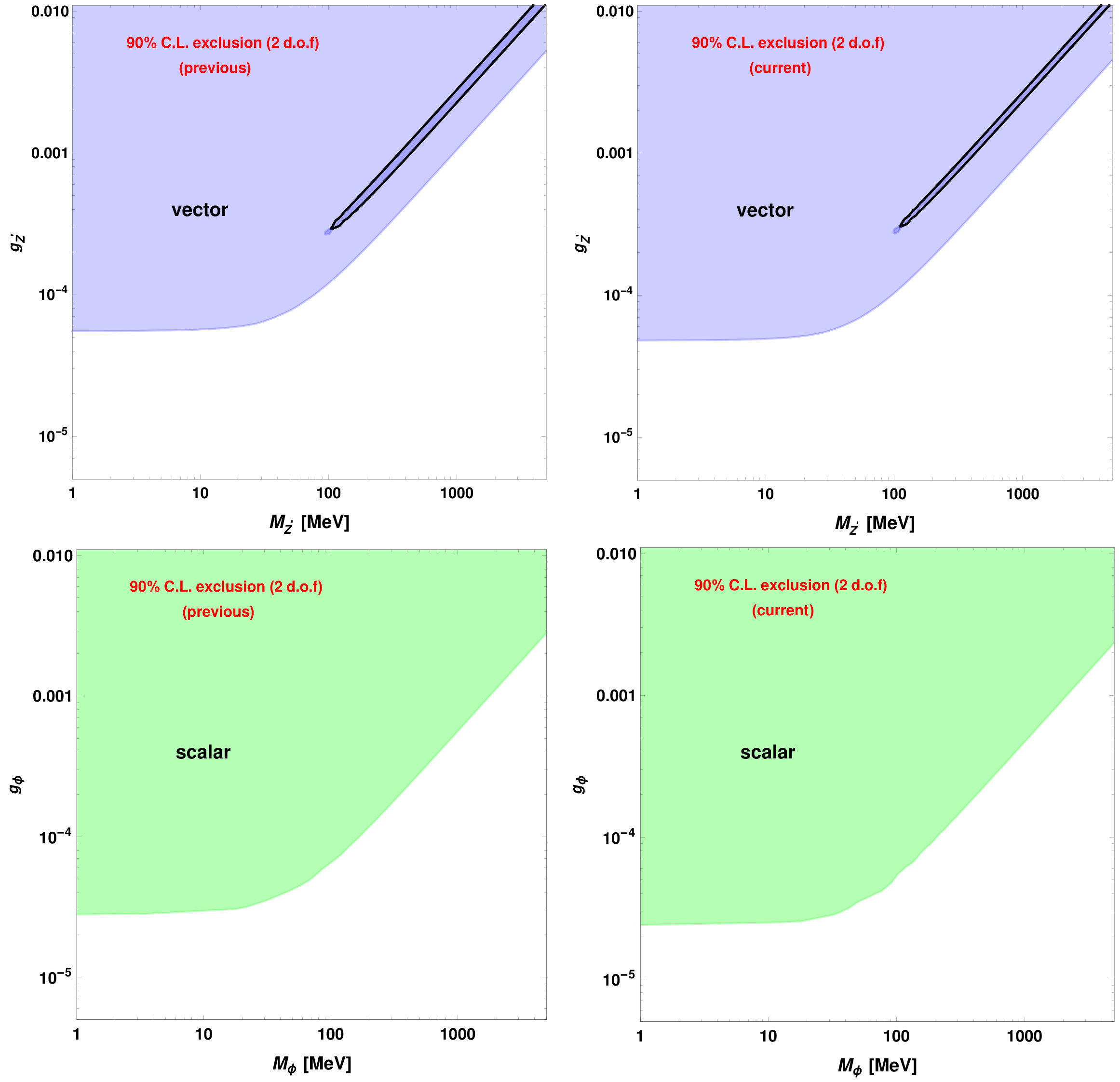 Figure 6
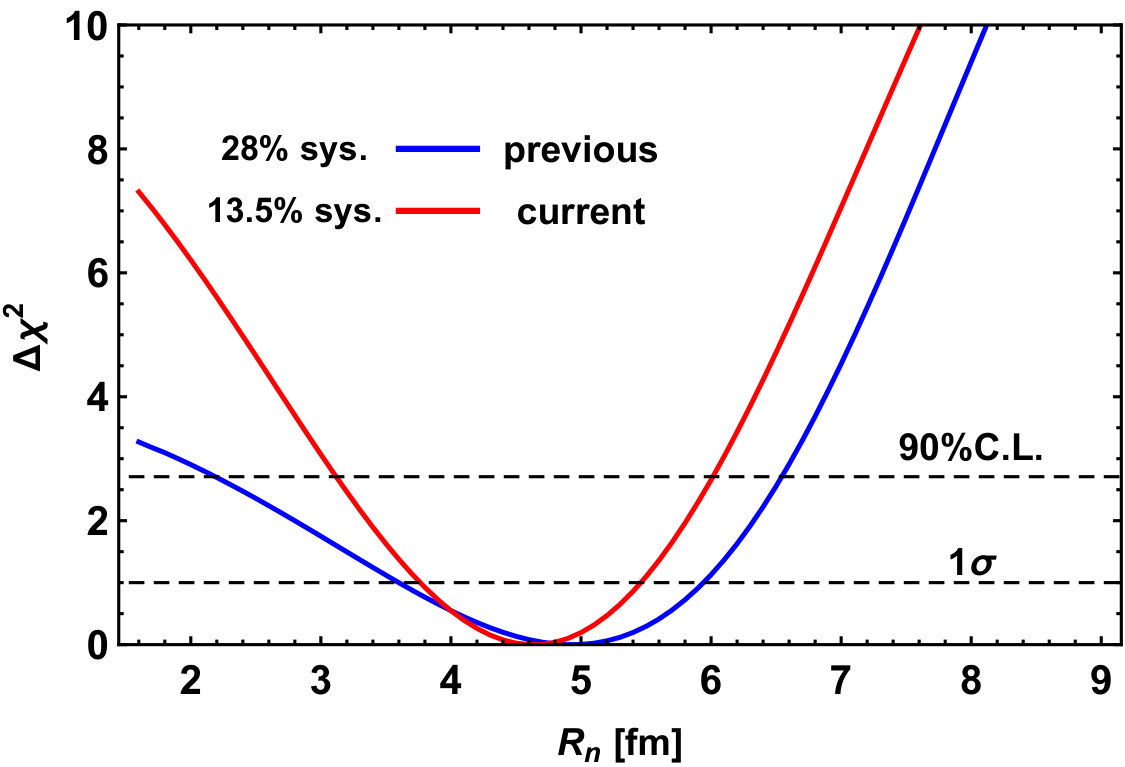 Figure 7
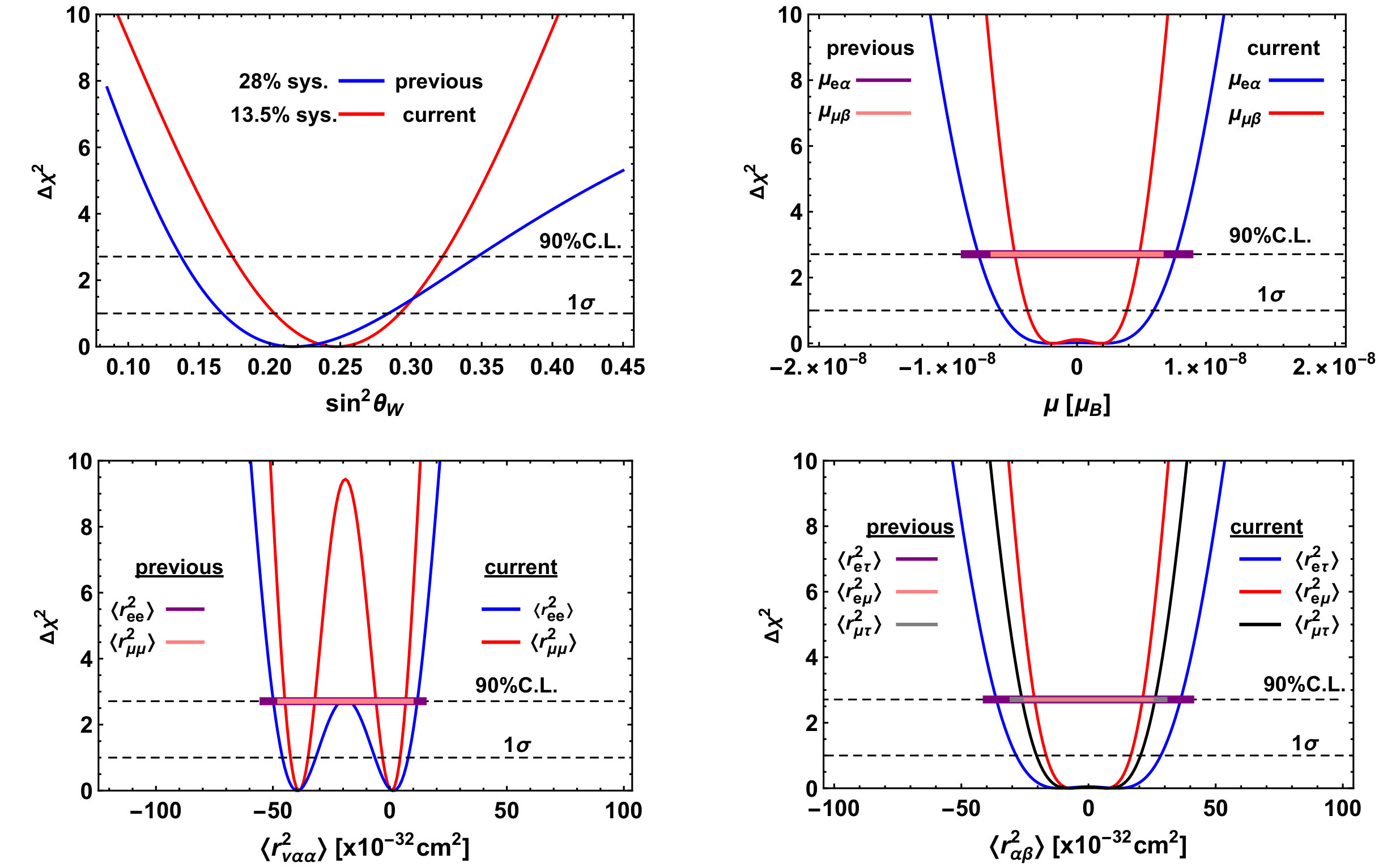 Figure 8
Peer Reviews
No public reviews on file for this paper yet. If you reviewed it on a platform where reviews are public (OpenReview, ICLR, NeurIPS, ICML), you can paste yours below so the community can read it here.
Videos
No videos yet. Explain this paper in a talk, walkthrough, or lecture? Add one.
New physics from COHERENT data with improved Quenching Factor
Amir N. Khana,b
[email protected], [email protected]
Werner Rodejohanna
aMax-Planck-Institut für Kernphysik, Postfach 103980, D-69029 Heidelberg, Germany
bTheoretical Physics Department, Fermi National Accelerator Laboratory, P.O. Box 500, Batavia, IL 60510, USA
Abstract
A recent new measurement and re-analysis of past measurements suggested an improved quenching factor value and uncertainty for CsI[Na]. This implies a measurement of the COHERENT experiment of coherent elastic neutrino-nucleus scattering that is closer to the Standard Model prediction and has less uncertainty. We illustrate the impact of this improvement by revisiting fits to the Weinberg angle, neutrino magnetic moments, neutron rms and neutrino charge radii, weak nuclear charge of the Cs nucleus, neutrino non-standard interactions (in particular those relevant for LMA-Dark) and new scalar as well as vector bosons. Significant improvement is observed, particularly for those scenarios coherently affecting the electroweak SM process.
pacs:
xxxxx
I Introduction
Coherent elastic neutrino-nucleus scattering (CENS) has been predicted in 1974 Freedman (1974), but not been observed before 2017 **Akimov **et al. (2017). The importance of the process ranges from its ability to probe Standard Model parameters at low momentum transfer Scholberg (2006); **Lindner **et al. (2017); **Miranda **et al. (2019a), test new neutrino physics and new neutral currents in general **Barranco **et al. (2005); **Dutta **et al. (2016a); **Lindner **et al. (2017); **Dent **et al. (2017); **Coloma **et al. (2017); Liao and Marfatia (2017); **Dent **et al. (2018); Papoulias and Kosmas (2018); **Farzan **et al. (2018); **Abdullah **et al. (2018); **Bauer **et al. (2018); **Heeck **et al. (2019); **Denton **et al. (2018); **Billard **et al. (2018); **Altmannshofer **et al. (2018); **Aristizabal Sierra **et al. (2019a); **Miranda **et al. (2019b); **Dutta **et al. (2019a); **Aristizabal Sierra **et al. (2019b); Bischer and Rodejohann (2019); **Arcadi **et al. (2019), sterile neutrino searches **Anderson **et al. (2012); **Dutta **et al. (2016b); Papoulias and Kosmas (2018); **Aristizabal Sierra **et al. (2019a); **Miranda **et al. (2019b), implications for supernova physics **Freedman **et al. (1977); Melson and Janka (2019); **Raj **et al. (2019); Raj (2019), dark matter searches **deNiverville **et al. (2015); Ge and Shoemaker (2018); **Brdar **et al. (2018); **Dutta **et al. (2019b); **Chao **et al. (2019), neutrino magnetic moments **Dodd **et al. (1991); Scholberg (2006); **Kosmas **et al. (2015); Papoulias and Kosmas (2018); **Billard **et al. (2018); **Miranda **et al. (2019a), nuclear physics **Cadeddu **et al. (2018a); Huang and Chen (2019); **Papoulias **et al. (2019); **Ciuffoli **et al. (2018) and its connection to gravitational waves **Hagen **et al. (2015); **Wei **et al. (2019). The process under discussion is taking place at energies below about 50 MeV, and given by
[TABLE]
Nuclear recoil is the relevant observable. In case of COHERENT, a CsI[Na] scintillation detector was used as target. Experimentally, the so-called Quenching Factor (QF) is of crucial importance. It denotes the energy-dependent ratio of the scintillation signal from nuclear recoils with respect to the one from electron recoils, i.e. the ratio of recorded energy to nuclear recoil. In the publication of the COHERENT experiment the QF-uncertainty of 18.9% dominated the total uncertainty **Akimov **et al. (2017). Recently, past measurements of the QF were revisited, and a new one was performed **Collar **et al. (2019). As a result, new (energy-dependent) values for the QF and its uncertainty were proposed. Applied to COHERENT, the systematic uncertainty would reduce from 28% to 13.5%, and the SM-predicted rate would reduce from to , compared to the measurement of events. As suggested in **Collar **et al. (2019), physics extracted from the measurement would significantly improve when taking into account the new QF-values and uncertainty.
We perform in this paper, as illustration of the impact of improved quenching understanding, a fit to COHERENT data taking into account the new QF value and uncertainty. We consider several parameters that can be extracted from CENS, namely the Weinberg angle, neutrino magnetic moment and charge radii, the neutron rms charge radius, neutrino non-standard interactions, as well as couplings and masses of new vector and scalar bosons mediating CENS. Improvement is found, particularly for those scenarios that coherently affect the SM process.
The paper is built up as follows. In Section II we describe the data we fit and the procedure we follow. Section III gives the fit results for parameters related to SM and new electroweak physics, namely the Weinberg angle, neutrino magnetic moments and neutron/neutrino charge radii. Section IV deals with neutrino non-standard interactions, Section V with parameters related to new vector or scalar bosons, before we conclude in Section VI.
II COHERENT Data and Fit Procedure
The neutrino source for COHERENT’s detection of coherent elastic neutrino-nucleus scattering are pions produced from the spallation neutron source. The total number of protons on target (POT) delivered to a liquid mercury target was **Akimov **et al. (2017). Monoenergetic muon neutrinos at MeV are produced from pion decay at rest (, followed by a delayed beam of electron neutrinos ( and muon-antineutrinos ( produced subsequently by muon decay . The average production rate from the pion decay chain is neutrinos of each flavor per proton.
The CsI[Na] scintillator detector is located at a distance of m. The fluxes are **Akimov **et al. (2018)
[TABLE]
where are the number of protons per day. The differential cross section of CENS with respect to the nuclear recoil energy , for neutrinos with energy scattered off a target nucleus , can be written as
[TABLE]
where is the Fermi constant, the nuclear mass, is nuclear recoil energy, and is the weak nuclear charge
[TABLE]
Here is the proton number, the neutron number (tiny contributions from the sodium dopant of the detector can be ignored **Akimov **et al. (2018)), and the standard vector coupling constants are , . Finally, is the nuclear form factor, we use the Klein-Nystrand parametrisation Klein and Nystrand (1999); Engel (1991):
[TABLE]
Here is the momentum transfer in the scattering of neutrinos off the CsI nuclei, is the normalized nuclear density, is the nuclear radius and is the range of the Yukawa potential. Following Ref. **Akimov **et al. (2017) we will treat form factors entering the Cs and I cross-sections as the same.
The differential event rate, after taking into account the detection efficiency , taken from Fig. S9 in Ref. **Akimov **et al. (2017), of COHERENT reads
[TABLE]
where days is the run time of the experiment, is the total number of target nucleons, kg, is Avogadro’s number and is the molar mass of CsI.
In the first result of COHERENT **Akimov **et al. (2017) the expected number of photo-electrons (p.e.) was 0.00117 p.e. (). The recent new measurement from Ref. **Collar **et al. (2019) improves this value and moreover gives its energy dependence. We can use the following relation between the recoil energy and number of photo-electrons:
[TABLE]
where is the new quenching factor whose energy dependence is given in the left panel of Fig. 1 in Ref. **Collar **et al. (2019). 111We thank the authors of Ref. **Collar **et al. (2019) for providing us with the data. For the acceptance function, we use Eq. (1) of Ref. **Akimov **et al. (2018) as recommended there:
[TABLE]
Here , MeV*-1*, MeV and the Heaviside function reads
[TABLE]
All results in this paper will be derived by considering the following -function:
[TABLE]
Here is the observed event rate in the -th energy bin, is the expected event rate given in Eq. (6) integrated over the recoiled energy corresponding to each flavor, and is the estimated background event number in the -th energy bin extracted from Fig. S13 of Ref. **Akimov **et al. (2017). The statistical uncertainty in the -th energy bin is , and , are the pull parameters related to the signal systematic uncertainty and the background rates. The corresponding uncertainties of the pull parameters are (previous value **Akimov **et al. (2017)) (new value **Collar **et al. (2019)) and . We calculate by adding the flux uncertainty (10%), neutron capture (5%), acceptance (5%), QF (25%-old and 5.1%-new) in quadrature. The effect of the new quenching factor with the improved uncertainty on the recoiled energy spectrum is shown in Fig. 1 in red (old) and green (new).
Note that for simplicity we do not fit the prompt and the delayed , separately. In the plots that will be presented in what follows, our best-fit value is always indicated by a black dot. The total event rate we obtained with the above set by summing over all the energy bins are 167 (previous) and 139 (new) which are well within 1 sigma of the expected values of (old) and (new), respectively.
III Constraints on electroweak physics of neutrinos
In this section discuss the improved constraints on the Weinberg angle , on parameters related to possible new electromagnetic properties of neutrinos, and on the neutron rms charge radius.
III.1 Evaluation of
Since the systematic effects are directly correlated with the electroweak physics parameters of CENS, any improvement in the quenching factor significantly affects for its best-fit value and uncertainty. The dependence on the Weinberg angle enters via in Eq. (4) in the differential cross section Eq. (3). The -distributions of with old and new systematic uncertainties are displayed in the upper left plot of Fig. 2. It is evident from the figure that the central value of has significantly shifted towards a larger value. The new value from the COHERENT data with improved systematics is now
[TABLE]
whereas the older value with 28% systematic uncertainty is . The prediction of the modified renormalization scheme for sub-MeV momentum regime at low energy is Erler and Ramsey-Musolf (2005) at 90% C.L. The fact that COHERENT data with the original QF yields a value smaller than the SM prediction is consistent with Refs. Papoulias and Kosmas (2018); Huang and Chen (2019); Cadeddu and Dordei (2019). The new fit-result has an about 20% smaller error and is closer to the SM-prediction. The error is also much more Gaussian.
III.2 Neutrino magnetic moments
Magnetic moments appear in the general coupling of neutrinos to the electromagnetic field strength for Majorana () or Dirac () neutrinos
[TABLE]
Here , which is antisymmetric (hermitian) for Majorana (Dirac) neutrinos. Complex phases and are ignored here, see Ref. **Miranda **et al. (2019a) for a general discussion. For Majorana neutrinos, in particular, there are only transition magnetic moments, . With unknown final state neutrino flavor no distinction between Dirac and Majorana neutrinos is possible. We assume here for definiteness Majorana neutrinos (and will drop the superscript from now on) and thus are sensitive to and with and .
The contribution of a helicity-changing neutrino magnetic moment contribution adds to the helicity-conserving SM cross-section incoherently. Therefore we can make for the case of the replacement , where is given in Eq. (4) and
[TABLE]
and analogously for /. Here is the fine-structure constant, the electron mass and is the effective neutrino magnetic moment in units of Bohr magnetons . The result of the fits is shown in Fig. 2 (top-right) for one parameter at-a-time and in Fig. 3 for two-parameter fitting. In the 1-dimensional plot, the previous constraints are shown for comparison at 90% C.L. for each case. Improvement can be clearly seen for both parameters. The new constraints obtained from one parameter at-a-time fitting at 90% C.L. in units of are
[TABLE]
while the previous constraints from our analysis are and , respectively. Improvement by 13% and 20% is found for and when an improved QF is taken into account.
III.3 Neutrino charge radii
Massive neutrinos have an effective electromagnetic vertex with Giunti and Studenikin (2015); **Cadeddu **et al. (2018b)
[TABLE]
where is the momentum transfer and is a form factor connected to the neutrino charge radius via
[TABLE]
The expression in the SM **Bernabeu **et al. (2000, 2002, 2004) is
[TABLE]
where is the mass of the charged lepton associated to . Only diagonal charge radii exist in the SM, while in general also transition charge radii are possible. The former add coherently to the SM process, and we can take their effect into account by making for incoming neutrinos of flavor the replacement where is given above Eq. (4) and
[TABLE]
For the COHERENT setup, and are relevant. The contribution of the flavor transition charge radii adds incoherently to the flavor-conserving SM process. Hence we can make for the replacement , where is given by
[TABLE]
where . While the neutrino flux at COHERENT includes and , since the transition charge radii of anti-neutrinos change only sign with respect to the ones for neutrinos Giunti and Studenikin (2015), only three flavor transition charge radii parameters are present: and . However, we have realized that this in principle is correct, but since the the weak neutral current couplings also change their signs from neutrinos to anti neutrinos under CP-transformation which leaves the overall sign of the term unchanged. As a result, the sign changing for the neutrino charge radii for muon anti-neutrino has no effects and we get similar -distribution of and as shown in the lower left panel in fig. 2.
The results for one parameter at-a-time and two parameter fitting are shown in Figs. 2 (lower 2 panels) and 4, respectively. In Fig. 2, the results for 28% systematic errors are shown using horizontal lines at 90% C.L. for comparison. Improvement by (13-40)% is found when an improved QF is taken into account. Our 90% C.L. constraints on the neutrino charge radii, in units of cm2, are
[TABLE]
III.4 Neutron Charge Radius and Cs weak nuclear charge
Nuclear physics parameters can be tested by coherent scattering as well. We estimate here the neutron charge radius of CsI nuclei using the improved QF following the prescription of Ref. **Cadeddu **et al. (2018a). We use the form factor defined in Eq. (5) both for protons and neutrons except that for neutrons we replace by
[TABLE]
Here is the root-mean-square (rms) neutron charge radius. Notice that all results are obtained in the approximation that the radii are the same for Cs and I.
We obtain the following best-fit values of the neutron charge radius of 133Cs and 127I
[TABLE]
The -distribution of a one-parameter fit is shown in Fig. 5. Notice that with the improved QF, there is 10% improvement in uncertainty, the distribution becomes more Gaussian, and the best-fit value is shifted towards a relatively lower value. Notice that the value obtained in Ref. **Cadeddu **et al. (2018a) was , which is consistent within .
We note at this point that Ref. **Cadeddu **et al. (2019) appeared a few days after this work, and that in particular the best-fit point of differs considerably. We find that this can be traced mainly to our use of 17 energy bins and the Klein-Nystrand form factor, compared to 12 bins and the Helm form factor in Ref. **Cadeddu **et al. (2019). Indeed, repeating our fit with 12 energy bins and the Helm form factor yields a best-fit value of fm, compared to the value fm in Ref. **Cadeddu **et al. (2019).
The so-called neutron skin **Horowitz **et al. (2001) is the difference between neutron and proton charge radii. The neutron skin influences among other things the equation of state of neutron stars **Hagen **et al. (2015). For the proton radius one takes the rather precisely known value fm **Fricke **et al. (1995) to obtain
[TABLE]
While the new best-fit value is now in better agreement with the predicted values of different models, which are in the regime 0.1 to 0.2 fm **Horowitz **et al. (2001), the uncertainty is still large.
Using the method described in Ref. Cadeddu and Dordei (2019), we can also calculate the electroweak nuclear charge of Caesium, whose value from our analysis is now
[TABLE]
IV Neutrino Non-Standard Interactions
Non-Standard Interactions (NSI) of neutrinos are among the most often considered candidates for new neutrino physics Farzan and Tortola (2018); **Bhupal Dev **et al. (2019). Motivated by their effects in neutrino oscillations one typically considers vector-like NSI in the form of dimension-6 operators:
[TABLE]
The dimensionless parameters fulfill . For our purposes we need to consider and can distinguish flavor-diagonal (FD) and flavor-changing (FC) NSI. The FD case is treated in Eq. (4) by making the replacement , while for the FC case we use :
[TABLE]
Ignoring phases we explicitly write out the coupling factors for and :
[TABLE]
where summation over in the last two lines is understood.
The results of one parameter at-a-time fits for the NSI parameters are shown in Fig. 6. The bounds at 90% C.L. are
[TABLE]
Of particular interest is a set of parameter values that would allow the LMA-Dark solution **Miranda **et al. (2006) with a solar neutrino mixing angle . It would correspond to large and negative . One such case is displayed in Fig. 7, compared to our fit results. A full analysis to quantify the degree with which LMA-Dark is ruled out would require fitting COHERENT data together with neutrino oscillation experiments as done in Ref. **Coloma **et al. (2017), and as shown there the LMA-Dark solution caused by effective operators is ruled out by COHERENT (with the previous QF) at 3. Here we simply take the LMA-Dark allowed parameter values and compare with our fit. One can see from Fig. 7 that the boundaries from our two-parameter fitting exclude the LMA-Dark solution at about 90% C.L. (at 2.1 ) for the previous data (left figure), while for the new QF the exclusion occurs at more than 99% C.L. (3.1 ).
V New Neutral Currents from Vector and Scalar Mediators
New neutral vector and scalar mediators may couple to neutrinos and quarks, thereby generating new neutral currents. We can write **Cerdeño **et al. (2016)
[TABLE]
For the vector case we restrict ourselves to the simplest scenario of coupling only to the left-handed SM neutrinos. We also assume all couplings to be universal. Apart from the couplings we also have the masses as new parameters.
We can take new vector bosons into account by replacing the SM couplings constants in Eq. (4) as (, where
[TABLE]
The scalar contribution, in turn, is added to the cross-section incoherently via the replacement , where
[TABLE]
We take here vector and scalar weak charges in Eq. (27) and (28) from calculations given in Ref. **Cerdeño **et al. (2016). For COHERENT with 28% (previous) and 13.5% (current) systematic uncertainties, we show the results both for the vector and scalar masses versus the coupling constants in Fig. 8.
Improvement can be seen from the plots, and in the vector case the degeneracy region Liao and Marfatia (2017) (when ) shrinks down further, but does of course not wash out completely.
VI Conclusions
Coherent elastic neutrino-nucleus scattering is an exciting new window to neutrino and neutral current physics. We investigated the effect of an improved quenching factor knowledge applied to COHERENT’s measurement of the process. Several Standard Model and beyond the Standard Model parameters were considered. Improvement is found for all parameters, demonstrating again that the process is a powerful new handle to test many scenarios. Future measurements with higher statistics will further cement this.
Note added:** When this paper was finalized, Ref. Papoulias (2019) appeared, which also uses the new QF measurement to probe several parameters in and beyond the Standard Model, although with a single-bin analysis while we do the full spectral analysis. Their results results agree with the relevant parts of this work except a few cases where different approaches were adopted.**
Acknowledgements.
** We thank Grayson Rich and Juan Collar for useful discussions and sharing the COHERENT data. WR was supported by the DFG with grant RO 2516/7-1 in the Heisenberg program. AK is supported by the Alexander von Humboldt foundation. AK is thankful to Evgeny Akhmedov, Carlo Giunti and Douglas McKay for useful discussions. **
The reference list from the paper itself. Each links out to its DOI / PubMed record.
- 1Freedman (1974) D. Z. Freedman, Phys. Rev. D 9, 1389 (1974) . · doi ↗
- 2Akimov et al. (2017) D. Akimov et al. (COHERENT), Science 357, 1123 (2017) , ar Xiv:1708.01294 [nucl-ex] . · doi ↗
- 3Scholberg (2006) K. Scholberg, Phys. Rev. D 73, 033005 (2006) , ar Xiv:hep-ex/0511042 [hep-ex] . · doi ↗
- 4Lindner et al. (2017) M. Lindner, W. Rodejohann, and X.-J. Xu, JHEP 03, 097 (2017) , ar Xiv:1612.04150 [hep-ph] . · doi ↗
- 5Miranda et al. (2019 a) O. G. Miranda, D. K. Papoulias, M. Tortola, and J. W. F. Valle, JHEP 07, 103 (2019 a) , ar Xiv:1905.03750 [hep-ph] . · doi ↗
- 6Barranco et al. (2005) J. Barranco, O. G. Miranda, and T. I. Rashba, JHEP 12, 021 (2005) , ar Xiv:hep-ph/0508299 [hep-ph] . · doi ↗
- 7Dutta et al. (2016 a) B. Dutta, R. Mahapatra, L. E. Strigari, and J. W. Walker, Phys. Rev. D 93, 013015 (2016 a) , ar Xiv:1508.07981 [hep-ph] . · doi ↗
- 8Dent et al. (2017) J. B. Dent, B. Dutta, S. Liao, J. L. Newstead, L. E. Strigari, and J. W. Walker, Phys. Rev. D 96, 095007 (2017) , ar Xiv:1612.06350 [hep-ph] . · doi ↗