Addition to Structure and dynamics of a polymer-nanoparticle composite: Effect of nanoparticle size and volume fraction
Valerio Sorichetti, Virginie Hugouvieux, Walter Kob

TL;DR
This paper demonstrates that the normalized diffusion coefficient of nanoparticles in a polymer-nanoparticle composite collapses onto a master curve when plotted against the ratio of mean interparticle distance to nanoparticle radius, extending previous findings on polymer diffusion.
Contribution
It introduces a new master curve for nanoparticle diffusion in polymer composites based on nanoparticle size and volume fraction, complementing earlier polymer diffusion results.
Findings
Nanoparticle diffusion coefficient collapses on a master curve when plotted against h/R_h.
Polymer diffusion coefficient follows a master curve as a function of h/λ_d.
Extension of previous polymer diffusion results to nanoparticle diffusion.
Abstract
In our previous publication (Ref. 1) we have shown that the data for the normalized diffusion coefficient of the polymers, , falls on a master curve when plotted as a function of , where is the mean interparticle distance and is a dynamic length scale. In the present note we show that also the normalized diffusion coefficient of the nanoparticles, , collapses on a master curve when plotted as a function of , where is the hydrodynamic radius of the nanoparticles.
Click any figure to enlarge with its caption.
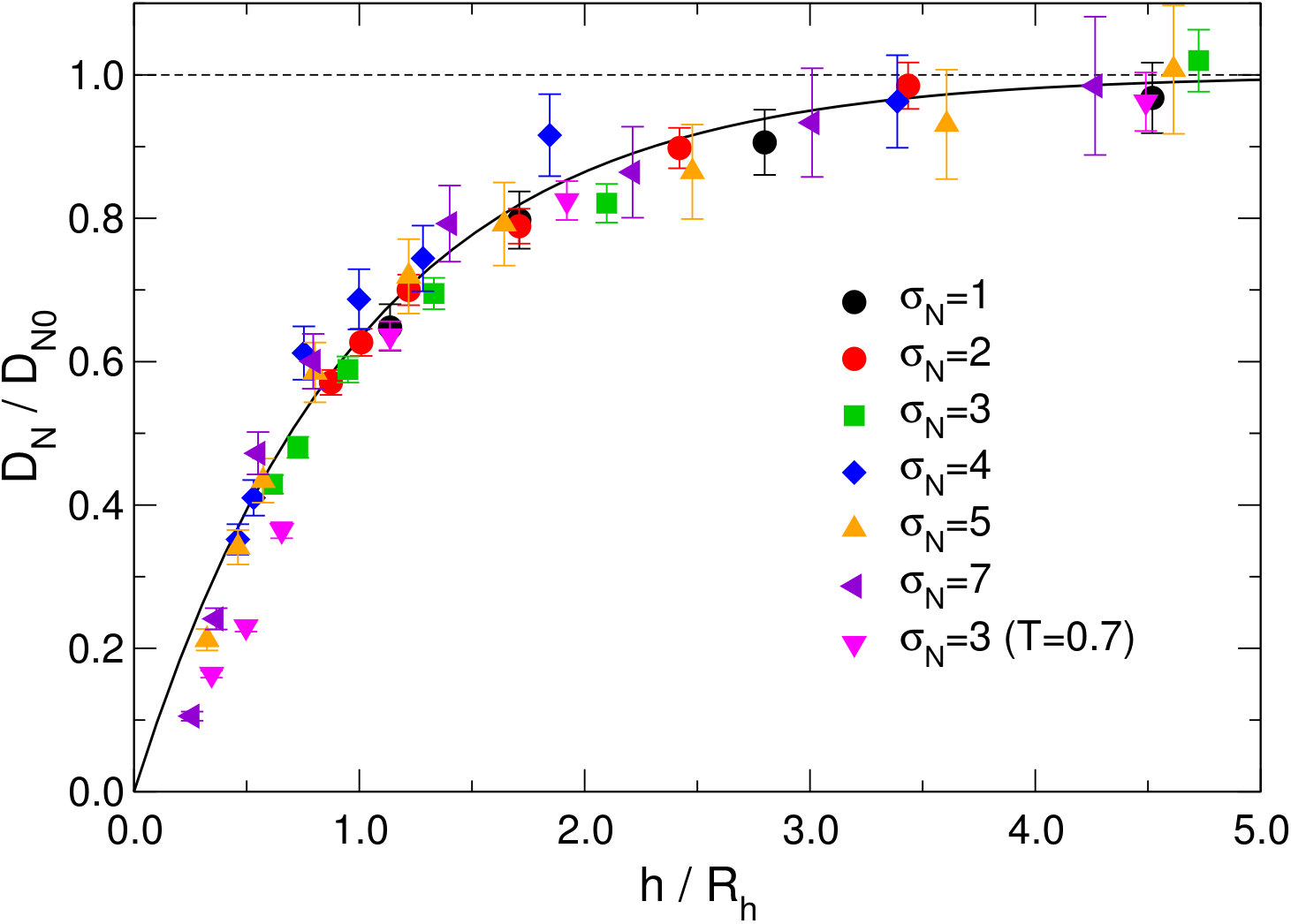 Figure 1
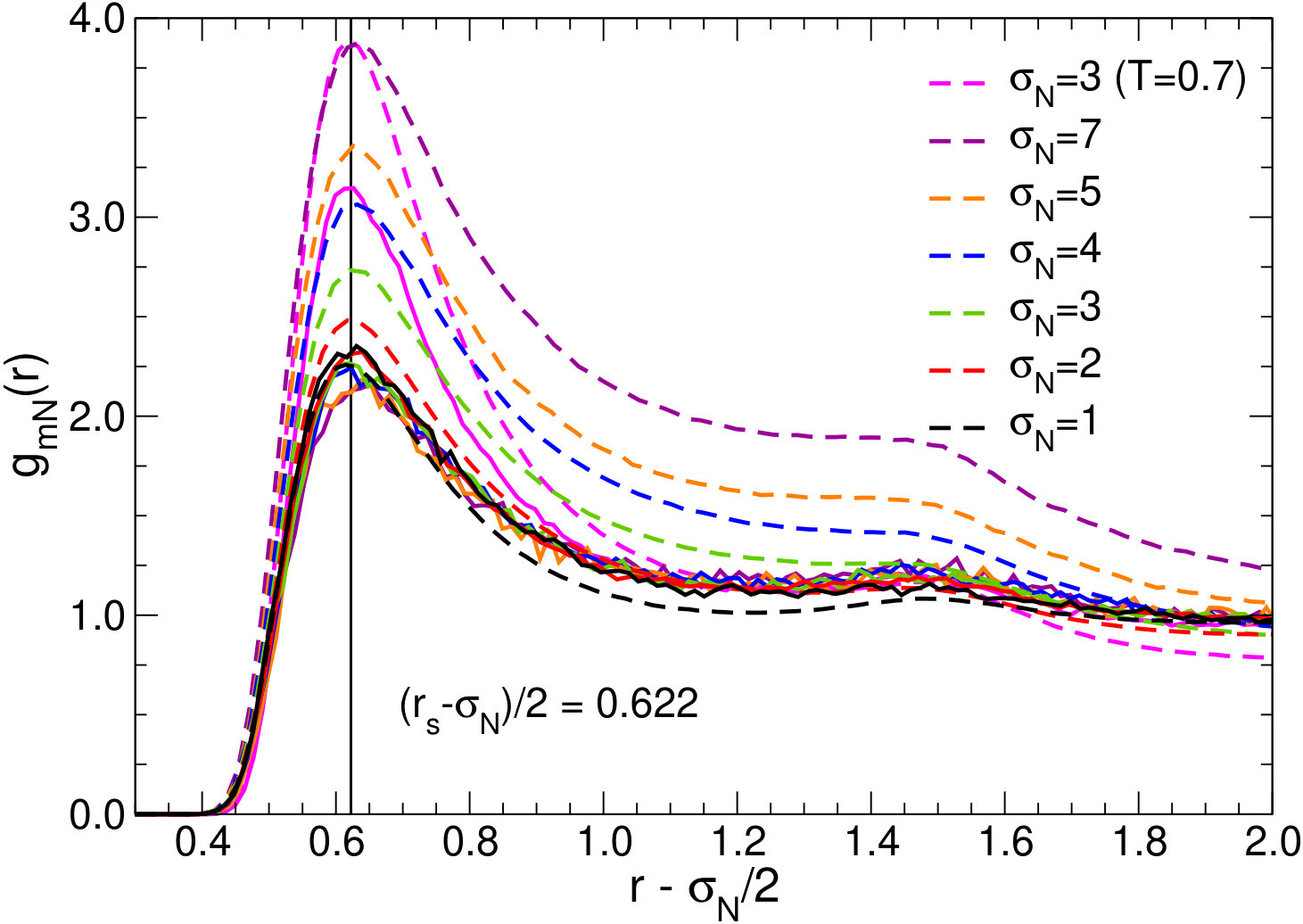 Figure 2
Peer Reviews
No public reviews on file for this paper yet. If you reviewed it on a platform where reviews are public (OpenReview, ICLR, NeurIPS, ICML), you can paste yours below so the community can read it here.
Videos
No videos yet. Explain this paper in a talk, walkthrough, or lecture? Add one.
Addition to “Structure and dynamics of a polymer-nanoparticle composite: Effect of nanoparticle size and volume fraction”
Valerio Sorichetti
Laboratoire Charles Coulomb (L2C), Univ. Montpellier, CNRS, F-34095, Montpellier, France and IATE, INRA, CIRAD, Montpellier SupAgro, Univ. Montpellier, F-34060, Montpellier, France
Virginie Hugouvieux
IATE, INRA, CIRAD, Montpellier SupAgro, Univ. Montpellier, F-34060, Montpellier, France
Walter Kob
Laboratoire Charles Coulomb (L2C), Univ. Montpellier, CNRS, F-34095, Montpellier, France
Abstract
In our previous publication (Ref. 1) we have shown that the data for the normalized diffusion coefficient of the polymers, , falls on a master curve when plotted as a function of , where is the mean interparticle distance and is a dynamic length scale. In the present note we show that also the normalized diffusion coefficient of the nanoparticles, , collapses on a master curve when plotted as a function of , where is the hydrodynamic radius of the nanoparticles.
In Sec. 4.4 of the original paper Sorichetti et al. (2018) we discussed the behavior of the reduced diffusion coefficient of the nanoparticles (NP), , as a function of the NP volume fraction (Fig. 13a) and of the NP diameter (Fig. 13b). Here, .
We report here an interesting observation that went unnoticed before the publication of Ref. 1. In that paper, Fig. 11, we showed that the reduced diffusion coefficient of the polymers collapses on a master curve when plotted as a function of the dynamic confinement parameter , where is the interparticle distance (see Sec. AI in the Appendix of Ref. 1) and is a fit parameter that depends on temperature and which can be interpreted as a dynamic length scale associated to polymer motion. The parameter is a generalization of the static confinement parameter introduced by Composto and coworkers Gam et al. (2011); Lin et al. (2016). The master curve is well described by the expression (Eq. 14 in Ref. 1).
Applying the same line of reasoning to the NP diffusion coefficient, we have fitted to the expression and found that this expression fits the data well with . In the following, we will argue that this value can be interpreted as the hydrodynamic radius of the NPs, i.e., .
In Ref. 1, Sec. 4.4, we defined the hydrodynamic radius of the NPs as , which is the minimum distance between the center of a NP and that of a monomer if they are considered as hard spheres of diameter and , respectively. However, the monomer-NP interaction potential is certainly steep, but not a hard-sphere potential. A more precise way to define is therefore to resort to the monomer-NP radial distribution function, , which we present in Fig. 1. This graph shows that for all values of , and temperature considered in the original work, displays a main peak located at
[TABLE]
where , defined in Sec. 3.1 of Ref. 1, is twice the distance of the minimum of the monomer-NP potential. The position of the main peak corresponds to the typical distance of closest approach between a monomer and a NP. Since Fig. 1 shows that the position of the peak relative to is basically independent of the relevant parameters of the system, i.e., and , and since it has been obtained directly by analyzing the configurations (with no assumption on the monomer-NP interaction potential) we propose the identification 111We note that this redefinition of does not change the results discussed in Sec. 4.3 of Ref. 1 (notably Fig. 12) significantly, since the value of changes only slightly., thus
[TABLE]
In Fig. 2 we show as a function of , and compare it with the expression
[TABLE]
We stress that here is not a fit parameter but obtained from Eq. (2). We note that although Eq. (3) gives a good description of the data, the discrepancy between the data and Eq. (3) is not negligible, as it is clear from the fact that one sees small but significant differences between the data and Eq. (3) at small values of .
In conclusion, we have shown that the interparticle distance controls not only the dynamics of the polymers, but also that of the NPs. In the case of the polymers, the reduced diffusion coefficient collapses on a master curve when plotted as a function of , where is a temperature-dependent parameter which does not depend on the NP diameter . In the case of the NPs, the variable which controls is , where is the hydrodynamic radius of the NPs, given by Eq. (2), which we find to be basically independent of temperature. At present, it is not clear how general these results are and if there is a unifying theory which explains both these observations, and therefore additional studies on this dependence are called for. In particular, simulations at different thermodynamic conditions and possibly with chains of different lengths are needed in order to clarify these questions.
The reference list from the paper itself. Each links out to its DOI / PubMed record.
- 1Sorichetti et al. (2018) V. Sorichetti, V. Hugouvieux, and W. Kob, Macromolecules 51 , 5375 (2018).
- 2Gam et al. (2011) S. Gam, J. S. Meth, S. G. Zane, C. Chi, B. A. Wood, M. E. Seitz, K. I. Winey, N. Clarke, and R. J. Composto, Macromolecules 44 , 3494 (2011).
- 3Lin et al. (2016) C.-C. Lin, E. Parrish, and R. J. Composto, Macromolecules 49 , 5755 (2016).
- 4Note (1) We note that this redefinition of R h subscript 𝑅 ℎ R_{h} does not change the results discussed in Sec. 4.3 of Ref. 1 (notably Fig. 12) significantly, since the value of σ h / 2 R g = R h / R g subscript 𝜎 ℎ 2 subscript 𝑅 𝑔 subscript 𝑅 ℎ subscript 𝑅 𝑔 \sigma_{h}/2R_{g}=R_{h}/R_{g} changes only slightly.