Comment on Nahimovs et al. `On the probability of finding marked connected components using quantum walks'
Adam Glos, Nikolay Nahimovs

TL;DR
This comment paper identifies and corrects misconceptions in Nahimovs et al.'s work on quantum walks, specifically regarding stationary states and probability bounds, clarifying the conditions under which their theorems hold.
Contribution
It highlights incomplete conditions in Theorem 2 and corrects the derivation of the coefficient in Theorem 3, refining the original results.
Findings
Theorem 2 is only valid when unmarked vertices form a single connected component.
The derivation of the coefficient in Theorem 3 was corrected.
Upper bounds for the coefficient were established.
Abstract
In this comment paper we present two misconceptions found in paper of Nahimovs et al. \emph{On the probability of finding marked connected components using quantum walks}. First, we show that the Theorem 2 (sufficient and necessary condition for a state to be stationary) is incomplete -- it works only if unmarked vertices form a single connected component. Second, we correct derivation of \emph{a} coefficient in the Theorem 3 (lower bound on the probability) and show how to upper bound value of \emph{a}.
Click any figure to enlarge with its caption.
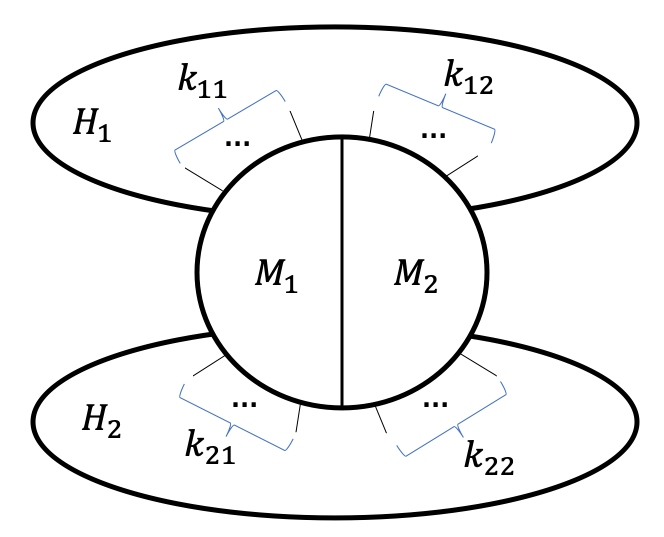 Figure 1
Peer Reviews
No public reviews on file for this paper yet. If you reviewed it on a platform where reviews are public (OpenReview, ICLR, NeurIPS, ICML), you can paste yours below so the community can read it here.
Videos
No videos yet. Explain this paper in a talk, walkthrough, or lecture? Add one.
Taxonomy
TopicsQuantum Computing Algorithms and Architecture · Quantum-Dot Cellular Automata · Quantum Information and Cryptography
Comment on Nahimovs et al. ‘On the probability of finding marked connected components using quantum walks’
Adam Glos
Institute of Theoretical and Applied Informatics, Polish Academy of Sciences, ul. Bałtycka 5, 44-100 Gliwice, Poland
Institute of Informatics, Silesian University of Technology, ul. Akademicka 16, 44-100 Gliwice, Poland
Nikolay Nahimovs
Centre for Quantum Computer Science, Faculty of Computing University of Latvia Riga Latvia
Abstract
In this comment paper we present two misconceptions found in paper of Nahimovs et al. On the probability of finding marked connected components using quantum walks. First, we show that the Theorem 2 (sufficient and necessary condition for a state to be stationary) is incomplete – it works only if unmarked vertices form a single connected component. Second, we correct derivation of a coefficient in the Theorem 3 (lower bound on the probability) and show how to upper bound value of a.
1 Corrections
1.1 Theorem 2
Let be an undirected graph and be a connected set of marked vertices. In [1] the authors showed
Theorem 1**.**
If is bipartite, then we can assign amplitudes to neutralise the shortages at each marked vertex if and only if the sums of the shortages on both partite sets are equal.
The shortage of a marked vertex is defined to be a sum of amplitudes between the vertex and its neighbouring unmarked vertices. Neutralising the shortages means finding amplitudes inside the marked component such that the total sum of amplitudes of each marked vertex is [math].
Let be bipartite with partite sets and and let
[TABLE]
be a total outgoing degree of , where is the degree of in . The authors of [2] claimed that according to the theorem above, the following theorem holds.
Theorem 2**.**
A bipartite marked connected component has a stationary state if and only if . A non-bipartite marked connected component always has a stationary state.
It turns out that the theorem is correct only if the induced subgraph spanned by is connected, as in such scenario all amplitudes of edges incident to an unmarked vertex must be equal. However, if is disconnected then amplitudes in its connected components might be different. Therefore, one can always construct a stationary state.
Theorem 3**.**
Let be connected graph, let be a connected set of marked vertices and let be disconnected. Then always has a stationary state.
Proof.
For simplicity suppose consist of two connected components and . The argument below can be easily extended to arbitrary number of components.
Let be a number of edges between vertices of and (see Figure 1). Similarly, we define , and . Let amplitudes of edges incident to vertices of be (all amplitudes must be equal) and amplitudes of edges incident to vertices of be .
The sum of shortages of is
[TABLE]
and the sum of shortages of is
[TABLE]
It follows from Theorem 1 that if one can assign amplitudes to neutralise shortages (i.e. construct a stationary state). Therefore, we need
[TABLE]
or
[TABLE]
As and are independent it is always possible to choose their values to satisfy the equality. ∎
Note that the constructed stationary state can have [math] overlap with the initial state. As before, let consist of two connected components and .
The initial state has all amplitudes equal to . The overlap of with the initial state is [math] (as the sum of amplitudes for each vertex of is [math]). Consider overlap of the rest of the graph . Let and . Then, from (2) we have . Therefore, if we have .
1.2 Derivation of in the proof of Theorem 3.
In the proof of Theorem 3 in [2] authors claimed that , where is the number of edges. Authors have defined through stationary state and have not considered the normalisation of the state, which in turns makes the mentioned equality incorrect in general. While it may be difficult to precisely determine the optimal value, it is relatively easy to provide upper bound that is satisfactory for small exceptional configurations.
Note that authors have considered only stationary states with the amplitudes for arbitrary unmarked and arbitrary being all equal. Since according to Theorem 2 from [1] only these amplitudes has impact on overlap between stationary state and initial state, can be upper-bounded by of the form
[TABLE]
Note that does not need to be a stationary state, but presents the worst case scenario of optimal stationary states. Thus
[TABLE]
where is the set of edges between marked vertices ad is the number of edges between marked and unmarked vertices. Thus,
[TABLE]
2 Final statements of Theorems 3
Finally we present a corrected version of Theorem 3.
Theorem 4**.**
Consider a graph with a component of marked vertices . Let be such that there exists a stationary state with amplitudes of unmarkedmarked arcs being all equal. Then the probability of finding a marked vertex after steps satisfies
[TABLE]
Note that the Theorem 3 covers also the Corollary 1 presented in [2].
The reference list from the paper itself. Each links out to its DOI / PubMed record.
- 1[1] K. Prūsis, J. Vihrovs, and T. G. Wong, “Stationary states in quantum walk search,” Physical Review A , vol. 94, no. 3, p. 032334, 2016.
- 2[2] K. Khadiev, N. Nahimovs, and R. Santos, “On the probability of finding marked connected components using quantum walks,” Lobachevskii Journal of Mathematics , vol. 39, no. 7, pp. 1016–1023, 2018.