Single-Particle properties of a strongly-interacting Bose-Fermi mixture with mass and population imbalance
Koki Manabe, Daisuke Inotani, Yoji Ohashi

TL;DR
This paper explores the effects of mass and population imbalance on the single-particle spectral properties of strongly interacting Bose-Fermi mixtures, revealing persistent spectral anomalies that can be observed via photoemission spectroscopy.
Contribution
It extends previous balanced mixture studies to imbalanced systems, demonstrating that spectral anomalies remain observable under realistic imbalance conditions.
Findings
Multiple peak structures in spectral weight persist in imbalanced mixtures.
Spectral anomalies are detectable via photoemission spectrum.
Results are relevant for real trapped Bose-Fermi mixtures with imbalance.
Abstract
We theoretically investigate strong-coupling properties of a Bose-Fermi mixture. In the mass- and population-balanced case, two of the authors have shown that a strong hetero-pairing interaction in this mixture brings about coupling phenomena between Fermi atomic excitations and Bose atomic and composite molecular excitations, that appear as an anomalous multiple peak structure in the single-particle spectral weight (SW). [D. Kharga, {\it et. al.}, J. Phys. Soc. Jpn. {\bf 86}, 084301 (2017)]. In this paper, extending this previous work, we show that, although these many-body phenomena are sensitive to mass and population imbalances between the Bose and Fermi components, SW still exhibits the multiple peak structure in a moderately mass-imbalanced Rb-K and Na-K mixtures. We also point out that the photoemission spectrum is a useful quantity to observe this…
Click any figure to enlarge with its caption.
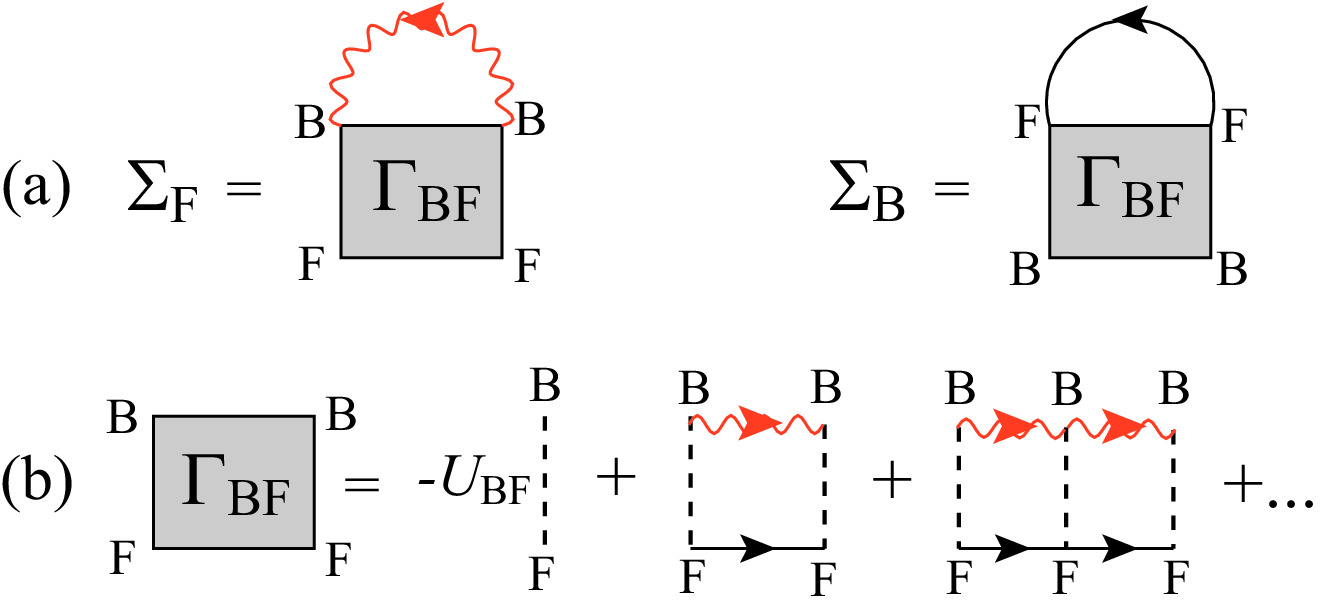 Figure 1
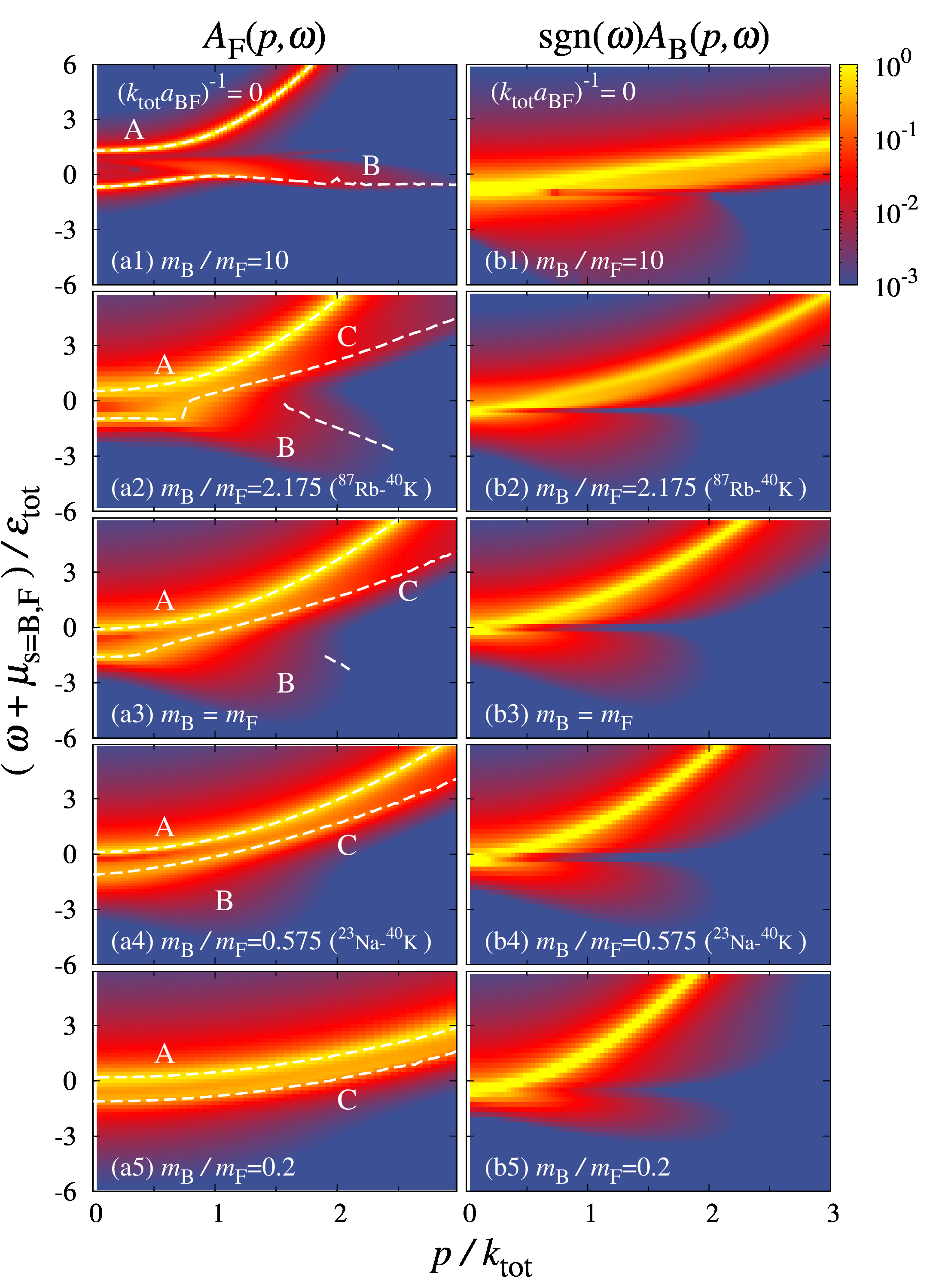 Figure 10
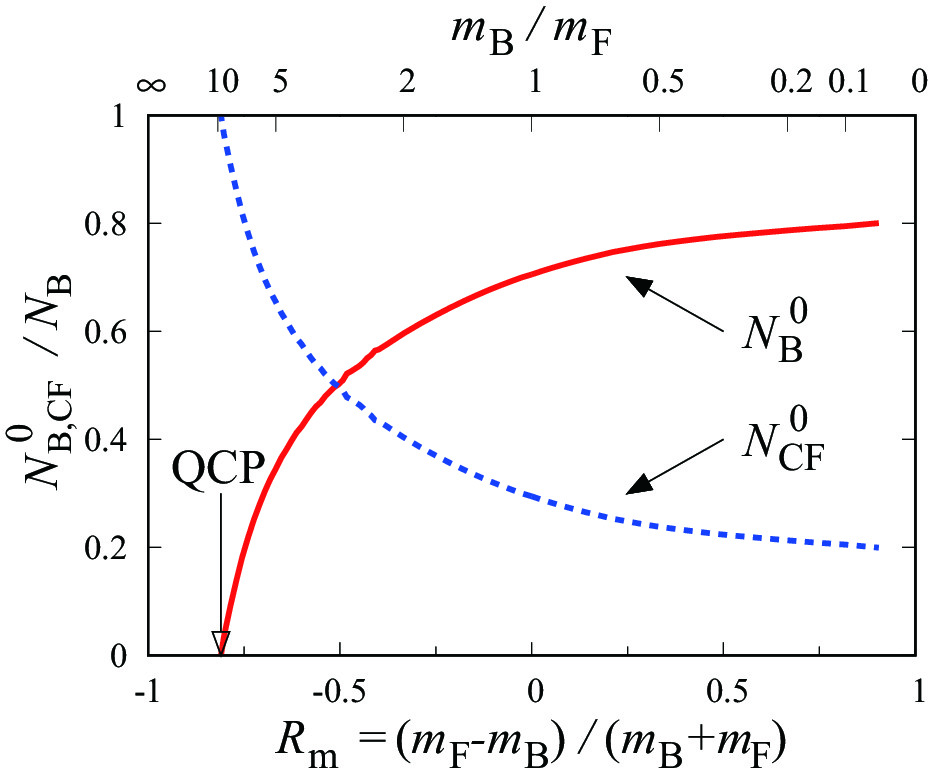 Figure 11
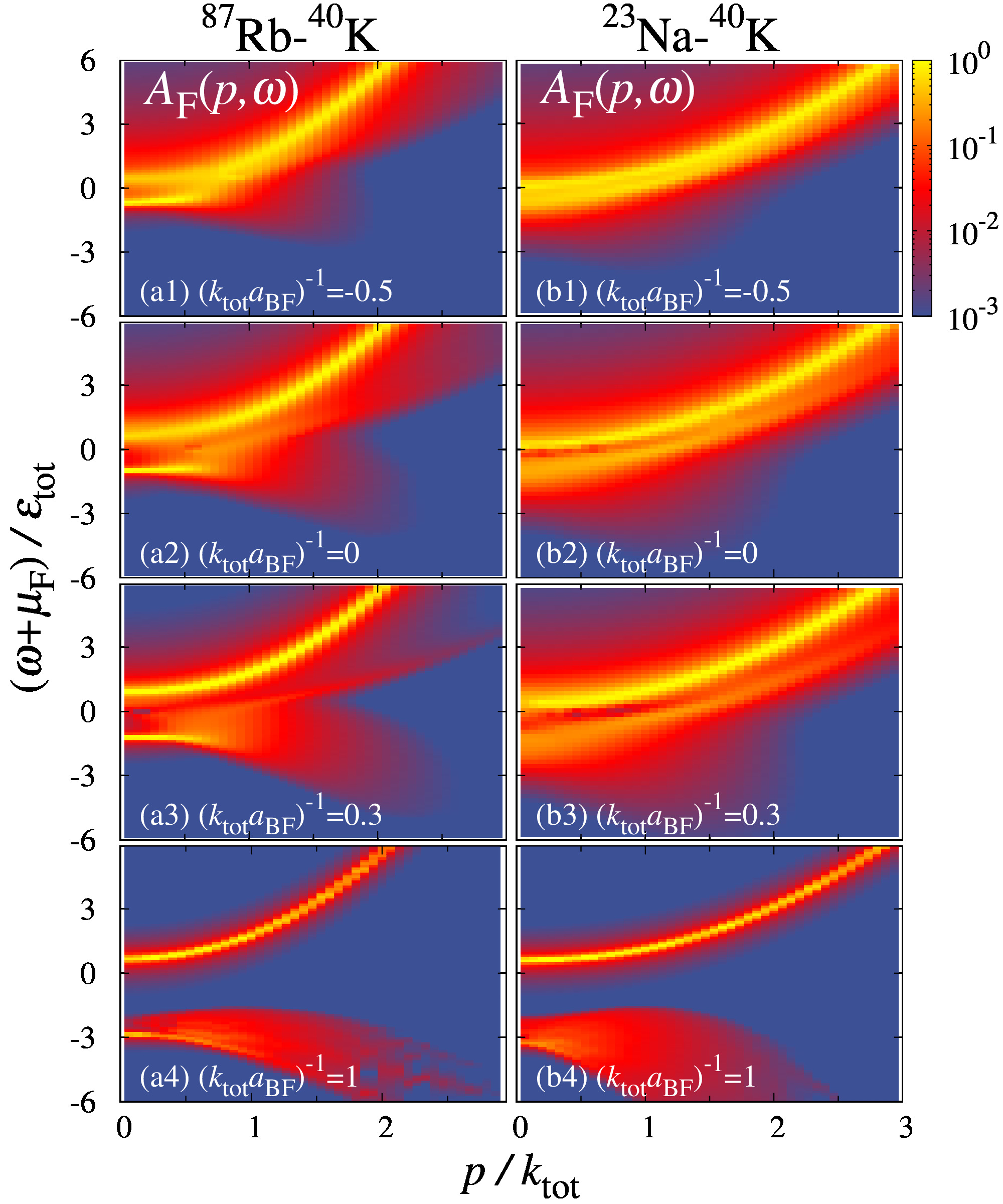 Figure 12
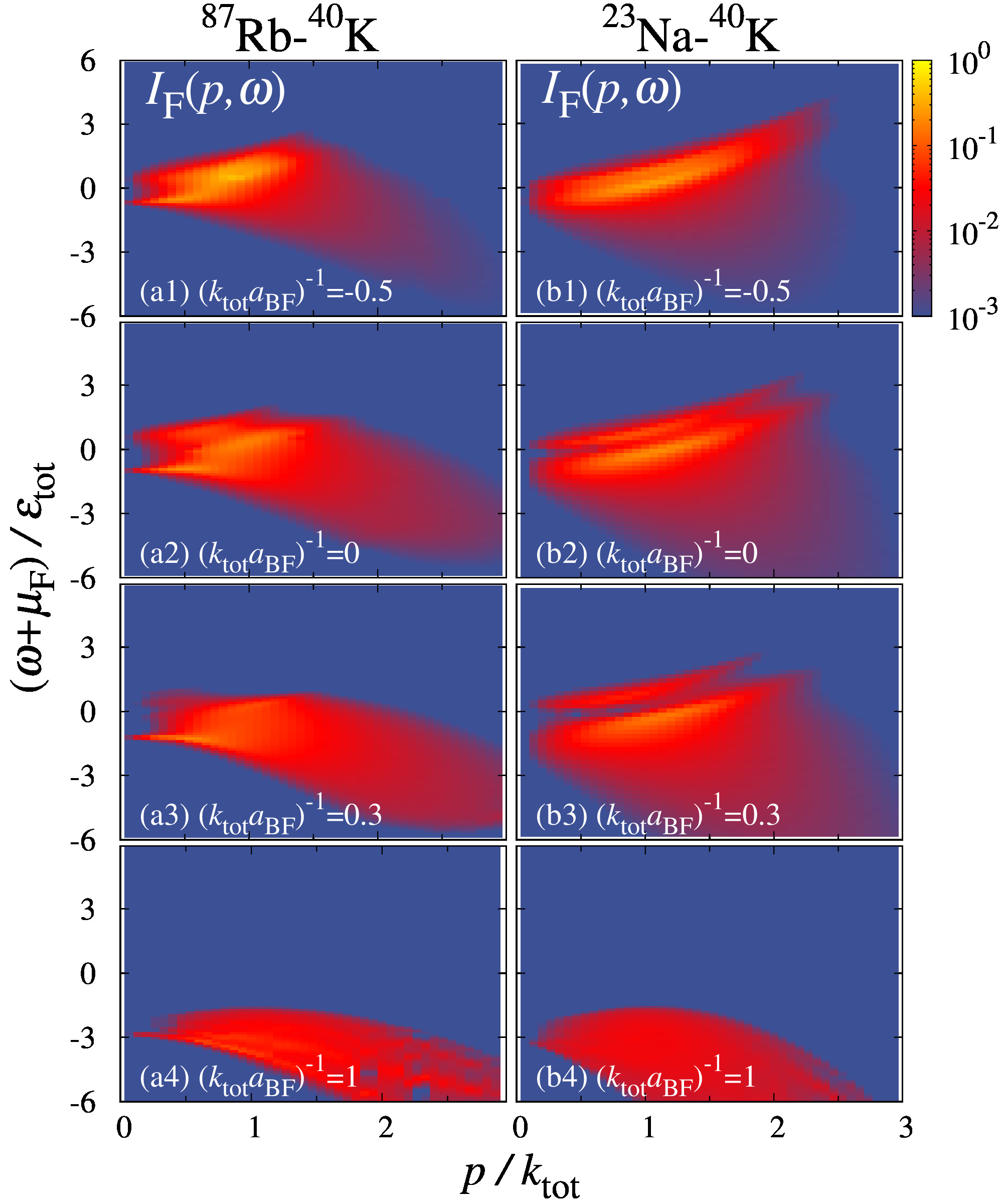 Figure 13
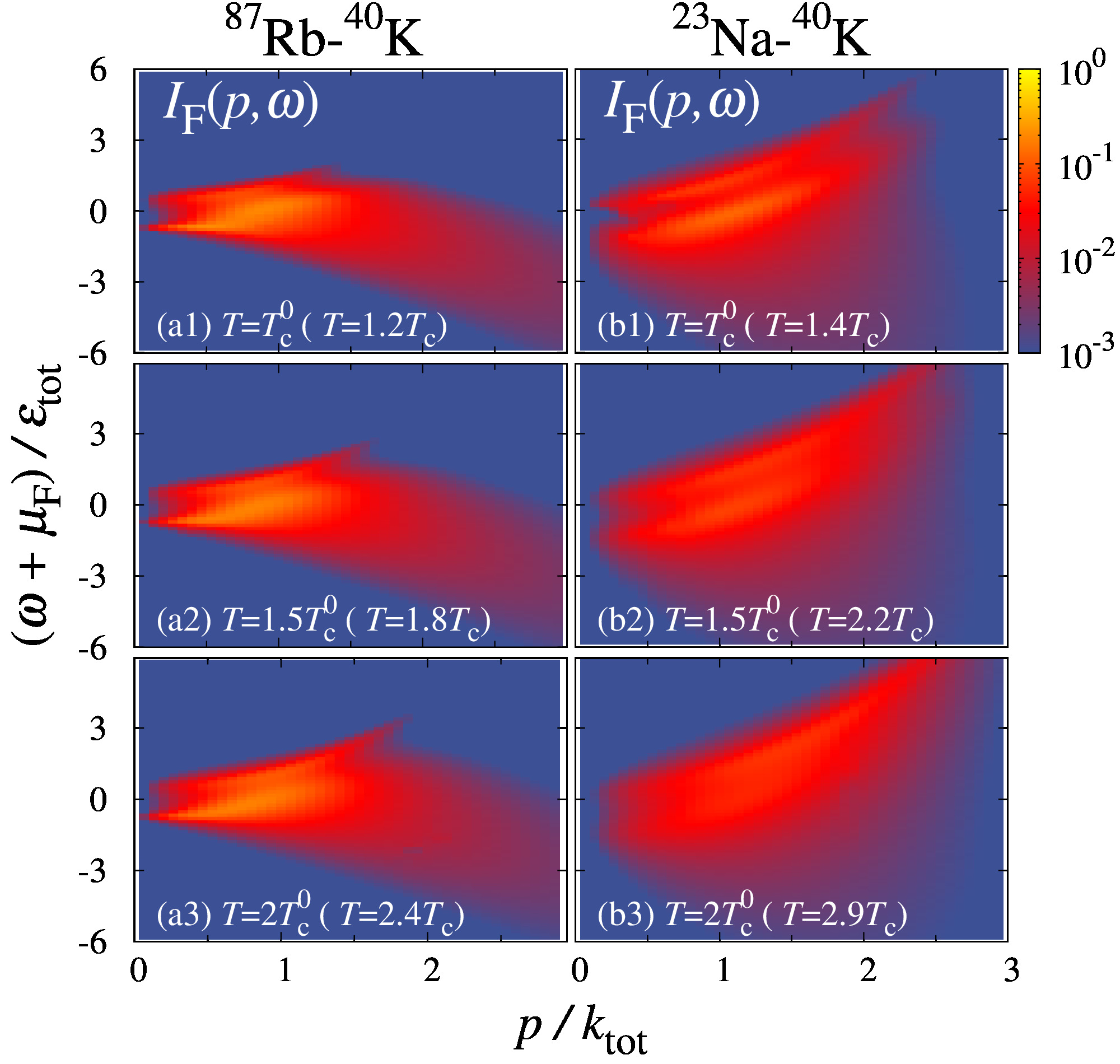 Figure 14
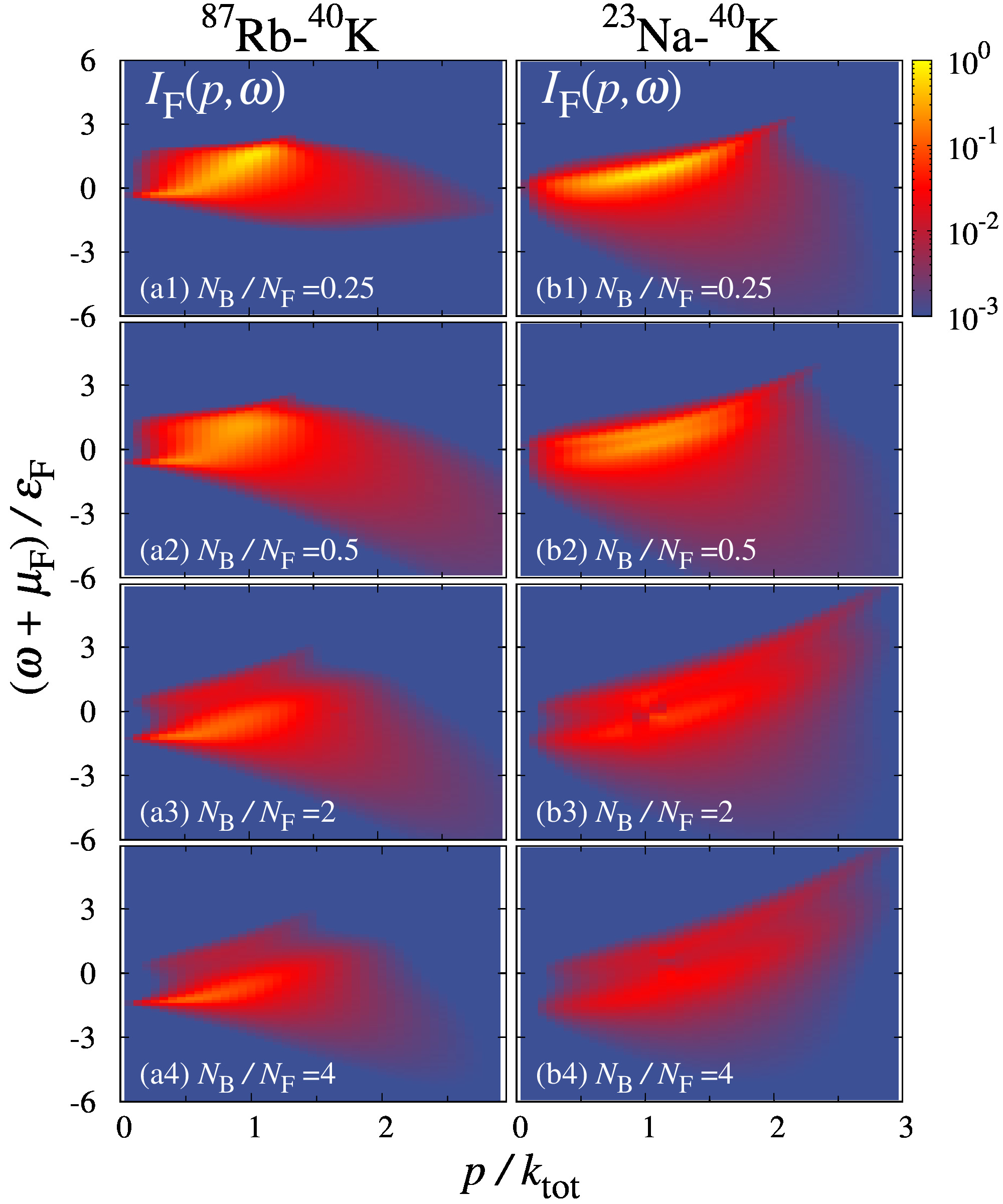 Figure 15
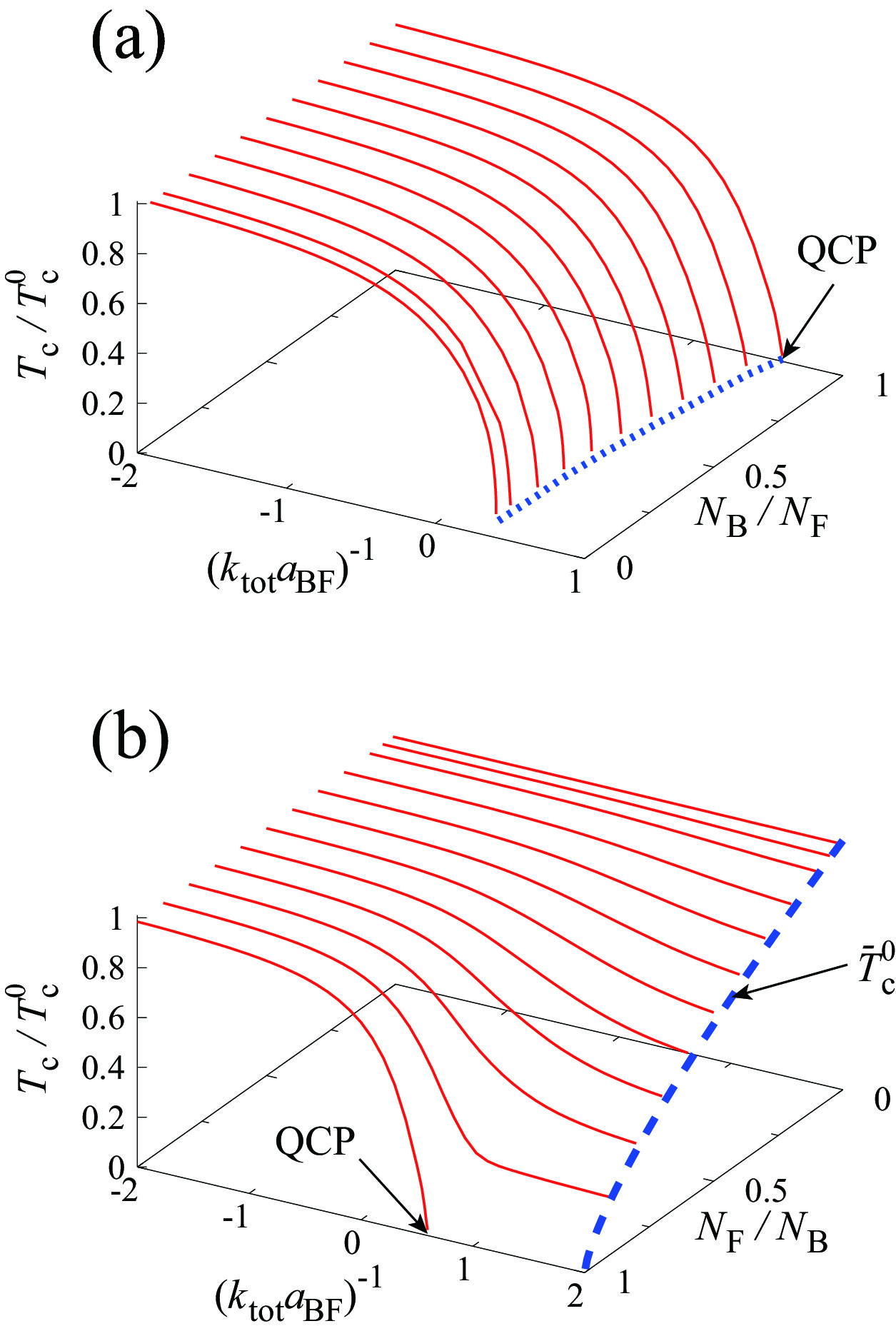 Figure 2
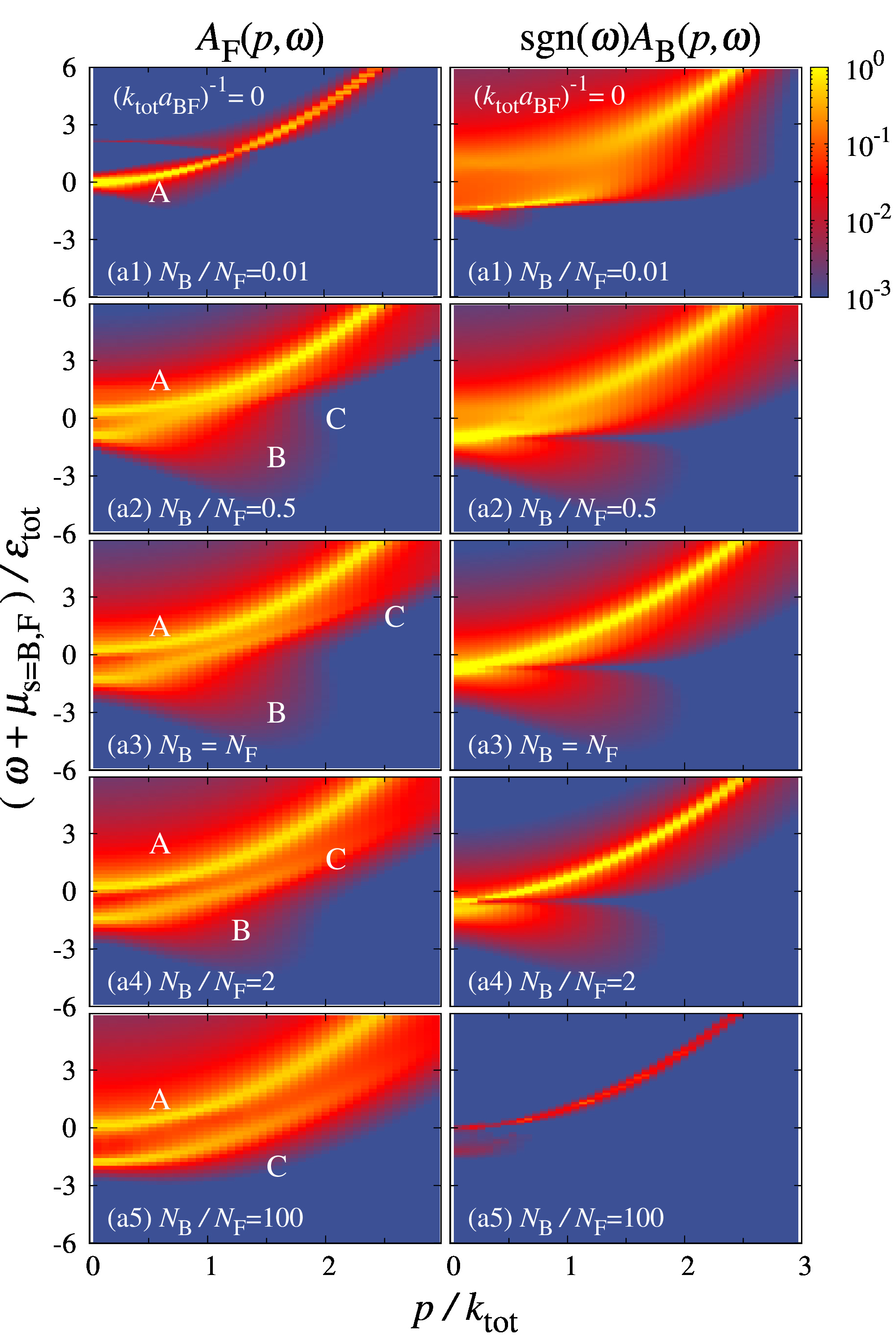 Figure 3
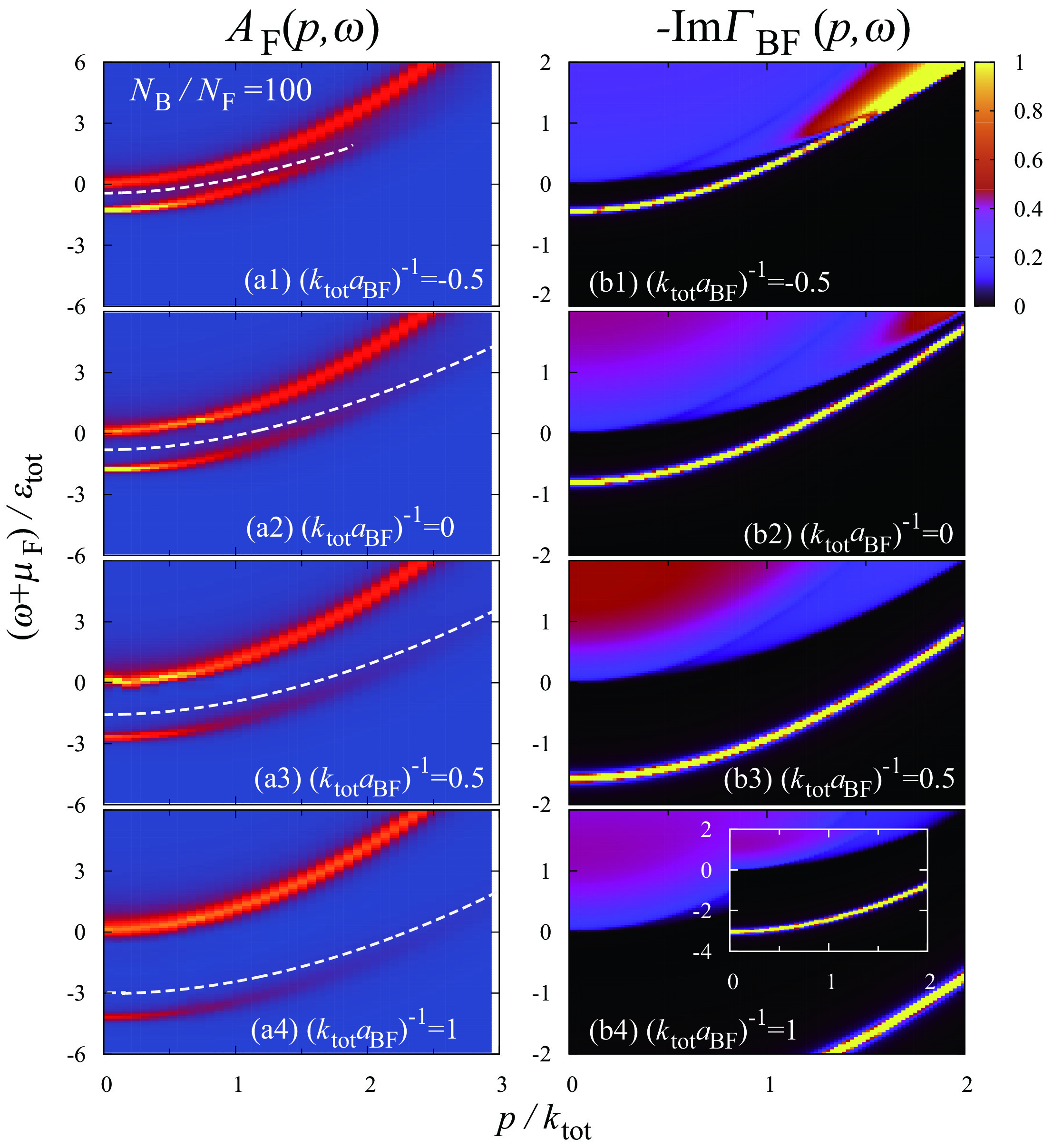 Figure 4
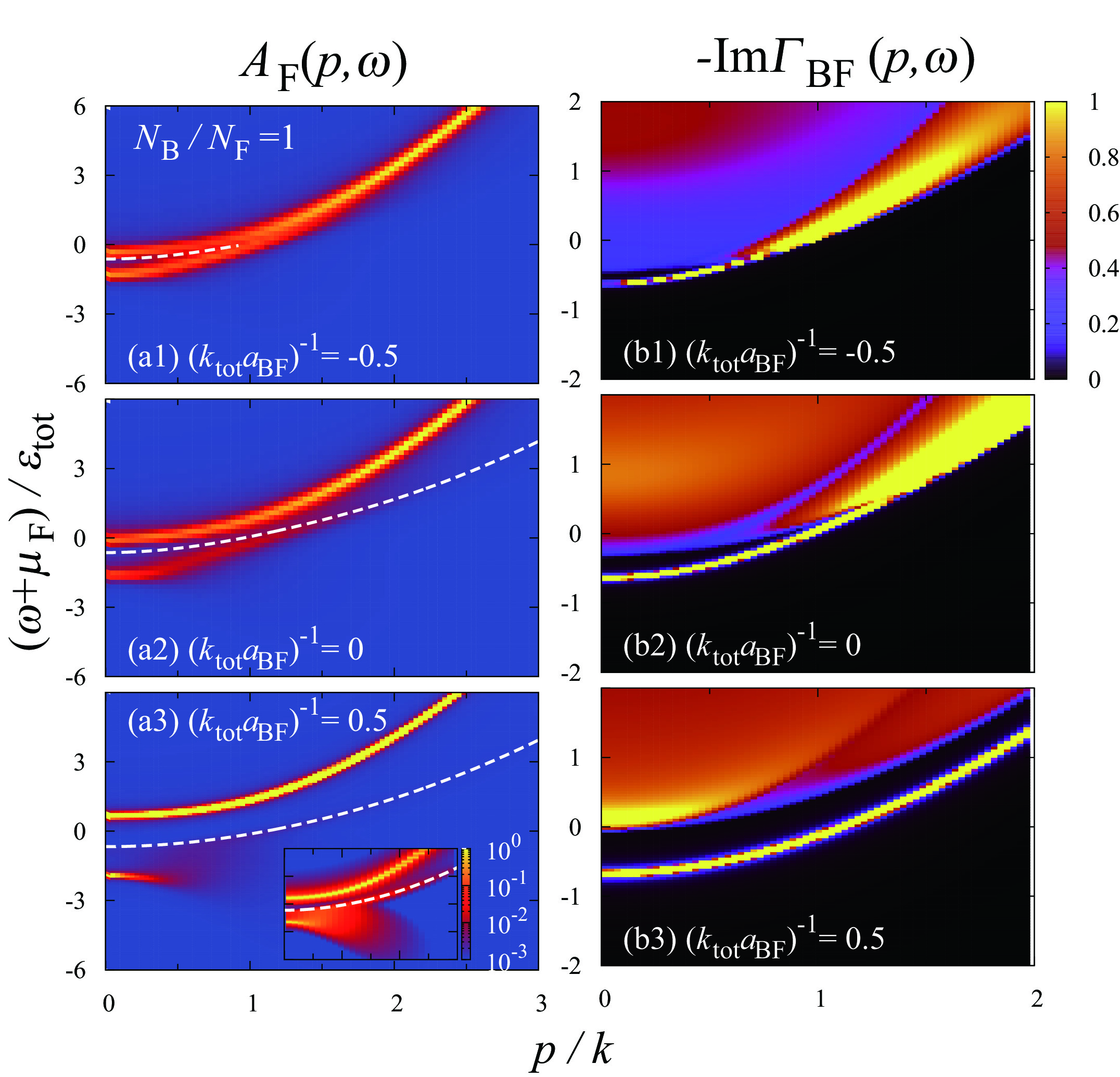 Figure 5
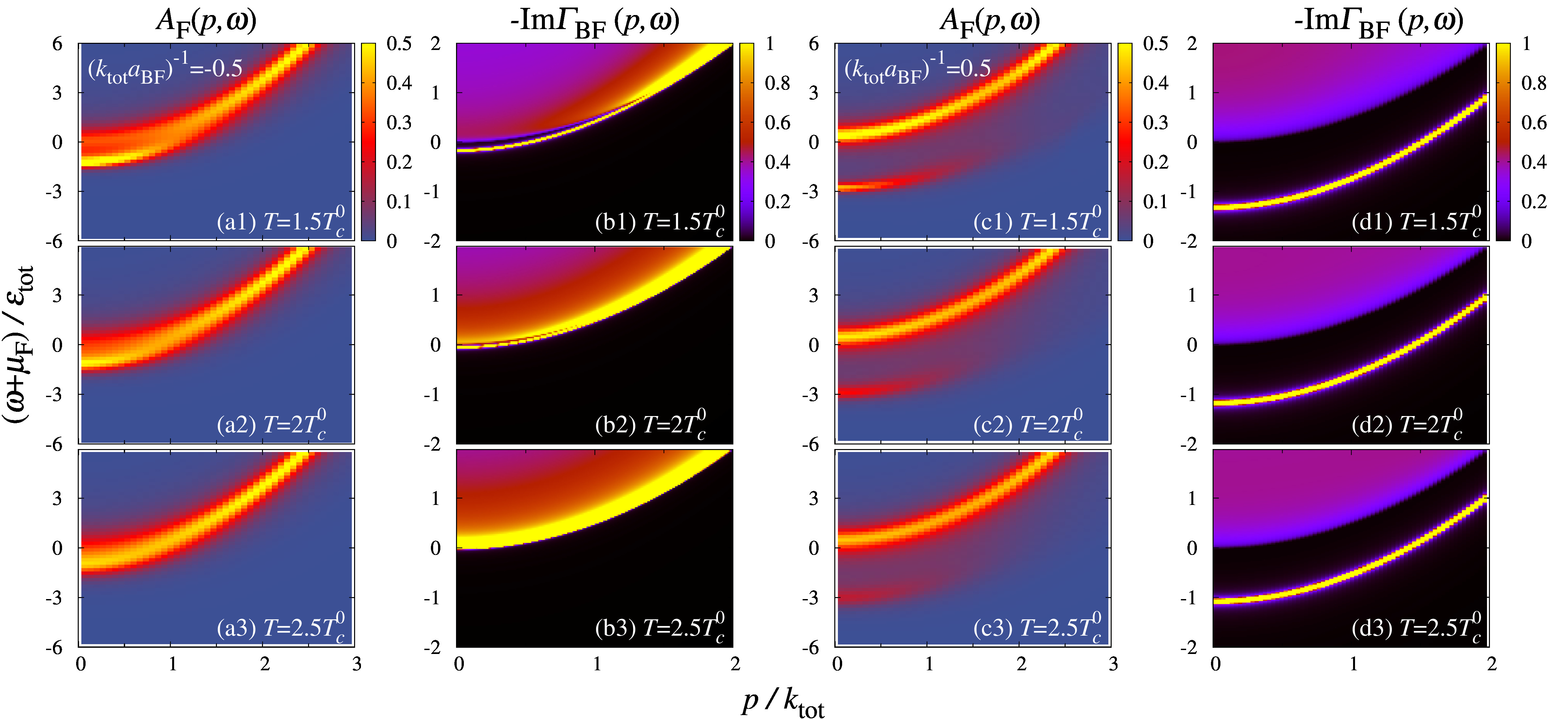 Figure 6
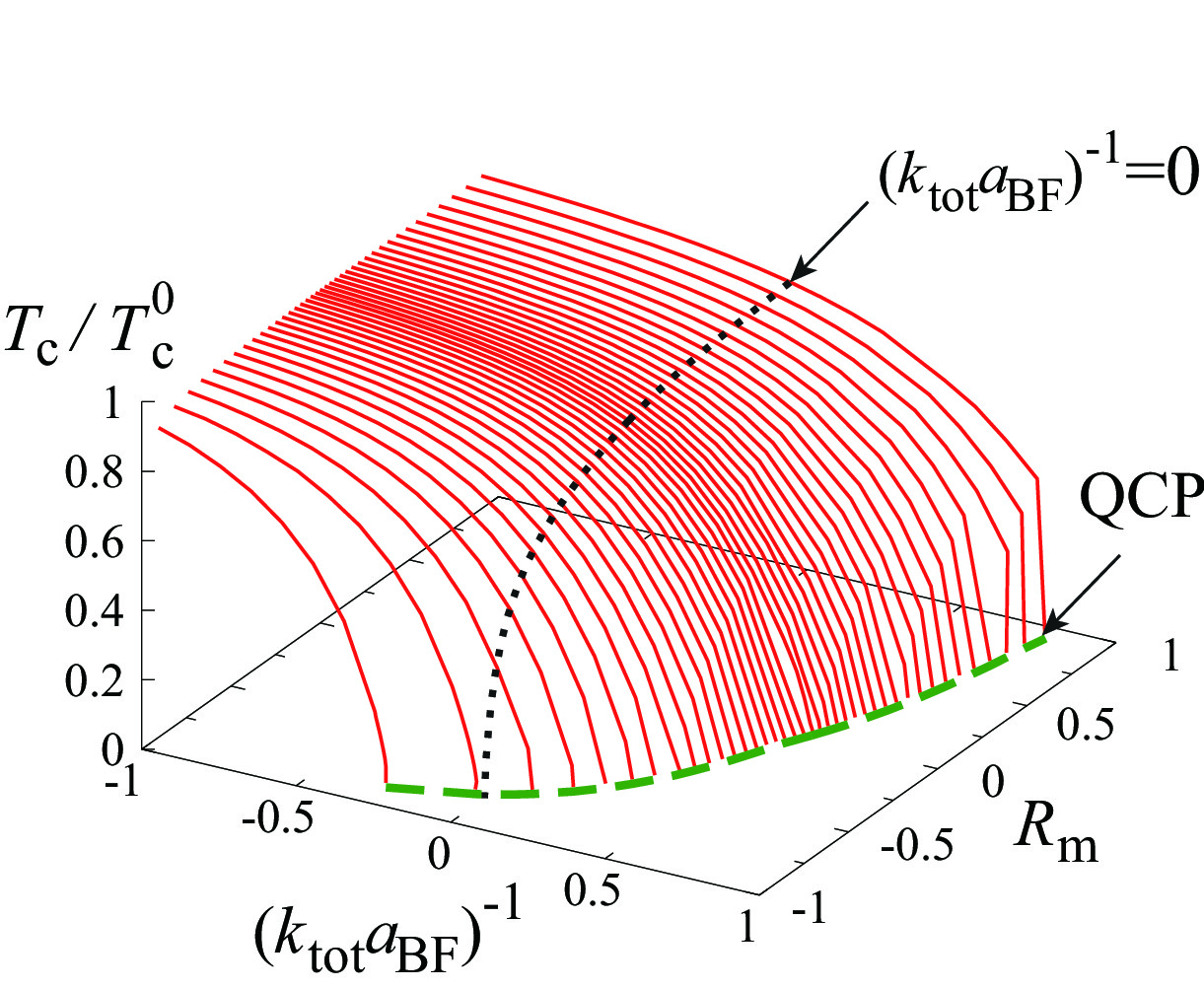 Figure 7
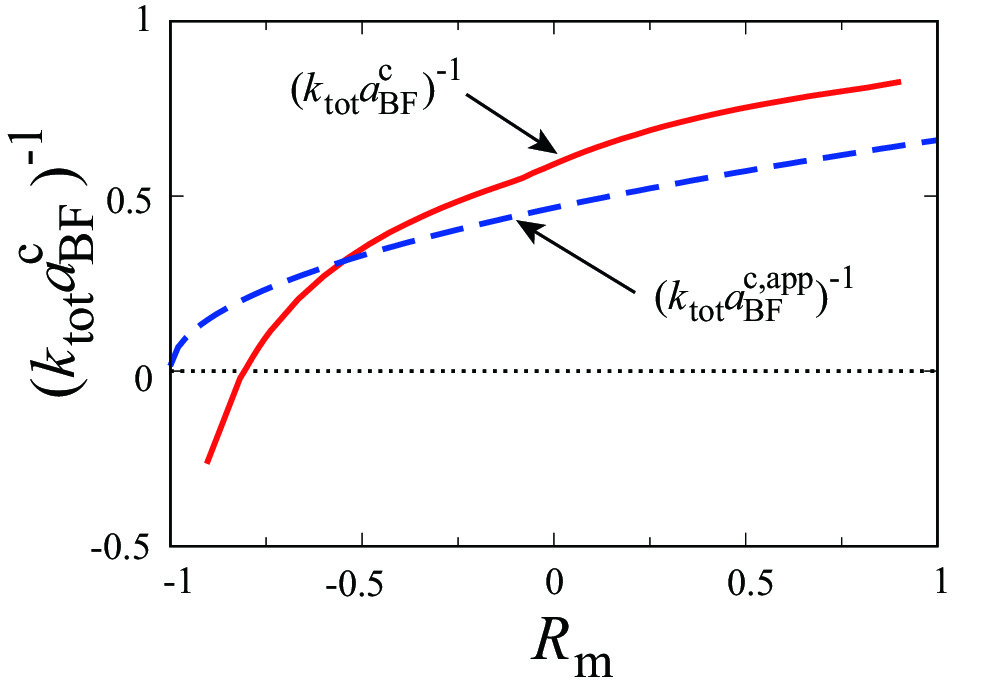 Figure 8
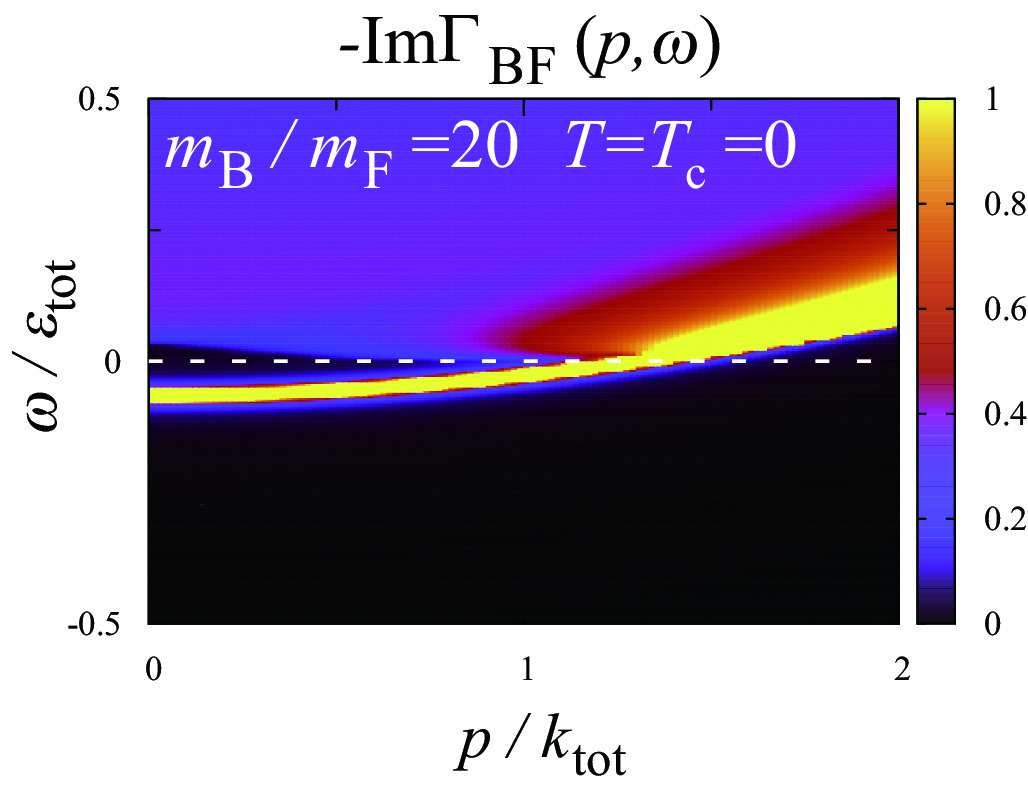 Figure 9
Peer Reviews
No public reviews on file for this paper yet. If you reviewed it on a platform where reviews are public (OpenReview, ICLR, NeurIPS, ICML), you can paste yours below so the community can read it here.
Videos
No videos yet. Explain this paper in a talk, walkthrough, or lecture? Add one.
Single-particle properties of a strongly-interacting Bose-Fermi mixture with mass and population imbalance
Koki Manabe1, Daisuke Inotani2, and Yoji Ohashi1
1 Department of Physics, Keio University, 3-14-1 Hiyoshi, Kohoku-ku, Yokohama 223-8522, Japan
2 Research and Education Center for Natural Sciences, Keio University, 4-1-1 Hiyoshi, Kohoku-ku, Yokohama 223-8521, Japan
Abstract
We theoretically investigate strong-coupling properties of a Bose-Fermi mixture. In the mass- and population-balanced case, two of the authors have shown that a strong hetero-pairing interaction in this mixture brings about coupling phenomena between Fermi atomic excitations and Bose atomic and composite molecular excitations, that appear as an anomalous multiple peak structure in the single-particle spectral weight (SW). [D. Kharga, et. al., J. Phys. Soc. Jpn. 86, 084301 (2017)]. In this paper, extending this previous work, we show that, although these many-body phenomena are sensitive to mass and population imbalances between the Bose and Fermi components, SW still exhibits the multiple peak structure in a moderately mass-imbalanced 87Rb-40K and 23Na-40K mixtures. We also point out that the photoemission spectrum is a useful quantity to observe this spectral anomaly. Since a real trapped Bose-Fermi mixture is usually accompanied by mass and (local) population imbalance, our results would contribute to the study of a strongly interacting Bose-Fermi mixture, under realistic imbalanced conditions.
I Introduction
The high tunability of ultracold atomic gases has contributed to the development of quantum many-body physics discussed in various research fieldsBloch ; Giorgini ; Georgescu ; Gross : Using an optical lattice technique, Greiner and co-workers have observed the superfluid-Mott insulator transition in a 87Rb Bose gasGreiner . In 40KRegal and 6Li Fermi gasesZwierlein ; Kinast ; Jochim , the superfluid phase transition and the BCS (Bardeen-Cooper-Schrieffer)-BEC (Bose-Einstein condensation) crossover phenomenonEagles ; Leggett ; Engelbrecht ; BCS-BEC_rev1 ; BCS-BEC_rev2 have been realized, by using a tunable pairing interaction associated with a Feshbach resonanceChin .
Besides Bose gas and Fermi gas, a gas mixture of Bose and Fermi atoms has also extensively been studied in cold atom physicsdg_KLi1 ; dg_LiLi1 ; dg_LiLi2 ; dg_LiNa1 ; FR_KRb1 ; FR_KRb2 ; FR_KRb3 ; FR_KRb4 ; FR_LiCs1 ; FR_LiNa1 ; FR_LiNa2 ; FR_LiRb1 ; FR_NaK1 ; FR_NaK2 ; Mf_KRb1 ; Mf_KRb2 ; Mf_KRb3 ; Mf_NaK1 ; Mf_NaK2 ; Mf_NaLi1 ; dualSF1 ; dualSF2 ; dualSF3 ; inducedint0 ; cTMA1 ; cTMA2 ; cTMA3 ; cTMA4 ; cTMA5 ; cTMA6 ; iTMA1 ; iTMA2 ; others0 ; others1 ; others2 ; Gamma2 ; Gamma3 ; Gamma4 ; stability1 ; stability2 ; Bruun1 ; Bruun2 ; Bruun3 ; inducedint1 ; inducedint3 ; inducedint4 . This Bose-Fermi mixture is similar to a 4He-3He mixture, as well as quark matter in high-energy physicsQCD1 . Using this similarity, as well as the advantage that one can tune the strength of a Bose-Fermi pairing interaction by using a hetero-nuclear Feshbach resonance, Ref. QCD1 suggests that this atomic mixture may be used as a quantum simulator for the study of dense QCD matter, where a bound di-quark (boson) and an unpaired quark (fermion) form a nucleon (composite fermion).
In a mass- and population-balanced Bose-Fermi mixture, two of the authors have recently shown that a strong Bose-Fermi pairing interaction causes couplings between Fermi atomic excitations and Bose atomic excitations, as well as atomic excitations and molecular excitationsiTMA1 . As an interesting phenomenon associated with these couplings, the Fermi component of the single-particle spectral weight (SW) has been shown to exhibit a three-peak structure, consisting of two sharp peaks along the free fermion dispersion and composite molecular dispersion, and a broad downward peak being related to Bose single-particle excitations. Here, we recall that SW in a free Fermi gas only has a single peak line along the free particle dispersion. In a two-component Fermi gas in the BCS-BEC crossover region, SW is known to exhibit a two-peak structure associated with the pseudogap phenomenon originating from strong-pairing fluctuationsFFSW1 ; FFSW2 ; FFSW3 ; Tsuchiya2009 . Thus, the three-peak structure in the Fermi SW is expected to be a characteristic of a strongly interacting Bose-Fermi mixture.
To confirm this expectation, however, one should remember that any real Bose-Fermi mixture is composed of different kinds of atoms or different isotopes, such as 87Rb-40K and 23Na-40K gases, so that it is always accompanied by mass imbalance. In addition, when it is trapped in a harmonic potential, bosons and fermions have different density profiles so that local population imbalance is unavoidable, even when both the components have the same number of atoms. Although a box-type trap has recently been inventedbox_Fermi ; box_Bose1 ; box_Bose2 (where a trapped gas is almost uniform), the conventional harmonic trap is still used in many experiments. At this stage, it is unclear to what extent these realistic situations affect the above-mentioned many-body coupling phenomena obtained in the somehow academic mass- and population-balanced case. We also note that highly population-imbalanced Bose-Fermi mixture has recently attracted much attention in the study of Bose polaronBose-pol_exp1 ; Bose-pol_exp2 ; Bose-pol_theo1 ; Bose-pol_theo2 ; Bose-pol_theo3 ; Bose-pol_theo4 ; Bose-pol_theo5 .
In this paper, we investigate single-particle properties of a Bose-Fermi mixture with a hetero-nuclear Feshbach resonance. Extending the previous workiTMA1 to include mass and population imbalances, we examine how these affect strong-coupling corrections to SW. We clarify whether or not the many-body coupling phenomena obtained in the mass- and population-balanced case survive in a mass-imbalanced 87Rb-40K and 23Na-40K mixtures. As an observable quantity related to SW, we also deal with the photoemission spectrumPES_exp1 ; PES_exp2 ; PES_exp3 ; PES_rev ; Ota .
This paper is organized as follows. In Sec. II, we explain our formulation. We separately examine effects of population imbalance and mass imbalance in Secs. III, and IV, respectively. In Sec. V, we pick up a 87Rb-40K mixture, as well as a 23Na-40K mixture as typical two example of mass-imbalanced Bose-Fermi mixture. Throughout this paper, we set , and the system volume is taken to be unity, for simplicity.
II Formulation
We consider a gas mixture of single-component Bose atoms and single-component Fermi atoms, with a hetero-nuclear Feshbach resonance. This Bose-Fermi mixture is modeled by the Hamiltonian,
[TABLE]
where is the creation operator of a Bose (s=B) and a Fermi (s=F) atom. is the kinetic energy of the s-component, measured from the chemical potential (where is an atomic mass). is a Bose-Fermi pairing interaction, which is assumed to be tunable by a hetero-nuclear Feshbach resonance. This contact-type interaction brings about the ultraviolet divergence, which is, as usual, absorbed into the -wave scattering length . It is related to the bare pairing interaction as
[TABLE]
Here, is twice the reduced mass, and is a cutoff momentum. We measure the interaction strength in terms of the inverse scattering length . Here is the Fermi momentum in an assumed two-component Fermi gas with the total number of fermions, where is the particle number in the s-component. In this scale, the interaction strength increases with increasing from the negative value. represents the unitarity limit.
This paper only considers a uniform gas, ignoring effects of a harmonic trap, for simplicity. However, the local population imbalance coming from the difference of the density profile between the Bose and the Fermi components in a trap is partially examined by considering the population-imbalanced case ().
Strong-coupling corrections to Bose and Fermi single-particle excitations are conveniently described by the self-energy in the single-particle thermal Green’s functions,
[TABLE]
where () is the boson (fermion) Matsubara frequency.
We evaluate within the framework of the -matrix-type approximation developed in Ref. iTMA1 , which is diagrammatically described in Fig.1. This diagrammatic structure is formally the same as that in the ordinary (non-selfconsistent) -matrix approximation (TMA); however, the crucial difference is that the bare Bose Green’s function,
[TABLE]
in the ordinary TMA self-energy diagrams is now replaced by the modified oneiTMA1 ,
[TABLE]
Here, (where ) involves the self-energy correction at . This is motivated by the Hugenholtz-Pines theoremHP ,
[TABLE]
stating that the Bose excitations become gapless at the BEC phase transition. The modified Green’s function in Eq. (5) is chosen so as to satisfy this required condition at . We briefly note that the bare Bose Green’s function in Eq. (4) still has a gapped Bose excitation spectrum at , which means that the self-energy in TMA underestimates effects of low-energy Bose excitations near .
In this improved -matrix approximation (iTMA), the summation of the diagrams in Fig. 1 gives
[TABLE]
where
[TABLE]
is the bare Fermi single-particle Green’s function, and
[TABLE]
is the iTMA Bose-Fermi scattering matrix, physically describing hetero-pairing fluctuations. Here,
[TABLE]
is the hetero-pair correlation function, where and are the Bose and Fermi distribution function, respectively.
The BEC phase transition temperature is conveniently determined from the Hugenholtz-Pines condition in Eq. (6). We actually solve this equation, together with the equation for the number () of Bose (Fermi) atoms,
[TABLE]
to self-consistently determine , , and . Above , we only deal with the number equations (12) and (13), to evaluate , and .
The single-particle spectral weights (SWs) are related to the analytic-continued Green’s functions as,
[TABLE]
where is an infinitesimally small positive number. The photoemission spectra (PESs) PES_exp1 ; PES_exp2 ; PES_exp3 are then immediately obtained from SWs asPES_rev ; Ota , under the assumption that the final state interaction is absent,
[TABLE]
Here, is a transfer-matrix element from the initial atomic hyperfine state to the final one (). Between the two, the Fermi SW will be found to be more useful for the study of many-body coupling phenomena mentioned in Sec. I. Thus, we only examine the corresponding Fermi PES in this paper.
III Single-particle excitations in a population-imbalanced Bose-Fermi mixture
Figure 2 shows the BEC transition temperature in a Bose-Fermi mixture with population imbalance (). In the weak-coupling limit , since Fermi atoms do not affect the BEC phase transition, is simply given by the BEC phase transition temperature in an ideal Bose gas,
[TABLE]
where is the zeta function. Starting from this extreme case, when , we see in Fig. 2(a) that the overall interaction dependence of is similar to that in the population-balanced case ()iTMA1 : gradually decreases from with increasing the interaction strength, to eventually vanish around the unitarity limit . This vanishing is because of the formation of Bose-Fermi molecules in the two-body level when , and the most Bose atoms pair up with Fermi atoms to become composite molecules there. As a result, BEC of unpaired Bose atoms no longer occurs, when the interaction strength exceeds a quantum critical point (QCP) at , as seen in Fig. 2(a).
When (Fig. 2(b)), on the other hand, the BEC phase transition remains to exist ( even in the strong-coupling limit (). This is simply because the number of bosons remain unpaired in this limit. Indeed, in the strong-coupling limit is well described by their BEC transition temperature ,
[TABLE]
as shown in Fig.2(b).
Figures 3(a1)-(a5) show the Fermi SW in the unitarity limit at . In the population-balanced case (panel (a3)), the Fermi SW exhibits a three-peak structure as a result of the Fermi-Bose and atom-molecule couplingsiTMA1 mentioned in Sec. I: (A) Sharp peak line along the Fermi free-particle dispersion, . (B) Broad downward peak in the negative energy region around , where the Bose dispersion is given below Eq. (5). (C) Sharp upward peak line along the composite molecular dispersion, , where is a molecular mass and is the molecular chemical potentialcomment4 .
When the ratio decreases from unity (Fig.s 3(a3)(a1)), the two peaks (B) and (C) are found to gradually disappear. This is simply because the system approaches a single-component free Fermi gas. In the extreme population-imbalanced case shown in Fig. 3(a1), the peak line (A) is only seen, as expected.
In the opposite case, on the other hand, with increasing the ratio , while the broad peak (B) gradually disappears, the molecular peak (C) continues to exist, in addition to the free fermion dispersion (A), even in Fig. 3(a5).
To understand these population-imbalance effects on the Fermi SW, we conveniently approximate the iTMA Fermi Green’s function toiTMA1
[TABLE]
(For the outline of the derivation, see the Appendix.) In Eq. (19), is the number of composite Fermi molecules with the chemical potential , , and gives the size of the Fermi surface in the composite Fermi molecular gas. The average is taken over the direction of , and is a positive constant. (For details of , we refer to Ref. iTMA1 .) Equation (19) explains that hetero-pairing fluctuations couple the Fermi atomic excitations (A) with the molecular excitations (C) with the coupling strength , as well as with the Bose excitations (B) with the coupling strength , respectively. For the latter Fermi-Bose coupling, because of the average over the direction of in Eq. (19), the Bose excitations gives the broad spectrum structure in the negative energy region of Fig. 3(a3).
As the number of Bose atoms decreases (), both and in the denominator in Eq. (19) decrease, to eventually vanish in the limit . This immediately explains the single-peak structure in the Fermi SW in Fig. 3(a1).
On the other hand, when decreases (), while vanishes in the large population-imbalance limit, would approach the non-zero value . Thus, Eq. (19) is reduced to
[TABLE]
which has the two poles,
[TABLE]
Equation (21) explains the two-peak structure in Fig.3(a5). That is, the Fermi single-particle excitations in the highly population-imbalanced regime () are dominated by the atom-molecule coupling phenomenon. We briefly note that this limit just corresponds to the Bose-polaron system.
Applying the same approximation to the Bose component, we obtainiTMA1 ,
[TABLE]
Here, , and . Equation (22) shows that the Bose single-particle excitations () couple with composite Fermi molecular excitations (), as well as Fermi hole excitations (); however, because of the angular averages in the denominator of Eq. (22), the three-peak structure is not clearly seen in the Bose SW , when (see Fig. 3(b3)).
When the number of Fermi atoms decreases (), both and decrease. Thus, the Bose SW is gradually reduced to the spectral weight in a free Bose gas (where the single peak line is along ), as seen in Figs. 3(b3)(b5).
With increasing (), the system eventually reaches the situation that and . Because of this, the spectral structure in Figs. 3(b1) and (b2) are dominated by Bose atomic excitations and broad composite molecular excitations, but the downward broad peak associated with Fermi hole excitations becomes weak.
The above discussions indicate that the Fermi SW is more suitable than the Bose SW , for the study of the Fermi-Bose and atom-molecule coupling phenomena.
The atom-molecule coupling phenomenon seen in Figs. 3(a4) and (a5) also appears away from the unitarity limit, as shown in the left panels in Fig. 4. In this figure, when , the appearance of the lower sharp peak associated with molecular excitations would be reasonable, because the pairing interaction is strong enough to produce two-body bound states there. On the other hand, Fig. 4(a1) shows that the Fermi SW still has a sharp molecular peak line, in spite of the absence of a two-body bound state when .
Regarding this, plotting the spectrum of the Bose-Fermi scattering matrix, one finds an isolated sharp peak line (which physically describes composite Fermi molecular excitations) below the continuum spectrum, not only in the strong-coupling regime (Figs. 4(b2)-(b4)), but also in the weak-coupling region (Fig. 4(b1)). The latter result implies the stabilization of a Bose-Fermi bound state by a many-body (medium) effect. To see this in a simple manner, we approximate Eq. (10) at to, after taking the analytic continuation ,
[TABLE]
where , and we have used the fact that the Bose distribution function in Eq. (11) diverges at at . When one ignores the last term in the denominator in Eq. (23), the pole equation of Eq. (23) is essentially the same as the two-body bound-state equation (which has a solution only when ). The term in Eq. (23) physically describes medium effects. Including this at , we obtain the pole equation,
[TABLE]
This indicates that a Bose-Fermi bound state is also possible, when (where the two-body bound state is absent) in the many-particle caseGamma2 ; Gamma3 ; Gamma4 . At the unitarity (), for example, Eq. (24) gives
[TABLE]
In Fig. 4, the lower peak line in each left panel is found to be close to the bound-state dispersion (dashed line) in the right panel, although the former is somehow pushed down, due to the coupling with the Fermi atomic excitations (see Eq. (21)). In this figure, with increasing the strength of a hetero-pairing interaction (panel (a1)(a4)), the character of a Bose-Fermi molecule continuously changes from the many-body bound state assisted by medium, to the two-body bound state. We briefly note that a similar crossover phenomenon from a polaron state to the two-body bound state (polaron-molecule crossover) has been discussed in the Bose-polaron system at Bose-pol_theo2 .
The above discussions are also applicable to the population-balanced case (): In Fig. 5, the spectrum of the Bose-Fermi scattering matrix (right panels) has an isolated sharp peak, bringing out the lower peak in the Fermi SW (left panels). In the right panels, the peak energy is lowered as the interaction strength increases, because of the increase of the binding energy of a Bose-Fermi bound state. This tendency is the same as the highly population-imbalanced case shown in Fig. 4.
In the normal state above , we expect the following two thermal effects: (1) The Bose distribution function no longer diverges at when , so that the approximation giving the first term in the last line in Eq. (30) becomes worse. Roughly speaking, this would lead to the broadening of the peak line coming from molecular excitations in the Fermi SW . In addition, because the factor decreases with increasing the temperature, the atom-molecule coupling also becomes weak. (2) When Bose-Fermi bound states thermally dissociate into unpaired atoms at high temperatures, the approximate expression for the Bose-Fermi scattering matrix in Eq. (29) is no longer valid.
Keeping these two thermal effects in mind, we find in Figs. 6(a1)-(a3) () that the molecular peak line soon becomes obscure with increasing the temperature above . In this case, because of the weak Bose-Fermi pairing interaction, the sharp spectral peak in describing molecular excitations also soon disappears above (see Figs. 6(b1)-(b3)). Thus, the above-mentioned two thermal effects are considered to suppress the atom-molecular coupling in the Fermi SW in the weak-coupling case.
When in the strong-coupling regime, Figs. 6(d1)-(d3) indicate that the molecular spectrum still remains even at , because of a large binding energy. In this case, thermal effects on the atom-molecule coupling are dominated by thermal effect (1) in the above discussion. Indeed, in Figs. 6(c1)-(c3), while the molecular peak line gradually becomes broad with increasing the temperature, the existence of this coupling phenomenon itself can still be confirmed in even at (panel (c3)).
Figure 6 indicates that, when we use the Fermi SW to examine the crossover from the medium-assisted (many-body) bound state in the weak-coupling regime to the two-body bound state in the strong-coupling regime in a highly population-imbalanced Bose-Fermi mixture, we need to set the temperature near , in order to observe the former bound state.
IV Single-particle properties of mass-imbalanced Bose-Fermi mixture
Figure 7 shows the BEC phase transition temperature and effects of mass imbalance in a Bose-Fermi mixture, where mass difference is parametrized by
[TABLE]
In this figure, gradually decreases from the ideal Bose-gas result in Eq. (17), with increasing the Bose-Fermi interaction strength, to eventually vanish at a certain interaction strength (QCP). Although this phenomenon has already been known in the mass balanced casecTMA1 ; iTMA1 , Fig. 7 indicates that this suppression effect becomes more (less) remarkable when (). To clearly show this, we separately plot in Fig. 8 the critical interaction strength () at which vanishes.
The overall behavior of shown in Fig. 8 may be understood as a result of competition between (1) the Bose-Einstein condensation of unpaired bosons, and (2) the formation of Bose-Fermi hetero-pairs: When , the two-body Bose-Fermi bound state can be formed, with the binding energy,
[TABLE]
where is given below Eq. (2). In the strong-coupling regime where most bosons form Bose-Fermi molecules, when the bare BEC transition temperature is much lower than the characteristic temperature , the BEC instability would no longer occur, because of the absence of unpaired bosons. Thus, the QCP is roughly estimated from the condition , which approximately gives the critical interaction strength,
[TABLE]
Figure 8 shows that Eq. (28) is consistent with the overall -dependence of .
Because the above simple discussion assumes the two-body bound state, in Eq. (28) must be positive. However, a Bose-Fermi bound state actually exists also in the weak-coupling region , as a result of the medium effects. For example, we show in Fig. 9 the spectrum of Bose-Fermi scattering matrix in the highly mass-imbalanced case () at the critical interaction strength (). In this figure, an isolated molecular branch is seen below the continuum, as in the population-imbalanced case (see Figs. 4-6). This many-body bound state in the weak-coupling region () naturally explains why the critical coupling can be negative in Fig. 8.
Figure 10 shows SWs in a mass-imbalanced unitary Bose-Fermi mixture at . In the Fermi SW (left panels), starting from the mass-balanced case (panel (a3)), we find that effects of mass difference are different between the cases of and : Among the two sharp peaks ((A) and (C)) and a broad peak (B) in panel (a3), the peak (C), coming from the atom-molecule coupling, gradually disappears with increasing the ratio (see Fig. 10(a3)(a1)). When decreases from unity, on the other hand, Figs. 10(a3)(a5) show that the broad peak (B), originating from the Fermi-Bose coupling, gradually disappears.
To understand these in a simple manner, we conveniently plot in Fig. 11 and in a unitary Bose-Fermi mixture at . Noting that these quantities are directly related to the atom-molecule coupling and Fermi-Bose coupling, respectively (see Eq. (19)), we find from Fig. 11 that the former (latter) coupling phenomenon becomes dominant when (). In addition, the momentum dependence of the Bose kinetic energy becomes weak with increasing , so that the broadening by the angular integration in the last term the denominator in Eq. (19) is suppressed. Because of this, the broad peak (B) in the mass balanced case in Fig. 10(a3) gradually becomes sharp, as one moves from panels (a3) to (a1).
Compared to the Fermi SW, the Bose SW is not so sensitive to the mass imbalance, as shown in the right panels in Fig. 10, which is simply due to the two angular integrations in the denominator in Eq. (22). Thus, as in the population-imbalanced case, the Fermi SW is more suitable for the study of strong-coupling corrections to single-particle excitations in a mass-imbalanced Bose-Fermi mixture.
V Examples: 87Rb-40K and 23Na-40K mixtures
Figures 10(a2) and (a4) show the cases of existing 87Rb-40K and 23Na-40K mixtures, respectively. These figures predict that the Fermi SW still exhibits the three-peak structure in the 87Rb-40K case. Although the broad peak (B) is suppressed in a 23Na-40K mixture, we can still see the atom-molecule coupling in this mixture.
We emphasize that these many-body coupling phenomena still remain to some extent, away from the unitarity limit, as shown in Fig. 12. In both the mixtures, the atom-molecule coupling is found to remain with decreasing the interaction strength (see the upper two panels in Fig. 12). This is simply due to the increase of and the decrease of in the denominator in Eq. (19). On the other hand, as one increases the interaction strength (see the lowest two panels in Fig. 12), the Fermi-Bose coupling becomes important, reflecting the decrease of and the increase of . In Figs. 12(a4) and (b4), the Fermi-Bose coupling is only seen.
Figure 13 shows the Fermi photoemission spectrum (PES) in a Bose-Fermi mixture, where the parameters in each panel are the same as those in the corresponding panel in Fig. 12. Comparing Fig. 12 with Fig. 13, one finds that, although the spectral structure seen in the positive energy region of SW is suppressed by the Fermi distribution function in PES (see Eq. (15)), it can still detect the downward broad spectral structure coming from the Fermi-Bose coupling associated with hetero-pairing fluctuations.
For the upward peak line along the molecular dispersion seen in the Fermi SW, since the thermal broadening of the Fermi distribution function around weakens the suppression of the spectral intensity in the positive energy region in the Fermi PES, it gradually appears in PES with increasing the temperature, as shown in Fig. 14. Of course, this method to observe the molecular branch is not always valid, especially for the very high-temperature region where Bose-Fermi molecules thermally dissociate into unpaired atoms. However, since the molecular binding energy is large in the strong coupling regime, the temperature region where this idea works would be wide there.
Figure 15 shows effects of population imbalance on the Fermi PES . As expected from Fig. 3, the multiple peak structure gradually becomes obscure in with decreasing the ratio from unity. Simply interpreting this result as the local PES at various spatial positions in a trapped Bose-Fermi mixture, one can imagine that the detailed spectral structure is smeared out after the spatial average of the spectrum, when the contribution from the spatial region where the Bose atomic density is much smaller than the Fermi atomic density is dominant. To avoid this as possible as we can, it would be a good idea to detect spectra, avoiding the spatial region where . For this purpose, the local photoemission-type experiment developed by JILA groupPES_exp3 would be useful. As an alternative way, a box trapbox_Fermi ; box_Bose1 ; box_Bose2 may also be promising, because an almost uniform gas is realized there.
VI Summary
To summarize, we have discussed single-particle excitations and effects of mass and population imbalances in a Bose-Fermi mixture. Including hetero-pairing fluctuations associated with an attractive Bose-Fermi interaction within the framework of the improved -matrix approximation developed by two of the authors, we calculated the single-particle spectral weight (SW), as well as the photoemission spectrum (PES), in the normal state above the BEC phase transition temperature .
In the mass- and population-balanced case ( and ), it is known that strong hetero-pairing fluctuations cause couplings between atomic excitations and composite molecular excitations (atom-molecule coupling), as well as between Fermi atomic excitations and Bose atomic excitations (Fermi-Bose coupling). These many-body phenomena bring about additional two spectral peaks in the Fermi SW. Together with the ordinary spectral peak along the single-particle Fermi dispersion, the resulting Fermi SW exhibits a three-peak structure.
In the presence of population imbalance, we showed that, when , the both atom-molecule and Fermi-Bose coupling phenomena become weak, so that the Fermi SW becomes close to that in a free Fermi gas. When , on the other hand, the former coupling remains to exist, leading to a two-peak structure in the Fermi SW. This difference comes from the fact that, while the atom-molecule coupling constant is dominated by the number of unpaired Bose atoms, the Fermi-Bose coupling constant is deeply related to the number of Bose-Fermi molecules (): The both coupling constants thus become small when . On the other hand, the former coupling remains non-zero even when .
We have also examined how mass difference between a Fermi atom () and a Bose atom () modifies many-body corrections to single-particle excitations. In both the limits and , we found that the Fermi SW exhibits, not a three-peak, but a two-peak structure; however, their physical meanings are different. When , the Fermi-Bose coupling causes the second peak line in addition to the ordinary peak line along the free-particle dispersion. In the opposite limit, the additional peak comes from the atom-molecule coupling. This is because the strengths of these couplings differently depend on the ratio .
When one goes away from these limiting cases, the Fermi SW exhibits the three-peak structure as in the mass-balanced case. We explicitly confirmed this in the cases of a mass-imbalanced 87Rb-40K () and a 23Na-40K () mixtures. We also pointed out that these many-body coupling phenomena may be observed by the photoemission-type experiment, by explicitly evaluating the photoemission spectra for these realistic examples.
In this paper, we have treated a uniform Bose-Fermi mixture, for simplicity. In a real trapped mixture in a harmonic potential, we expect that the Fermi and Bose atoms have different density profiles, leading to local population imbalance. Although this inhomogeneous effect has only partially been examined in this paper, by considering the population-imbalanced case, to fully understand strong-coupling properties of a trapped Bose-Fermi mixture, it would be necessary to explicitly treat the trapped geometry. Besides this, we have also ignored an interaction between Bose atoms, which would be crucial for the stability of this system. These problems remain as our future challenges. Since the atom-molecule and Fermi-Bose couplings are characteristic many-body phenomena in a Bose-Fermi mixture with a hereto-pairing interaction, our results would contribute to further understanding of strong-coupling properties of this novel quantum many-body system.
Acknowledgements.
We thank D. Kagamihara and R. Sato for discussions. This work was supported by the KiPAS project at Keio University. Y.O. was supported by a Grant-in-aid for Scientific Research from MEXT and JSPS in Japan (No.JP18K11345, No.JP18H05406, and No.JP19K03689).
Appendix A Derivation of Eq. (19)
We approximate the Bose-Fermi scattering matrix in Eq. (10) to the composite molecular propagator,
[TABLE]
where is a positive constantiTMA1 , and the molecular dispersion is given below Eq. (18). Although Eq. (29) is, strictly speaking, only justified in the strong-coupling limit, this approximate expression is still useful to grasp the essence of strong-coupling corrections to single-particle excitations. Substituting Eq. (29) into the self-energy in Eq. (8), we have, after carrying out the -summation,
[TABLE]
Here, the definitions of the parameters in Eq. (30) are explained in the text. In obtaining the first term in the last line, we have set in the denominator by using that the Bose distribution function diverges in the low momentum limit at . For the last term in the last line in Eq. (30), we have approximated in the denominator to , by noting that the region near the Fermi surface of the composite Fermi molecules is important. Substitution of Eq. (30) into Eq. (3) gives Eq. (19).
The reference list from the paper itself. Each links out to its DOI / PubMed record.
- 1(1) I. Bloch, J. Dalihard, and W. Zwerger, Rev. Mod. Phys. 80 , 885 (2008).
- 2(2) S. Giorgini, L. Pitaevskii, and S. Stringari, Rev. Mod. Phys. 80 , 1215 (2008).
- 3(3) I. M. Georgescu, S. Ashhab, and F. Nori, Rev. Mod. Phys. 86 , 153 (2014).
- 4(4) C. Gross and I. Bloch, Science 357 , 955 (2017).
- 5(5) M. Greiner, O. Mandel, T. Esslinger, T. W. Hänsch, and I. Bloch, Nature 415 , 39 (2002).
- 6(6) C. A. Regal, M. Greiner, and D. S. Jin, Phys. Rev. Lett. 92 , 040403 (2004).
- 7(7) M. W. Zwierlein, C. A. Stan, C. H. Schunck, S. M. F. Raupach, A. J. Kerman, and W. Ketterle, Phys. Rev. Lett. 92 , 120403 (2004).
- 8(8) J. Kinast, S. L. Hemmer, M. E. Gehm, A. Turlapov, and J. E. Thomas, Phys. Rev. Lett. 92 , 150402 (2004).