Gauge field and brane-localized kinetic terms on the chiral square
Ricardo G. Landim

TL;DR
This paper explores how brane-localized kinetic terms affect gauge fields in a six-dimensional model with two flat extra dimensions compactified on a chiral square, revealing similarities to five-dimensional cases and limitations in thick brane scenarios.
Contribution
It investigates the impact of brane-localized kinetic terms on gauge fields in 6-D models with chiral square compactification, highlighting differences between thin and thick brane cases.
Findings
Thin brane case shows KK tower with masses depending on radius and BLKT.
Thick brane scenario has no boundary condition solutions.
Suppressed coupling mechanisms from 5-D do not extend to 6-D.
Abstract
Extra dimensions have been used as attempts to explain several phenomena in particle physics. In this paper we investigate the role of brane-localized kinetic terms (BLKT) on thin and thick branes with two flat extra dimensions (ED) compactified on the chiral square, and an abelian gauge field in the bulk. The results for a thin brane have resemblance with the 5-D case, leading to a tower of massive KK particles whose masses depend upon the compactification radius and the BLKT parameter. On the other hand, for the thick brane scenario, there is no solution that satisfy the boundary conditions. Because of this, the mechanism of suppressed couplings due to ED [1902.08339] cannot be extended to 6-D.
Click any figure to enlarge with its caption.
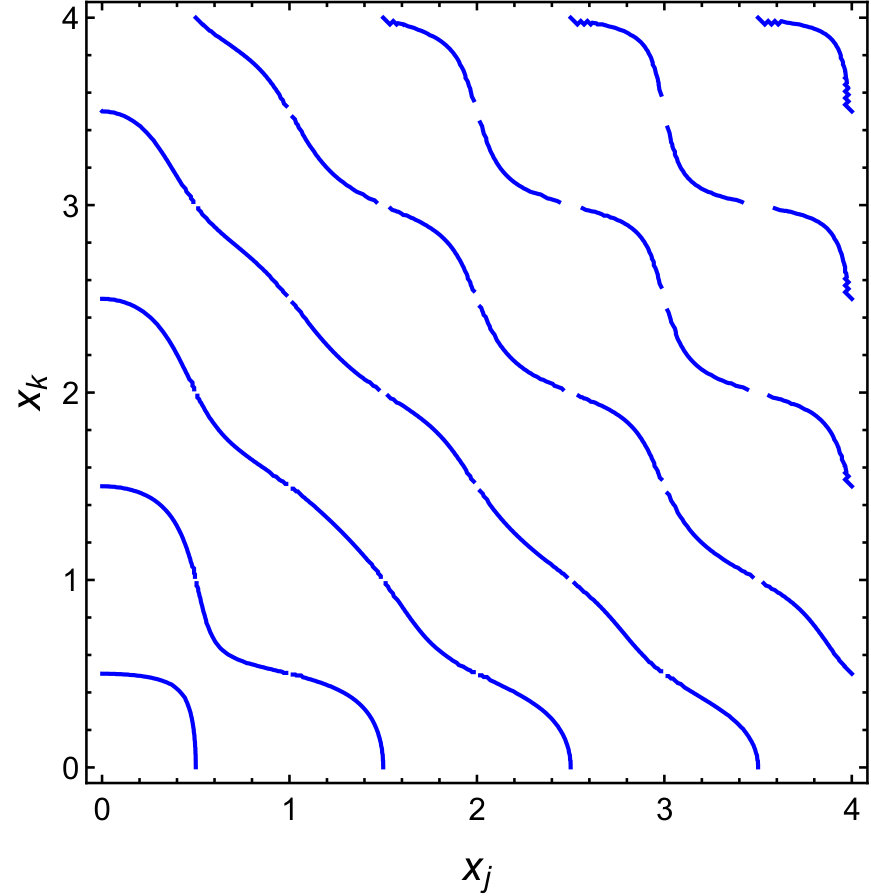 Figure 1
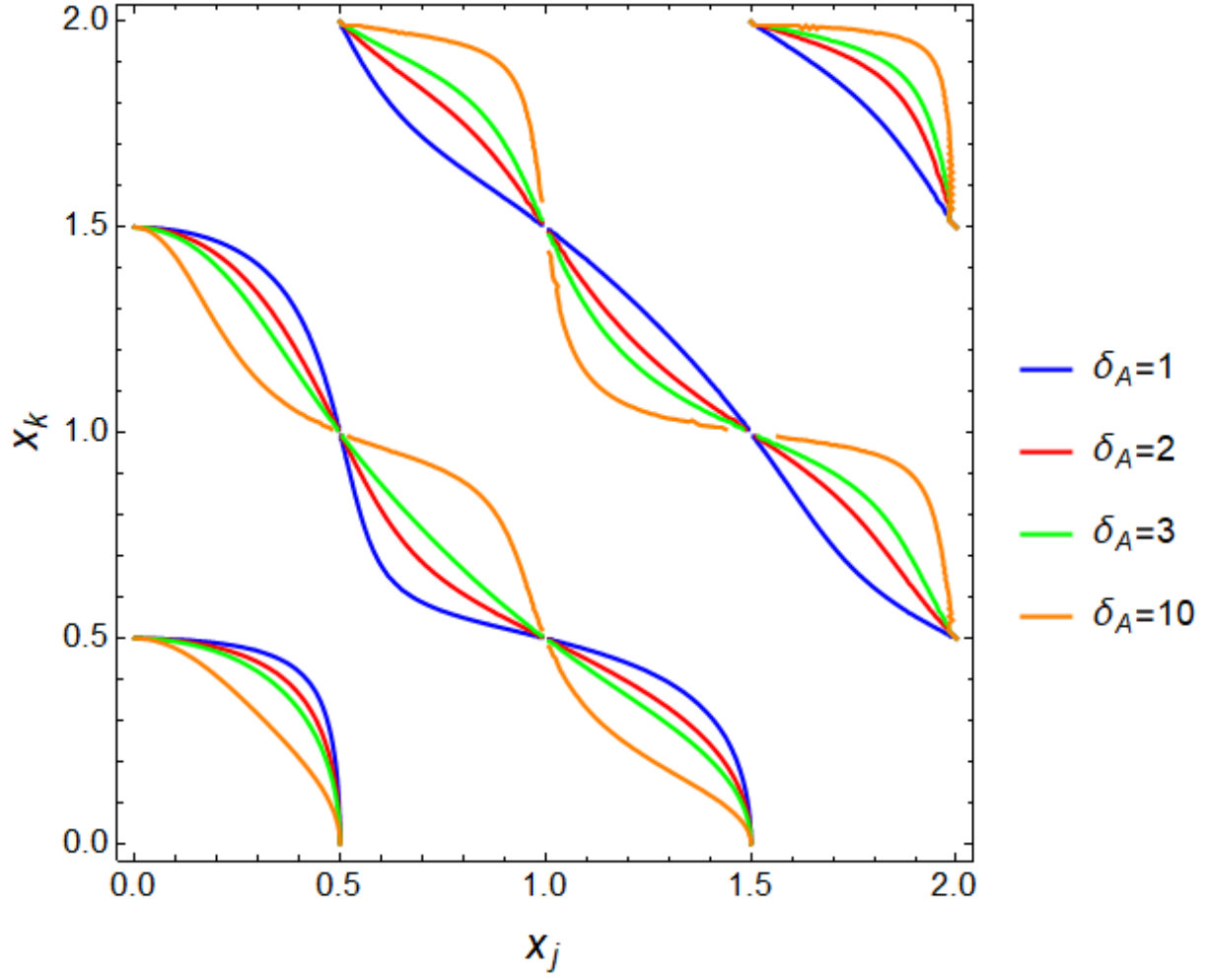 Figure 2
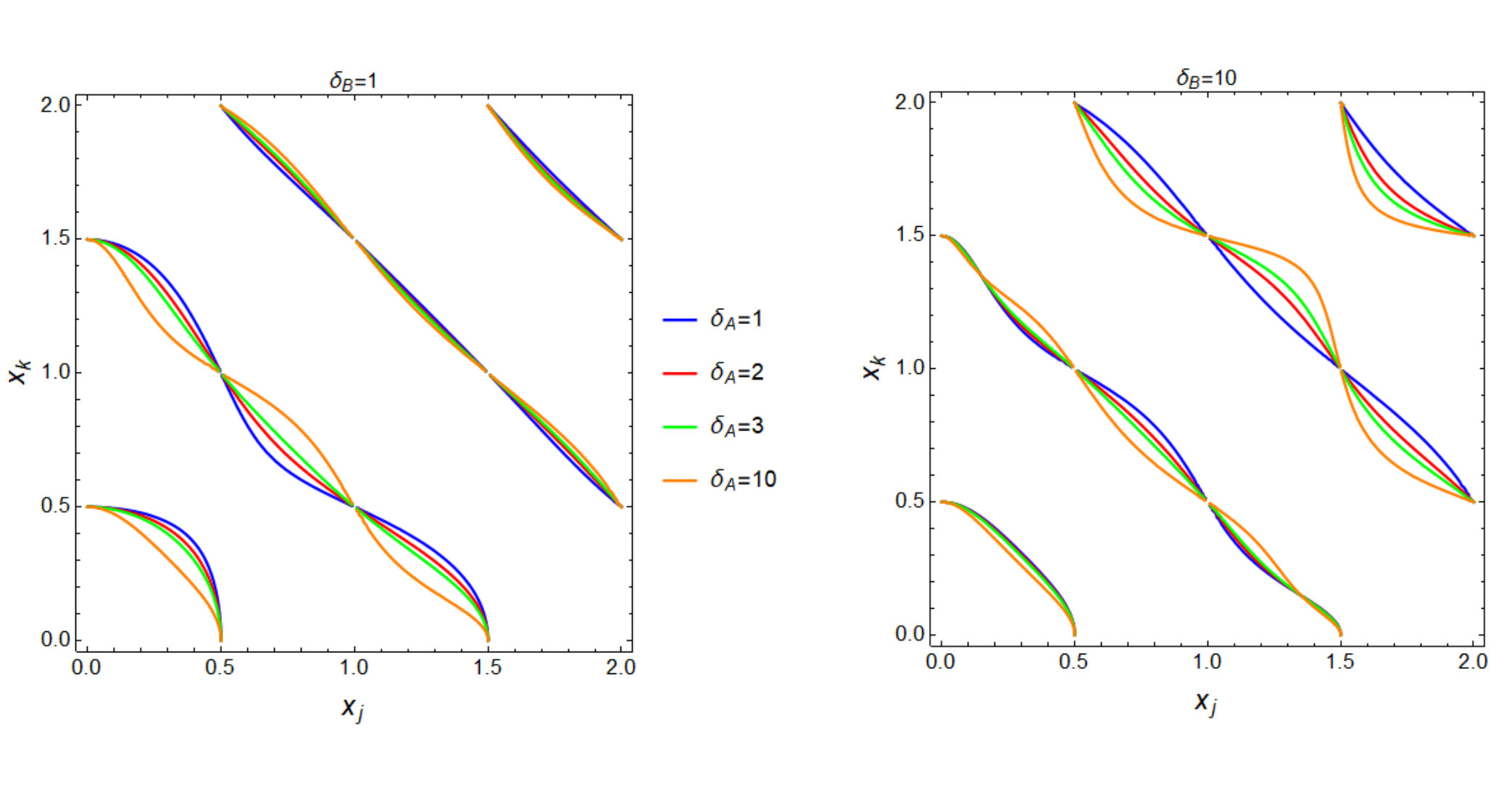 Figure 3
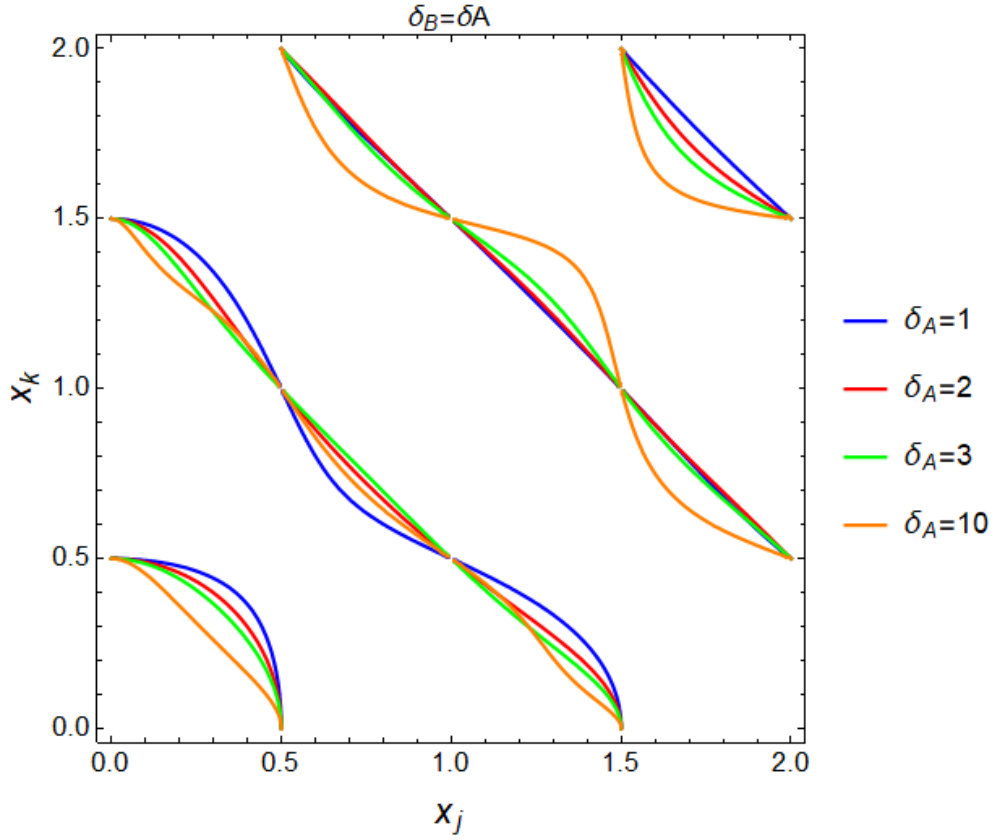 Figure 4
Peer Reviews
No public reviews on file for this paper yet. If you reviewed it on a platform where reviews are public (OpenReview, ICLR, NeurIPS, ICML), you can paste yours below so the community can read it here.
Videos
No videos yet. Explain this paper in a talk, walkthrough, or lecture? Add one.
∎
\thankstext
11institutetext: Physik Department T70, James-Franck-Strasse, Technische Universität München, 85748 Garching, Germany
Gauge field and brane-localized kinetic terms on the chiral square
Ricardo G. Landim\thanksrefe1,addr1
(Received: date / Accepted: date)
Abstract
Extra dimensions have been used as attempts to explain several phenomena in particle physics. In this paper we investigate the role of brane-localized kinetic terms (BLKT) on thin and thick branes with two flat extra dimensions (ED) compactified on the chiral square, and an abelian gauge field in the bulk. The results for a thin brane have resemblance with the 5-D case, leading to a tower of massive KK particles whose masses depend upon the compactification radius and the BLKT parameter. On the other hand, for the thick brane scenario, there is no solution that satisfy the boundary conditions. Because of this, the mechanism of suppressed couplings due to ED Landim:2019epv cannot be extended to 6-D.
††journal: Eur. Phys. J. C
1 Introduction
Extra dimensions (ED) have been considered over the decades as tools to address a wide range of issues in particle physics, such as the hierarchy Antoniadis:1990ew ; Dienes:1998vh ; Antoniadis:1998ig ; ArkaniHamed:1998rs ; Randall:1999ee ; Arkani-Hamed:2016rle and flavor problems Agashe:2004cp ; Huber:2003tu ; Fitzpatrick:2007sa . Quantum field theory with two ED, for instance, may provide explanations for proton stability Appelquist:2001mj , origin of electroweak symmetry breaking ArkaniHamed:2000hv ; Hashimoto:2000uk ; Csaki:2002ur ; Scrucca:2003ut , breaking of grand unified gauge groups Hebecker:2001jb ; Hall:2001xr ; Asaka:2002my ; Asaka:2003iy and the number of fermion generations Dobrescu:2001ae ; Fabbrichesi:2001fx ; Borghini:2001sa ; Fabbrichesi:2002am ; Frere:2001ug ; Watari:2002tf . The Standard Model (SM) itself might be extended by employing ED, in the so-called Universal Extra Dimension model (UED). In this context, the whole SM content is promoted to fields which propagate in compact ED, having Kaluza-Klein (KK) excitations, in either one Appelquist:2000nn or two ED Dobrescu:2004zi ; Burdman:2005sr ; Ponton:2005kx ; Burdman:2006gy . The zero-mode of each KK tower of states in 4-D is thus identified with the correspondent SM particle and a lowest KK state can be a dark matter (DM) candidate. Current results from LHC Aad:2015mia ; TheATLAScollaboration:2013uha impose bounds on the UED compactification radius for one ( TeV)111For , where is the cutoff scale. Deutschmann:2017bth ; Beuria:2017jez ; Tanabashi:2018oca or two ED ( GeV) Burdman:2016njl .
On the other hand, the 4-D gravity might be an emergent phenomenon from ED, as in the DGP model Dvali:2000hr , where the brane-induced term was initially obtained for a massless spin-2 field. Such a mechanism is possible for a spin-1 field as well, in which a brane-localized kinetic term (BLKT) is generated on the brane by radiative corrections due to the interaction of localized matter fields on the brane with the gauge field in the bulk Dvali:2000rx , and it holds for infinite-volume, warped and compact ED. The same mechanism also works for two ED Dvali:2000xg ; Dvali:2001ae ; Dvali:2002pe and the role of such a term has been investigated in several different scenarios Carena:2002me ; Carena:2002dz ; delAguila:2003gv ; delAguila:2003bh ; Davoudiasl:2002ua ; Davoudiasl:2003zt ; Rizzo:2018ntg ; Rizzo:2018joy . The localization of matter/gauge fields in branes was studied in other contexts, for thin ArkaniHamed:1998rs ; Dvali:1998pa ; Alencar:2014moa ; Alencar:2017dqb ; Alencar:2015awa ; Alencar:2015rtc ; Alencar:2015oka ; Alencar:2018cbk ; Freitas:2018iil and thick branes DeRujula:2000he ; Georgi:2000wb .
ED can also be employed in order to elucidate the nature of the DM and its possible interaction with the SM. Usually, a DM candidate may couple with the SM through a scalar mediator (or directly through Higgs if DM is a scalar field), via the so-called Higgs portal Silveira:1985rk ; McDonald:1993ex ; Burgess:2000yq ; Bento:2000ah ; Bertolami:2007wb ; Bento:2001yk ; MarchRussell:2008yu ; Biswas:2011td ; Costa:2014qga ; Eichhorn:2014qka ; Khan:2014kba ; Queiroz:2014yna ; Kouvaris:2014uoa ; Bhattacharya:2016qsg ; Bertolami:2016ywc ; Campbell:2016zbp ; Heikinheimo:2016yds ; Kainulainen:2016vzv ; Nurmi:2015ema ; Tenkanen:2016twd ; Casas:2017jjg ; Cosme:2017cxk ; Heikinheimo:2017ofk ; Landim:2017kyz , or through a vector mediator, which is introduced by a kinetic-mixing term Holdom:1985ag ; Holdom:1986eq ; Dienes:1996zr ; DelAguila:1993px ; Babu:1996vt ; Rizzo:1998ut ; Feldman:2006wd ; Feldman:2007wj ; Pospelov:2007mp ; Pospelov:2008zw ; Davoudiasl:2012qa ; Davoudiasl:2012ag ; Essig:2013lka ; Izaguirre:2015yja . In both cases, much of the parameter space has been excluded by a diverse set of experiments and observations Duerr:2015aka ; Athron:2017kgt ; Djouadi:2011aa ; Cheung:2012xb ; Djouadi:2012zc ; Cline:2013gha ; Endo:2014cca ; Goudelis:2009zz ; Urbano:2014hda ; Akerib:2015rjg ; He:2016mls ; Escudero:2016gzx ; Ade:2015xua ; Cline:2013fm ; Slatyer:2015jla ; Ackermann:2015zua ; Akerib:2016vxi ; Tan:2016zwf ; Agnese:2014aze ; Aprile:2012nq ; Aartsen:2012kia ; Aartsen:2016exj ; Battaglieri:2017aum ; Riordan:1987aw ; Bjorken:1988as ; Bross:1989mp ; Bjorken:2009mm ; Pospelov:2008zw ; Davoudiasl:2012ig ; Endo:2012hp ; Babusci:2012cr ; Archilli:2011zc ; Adlarson:2013eza ; Abrahamyan:2011gv ; Merkel:2011ze ; Reece:2009un ; Aubert:2009cp ; Dreiner:2013mua . The small value of both couplings constants may be explained if we consider a single, flat ED and a thick brane with BLKT spread inside it Landim:2019epv , where inside the ‘fat’ brane the SM fields behaves as in the UED model with one ED.
An obvious generalization of this previous work then would be investigate the possibility of suppressed couplings, along with the presence of BLKT on thin branes, for higher dimensional spacetimes. In this paper we investigate this possibility in 6-D, which is a natural extension since UED has been built for two ED as well. Alongside with this aim, we consider BLKT on thin branes, leading to results that can be compared with the 5-D case Carena:2002me . We assume the same compactification of the UED model in 6-D, where the so-called chiral square was chosen because it is the simplest compactification that leads to chiral quarks and leptons in 4-D Dobrescu:2004zi . For simplicity we will only consider an abelian gauge field in the bulk, although for other fields the results are analogue. The presence of BLKT on thin branes has a similar result as in the 5-D case, where the masses of the 4-D KK tower of states are determined by a transcendental equation. A thick brane with a BLKT, on the other hand, is not allowed by the boundary conditions (BC) at the intersection between the regions thick brane/bulk. Therefore, the mechanism in 5-D can be consistently extended for 6-D only for thin branes.
This paper is organized as follows. Sect. 2 reviews the 6-D gauge field without any BLKT on the chiral square. In Sect. 3 we introduce thin branes with BLKT and analyze the spectrum of masses while in Sect. 4 a fat brane is considered. Sect. 5 is reserved for conclusions.
2 Gauge field in the bulk
We will consider two flat and transverse ED ( and ) compactified on the chiral square. The square has size and the adjacent sides are identified and , with , which means the Lagrangians at those points have the same values for any field configuration: and .
There is only an abelian gauge field in the bulk and the action is similar to the one of UED with two ED Dobrescu:2004zi ; Burdman:2005sr , given by
[TABLE]
where A is the 6-D index and the gauge fixing term has the following form to cancel the mixing between and with Burdman:2005sr
[TABLE]
where is the gauge fixing parameter and we will work in the Feynman gauge (). After integrating by parts the action (1) is written as
[TABLE]
In the Feynman gauge, the equations of motion for the components of are
[TABLE]
where . Furthermore, it is required that the surface terms vanish on the boundary, in order not to have flow of energy or momentum across it, i.e.
[TABLE]
Vanishing the surface terms lead to the following BC for
[TABLE]
and for and
[TABLE]
[TABLE]
for any . The same relations exist for the fields at and . From the above relations it is possible to see the transformation law satisfied by the fields under Burdman:2005sr .
We expand the components of the 6-D gauge field in KK towers of states
[TABLE]
[TABLE]
[TABLE]
which yields the equation of motion for , with or ,
[TABLE]
where are the physical masses of the gauge field and the scalar fields and , respectively. The solutions for the equation of motion, which satisfy the BC above, and are normalized through the relation
[TABLE]
are given by
[TABLE]
[TABLE]
[TABLE]
where and are integers and the parameters and are and , for the sign in Eq. (14) or and for the sign. The physical masses of the scalar fields are while for the tower of states of the 4-D vector field they are given by
[TABLE]
Unlike the 5-D case, where the new scalar field, which is the extra component of the vector field, can be gauged away, in 6-D there is an additional degree of freedom that remains. This fact is explicitly seen if one works in the unitary gauge, where only one of the two linear combinations of the the scalar fields and is eaten by the vector boson Burdman:2005sr .
3 BLKT on thin branes
Applying the same ideas of the last section, we will now consider the effect of BLKT on branes localized at the points , and . We should recall that preserving KK parity implies that operators at and are identical.
3.1 BLKT at (0,0)
We will first analyze the change in the wave-function due to the presence of a BLKT term on a brane localized at .222As explained in Dvali:2001ae the propagator of the 6-D gauge field is found after a regularization procedure. The localized kinetic term is four-dimensional for distances shorter than , and it is given by Dvali:2000rx ; Dvali:2001ae
[TABLE]
where we conveniently added a gauge-fixing term. After expanding the 6-D gauge field into a tower of KK states, the equation of motion for the wave-function has the same structure of the 5-D case
[TABLE]
where we relabeled .
The 4-D Lagrangian is found integrating the wave-function over the ED. The resulting Lagrangian has diagonal terms
[TABLE]
where is a normalization factor, if the wave-function satisfies the relations
[TABLE]
The normalization factor for a delta-function at the origin is
[TABLE]
and the gauge field in 4-D becomes canonically normalized after dividing it by .
Due to the presence of a BLKT the surface terms are no longer zero. The non-trivial solution () for the Eq. (19) is
[TABLE]
The solution above no longer satisfy the last BC in Eq. (2). Eq. (14) is recovered if and is replaced by . The coefficients and are found requiring the familiar conditions of continuity of the function and discontinuity of its derivative at . Similar to the case of a delta-function in 1-D, we integrate the equation of motion (19) over and , from to . Performing a replacement of dummy variables we get
[TABLE]
where is the wave-function for and is the wave-function for . Terms with crossed coordinates such as are zero. Using Eqs. (3.1) and (17) we get the wave-function due to a two-dimensional delta-function source
[TABLE]
where , and is the normalization constant defined through Eq. (13), which gives
[TABLE]
As in the 5-D case Rizzo:2018ntg , the transcendental equation that determines the roots and is found requiring the Dirichlet BC , whose solutions depend only upon
[TABLE]
Eq. (27) has an evident resemblance to the root equation in 5-D () Rizzo:2018ntg . Since only one equation (27) determines both roots and , it is expected the existence of a continuous set of values and that satisfies Eq. (27). The solutions of Eq. (27) are shown in Fig. 1, for , while different values of are plotted in Fig. 2.
From Fig. 1 we see that there are quantized masses for each curve , where we labeled as being each one of the dashed lines. Each mode is described by the segments in the dashed lines, i.e., at (first dashed line) there is one mode , a massive zero-mode, the second dashed line () has three quantized masses , and (being the first two degenerate), and so on. The segments in the middle of each dashed line are the levels corresponding to and since the curves are symmetric under reflection over the line , the masses and are degenerate. These features are the usual behavior of quantum systems in two dimensions. Although there is a continuous set of values in each segment, the whole set represent only one (mass) state, being narrow the range of each state. In Table 1 it is presented the masses for the first three curves of Fig. 1. The masses correspondent to each KK level are either increased or decreased in an alternated pattern, when the parameter is increased, as seen in Fig. 2.
3.2 BLKT at (0,0) and (, )
We consider now branes localized at and with BLKT on them. For the sake of completeness we add the following term in the Lagrangian
[TABLE]
where is not necessarily equal to . The equation of motion (19) is modified by an extra term proportional to . The normalization factor has now the following terms
[TABLE]
The wave-function is equal to Eq. (25) for , and the transcendental equation is found through the non-continuity of the derivative of the wave-function, whose expression is similar to (3.1). The quantized masses are therefore found through the transcendental equation
[TABLE]
which is reduced to Eq. (27) when . This root equation is also similar to the one in the 5-D case Carena:2002me . The solutions of Eq. (30) are depicted in Fig. 3. For lower (higher) values of the larger (smaller) roots start having the same value, roughly independent of . The case preserves KK-parity and the roots are presented in Fig. 4. Their values are similar to the case .
3.3 BLKT at
Since the points and are identified it is sufficient to consider only one case. We will consider now the BLKT inside a brane localized at , whose Lagrangian is
[TABLE]
Similar to the previous cases, the normalization constant becomes
[TABLE]
The solution for the equation of motion with a delta function source at , satisfying similar BC as Eq. (3.1), is
[TABLE]
where
[TABLE]
The dependence of appears in the transcendental equation, which is identical to Eq. (27), thus having the same solutions for the pair of roots .
4 BLKT on a thick brane
We consider now the effect of a BLKT on the thick brane, lying between , with a width . The thin brane is obtained in the limit . In 5-D, the difference between thin and thick branes leads to the suppressed coupling mechanism Landim:2019epv , existing for branes with a finite thickness. In 6-D, thin branes carry localized operators on the conical singularities at the corners of the square. On the other hand, BLKT are spread inside the thick branes, thus for thin branes the surface terms (2) are non-zero, while for a fat brane the operators are not localized at the conical singularities and there are two regions in the two-dimensional (ED) space, each one having (in principle) vanishing surface terms.
The BLKT with gauge fixing term is Dvali:2000rx ; Dvali:2001ae
[TABLE]
where the step function is non-zero only inside the thick brane, i.e.
[TABLE]
The equation of motion for the wave-function inside the thick brane is now
[TABLE]
Similar to the 5-D case Landim:2019epv , we may define an effective mass as , thus the presence of the step-function changes the mass term in the equation of motion for inside the thick brane. It has the same structure of Eq. (12), but with the replacement Landim:2019epv . Defining the effective mass parameters as
[TABLE]
the wave-function inside the thick brane has also the same structure of Eq. (14). The wave-function outside the thick brane is
[TABLE]
while inside the thick brane the wave-function is
[TABLE]
where and are coefficients to be determined.
Both wave-functions have this form in order to satisfy the BC (2). The mass parameters, however, should be either () or (), for , in order to satisfy the same BC. This is only possible if . Even if we assume that the fields no longer need to satisfy all previous BC, the situation remains the same by the following reason. The wave-function should be continuous at and , as well as its derivative with respect to both ED coordinates and . Thus and (the continuity conditions at give exactly the same expressions). These conditions can be satisfied at a point on the boundary, but it is not possible to match the functions all along the boundary, being the only possibility . Therefore the only viable solution is , which leads to a thin brane.
5 Conclusions
In this paper we have investigated the implications of BLKT on thin and thick branes, for a model of two ED compactified on the chiral square, when a vector field is present in the bulk. For thin branes the presence of BLKT gives mass to all modes of the KK tower of states, being the masses dependent upon the compactification radius and the BLKT parameter. The roots are roughly the same for branes at different positions, i.e., they have similar values for branes localized at , and . The transcendental equations and other relations resemble the 5-D case. The model presents the usual behavior of quantum systems in two dimensions, i.e., there are quantized masses for each curve , and each mode is described by the segments in the dashed lines: one massive zero-mode at , three quantized masses , and at (being and degenerate), etc.
The BLKT on thick branes, on the other hand, does not provide a non-trivial result due to the BC. This scenario is similar to the refraction of a wave-function by a two-dimensional step function. Suppose an incident wave-function , a refracted wave and a step-function different from zero for . The BC implies that and the analogue situation in our problem is therefore . Hence the mechanism of suppressed coupling in 5-D Landim:2019epv cannot be applied in 6-D.
The results presented here works for different fields in the bulk and can be used in several further proposals, as for instance, in a model of ED with the dark photon as mediator. This model was done in 5-D Rizzo:2018joy ; Rizzo:2018ntg , but an extension might be able with two ED as well, or even its inclusion in the UED model. In both cases, the BLKT breaks the extra gauge symmetry via BC without adding an extra Higgs-like field, avoiding, in turn, constraints on the Higgs-portal coupling. Potential signatures for such massive spin-1 KK particles depend upon the specific model considered but it usually includes missing energy searches, which might constrain the two parameters in this model.
Acknowledgements.
The author would like to thank Gia Dvali for clarifications and Thomas Rizzo for comments. This work was supported by CAPES under the process 88881.162206/2017-01 and Alexander von Humboldt Foundation.
The reference list from the paper itself. Each links out to its DOI / PubMed record.
- 1[1] Ricardo G. Landim and Thomas G. Rizzo. Thick Branes in Extra Dimensions and Suppressed Dark Couplings. JHEP , 06:112, 2019.
- 2[2] Ignatios Antoniadis. A Possible new dimension at a few Te V. Phys. Lett. , B 246:377–384, 1990.
- 3[3] Keith R. Dienes, Emilian Dudas, and Tony Gherghetta. Extra space-time dimensions and unification. Phys. Lett. , B 436:55–65, 1998.
- 4[4] Ignatios Antoniadis, Nima Arkani-Hamed, Savas Dimopoulos, and G. R. Dvali. New dimensions at a millimeter to a Fermi and superstrings at a Te V. Phys. Lett. , B 436:257–263, 1998.
- 5[5] Nima Arkani-Hamed, Savas Dimopoulos, and G. R. Dvali. The Hierarchy problem and new dimensions at a millimeter. Phys. Lett. , B 429:263–272, 1998.
- 6[6] Lisa Randall and Raman Sundrum. A Large mass hierarchy from a small extra dimension. Phys. Rev. Lett. , 83:3370–3373, 1999.
- 7[7] Nima Arkani-Hamed, Timothy Cohen, Raffaele Tito D’Agnolo, Anson Hook, Hyung Do Kim, and David Pinner. Solving the Hierarchy Problem at Reheating with a Large Number of Degrees of Freedom. Phys. Rev. Lett. , 117(25):251801, 2016.
- 8[8] Kaustubh Agashe, Gilad Perez, and Amarjit Soni. Flavor structure of warped extra dimension models. Phys. Rev. , D 71:016002, 2005.