Few-body perspective of a quantum anomaly in two-dimensional Fermi gases
X. Y. Yin, Hui Hu, Xia-Ji Liu

TL;DR
This paper provides precise few-body calculations of the quantum anomaly in two-dimensional Fermi gases, elucidating how effective range influences breathing mode frequencies and aligning well with experimental data.
Contribution
It offers the first accurate few-body benchmark results on quantum anomaly in 2D Fermi gases, considering effective range effects and extrapolating to many-body systems.
Findings
Quantum anomaly decreases with increasing effective range.
Maximum anomaly shifts towards weak coupling as effective range grows.
Extrapolated results agree with experimental observations.
Abstract
Quantum anomaly manifests itself in the deviation of breathing mode frequency from the scale invariant value of in two-dimensional harmonically trapped Fermi gases, where is the trapping frequency. Its recent experimental observation with cold-atoms reveals an unexpected role played by the effective range of interactions, which requires quantitative theoretical understanding. Here we provide accurate, benchmark results on quantum anomaly from a few-body perspective. We consider the breathing mode of a few trapped interacting fermions in two dimensions up to six particles and present the mode frequency as a function of scattering length for a wide range of effective range. We show that the maximum quantum anomaly gradually reduces as effective range increases while the maximum position shifts towards the weak-coupling limit. We extrapolate our few-body results to the…
Click any figure to enlarge with its caption.
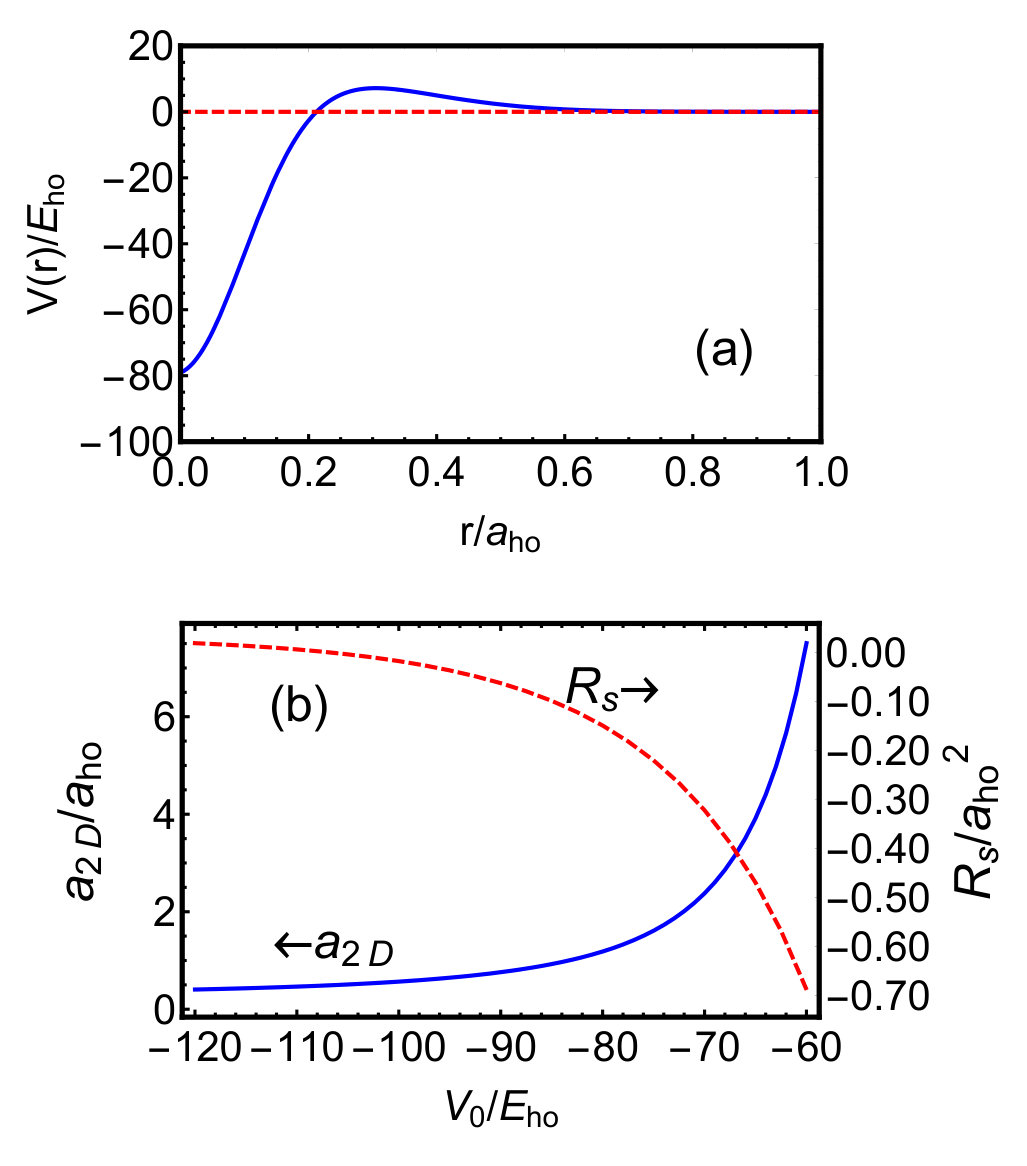 Figure 1
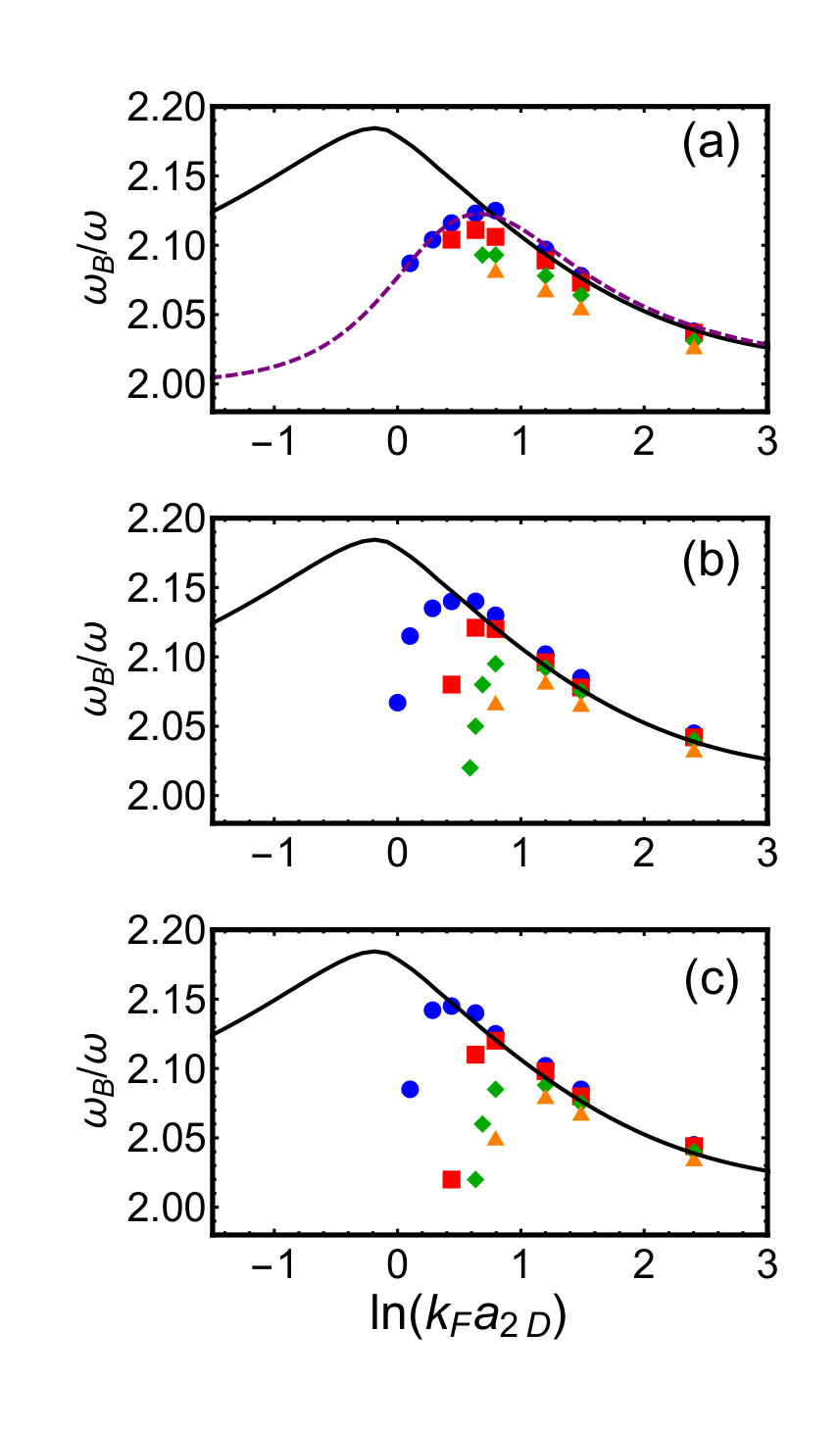 Figure 2
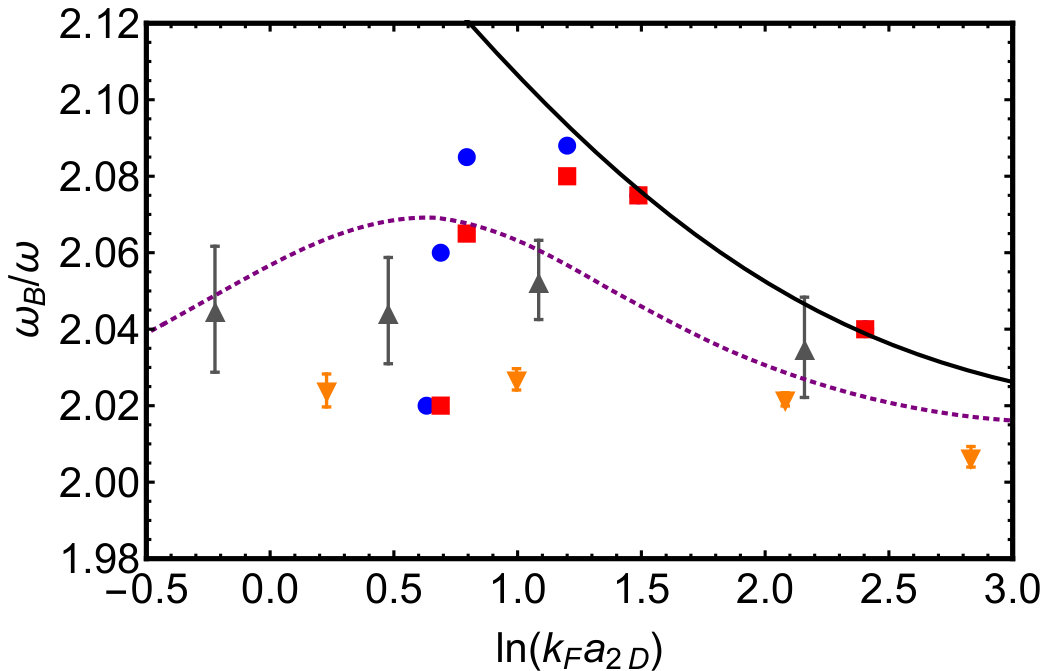 Figure 3
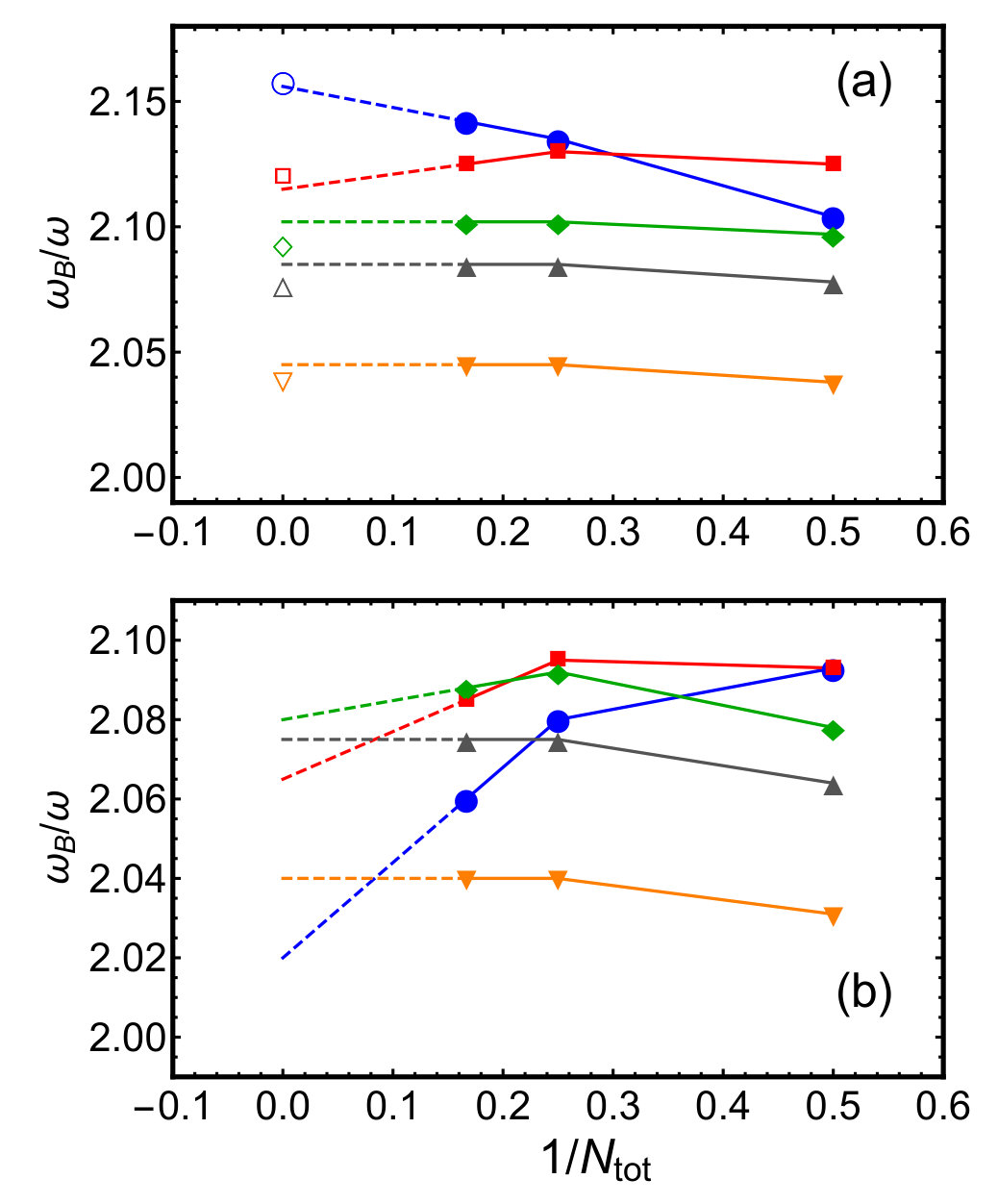 Figure 4
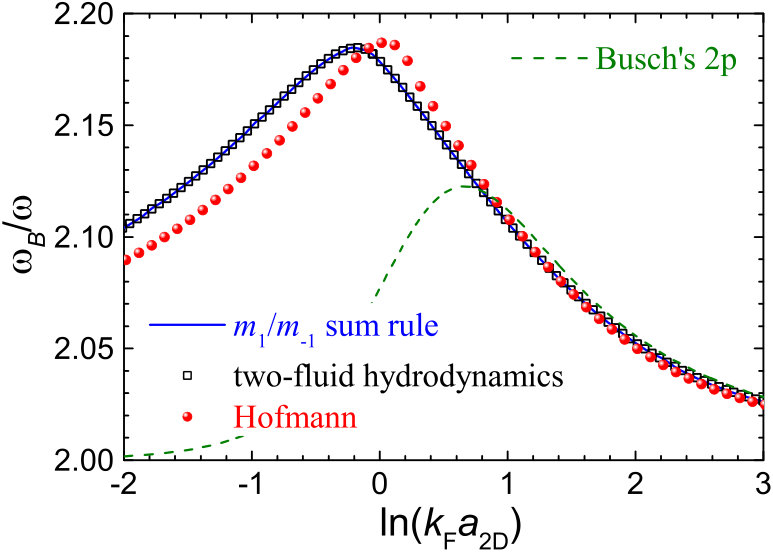 Figure 5
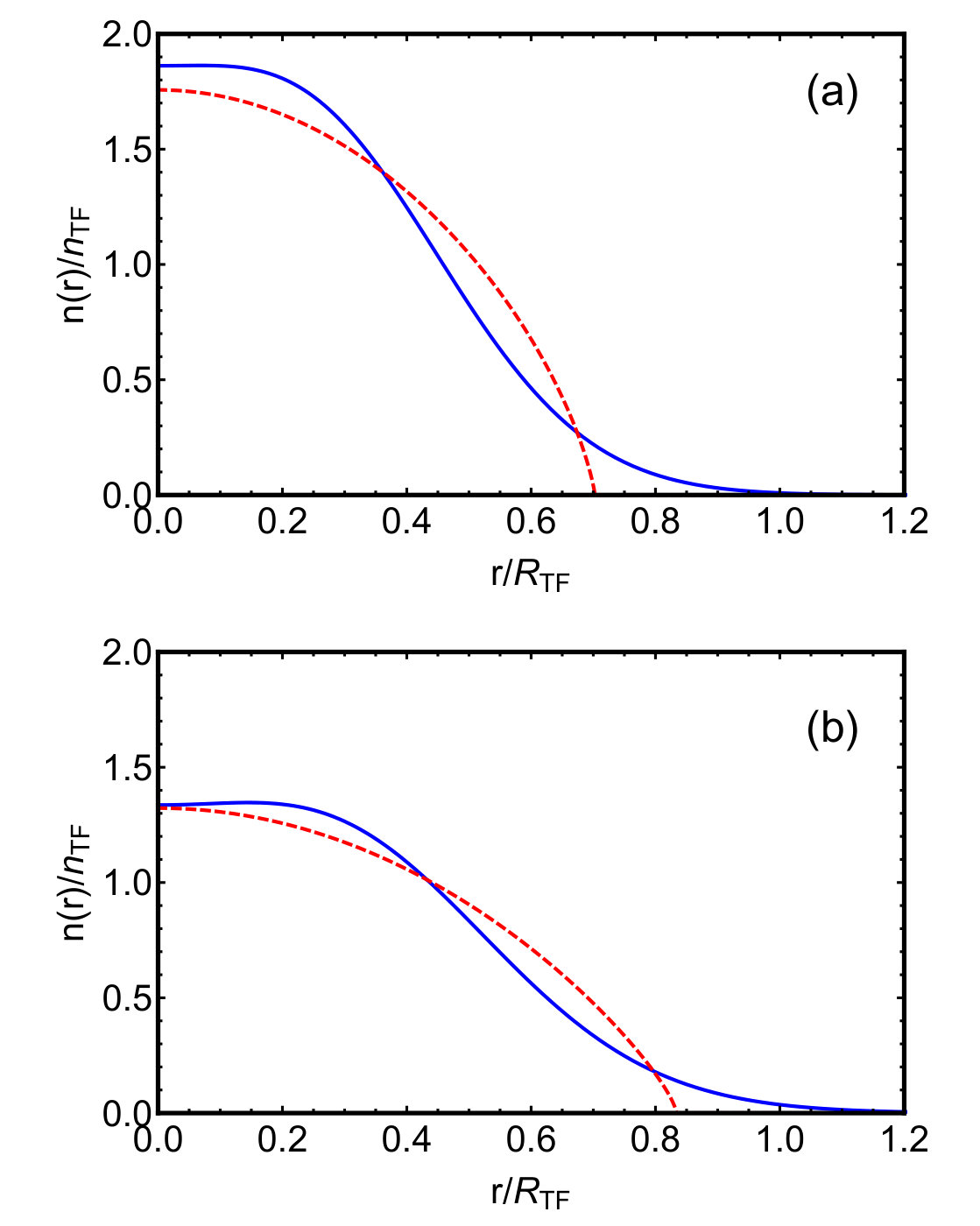 Figure 6
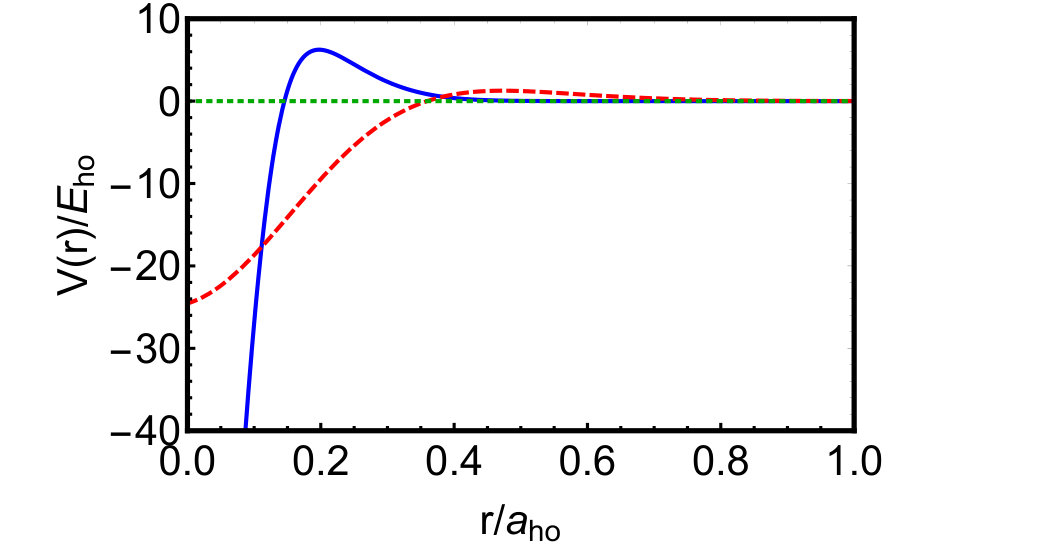 Figure 7
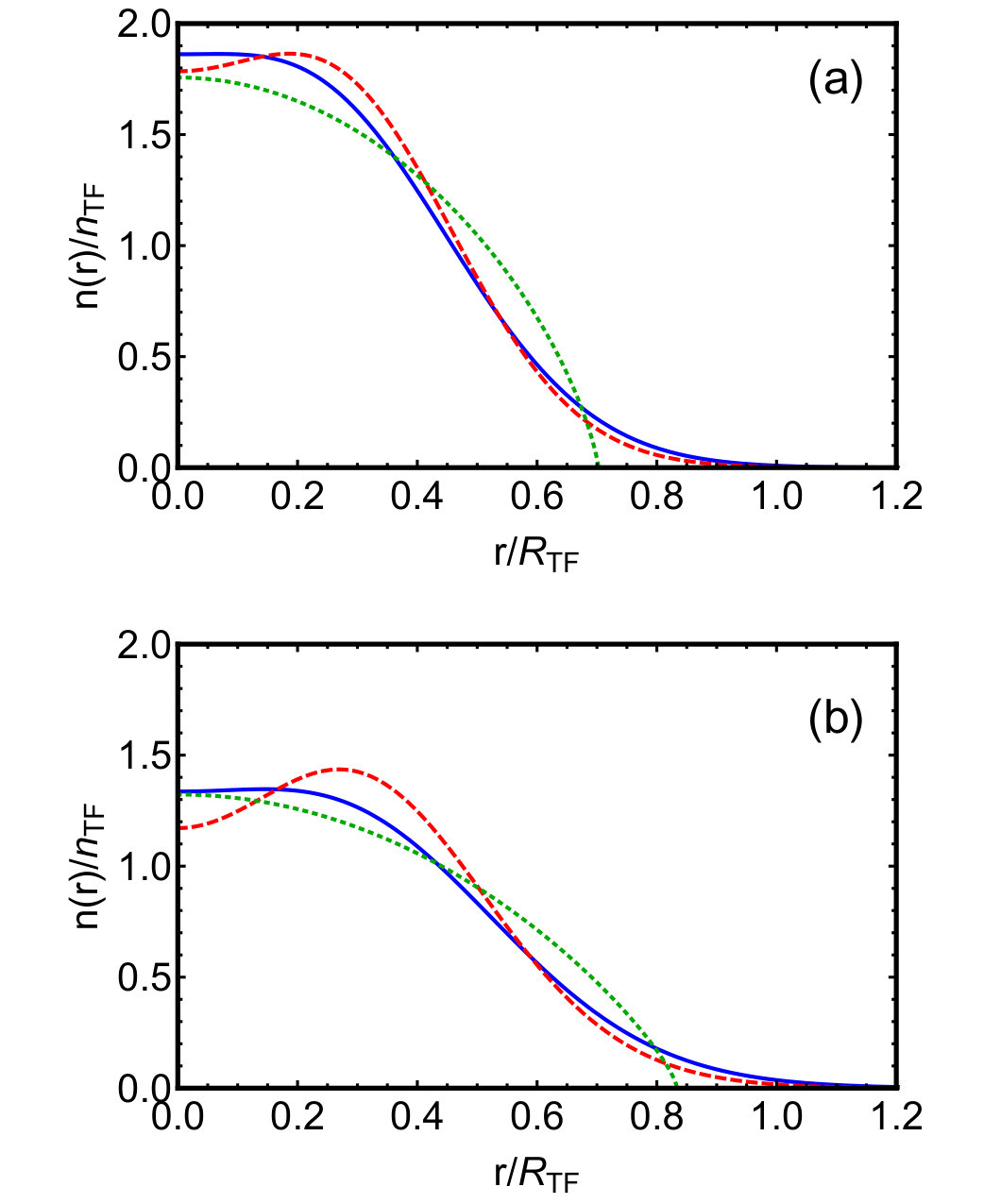 Figure 8
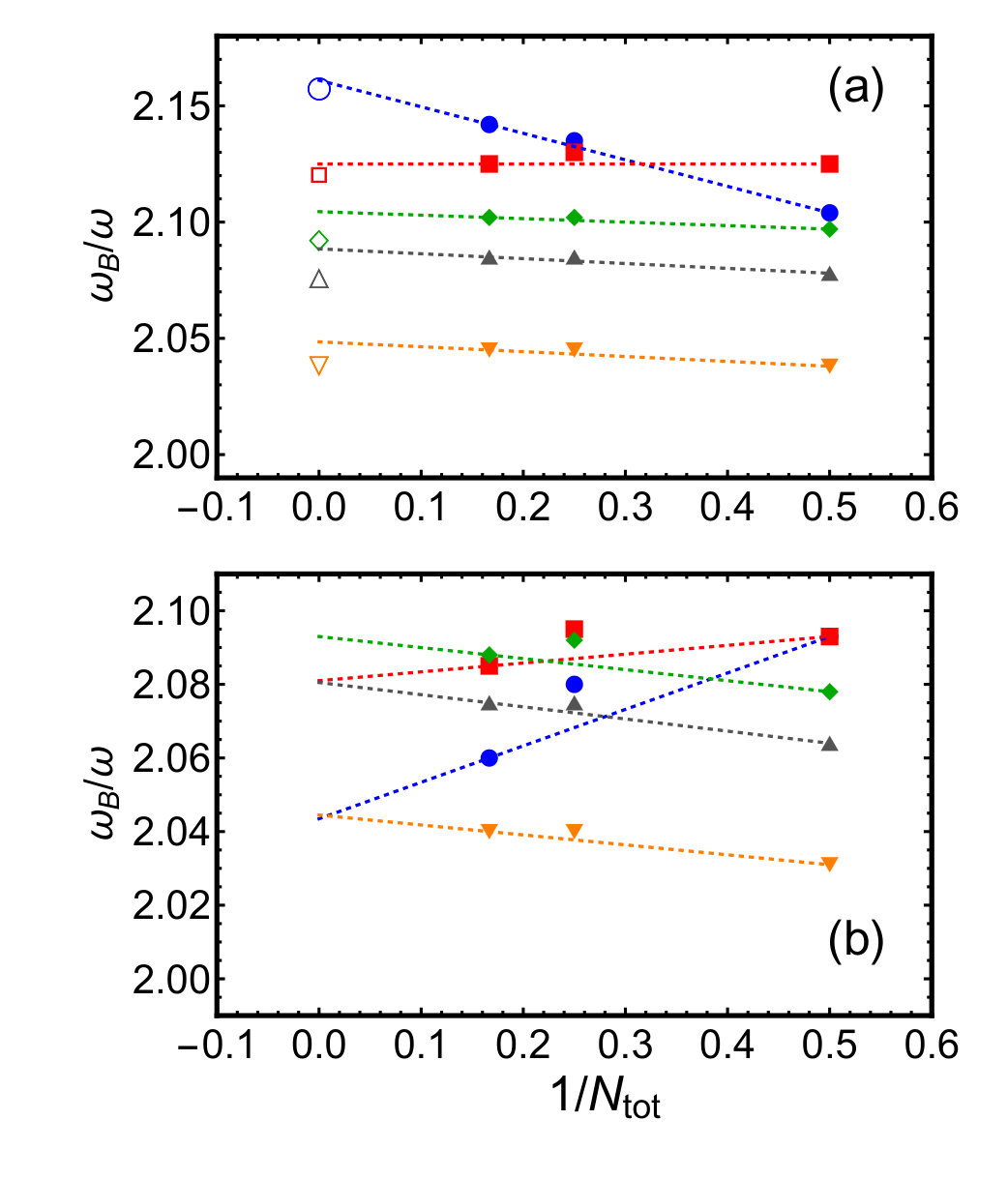 Figure 9
Peer Reviews
No public reviews on file for this paper yet. If you reviewed it on a platform where reviews are public (OpenReview, ICLR, NeurIPS, ICML), you can paste yours below so the community can read it here.
Videos
No videos yet. Explain this paper in a talk, walkthrough, or lecture? Add one.
Few-body perspective of quantum anomaly in two-dimensional Fermi
gases
X. Y. Yin
Centre for Quantum and Optical Science, Swinburne University of Technology, Melbourne, Victoria 3122, Australia
Hui Hu
Centre for Quantum and Optical Science, Swinburne University of Technology, Melbourne, Victoria 3122, Australia
Xia-Ji Liu
Centre for Quantum and Optical Science, Swinburne University of Technology, Melbourne, Victoria 3122, Australia
Abstract
Quantum anomaly manifests itself in the deviation of breathing mode frequency from the scale invariant value of in two-dimensional harmonically trapped Fermi gases, where is the trapping frequency. Its recent experimental observation with cold-atoms reveals an unexpected role played by the effective range of interactions, which requires quantitative theoretical understanding. Here we provide accurate, benchmark results on quantum anomaly from a few-body perspective. We consider the breathing mode of a few trapped interacting fermions in two dimensions up to six particles and present the mode frequency as a function of scattering length for a wide range of effective range. We show that the maximum quantum anomaly gradually reduces as effective range increases while the maximum position shifts towards the weak-coupling limit. We extrapolate our few-body results to the many-body limit and find a good agreement with the experimental measurements. Our results may also be directly applicable to a few-fermion system prepared in microtraps and optical tweezers.
Quantum anomaly arises if a certain symmetry of a classical theory (i.e., action) of the system fails to hold when a full quantum description is developed. One important example is the deviation from the scale invariant breathing mode frequency in two-dimensional (2D) ultracold atomic quantum gases pitaevskii1997 ; olshanii2010 . In a classic 2D gas interacting through zero-range interaction, a hidden symmetry leads to an exact breathing mode frequency of , where is the trapping frequency pitaevskii1997 . In a 2D quantum gas, the requirement of renormalization of the contact interaction leads to an additional length scale, the 2D scattering length. Therefore, the breathing mode frequency deviates from and depends on the scattering length. This is in contrast to the three-dimensional unitarily interacting quantum gas, where infinitely strong interaction strength leads to scale invariance and the preservation of symmetry werner2006 .
Experimental verification of quantum anomaly in 2D quantum gases comes with several interesting surprises. The initial idea of a weakly-interacting 2D Bose gas pitaevskii1997 ; olshanii2010 does not work since the breathing mode frequency shift is too small to be observable. A strongly interacting two-component 2D Fermi gas of 40K and 6Li atoms appears to be a better candidate hofmann2012 ; taylor2012 ; murthy2019 . However, the early observation of about frequency shift from vogt2012 is much smaller than the anomaly predicted for zero-range contact interaction at zero temperature hofmann2012 ; taylor2012 . This discrepancy is probably caused by the large temperature of the 40K Fermi gas in the experiment vogt2012 , as suggested by virial expansion studies chafin2013 ; mulkerin2018 . In two most recent experiments with 6Li atoms, the 2D Fermi gas was cooled down to one-tenth of Fermi temperature, to avoid any dominant finite temperature effect holten2018 ; peppler2018 . Surprisingly, the measured quantum anomaly, about , is still at the same level as in the first observation vogt2012 . This unexpected, much reduced quantum anomaly is now understood as a result of a significant effective range of interactions induced by the tight axial confinement petrov2001 ; hu2019 ; wu2019 that is necessary to restrict the motion of atoms into two dimensions petrov2001 ; turlapov2017 . An approximate many-body theory that takes into account Gaussian pair fluctuations (GPF) has then been developed, giving rise to a qualitative explanation for the experimental observation hu2019 . More accurate many-body calculations (except quantum Monte Carlo simulations shi2015 ; anderson2015 ; schonenberg2017 ) are difficult to carry out at finite effective range, due to strong correlation inherent in 2D interacting Fermi gases.
In this Letter, we aim to provide benchmark predictions on quantum anomaly from a few-body perspective. Our purpose is three-fold. First, few-body systems can be solved exactly with high accuracy. Therefore, the few-body results include all correlations that can not be accounted for in the approximate mean-field and GPF studies. Here we use explicitly correlated Gaussian (ECG) basis set expansion approach cg_book ; mitroy2013 to understand the breathing mode frequency in a small Fermi cloud with up to six particles. Second, few-body systems provide a bridge between the two-body physics and many-body physics. Many results in the many-body limit can be successfully deduced from few-body studies liu2009 ; liu2010 ; blume2012 ; liu2013 ; bruun2016 ; levinsen2017 . In this work, we find that our few-body results reveal two important features observed in the experiments in the presence of a nonzero effective range holten2018 ; peppler2018 : the maximum quantum anomaly reduces gradually with increasing effective range while the peak position shifts to the weakly-interacting regime. Finally, it is worth emphasizing that the few-fermion system under consideration can nowadays be routinely prepared by using microtraps serwane2011 or optical tweezer kaufman2012 ; liu2018 . Thus, the few-body result should be of its own interest and we anticipate that our few-body predictions with tunable number of particles might be directly examined in future experiments.
Model Hamiltonian. — We start by mentioning the -wave scattering phase shift of two particles in 2D, which can be expanded in the low-energy limit as verhaar1984 ; adhikari1986
[TABLE]
where is Euler’s constant, the 2D scattering length and the effective range Note2DScatteringLength . is related to the asymptotic form of the normalized scattering wave function of a particular interaction potential by
[TABLE]
In 2D, the scattering length is always positive. The two-component Fermi gas goes through a crossover from a Bose-Einstein condensate (BEC) to a Bardeen-Cooper-Schrieffer (BCS) superfluid as increases. However, unlike 3D, there is no scale invariant unitarity limit where the interaction strength diverges. Instead, the strongly interacting regime is around , where is the characteristic Fermi wavevector.
We consider a two-component Fermi gas consisting of spin-up and spin-down atoms () under harmonic confinement with transverse trapping frequency . The system Hamiltonian reads,
[TABLE]
where is the mass of a single atom, ( and ) denotes the 2D position vector of the th spin-up or down atom with respect to the trap center, and is the interspecies two-body interaction potential that depends on the distance .
The effective range induced by a tight axial confinement in 2D Fermi gas experiments is negative hu2019 . To simulate a negative , we employ a pseudopotential,
[TABLE]
which is numerically amenable to ECG simulations. Alternative pseudopotential is also examined to check the negligible effects beyond effective range SM . As exemplarily shown in Figure 1(a), the potential exhibits two features that are essential for supporting a shape resonance: an attractive well that supports virtual bound states and a potential barrier that couples the virtual bound state to the free-space scattering states schonenberg2017 . Negative becomes possible near a shape resonance. Figure 1(b) shows the 2D scattering length and effective range as a function of the depth of potential for a fixed . As the depth of potential increases, both and the absolute value of decreases until the next bound state appears. Another interesting feature of the potential is that the volume is positive, and therefore cannot support a two-body bound state when . Here, we restrict ourself to potential that supports at most one two-body bound state in free space. By adjusting both and , one can achieve a wide range of combination of and . The limitation for our potential is that it is not possible to produce a small and large at the same time.
We solve the time-independent Schrödinger equation for the Hamiltonian given in Eq. (3) using ECG basis set expansion approach cg_book ; mitroy2013 ; SM . We expand the eigenstates of the Hamiltonian in terms of ECG basis functions, which depend on a number of nonlinear variational parameters that are optimized through energy minimization mitroy2013 ; blume2009 ; blume2011 ; yin2015 . After a proper basis set is constructed, we calculate various ground-state properties of a few-fermion system with number of particles , and . For a trapped system, it is convenient to use Fermi wavevector , which is basically the wavevector of a non-interacting Fermi gas at the trap center in the large-particle limit turlapov2017 . Here, is the total number of atoms and the harmonic oscillator length.
Breathing mode frequency. — The breathing mode of two-component Fermi gases is a density fluctuation excited by the perturbation . It appears as a well-defined single mode in the density response function in the low-momentum and low-energy limit, i.e., . As a result, we may use a sum-rule approach to calculate the breathing mode frequency, , through the energy weighted moments . In harmonic traps, both the energy weighted moments and can be easily calculated at zero temperature. The former can be transformed into the calculation of commutators involving the operator and the Hamiltonian dalfovo1999 , leading to , where is the square cloud width calculated using the density distribution . The moment , on the other hand, is proportional to the linear static response of the operator , dalfovo1999 . Putting the two moments together, we obtain an elegant expression for the breathing mode frequency menotti2002 ; hu2014 ,
[TABLE]
The accuracy of the above sum-rule expression may be examined in the many-particle limit, by using alternative two-fluid hydrodynamic theory taylor2009 for the breathing mode frequency in case of zero range interaction. We outline the details in Supplemental Material SM . For our few-body calculations, which are performed in harmonic oscillator unit, we define , , and , where , , and are dimensionless. If we keep a constant while vary and proportionally, i.e., keep a constant, the sum rule result can be alternatively expressed as
[TABLE]
This allows us to compute for few-body systems through a finite difference method SM . To compare for , , and systems, and to provide insights for larger systems, we express the harmonic oscillator length in terms of Fermi wavevector and consequently use the dimensionless interaction parameters and .
Symbols in Fig. 2(a), (b), and (c) show the breathing mode frequency as a function of for various effective ranges , ranging from close to zero to around . The solid line shows the zero-range many-body results determined using the equation of state from auxiliary-field quantum Monte Carlo (AFQMC) SM . In all regimes, is greater than the scale invariance value . It peaks within strongly interacting regime, gradually decreases towards the BCS limit, and decreases sharply towards the BEC limit.
As the effective range approaches zero, our finite-range few-body results approaches the zero-range many-body result. The difference between results, where is very close to zero, and the zero-range many-body result is very small on the BCS side and could likely be attributed to the finite size effect. However, the discrepancy becomes prominent when . This may be caused by the dramatically increased peak density in the strongly interacting regime, where the wavevector of the non-interacting trapped Fermi gas is no longer a proper choice for parameterization. The actual effective range at the trap center is larger, leading to a significant deviation in the breathing mode frequency with respect to the zero-range result. Notably, our numerical result for system with agrees extremely well with the prediction from the exact two-body zero-range solution SM , based on the seminal work of Busch et al. busch1998 .
As increases, the quantum anomaly, i.e., the difference between and scale invariance value , is gradually suppressed across all scattering strength. Specifically, as increases from near zero to around , the maximum value of breathing mode shift decreases from to . Also, the scattering length where maximum value of occurs shifts towards the BCS limit as increases. The downward shifting of as the effective range increases qualitatively agrees with the trend observed in the many-body calculations hu2019 ; wu2019 .
Although we consider only , , and systems, it is important to analyze the finite size effects and the trend as the system size increases. This will allow us to see how our few-body results connect to the many-body limit. Solid symbols in Fig. 3(a) show as a function of for and different values of across the BEC-BCS crossover. Overall, the differences between the and systems are very small. Since system cannot capture the many-body correlations beyond two-body level, it is expected to see a significant difference between system and larger systems. If we do a simple linear extrapolation of and results towards the limit NoteExtrapolation , the extrapolated results agree reasonably well with the many-body AFQMC result shown in hollow symbols. The good agreement encourages us to perform the same extrapolation for the data with effective range , which is the realistic effective range in recent two 6Li experiments holten2018 ; peppler2018 ; hu2019 . This is shown in Fig. 3(b) by dashed lines. From the results at zero-range, we estimate that the systematic error in the extrapolated mode frequency due to our naïve extrapolation procedure is about .
Comparison with experiments. — The main motivation for this work is the discrepancy between the large quantum anomaly () predicted with zero-range model and the much smaller quantum anomaly () observed in the experiments holten2018 ; peppler2018 . In both Heidelberg and Swinburne experiments, two hyperfine states of 6Li are cooled to deep quantum degeneracy in a 2D trap. It has been shown that the effective range in those setups are non-negligible hu2019 . Here, we compare the experimental data with our few-body results with same value of in Fig. 4. Circles and squares show the system results and extrapolated many-body results following Fig. 3(b). Upper and lower triangles show the experimental data from Swinburne and Heidelberg groups holten2018 ; peppler2018 , respectively.
Although we have observed a reduced quantum anomaly with finite effective range, quantitative discrepancy between experimental data and our few-body results exist. One of the reasons could be the residual finite temperature effect. The temperature in both experiments is at the range of , where is Fermi temperature. It has been shown that the quantum anomaly is reduced at non-zero temperature mulkerin2018 . Combining the finite range effect and the finite temperature effect, we expect that the quantum anomaly should be further reduced. These two effects together, could possibly explains the much smaller deviation observed in the experiments holten2018 ; peppler2018 .
Conclusions. — We have calculated the breathing mode frequency of a two-component Fermi cloud with a few particles up to six in two dimensions. We have found that the quantum anomaly, i.e., the enhancement of the breathing mode frequency with respect to its classical scale invariant value, is gradually suppressed as effective range of interactions increases. In particular, the maximum value of the breathing mode frequency is reduced while the interaction strength corresponding to the maximum value shifts towards the weak-coupling limit. These two key trends qualitatively agree with recent experiments. Our accurate few-body results open a new way to better understand the intriguing quantum anomaly and provide benchmark predictions for future few-particle experiments in microtraps and optical tweezers.
Acknowledgements.
We are grateful for discussions with Jia Wang. This research was supported by the Australian Research Council (ARC) Discovery Programs, Grants No. DP170104008 (H.H.), No. FT140100003 (X.-J.L) and No. DP180102018 (X.-J.L).
The reference list from the paper itself. Each links out to its DOI / PubMed record.
- 1(1) L. P. Pitaevskii and A. Rosch, Breathing modes and hidden symmetry of trapped atoms in two dimensions, Phys. Rev. A 55 , R 853 (1997).
- 2(2) M. Olshanii, H. Perrin, and V. Lorent, Example of a Quantum Anomaly in the Physics of Ultracold Gases, Phys. Rev. Lett. 105 , 095302 (2010).
- 3(3) F. Werner and Y. Castin, Unitary gas in an isotropic harmonic trap: Symmetry properties and applications, Phys. Rev. A 74 , 053604 (2006).
- 4(4) J. Hofmann, Quantum Anomaly, Universal Relations, and Breathing Mode of a Two-Dimensional Fermi Gas, Phys. Rev. Lett. 108 , 185303 (2012).
- 5(5) E. Taylor and M. Randeria, Apparent Low-Energy Scale Invariance in Two-Dimensional Fermi Gases, Phys. Rev. Lett. 109 , 135301 (2012).
- 6(6) P. A. Murthy, N. Defenu, L. Bayha, M. Holten, P. M. Preiss, T. Enss, and S. Jochim, Quantum scale anomaly and spatial coherence in a 2D Fermi superfluid, ar Xiv:1805.04734.
- 7(7) E. Vogt, M. Feld, B. Fröhlich, D. Pertot, M. Koschorreck, and M. Köhl, Scale Invariance and Viscosity of a Two-Dimensional Fermi Gas, Phys. Rev. Lett. 108 , 070404 (2012).
- 8(8) C. Chafin and T. Schäfer, Scale breaking and fluid dynamics in a dilute two-dimensional Fermi gas, Phys. Rev. A 88 , 043636 (2013).