Solution of Dirac equation and greybody radiation around a regular Bardeen black hole surrounded by quintessence
Ahmad Al-Badawi, \.Izzet Sakall{\i}, and Sara Kanzi

TL;DR
This paper derives exact solutions to the Dirac equation around a regular Bardeen black hole with quintessence, analyzes the effects of quintessence on effective potentials, and studies greybody radiation of spin-0 particles.
Contribution
It provides a new analytical approach to the Dirac equation in the BBHSQ background and examines the influence of quintessence on particle behavior and radiation.
Findings
Effective potentials depend on quintessence parameters.
Angular solutions are expressed in spherical harmonics.
Greybody radiation characteristics are analyzed.
Abstract
The exact solutions of the Dirac equation that describe a massive, non-charged particle with spin-(1/2) in the curved spacetime geometry of regular Bardeen black hole surrounded by quintessence (BBHSQ) are investigated. We first derive the Dirac equation in the BBHSQ background using a null tetrad in the Newman-Penrose formalism. Afterward, we separate the Dirac equation into ordinary differential equations for the radial and angular parts. The angular equations are solved exactly in terms of standard spherical harmonics. The radial part equations are transformed into a Schr\"odinger like differential wave equations with effective potentials. The effect of the quintessence on the regular Bardeen black hole is studied by understanding the physical behavior of the effective potentials. In addition, the potentials are plotted with changing the quintessence parameters, magnetic monopole…
Click any figure to enlarge with its caption.
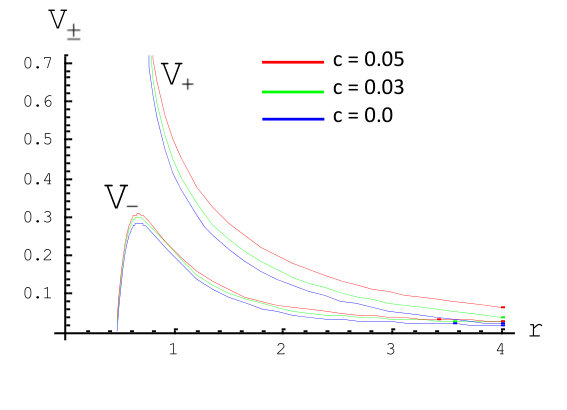 Figure 1
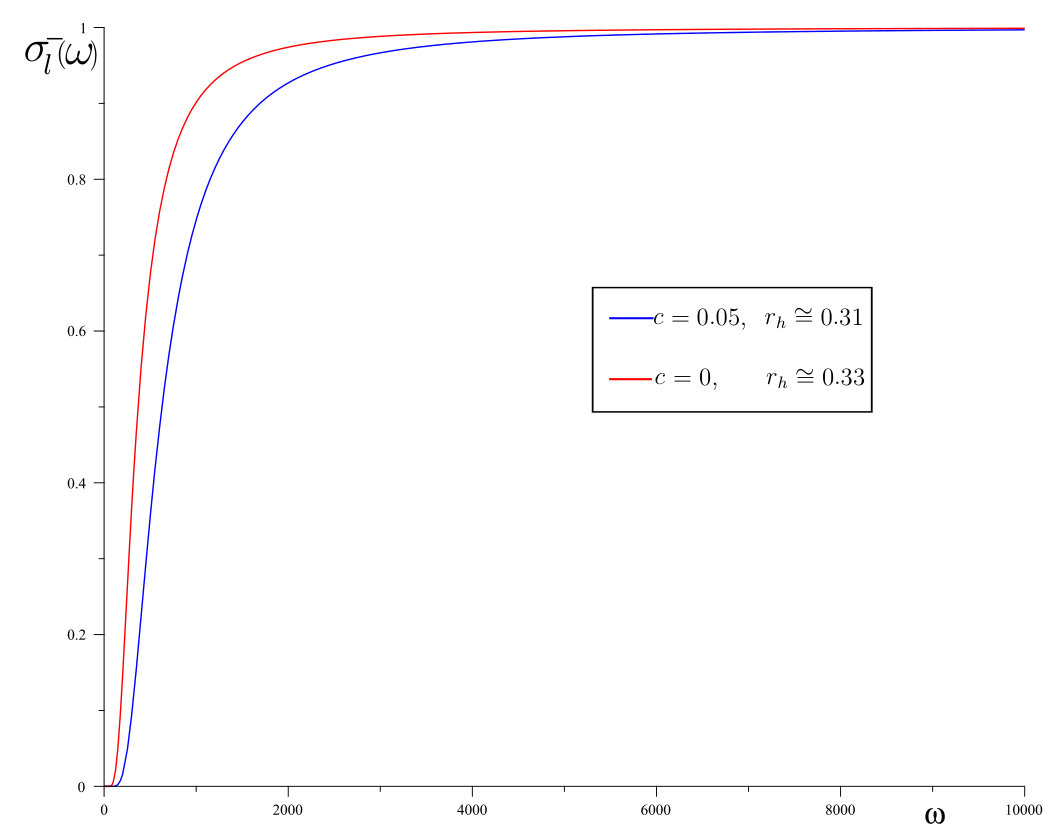 Figure 2
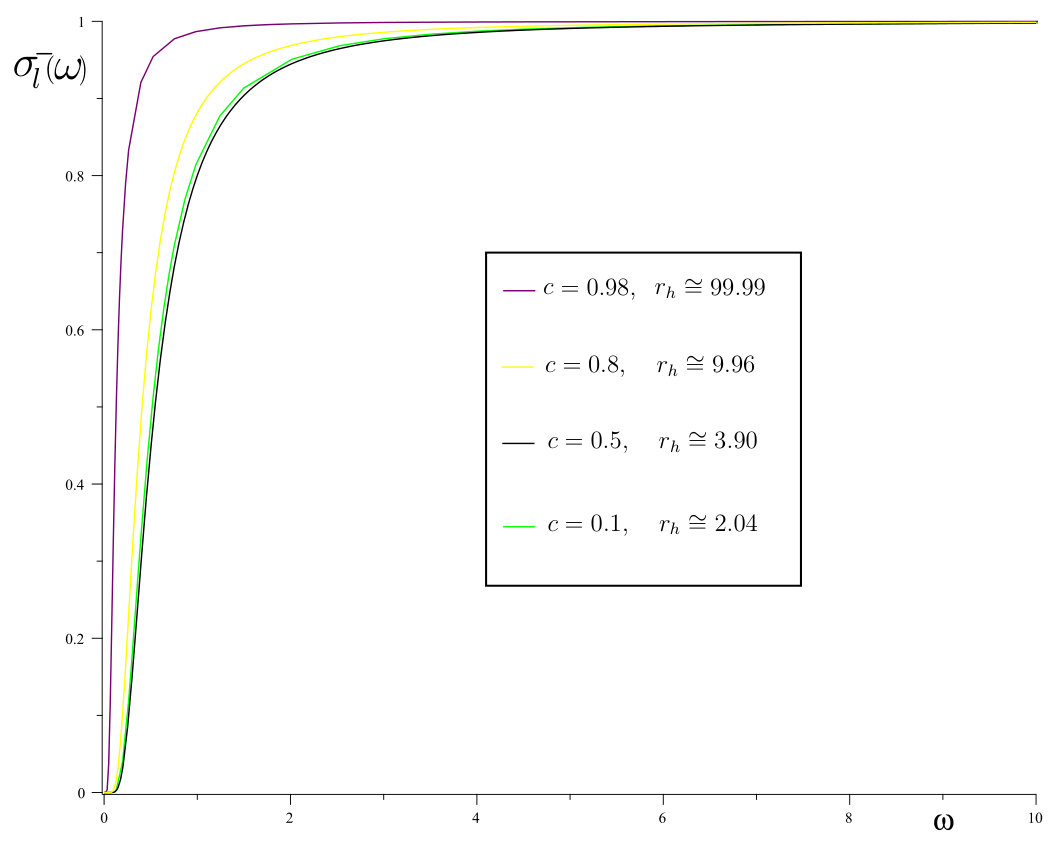 Figure 3
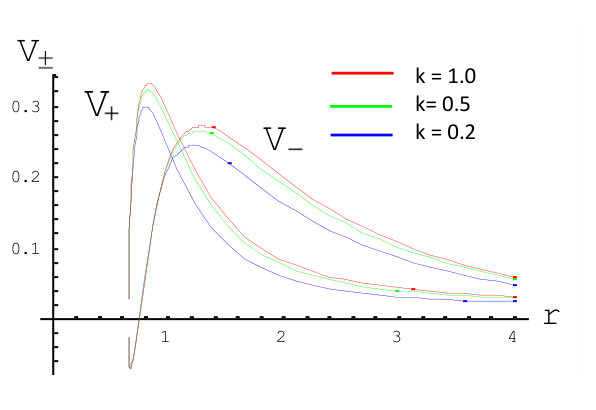 Figure 4
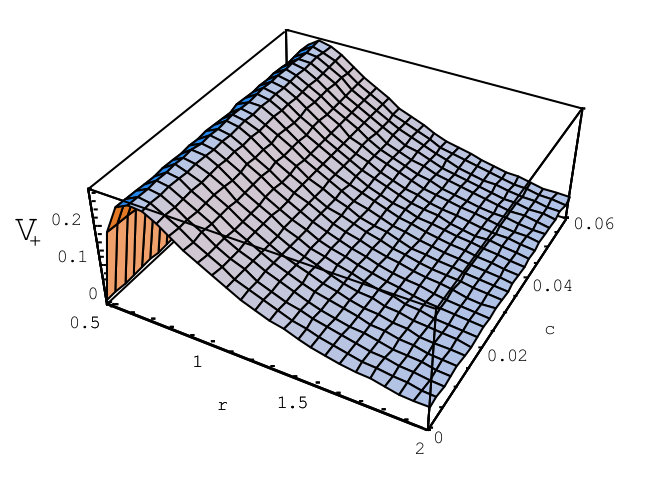 Figure 5
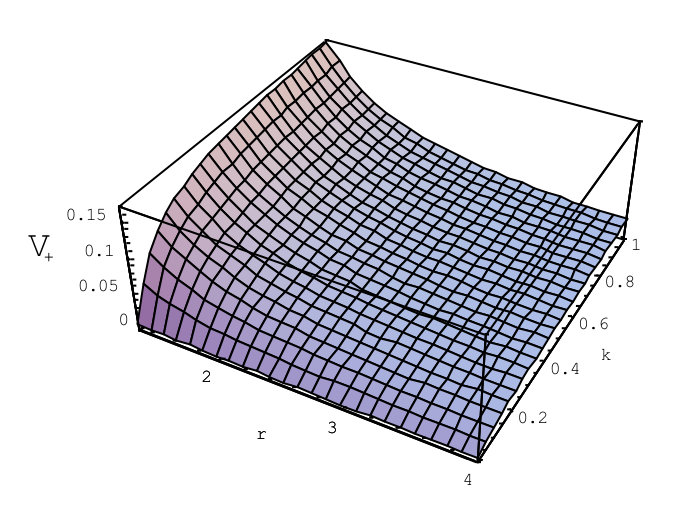 Figure 6
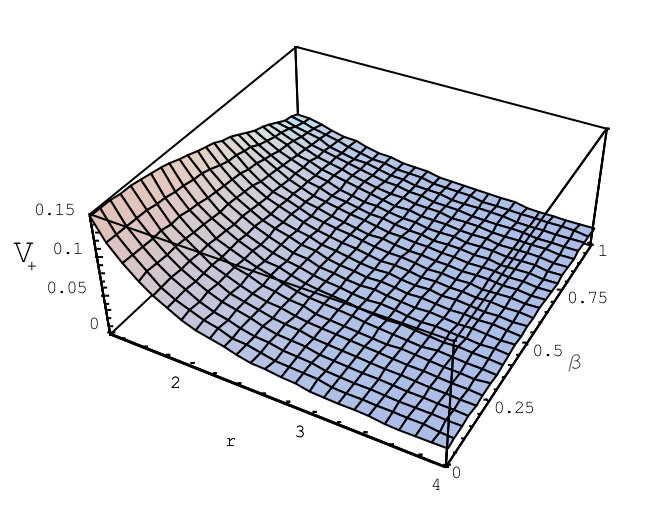 Figure 7
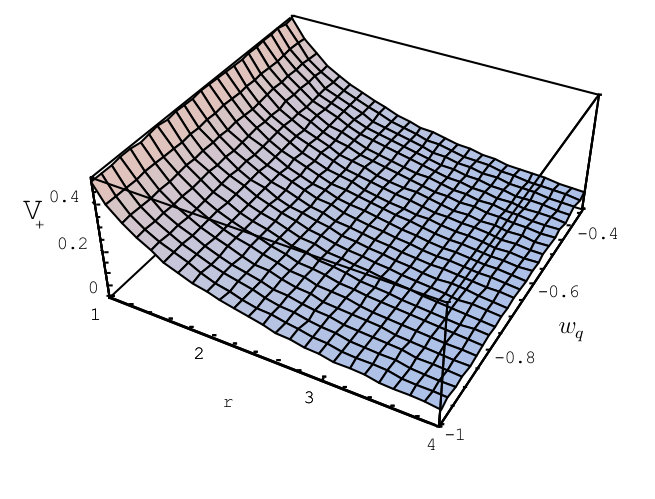 Figure 8
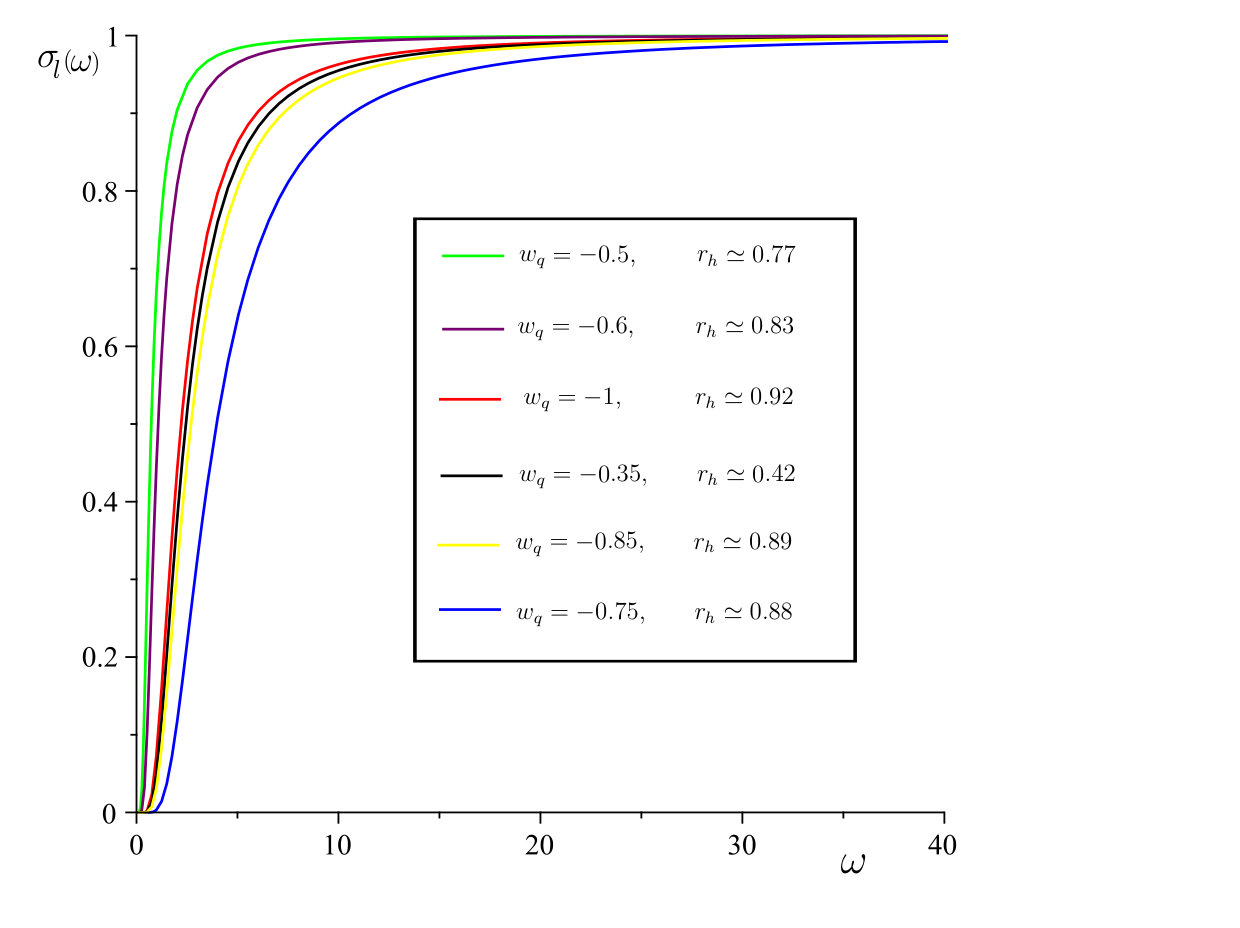 Figure 9
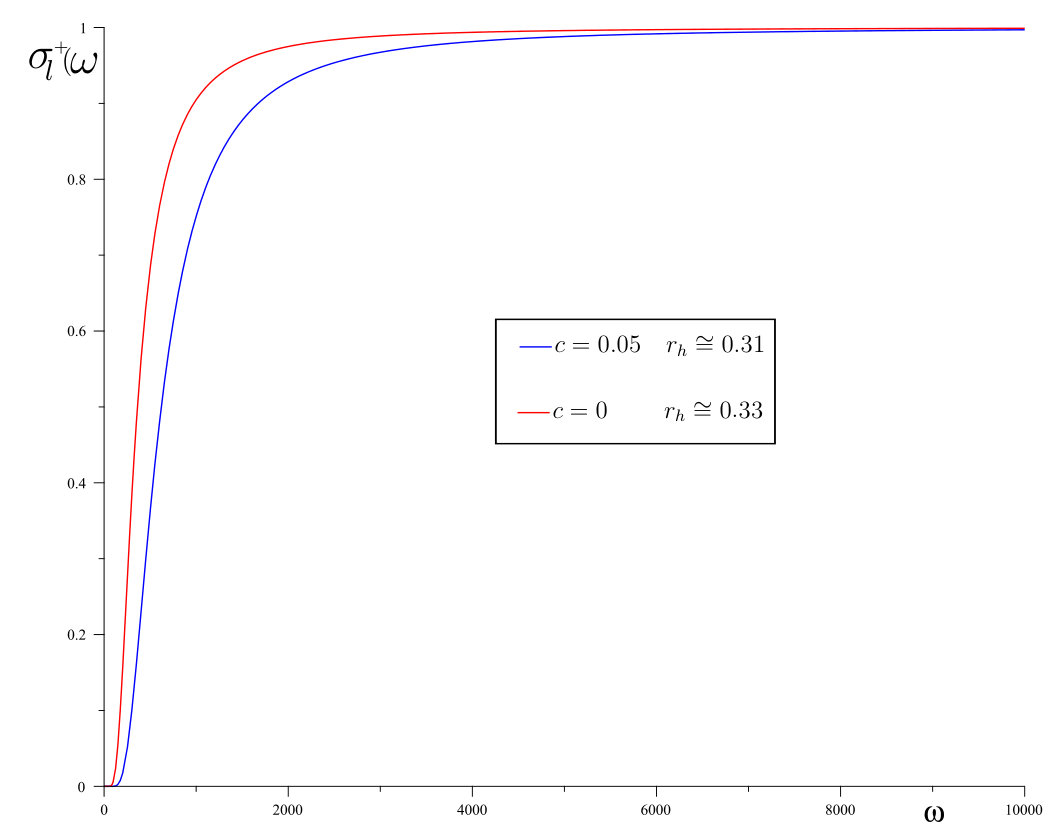 Figure 10
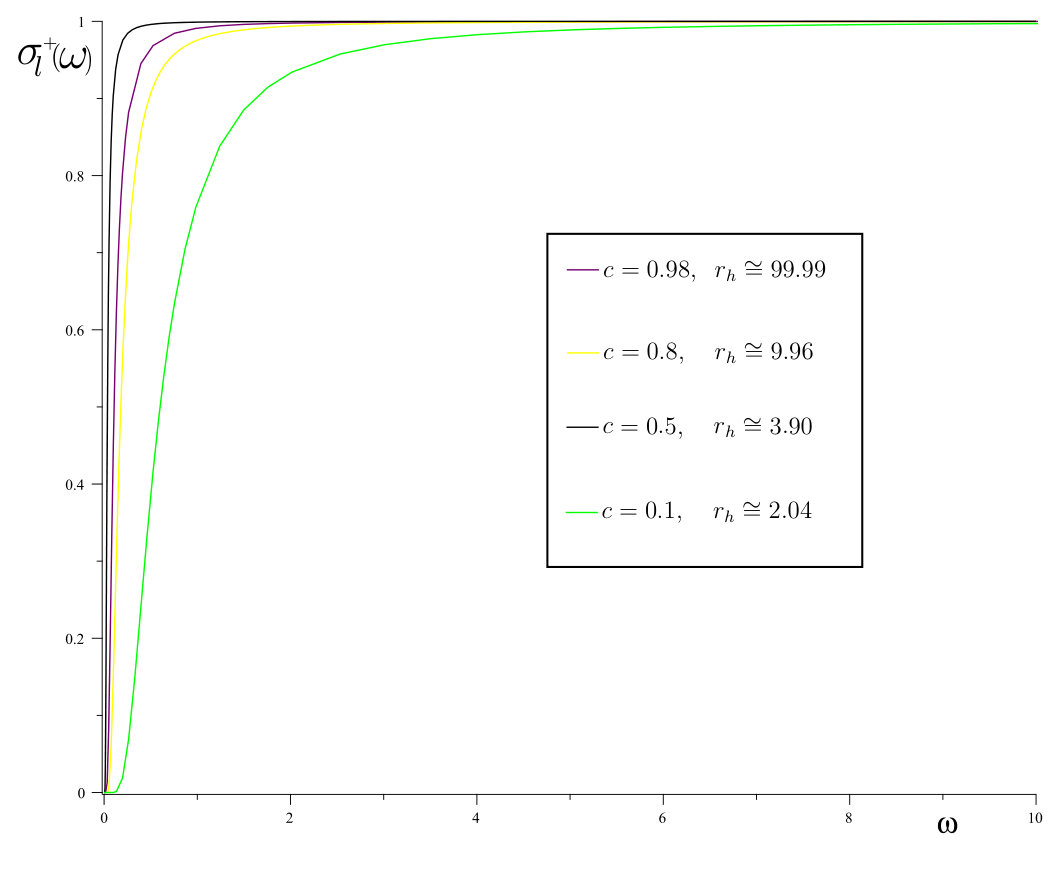 Figure 11
Peer Reviews
No public reviews on file for this paper yet. If you reviewed it on a platform where reviews are public (OpenReview, ICLR, NeurIPS, ICML), you can paste yours below so the community can read it here.
Videos
No videos yet. Explain this paper in a talk, walkthrough, or lecture? Add one.
Solution of Dirac equation and greybody radiation around a regular
Bardeen black hole surrounded by quintessence
Ahmad Al-Badawi
Department of Physics, Al-Hussein Bin Talal University, P. O. Box: 20, 71111, Ma’an, Jordan.
İzzet Sakallı
Physics Department, Arts and Sciences Faculty, Eastern Mediterranean University, Famagusta, North Cyprus via Mersin 10, Turkey.
Sara Kanzi
Physics Department, Arts and Sciences Faculty, Eastern Mediterranean University, Famagusta, North Cyprus via Mersin 10, Turkey.
([])
Abstract
The exact solutions of the Dirac equation that describe a massive, non-charged particle with spin in the curved spacetime geometry of regular Bardeen black hole surrounded by quintessence (BBHSQ) are investigated. We first derive the Dirac equation in the BBHSQ background using a null tetrad in the Newman-Penrose formalism. Afterwards, we separate the Dirac equation into ordinary differential equations for the radial and angular parts. The angular equations are solved exactly in terms of standard spherical harmonics. The radial part equations are transformed into one-dimensional Schrödinger like wave equations with effective potentials. The effect of the quintessence on the regular Bardeen black hole is analyzed via the physical behaviors of the effective potentials. We also exhibit the potential graphs by changing the quintessence parameters, magnetic monopole charge parameter, and the frequency of the particle in the physically acceptable regions. Finally, we study the greybody factors of bosons and fermions from the BBHSQ.
Dirac equation, Bardeen, Quintessence, Black Hole, Greybody, Quantum Gravity, Klein-Gordon, Magnetic monopole, Newman-Penrose formalism.
††preprint: HEP/123-qed
Contents
- I INTRODUCTION
- II Regular BBHSQ Space-time
- III Dirac Equation in BBHSQ
- IV Solution of Angular and Radial Equations
- V Greybody Radiation of Bosons from BBHSQ
- VI Greybody Radiation of Fermions from BBHSQ
- VII Conclusion
I INTRODUCTION
At astrophysics scale, observations confirm the accelerating expansion of the universe 1 . To explain the expansion, it is suggested that the matter content in the universe has a negative pressure called dark energy 2 . There are two kinds of negative pressure, first the cosmological constant 3 ; 4 and the second is the so-called quintessence that causes the acceleration of the universe 5 ; 6 ; 7 . Quintessence is characterized by the state equation: where is the pressure, is the energy density, and is the state parameter. In addition, the scalar fields are also hypothetical forms of dark energy where a broad types of scalar field models have been suggested such as quintessence 8 ; 9 ; 10 ; 11 ; 12 ; 13 ; 14 ; 15 , phantom models 16 ; 17 ; 18 ; 19 ; 20 , K-essence 21 ; 22 , quintom 23 ; 24 , and so on. Ultimately, the difference between these models is due to the magnitude of and for quintessence . The quintessence model refers to a minimally coupled scalar field with a potential which decreases as the field increases. Quintessence is a scalar field with an equation of state where is given by the potential energy and a kinetic term. Hence, quintessence is dynamic and generally has a density, and parameter varies with time. By contrast, a cosmological constant is static, possessing a fixed energy density, and it has
Usually, black holes (BHs) have singularity inside the horizon. However, Bardeen BH (BBH) is a regular BH which does not have singularity inside the horizon. It was first introduced by Bardeen 25 . Since Bardeen introduced his model, many other models of spherical symmetric regular BHs were presented in the literature 26 ; 27 ; 28 ; 29 ; 30 ; 31 ; 32 ; 33 ; 34 ; 35 ; 36 . Later, in Ref. 37 ; 38 the authors have shown that BBH model is explained as the gravitational field produced by a nonlinear magnetic monopole. This explanation was extended so that it includes nonlinear electric charge. Moreover, regular BHs surrounded by quintessence have received major attention. Kiselev 8 obtained the first analytical solutions with spherical symmetry with quintessence surrounding the static BHs. Later, the generalization of Kiselev solutions was obtained by constructing their rotating counterpart 39 ; 40 . On the other hand, the effect of quintessence on BHs have received considerable attention and their thermodynamics has been investigated. For example, in Ref. 41 the thermodynamic properties of the Bardeen black hole surrounded by quintessence (BBHSQ) was thoroughly studied.
In this paper, we consider the Dirac equation in regular BBHSQ space-time. Recall that analytical solutions to the Dirac equation can be obtained in several backgrounds 42 ; 43 ; 44 ; 45 ; 46 ; 47 ; 48 . A reader is referred to see the complete analytical solutions to the Dirac equation on de-Sitter and anti de-Sitter space-time 49 ; 50 ; 51 ; 52 ; 53 . The Dirac equation that we consider in this study describes a massive and non-charged particle with spin-. To this end, we choose a null tetrad in order to apply the Newman-Penrose (NP) formalism. Next, we separate the Dirac equation into ordinary differential equations and the get coupled radial and angular parts. The angular part equations are solved exactly in terms of standard spherical harmonics. The radial equations are transformed into one dimensional Schrödinger like differential wave equations with effective potentials. In addition, we investigate the behavior of the effective potentials by plotting them as a function of radial distance and expose the effect of the quintessence parameters, magnetic monopole charge parameter, and the frequency of the particle on them. Finally, we study the outcome of scattering a wave off a BBHSQ in terms of an absorption cross-section. The absorption cross-section, which is a measure for the probability of an absorption process, is directly connected to the greybody factor. Then, we compute the greybody factor, which is nothing but the transmission probability for an outgoing wave emitted from the event horizon of the BBHSQ to reach the asymptotic region 53v2 ; 53v3 ; 53v4 ; 53v5 . Our main motivation in the present paper paves the way to study the quasi-normal modes associated to a field of spin- on the BBHSQ background. Further, the given analytical expressions of the solution could be useful for the study of the thermodynamical properties of the spinor field in same background.
The plan of the paper is as follows. In the next section, we give a brief discussion on the regular BBHSQ space-time. In Sec. 3, we present the Dirac equation in BBHSQ geometry and decouple the equations into ordinary differential equations for having the radial and angular parts. We then obtain solutions of the angular and radial equations in Sec. 4. The influence of the quintessence parameter is investigated through the behavior of the effective potentials by plotting them as a function of radial distance in the physically acceptable region. Sections 5 and 6 are devoted to the studies of greybody factors of the BBHSQ for the spin-[math] and spin- particles, respectively. Finally, we present our conclusions in Sec. 7.
II Regular BBHSQ Space-time
In this section, we shall give a brief introduction to BBHSQ which was obtained by Kiselev 8 , who assumed a spherically symmetric static gravitational field with the following energy-momentum tensor:
[TABLE]
where is the quintessence state parameter with range and is the density of the quintessence matter given by
[TABLE]
where is the positive normalization factor (). The metric of the regular BBHSQ can be expressed as 41
[TABLE]
where has the following form
[TABLE]
in which is the mass of the BH and can represent the monopole charge of a self-gravitating magnetic field described by a nonlinear electrodynamics source or an electric source with a field that does not behave as the Coulomb field Coulomb . In fact, term is related to the density of quintessence:
[TABLE]
The curvature of the metric (3) has the form of
[TABLE]
which admits a singularity at if . Therefore, the metric in (3) represents a spherically symmetric solutions for the Einstein equations describing BBHSQ with the energy-momentum tensors given in (1). This metric satisfies all the required limits: when , we have Schwarzschild BH metric; as , we get Bardeen BH; and yields the BBHSQ.
We use the NP formalism 54 ; 55 to write and solve the Dirac equation in the spacetime of (3). Therefore let us define the complex null tetrad vectors for the metric (3) where they satisfy the orthogonality conditions, as
[TABLE]
[TABLE]
[TABLE]
[TABLE]
and
[TABLE]
[TABLE]
[TABLE]
[TABLE]
We determine the nonzero NP complex spin coefficients 55 as follows
[TABLE]
III Dirac Equation in BBHSQ
We write the Dirac equations in the NP formalism by using the standard notation for the spin coefficients 54 ; 55 as
[TABLE]
[TABLE]
[TABLE]
[TABLE]
where and represent the components of the wave functions ”Dirac spinors”, the mass of the particle and are the spin coefficients and bar over a quantity denotes complex conjugation. We now study the Dirac equations (9-12) in the background of metric (3). To solve the Dirac equations, we will consider the corresponding Compton wave of the Dirac particle as in the form of , where is the frequency of the incoming wave and is the azimuthal quantum number of the wave. For separable solutions, we assume 54 ,
[TABLE]
[TABLE]
[TABLE]
[TABLE]
Substituting the appropriate spin coefficients (8) and the spinors (13) into the Dirac equations (9-12), we obtain the following set of equations
[TABLE]
[TABLE]
[TABLE]
[TABLE]
where and are the angular operators, which are known as the laddering operators:
[TABLE]
[TABLE]
[TABLE]
The constants , and are called the separation constants. To obtain the radial and the angular pair equations, we assume , therefore (16) and (17) reduce to
[TABLE]
[TABLE]
[TABLE]
IV Solution of Angular and Radial Equations
Angular equations (20) can be rewritten as
[TABLE]
[TABLE]
which lead to the spin-weighted spheroidal harmonics whose solution is given in terms of standard spherical harmonics 55 ; 56 ; 57 as
[TABLE]
with .
The radial equations (18) and (19) can be rearranged as
[TABLE]
[TABLE]
where is the normalized rest mass of the spin- particle.
Our task now is to put the radial equations (24) and (25) in the form of one dimensional wave equations. To this end, we follow the method applied by Chandrasekhar’s book 54 . We start by making the following transformations
[TABLE]
Hence, (24) and (25) transform to
[TABLE]
[TABLE]
Assuming
[TABLE]
then, (27) and (28), in terms of the new independent variable , become
[TABLE]
[TABLE]
where
[TABLE]
Let us apply another transformation:
[TABLE]
and then changing the variable into as then (30) and (31) can be written in the alternative forms:
[TABLE]
[TABLE]
where
[TABLE]
To put (34) and (35) into one dimensional wave equations, we define
[TABLE]
[TABLE]
[TABLE]
Finally, we end up with the following pair of one dimensional wave equations
[TABLE]
[TABLE]
where the effective potentials can be obtained from
[TABLE]
We calculate the effective potentials as
[TABLE]
where
[TABLE]
Let us note that the effective potentials for the case of massless Dirac particle (neutrino) can be obtained by setting in (43) namely
[TABLE]
whereas substituting reduces to the effective potentials for BBH
[TABLE]
where
[TABLE]
The complete solution of (40) and (41) can be obtained by the WKB approximation method (for more details, a reader is referred to WKB1 ; WKB2 ). To study the asymptotic behavior of the potentials (43), we can expand it up to order . The potentials (43) for BBHSQ (here, we choose ) behave as
[TABLE]
where
[TABLE]
In case of neutrino, the potentials simplified to
[TABLE]
The first term in (48) represents the constant value of the potential at the asymptotic infinity. The second term corresponds to the monopole type potential, while the third term represents the dipole type potential. As seen from the asymptotic expansion of the potentials (48), the effect of adding the quintessence term to the lapse function in the metric (3) is observed at all terms. From (43), we notice that the potentials depend on the , and parameters. We would like to remind that the effect of the quintessence on BH has received considerable attention in General Relativity 58 ; 59 . Therefore, it is interesting to investigate the quintessence affect the massive and non-charged Dirac particle.
It is obvious from (43) that the potentials become singular when . They also have local extrema when , however, these local extrema are very complicated algebraic equation to be solved. To understand the physical behavior of the potentials (43) in the physical region and to expose the effect of the quintessence parameters , magnetic monopole charge parameter and the frequency of the particle,we make two-dimensional and three-dimensional plots of the potentials for massive particles. In all plots, we choose the fermion’s mass and the frequency such that The effective potential (43) versus for different values of is depicted in Fig. 1. It is observed that the potentials have sharp peaks for all values of . We notice that when the normalization factor increases, the sharpness of the potential peaks also increases. We deduse From Fig. 1 that, a massive Dirac particle in the presence of quintessence matter () meets with a high potential barrier, which causes a decreasing in their kinetic energies. However, without quintessence () the particle encounters a low potential barrier, which means that the Dirac particle’s kinetic energy would increase.
In Fig. 2, we investigate the behavior of the effective potentials by obtaining potential curves for some specific values of the frequency while keeping the normalization factor constant (). We can see that the potentials have peaks for all values of . Again, while the frequency increases, the potentials barrier increases, and potentials behave similarly in the sufficiently large distances.
The effect of the quintessence term can be observed explicitly by making a three-dimensional plot of the potential with respect to the normalization factor and the radial distance . In Fig. 3, we observe a three-dimensional small peak for values of normalization factor . As the value of radial distances increases, potentials level off. Fig. 4 represents the three-dimensional plot of potential with respect to frequency and the radial distance. It is seen from Fig. 4 that; sharp peaks are clear for high frequencies. The effect of the monopole charge of a self-gravitating magnetic field on the the potentials for the massive charged spin- particle can be observed in Fig. 5. We deduce that; high potential barriers are observed for small values of whereas for large values the potential barriers decrease. Again, the potential levels decrease for large values of distance and asymptote behavior is manifested. Finally, the three-dimensional plot of potential with varying the state parameter is shown in Fig. 6. We see from Fig. 6 that the potential levels are constant for different values of which implies that the state parameter does not affect the potentials.
V Greybody Radiation of Bosons from BBHSQ
In this section, we evaluate the greybody factor of BBHSQ for spin particles. For the sake of simplicity, we consider the massless Klein-Gordon equation 60
[TABLE]
where the box symbol denotes the Laplacian operator 61 :
[TABLE]
By considering the metric (3) of BBHSQ, then (51) reads
[TABLE]
Where the scalar field can be defined as
[TABLE]
here denotes the frequency of the wave. Substituting the the scalar field in (53), one obtains
[TABLE]
where is the eigenvalue coming from the physical solution of the angular equation of , which is nothing but the standard spherical harmonics 55 ; 56 ; 57 . By changing the variable in a new form as the radial wave equation (55) recasts into a one dimensional Schrödinger like equation as follows
[TABLE]
where the effective potential for BBHSQ is given by
[TABLE]
To evaluate the greybody factor we use 54 ; 62
[TABLE]
in which is the tortoise coordinate: and
[TABLE]
In (59), is a particular positive function that satisfies the following conditions: and 63 . Here, without loss of generality, we simply set it as 62 ; 63 , resulting in that the integration of (58) becomes
[TABLE]
After making a straightforward calculation, one finds
[TABLE]
where represents the event horizon.
We depict the greybody factors of the BBHSQ in Fig. 7. As seen from Fig. 7, the values of and event horizon () are linearly proportional to each other. It is obvious that greybody radiation strictly depends also on the state parameter . According to the information we obtained from the graph, a similar radiation emission occurs around critical values ( and ). However, while value moves away from those critical values, then radiation may decrease or increase depending on .
VI Greybody Radiation of Fermions from BBHSQ
In this section, we shall derive the fermionic greybody factors of the neutrinos emitted from BBHSQ. To this end, we consider the case of in order to obtain analytical results from Eq. (58). In the case of , the potentials (45) can be rewritten as
[TABLE]
in which
[TABLE]
Following the procedure described in the previous section [see Eqs. (58)-(62)], one can get
[TABLE]
in which and stand for the greybody factors of the spin-up and spin-down fermions, respectively. After performing some tedious computations, the greybody factors of the fermions can be obtained as follows
[TABLE]
As it can been seen from Figs. (8) and (9), the greybody factors of spin-up and spin-down fermions exhibit almost the same behaviors as changes.
VII Conclusion
In this paper, we have investigated the exact solutions of the Dirac equations that describe a massive, non-charged particle with spin- in the curved space-time geometry of BBHSQ, using NP (null tetrad) formalism. By employing an axially symmetric ansatz for the Dirac spinors, we decouple equations into angular and radial parts. The angular equation leads to the spin-weighted spheroidal harmonics with eigenvalue . The radial equations were reduced to pair of one-dimensional Schrodinger-like wave equations with effective potentials for the Dirac particle. We then studied the potentials by plotting them as a function of radial distance. Thus, the effect of the quintessence term on the BBH are unfolded. We revealed that potentials barriers having quintessence matter become more higher than the potentials without the quintessence. We also showed that, as the frequency increases, potentials levels increase as well. However, as the magnetic monopole charge parameter increases, the potential levels decrease whereas the potentials do not change for varying the state parameter . Remarkably, we depicted how the greybody factors of bosons and fermions vary with the quintessence state parameters (see Fig. 7) and (see Figs. 8 and 9), respectively.
In future work, we will extend our analysis to the Dirac equation of charged massive fermionic waves propagating in the rotating geometry of the BBHSQ. In this way, we plan to analyze the effect of quintessence on the stationary spacetimes using fermions. For this purpose, we shall also consider the Janis-Newman algorithm 64 for the static BBHSQ (3).
The reference list from the paper itself. Each links out to its DOI / PubMed record.
- 1(1) P. J. E. Peebles and B. Ratra, Rev. Mod. Phys. 7 5, 559 (2003).
- 2(2) P.A. Ade et al., Astron. Astrophys. 571, A 1 (2014).
- 3(3) R. Caldwell, Braz. J. Phys. 30 , 215 (2000).
- 4(4) J.A.S. Lima, Braz. J. Phys. 34(1A), 194 (2004).
- 5(5) S. Perlmutter et al., Astrophys. J. 517, 565 (1999).
- 6(6) A. G. Riess et al., Astron. J. 116 , 1009 (1998).
- 7(7) P. M. Garnavich et al., Astrophys. J. 509 , 74 (1998).
- 8(8) V. V. Kiselev, Class. Quantum Grav. 20 , 1187 (2003).