On jump relations of anisotropic elliptic interface problems
Baiying Dong, Xiufang Feng, and Zhilin Li

TL;DR
This paper develops a systematic approach to derive interface relations for anisotropic elliptic PDEs with discontinuities, addressing the challenges posed by anisotropy and coordinate transformations, which is crucial for high-order numerical methods.
Contribution
It introduces a new systematic method for deriving interface relations in anisotropic elliptic problems, extending beyond isotropic cases and handling coordinate transformation issues.
Findings
Derived interface relations for anisotropic elliptic PDEs in 2D and 3D.
Addressed invariance issues under coordinate transformations.
Facilitated development of high-order numerical methods.
Abstract
Almost all materials are anisotropic. In this paper, interface relations of anisotropic elliptic partial differential equations involving discontinuities across interfaces are derived in two and three dimensions. Compared with isotropic cases, the invariance of partial differential equations and the jump conditions under orthogonal coordinates transformation is not valid anymore. A systematic approach to derive the interface relations is established in this paper for anisotropic elliptic interface problems, which can be important for deriving high order accurate numerical methods.
Click any figure to enlarge with its caption.
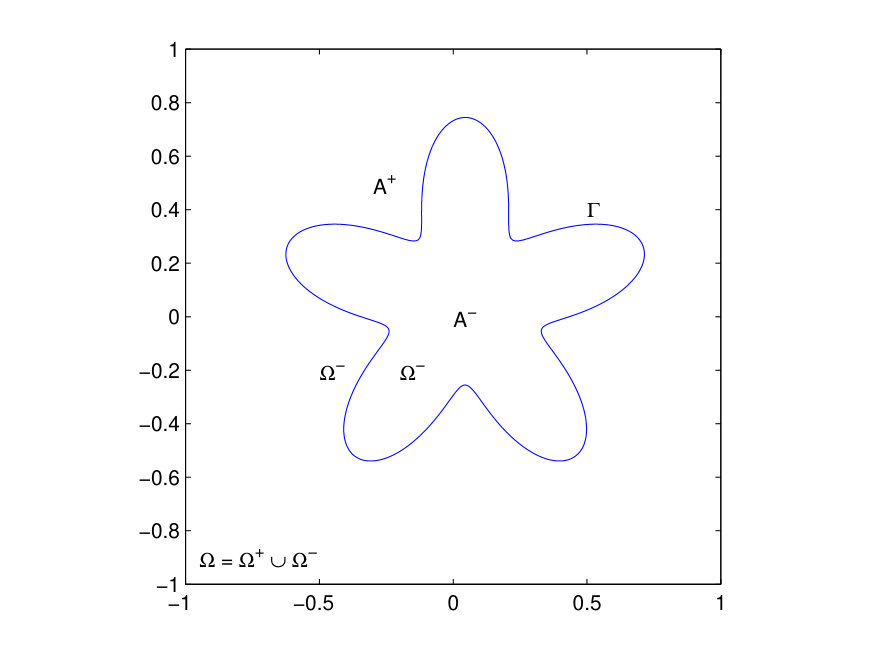 Figure 1
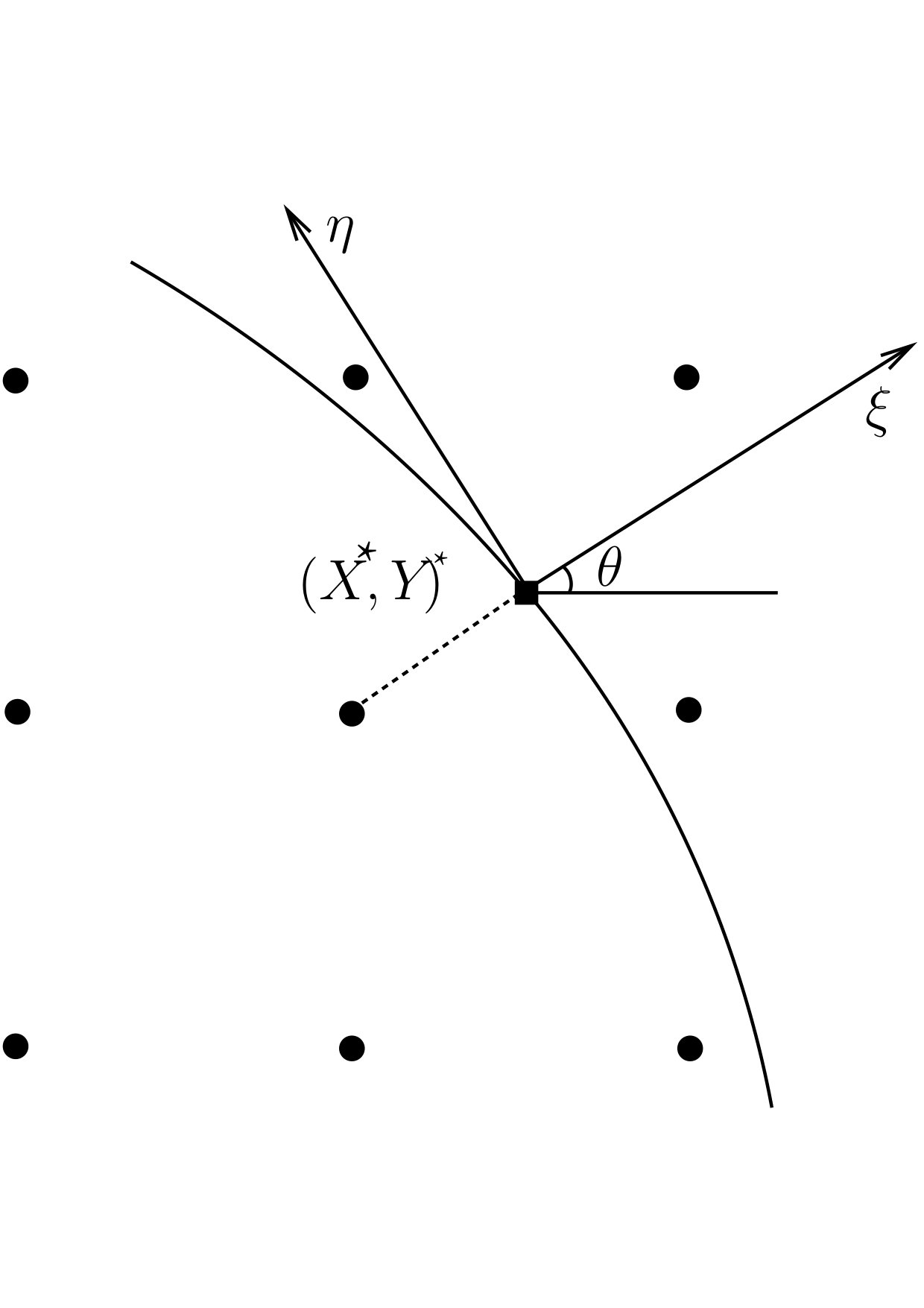 Figure 2
Peer Reviews
No public reviews on file for this paper yet. If you reviewed it on a platform where reviews are public (OpenReview, ICLR, NeurIPS, ICML), you can paste yours below so the community can read it here.
Videos
No videos yet. Explain this paper in a talk, walkthrough, or lecture? Add one.
Taxonomy
TopicsAdvanced Numerical Methods in Computational Mathematics · Numerical methods in engineering · Electromagnetic Simulation and Numerical Methods
On jump relations of anisotropic elliptic interface problems
Baiying Dong School of Mathematics and Statistics, Ningxia University, Yinchuan, 750021, China.
Xiufang Feng School of Mathematics and Statistics, Ningxia University, Yinchuan, 750021, China.
Zhilin Li Corresponding Author: CRSC & Department of Mathematics, North Carolina State University, Raleigh, NC 27695-8205, USA. Z. Li is partially supported by a Simon Foundations grant.
Abstract
Almost all materials are anisotropic. In this paper, interface relations of anisotropic elliptic partial differential equations involving discontinuities across interfaces are derived in two and three dimensions. Compared with isotropic cases, the invariance of partial differential equations and the jump conditions under orthogonal coordinates transformation is not valid anymore. A systematic approach to derive the interface relations is established in this paper for anisotropic elliptic interface problems, which can be important for deriving high order accurate numerical methods.
keywords: anisotropic elliptic interface problems, jump conditions/relations, local coordinates.
AMS Subject Classification 2000 .
1 Introduction
Consider an anisotropic elliptic interface problem below,
[TABLE]
where is a symmetric positive definite matrix whose eigenvalues satisfy, , for all ; and ; the source term .
[TABLE]
where is a smooth interface with the solution domain, and the notation is a jump of a quantity across the interface. The above jump conditions are often referred as internal boundary conditions that make the problem well-posed.
There are many discussions in the literature about anisotropic interface problems including physics and modeling [2, 8, 10], analysis [11, 6, 12], and numerical methods [4, 1, 5].
For theoretical and numerical purposes, we want to know the interface relations of the partial derivatives of the solution across the interface. When , that is, a scalar case, the interface relations have been derived using the invariance of the PDE and the jump conditions. The derived interface relations have then been applied in derive accurate finite difference methods such as the IIM [7, 3, 9].
2 The interface relations for anisotropic interface problems in 2D
In 2D, the interface is a curve within the solution domain. We cannot assume invariances of the PDE, the flux jump conditions, and their surface derivatives under different coordinates systems. In this paper, we propose a way to parameterize the interface locally using a level set function so that we can derive the interface relations in a systematically way as described below.
2.1 The local coordinate system and representation of the interface in 2D
Let be a fixed point on the interface , and the normal direction at be , where is the angle of the normal direction and the -axis, see Figure 1 for an illustration. The local coordinates in the neighborhood of is defined as
[TABLE]
In a neighborhood of , the interface can be written as
[TABLE]
and can be further parameterized as
[TABLE]
We have , here can be regarded as arc-length parameter starting from . The tangent vector then is
[TABLE]
with \mbox{\boldmath\tau}(0)=[-\sin\theta^{*},\;\cos\theta^{*}], and the normal direction is
[TABLE]
For simplicity, we still use the same notations for the solution , , , and in the local coordinate system. In the neighborhood of , using the idea of the level set method, we can extend the quantities on the interface along the normal line using . Thus the tangential and normal derivatives and other interface quantities are also defined in the neighborhood as the normal extension of their value from the interface along the normal line. Note that in the local coordinates, the PDE can be written as
[TABLE]
where are defined below
[TABLE]
Under the framework above, we are ready to prove the main theorem in 2D.
Theorem 1
If is a piecewise constant matrix, , , , , , then the following interface relations hold.
[TABLE]
where , , and are given below,
[TABLE]
Note that depends on the jump conditions and , their (surface) derivatives, coefficient matrix , and the curvature of .
Proof: Differentiating with respect to once we get
[TABLE]
Differentiating the identity above with respect to we get
[TABLE]
Setting in the above two identities and using , we obtain the third and the fourth identities in the theorem.
From , and defined above, and the relation between and , and with some manipulations, we can rewrite \big{[}\mathbf{A}\nabla u\cdot\mathbf{n}\big{]} as,
[TABLE]
Therefore, the flux jump condition can be written as
[TABLE]
We get the second identity by setting .
To get the fifth identity, we differentiate the flux jump condition above with respect to . The left hand side then is
[TABLE]
The right hand side is
[TABLE]
By plugging to the left and right hand sides and using , we get the fifth identity.
The last identity is obtained from the PDE using
[TABLE]
Remark 1
For variable coefficients , , and , the derivation process is similar but the expressions are long and more complicated. The PDE in the local coordinates now is
[TABLE]
where
[TABLE]
The first four identities are the same and the last two are the following:
[TABLE]
[TABLE]
where , are given below where
[TABLE]
The reference list from the paper itself. Each links out to its DOI / PubMed record.
- 1[1] N. An and H. Chen, A partially penalty immersed interface finite element method for anisotropic elliptic interface problems , Numerical Methods for Partial Differential Equations 30 (2014), 1984–2028.
- 2[2] S. Bergmann, K. Albe, E. Flegel, D. A. Barragan-Yani, and B. Wagner, Anisotropic solid–liquid interface kinetics in silicon: an atomistically informed phase-field model , Modelling Simul. Mater. Sci. Eng. 25 (2017).
- 3[3] S. Deng, K. Ito, and Z. Li, Three dimensional elliptic solvers for interface problems and applications , J. Comput. Phys. 184 (2003), 215–243.
- 4[4] M. Dumett and J. Keener, A numerical method for solving anisotropic elliptic boundary value problems on an irregular domain in 2D , SIAM J. Sci. Comput. 25 (2003), 348–367.
- 5[5] S. Hou, W. Wang, and L. Wang, Numerical method for solving matrix coefficient elliptic equation with sharp-edged interfaces , J. Comput. Phys. 229 (2010), no. 19, 7162–7179.
- 6[6] W. Huang and S. I. Rokhlin, Interface waves along an anisotropic imperfect interface between anisotropic solids , J. Nondestructive Evaluation 11 (1992), 185–198.
- 7[7] R. J. Le Veque and Z. Li, The immersed interface method for elliptic equations with discontinuous coefficients and singular sources , SIAM J. Numer. Anal. 31 (1994), 1019–1044.
- 8[8] V. I. Levitas and J. A. Warren, Phase field approach with anisotropic interface energy and interface stresses: Large strain formulation , J. Mech. Phy. Solids 91 (2016), 94–125.