Structure of quantum and classical implementations of Popescu-Rohrlich box
Anna Jen\v{c}ov\'a, Martin Pl\'avala

TL;DR
This paper explores how Popescu-Rohrlich boxes can be implemented using quantum and classical channels, revealing structural similarities and properties like entanglement-breaking in quantum cases.
Contribution
It provides a unified construction approach for PR-box implementations in quantum and classical frameworks, highlighting their structural features and quantum channel characteristics.
Findings
Quantum channels that maximize CHSH violation are entanglement-breaking.
All such quantum channels share a block-diagonal structure.
The constructions are inspired by general probabilistic theories and the square state space model.
Abstract
We construct implementations of the PR-box using quantum and classical channels as state spaces. In both cases our constructions are very similar and they share the same idea taken from general probabilistic theories and the square state space model. We construct all quantum qubit channels that maximally violate a given CHSH inequality, we show that they all are entanglement-breaking channels, that they have certain block-diagonal structure and we present some examples of such channels.
Click any figure to enlarge with its caption.
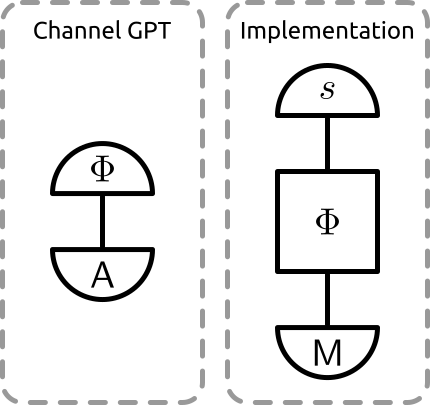 Figure 1
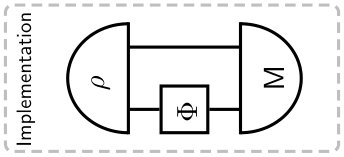 Figure 2
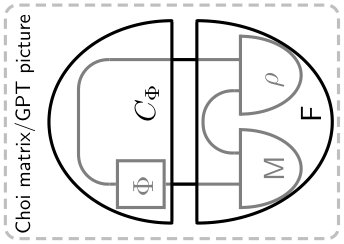 Figure 3
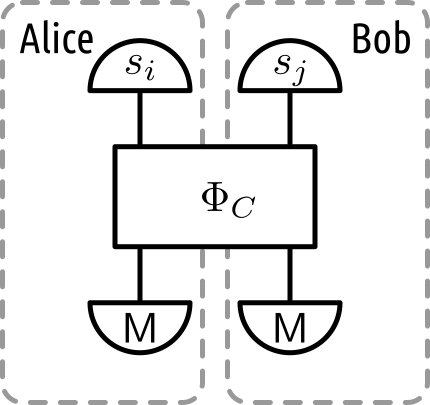 Figure 4
Peer Reviews
No public reviews on file for this paper yet. If you reviewed it on a platform where reviews are public (OpenReview, ICLR, NeurIPS, ICML), you can paste yours below so the community can read it here.
Videos
No videos yet. Explain this paper in a talk, walkthrough, or lecture? Add one.
Structure of quantum and classical implementations of Popescu-Rohrlich box
Anna Jenčová
Mathematical Institute, Slovak Academy of Sciences, Štefánikova 49, Bratislava, Slovakia
Martin Plávala
Mathematical Institute, Slovak Academy of Sciences, Štefánikova 49, Bratislava, Slovakia
Naturwissenschaftlich-Technische Fakultät, Universität Siegen, 57068 Siegen, Germany
Abstract
We construct implementations of the PR-box using quantum and classical channels as state spaces. In both cases our constructions are very similar and they share the same idea taken from general probabilistic theories and the square state space model. We construct all quantum qubit channels that maximally violate a given CHSH inequality, we show that they all are entanglement-breaking channels, that they have certain block-diagonal structure and we present some examples of such channels.
I Introduction
The Bell non-locality is a well known topic in quantum theory, yet we still lack full understanding of its implications. The research of Bell non-locality was inspired by the famous paradox of Einstein, Podolsky and Rosen Einstein et al. (1935) that questioned the completeness of quantum theory.
As it was later shown by Bell (Bell, 1964) the EPR paradox does not question the completeness of quantum theory, but it rather separates it from any other classical theory. This was demonstrated by the well-known Bell inequalities, that constrain any classical theory but are violated by quantum theory. Probably the most well known and most studied of Bell inequalities is the CHSH inequality Clauser et al. (1969) that can be violated by quantum states and measurements, but this violation is constrained by the Tsirelson bound Cirel’son (1980). On one hand this shows that quantum theory is more non-local than any classical theory, on the other hand, Popescu and Rohrlich proved that the CHSH inequality may be violated even more by non-signaling correlations Popescu and Rohrlich (1994); Rohrlich (2014). Since then, it is a long-standing question whether the Tsirelson bound does have any operational meaning for quantum theory.
It was later shown by Barrett that the conditional probability distribution identified in Popescu and Rohrlich (1994), now often called the PR-box, can be generated by a non-signaling theory Barrett (2007), most commonly known as the Boxworld GPT. A realization of the PR-box in the real world would have several rather interesting implications, as shown in Quek and Shor (2017); Van Dam (2013); Buhrman et al. (2006), see also Brunner et al. (2014) for a review.
It has been demonstrated several times that non-signaling classical and quantum channels provide realizations of the PR box Beckman et al. (2001); Hoban and Sainz (2018); Plávala and Ziman (2020); Crépeau et al. (2017). As described in Plávala and Ziman (2020), such constructions can be put into the framework of general probabilistic theories (or GPT for short), in the following way: since the set of classical (or quantum) channels is compact and convex, it can be seen as a state space of some GPT. One can see non-signaling channels as elements of a joint state space, equivalent to entangled states in quantum theory, and one can describe measurement procedures and CHSH experiments within this theory, yielding maximal violation of the CHSH inequality.
One has to be careful when using channels in this way. The formalism implies that we are able to use the channel only once, hence one can exploit the input state incompatibility of measurements on channels Sedlák et al. (2016). From a realistic view-point it is important to remember that using a non-local channel may take some time and resources, but the channel is considered to permit communication only if the channel is signaling.
In the present paper, we focus on the structure of the non-signaling channels such that the CHSH inequality is maximally violated for some choice of channel measurements. Such channels will be called the PR-channels. All the PR-channels obtained so far are in fact classical-to-classical and it is natural to ask whether there are some truly quantum non-signaling PR-channels. Another important question is the possibility of instantaneous implementation of such channels. Since PR-channels are non-signaling, their instantaneous implementation is not forbidden by special theory of relativity simply because no information is transferred, yet it is believed that such implementations do not exist.
We make a step toward addressing these questions, in that we present a characterization of the structure of all implementations of the PR-box in the framework of GPTs, especially for theories in which classical and quantum channels play the role of states. In any GPT, the pairs of measurements appearing in such implementations must be maximally incompatible and we show how the corresponding bipartite states are constructed from such pairs.
We apply the obtained results mainly to qubit bipartite non-signaling channels, where both parts of the input and output are qubit spaces. Here we give a full description of all possible pairs of maximally incompatible two-outcome channel measurements and of all qubit PR-channels. In particular, we prove that all these channels are necessarily entanglement-breaking. We believe that our results will bring more insight into the structure of PR-channels, in particular to the question of existence of their instantaneous implementation.
The article is organized as follows: in Sec. II we give a brief overview of general probabilistic theories as it will be used in later calculations. In Sec. III we present the method of finding all bipartite non-signaling states that maximally violate the CHSH inequality and show that maximally incompatible measurements are necessary, the main result is stated as Thm. 1. In Sec. IV, we present the (known) PR-box implementation by classical channels in the light of the results of Sec. III. The main purpose of Section V is to introduce the GPT of quantum channels and show how the known PR-box implementations (and their slight generalizations) are obtained by our construction. In Sec. VI we derive the structure of all qubit PR-channels. The main result is in Thm. 2 where we prove that all qubit PR-channels must be entanglement-breaking and we provide some examples. Some more technical proofs can be found in the appendices.
II Overview of general probabilistic theories and tensor products
General probabilistic theories (GPTs for short) provide a framework that uses operational axioms to describe various possible physical theories. GPTs include the classical and the quantum theory, hence this setting allows us to compare these two theories as well as to construct theories that are different from both. Among other things, GPTs provide a framework to describe measurements of a physical systems in a general and mathematically clear way. We briefly introduce the formalism below, which allows us to obtain general results applicable to various state spaces. Since it will be sufficient for all of our calculations, we will only consider theories with finite dimensional state spaces. This section is only intended to settle the notation that we use; for a full review of GPTs we refer the reader to Janotta and Hinrichsen (2014). A nice introduction to GPTs, including a historical account, can be found in Lami (2017).
The main idea behind GPTs is the following: both in (finite-dimensional) classical and quantum theory, the state space (i.e. the set of all preparation procedures) is a compact convex subset of a real finite-dimensional vector space. We will generalize both theories by assuming that the state space is some compact convex subset of a finite-dimensional vector space.
Any GPT can be described as a set of physical systems it contains. In operational terms, any system is determined by the set of allowed preparation procedures (states) and yes-no experiments (effects).
The set of states has a natural convex structure, because if and are preparable states of a system, then we can randomize the preparation to prepare the convex combination , which we again postulate to be a viable state. One can also argue that the state space must be closed (in a for now unspecified topology) as if we can prepare a series of states converging to , then we should be also able to prepare (albeit with infinite resources).
An effect is described by an affine function mapping states to probabilities of the "yes" outcome, represented by the interval . Recall that a function is affine if it respects the convex structure: , for any states and and any . We will require that for any two distinct states there is an effect that distinguished these states strictly better than a random guess. This implies that the state space must be bounded. Indeed, if the state space would have a direction of recession in which it would go to infinity (i.e. it would be unbounded), any effect would have to be zero in this direction, so we would be unable to distinguish these states.
We also require the state space to be embedded in a real finite-dimensional vector space equipped with the Euclidean topology. This last assumption is only practical as it allows us to stick only to rather simple mathematics. Note that it is well known that any bounded and closed subset of a finite-dimensional real vector space is compact, hence the state space is compact.
II.1 Structure of GPTs
As we have seen above, the basic mathematical framework for GPT consists of compact convex sets in finite dimensional Euclidean spaces and affine functions on them. Below, we introduce the notations and further assumptions, applied throughout the paper.
Let be a finite dimensional real vector space with the standard Euclidean topology and let be a compact convex set, interpreted as the state space of a system in a GPT. Let denote the linear space of real-valued affine functions on . We will denote constant functions by the value they attain. Let , then we introduce an ordering to as follows: if and only if for every we have . Let denote the convex, closed, generating, pointed cone of positive functions and let denote the set of effects on , called the effect algebra. The effect algebra is important in GPTs since (as will be explained below) the effects describe two-outcome measurements of the theory.
Denote the dual of and denote the positive cone dual to , i.e.
[TABLE]
The cone gives rise to an ordering on : let , then if and only if , i.e. if . The state space is affinely isomorphic to the subset , see (Asimow and Ellis, 1980, Chapter 1, Theorem 4.3). Note that by definition, we consider all states to be normalized, which is expressed by the condition . For simplicity we will omit the above isomorphism and treat as a subset of .
It follows that any can be expressed uniquely as for and . The cone is generating, so we can express every as for some and , .
Now we will present a simple definition of a two-outcome measurement in GPTs. Generally speaking, a measurement is a procedure that assigns probabilities to possible measurement outcomes. For simplicity we will restrict ourselves to outcomes labeled by the numbers , . Let be such a measurement and let denote the probability of obtaining the outcome labeled as when we measure a system in the state . Since the outcome probabilities must respect probabilistic mixtures, the map is an effect and is an effect as well. Although in general the measurements in the theory may be restricted, in this work we will assume that any effect gives rise to such a measurement, determined for as
[TABLE]
Such an assumption is called the No-Restriction hypothesis Chiribella et al. (2010), see also Filippov et al. (2019) for a recent treatment.
Measurements with a finite number of outcomes are similarly described by collections of effects , such that . For a more general treatment of measurements see e.g. (Holevo, 2011, Section 2.2).
We now list some examples of state spaces, and relations between them, that are basic for the present work.
Example 1* (Classical bit).*
The simplest (nontrivial) example is the 1-dimensional simplex . Let the extreme points (deterministic states) in be denoted by , then . Since all affine functionals are fully determined by their values at , we have and the set of effects is identified with . Let be the effect determined by , , then is an affine isomorphism.
Example 2* (Quantum state space).*
Let be a finite dimensional complex Hilbert space. Let denote the set of self-adjoint operators on and let denote the set of density operators (or states) on , where means that is positive semi-definite and denotes the trace of . Let denote the identity operator. Then and , where is the set of quantum effects. The quantum measurements will be thus described by collections of positive operators such that , such a collection is called a POVM Heinosaari and Ziman (2012). We will mostly treat the qubit case, that is .
Example 3* (Square state space).*
This state space is also called the gbit and appears as the state space of systems in a theory called GNST introduced in Barrett (2007), now also known as the Boxworld GPT. This theory is one of the most commonly used examples of a GPT other than classical or quantum theories. The square is a state space with four extreme points , such that
[TABLE]
Let be given, for , as
[TABLE]
then and . Moreover, we can see that forms a linear basis of , which is dual to . Note also that the map
[TABLE]
is an affine isomorphism of onto , its inverse is given by
[TABLE]
The notations , , introduced in the above examples will be kept throughout.
Example 4* (Classical bit channels).*
A channel is defined as an affine map of into itself; a simple example of a channel is the identity channel . Let be the set of all channels (on the classical bit), then since is an effect on for every and is an isomorphism, we see that
[TABLE]
Through this isomorphism, we establish a relation between classical bit channels and the Boxworld GPT.
The effect () on corresponds to the effect in , determined as (). More generally, each effect in is a convex combination of effects of the form
[TABLE]
where and (clearly, we may restrict to the extreme points ). The corresponding measurement can be seen as a protocol where we choose the state with some probability , input it into the measured channel and apply the effect to the output of the channel. For such a measurement and a channel , we have
[TABLE]
where is the measurement given by , see also Fig. 1.
Note that we can obtain similar relations for finite dimensional simplices, their products and channels between them. The (for us) most important example of quantum channels will be described later in Section V.
II.2 Incompatible measurements in GPT
Let , be two-outcome measurements on given by the effects respectively, then we say that they are compatible Stevens and Busch (2014); Banik (2015); Sedlák et al. (2016); Heinosaari et al. (2015) if there is a four-outcome measurement with outcomes , , , such that for all we have
[TABLE]
Equivalently, measurements and are compatible if and only if there is such that
[TABLE]
see Plávala (2016) for a proof. This definition of compatibility of measurements generalizes to GPTs the well-known notion of compatibility (or joint measurability) of POVMs in quantum theory, which itself generalizes the notion of commutativity of projective measures, see Heinosaari et al. (2015) for a review.
The degree of compatibility of and is defined as
[TABLE]
where and are trivial or coin-toss measurements determined by constant effects for . It is known that we always have Busch et al. (2013) and we say that the measurements and are maximally incompatible if .
By Jenčová and Plávala (2017), the effects correspond to maximally incompatible measurements if and only if there are four points satisfying
[TABLE]
and such that
[TABLE]
We will call such a set of points a witness square for , or equivalently for .
Example 5*.*
Let denote the two-outcome measurement on the square determined by effect and let be determined by the effect , see Example 3. It is immediate that and are maximally incompatible, the witness square being formed by the extreme points . The existence of maximally incompatible measurements on was first observed in Busch et al. (2013).
We now present an equivalent characterization of maximally incompatible measurements which shows that all such pairs are, in some sense, isomorphic to the pair on . This characterization was proved in a more general form in (Jenčová, 2018, Corollary 5), we include a short proof for the convenience of the reader.
Proposition 1**.**
The measurements , on the state space corresponding to the effects , respectively are maximally incompatible if and only if there are affine maps and such that and for we have
[TABLE]
Proof.
Assume that the maps with said properties exist, then the points form a witness square which implies that the measurements are maximally incompatible.
If the measurements are maximally incompatible, then let , , be the corresponding witness square. Now define the maps and as follows: is determined by the property that the images of the vertices of form the witness square:
[TABLE]
and for we put
[TABLE]
We have
[TABLE]
and so follows as well. Note that Eq. (4) and (5) are satisfied simply because . ∎
The maps in Prop. 1 can be uniquely extended to positive maps , , that is, linear maps preserving the positive cones. Note also that the map is uniquely determined by the given pair of measurements while is given by the choice of the witness square, which may be non-unique.
Corollary 1**.**
Let , and , be two pairs of maximally incompatible measurements on a state space defined by the effects . Let , and , be the corresponding maps. Then there is an affine map , such that , and
[TABLE]
Proof.
Put , all the properties are checked straightforwardly. ∎
Remark 1*.*
Note that the above results imply that is, up to affine isomorphisms, the unique maximally incompatible pair of two-outcome measurements on .
II.3 Tensor products and bipartite systems in GPTs
To describe the state spaces of composite systems in GPTs, we need the notion of a tensor product of the state spaces. For simplicity, we will only consider the tensor product of a state space with itself.
There are several ways to define the tensor product of compact convex sets, but there is a minimal and a maximal one. All of the possible tensor products are compact convex subsets in the tensor product .
The minimal tensor product, denoted by , is the convex hull of the points of the form for , i.e.
[TABLE]
In other words, this is the smallest composite state space containing all locally prepared states. The maximal tensor product, denoted , is the state space of all non-signaling states, that is
[TABLE]
To give more insight into these definitions, we will look at state spaces of quantum theory (Example 2). In this case, is the set of all separable states and is the set of all (normalized) entanglement witnesses (Heinosaari and Ziman, 2012, Definition 6.38).
Every GPT in which we want to describe bipartite systems must come equipped with a composition rule on how to form the joint state space of two (or more) systems. We will denote the joint state space as and it will represent the set of all bipartite states for the given system. Note that does not have any general definition as it is specified by the theory we are working with. Some properties of the composition rule are sometimes imposed (such as it is given by a symmetric monoidal structure), but here we only require that it is a state space such that
[TABLE]
In quantum theory, the joint state space is so that all of the above inclusions are strict. On the other hand, for the classical bit (or any simplex) we have , so that the joint state space is unique, denoted by . It can be easily seen that can be identified with the 3-dimensional simplex, with vertices labeled by . In the Boxworld GPT, the composition rule is the maximal tensor product, so that . Here the minimal tensor product is quite different from (the GPT with the composition rule is called GLT in Barrett (2007)).
Consider a state space and let be the joint state space. Let , be two-outcome measurements on given by effects and let denote the four-outcome measurement obtained by measuring on the first part and on the other. This measurement is determined by the effects and it is clear that is the largest state space such that all such locally prepared measurements are valid. Note also that for any and one can define as the unique functional such that for any other we have
[TABLE]
In particular, and belong to and define the two marginals of which correspond to partial traces in quantum theory.
II.4 Review of the CHSH inequality
We provide a very short introduction to the CHSH inequality, in the setting of non-local boxes. These are defined as a black box, with two inputs with possible values and , respectively, and two outputs, each with values 1 or -1. It is assumed that such a box describes the situation when two experimenters (Alice and Bob), each on their part of a bipartite system, apply one of a given pair of two-outcome measurements resp. .
Any non-local box is fully described by the outcome probabilities , with or , or and . Assume that the measurements and are chosen. Then Alice will see the outcome on her part with the probability . For this to be a well-defined marginal outcome probability of , we require that it stays the same if the other measurement is , that is,
[TABLE]
This condition, together with the analogical condition
[TABLE]
are called the non-signaling conditions Cirel’son (1980); Popescu and Rohrlich (1994), because they mean that neither side can signal to the other by only using different local measurements and without announcing the outcome of the measurement. Non-local boxes satisfying these conditions, also called non-signaling boxes, are of particular interest in the theory of Bell inequalities, see also Brunner et al. (2014).
It is clear that if is a state space in a GPT, then any and any measurements of the first part and on the other implement a non-signaling box.
The central quantity for the formulation of the CHSH inequality is the correlation between the measurements and , defined as
[TABLE]
It is straightforward that we have . For the two pairs of measurements , and , , the CHSH quantity is given as
[TABLE]
It is known that in classical theories we have , this is called the the CHSH inequality. This inequality is violated in quantum theory, where the Tsirelson bound Cirel’son (1980) gives . The maximal value reachable by a non-signaling theory coincides with the algebraic maximum, which is .
The non-signaling box attaining the value was defined by Popescu and Rohrlich Popescu and Rohrlich (1994), it is called the PR-box. The PR-box is determined by the outcome probabilities
[TABLE]
It can be seen that the value is obtained from the PR-box by relabelling the outcomes on one of the sides and that this is the only other possibility for maximal CHSH violation. We provide some more details in Appendix A for the convenience of the reader.
III Implementations of the PR-box
The aim of this section is to characterize all implementations of the PR-box in the GPT framework, that is, for a state space , we want to describe the states and pairs of two-outcome measurements and such that the corresponding outcome probabilities maximally violate the CHSH inequality.
The best known implementation of the PR-box is provided in the Boxworld GPT. It was shown in Barrett (2007) that all non-signaling boxes can be implemented with elements of the state space and the outcome probabilities are obtained by applying the measurements given by and . The state in corresponding to the PR-box is given by
[TABLE]
up to local isomorphisms, this is the only implementation of the PR-box on , see Appendix B for a proof.
It is known that for some systems the degree of compatibility of measurements is tied to violation of the CHSH inequality Wolf et al. (2009); Stevens and Busch (2014) and, as we have seen in Prop. 1, all maximally incompatible pairs are obtained from the square state space by embedding it into other state spaces. It is therefore not surprising that all implementations of the PR-box are obtained from the above implementation on .
Theorem 1**.**
Let be a state space and let , and be an implementation of the PR-box. Then both pairs and are maximally incompatible. Moreover, let , and , be the maps for these pairs given by Prop. 1. Then
[TABLE]
where is given by (11) and .
Proof.
The proof is in Appendix C. ∎
We see from this result that maximally incompatible pairs of measurements are necessary for maximal CHSH violation, moreover, having such pairs of measurements on both sides, we can construct all possible states. While existence of such measurements is a property of , we need also a joint state space that contains at least one of the candidate states. It follows from the next result that if we work with the maximal tensor product, maximal incompatibility is also sufficient for existence of an implementation of the PR-box.
Proposition 2**.**
Let be a state space on which there exists a pair of maximally incompatible measurements and let be the corresponding map. Then
[TABLE]
Proof.
Since extends to a positive map with the respective positive cones, the assertion follows by the fact that positive maps are completely positive for the maximal tensor product. In more details: note that the adjoint map , given by
[TABLE]
is again positive. Hence, for any we have
[TABLE]
as and . It follows that . ∎
We finish this section by observing that the element , corresponding to the special case in Thm. 1, can be constructed from a witness square of the maximally incompatible pair of measurements as
[TABLE]
This is immediate from (6) and (11). It is clear that we can construct a similar state for different measurements on each side, using some respective witness squares.
IV Classical channels as implementations of the PR-box
In this section we discuss known results, showing that non-signaling classical channels implement the PR-box.
As we have seen in Example 4, the set of classical bit channels is isomorphic to the square state space. By a similar reasoning as in the proof of Proposition 2, we can extend this to an isomorphism of the maximal tensor products and . In this way, we may view the Boxworld as a GPT based on classical channels. It this section, we will describe the PR-box implementation (11) in this setting.
It is immediate from the definition that the non-local boxes can be identified with classical bipartite channels , where the four vertices of are labeled by elements of in the input space and by elements of in the output. Since is identified with the non-signaling boxes, we see from the above remarks that can be described as the set of non-signaling classical bipartite channels.
As shown in Example 4, the measurements on corresponding to , on are given by the effects and , respectively (where is as in Example 1). Note also that the corresponding maps and are precisely the isomorphism and its inverse. To construct the bipartite channel corresponding to the state of (11), we first find the elements of corresponding to the vertices of . Looking at Example 4, the channels are determined by
[TABLE]
hence and are constant channels, and is the negation channel, given by and . It is now easily checked that is given by
[TABLE]
It can be also checked directly that this channel, together with the above pair of measurements applied on both sides, maximally violates the CHSH inequality. The protocol is depicted on Fig. 2. As in the case of , this is the only implementation of the PR-box in this setting, up to local isomorphisms.
V Quantum channels as implementations of the PR-box
We now get to the most important example of a state space for this work. Let be a finite dimensional Hilbert space and let denote the set of all quantum channels on , that is, all completely positive and trace preserving linear maps . Let be an orthonormal basis of , then is a multiple of the maximally entangled state. The Choi matrix of a channel is given as . The set is isomorphic to the set of Choi matrices
[TABLE]
where is the partial trace over the first Hilbert space. Clearly, is a compact convex subset of the finite dimensional real vector space of linear maps on and can therefore be treated as a state space in some GPT. The following description of the quantum channel GPT is based on the ideas of Chiribella et al. (2009).
The measurements of quantum channels are in principle similar to measurements of classical channels described in Example 4. Clearly we can input any quantum state into the channel in question and measure the outcome, but this does not describe all of the possible measurements on quantum channels for a simple reason: the input state can also be entangled to other system. It turns out that all measurements on quantum channels are described as procedures where we input a bipartite and potentially entangled state into the channel (possibly tensored with identity) and measure the outcome. The measurement on channels given by and a quantum measurement described by the POVM is determined by the outcome probabilities
[TABLE]
for and any quantum channel . Any effect on channels has the form
[TABLE]
for some effect and input state . Note also that this expression is not unique. In particular, we can always assume the state to be pure as we can always purify it by enlarging the Hilbert space .
We can describe the measurements in an equivalent way, using the Choi matrices. Then there are operators such that
[TABLE]
for . One can show that we may always choose for all and we must have where . Such a collection of operators is called a process POVM, or PPOVM, or a quantum tester, which were first introduced in Ziman (2008); Chiribella et al. (2009). This passage from quantum channels to Choi matrices is directly related to viewing the quantum channels in the GPT picture, see also Fig. 3.
We now need to specify the joint state space . This will be defined as the set of completely positive maps in , which is precisely the set of bipartite non-signaling (or causal) channels, as defined in Beckman et al. (2001). On the set of Choi matrices, it can be seen that the set of positive elements in is isomorphic to the set of Choi matrices of elements in , via the map
[TABLE]
where denotes the swap gate, that is for we have
[TABLE]
We next describe a pair of maximally incompatible two-outcome measurements on . Let , such that . Then there exist projections , such that , , , . Also let us denote , . Let the two-outcome measurements , be given by the effects and . Consider the channels given for as
[TABLE]
It is straightforward to verify that the measurements , are maximally incompatible and the channels , , , form a witness square for , . Let be the map (6) for this witness square.
Let be the tensor product element as described in Prop. 2. Let us denote and . One can check that for , we have
[TABLE]
By linearity, for every we have
[TABLE]
It is easy to see that this is indeed a quantum channel, so that we have . It follows by Thm. 1, but is also straightforward to verify, that the channel and the measurements and are an implementation of the PR-box. The protocol is similar to the one used in the case of classical channels: Alice and Bob share the bipartite channel and they both can choose the input state or each on their part of the channel, followed by the measurement on their part of the output.
Example 6*.*
The above pair of maximally incompatible measurements is a generalization of an example studied in Sedlák et al. (2016); Jenčová and Plávala (2017), with and and . The corresponding channel has the form
[TABLE]
The resulting implementation of the PR-box was already observed in Beckman et al. (2001); Hoban and Sainz (2018); Plávala and Ziman (2020). Note that under the identification , the map becomes the inclusion of onto the set of classical-to-classical qubit channels determined by for conditional propabilities , while is a projection of onto this set.
As the results of Thm. 1 suggest, even if the pair of maximally incompatible measurements is fixed, there can be more bipartite non-signaling channels that implement the PR-box. Any such channel will be called a PR-channel.
Observe that the PR-channel given by (14) is of a special form, called an entanglement-breaking channel. An entanglement-breaking channel is such that for any state we have that is a separable state. Such channels are also called measure-and-prepare, since we first perform a measurement, in this case the two-outcome measurement given by the effect , and according to the result, we prepare one of a given set of states, in this case or .
The structure of the channel is even more simple. In fact, since is a projection and the two states and commute, is classical-to-classical. Moreover, note that both the measurement and the target states are separable. Even so, the resulting channel implements a PR-box.
Now we would like to see whether there are PR-channels of a more complicated structure. It would be quite hard to characterize all such channels in the general case. For this reason, in the next section we restrict to , i.e. to qubits.
VI The special case of qubits
In this section we restrict to qubits, i.e. and we characterize all PR-channels that exist in this scenario. So let be a complex Hilbert space, and let be an orthonormal basis of . For vectors from , we will use the shorthand for . We will also use the notation for addition modulo 2.
We will begin by characterizing all maximally incompatible pairs of two-outcome measurements and their witness squares. Let the two measurements be given by effects and , for pure states and . Let denote the projection onto the kernel of . Then by (2) and (3), a witness square must satisfy
[TABLE]
and
[TABLE]
From (1) it follows that
[TABLE]
and after applying we get
[TABLE]
It follows that cannot have maximal Schmidt rank as then (15) would imply which is impossible by (2) and (3). Since we have assumed , it follows that must have Schmidt rank , i.e. must be a pure product state, so we can assume for some , , and , since is not entangled and therefore we do not need the ancillary Hilbert space . From
[TABLE]
and
[TABLE]
it follows that there must be an orthonormal basis of such that
[TABLE]
and for we have
[TABLE]
In a similar fashion, one can show that we must have for some , , and that there is an orthonormal basis of such that
[TABLE]
and for we have
[TABLE]
Let be given by , and let . Then are completely positive maps satisfying (1), with Choi matrices
[TABLE]
where . It follows by positivity of that we must have
[TABLE]
where , , see (Bhatia, 2009, 1.3.2 Proposition). From Eq. (1) we get
[TABLE]
from which it follows that for all . This implies that are block-diagonal matrices. In particular,
[TABLE]
so that is an orthonormal basis of and we have proved that are block-diagonal in this basis. Applying unitary transformations to the input resp. output space, transforming the basis resp. to , we can summarize as follows.
Proposition 3**.**
Let , be two-outcome measurements on qubit channels, given by PPOVMs and . Then , are maximally incompatible if and only if, up to unitary conjugation on the input and output spaces,
[TABLE]
where is an orthonormal basis of . Moreover, there is a unique witness square for , with Choi matrices of the form
[TABLE]
By the above proposition, essentially any maximally incompatible pair is characterized by the choice of an orthonormal basis . The corresponding channel measurements then consist of inputting into the channel and measuring the basis on the output, or inputting and measuring the basis .
Let us pick some choice of the bases and on Alice’s and Bobs part, respectively, and let and denote the corresponding maximally incompatible pairs. Note that the set of all PR-channels that give an implementation of the PR-box with these measurements is a face of . As we will see, all such faces consist entirely of entanglement-breaking channels.
Let be a qubit PR-channel and let be its Choi matrix. Then , where both the input and the output spaces are composed of Alice’s and Bob’s part: and . We write as a block matrix
[TABLE]
where . To describe the structure of , we need to introduce the following notations. For , we denote
[TABLE]
For , we denote by a block matrix in of the form
[TABLE]
Proposition 4**.**
Let be a qubit PR-channel. Then there are isometries , and a decomposition , such that for and has the form
[TABLE]
here , and is an isometry such that , , .
The proof of this proposition is given in Appendix D.
Lemma 1**.**
Let and let be a matrix of the form (16). If is positive, then it is separable.
Proof.
Let be positive. Since and , we may apply the PPT criterion Woronowicz (1976); Horodecki et al. (1996), that is, is separable if and only if it remains positive under partial transpose. We will apply the transpose to the first part, so we will show that the matrix
[TABLE]
is positive. Let be given as
[TABLE]
then is unitary, and for any and we have
[TABLE]
It follows that
[TABLE]
so we have and is separable. ∎
We now prove the main result of this section.
Theorem 2**.**
Let be a qubit PR-channel. Then is an entanglement-breaking channel.
Proof.
The channel is entanglement-breaking if and only if its Choi matrix is separable. The assertion now follows by Prop. 4 and Lemma 1. ∎
We will proceed by presenting a few examples of PR-channels. We concentrate on the choice . According to Appendix D, in this case we have
[TABLE]
and . So any such channel is specified by the choice of the parameters , such that the matrix is positive, and any choice of with .
An obvious choice is setting all these parameters to 0, in which case we obtain the channel of Example 6.
Example 7*.*
Another possible choice of parameters is
[TABLE]
The resulting channels are similar to . We have
[TABLE]
where
[TABLE]
These channels are again classical-to-classical, but here the target states are pure and maximally entangled. A similar channel was also constructed by Crépeau et al. (2017).
Example 8*.*
Let be the isometry given by and let . Let , be effects such that and let , . Then the entanglement-breaking channel
[TABLE]
is a PR-channel of the required form, with values of the parameters and for
[TABLE]
This example contains the above examples. Note that not all the PR-channels can be written in this form, since here . Note also that we may choose and is such a way that the channel is not classical-to-classical and neither the measurement nor the target states are separable.
Example 9*.*
We next look at an example where all the parameters have the same nonzero value, namely
[TABLE]
One can use numerical calculations to check that the corresponding matrix is positive. This example shows that we can have all of the parameters non-zero at the same time.
VII Conclusions
We have show that maximal violation of the CHSH inequality requires existence of maximally incompatible two-outcome measurements and described states in that lead to this violation. It follows that a GPT permits implementations of the PR-box if it contains a system with maximally incompatible measurements and such that the joint state space is large enough. We have applied the results to derive the implementations of PR-boxes by classical and quantum non-signaling channels. The derivation was carried out in the framework of GPTs, which opens the door for generalizations of our calculation. For the qubit case, we gave a full description of the PR-channels and proved that all such channels are necessarily entanglement-breaking.
The question of possibility of instantaneous implementation of these channels is out of the scope of this work. Obtaining some no-go theorems that would forbid such a possibility would provide further insight into Bell non-locality and our complete characterization of the qubit case might be useful for proving such results.
There is a plethora of further open questions and directions of research: one may ask about the structure of all implementations of PR-boxes for channels in higher dimensions and also for more general state spaces, one may also ask which states (and which measurements) violate the CHSH inequality more than a given number. One may also consider a resource theory of CHSH inequality violations.
Our results also raise the question of general applicability of the CHSH inequality as a test of quantumness of a system, if having too big CHSH violation constrains us to entanglement-breaking channels, which can be seen as classical channels in a sense. This also suggests the existence of some kind of trade-off between CHSH violation and some notion of quantumness of non-signaling channels.
Acknowledgements.
We would like to thank the anonymous referee for giving us valuable hints and insights to improve the readability of the manuscript. This research was supported by grant VEGA 2/0142/20 and by the grant of the Slovak Research and Development Agency under contract APVV-16-0073. MP acknowledges support from the DFG and the ERC (Consolidator Grant 683107/TempoQ).
Appendix A The Popescu-Rohrlich box
Let be a non-signaling box such that
[TABLE]
Since all the correlations are in , we must have
[TABLE]
It is easily seen that this happens if and only if we have
[TABLE]
with all other probabilities equal to [math]. From this and the non-signaling conditions, we obtain
[TABLE]
In a similar fashion one may show that all the nonzero probabilities must be equal, which implies the equality (10). The case is treated similarly.
Appendix B Implementation of the PR-box on the square state space
Let be the square state space and let , be the maximally incompatible two-outcome measurements corresponding to the effects respectively. Since form a basis of , it is clear that any element is uniquely determined by the values , where , which are exactly the outcome probabilities , , . So if there is an implementation of the PR-box with the measurements on both sides, it must be unique. Moreover, it follows by Corollary 1 that any other implementation, with other maximally incompatible pairs of measurements, is obtained by applying a local isomorphism on each copy of .
Let us now find a state , satisfying the equalities (10). Every can be written as
[TABLE]
for some . By the characterization of in Example 3, we see by applying the maps , , , , that if and only if
[TABLE]
and
[TABLE]
Writing in the basis and using the fact that is the dual basis (see Example 3), we see that the required equalities hold if we put
[TABLE]
and it is easily checked that the conditions required for are satisfied (the last inequality follows from ). This gives (11).
Appendix C Proof of Thm. 1
Since , we see that the outcome probabilities must satisfy (10). Let be the effects corresponding to the four measurements and put
[TABLE]
From the fixed values of the outcome probabilities, it can be checked that and that for all we have
[TABLE]
and
[TABLE]
i.e. the points form a witness square for . It follows that and are maximally incompatible and we can prove in the same way that and are maximally incompatible as well. Let and , be the affine maps from Prop. 1, resp. their positive linear extensions. Then it is easily seen from (7) that we have
[TABLE]
It follows that with the pair of two-outcome measurements , applied on both sides is an implementation of the PR-box, hence we must have .
Next, note that () is a positive projection on onto the range of the map (). We then have
[TABLE]
where , which implies that
[TABLE]
Now note that using (7) and the definition of , we get
[TABLE]
and hence . In a similar manner, we obtain that , which implies that .
Appendix D The proof of Prop. 4
Let , be the pair of maximally incompatible two-outcome measurements corresponding to the choice of the ONB , (Prop. 3) and similarly let , be the measurements for , . Let denote the unitaries given as
[TABLE]
Let be a PR-channel that maximally violates the CHSH inequality with this choice of measurements and let have the block-diagonal form
[TABLE]
Then must satisfy (10), where for all and , we have
[TABLE]
here are the PPOVM operators corresponding to and correspond to . Let , be operators obtained as
[TABLE]
where and similarly for . Then are mutually orthogonal rank 1 product projections and all the values of are either 0 or . Let
[TABLE]
Since and , we must have . One can check by (10) that
[TABLE]
for the isometries , given as
[TABLE]
where and is the isometry given as . It follows that
[TABLE]
so that for , we have
[TABLE]
for some coefficients .
Since is non-signaling, the Choi matrix must satisfy the conditions
[TABLE]
where and . This amounts to
[TABLE]
If , we have
[TABLE]
By (19), we see that we must have , whenever . Similarly, by (21) we obtain for that , and , . Note also that by (10).
Looking at the conditions (18) and (20), we see that there are two different possibilities on each side: either for some or for all , the same for . The first condition means that is diagonal or off-diagonal (i.e. ). Since the diagonal (off-diagonal) elements in these cases only correspond to scalar factors of the basis vectors, they may safely be put to 1, so that ().
Assume that , , then we obtain from (18) that whenever . There are essentially two off-diagonal blocks left:
[TABLE]
and
[TABLE]
The condition (20) implies that only if is diagonal, in which case and
[TABLE]
Similarly, we can have only if , in which case
[TABLE]
It follows that if also , , then is block-diagonal, which means that is has the form (17) with . If then we have and , for we obtain and . We may apply similar reasoning in all cases with , .
Next we turn to the cases when . We will provide a proof for , all other cases are similar. Here we obtain from (18) - (21) that all off-diagonal blocks must have and whenever , which implies that for all . Note that , so that has the form (17) with and . All possible forms of in the different cases are summarized in table 1.
The reference list from the paper itself. Each links out to its DOI / PubMed record.
- 1Einstein et al. (1935) A. Einstein, B. Podolsky, and N. Rosen, Can Quantum-Mechanical Description of Physical Reality Be Considered Complete?, Phys. Rev. 47 , 777 (1935) . · doi ↗
- 2Bell (1964) J. S. Bell, On the Einstein Podolski Rosen Paradox, Physics (College. Park. Md). 1 , 195 (1964).
- 3Clauser et al. (1969) J. F. Clauser, M. A. Horne, A. Shimony, and R. A. Holt, Proposed Experiment to Test Local Hidden-Variable Theories, Phys. Rev. Lett. 23 , 880 (1969) . · doi ↗
- 4Cirel’son (1980) B. S. Cirel’son, Quantum generalizations of Bell’s inequality, Lett. Math. Phys. 4 , 93 (1980) . · doi ↗
- 5Popescu and Rohrlich (1994) S. Popescu and D. Rohrlich, Quantum nonlocality as an axiom, Found. Phys. 24 , 379 (1994) . · doi ↗
- 6Rohrlich (2014) D. Rohrlich, PR-box correlations have no classical limit, Quantum Theory A Two-Time Success Story Yakir Aharonov Festschrift Glob. Financ. Cris. Indian Econ. , 205 (2014) , ar Xiv:1407.8530 . · doi ↗
- 7Barrett (2007) J. Barrett, Information processing in generalized probabilistic theories, Phys. Rev. A 75 , 032304 (2007) , ar Xiv:0508211 . · doi ↗
- 8Quek and Shor (2017) Y. Quek and P. W. Shor, Quantum and superquantum enhancements to two-sender, two-receiver channels, Phys. Rev. A 95 , 052329 (2017) , ar Xiv:1701.03813 . · doi ↗