Direct real photons in relativistic heavy ion collisions
Gabor David

TL;DR
This review discusses the role of direct real photons as penetrating probes in relativistic heavy ion collisions, highlighting experimental and theoretical advances and addressing the unresolved 'direct photon puzzle' related to photon yields and asymmetries.
Contribution
It provides a comprehensive overview of developments since the 1970s, emphasizing recent challenges like the direct photon puzzle in heavy ion collision studies.
Findings
Large photon yields observed in experiments
Strong azimuthal asymmetries detected in photon emissions
The 'direct photon puzzle' remains unresolved
Abstract
Direct real photons are arguably the most versatile tools to study relativistic heavy ion collisions. They are produced, by various mechanisms, during the entire space-time history of the strongly interacting system. Also, being colorless, most the time they escape without further interaction, ie they are penetrating probes. This makes them rich in information, but hard to decypher and interpret. This review presents the experimental and theoretical developments related to direct real photons since the 1970s, with a special emphasis on the recently emerged "direct photon puzzle", the simultaneous presence of large yields and strong azimuthal asymmetries of photons in heavy ion collisions, an observation that so far eluded full and coherent explanation.
Click any figure to enlarge with its caption.
 Figure 1
 Figure 2
 Figure 2
 Figure 2
 Figure 3
 Figure 6
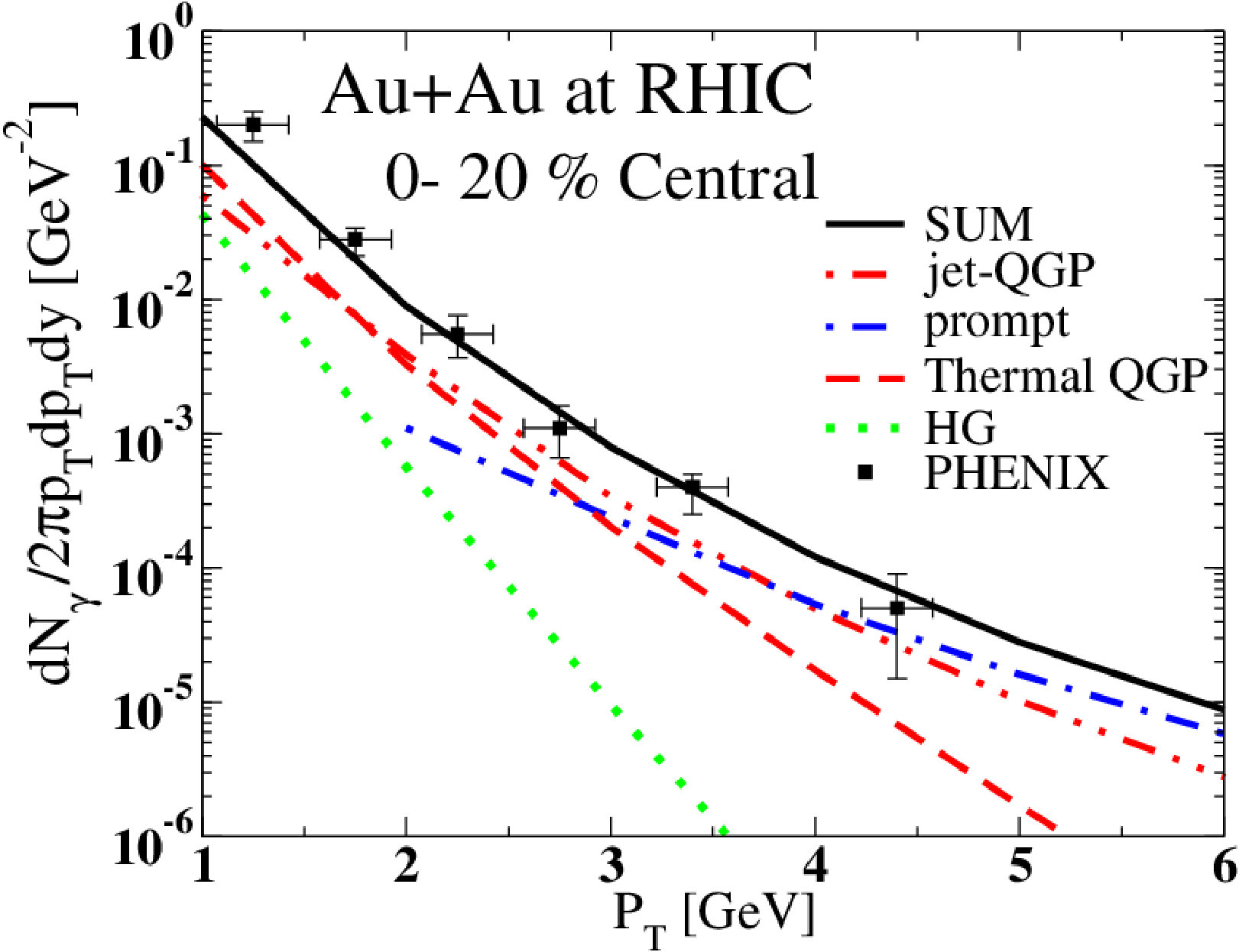 Figure 5
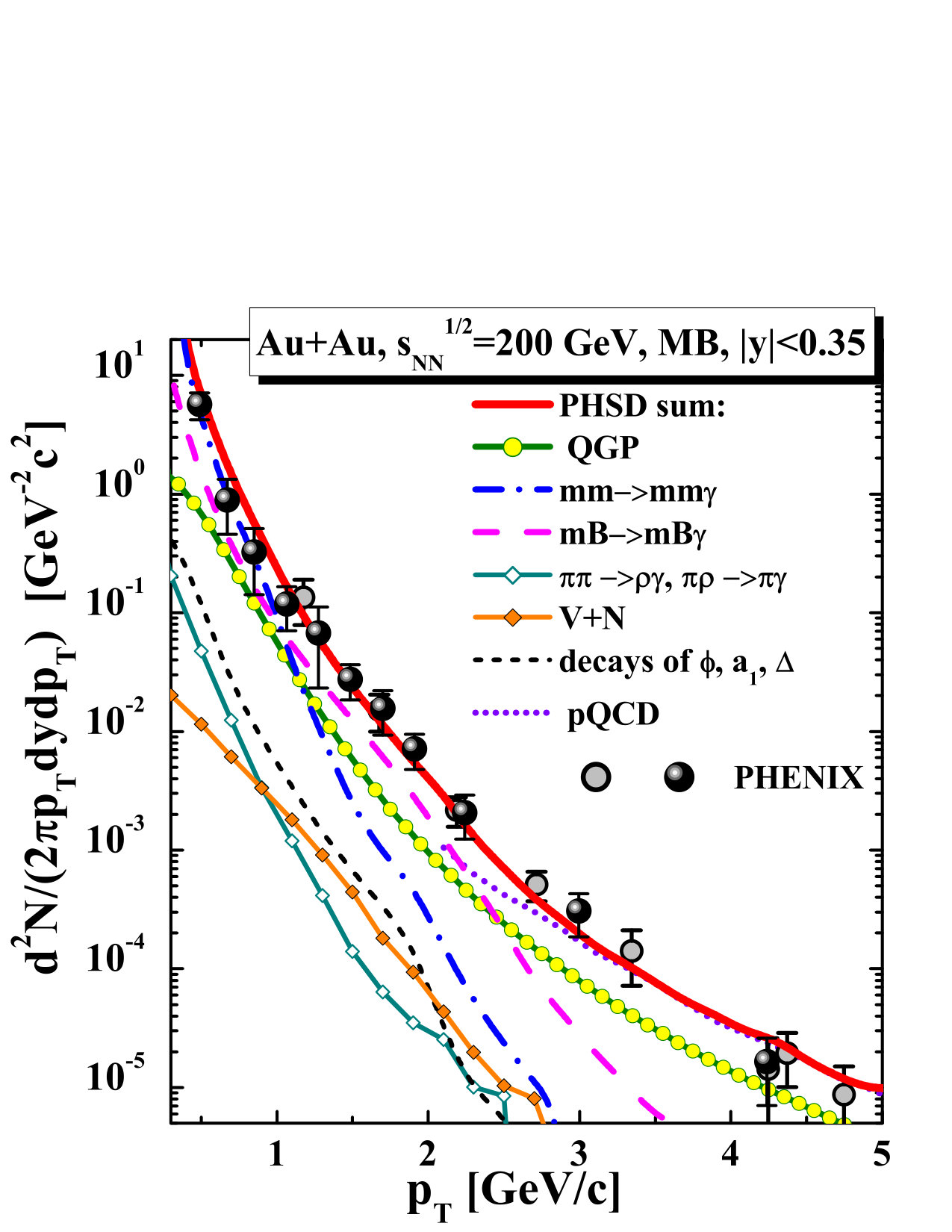 Figure 5
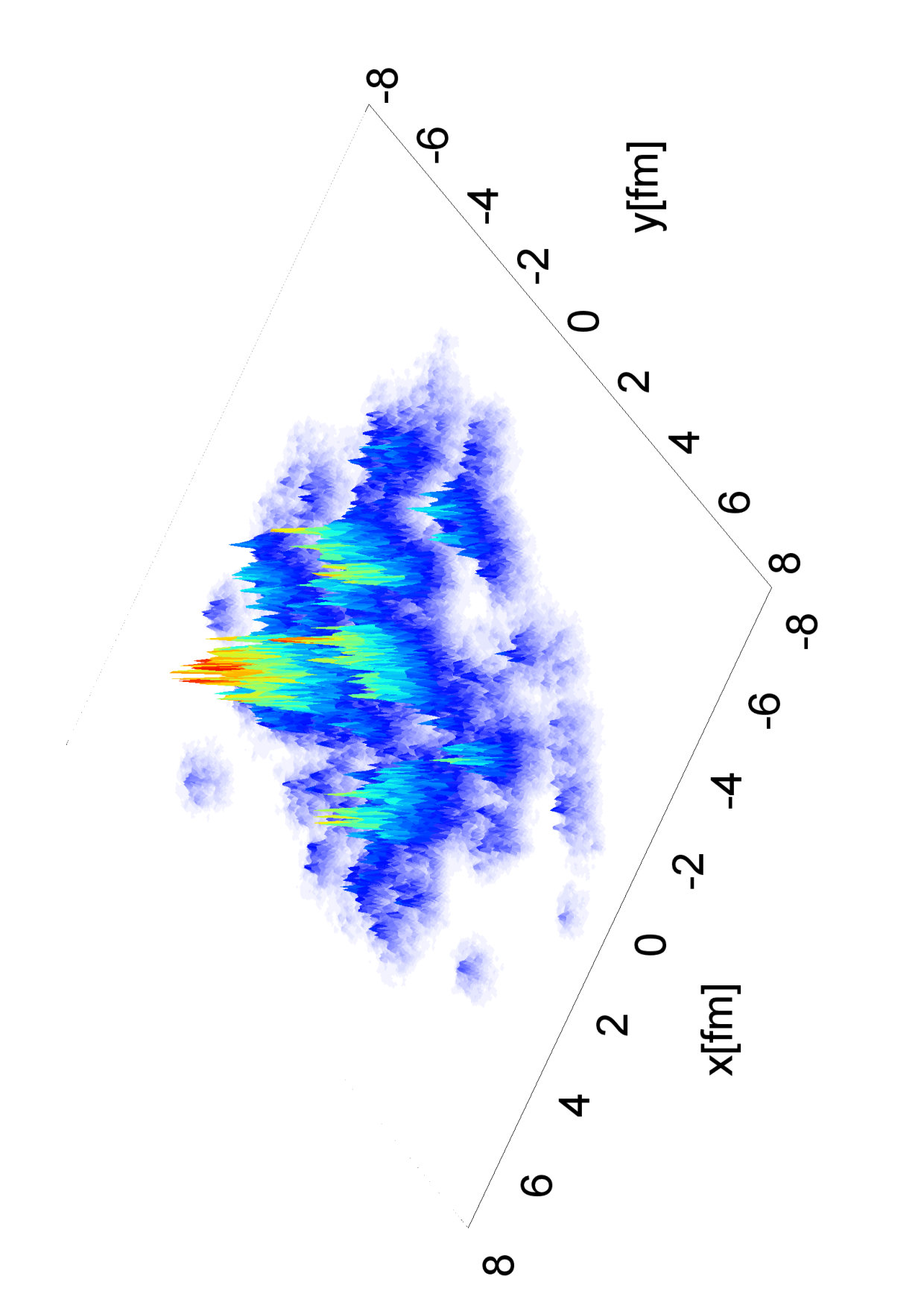 Figure 37
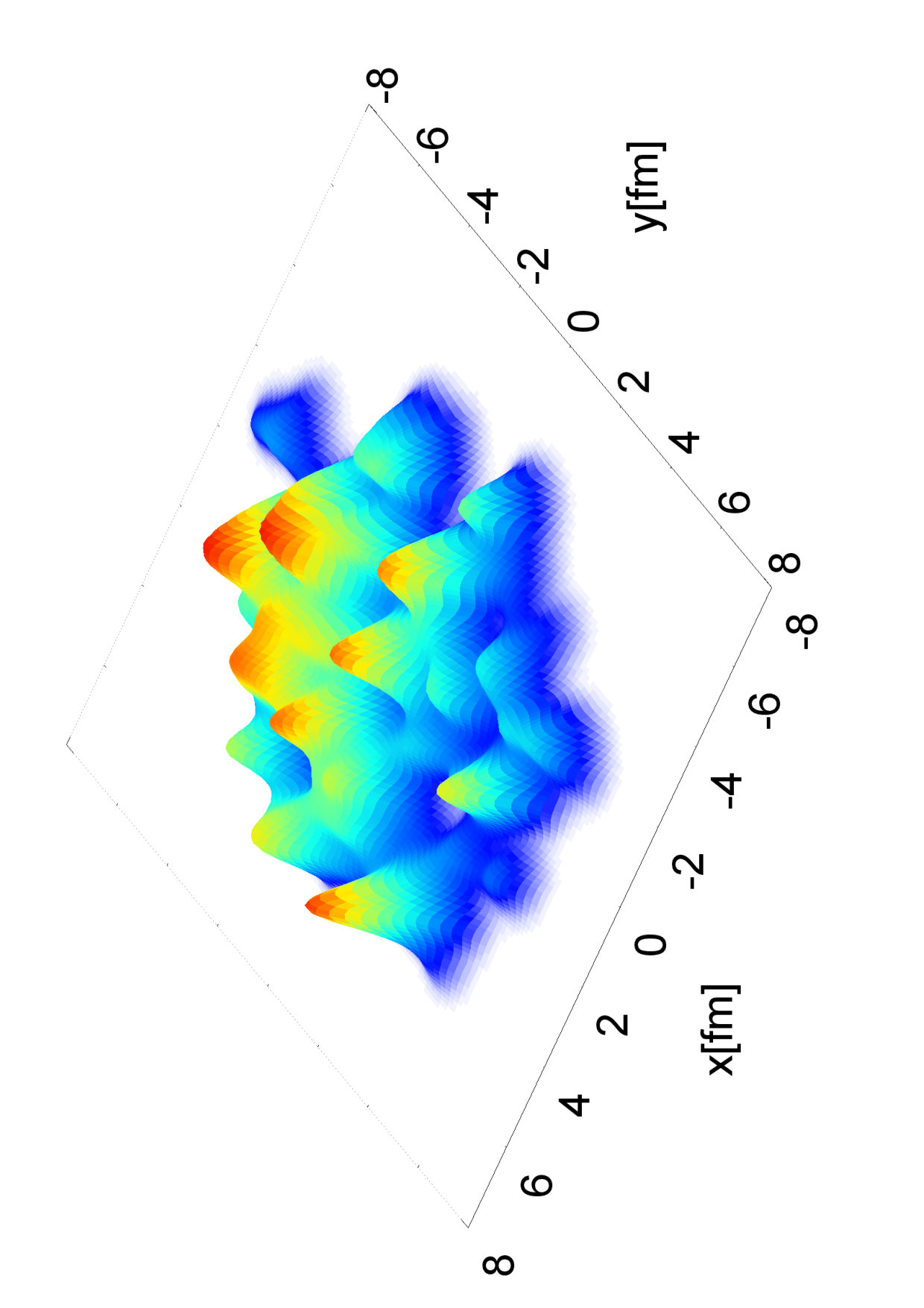 Figure 37
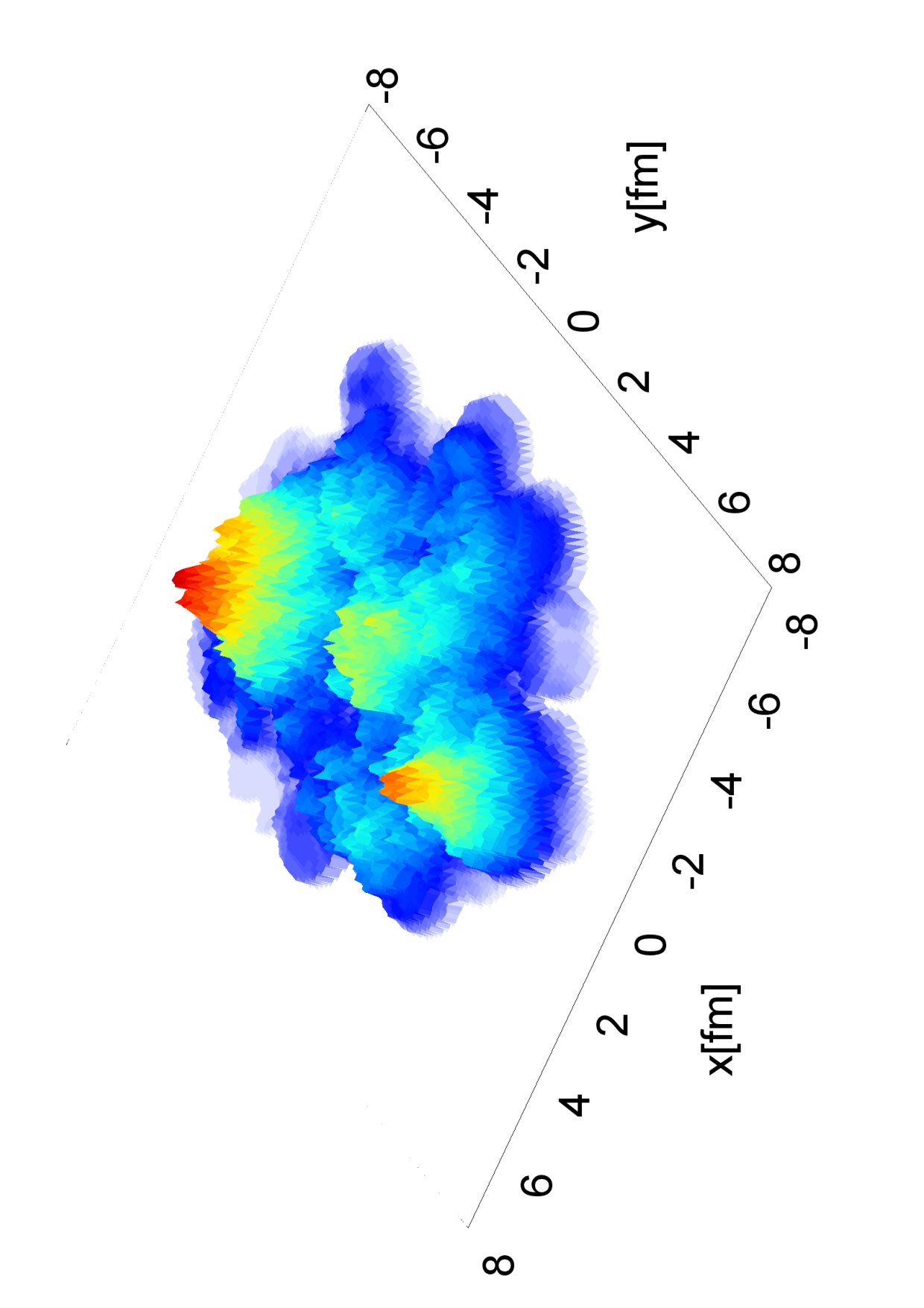 Figure 37
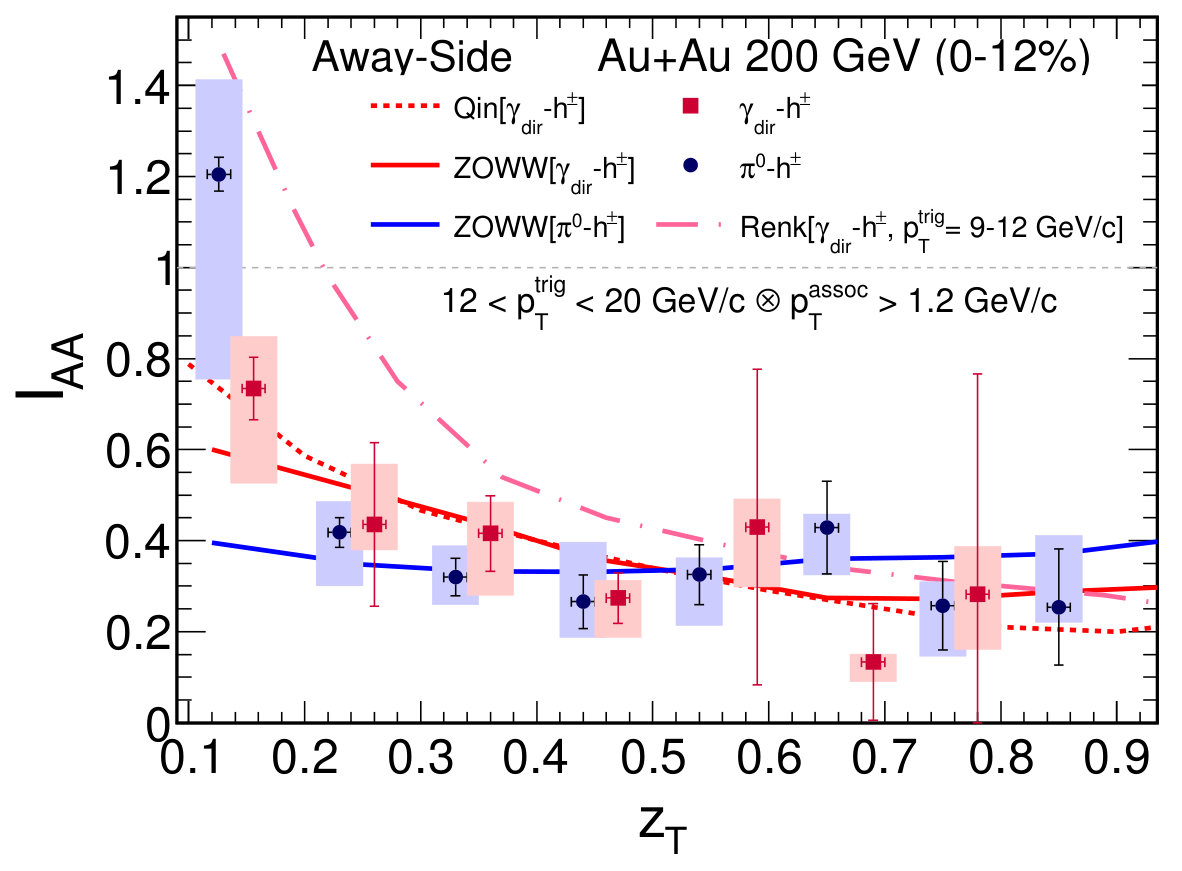 Figure 5
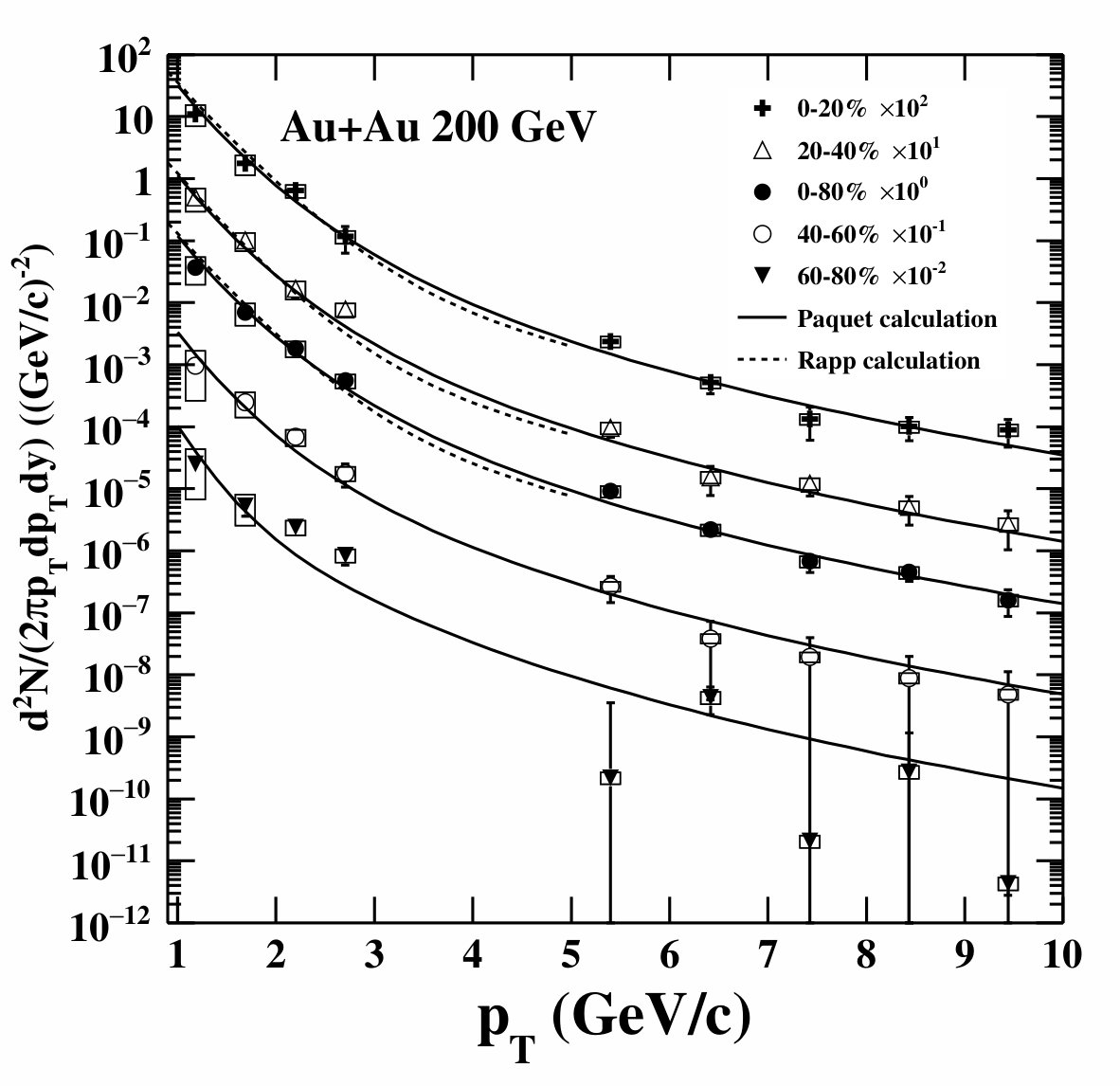 Figure 5
 Figure 6
 Figure 1
 Figure 2
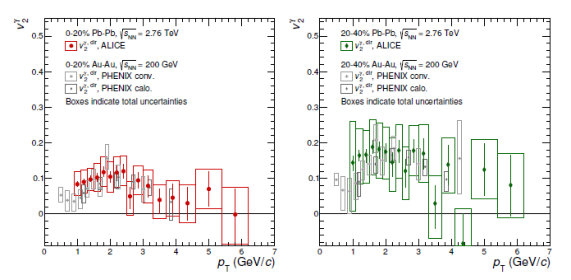 Figure 17
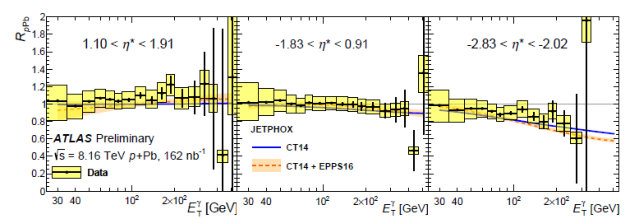 Figure 18
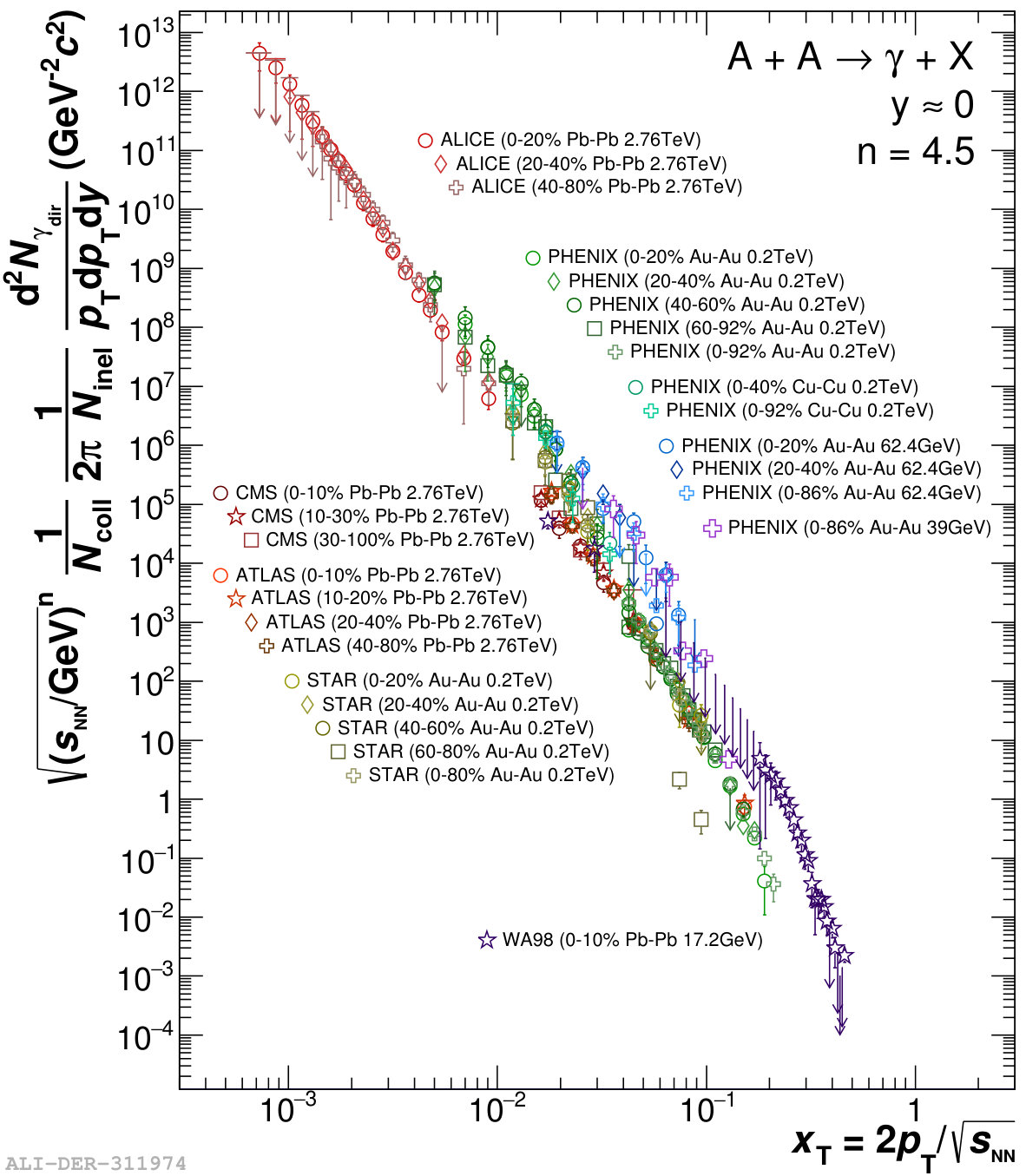 Figure 19
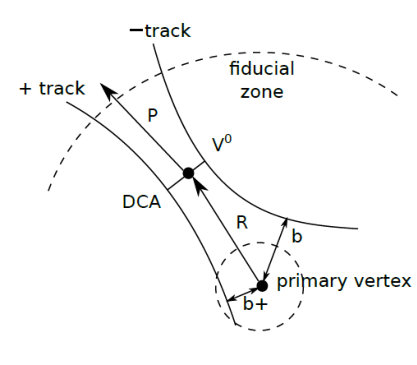 Figure 20
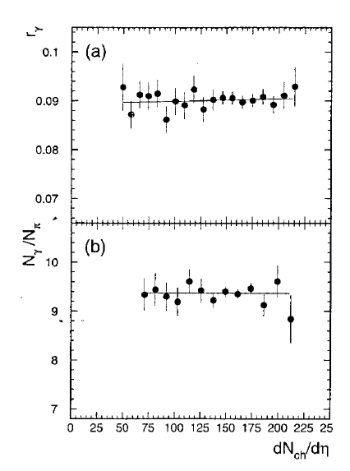 Figure 21
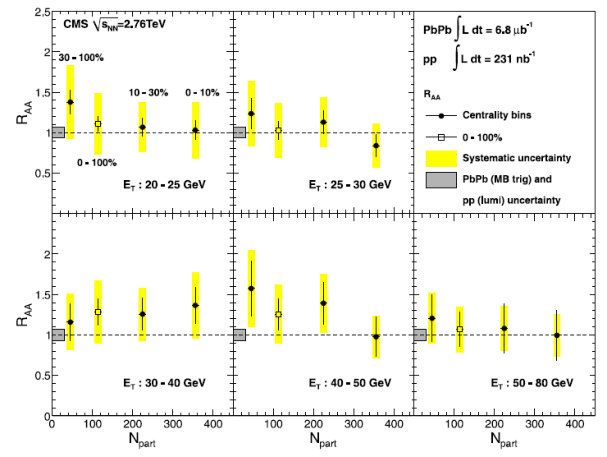 Figure 22
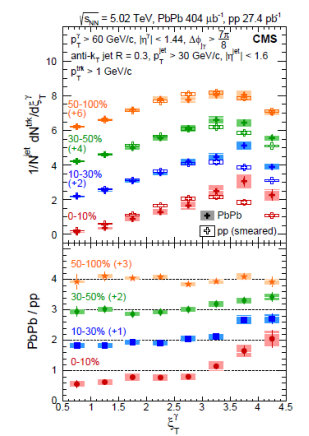 Figure 23
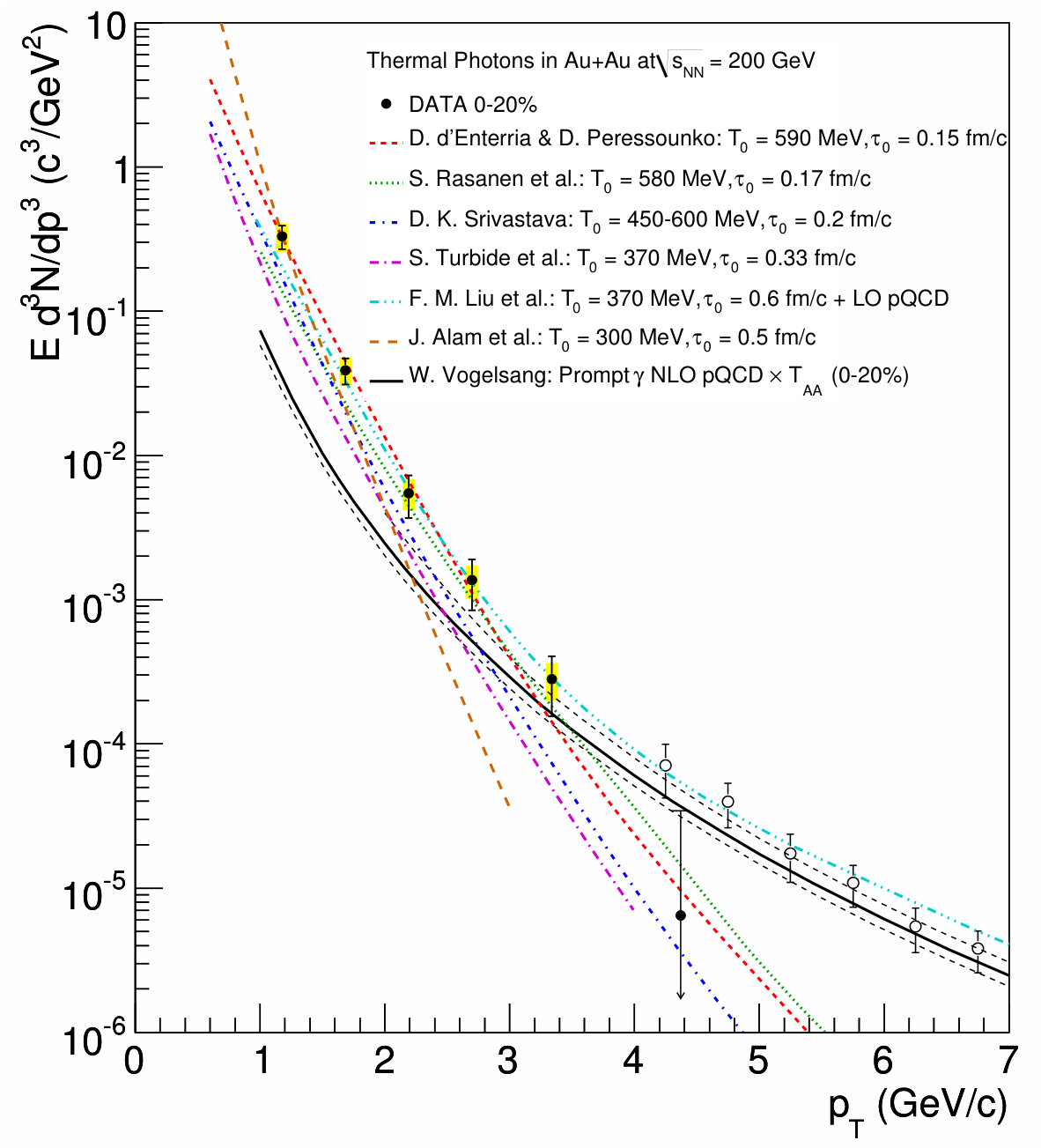 Figure 24
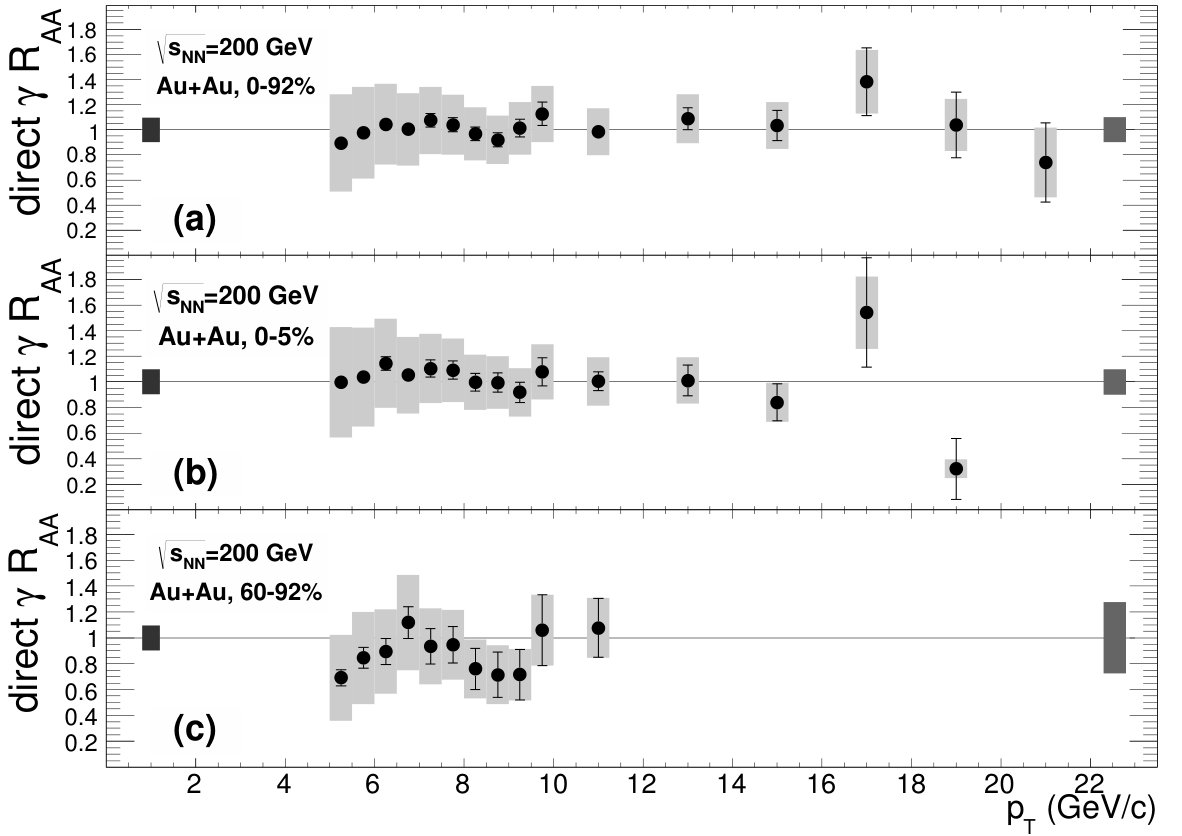 Figure 25
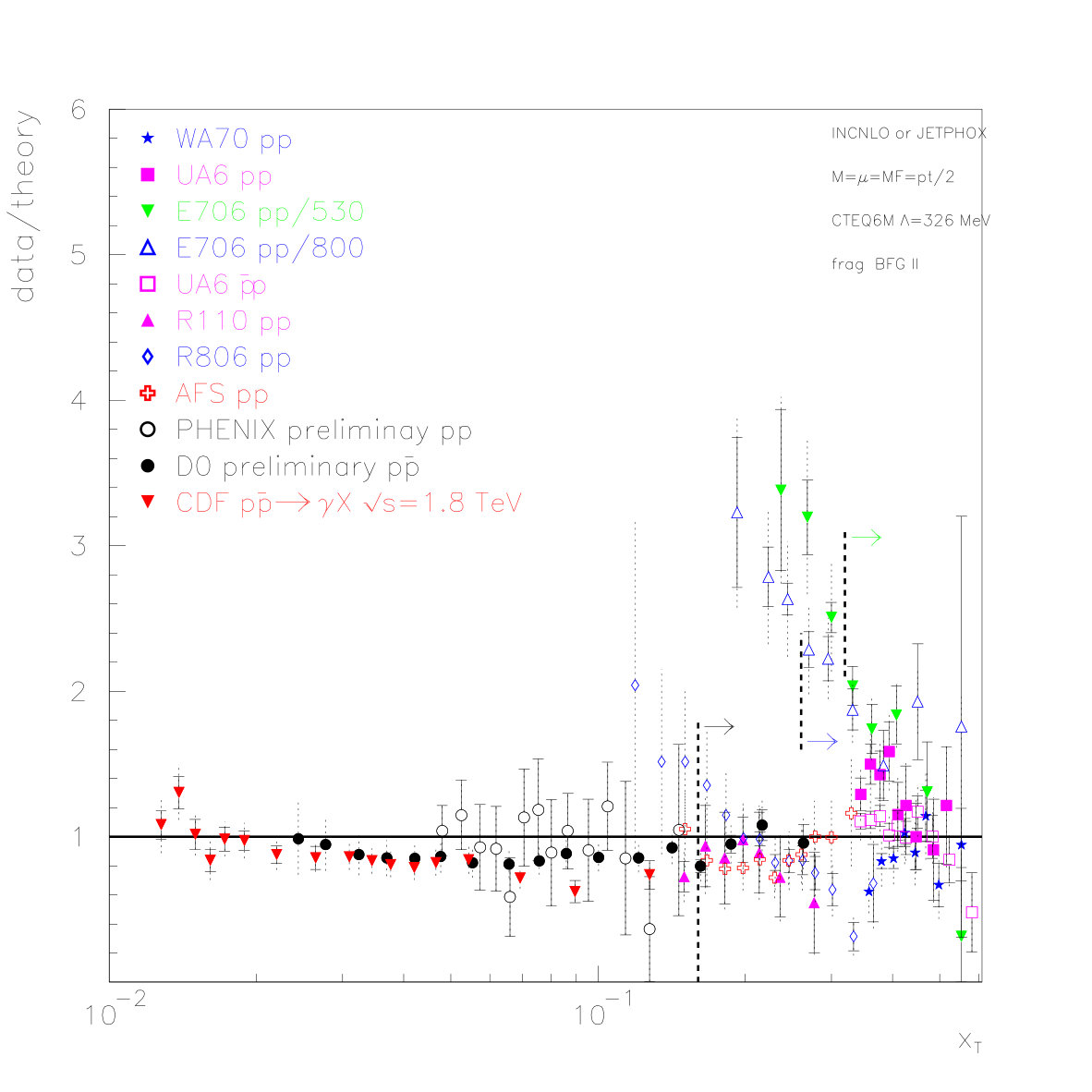 Figure 5
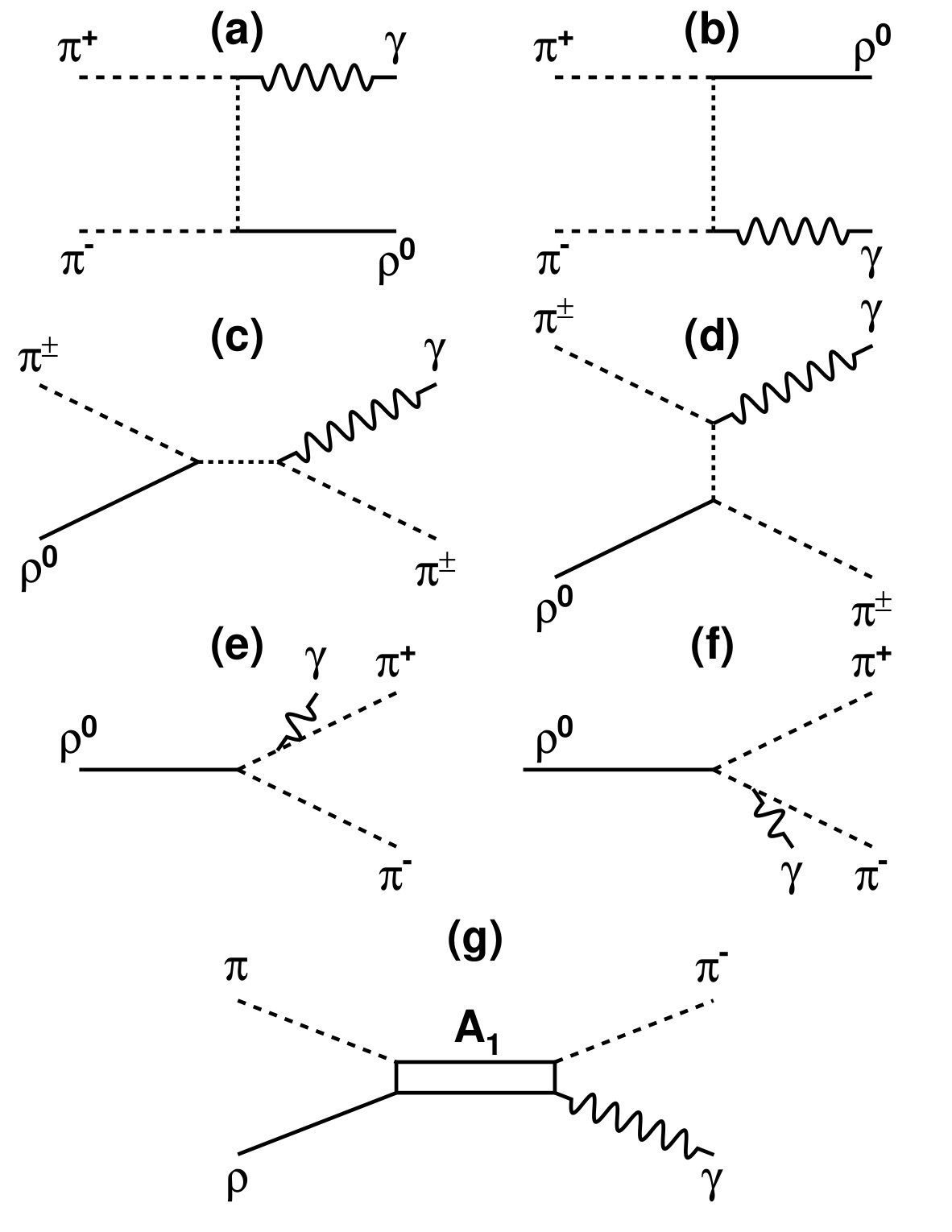 Figure 27
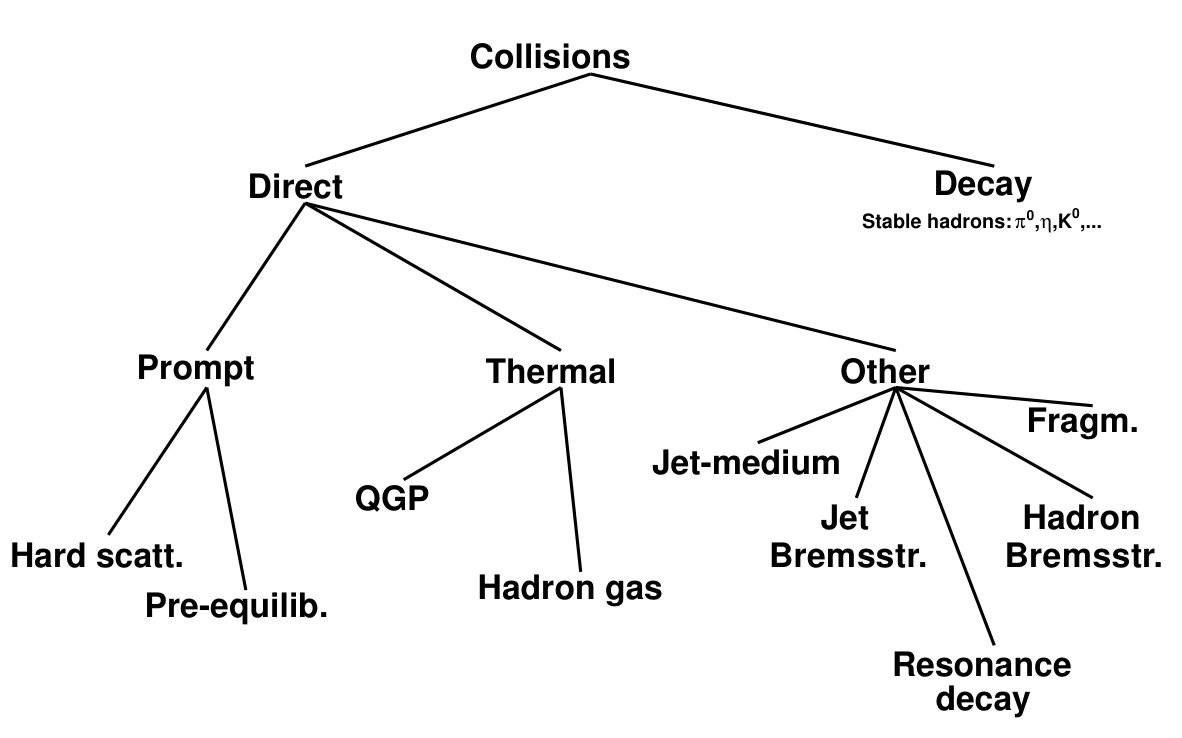 Figure 28
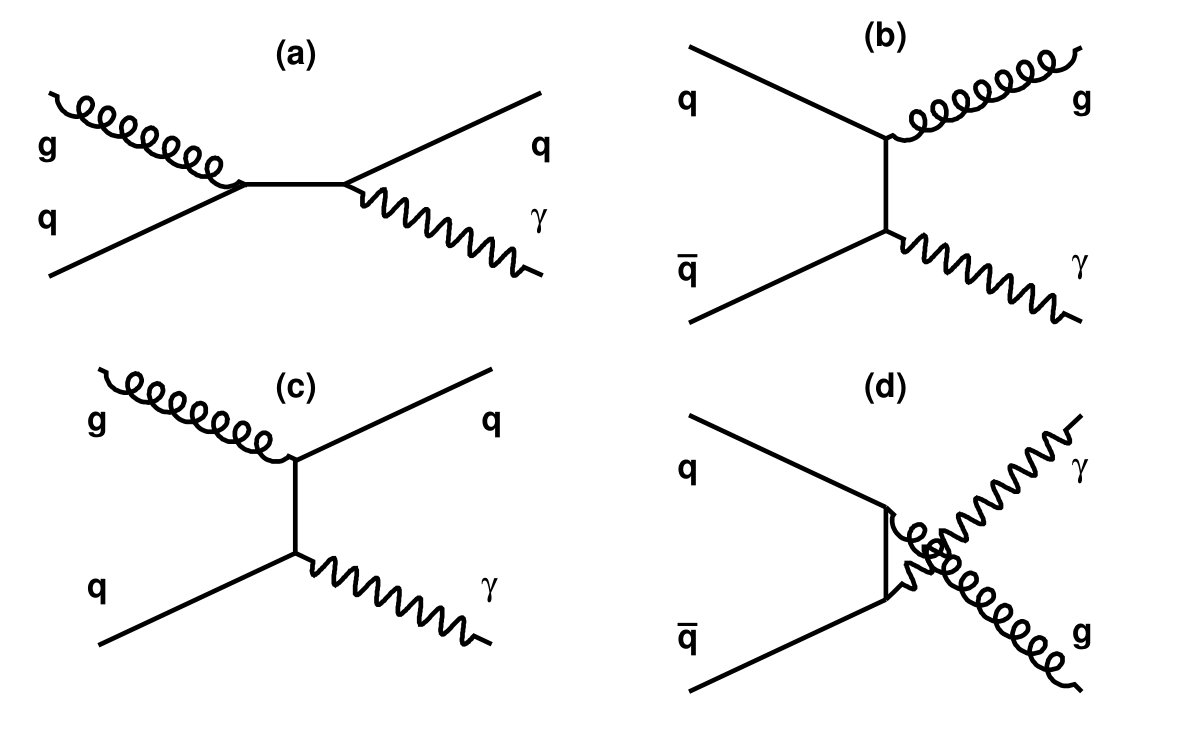 Figure 29
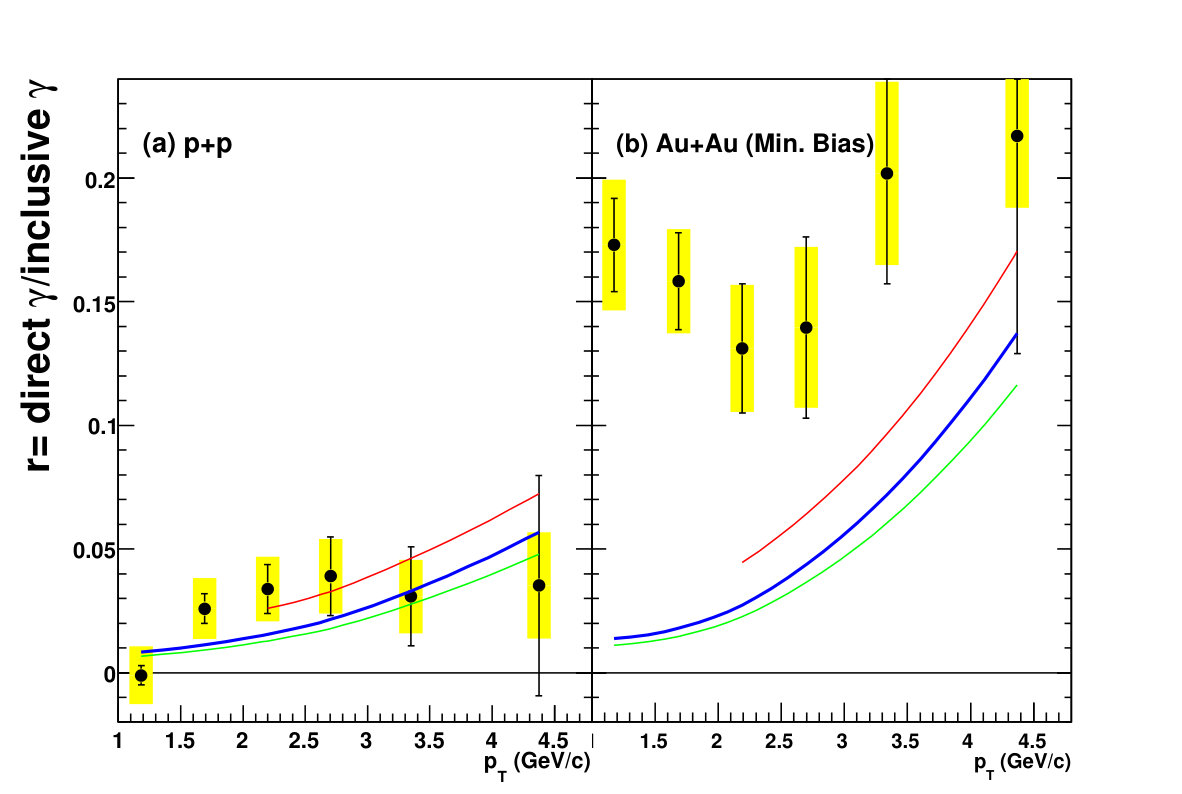 Figure 3
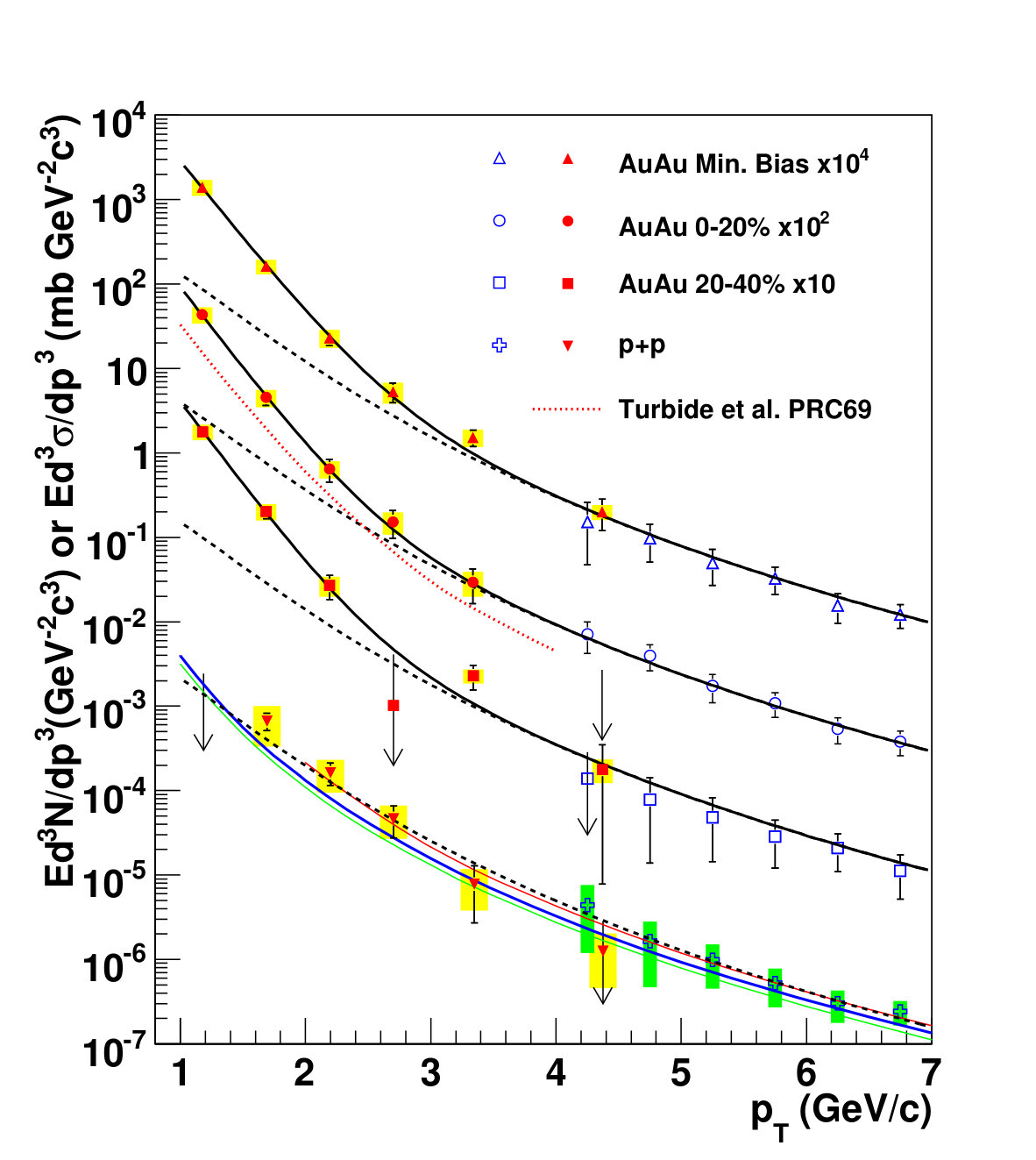 Figure 4
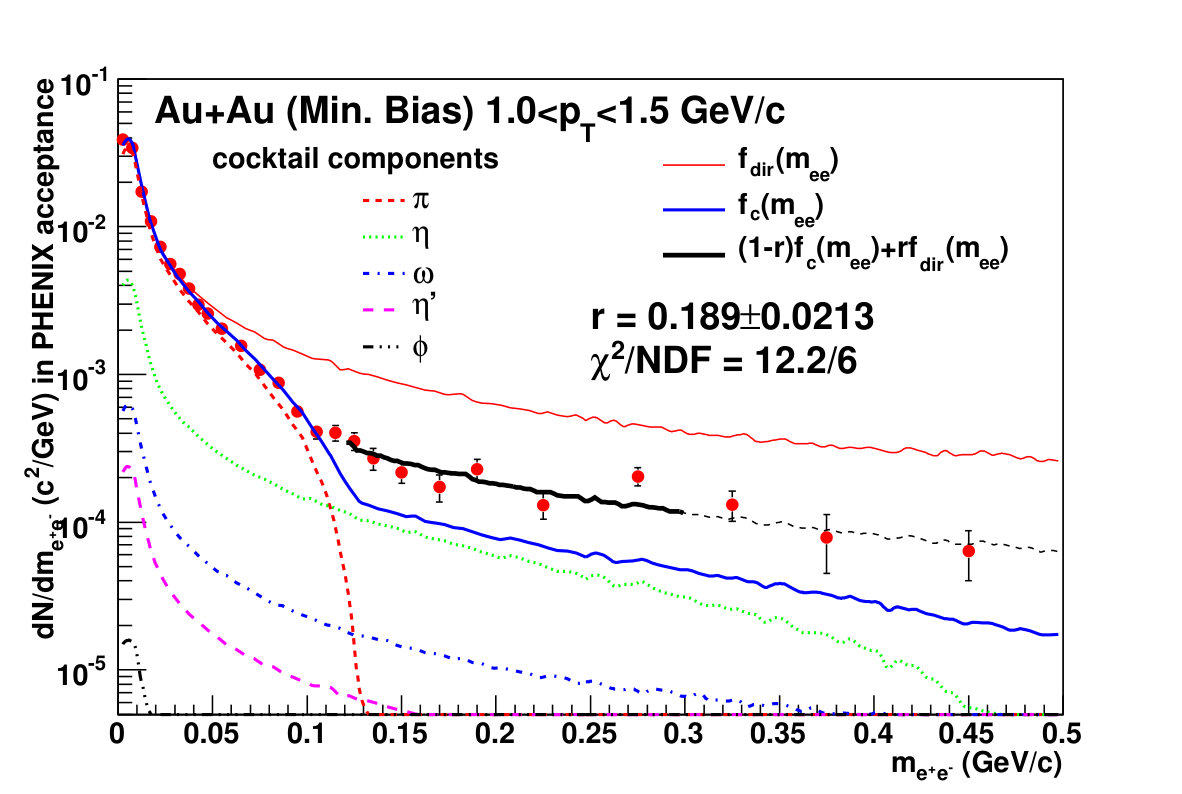 Figure 31
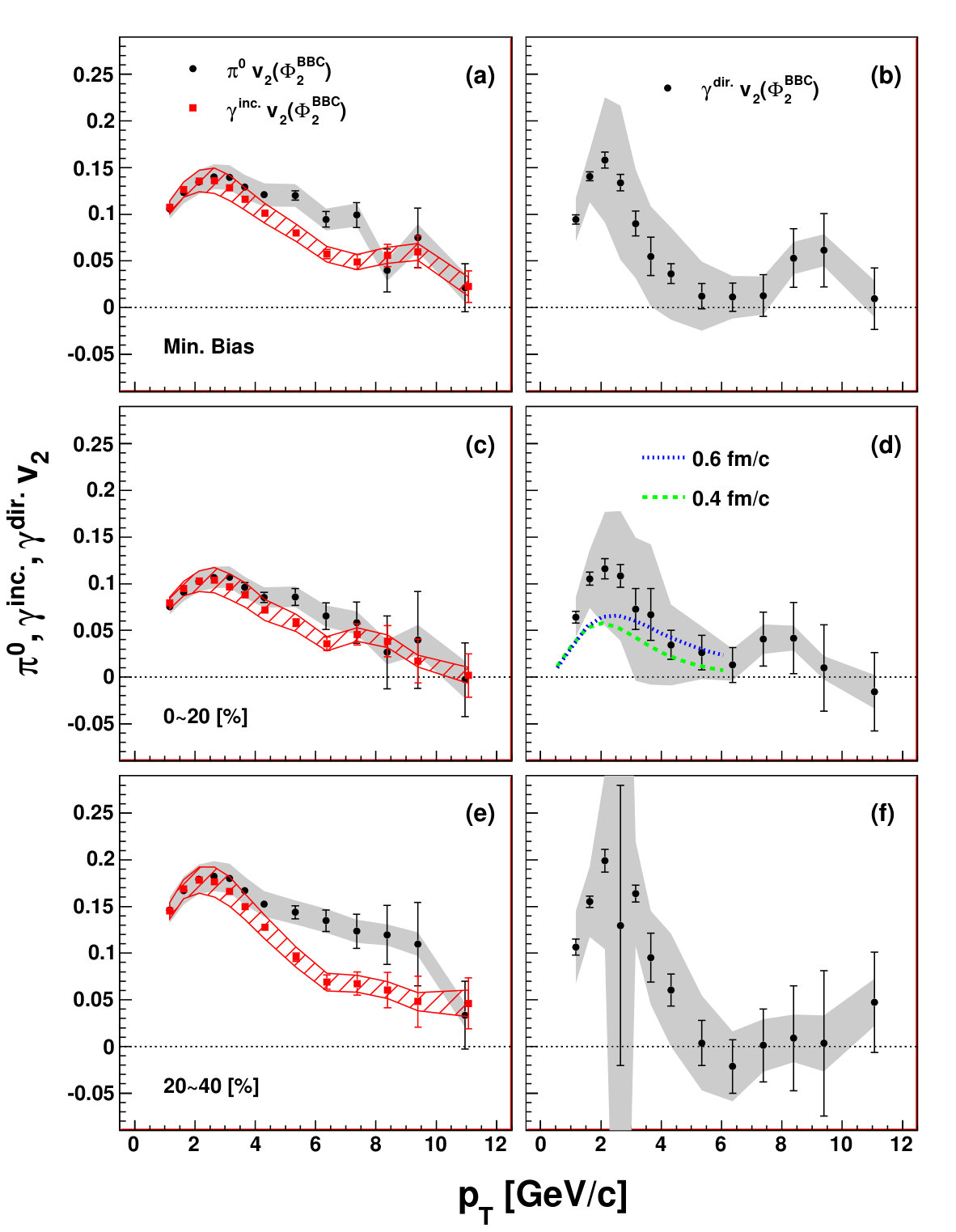 Figure 2
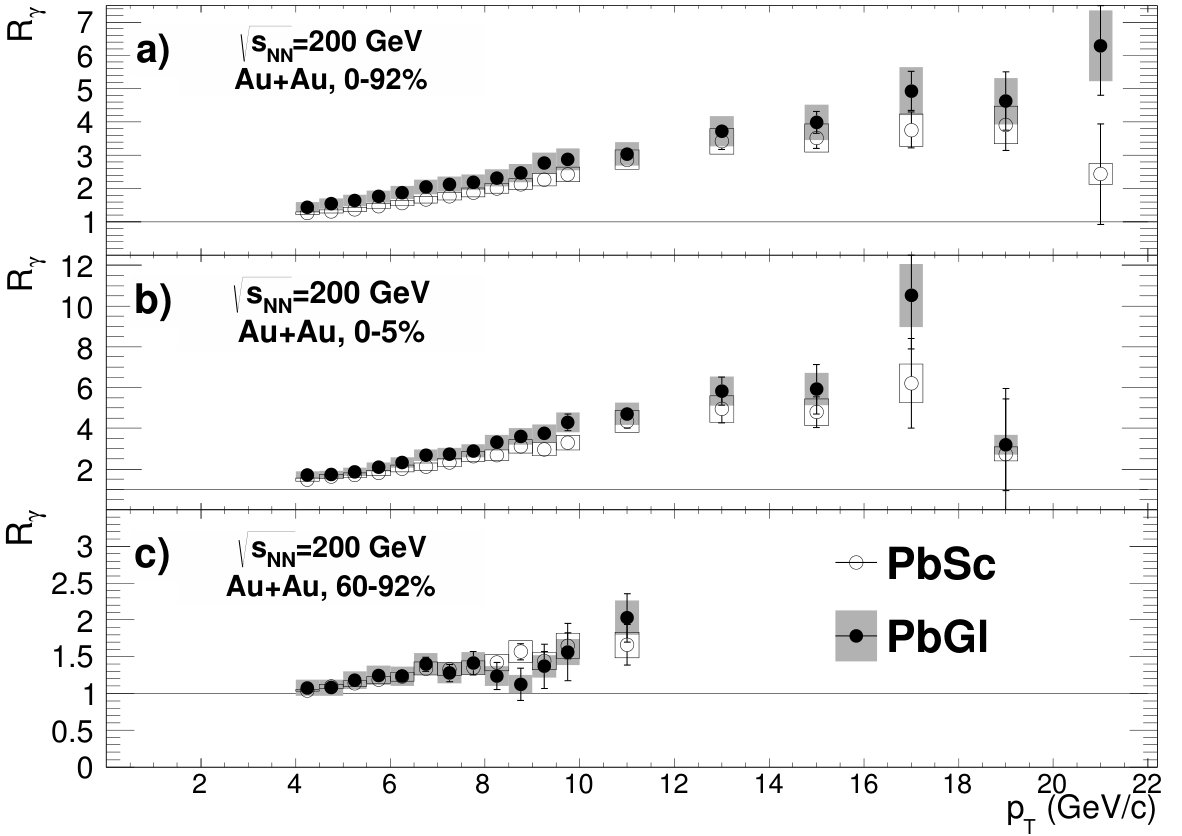 Figure 1
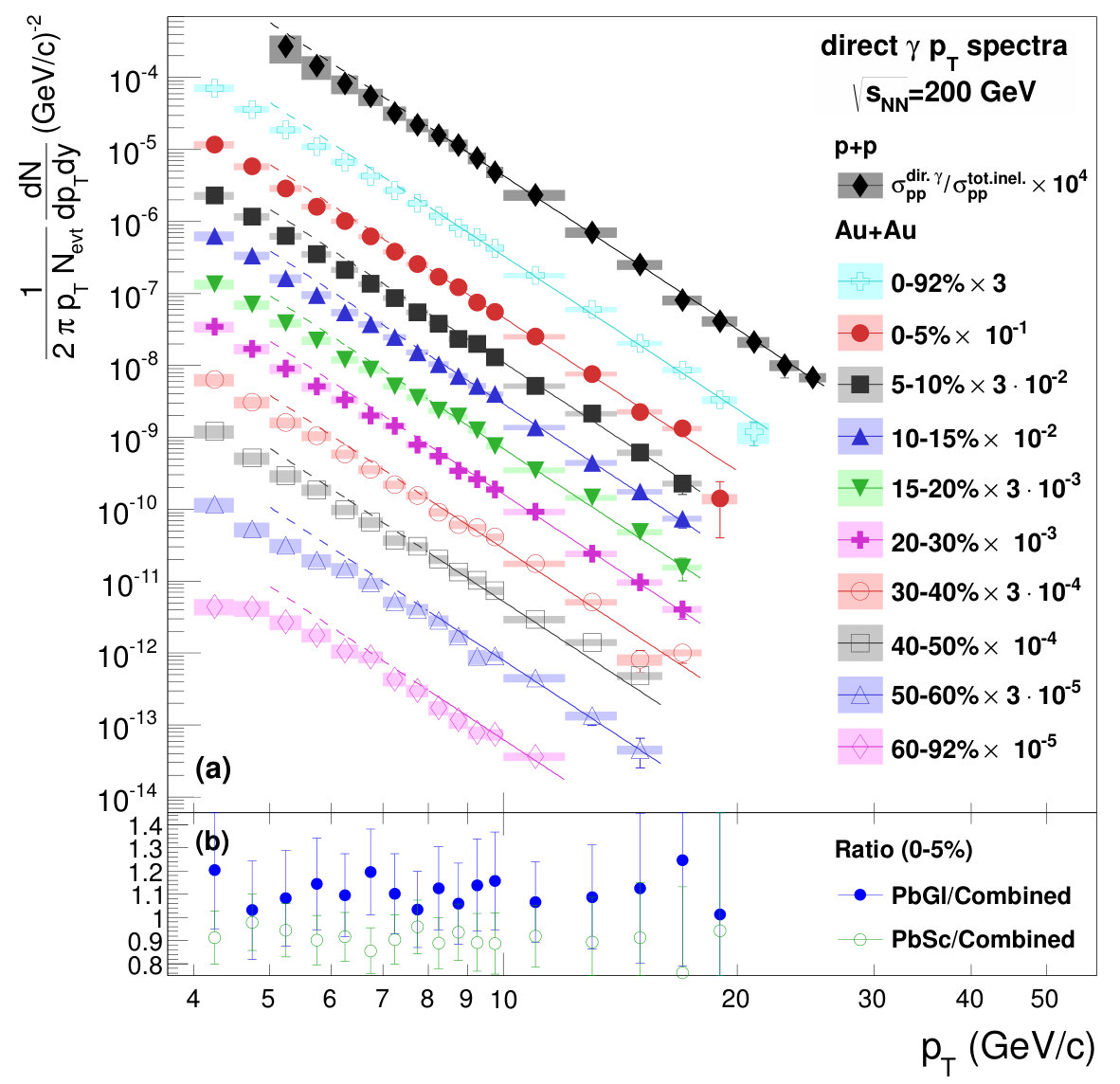 Figure 2
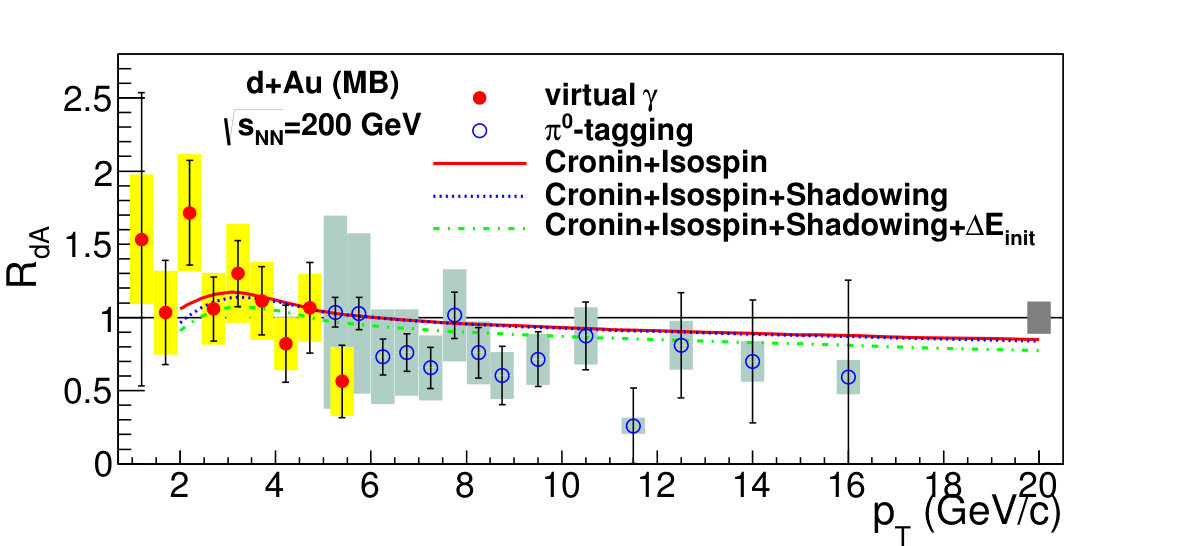 Figure 3
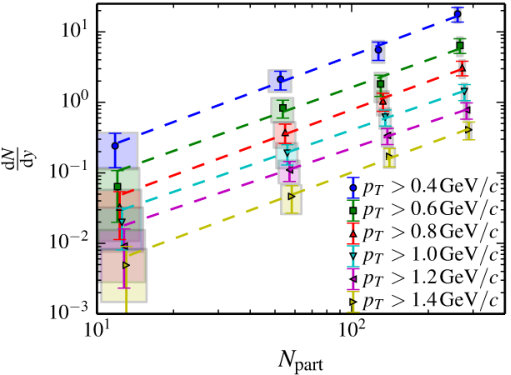 Figure 10
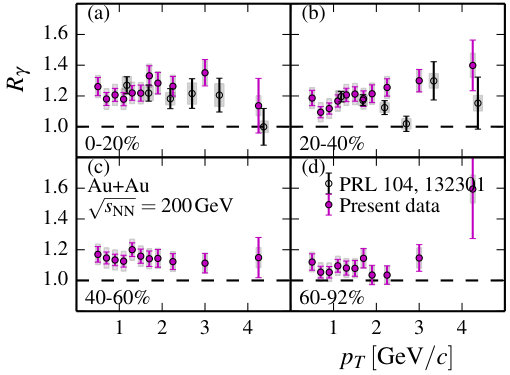 Figure 38
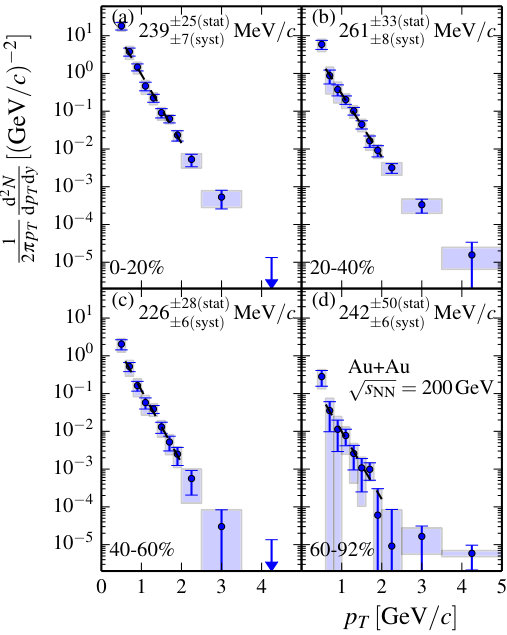 Figure 39
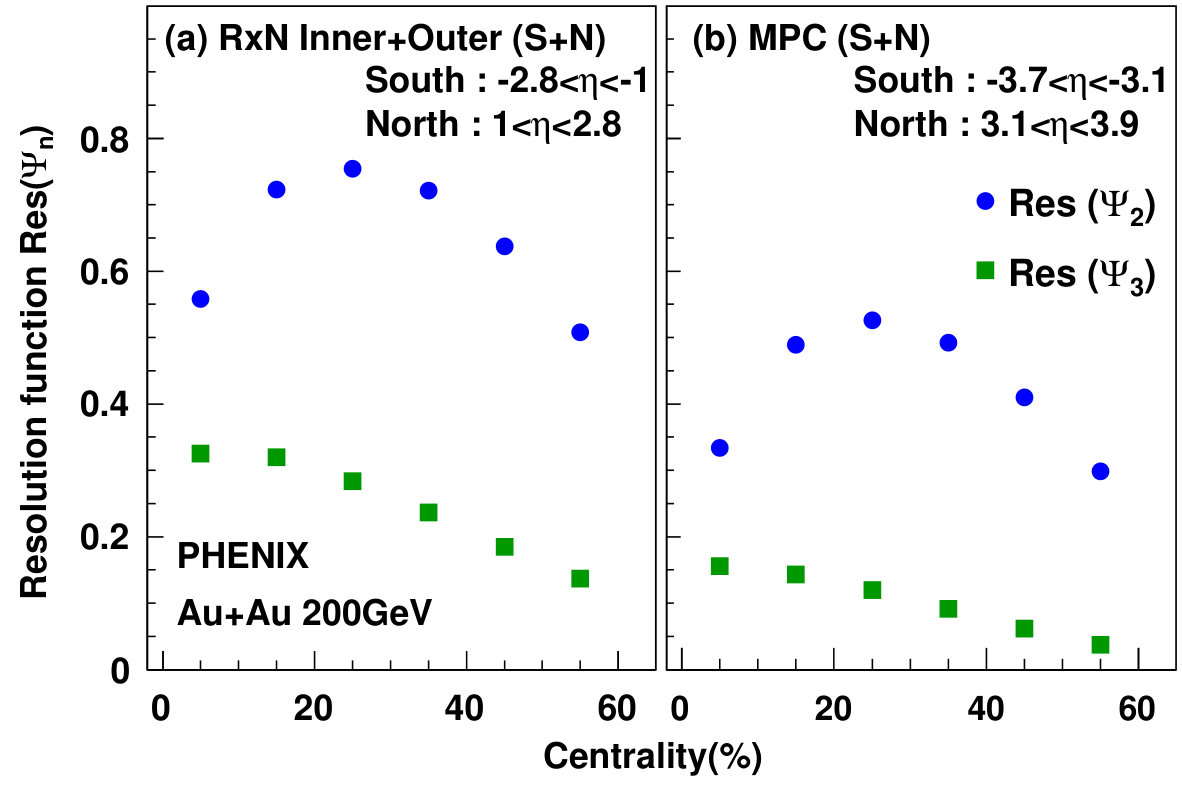 Figure 1
| Experiment | method | Publications | Comment | |||
|---|---|---|---|---|---|---|
| R412 / CERN ISR | 45, 53 GeV | calor. | 1.6-3.8 GeV/ | [162] (1976) | ||
| R107 / CERN ISR | 53 GeV | calor. | 2.3-3.7 GeV/ | [163] (1978) | ||
| AFS / CERN ISR | 31, 53, 63 GeV | calor. | 3 - 7(9) GeV/ | [122, 123] (1979/80) | ||
| CCOR / CERN ISR | 62.4 GeV | calor. | 5 - 13 GeV/ | [157] (1980) | ||
| AFS / CERN ISR | 31, 45, 53, 63 GeV | calor. | 3 - 12 GeV/ | [124] (1982) | ||
| AFS R807 / CERN ISR | 63 GeV | calor. | 1.5-4.25 GeV/ | [164] (1983) | ||
| AFS R808 / CERN ISR | 53 GeV | calor. | 2-6 GeV/ | [125] (1985) | ||
| UA2 / CERN SS | 630 GeV | calor. | 15-43 GeV/ | [126] (1986) | ||
| NA24 / CERN SPS | 23.7 GeV | calor. | 3-6 GeV/ | [159] (1987) | fixed tgt | |
| WA70 / CERN SPS | 22.3 GeV | calor. | 4-6.5 GeV/ | [138] (1988) | fixed tgt | |
| UA1 / CERN SS | 546, 630 GeV | calor. | 16-100 GeV/ | [91] (1988) | ||
| CMOR / CERN ISR | 63 GeV | calor. | 4.5 - 10 GeV/ | [149] (1989) | ||
| AFS / CERN ISR | 63 GeV | calor. | 4.5 - 11 GeV/ | [150] (1990) | ||
| CDF / FNAL | 1.8TeV | calor,conv | 10-60 GeV/ | [165] (1993) | iso. | |
| UA6 / CERN SS | 24.3 GeV | calor. | 4.1 - 5.7 GeV/ | [128] (1993) | fixed tgt | |
| E704 / FNAL | 19.4 GeV | calor. | 2.5-3.8 GeV/ | [158] (1995) | fixed tgt | |
| UA6 / CERN SS | 24.3 GeV | calor. | 4.1 - 7.7 GeV/ | [129] (1998) | fixed tgt | |
| D0 / FNAL | 1.8TeV | calor. | 10-110 GeV/ | [166] (2000) | iso. | |
| D0 / FNAL | 0.63 TeV | calor. | 10-30 GeV/ | [148] (2001) | iso. | |
| CDF / FNAL | 0.63, 1.8TeV | calor. | 10-30(110) GeV/ | [151] (2002) | iso. | |
| CDF / FNAL | 1.8TeV | conv. | 10-60 GeV/ | [152] (2004) | iso. | |
| E706 / FNAL | 31.8, 38.7 GeV | calor. | 3.5 - 12 GeV/ | [137] (2004) | fixed tgt | |
| PHENIX / BNL RHIC | 200 GeV | calor. | 5.5-7 GeV/ | [167] (2005) | ||
| PHENIX / BNL RHIC | 200 GeV | calor. | 3-16 GeV/ | [139] (2007) | iso. | |
| PHENIX / BNL RHIC | 200 GeV | int. conv. | 1-4.5 GeV/ | [99, 95] (2010) | ||
| STAR / BNL RHIC | 200 GeV | calor. | 6-14 GeV/ | [141] (2010) | ||
| CMS / CERN LHC | 7 TeV | calor. | 21-300 GeV | [143] (2011) | iso. | |
| ATLAS / CERN LHC | 7 TeV | calor. | 15-100 GeV | [142] (2011) | iso. | |
| ATLAS / CERN LHC | 7 TeV | calor. | 45-400 GeV | [153] (2011) | iso. | |
| PHENIX / BNL RHIC | 200 GeV | calor. | 5.5-25 GeV/ | [140] (2012) | iso. | |
| CMS / CERN LHC | 2.76 TeV | calor. | 20-80 GeV | [108] (2012) | iso. | |
| ATLAS / CERN LHC | 7 TeV | calor. | 100-1000 GeV | [168] (2014) | iso. | |
| ATLAS / CERN LHC | 8 TeV | calor. | 25-1500 GeV | [144] (2016) | iso. | |
| ATLAS / CERN LHC | 13 TeV | calor. | 125-1000 GeV | [145] (2017) | iso. | |
| ALICE / CERN LHC | 2.76 and 8 TeV | comb. | 0.3-16 GeV | [121] (2018) | iso. | |
| ATLAS / CERN LHC | 13 and 8 TeV | calor. | 125-1500 GeV | [169] (2019) | iso. |
| Experiment | method | Publications | Comment | |||
|---|---|---|---|---|---|---|
| E95 / FNAL | 19.4, 23.8 GeV | calor. | 1.5-4 GeV/ | [186] (1979) | ||
| E629 / FNAL | 19.4 GeV | calor. | 2.1-5 GeV/ | [188] (1983) | ||
| NA3 / CERN SPS | 19.4 GeV | calor. | 3-5 GeV/ | [189] (1986) | spectrum | |
| NA34 / CERN SPS | 29 GeV | calor. | 0.0-0.1 GeV/ | [190] (1989) | spectrum | |
| NA34 / CERN SPS | 19.4 GeV | conv. | 0.1-1.4 GeV/ | [191] (1990) | spectrum | |
| WA80 / CERN SPS | 19 GeV | calor. | 0.4-2.8 GeV/ | [192] (1991) | ||
| WA80 / CERN SPS | 19 GeV | calor. | 0.5-2.5 GeV/ | [119] (1996) | upp. lim. | |
| NA45 / CERN SPS | 19 GeV | conv. | 0.4-2 GeV/ | [120] (1996) | upp. lim. | |
| E855 / BNL AGS | 18 GeV | calor. | 0.0-1 GeV/ | [193] (1996) | had. Brems. | |
| E706 / FNAL | 31.8, 38.7 GeV | calor. | 3.5 - 12 GeV/ | [136] (1998) | spectra | |
| WA98 / CERN SPS | 17.4 GeV | calor. | 0.5-4 GeV/ | [70] (2000) | spectra | |
| STAR / BNL RHIC | 130 GeV | conv. | 1.65-2.4 GeV/ | [194] (2004) | ||
| E706 / FNAL | 31.8, 38.7 GeV | calor. | 3.5 - 12 GeV/ | [137] (2004) | spectra | |
| WA98 / CERN SPS | 17.4 GeV | calor. | 0.1-0.3 GeV/ | [110] (2004) | HBT | |
| PHENIX / BNL RHIC | 200 GeV | calor. | 1-14 GeV/ | [195] (2005) | spectra | |
| PHENIX / BNL RHIC | 200 GeV | int. conv. | 1-4.5 GeV/ | [99, 95] (2010) | spectra | |
| STAR / BNL RHIC | 200 GeV | calor. | 6-14 GeV/ | [141] (2010) | ||
| CMS / CERN LHC | 2.76TeV | calor. | 20-80 GeV | [108] (2012) | iso. | |
| PHENIX / BNL RHIC | 200 GeV | mixed | 1-17 GeV/ | [196] (2013) | ||
| WA98 / CERN SPS | 17.4 GeV | calor. | 0.7-3 GeV/ | [197] (2013) | upp. lim. | |
| PHENIX / BNL RHIC | 200 GeV | conv. | 0.6-4 GeV/ | [92] (2015) | ||
| ALICE / CERN LHC | 2.76 TeV | mixed | 1-14 GeV/ | [93] (2016) | ||
| ATLAS / CERN LHC | 2.76 TeV | calor. | 22-280 GeV/ | [39] (2016) | ||
| STAR / BNL RHIC | 200 GeV | int. conv. | 1-10 GeV/ | [100] (2017) | ||
| ATLAS / CERN LHC | 8.16 TeV | calor. | 25-500 GeV/ | [198] (2017) | iso. | |
| PHENIX / BNL RHIC | 200 GeV | int. conv. | 1-4 GeV/ | [199] (2018) |
| Experiment | method | Publications | Comment | |||
|---|---|---|---|---|---|---|
| UA1 / CERN SPS | 546, 630 GeV | calor. | 12-30 GeV/ | [91] (1988) | di-, | |
| WA70 / CERN SPS | 280 GeV | calor. | 0-3.5 GeV/ | [183] (1990) | di-, | |
| CDF / FNAL | 1.8 TeV | calor. | 10-35 GeV/ | [184] (1993) | di-, | |
| WA93 / CERN SPS | S+Au 200 AGeV | PMD | [103] (1998) | mult. | ||
| WA98 / CERN SPS | Pb+Ni,Nb,Pb 158 AGeV | PMD | [243] (1999) | mult. | ||
| WA98 / CERN SPS | PbPb 158 AGeV | PMD | [273] (2005) | |||
| PHENIX / RHIC | 200 GeV | calor. | 5-15 GeV/ | [109] (2010) | -jet | |
| PHENIX / RHIC | AuAu 200 GeV | calor. | 1-12 GeV/ | [83] (2012) | ||
| ALICE / LHC | PbPb 2.76 TeV | conv. | 1-5 GeV/ | [274] (2012) | ||
| ATLAS / CERN LHC | 7 TeV | calor. | 0-200 GeV/ | [185] (2012) | di- | |
| PHENIX / RHIC | AuAu 200 GeV | calor. | 5-9 GeV/ | [173] (2013) | – hadron | |
| ATLAS / CERN LHC | 7 TeV | calor. | 50-300 GeV/ | [175] (2013) | jet | |
| CMS / LHC | 7 TeV | calor. | 40-300 GeV/ | [275] (2014) | – jet | |
| ALICE / LHC | 0.9-7 TeV | PMD | [245] (2015) | mult | ||
| STAR / RHIC | AuAu 200 GeV | comb. | [244] (2015) | mult | ||
| STAR / RHIC | , AuAu 200 GeV | comb. | 8-20 GeV/ | [174] (2016) | – jet | |
| PHENIX / RHIC | AuAu 200 GeV | comb. | 1-4 GeV/ | [276] (2016) | ||
| PHENIX / RHIC | 510 GeV | calor. | 7-15 GeV/ | [180] (2017) | -h | |
| ATLAS / CERN LHC | 13 TeV | calor. | 125-1500 GeV/ | [176] (2018) | – jet | |
| CMS / CERN LHC | PbPb 5.02 TeV | calor. | 60 GeV/ | [246] (2018) | – jet | |
| PHENIX / RHIC | AA 39-2760 GeV | 1-15 GeV/ | [277] (2018) | scaling | ||
| ALICE / CERN LHC | PbPb 2.76 TeV | mixed | 0.9-6.2 GeV/ | [219] (2018) | ||
| ATLAS / CERN LHC | PbPb 5.02 TeV | calor. | 63-200 GeV/ | [233] (2018) | – jet | |
| ATLAS / CERN LHC | 8.16 TeV | calor. | 20-550 GeV/ | [278] (2019) |
Peer Reviews
No public reviews on file for this paper yet. If you reviewed it on a platform where reviews are public (OpenReview, ICLR, NeurIPS, ICML), you can paste yours below so the community can read it here.
Videos
No videos yet. Explain this paper in a talk, walkthrough, or lecture? Add one.
Direct real photons in relativistic heavy ion collisions
*Gabor David
Stony Brook University, Brookhaven National Laboratory*
Abstract. Direct real photons are arguably the most versatile tools to study relativistic heavy ion collisions. They are produced, by various mechanisms, during the entire space-time history of the strongly interacting system. Also, being colorless, most the time they escape without further interaction, *i.e. *they are penetrating probes. This makes them rich in information, but hard to decypher and interpret. This review presents the experimental and theoretical developments related to direct real photons since the 1970s, with a special emphasis on the recently emerged “direct photon puzzle”, the simultaneous presence of large yields and strong azimuthal asymmetries of photons in heavy ion collisions, an observation that so far eluded full and coherent explanation.
Contents
-
II.3 Who outshines whom? From pre-equilibrium to QGP to hadron gas
-
IV.1.2 Photon-jet, photon-hadron and photon-photon correlations
-
IV.2.3 Collision centrality – photons as the standard candle
-
IV.2.5 Photon - hadron/jet correlations: energy loss in the medium
-
VI Direct photon flow – the era of the “direct photon puzzle”
I Introduction
The centuries old quest to reveal the “ultimate” constituents of matter and the laws of Nature governing them, and the realization from quantum mechanics that mapping smaller and smaller objects requires ever larger energy probes, made high energy physics one of the dominant scientific disciplines of the XXth century. At first we took advantage of the Universe as an “accelerator” providing high energy probes (cloud chamber and emulsion experiments), but soon we started to build our own accelerators, constantly increasing their energy and luminosity. The most spectacular and best known results came in elementary particle physics, but astrophysics and nuclear physics were a close second, benefiting enormously from the progress in experimental and theoretical tools.
The central question in particle physics was the substructure of hadrons and the nature of confinement, while high energy nuclear physics’ foremost concern was the behavior of high density nuclear matter, including its collectivity and possible phase transition into partonic matter, which in turn evoked the early stages of the Universe. Albeit particle and nuclear physics came with different perspectives, both were concerned with the strong interaction and its underlying theory, quantum chromodynamics (QCD), so the birth of a new discipline at their intersection, relativistic heavy ion physics, was almost inevitable. From Princeton and Berkeley to Dubna the race for larger and larger ions, energies and luminosities was on. Hadrons and nuclear fragments were studied extensively, and the applicability of thermo- and hydrodynamics gradually recognized. An excellent review of these first facilities and early developments – both experimental and theoretical – can be found in [1] by Goldhaber, while a (literally) insightful account of the genesis and achievements of RHIC and LHC was given by Baym in [2].
Although lepton and photon production in hadronic and nuclear collisions was studied almost since the birth of quantum mechanics and quantum electrodynamics [3, 4, 5, 6], the golden era started in the early 1970s when ISR and Fermilab became operational. The available large energies allowed almost from the beginning to explore both fundamental facets of direct photons: at high transverse momentum () they are probes of QCD hard scattering, while at low they help to shed light on multiparticle production. The high aspect was first pointed out by Escobar [7], Farrar and Frautschi [8] in 1975. At low , the first one to emphasize their importance in the context of multiparticle production was Feinberg [9] in 1976, famously stating that “the thermodynamical approach naturally leads to direct ’s and dilepton production. … If the multihadron production process contains an intermediate stage of a thermodynamical hadronic matter, then this kind of and dilepton production inevitably exists. The question is only on its intensity and on the detailed behaviour of the spectra.”111Feinberg in [9] even provided an estimate (based on Landau theory) of the photon yield w.r.t. the pion yield, with the expression
N_{\gamma}=6.4Ae^{2}N_{\pi}^{4/3}\Big{(}1-\frac{1}{N_{\pi}^{1/3}}+0.21lnN_{\pi}\Big{)}
(1)
which gives in the 0.1-0.15 range for realistic pion multiplicities; remarkably close to today’s measurements!
A few years later Shuryak [10] already estimated the lepton and photon production from the “Quark-Gluon Plasma” (along with the hadronic production). The idea that photons can test the most diverse manifestations of the strong interaction took hold. The rapid growth of the field has been documented in several reviews in the past (see for instance [11, 12, 13, 14, 15, 16, 17]). By now, photon physics became mature, but by no means a closed chapter – just the opposite.
Promises.
One of the earliest motivations to measure direct photons in heavy ion collisions was to gain access to the initial temperature of the system and to study the properties of the QGP via its thermal radiation. With time, first observations and evolving theory, expectations grew to include information on geometry, viscosity (and the time-evolution thereof), effects of the conjectured large magnetic field, gluon saturation, and the initial conditions in general. Also, just as in , high direct photons back-to-back to a jet in AA were expected to be the ultimate calibration tool for the energy of the hard scattered parton, and of the possible energy loss in a colored medium.
The blessing and curse of direct photons.
Photons play a special role in the study of high-energy hadronic and nuclear interactions, because they are penetrating probes. Being color neutral, their mean free path is rather large not only in very dense hadronic matter, but also in a medium of deconfined quarks and gluons, the quark-gluon plasma, or QGP (see Sec. IV.2). This ensures that if they are created at any time, they will escape the interaction region (mostly) unaltered and will be detectable. This is true even if they have to cross the hot, dense medium of QGP. On the other hand, to our current best knowledge at every stage (or at the very least at most stages) of the collision there are physics mechanisms to produce photons, providing direct information both on the process itself and the environment (*e.g. *the initial state including geometry, the expansion of the plasma or the hadron gas, and so on). In this sense photons are the perfect “historians” of the evolution of the system.
Unfortunately, all that information on instantaneous rates and expansion dynamics is convolved (integrated in space-time) leaving us with just a few high level experimental observables: the all-inclusive spectrum, possible azimuthal asymmetries, energy deposit or lack thereof around the photons (isolation), rapidity distribution, correlations, and so on. Therefore, disentagling the contributions from the various processes is nearly impossible without relying on models. Finally, the number of photons created in the collision, before the final chemical and kinematic freeze-out of the system (direct photons) is usually small compared to the photons coming from the decay of final state hadrons, like , . While these decay photons are highly interesting in hadron physics, they pose a serious background problem for direct photon measurements.
This review was written with the following goals in mind. It is trying to be accessible even for physicists outside our field, but providing plenty of references for those who want to learn the details. It intends to show the historic context and evolution of ideas, in the firm belief that nothing is more instructive and promotes creativity and progress better, than understanding not only what do we know now, but also the process how did we acquire this current knowledge. It is aiming to be as up-to-date as possible, by including even very recent preliminary results (as of early 2019). Also, it is meant to be realistic in its claims on which issues are really settled and which ones are not. If in doubt, we would rather err on the side of under-, than overconfidence.
Photons taught us a lot already, but in the process new questions emerged, and a fully self-consistent description of direct photons in heavy ion collisions is not available yet, not the least because important measurements are still missing or not sufficiently precise to discriminate between theories. The field is very much open and if this review helps to raise fresh interest and generate new efforts, it achieved more than we ever dared to hope for.
In this review first we introduce the basic theory concepts (Sec. II) and experimental techniques (Sec. III), then we discuss the results from past decades, concentrating on the direct photon spectra in hadron-hadron and heavy ion collisions. As mentioned above, the relevant physics (and even the experimental techniques) of high and low photon production are quite different, so we describe them in separate sections, in their own historic context. On the other hand observations in heavy ion collisions can not be understood without the corresponding “baseline” in . Therefore, we group together all high photon results in and AA and their impact on jet physics, collision centrality determination, nuclear PDFs and other issues in Sec. IV, whereas the low (or “thermal”) production in all colliding systems will be discussed in Sec. V. Finally, we review the challenging developments of the past few years, starting with the 2011 observation of elliptic flow of “thermal” photons and resulting in the so-called “direct photon puzzle”, its consequences, the attempts to resolve the “puzzle” and the questions that are still open in Sec. VI.
II Sources of photons
II.1 Terminology
The prevalent (although not completely unique) terminology of real photons in heavy ion physics, referring to their sources, is shown in Fig. 1. The two main categories are direct and decay photons. Decay photons come from electromagnetic decays of long lifetime final state hadrons222Long lifetime means that it significantly exceeds 10-100 fm/ after which the colliding system is completely decoupled. and as such are extremely valuable – sufficient to say that ’s reconstructed from \mbox{\pi^{0}}\rightarrow\gamma\gamma provided the first strong hint that QGP has been formed in relativistic heavy ion collisions [18]. However, when measuring direct photons, *i.e. *those that are produced any time during the collision proper, before the final products completely decouple, the decay photons are a large background and often the principal source of systematic uncertainties of the direct photon measurement.
The subcategory prompt as a rule includes photons from initial hard parton-parton scattering (see for instance [19]). Usually other conjectured early sources, like photons from the “hot glue”, created before local thermalization [20] or the Glasma [21, 22], photons from the strong initial magnetic field [23, 24], synchrotron radiation [25], are also included here as pre-equilibrium.
The subcategory thermal is widely used but problematic, even theoretically, since thermalization is local at best, and the instantaneous rates calculated with evolving temperature are in addition subject to blue-shift due to medium expansion, so the inverse slope parameter of spectra does not directly represent any “temperature” [26, 27, 28]. Depending on their origin (partonic or hadronic processes, see Sec. II.2) they are called photons from the QGP or the hadron gas [29, 30]. To complicate things, several other sources (like Bremsstrahlung) emit photons in the thermal range, which are indistinguishable from truly “thermal” photons. Therefore, in experimental papers “thermal” is usually just a shorthand for photons in the few hundred MeV – few GeV range, and we will put the word in quotation marks whenever experimental results are discussed.
Other sources include photons from jet fragmentation in vacuum, well known and measured in [19, 31, 32, 33, 34]. They should be distinguished from jet Bremsstrahlung which occurs while the parton is still traversing the (QGP) medium and losing energy in it [19]. Jet-medium or jet-photon conversion, jet-thermal photons [35, 36] are a special case of the ultimate parton energy loss where a high quark collides with a thermal parton and transfers all its momentum to a photon flying out in the same direction (see IV.2). Hadron Bremsstrahlung happening in the hadron gas is yet another source of photons [37, 38]).
Words of caution.
There are many sources of direct photons that are hard or impossible to disentangle experimentally. This often leads to some misunderstanding when comparing data to model calculations. For instance, in the high region (above 4-5 GeV/), dominated by hard scattering, experiments often publish results on isolated photons even in AA collisions [39], using well-defined isolation criteria. These results are then compared to perturbative QCD (pQCD) calculations, but the comparison is only valid if the same isolation criteria are applied as in the data. In case of this is relatively straightforward but in AA the underlying event has to be properly simulated, too – a very non-trivial task. Also, in AA “jet-conversion” photons (from the interaction of a hard-scattered fast parton with the medium) are an additional source of isolated photons in the experiment, but seldom included in theory calculations.
Even the distinction between direct and decay photons can become problematic. Short-lived resonances, like are sources of decay photons [40], but rarely if ever are actually subtracted by the experiments from the inclusive photon yields (not the least because the parent distributions are usually not or poorly known. Typically only and decays are considered and the effect of all other hadron decays included in the systematic uncertainties). While raising this issue may sound somewhat pedantic, we should point out that at some point for instance the has been predicted to be a major source of photons [41].
II.2 The fundamental processes to produce direct photons
In this section we review the fundamental sources that were believed for a long time to be the main sources of photons in relativistic heavy ion collisions. More “exotic” mechanisms will be described in the context of the “direct photon puzzle” (see Sec. VI).
II.2.1 Partonic processes in hadron-hadron collisions
To leading order there are two types of partonic processes that produce photons: quark-gluon Compton-scattering and quark-antiquark annihilation (see Fig. 2).
For massive quarks and using the Mandelstam variables , and the cross section for the Compton process is [42]
[TABLE]
and with , and the cross section for the annihilation process is
[TABLE]
These are the cross-sections of the lowest order photon-producing partonic processes (for higher order corrections in hadron-hadron collisions see for instance [33]). In order to calculate the photon rates the initial parton distribution functions (PDF) have to be known. At higher order the fragmentation functions (FF) of the outgoing partons into photons are also needed [31, 32, 33, 34]. The FFs are defined as providing the probability that a quark or gluon fragments into a photon carrying the fraction of the original parton momentum. (For a recent review see [43].)
For high momentum transfer (hard scattering) factorization holds [19, 44, 45], meaning that the cross-section of an process is the incoherent sum of the cross-sections of all contributing constituent scattering processes, each convolved in the available phase-space with the respective initial parton distributions (PDFs), and, if relevant, with the final state parton fragmentation functions (FFs). Schematically, for an inclusive hadron production in
[TABLE]
The PDFs and FFs cannot be calculated using perturbation theory, but they are universal and can be obtained from data for various types of well-controlled (*e.g. *. ) hard processes [19]. The cross-sections can be calculated in pQCD.
For instance, the single inclusive photon cross-section in hadron-hadron collisions () to lowest order will have the form [46]
[TABLE]
with , , the indices run over the quarks, antiquarks and gluons of the initial hadrons, and are the respective parton distribution functions, while the next-to-leading order corrections are omitted. For fragmentation photons (an outgoing parton emits a photon) an additional convolution is necessary with the photon fragmentation function
[TABLE]
In lowest order only the Compton () and annihilation () processes contribute to prompt photon production, the latter being suppressed in due to the lack of valence antiquarks. This provides (at least in principle) a way to disentangle the two processes by measuring the cross-section differences which provides direct access to the valence-quark and gluon PDFs [47].
Some higher order processes – like Bremsstrahlung or fragmentation – can contribute to the partonic rates at a strength comparable to the fundamental Compton-scattering and annihilation. The calculations are quite complex, and usually implemented in Monte Carlo programs, like JETPHOX [48], but they are reasonably well understood and are consistent with the available data [33].
II.2.2 Radiation from the QGP
When the QGP, a medium of deconfined quarks and gluons is formed in a heavy ion collision, it will also radiate photons. The basic partonic interactions producing photons are still the same as discussed above, but the role of the traditional PDFs (obtained for partons confined in hadrons in vacuum and fixed long time before the collision) is taken over by the dynamically evolving distribution of deconfined, interacting partons, mostly produced in the collision itself, and collectively forming the “medium”. Under these circumstances there are two complementary ways to handle the problem of having parton distributions that now strongly depend (including their number!) on space-time, and keep changing as the medium evolves. The first is to prepare the initial state of the partons then follow their paths and interactions one-by-one (microscopic transport), circumventing the concept of the medium. The second is to model the medium as a statistical ensemble, describe its properties and evolution, like that of a gas or fluid (thermo- or hydrodynamical system)333There are also hybrid techniques like coarse graining introduced in [49]. .
The very first attempt to predict radiation from the QGP [10] starts with an ensemble of quarks and gluons assumed to be already in local thermal equilibrium with initial temperature “at which the thermodynamical description becomes reasonable”, and continues up to the final temperature “where the system breaks into secondaries”. The production cross-section of a (penetrating) particle “a” is then given by the integral over the space-time plasma region
[TABLE]
where is the total inelastic cross-section, the production rate per unit volume of the plasma, is a temperature-dependent weighting factor, estimated as for various expansion (Feynman scaling and Landau hydrodynamics) scenarios. Note that strongly favors small , *i.e. *production in the later stages. In specific, the author [10] finds for the distribution of direct leptons from the elementary processes
[TABLE]
where is the total inelastic cross-section, is a slowly varying function of the c.m.s. energy (like or ) and is the incomplete gamma function. The direct photon yield is a factor of higher [10]. In addition to its historic value, it is interesting to note that this early calculation claims that photons of quite high (3-5 GeV/) are produced predominantly not by hard scattering but in the plasma, and late (at lower ).
A more formal treatment is based on the imaginary part of the photon self-energy in the medium which is related to the escape rate of photons from the medium [50, 51, 52]. For small thermal systems (compared to the photon mean free path) the emission rate R of photons, valid to all orders in and first order in is [29]
[TABLE]
The one- and two-loop contributions to are shown in Fig. 3, and obtained by cutting the two-loop diagrams444Cutting the one-loop diagram leads to prohibited for a photon on mass shell. , which then reproduces the basic graphs in Fig. 2. For vanishing quark masses the differential cross-sections go to infinity as and/or (see Eqs. 2,3). This infrared divergence can be regulated using the resummation technique of Braaten and Pisarski [53]. Assuming a thermalized QGP the first compact formula for total photon radiation rate, including hard momentum transfers (Compton scattering, annihilation) and soft momentum transfers (regularized by the Braaten-Pisarski method), at was given in [29] as
[TABLE]
In the following decade, in part inspired by the availability of new data from the SPS, the calculations were extended to include Bremsstrahlung in the plasma [54], the effect of soft gluons [55], and the Landau-Pomeranchuk-Migdal effect [56]. A comprehensive set of rates contributing in leading order to photon emission from the QGP were given in [57]; those “AMY rates” are often used even today in hydro codes (see for instance [58, 59]). It should be noted, however, that the AMY rates (and most other explicit calculations) assume a weakly coupled ultrarelativistic plasma [57], calculating photon emission one by one for various leading order processes (diagrammatic approach). Note that these are only the rates, which then have to be convolved with some description of the space-time evolution of the QGP. The first attempt to describe the QGP evolution by longitudinal (1+1D) hydrodynamics was made by Bjorken [60], who in turn relied heavily on Landau’s seminal work on the hydrodynamic theory of multiple particle production [61], largely inspired by Fermi [62]. Deep are the roots… We will discuss some more recent models in Sec. VI.
II.2.3 Radiation from the hadron gas
Radiation from the hadron gas can be calculated in similar ways as the radiation from the QGP – from kinetic theory or by loop expansion of the photon self-energy – but the processes are different. Some basic diagrams are shown in Fig. 4. The first estimate of the photon emission rate from hot hadronic gas at a fixed temperature was made in [29] calculating processes (a)-(f) in Fig. 4 (all except the channel [41]), and the authors concluded that at the same temperature the QGP and the hadron gas radiate photons in the 1-3 GeV/ range at the same rate, summarized in the oft-quoted sentence: “The hadron gas shines just as brightly as the quark-gluon plasma.” It was assumed that the phase transition is first order and the system will spend a long time at the transition temperature *i.e. *the thermal photon spectrum would allow to measure .
The concept of quark-hadron duality [63] , inspired by dilepton production at the SPS (CERES and NA50) and rooted in chiral symmetry restoration initially led to similar conclusions555In its original form duality meant that the hadronic and quark-gluon degrees of freedom are equally well describing the emissivity of strongly interacting matter if the temperature is the same. . Ironically, this has cast early on some doubts on the usefulness of “thermal” photons to diagnose the QGP [15]. However, initially the expansion of the hot matter (QGP or hadronic) was often not taken into account, despite the pioneering work by Bjorken in 1983 [60] pointing out the applicability of hydrodynamics to the temporal evolution of the hadronic matter in highly relativistic nucleus-nucleus collisions666And even in [60] only longitudinal flow was discussed, the transverse motion of the fluid, which became an all-important issue in understanding “thermal” photon production, was not addressed. . In [64] the temperature-dependent emission rates for “thermal” photons from hadronic matter are described using an effective chiral Lagrangian (, , and , allowing intermediate states). Substantial enhancement of the rates in case of finite pion chemical potential has been pointed out in [65]. Calculations in the Hadron String Dynamics framework (see also Sec. VI) have been presented in [13]. Results with another microscopic transport model (uRQMD) are shown in [66].
The role of radial expansion () in modifying the photon spectra was first emphasized in the attempts to explain the WA80/WA98 data [67, 68] and the effective temperature was first considered in [69] where described the low end of the available WA98 data [70] well. A major update of thermal photon production in a radially expanding fireball [71] introduced strangeness-bearing channels but found the less important than earlier thought. A year later this work was followed by a calculation of the high and direct photons [72] simultaneously777It is very important that the and photon production will be accounted for in the same theoretical framework – unfortunately few publications satisfy this requirement. A good early example from 1995 is the three-fluid model in [67]. , and, in parallel, first predictions of azimuthal asymmetries (, or elliptic flow) of direct photons have been made [73, 74], including negative for high photons.
Unlike Eq. 10 there is no simple “pocket formula” for the radiation from the hadron gas. Schematically the total cross section for a particular process like reads [17]
[TABLE]
*i.e. *folding the vacuum cross section with the in-medium spectral function , where is the nuclear density, and accounts for the fraction of the available part of the full spectral function available in the phase space limited by . Similar schemes apply for other hadronic processes, but while the spectral function is relatively well known, others, like are not. Calculations of the meson-meson and meson-baryon Bremsstrahlung are equally involved [38]. The complexity of calculating the direct photon yield, particularly the hadronic part is well illustrated in Fig. 5, where the contributions from different sources are shown from a 2008 hydrodynamic and a 2015 microscopic transport calculation.
II.3 Who outshines whom? From pre-equilibrium to QGP to hadron gas
Like with any new phenomenon, the hunt for the QGP started with theorizing about the decisive signal, whose presence (or disappearance) would unambiguously prove that this new state of matter has been formed. Historically the earliest suggestions were strangeness enhancement888See a lively historic review in [76]. , radiation from the QGP [10], and suppression [77].
First estimates of direct photon radiation from relativistic heavy ion collisions [10, 78, 79] assumed that the dominant source will be a thermally equilibrated QGP, and the shape of the spectrum would reflect its properties. Then in 1991 a very influential paper [29] came to the conclusion that “the hadron gas shines just as brightly as the quark-gluon plasma”. The primacy of QGP radiation has been questioned. Note that in this calculation the space-time evolution of the system was not yet considered. Due to technical and conceptual difficulties it took some time before the dynamical expansion of the radiating system became standard part of photon yield calculations.
Around 2000, based on PbPb direct photon results from WA98 [70], quark-hadron duality and the space-time evolution of the fireball modeled in Bjorken hydrodynamics [60] the calculations became more sophisticated and the predictions more differential (in ). For instance, in [80] it has been predicted that at RHIC and LHC the QGP will “outshine” the hot hadron gas above of 3.2 and 2.5 GeV/, respectively, while below that (and at the SPS in the entire spectrum) radiation from the hadron gas will dominate. A somewhat different conclusion (below 1 GeV/ quark matter still dominates emissions even at SPS) has been reached in [81, 82]. The problem is quite complex999Not the least due to the incomplete knowledge of the equation of state, governing the space-time-temperature evolution of the system., and data are often only of limited help, since direct photon yields are a convolution of many terms that are hard to “factorize” experimentally.
With the observation of an unexpectedly large direct photon flow [83] (essentially the same magnitude as hadron ) the situation became even more complicated: models had to simultaneously explain large yields and . Large yields are usually easier to get early (at higher temperatures, *i.e. *from the QGP phase), but large usually indicates late production (hadronic phase). However, this is not the only possibility: in the past few years some mechanisms producing photons with large asymmetries very early, pre-equilibrium have also been proposed. We will discuss the current models in Sec. VI, but it is safe to say that for the time being we are not sure which stage of the evolution dominates the emission of low photons, but most likely it is not the QGP.
III Experimental techniques
Direct photon measurements are “notoriously difficult” due to a combination of low rates, large physics background (photons from hadron decays), occasional instrumental background (photons from secondary interactions with detector components) and issues with photon identification (contamination from misidentified hadrons at low and hadron decay photon pairs merged and misidentified as a single photon at high ).
There are two fundamentally different techniques to measure real photons: electromagnetic calorimetry where the energy of the photon itself is measured directly, and conversion, where the photon converts into an pair101010Preferably, but not necessarily at a known place in the detector. ; the original photon direction and energy are then reconstructed from the measured pair momenta.
III.1 Real photons (calorimetry)
Electromagnetic calorimeters are detectors in which the impinging photons and electrons lose (ideally) all their energy, part of which is converted into some detectable signal. The energy loss mechanism is the production of secondary particles in an alternating sequence of pair creation () and Bremsstrahlung (), until the energy of the secondaries fall below the critical energy [84]. The set of all secondaries is the (electromagnetic) shower, a statistical object. The average depth of the shower is proportional to , and is usually measured in units of radiation length (related to the mean free path of the shower particles in the material), while the transverse size is characterized by the Moliere-radius (about 95% of the electromagnetic shower is contained laterally in a cylinder with radius [84]). Part of the deposited energy is converted into some detectable signal, like Cerenkov or scintillation light, captured by some photosensitive device, or the number of electrons at various depths, typically measured by silicon detectors. The transverse size of the detector modules read out individually (granularity) is of the order of , optimizing the contradictory requirements of energy and position resolution111111In heavy ion physics calorimeters are usually designed such that a shower from a single impinging particle deposits energy in several neighboring modules (“cluster”). Energy measurement is usually better, if the cluster consists of fewer modules, but impact position measurement improves with the number of modules. . To prevent shower leakage at the far end the depth of the modules should be at least 18-20.
Calorimeters can be homogeneous, like scintillating crystals or strong Cerenkov emitters; in these transparent detectors the entire volume is active, because light is produced everywhere and most of it can be collected and observed. In sampling calorimeters highly absorbing passive regions (usually high material) absorb most of the energy without producing detectable signals. These alternate with regions of active material, where the remaining energy of the shower produces observable light or charge (“visible energy”). The ratio of visible to total energy is called the sampling fraction. Due to the statistical nature of shower development the resolution of sampling calorimeters is inferior to homogenous ones, but they can be much more compact and cost-effective. For good calorimeters the resolution is dominated by the statistical term , with in the few percent range for homogenous and 8-15% for sampling calorimeters. Excellent reviews of calorimeter technologies, performance, applications (and pitfalls!) can be found in [85, 86, 87].
Photon reconstruction in electromagnetic calorimeters involves identifying showers (clusters in the raw data) that are likely coming from photons, rejecting hadrons, reconstructing the photon energy and its impact point on the calorimeter surface. An additional, extremely important step is at higher energies to determine whether a single, photon-like cluster comes indeed from a single photon, or two nearby photons, *e.g. *from a decay (merging). Hadron rejection is sometimes aided by a thin, charge-sensitive device in front of the calorimeter (charge veto, see for instance [88]), while the position measurement and the resolution of two nearby photons can be enhanced by a high granularity “pre-shower” detector (see for instance [89]. The principal tool for photon identification is the analysis of the shower shape (size, compactness, dispersion, ellipticity, comparison to the predictions of a shower model *etc. *), where the different characteristics are often combined stochastically [90]. – Yet another way to distinguish between single photons and merged decay photons of the same total energy is to use a longitudinally segmented calorimeter (see for instance the UA1 detector at CERN [91]): the penetration of the two smaller energy photons is shallower, so the ratio of energy deposit in the first and second segment discriminates between a single high energy and two lower energy, but merged photons.
As mentioned before, the direct photon signal has a large background from hadron decay photons. In a low multiplicity environment, like collisions, such decay photons can be tagged in each event with a reasonable efficiency by checking if it has an invariant mass consistent with if combined with any other photon in the event. In high multiplicity events, like AA, such tagging isn’t possible, because the combinatorial background – two, in reality uncorrelated, photons having by accident consistent with the mass – is too large. In AA the direct photon yield is usually obtained statistically, by subtracting the estimated decay photon yield from the observed inclusive yield. The decay kinematics is known, but it is hard to overemphasize how much in these type of measurements the accuracy of the final direct photon result depends on the knowledge of hadron yields, particularly those of and . Ideally those are measured in the same experiment, with the same setup, to minimize systematic uncertainties from acceptance, absolute calibration, and so on. Note that the photon contribution from other meson decays is usually small compared to other uncertainties of the measurement.
Once the and spectra are known, their decay photon contribution in the detector has to be simulated (including the acceptance and analysis cuts), then this simulated decay spectrum is subtracted from the inclusive photon spectrum. Finally, the difference (inclusive - decay), *i.e. *the direct photon spectrum has to be unfolded for detector resolution and other effects [90].
III.2 External and internal conversion
In high multiplicity heavy ion collisions calorimetry is not ideal for photon measurements in the low (less than 3-4 GeV/) range121212The principal reasons are rapidly deteriorating resolution (), increasing contamination from hadrons, including neutral ones like , and lack of direction which hinders rejection of instrumental background photons. . Instead, photons that converted into an pair in some (external) detector material are reconstructed from the invariant mass of dielectrons. Momentum resolution in tracking is usually much superior to energy resolution in calorimeters, so the photon energy is measured more precisely and the direction of the photon is reconstructed, too. The method is described for the case where the conversion point (radius) is assumed in [92], or explicitely known from secondary vertex reconstruction in [93], illustrated in Fig. 6, right panel. Hadron contamination is typically very small (less than 1-5% of the sample); the main background is due to dielectrons from Dalitz-decay. The drawback is small statistics, since detectors, for obvious reasons, tend to put as little material as possible in the region where high precision tracking is done, so the probability for real photons to convert on such material is small. This limits the high reach of the measurement typically to a few GeV/. –
Recently, another technique has been introduced that does not require a priori knowledge of the conversion point (radius) [94]. It relies on the fact that if a pair of well-identified tracks cross at a certain point, which is at macroscopic distance from the vertex with some detector material nearby and the opening angle of the tracks at this point is zero, it is virtually certain that they come from a converted photon (see Fig. 6, left panel).
Yet another method (“internal conversion”) takes advantage of the fact that any process emitting real photons can also produce off-shell virtual photons (), which then emerge as low invariant mass pairs. The relation between real photon production and associated production can be written as [96, 97, 95]
[TABLE]
where is the fine structure constant, is the electron mass, the mass of the dielectron pair, is a process-dependent factor encoding the differences between real and virtual photon production. The terms containing go to unity for . The factor is *assumed131313There are some arguments about the validity of this assumption, for instance in [98]. * to become unity as or , *i.e. *at sufficiently high [99, 95, 100]. This way Eq. 12 simplifies to
[TABLE]
The measurement then proceeds as illustrated in Fig. 7, providing the direct photon excess ratio . At any given the distribution is fitted with a two-component function
[TABLE]
where is the expected shape of the background mass distribution, (sum of expected pairs from hadron decays, or “cocktail”, as shown in Fig. 7), is the expected shape of the virtual direct photon internal conversion mass distribution (for 1 GeV/ its shape is , see Eq. 13), both separately normalized to the data for MeV/. The direct photon excess ratio is the only free parameter. If the inclusive photon yield is known, the direct photon yield can be calculated as .
III.3 Other tools and techniques
Pre-shower / photon multiplicity detectors
In a high multiplicity environment electromagnetic calorimeters often cannot measure individual photons (and their energy) due to the inherent limitation given by the transverse size of the electromagnetic showers141414They still can measure total neutral energy in a solid angle, a quantity relevant for instance in jet physics. . However, sometimes the sheer number of photons – irrespective of their energy – can be an important observable (see Sec. V.1). Photon multiplicity detectors are simple devices, with a thin (2-3) converter followed by a high granularity sensitive layer, like small scintillator pads [101, 102], read out separately. Most hadrons crossing the scintillator deposit only minimum ionization energy, so counting the pads with energy above this threshold is a good proxy of the number of photons. The readout device can be as simple as a CCD camera [103]. – Pre-shower detectors are usually installed in front of electromagnetic calorimeters meant to solve the problem of resolving single photons from two close-by photons from the decay of a high momentum and to provide a very precise measurement of the impact point. They usually consist of layers of thin (0.5-1 ) converters and high granularity, position sensitive detectors, like fine pitched Si pads or wire chambers [104]. The electromagnetic showers start before entering the calorimeter proper, their transverse size is still very small, so even close-by particles can be well distinguished. A variation on the idea is the shower maximum detector, a similar, charge-sensitive, high granularity device placed at 5-6 depth in the calorimeter, where the showers are already well developed [105].
Isolation cuts
Isolated high prompt photons are a precious tool to investigate pQCD, the gluon distribution functions [47, 106, 107] and, in back-to-back correlation measurements, setting the parton energy scale (-jet) and measuring fragmentation functions of partons into final state hadrons (-hadron)151515In Sec. II we discussed fragmentation of a quark or gluon into a photon, *i.e. *the photon is non-isolated, part of a jet, carrying a fraction of the original parton energy. Here we discuss back-to-back correlation of an isolated photon, that emerges unchanged from the hard scattering, and a jet on the opposite side. The isolated photon has the same energy as the quark or gluon originating the opposing jet, setting the scale to the fragmentation function of the original parton into the final state hadrons observed in the jet. . Here isolated means little or no activity – at least no correlated activity – in the vicinity of the photon. Isolation cuts are not uniquely defined, they vary depending on the experiment, colliding system and energy, but typically they impose an upper limit on the energy observed in a certain radius around the photon, derived from the average “underlying event”. As an example, for =2.76 TeV PbPb collisions and photons of 20 GeV energy or higher CMS requires less than 5 GeV energy in an isolation cone of the size aound the photon [108]. For =200 GeV collisions PHENIX requires that the sum of the momenta of charged tracks in a cone should be less than 10% of the photon energy [109]. Lack of a single, unique definition makes the comparison of isolated photon data from different experiments difficult, and of course theory calculations should always try to implement the same cuts as the experiment they are compared to.
Hanbury Brown – Twiss correlations.
Hanbury Brown – Twiss (HBT) interferometry [111] has been extensively used for hadrons [112] earlier to explore the space-time extent of the emitting source at kinetic freeze-out. Applying it for momentum differences of photon pairs from heavy ion collisions sounds eminently plausible: after all, the method has been first introduced to measure the size of distant stars using two-photon correlations. For a chaotic source and photons of similar momenta () the correlation of the invariant relative momenta is Gaussian and it characterizes both the source size and its relative strength with respect to other sources [113]. The region where the correlation is enhanced (width of the Gaussian) is inversely proportional to the source size (). That means that HBT at very low can in principle differentiate between photons from the collision itself (length scale is fm, 100 MeV) and final state hadron decay (length scale is nm, 100 eV)161616In [114] it has been suggested that HBT of photons at =2 GeV/ could be used to measure the system size at the time of hard scattering, before thermalization. Even more detailed information on quark-gluon dynamics using high photon HBT is proposed in [115]. . Furthermore, if is the fraction of photons from a particular source, the strength parameter of the respective correlation is proportional to [113]. So if one can measure the inclusive yield of photons at momentum and the correlation strengths of photon pairs with the same average momentum and 10-100 MeV, one can assert the direct photon yield at . As seen in Fig. 8 the method is quite delicate: around the background is overwhelming, and the Gaussian has to be reconstructed and extrapolated to in a narrow window. Furthermore, to measure small differences of large momenta with high precision is a task ill-suited for the average calorimeters. Conversion techniques with their superior energy resolution are more promising, but due to their low rate still very challenging and never tried so far. A very clear and pedagogical description of the method is given in [15].
III.4 Ways to present direct photon data
There are several ways to present the direct photon data. The most transparent one is the cross section (for ) or invariant yield (for AA)
[TABLE]
where is the rapidity (equivalent to pseudorapidity for photons). This quantity is easy to compare to pQCD or other calculations (see Fig. 9, left panel). However, the uncertainties are usually quite large171717There are many issues, among them the irreducible problem that the direct photon spectrum is the small difference of two large numbers: the inclusive minus the hadron decay photons. Uncertainty of the absolute energy scale is another issue: 1% error on translates to 6-11% error on the yield, depending on . . Another useful observable is the excess photon ratio
[TABLE]
where is the (calculated) number of hadron decay photons in the total inclusive photon spectrum. While information on the absolute yield is lost, in systematic uncertainties related to particle identification and energy scale are substantially reduced (see Fig. 9, right panel). On the other hand it is not a good quantity to make comparisons between different colliding systems, energies or centralities, because it depends on the yield of neutral mesons, too. If the direct photon yields are unchanged, but some reason mesons are suppressed or enhanced, becomes artificially high or low.
is not to be confused with the ratio of direct over inclusive photons
[TABLE]
also called “direct photon fraction” and preferred in internal conversion photon analyses [99, 100] (also see the left panel in Fig. 19).
A third way to present the results is the ratio. Unfortunately it is used two different ways, and it is not always immediately clear which definition is meant in a particular instance. In one case its precise definition is , the ratio of direct photon and yields at the same . This ratio was very popular since the earliest days of perturbative QCD calculations, many quantitative predictions have been made for in hadron-hadron collisions (see for instance [7, 8, 11]). The high direct photons come primarily from quark-gluon Compton scattering, and preserve their original , while the comes from the fragmentation of the scattered parton and carries only a fraction of the original parton . This way the ratio at the same can become quite large. If the fragmentation functions are known the process provides information on the gluon PDF in the colliding hadron [116, 47]. Experimentally, finding high (isolated) photons in hadron-hadron collisions is moderately difficult (the multiplicity is low).
The second definition of is the ratio of the inclusive photon and yields taken at the same . This is a very robust quantity, since inclusive (but not necessarily direct) photons can be measured even in very high multiplicity environments. On the other hand, it carries only limited information content (see Fig. 10, left panel). It can indicate the presence of direct photons in addition to the numerous decay photons, but is rarely used to extract actual yields or cross-sections. Its usefulness is rooted in Sternheimer’s formula [117] stating that at sufficiently high energies ( MeV) the energy spectrum of decay photons is related to the spectrum (in the same solid angle) as
[TABLE]
At mid-rapidity and high energies and can be replaced by the respective . Since high particle spectra are power-law (), the decay photon spectra are related to the spectra as , and the ratio converges to a constant at higher , if and only if the sole source of photons is decay. It was frequently used in the early days of photon physics, and even today it is an important sanity check in any photon analysis. It also inspired the introduction of the double ratio of the measured inclusive and the simulated, purely decay
[TABLE]
a quantity very similar, but not identical to discussed above (see Fig. 10, middle panel). Finally, we should mention the ratio of photons to charged particles (see Fig. 10, right panel), frequently used in the early days of direct photon physics, because it didn’t require reconstruction of the spectrum (see Sec. V.1).
IV The high region.
IV.1 Hard photons in and collisions
While the actual transverse momentum above which direct photons are considered “high ” is ill-defined, the term usually refers to photons originating from scattering of hard (large ) partons and calculable with pQCD, with the dominant process being quark-gluon Compton scattering (). Typically larger than 3-5 GeV/ is considered high (depending on ), and photon measurements are relatively easy there. Below that the uncertainties on calculations are large (reaching an order of magnitude [121]), not the least because the fraction of fragmentation photons increases, but the actual values are poorly known. As we will see later, at low the experimentally observed yields are usually very small [99] or just upper limits [121], so there is little input to meaningfully test the calculations.
IV.1.1 Spectra
High direct photons in collisions in the 30<$$\sqrt{s} 62 GeV range have first been studied at the CERN ISR181818For a review of the early experiments at CERN ISR and Fermilab see [11] up to =7GeV/ [122], by measuring the ratio of single photons to at the same (/) for =31, 53 and 63 GeV. For photons coming from decays this ratio is easy to calculate (see Sternheimer’s formula, Sec. III.4); in presence of direct photons the ratio will increase. Within uncertainties / was consistent with no direct photons at =3 GeV/ (all measured photons were accounted for from hadron decays), then started to rise slowly, reaching about 20% excess above 5 GeV/. Remarkably, / didn’t seem to depend on . Using the same setup and measuring the differences in same-side and away-side charged multiplicity in events triggered by and single photons R807 found evidence that the dominant process might indeed be [123]191919A photon produced by this process has no additional multiplicity associated with it.. One interesting consequence is that direct photons offer access to gluon PDFs, another one is that if those “isolated” photons are back-to-back to a jet, they provide a very good estimate of the jet (*i.e. *the original parton) energy.
By 1982 inclusive cross-sections for single- and up to =12 GeV/ in 30<$$\sqrt{s} 63 GeV collisions were published [124]. The last important attempt at the ISR was the comparison of / in and by the AFS collaboration [125]. This was promising, because due to the presence of large antiquarks in collisions the annihilation process was expected to contribute to the high direct photon production, as predicted by QCD, and its amplitude could in principle be determined when photon production in and is compared. Unfortunately, due to the short running time AFS didn’t find a statistically significant difference between the / in and .
Shortly thereafter the situation changed when at the CERN SS the available energy in collisions increased an order of magnitude, up to =630 GeV. Thanks to improvements in detector technology and analysis techniques isolated direct photons could be measured202020In fact, being isolated, *i.e. *a single large neutral energy deposit with no other activity around it became the main identification criterion of direct photons, to distinguish them from two very close decay photons from a , which in turn was expected to be part of a jet, with plenty of activity near the photon [126].
up to 100 GeV/ at mid-rapidity [126, 91]. Due to the presence of valence antiquarks collisions made it possible to study for the first time the process212121A real tour de force with altogether 6 events found. , by observing back-to-back, isolated, high “double photons” [91]. This rare process in principle provides information on the intrinsic of the partons, by the transverse momentum imbalance of the two photons222222For more detailed discussion see Sec. IV.1.2. , although perturbative corrections may destroy the significance [127]. Somewhat later, using an internal hydrogen gas jet target, and data were also taken at =24.3 GeV by UA6 and the difference was measured for the first time [128, 129]. This difference isolates the leading order annihilation term. Once the quark distributions are known (from deep inelastic scattering), one could determine the gluon distributions from the other leading order process, the Compton scattering, and even can be measured [130]
In the early 1990s Fermilab experiments CDF and D0 measured prompt photon cross sections in =1.8 TeV collisions up to =120 GeV/. CDF measured at central rapidities [131], while D0 also published results for forward rapidities [132], providing constraints on the low- gluon distributions. All these data provided input for incremental improvement of NLO, then NNLO calculations [133, 134, 135] without any major surprises. However, one particular fixed target experiment (FNAL E706 [136, 137]) strongly disagreed with the calculations, triggering speculations that the effect of intrinsic is much larger than previously assumed, and, to lesser extent, the results from WA70 [138] also deviated from the general trend, shown below. Due to this discrepancy, photon data in and were omitted from global-fit analyses of proton PDFs for about a decade [106].
The relatively wide gap between the CERN and FNAL fixed target and collider data has been filled by RHIC when PHENIX published direct photon cross-sections in at =200 GeV [139, 140] and STAR in [141]. Although data have been taken at =510 GeV as well, direct photon spectra have not been published yet. The impact of the FNAL and RHIC data on the gluon distribution in the proton is discussed in [106]. At central rapidities various PDF parametrizations provide cross sections within 15%, while at (low ) the differences are within 30%. The uncertainties are largest at low which has some impact on the “thermal” photon measurements in heavy ion collisions, too.
Beyond FNAL energies at the LHC both ATLAS and CMS measured isolated prompt photon cross-sections at =7 TeV [142, 143], CMS and ALICE provided data at 2.76 TeV [108, 121], ATLAS and ALICE published results for 8 [144, 121] and ATLAS for 13 Tev, too [145] (see Table 1).
A convenient and physics driven way to compare photon data taken at very different and covering orders of magnitude both in and cross-section is to present them as a function of the scaling variable =2/. For the hard scattering region [146]
[TABLE]
where for leading order QCD without evolution of , and all effects from the structure function and the fragmentation function into photons are encoded in . Higher order effects usually increase the value of .
An excellent compilation of the data on prompt photon production in hadron-hadron interactions, available until 1997, and comparisons in terms of to contemporary NLO calculations can be found in [147]. The comparisons were moderately successful, meaning that in addition to differences in absolute magnitude often the shapes of the spectra in data and theory differed significantly. This can be explained in part by lack of proper tools to implement the precise experimental cuts (like isolation cuts) in the calculations.
A decade later a landmark survey of photon production in hadronic collisions [33], using NLO pQCD calculations implemented in the JETPHOX Monte Carlo code, found much better agreement between data and theory (see Fig. 11, left panel). Apart of two (controversial) datasets from Fermilab E706 [137] and to some lesser extent the D0 results [148] the data are well described from = 23 GeV to 1.96 TeV, covering 9 orders of magnitude in cross section.
In Fig. 11, right panel, the and direct photon data available in 2012 are shown. The cross sections are multiplied by )4.5 and plotted vs . The data covering the range of 19.4 - 7000 GeV in line up on a single curve, and the effective exponent =4.5 indicates that the role of scaling violations from PDF and running of is small [160]. The fact that hard photon production in is well understood at least down to is crucial when interpreting certain observations in heavy ion collisions232323Recent measurements by ALICE [121] extended the range down to , although often prividing only upper limits. The new data don’t line up with the trend seen previously at higher (see Bock [161]). . Direct photon cross-section measurements in are summarized in Table 1.
IV.1.2 Photon-jet, photon-hadron and photon-photon correlations
With the caveat mentioned earlier (see also [127]), high isolated photons back-to-back in azimuth with a high hadron or jet can set the energy scale of the original hard scattered parton242424This is particularly important in heavy ion collisions where the partons lose energy while traversing the QGP. . It has been pointed out already in 1980 [116, 170, 171] that back-to-back isolated photon-jet correlation measurements in can provide direct infomation about the gluon distribution (PDF) in the proton, furthermore, if there is good particle identification on the jet side, also provide information on the parton fragmentation into hadrons, primarily of quarks252525The dominance of -quarks in back-to-back correlations is demonstrated by the observed charge asymmetry of hadrons opposite to the photon [149, 109]. .
These measurements are more complicated than the inclusive photon technique by UA6 discussed above, but they are also richer in information [172]. PHENIX estimated the average parton transverse momentum at RHIC energies in [109], and measured the ratio , a proxy for the fragmentation function [173]. A similar measurement has been published by STAR in [174]. Various proton PDF sets have been tested for instance by back-to-back isolated photon-jet measurements in at =7 TeV by ATLAS [175]. Also, the distribution of the rapidity difference between the photon and the jet reveals that -channel quark exchange (Compton-scattering) is the dominant source of photons, rather than gluon exchange (fragmentation) [175]. A recently published analysis of the 13 TeV data reaches similar conclusions [176]. The measurements are quite precise tests of pQCD – the experimental uncertainties are smaller than those of the theory calculations. Triple differential cross sections in at 7 TeV have been published by CMS and compared to LO (SHERPA) and NLO (JETPHOX) predictions: the LO calculation underpredicts the data by about 10-15%, while NLO describes the data within uncertainties. Recently PbPb -jet results at 5.02 TeV have also been published by CMS [177].
While the most important properties of the free proton are encoded in the PDFs, its multi-dimensional structure has long been conjectured (see for instance [44, 178]), and a breakdown of QCD factorization has been predicted when the nonperturbative transverse momentum of partons are explicitely considered (transverse momentum dependent, or TMD framework). Factorization breaking can be studied comparing the acoplanarity [179] in back-to-back dihadron (dijet) and photon-hadron (photon-jet) angular correlation and its dependence on the hard scale (*i.e. *the trigger ). Measurements of -h and -h correlations in at =200 and 510 GeV [180, 181] have so far not confirmed factorization breaking in these processes.
As mentioned earlier, the and the channels give access to the primordial (or intrinsic) of partons, the driving factor behind the Cronin-effect [182]. In order to get high photons valence antiquarks are needed. The WA70 experiment at CERN studied the process at 280 GeV/ beam momentum looking for two high photons (2.75 GeV/) and estimated the effective intrinsic using three different observables ( and ( )), which all provided consistent \langle\mbox{k_{\rm T}}\rangle values in the 0.91-0.98 GeV/ range [183]. At FNAL the CDF experiment measured isolated prompt diphoton \langle\mbox{k_{\rm T}}\rangle and cross-section in ( =1.8 TeV) collisions [184] primarily with the goal to estimate a possible background to the Higgs-search in the channel. Similar studies of diphoton angular and momentum correlations have been done at the LHC (see for instance [185]), not only to facilitate the Higgs search, but also because they are potent probes of QCD in some kinematic regions.
IV.2 Hard photons in heavy ion collisions
As mentioned before, the definition of “hard” (high ) photons is somewhat arbitrary, but at RHIC and LHC energies usually photons above 3-5 GeV/ are considered hard. The key issue is their origin: most hard photons come from low-order scattering of incoming partons with relatively high momentum fraction, and are calculable in pQCD using the free hadronic or nuclear PDFs. This is to be contrasted with “soft” photons, that come from non-perturbative sources, ranging from “thermal” production to hadron Bremsstrahlung. Also note, that – somewhat misleadingly – hard photons are sometimes called “prompt” (first interaction) photons, although not all prompt photons are necessarily high and not all high photons are prompt (*e.g. *fragmentation or jet-photon conversion photons).
Contrary to high hadrons, invariant yields of hard photons in relativistic heavy ion collisions so far didn’t provide major surprises, drastically new physics insights. Paradoxically, this is the most favorable outcome possible. High photons are indeed penetrating probes, as advertised, well calculable in pQCD262626This means that the contribution of hard, but non-prompt photons to the total yield is relatively small. , unmodified by the QGP, thus they are important reference and solid calibration tools for hadronic processes, even if a medium is formed in AA with a complicated space-time evolution.
IV.2.1 Invariant yields
The first measurement of direct photon production at moderately high 272727 For a summary of the published invariant yield measurements see Table 2. in collisions involving nuclei (+Be at 19.4 and 23.8 GeV) was published by Fermilab E95 in 1979 [186] and used calorimetry to establish the (inclusive) / ratio. The authors found an excess of single photons above that was expected from and decays. The excess was consistent with the predictions in [187], and the signal increased both with increasing and . The next two decades were dominated by the CERN SPS program, with some activity at Fermilab and BNL AGS, and restricted mostly to fixed target collisions.
The first direct photon signal in AA collisions ( at 17.4 GeV) that marginally reaches into the hard scattering domain was published by WA98 [70] in 2000282828Photons were measured up to 4 GeV/ which can be considered high at that . , and compared to the scaled yield, The authors found that the shape of the and PbPb distributions is similar, but the yield in PbPb is somewhat enhanced.
The first measurement of direct photon production at truly high in collisions involving nuclei (+Be at 530 and 800 GeV/) was published by FNAL E706 [136, 137] and has shown a large discrepancy between the data and the NLO pQCD calculations, irrespective of the scales applied. A similar discrepancy has been observed in production, too, leading the authors to suggest adding a supplemental Gaussian transverse momentum smearing to the incoming partons with in the 1-1.7 GeV/ range to describe the data. Although never officially withdrawn, the validity of these data has been questioned [33].
RHIC enabled for the first time the study of photon production with heavy ions at that is unquestionably in the pQCD range. PHENIX measured direct photons in 200 GeV AuAu up to 14 GeV/ [195], followed by a +Au measurement by STAR [141]. Apart of the “isospin effect” (see Sec. IV.2.4) the results were consistent with NLO pQCD calculations [134] scaled by the expected number of binary nucleon-nucleon collisions (see also Sec. IV.2.2). The calculation used the CTEQ6 [200] set of parton distribution functions and the GRV [31] set of fragmentation functions. With the start of the LHC heavy ion program both and the range increased considerably, but the measurements at CMS [108] (PbPb at 2.76 TeV up to 80GeV/ ), ALICE [93] (up to 14 GeV/) and ATLAS [39] (up to 280 GeV/) also agreed well with the respective NLO pQCD calculations, properly scaled, at least at central rapidity. These observations are strong evidence that the dominant sources of high photons are the same in AA as is , namely hard scattering, and those photons are unaffected by any later state or evolution of the colliding system. The nuclear modification factor of high photons is about unity.292929Some small deviations are expected and well understood – see Sec. IV.2.4.
IV.2.2 Nuclear modification factor
When nuclei and collide, the nuclear modification factor quantifies those effects on particle production in hard scattering processes that arise because entire nuclei collided rather than individual hadrons (like ). Such effects can be the formation of the QGP, in which the hard scattered parton loses energy (final state or FS effects), but also the modification of the parton distribution functions in the nuclei with respect to those of free hadrons (nPDF, an initial state or IS effect). For an observable (like jets, hadrons, photons) the yield measured in AB is compared to the yield expected from the properly scaled number of independent nucleon-nucleon collisions. The scaling factor is the nuclear overlap function , originated in [201], or, more often, its equivalent \langle\mbox{N_{\rm coll}}\rangle, the number of binary nucleon-nucleon collisions, where the two quantities are connected by the total inelastic cross section
[TABLE]
can be derived for instance from a Monte-Carlo implementation of the Glauber model [202, 203, 204]. The nuclear modification factor is then defined as
[TABLE]
where is the measured cross section for observable (jets, leading hadrons, photons) and is the total inelastic cross section. If the yield of an observable in AA collisions is unaffected by the environment, *i.e. *it is a simple incoherent superposition of the yields from elementary collisions, would be unity303030While the reverse is not necessarily true, it would be a remarkable coincidence if mechanisms enhancing and depleting would exactly cancel each other’s effect over a wide range. . This is exactly the case for high photons.
Contrary to that, already from the very first data taken at RHIC it was found that is much smaller than unity for high – their production at any given is suppressed in central AuAu collisions as compared to the -scaled expectation [18]. The phenomenon, dubbed as “jet quenching”, and confirmed by numerous other measurements of hadrons and jets at RHIC and LHC, became a crucial evidence of QGP formation in heavy ion collisions. The interpretation was that while in AA collisions high partons are still produced at the expected rate (-scaled ), they suffer radiative and collisional energy loss when moving through the colored QGP medium formed around them, and fragment into final state particles as a smaller energy parton would in a collision.313131 This explanation was supported by the observation that the exponents at high- of the power-law spectra were very similar in and AuAu, therefore, the difference between the AA and -scaled yields could be interpreted as a shift in the -scale [205].
In Fig. 13 the direct photon is shown for various centralities in =200 GeV AuAu collisions [90]. All -s are consistent with unity within uncertainties, as expected, proving that the concept of and the way it is calculated are sane, at least in the case when two large ions collide. Similar results were obtained at the LHC by CMS [108] (see Fig. 14), ATLAS at mid-rapidity [39] and ALICE [93]: within uncertainties is unity. To first order neither enhancement, nor suppression can be observed for photons, i.e. , as calculated in AA from the Glauber model, is a meaningful quantity. Therefore, the observed large suppression of hadrons and jets is not a methodological artifact.
Moreover, the nuclear modification factor for photons at mid-rapidity is around unity even in very asymmetric (small-on-large nuclei) collisions, at least in minimum bias collisions, as seen on the right panel of Fig. 13 for d$$+Au collisions at RHIC and Fig. 15 for Pb at LHC323232The deviation from unity at large rapidities may reflect a nuclear modification of the parton densities (nPDF vs free proton PDF), but there are not enough data yet to settle this issue, which quite possibly will only be resolved at a future electron-ion collider (EIC). . Note that – in contrast to the PbPb case – dependence on collision centrality is not shown. In fact, determination of the collision centrality in small-on-large systems became controversial based on results shown at the Quark Matter 2012 conference333333Now often replaced by the (purely experimental) “event activity” or some other non-geometric quantity, see for instance [207]. Lately centrality even in the most peripheral PbPb collisions is revised in [208]. , for an early calculation see Fig. 6 in [209]. We will discuss in more detail this and the role of photons in eliminating possible centrality biases in Sec. IV.2.3.
IV.2.3 Collision centrality – photons as the standard candle
The concept of centrality is paramount in heavy ion collisions. Originally, in theoretical calculations, it was defined by the impact parameter , which in case of large, spherical and identical nuclei is a well-defined quantity. Using and the density distribution of the nucleons in the nucleus, the nuclear overlap function and the average number of participating nucleons (), binary nucleon-nucleon collisions () – or any other geometric quantity like eccentricity – can also be calculated in models [204].
Experimentally, however, , , , or any other geometric quantity, and centrality in general, can not be directly measured. Instead, events are classified based upon the distribution of some bulk observable, like transverse energy or (charged) multiplicity , occasionally energy at zero degrees (attributed to “spectators”) or some combination thereof. Centrality is defined by percentiles of the total (minimum bias) distribution.343434Counterintuitively, the most central - smallest - 10% is called 0-10%, the most peripheral 90-100%.
These observables then are linked to the geometric quantities (, , , *etc. *) – most often by using some Monte Carlo implementation of the Glauber-model (for a comprehensive review see [204]). The typical Glauber Monte Carlo samples the distribution of nucleons in the colliding nuclei A and B, and based upon the impact parameter calculates the overlap area/volume (). Next it propagates the nucleons of A and B in this volume on a straight path (optical limit), and using the nucleon-nucleon cross section calculates the number of nucleons that participated in any interaction (), as well as the total number of binary nucleon-nucleon interactions (), since a nucleon from nucleus A can interact with more than one nucleon of nucleus B and vice versa.
There are two crucial and non-trivial assumptions here: the straight path and the incoherence of the nucleon-nucleon () collisions. Even if a nucleon collides times, each interaction happens with the same 353535In the last few years, in light of high precision RHIC and LHC data from very asymmetric collisions, like +A, +A, these assumptions have been questioned, see below. . This is in line with the original Glauber-model (small momentum exchange in each interaction)363636Recently the original assumptions have been relaxed in order to explain unexpected results in small-on-large collisions [209]. .
The connection between the observed or and the theoretical is then made by finding a kernel distribution (usually negative binomial), which, if convolved times for a specific , and integrated over reproduces the observed or distribution. This is reasonable because the bulk observables and are dominated by contributions from soft particles and correlated mostly with 373737Based on simultaneous studies of , d$$+Au and AuAu collisions it has been suggested recently that the proper degree of freedom is the number of constituent-quark participants [210]. . On the other hand, rare hard probes (high particles, jets, originating in initial, high parton-parton scattering) are expected to scale with , the effective luminosity in heavy ion collisions. This expectation is justified as long as the individual collisions are incoherent and the cross section of the hard process in question is , in other words almost all collisions are soft, low momentum exchange, and despite the increased luminosity () it takes hundreds or thousands of AA collisions to have one single hard scattering, still accompanied by many soft collisions in the same event. At RHIC energies and below this condition is usually satisfied383838Maybe with the exception of specially selected “extreme” event classes, like the top 0-1% centrality in [211]. , at least for photon-producing processes393939Remember, their cross section os suppressed by a factor of . , but at higher energies it may be violated in multiparton interactions (MPI) [212].
While not directly observable, plays a central role in the diagnostics of the hot and dense QGP formed in heavy ion collisions, as discussed above (Sec. IV.2.2). But straightforward as it is, the concept of , and its calculated value at different centralities, hinges upon the assumptions and actual Monte Carlo implementation of the Glauber-model. Fortunately, high direct photons offer a purely experimental sanity check. To leading order, all high isolated photons are produced in initial hard scattering, like in , where the yields are well understood. The mean free path of the photon in the QGP can be estimated from the equilibration time of photons in the plasma [42]
[TABLE]
With =0.4 and =200 MeV =481 fm/ for 2 GeV/ photons and rapidly increasing with . This is to be compared with the fm/ lifetime of the plasma. Therefore, photons from hard scattering leave the collision volume unaltered. The rate of hard scattering photons in AA is times the rate in , so the nuclear modification factor of photons will be unity if and only if the Glauber calculation provides the proper for the given (experimental) event centrality class. High direct photons should then be the “standard candles” when deriving , and in general, quantities related to collision geometry.
High direct photons in AA collisions prove that the mapping between collision geometry and bulk experimental observables via the Glauber-model works without any obvious problems. The reason is that “in heavy ion collisions, we manipulate the fact that the majority of the initial-state nucleon-nucleon collisions will be analogous to MB p+p collisions, with a small perturbation from much rarer hard interactions” [204]. The cautious phrasing is warranted, because, to quote Glauber’s original lecture “…the approximate wave function (74) is only adequate for the treatment of small-angle scattering. It does not contain, in general, a correct estimate of the Fourier amplitudes corresponding to large momentum transfer.” [202]. In other words in AA the original Glauber model works, because in any particular collision, even if a few nucleons suffer hard scattering (violating the basic assumptions above), there are many more nucleons in both nuclei that collide softly and behave like the average minimum bias . These “normal” collisions then produce sufficient number of soft particles to make the centrality determination essentially correct, the more so, because the fluctuations of soft production in individual nucleon-nucleon collisions404040Negative binomial distributions, or NBDs. are quite large. The only case when this logic breaks down are extremely peripheral collisions in which only a few nucleons from both nuclei interact at all414141Extremely peripheral nuclear collisions should not be confused with ultraperipheral collisions (UPCs) discussed in Sec. IV.2.7. .
When very asymmetric systems collide (like p$$+Au) and a hard scattering happens, the sole projectile nucleon is necessarily part of it, suffering large momentum transfer, degrading its ability to produce soft particles, and there are not dozens of other projectile nucleons around that would “make up” with their average collisions for the missing multiplicity (or any other global observable used to determine centrality). The basic conditions of applicability of the Glauber-model in its original form are violated for the (only) projectile nucleon. The result is a potentially serious bias in the experimental determination of centrality in p(d)$$+Au (or other very small on large) collisions when a hard scattering occured in the event [213, 214]. The reduced multiplicity means that the event tends to be classified as less central than it should be based on collision geometry, potentially leading to mistaken claims of suppression of high hadrons in “central” and/or their enhancement in “peripheral” p(d)$$+Au collisions. Moreover, if there is indeed such a bias, it can increase with the of the most energetic particle or jet observed: in “peripheral” events will increase with monotonically, and continuously decrease with in “central” events. Such trends were clearly seen in early results on leading hadron or jet when the experiments applied the traditional Glauber-model to determine centrality in very asymmetric collisions.
One way to circumvent the bias is to categorize events according to the experimentally measured “event activity” rather than the model-calculated “centrality” (this path has been adopted by the ALICE experiment, see for instance [207, 215]). This is not just a question of semantics. “Centrality” implies that all events in the class are in the same impact parameter range, similar in collision geometry, governed by similar physics and therefore directly comparable. “Event activity”, on the other hand, is a neutral, purely empirical classifier, allowing the members of the class to occasionally reflect quite different physics processes.
Another way to eliminate the bias is to assume that the direct photon at sufficiently high is *always unity424242Apart of the well understood effects discussed in Sec. IV.2.4. *, and any deviation should be treated as a ( dependent) bias on how is calculated, *i.e. *on the centrality determination, and the centrality redefined accordingly [216]. While feasible, this is a non-trivial task. A practical workaround that leaves the centrality itself biased, but allows to decouple and study purely final state effects (like jet or leading hadron suppression) is to use the double ratio , or, in general, the double ratio formed with electroweak bosons [217].
In any case, we would like to emphasize that – particularly in very asymmetric collisions – high direct photon production should always be the standard candle with which other high observables are calibrated to avoid premature or outright false physics conclusions.
IV.2.4 Expected deviations of the photon from unity
The argument that the photon proves the validity of the Glauber-type calculations in heavy ion collisions hinges upon the assumption that all high isolated photons are produced in initial hard scattering. One should also keep in mind that when deriving direct photon , all experiments (and many calculations) use the direct photon spectra in . Strictly speaking this is not correct: there are some minor issues, second order effects to consider. First, in AA the binary (nucleon-nucleon) collisions are not only , but and as well. While irrelevant for strong interactions, this is important in electromagnetic processes434343Colliding deuteron on deuteron at RHIC would offer clearly tagged and separated , and, most interesting, high energy collisions – a unique opportunity to study isospin effects (and lack thereof in strong interactions) at high . While no new physics is expected, it would serve as a powerful confirmation of some QCD and QED fundamentals, and if some unexpected results were found, they would obviously be of utmost interest. Unfortunately collisions didn’t happen so far, despite repeated suggestions since 2005, including those by the author. , since the cross sections are proportional to the squared sum of quark charges (, see Eq. 2), and the fraction of quarks is higher in than in any heavy ion collision444444Remember, is , is , and the electric charge of is 2/3, while is -1/3. . Therefore, if hard scattering is indeed the only source of high photons, the difference between , and collisions decreases the direct photon (isospin effect [218], see also Fig. 13, right panel with calculations from [206]).
Another source of high (nearly) isolated photons is the interaction of the hard scattered, fast quark with the (thermalized) QGP medium (jet-photon conversion [35]). Setting the parton masses to zero in Eqs. 2 and 3 we get for annihilation
[TABLE]
and the contribution is largest when () or (). For the Compton process
[TABLE]
and the largest contribution comes again from (). In all cases the photon is mostly collinear with the original and provides a direct measurement of the quark momentum. In [35] the authors predicted that at RHIC energies jet conversion photons will be the dominant source of photons up to =8 GeV/, “outshining” prompt photons from initial hard scattering, but this appears to be an overestimate. If it were true, there should be a significant (factor of 2 or more) enhancement of the photon up to 8 GeV/, but it is not observed in the data (see Fig. 13). A more detailed calculation that includes realistic parton energy loss454545It is hard to over-emphasize the importance of treating (hadrons) and photons simultaneously.
before jet-photon conversion [72] finds a 30% reduction of the photon at 8 GeV/ [74]464646Note that this model has been challenged in [36], which claims a much reduced jet-photon conversion cross section. . Also, since the probability of jet-photon conversion increases with the pathlength of the quark in the medium, such photons should exhibit a quite unique azimuthal asymmetry. While the initial prompt photons are produced uniformly in azimuth, jet-photon conversions should be enhanced in the direction orthogonal to the reaction plane, resulting in a quite unusual negative of those high photons. Unfortunately the effect is small [73] and so far not observed in the data [83, 219, 220], nor have jet-photon conversion photon yields been measured yet. More sophisticated analysis techniques might help in the future474747Jet-conversion photons are isolated or nearly isolated (*i.e. *there is no fully evolved jet), and have a negative . The only other process producing isolated photons is initial hard scattering with =0 and calculable rates. Studying of isolated, medium photons could in principle reveal the fraction (and thus the spectrum) of jet-conversion photons. .
IV.2.5 Photon - hadron/jet correlations: energy loss in the medium
Energy loss of hard scattered partons, traversing the medium formed in heavy-ion collisions, was established early on as the cause of jet quenching, but the nature of energy loss remained disputed. The simplest, single-particle observable, the nuclear modification factor “integrates” too many possible effects (surface bias, relative role of collisional and radiative energy loss, providing little if any “tomographic” information [221]). It does not have good discriminative power among models with widely different assumptions and mechanisms484848The interested reader can find a short but excellent summary of the situation, and many references in the introduction of [222]. . Measuring *vs *the reaction plane [223] provides some more constraint on models, as do dihadron-correlations [224]. For instance, in [225] the in-plane and out-of-plane for high is compared to four model calculations (see Fig. 16, left plot). The first three models are pQCD-based and exhibit an L2-dependence of the energy loss on the pathlength in the medium, while the ASW-AdS/CFT model has an energy loss proportional to L3, which appears to be favored over the other three scenarios. Nevertheless, the energy of the parent parton is still ill-constrained.
This can be remedied by studying back-to-back photon-hadron (or photon-jet) correlations, since the high trigger photon, being a penetrating probe, calibrates the initial energy of the recoil parton before it could lose energy in the medium or start to fragment. The direct photon sets the scale of the initial hard scattering. The method is illustrated in Fig. 16, right plot, from [174], where (associated) away-side charged hadron yields are measured as a function of z_{T}=\mbox{p_{\rm T}}^{assoc}/\mbox{p_{\rm T}}^{trig} in and AuAu with high direct photon and triggers. While these data are not definitive, the idea is that the measured fragmentation functions for photon and triggers should be very similar in , but quite different in AuAu, where the trigger now comes from a parton which already lost energy in the medium. By forming the ratio of the conditional yields (having a trigger photon/ of a given )
[TABLE]
and, in particular, comparing the high- and low-end of the distributions in principle one can discriminate between a picture where the medium substantially modifies the parton shower (modified FF) and one where mostly a single parton carries the energy through the medium and the lost energy shows up only at extremely low energies and angles [174].
Analyzing the azimuthal distribution of the back-to-back photon-jet pair in PbPb CMS concluded [177] that while there is no indication of in-medium deflection of partons, there is strong parton energy loss in the medium (jet quenching), that depends on centrality and photon . While this observation is not new, photon-jet correlation data provide strong constraints to in-medium energy loss models in AA collisions. PHENIX and ATLAS also published photon-hadron and photon-jet measurements (see Table 3). A recent publication by ATLAS [233] on photon-jet correlations in 5.02 TeV PbPb includes many comparisons to model calculations, none of them being completely satisfactory.
IV.2.6 Nuclear PDFs and fragmentation function modification
As pointed out in Sec. II.2, the cross-section for hard scattering processes factorizes into short distance (parton-parton scattering) and long distance effects (the incoming state, *i.e. *the parton distribution functions and the fragmentation functions of the scattered partons into colorless final particles). Deep inelastic lepton-nucleus scattering [234, 235] revealed than the PDF of nucleons bound in a nucleus is different from the ones of free nucleons. In terms of Bjorken- the nuclear effects are [236]:
- •
depletion at (shadowing)
- •
excess at (anti-shadowing)
- •
depletion at (EMC-effect)
- •
excess towards (Fermi motion)
The nuclear PDFs for parton species are defined relative to the free-proton PDF as
[TABLE]
and usually the modification is shown. Ideally, the free proton and nuclear PDFs should be fitted within the same analysis to reduce uncertainties [237], but this hasn’t been done so far. – Various sets of nuclear PDFs, including impact-parameter dependent ones are available and updated from time to time [238, 239, 240, 241]. The uncertainties are particularly large for the gluon nPDF at low (shadowing region) [107]. As we have seen, photons are sensitive to the gluon distribution, and the low region is experimentally accessible with prompt photon measurements at high rapidity in A or A collisions494949Selecting a small “projectile” and a large “target” A and measuring prompt photons at high rapidity in the projectile-going direction ensures that the parton in the target will have small . Also, the overall multiplicity will be small, making the measurement technically feasible, while it would be virtually impossible in an AA collision. . While there are ongoing efforts at RHIC and a detector upgrade plan at LHC [242], data on prompt photon production at high rapidity are not available yet. However, inclusive photon multiplicity measurements at high rapidity, pioneered by WA93 [103] at CERN SPS have been also performed by WA98 [243], STAR [244] at RHIC and ALICE [245] at the LHC, which provide some loose constraints on PDFs.
Fragmentation functions in hadron-hadron collisions have been discussed in Sec. II.2 as the probability of a parton to produce a particular final state particle at a given momentum fraction of the original parton momentum. The high part of the FF characterizes the leading particle of the jet. As we have seen, in back-to-back isolated photon-hadron correlations the photon served as the measure of the original parton momentum, setting the jet energy scale when calculating the (transverse) momentum fraction of an observed final state hadron. This picture implies that fragmentation occurs fully in the vacuum. In heavy ion collisions the situation is somewhat less clear, because the parent parton usually loses energy in the medium, for instance by radiating gluons or photons. The opposing isolated photon still measures the initial momentum of the parton, but the experimentally observed “fragmentation function” is now depleted at high due to the parton energy loss before fragmentation. The low behavior is less trivial: the lost energy can go into very soft and diffuse modes (no appreciable enhancement at low in the jet cone), or it can still be spatially strongly correlated with the jet, in which case it is interpreted as an in-medium modification of the parton shower [247]. It turns out that such enhancement is manifest both at RHIC [173, 174] and at the LHC [246], as seen in Fig. 17, where the results are shown as a function of in order to emphasize the soft part (large ). As pointed out in [248], the turn-over at the largest values is due to experimental cutoff, below which particles are not counted as parts of the jet. We should also mention that the picture in which the parton shower is modified, but hadronization still occurs in the vacuum is not unique: for instance in [249] an alternate model with (colorless) prehadrons produced both inside and outside the medium is proposed.
IV.2.7 A collateral benefit: photon-photon scattering
In classical electrodynamics the Maxwell-equations prohibit photon-photon interactions. Inspired by Dirac’s positron theory in 1936 Heisenberg published a seminal paper [5] describing the process of photon-photon scattering (“Streuung von Licht an Licht”), enabled by a fundamentally new property of quantum electrodynamics (“grundsätzlich neuen Zügen der Quantenelektrodynamik”), the polarization of the vacuum. One of the related phenomena, elastic scattering of a photon in the Coulomb filed of a nucleus via virtual scattering (Delbrück scattering) has actually been observed [4] before the Heisenberg paper and turned out to play an important role in the study of nuclear structure (for a review see [250]), but observation of other consequences, like photon splitting in a strong magnetic field [251] or and scattering remained elusive for a long time.
Addressing a completely different problem, excitation of an atom by a charged particle passing nearby, in 1925 Fermi realized that the Fourier-transform of the fast moving electric field is equivalent to a continuous distribution of photons (“Se noi, con un integrale di Fourier, decomponiamo questo campo nelle sue componenti armoniche riscontriamo che esso e eguale al campo elettrico che vi sarebbe in quel punto se esso fosse colpito da della luce con una conveniente distribuzione continua di frequenze.”), de facto laying the foundation of the equivalent photon approximation (EPA) by Weizsäcker [252] and Williams [253]. With the advent of accelerators intensive photon sources became in principle available, but the much coveted photon-photon scattering has not been observed for many more decades. In 1967 in a feasibility study of such experiments [254] the author, after enumerating other methods, even mentions the possibility of two synchronized underground nuclear explosions producing instantaneous radiation of for about 70 ns (with the instantaneous neutrons arriving only after 1 s, leaving time to collect and transmit the data), and the shock waves arriving even later. Luckily the author himself cautions wisely in a footnote: “The practice of performing this experiment, in conventional laboratories, should be discouraged because of the detrimental effect it may have on the personnel, equipment and general appearance of the neighbourhood.”
The pursuit of colliding heavy ions at relativistic energies had little if anything to do with the quest for photon-photon scattering experiments – but as a “collateral benefit” it made them possible. The electromagnetic fields of the highly accelerated charges can be treated in the EPA as photon beams [255, 256] of small virtuality ( where is the charge radius), with an fall-off up to with being the mass of the particle or ion [257]. While the collision rate and the photon spectrum are harder in , the luminosities increase as , strongly favoring heavy ion beams. Study of so-called *ultraperipheral collisions505050Ultraperipheral collisions are defined by the impact parameter larger than the sum of radii of the two ions. The interaction can involve either one photon and a nucleus, or two photons only.
- or UPCs quickly became an important topic both at RHIC and LHC, like photonuclear production of in ultraperipheral AuAu collisions in PHENIX [258], or PbPb collisions in ALICE [259]. STAR studied early on production [260], then the photonuclear production of in AuAu collisions [261]. As for pure photon-photon collisions CMS studied for instance the [262] and [263] as well as [264]. Similar dilepton measurements by ATLAS have been published in [265], and the results in [266]. The interested reader can find recent results and references in the presentations of the Photon 2017 conference [267]. As for the early developments, a very thorough historic overview has been published recently [268] with the first reference dating from 1871!
V “Thermal” radiation (low region)
V.1 SPS, FNAL and AGS
The fixed target heavy ion program at CERN SPS started in 1986 and soon the search for thermal radiation from the system formed in nucleus-nucleus collisions was underway. The first results on inclusive photon production and its comparison to the expected hadron decay yield in pA and AA collisions were published by the HELIOS/NA34 collaboration [191]. Protons, 16O and 32S beams were used on W and Pt targets, and photons were measured with the (external) conversion technique (Sec. III.2). The ratio of inclusive photons to those expected from hadron decays remained unity within uncertainties in the entire measured range ( GeV/), indicating no extra (“thermal”) source. Independently, the -integrated yields of inclusive photons were compared to the expected decay photon yields as a function of (a proxy for charged multiplicity or collision centrality). The argument was that while decay photons should be proportional to ( number of final state particles), thermal radiation may have a quadratic dependence on [269]. Such excess has not been observed, the inclusive/decay photon ratio was constant within uncertainties for all colliding systems and , moreover, the absolute value of the ratio agreed remarkably well with the expected value if hadronic decays are the only source [191].
Just one year later another CERN SPS experiment, WA80 published an upper limit for thermal direct photon production using 60 and 200 AGeV proton and 16O projectiles on C and Au nuclei. Technically, this measurement was complementary to HELIOS/NA34, because it measured real photons in a calorimeter with a charged particle veto detector in front of it (rather than measuring photons converted to a dielectron pair)515151Observing the same signal independently and with a completely different technique obviously promotes credibility of the result – a lesson we don’t always seem to take seriously enough. . Different from HELIOS, spectra have been measured explicitely in the same setup. These were then used to estimate (via scaling) the yields of , , when simulating the expected hadron decay photons. The results were presented both as invariant yields and ratios (see Sec. III.4). For pA collisions the inclusive photon spectra were completely consistent with the expected decay photon spectra (no direct photons); for 16O+A collisions there was a hint but no clear excess either within stated uncertainties: the publication claimed a 15% upper limit on the signal for all systems.
The WA80 experiment went through a significant upgrade meant to greatly reduce systematic uncertainties, and took data with 32S beam at 200 AGeV in 1990. The double ratios (see middle panel in Fig. 10) indicated no clear excess within the (reduced) uncertainties, and made it possible to set a 15% upper limit at 90% confidence level on the invariant excess photon yield for the most central collisions [119], providing a useful constraint on theoretical models.
Using the same 200 AGeV 32S beam on a (segmented) Au target the CERES/NA45 experiment at CERN SPS found almost exactly the same upper limit (14%) for the emission of direct photons in central S+Au collisions [120]. CERES measured photons via external conversion, using two ring imaging Cherenkov detectors (RICH) to identify electrons with high efficiency. The shape and the absolute yield of inclusive photon distributions for minimum bias collisions was well described within systematic uncertainties by known hadronic sources. Collision centrality dependence was also studied (see right panel in Fig. 10). The ratio of inclusive photons to charged hadrons, as a function of charged particle multiplicity, has been fitted with . Within systematic uncertainties the slope was consistent with zero (), meaning that the number of inclusive photons is proportional to at all centralities, as expected if hadron decays are the sole source of photons. That means that for beams as heavy as 32S none of the CERN SPS experiments found direct photons (“thermal” radiation), the more surprising because at the same time the same experiments found clear evidence of enhanced dilepton production525252Triggering the question by the author “if virtual photons are really there, how come real photons are virtually absent”?
( or ) in the same collisions. The issue is directly addressed and a plausible explanation is given in [270], namely, that the dielectron pair mass cut (200 MeV/), by virtue of eliminating the largest hadronic sources, increases the sensitivity of the virtual photon measurement with respect to real photons by 2-3 orders of magnitude.
In contrast to the vigorous photon/dilepton program at CERN SPS only one experiment was dedicated to (low ) photon search at BNL AGS, where E855 was looking for soft photons with an 18 GeV/ beam hitting Be and W targets [193]. The data were taken in 1990, and photons were detected in two small, movable electromagnetic calorimeters, both consisting of 19 hexagonal BaF2 scintillating crystals, each 9.5 long. In their various data taking positions the two detectors ultimately covered a wide rapidity range, . The inclusive photon spectra were measured up to 1 GeV/ in , in eight bins of rapidity, and compared to the photon spectra expected from hadron decay. While the fitted slopes changed significantly with rapidity, no significant excess was found at any of the rapidities. – Due to the high energy resolution of the BaF2 array, E855 could also study the very low limit ( MeV) and found no excess beyond the expected decay yields and Bremsstrahlung from charged hadrons [193]. The result is consistent with what the HELIOS collaboration found in 450 GeV/ +Be collisions [271].
The first positive observation of direct photons in ultrarelativistic heavy ion collisions was reported by the CERN WA98 experiment using 158 AGeV 208Pb beams on a Pb target [70], and in the February 10, 2000 announcement at CERN of the discovery of a new state of matter it served as an “indication” (but not the strongest evidence presented) [272]. Photons were measured in the LEDA PbGl calorimeter supplemented with a charged particle veto in front of it. In addition to inclusive photons, WA98 measured simultaneously and , which reduces systematic uncertainties from decay photon subtraction. The range covered was the largest so far ( GeV/, almost 6 orders of magnitude in invariant yield). It was found that the ratio of inclusive photons to the expected decay background exceeded unity at the level of in the GeV/ range in the 10% most central collisions, while no such excess was seen in the 20% most peripheral collisions (see Fig. 18, left panel). The excess ratio was used to derive the invariant direct photon yield in central collisions (see Fig. 18, right panel). The data were compared to the scaled yields from three earlier experiments535353In essence this was the first attempt to establish the nuclear modification factor for photons (see Sec. IV.2). , FNAL E629 [188], using 200 GeV/ beam on a C target, FNAL E704 [158], using 200 GeV/ beam on a target, and CERN NA3 [189] also using 200 GeV/ beam on a C target. The , pA data were divided by the inelastic cross section (30 mb) and the mass number of the target to get the direct photon yield per nucleon-nucleon collisions, then rescaled for the difference in , finally multiplied by the calculated average number of nucleon-nucleon collisions in central Pb+Pb events (660). WA98 concluded that the shape of the direct photon spectra in Pb+Pb is similar to that expected from proton-induced reactions, but the yield is enhanced [70].
The same 158A GeV 208Pb + 208Pb data were re-analyzed by WA98 for two particle correlations of direct photons in central collisions [110]. In the 0.2-0.3 GeV/ region the direct photon interferometric radii were quite similar to the pion radii, indicating that in this region photons are emitted in the late stage of the collision. A lower limit on direct photon production in the same region has been given using the method described in Sec. III.3; the yield exceeded predicted yields from the hadron gas.
V.2 RHIC and LHC
The Relativistic Heavy Ion Collider (RHIC) became operational in 2000 colliding AuAu at =130 GeV. Almost immediately two fundamental observations have been made and published that ultimately545454After being confirmed many times by measurements at different energies, systems, and ever high statistics.
became cornerstones to the claim of discovering the Quark-Gluon Plasma: the suppression of high hadrons [18] and elliptic flow of charged hadrons [279]. In contrast results on photons, particularly low , “thermal” photons, while shown at conferences as preliminaries starting 2005 and motivating many model calculations, were first published in a peer-reviewed journal in 2010555555The influential 2005 paper [195] has shown the high direct photon yields in AA collisions and their consistency with independent nucleon-nucleon collisions (see Sec. IV.2), but it provided only upper limits in the “thermal” region due to the limitations of the calorimetric measurement. [99, 95].
V.2.1 “Thermal” photon yields and
effective temperatures
The first published results [99, 95] were obtained with the internal conversion method (see Sec III.2) by the PHENIX experiment at RHIC, and are reproduced in Fig. 19. Notably, the paper presented results for 200 GeV and AuAu collisions simultaneously. In the direct photon fraction (see Sec. III.4) was consistent with the NLO pQCD calculation565656Note that below 2 GeV/ the validity of NLO pQCD is questionable, primarily due to the poorly constrained yield of fragmentation photons, although they are predicted to exceed the prompt photon yield by a factor of 2-3 [34]. , but for minimum bias AuAu a clear excess over primordial photons has been found. The absolute yields for various centralities are shown in the right panel of Fig. 19, with higher points added from [195]. A fit to the spectrum of the form and the same fit scaled by the nuclear overlap function of the respective AuAu centrality bin is superimposed on the data. For 4 GeV/ the yields are consistent with -scaled , allowing little if any additional photon sources due to the medium. On the other hand, below 4 GeV/ there is a clear excess, and the shape of the distributions also changes from power-law (, characteristic to high , hard scattering sources) to exponential. The AuAu yields in the entire -range are reproduced within uncertainties by the two-component fit
[TABLE]
where the only free parameters are and the inverse slope of the exponential term, which is MeV for the most central (0-20%) collisions [99]. However, the simple picture suggested by the formula above is quite misleading: there is no reason to equate with some well-defined “temperature” of the system.
Even if we assume that the dominant source of excess photons in the 1<\mbox{p_{\rm T}}<4 GeV/ range is thermal production from the QGP and/or the hadronic gas575757An assumption seriously questioned by some recent models, e.g. [281, 282, 283]. , due to the “penetrating probe” nature of photons the resulting spectrum is a convolution of the entire space-time history of the collision and the respective instantaneous rates. In other words, reflects some average of radiations from different temperatures, subject in addition to varying Doppler-shift from the (time-dependent) radial boost of the system. The problem is well demonstrated in Fig. 20 in the framework of one particular hydrodynamic model calculation [27], where the horizontal axes are the true instantaneous temperatures, the vertical axes are the observable inverse slopes and the size of the markers reflects the magnitude of the instantaneous rate. Different models give different correlations between the inverse slope and the true instantaneous (see for instance Fig. 6 in [26]), but it is clear that the experimentally measured single inverse slope (often called “effective” temperature or ) in itself provides little constraint on the evolution of the system.
This point is well illustrated in Fig. 21 (left panel) where various hydro model calculations are overlayed on the 0-20% centrality direct photon data by PHENIX [95]. By varying the “initial time” (the time when the QGP is formed and system can be considered locally thermalized) and the initial temperature at most calculations come reasonably close to the data. Note that and are anti-correlated: a conservative, late formation time (=0.6 fm/) implies =300 MeV, while the extreme fast formation (=0.15 fm/) would imply =600 MeV. While the data could not rule out any of these scenarios, in [95] it has been argued that even the lowest is well above the 170 MeV cross-over transition temperature from the hadronic phase to the QGP, predicted by lattice QCD calculations [291, 292, 293].
The first direct photon measurement at the LHC was performed by the ALICE experiment in =2.76 TeV PbPb collisions and first shown as preliminary for the 114 GeV/ range in the 0-40% centrality bin in 2012. This analysis has been done with the external conversion technique (see Sec. III.2), and a clear, exponential excess over the NLO pQCD expectation was seen below 4 GeV/ , with an inverse slope of 30451 MeV. For the final publication [93] the analysis has been extended to three centrality bins (0-20%, 20-40% and 40-80%), and, more important, a second, independent measurement with the high resolution, high granularity PHOS calorimeter has been added. The agreement of the inclusive photon spectra between the two methods (external conversion and calorimetry) was within 1.2 standard deviations, while the double ratios agreed within 0.4 standard deviation. The published results are the error-weighted average of the two independent measurements.
The final ALICE direct photon spectra at low are shown in Fig. 21 (right panel) and compared to various model calculations. In the most central collisions there is a signal down to =1 GeV/. The low region 0.9<$$p_{\rm T} 2.1 is fitted with an exponential two different ways. First, the pQCD photons, as calculated in [58] are subtracted. In that case the inverse slope for 0-20% centrality is =2971241sys), close to the preliminary value obtained for 0-40%, but in the next centrality bin (20-40%) is much higher, albeit with very large uncertainties (=41084140sys). The role of pQCD photons is negligible up to a few GeV/: the inverse slopes without subtraction are =3041140sys and =4076196sys for 0-20% and 20-40%, respectively. Finally, in peripheral collisions (40-80%) only upper limits could be established up to 2 GeV/. Also, the spectra in Fig. 21 (right panel) are clearly ill-described by a single exponential in the 0.9<$$p_{\rm T} 4.0 GeV/ range.
Although radically different, the listed models585858For a more detailed discussion of the models see Sec. VI.
all describe the data within uncertainties. Van Hees et al. [289] uses an updated version of their thermal fireball model [294] based on ideal hydrodynamics with initial flow (prior to thermalization). The initial time is =0.2 fm/ with =682 MeV and =641 MeV for the 0-20% and 20-40% event classes, respectively. Chatterjee et al. [290, 295] use and event-by-event (2+1D) longitudinally boost invariant ideal hydrodynamic model with fluctuating initial conditions. The initial time is =0.14 fm/ with =740 MeV and =680 MeV for the 0-20% and 20-40% event classes, respectively. Paquet et al. [58] use (2+1D) longitudinally boost-invariant viscous hydrodynamics [296] with fluctuating, impact-parameter dependent glasma (IP-Glasma) initial conditions [297]. The hydro evolution starts at =0.4 fm/ with =385 MeV and =350 MeV for the 0-20% and 20-40% event classes, respectively. For a given the initial temperatures are somewhat higher than for the RHIC data. In the PHSD model by Linnyk et al. [75] the full evolution of the system is described microscopically in an off-shell transport approach, rather than by hydrodynamics. Given the experimental uncertainties, the data in Fig. 21 (right panel) can not discriminate between the models. This is a common problem so far in the low direct photon measurements.
About the same time the PHENIX experiment repeated the measurement of low direct photons on a much larger =200 GeV AuAu dataset (taken 2007 and 2010) with the external conversion technique [92]. The results for all centralities are shown in Fig. 22. The ratios (inclusive over decay photons) in the two most central bins are compared to the corresponding ratios obtained earlier with the internal conversion method [99], and found to be consistent within stated uncertainties, although a 15% difference, as predicted in [98] could not be excluded. The direct photon yield can then be obtained from the hadron decay photon yield using
[TABLE]
Finally, the -scaled contributions595959Measured at and above =1.5 GeV/ and extrapolated below.
are subtracted, and the resulting spectra shown in Fig. 22 (right panel) along with exponential fits in the 0.6<$$p_{\rm T} 2.0 GeV/ region. Remarkably, all inverse slopes are consistent with 240 MeV, independent of centrality. The PHSD model606060Which is a transport code so it does not have temperature evolution per se, but of course an exponential can always be fitted to the spectra.
actually predicts such behavior [298] and the effective temperature in the same 0.6<$$p_{\rm T} 2.0 GeV/ region is MeV, very close to the experimental result. On the other hand, a viscous hydrodynamic calculation [27] using the VISH2+1 code [299] for system evolution predicts a weakly centrality-dependent , which is 267 MeV for 0-20%, dropping monotonically to 225 MeV for 60-92% centrality.
In 2017 the STAR Collaboration at RHIC published a new measurement of direct virtual photon production in GeV AuAu collisions [100] and the derived direct (real) photon invariant yields as a function of centrality in the 1<$$p_{\rm T} 10 GeV/ range, with a gap between 3 and 5 GeV/ (see Fig. 23, left plot). The basic technique used (internal conversion) is identical to the one in the PHENIX publications [99, 95], but the detectors, and consequently details of the analyses are rather different. Unfortunately the low results obtained by STAR and PHENIX are incompatible, as shown in the right plot of Fig. 23, where the integrated yields in the low region are compared. The small difference in the regions of integration does not explain the discrepancies (other possibilities will be discussed in Sec. VI.2). Interestingly, the centrality dependence is similar, *i.e. *the slope of the *vs * fit to the STAR data is (within uncertainties) compatible with the PHENIX slopes (see the flatness of the STAR points in Fig. 28, also [300])616161It should be noted that the high part in STAR agrees with the -scaled pQCD calculation, just as in PHENIX [90] – see the argument about and significance of the finding that at high the direct photon is unity in Sec. IV. On the other hand the high measurement in PHENIX was done with a different technique (calorimetry), while in STAR both the low and high regions were measured with the same method (internal conversion). . Extrapolation of the spectrum to low (where it is not measured but is an important source of background) is done differently in STAR and PHENIX. Unfortunately, if STAR adopts the PHENIX extrapolation (everything else unchanged) the discrepancy increases. Despite a joint effort by the two experiments the issue of the discrepancy is so far unresolved. Unwelcome as they are, such situations happen, as they did in the past (and with time found a resolution). Ongoing analysis of the 2014 200 GeV AuAu dataset by PHENIX, larger than all previous datasets combined, and with yet another method (external conversion) might help to put an end to the controversy.
The PHENIX experiment also measured low direct photons with the internal conversion technique in =200 GeV CuCu collisions [199], and via external conversion in =62.4 GeV and =39 GeV AuAu collisions [277]. Preliminary results have been shown at the Quark Matter 2017 conference and reported in [301]. The inverse slope for minimum bias CuCu data was MeV (note the large uncertainties), while for the 62.4 and 39 GeV minimum bias data MeV and MeV, respectively. It should be noted that for the 62.4 and 39 GeV AuAu data the contribution has not been subtracted. With the inclusion of the =2.76 TeV ALICE data large colliding systems from CuCu to PbPb and almost two orders of magnitude in collision energy are now covered.
While the inverse slopes in Fig 22 do not show a clear centrality-dependence, the yields certainly do. As discussed in Sec. II, the emission of hadrons, originating from a medium (QGP or hadron gas) and characterized by should roughly be proportional to the number of constituents626262The appropriate degree of freedom can be participating nucleons or participating constituent quarks, as pointed out in [210]. , or a small power thereof, due to rescattering [302, 303], while photons, coming from binary collisions of the constituents, should be produced at a higher power . Naively one would expect , but the power is substantially decreased by the rapid cooling and expansion/dilution of the system. Alternately, instead of comparing the (integrated) photon yields to or (not directly measured) one can compare them to the observed charged particle density , essentially the number of final state charged hadrons. In the viscous hydro model cited above [27] the dependence of the integrated photon yields on both and are calculated; also, for both sets the lower integration limit is varied from =0.4 GeV/ to 1.4 GeV/. The results, including the non-negligible variation of the slopes with the lower integration limit, are shown in Fig. 24, and reflect the fact that the ratio of yields coming from the QGP and the hadron gas (HG) changes with . In fact, the authors point out that taking only the HG yields for 0.4 GeV/ they would scale as a function of with power 1.46 and as a function of with power 1.23; the corresponding powers for the QGP are much larger, 2.05 and 1.83.
The first experimental results are shown in Fig. 25. Contrary to the prediction in [27], the slopes in did not change significantly with the integration limit, and the average value is , even somewhat lower than the purely HG slope in [27]. This constancy of the slope was quite unexpected. The spectra are steeply falling, so the integral is mostly determined by how the spectrum looks like near the lower integration limit. If one neglects non-conventional sources and thinks only in terms of the “radiation comes either from the QGP or the HG” dichotomy, yields with the lowest integration limit would clearly be overwhelmed by HG production, while yields integrated from the highest, =1.4 GeV/ limit should have some (substantial?) QGP contribution, which in turn should have a steeper centrality () dependence. This is reflected in other models, too. In the PHSD transport model [298] ; the scaling power from the QGP contribution alone would be higher (), but the ratio of photons from the QGP and the hadron phase is quite small, only about 10% in the most peripheral, and 30% in the most central collisions. Also, it is strongly dependent on in the low region (up to =1 GeV/, see Fig. 6 in [298]). – A simple (and admittedly incomplete) model of photon production in the Glasma [304] puts the scaling power in the range 1.472.2, but the shape and the centrality dependence of the spectra are well described, once the normalization is fixed for one centrality and “geometric scaling” is applied. – The model claiming enhanced photon emission due to strong initial magnetic fields [305] predicts less enhancement in central collisions, since the magnetic field decreases with decreasing impact parameter, disfavored by the data. – It is interesting to note that recent models tend to deprecate QGP radiation: they assume that the bulk of the “thermal” yield is produced either before QGP is formed, or at the transition from QGP to HG and later. We will discuss these models and their implications in more detail in the context of the “direct photon puzzle”, see Sec VI.
V.2.2 Scaling of direct photon yields with
The integrated yield vs provides good insight in the centrality dependence in a particular AA system at a specific collision energy, but is ill-suited for comparisons between systems and energies (also, it is not a direct experimental observable). When investigating the system size and energy dependence of photon production, the (pseudo)rapidity density of produced, final state charged particles, is a more natural choice – and it is a measured, model-independent quantity.
In a recent publication [277] by PHENIX it has been pointed out that if the direct photon yields at mid-rapidity are normalized by the corresponding ()1.25 then the “thermal” photon yields are similar for a wide range of colliding nuclei636363As long as the nuclei are both sufficiently large; as of now it is still unclear what happens in very asymmetric collisions, like p$$+Au or d$$+Au. , collision centralities and collision energies (see Fig. 26). Alternately, the photon yields integrated above \mbox{p_{\rm T}}>1.0 GeV/ as a function of scale with a power for the same wide range of systems and energies and centralities (see Fig. 27). It is important to note that \mbox{N_{\rm coll}}\sim(\mbox{dN_{\rm ch}/d\eta})^{1.25}\sim\mbox{N_{\rm qp}}^{1.25} where is the number of quark participants [210]646464In other words, direct photon production apparently scales with , which is fully expected at high , but quite surprising in the “thermal” region. . The origins of that scaling are unclear, but, at least qualitatively, it would fit a picture where most photons are produced in space-time near the QGPHG transition, which in turn would be largely independent of the initial conditions (as long as QGP is formed). While highly speculative at the moment, it is an avenue worth exploring, among others by filling the gap between the and the most peripheral AA points in Fig. 27. This can be done two different ways. The cleaner one is to continue exploring large-on-large ion collisions (where the scaling has been observed) but decrease further, and also to analyze very peripheral data in smaller and smaller centrality bins, which in light of the increasing AA datasets should be possible. The other possibility is to look at pA and d$$+Au data – an ongoing effort – and maybe at very high multiplicity events. However, one has to be careful with the conclusions. As recent results from other observables indicate, kinematics and initial state effects [209, 214] play much bigger role in very asymmetric collisions (pA, d$$+Au) than in AA, and comparing very high multiplicity, *i.e. *extreme events to average AA collisions may also be misleading. Unfortunately telling apart new physics from experimental bias is not always trivial.
It should be pointed out (and in fact it is mentioned in [277]), that the scaling function A(\mbox{dN_{\rm ch}/d\eta})^{\alpha} used in Fig. 27 is not unique; the integrated yields can be equally well fitted for instance with
[TABLE]
another function with just two free parameters, but completely different form. In order to show that the two functions provide equally good fits, in Fig. 28 the low integrated yields are divided by the two different fit functions discussed above. The functions are normalized to the point. Fig. 28 has a few more data points than Fig. 27, including the d$$+Au results from PHENIX [196], upper limits calculated from the WA98 data [70] and the STAR virtual photon data [100] that are incompatible with the PHENIX results. Obviously the two fits describe the data equally well, although the functional form is quite different, suggesting different physics. Remarkably, the power is exactly that of the second, nonlinear term in Feinberg’s 1976 paper [9] where he calculates the number of photons produced in hadron-hadron collisions if “an intermediate stage of hadronic matter” exists (see Sec. I). Very suggestive, but one has to be careful before drawing any conclusions. Nevertheless, it appears that the “excitation function” of low direct photon production over a wide range of colliding systems, centralities and energies can be described with just two free parameters, a tantalizing hint that there might be some fundamental commonality in the underlying physics.
VI Direct photon flow – the era of the “direct photon puzzle”
VI.1 First results on and
In a 2008 review of the electromagnetic probes [16] the authors pointed out that a coherent and quantitative description of the sQGP – including direct photon observations – in heavy ion collisions is still missing. The measured large photon yields in the “thermal” region [99] could be explained in a hydrodynamic framework with inverse slopes ranging from 370 to 660 MeV (varying the initial thermalization time , see [284] and references therein). Independently, large elliptic flow , scaling with the number of quarks was found for hadrons. The usual interpretation was (and still is) that hadrons inherit the final momentum anisotropies of the sQGP which in turn build up gradually from the initial pressure anisotropies, starting at and lasting until the time of chemical freeze-out. Photons are produced predominantly early (highest temperatures), when the pressure gradients, *i.e. *acceleration is highest, but velocities are still small, while hadrons are imprinted by the large velocities at the end of sQGP expansion. Accordingly, direct photons from the QGP were expected to have very small compared to photons from the hadron phase [306, 73, 307], which itself is still smaller than of the final state hadrons, and, per extension, of the decay photons. Interestingly, the first report on direct photon flow appeared to confirm this expectation of small photon [308], albeit with important caveats.
All this changed radically at the Quark Matter 2011 conference where PHENIX presented preliminary results on direct photon in the 1-12 GeV/ region and found that “for 4 GeV/ the anisotropy for direct photons is consistent with zero, which is as expected if the dominant source of direct photons is initial hard scattering. However, in the 4 GeV/ region dominated by thermal photons, we find a substantial direct-photon comparable to that of hadrons, whereas model calculations for thermal photons in this kinematic region underpredict the observed .” [83].
The results, reproduced in Fig 29, were received with significant scepticism because they meant that “thermal” photons have just as large as final state hadrons. This was simply incompatible with the old paradigm. The observed is a convolution of the rates (largest early on, when is highest) and the anisotropic boost from the expansion (largest at late times, when is in turn smallest). Hadron encodes the final, maximum velocities, but photons, being penetrating probes, are boosted only by the velocities experienced at the moment of their creation, which initially are close to zero. No theory predicted or could readily accomodate the simultaneous observation of large yields and large for “thermal” photons, and the issue quickly became dubbed the “direct photon puzzle”, spawning workshops [309, 310, 311, 312, 313, 314, 161], impromptu collaborations of experimentalists and theorists, and a remarkable number of papers.
In 2012 the ALICE Collaboration made a similar observation at LHC energies, and has shown it as preliminary result at the Quark Matter 2012 conference [274], but in the subsequent years there was some doubt whether the observed is really significant or still consistent with zero (no flow at all) [313, 312, 161]. In 2016 the PHENIX Collaboration published another paper on direct photon and [276], concentrating only on the 4 GeV/ (“thermal”) region, measuring photons two different ways (calorimeter and conversion, see Sec. III), and confirmed the previous findings: the direct photon is large, comparable to the hadron . The new results are shown in Fig. 30. The final results by ALICE on photon in 2.76 TeV PbPb collisions [219, 315] are just being published (2019) and the authors conclude that “A comparison to RHIC data shows a similar magnitude of the measured direct-photon elliptic flow. Hydrodynamic and transport model calculations are systematically lower than the data, but are found to be compatible.” [219] Different from the 2012 (preliminary) measurement this time (2019) ALICE applied two independent methods, conversion and calorimetry. The final data are shown in Fig. 31. Remarkably, the results are consistent with the PHENIX presented in Fig. 30. There is an ongoing effort in PHENIX to repeat the analysis with a third method [220] and on a dataset that is an order of magnitude larger than earlier ones; preliminary results are shown in Fig. 32. The low part once again confirms earlier findings. The high part should be compared to the first (2011) measurement, shown in Fig. 29. The range is extended while the uncertainties are considerably smaller, and the clear message is that at high the direct photon is consistent with zero, as expected, if the bulk (or all) of those photons are produced in initial hard scattering.
There is only one published direct photon measurement so far [276], and it has large uncertainties (see Fig. 30). As pointed out in [316, 317], is purely driven by initial density fluctuations, therefore, it carries information on pre-equilibrium photons, including what, if any role the initial magnetic field plays. Also, the ratio of photon / serves as a “viscometer”. It has been argued already in [318] that shear viscosity () effects both the photon and extracted at low . The idea was expanded in [316, 319] by studying higher order and suggesting that / of “thermal” photons is different from that of hadrons, because it is weighted toward earlier times, and viscous effects are largest at early times when the expansion rate is largest. The expected ratio of integrated and integrated for photons and charged hadrons is shown in Fig. 33 for two types of initial conditions (Monte-Carlo Glauber and Monte-Carlo Kharzeev-Levin-Nardi) and two values of specific shear viscosity . In all settings the differences between photons and hadrons (shaded regions) are substantial, as are the predictions for the different settings (different colors), making / a powerful observable to support or rule out models. Unfortunately current experimental uncertanties (see Fig. 30) are still too large to allow this, but hopefully the data will improve soon, since large existing datasets have not been analyzed so far (or the results are not public yet).
VI.2 The Devil’s advocate
In Sec. VI.4 we will review the current theories, but it is fair to say that none of them is able to simultaneously describe both the observed large yields and the large . This is demonstrated for instance in Fig. 34, with more comparisons in Sec. VI.4. Moreover, those models that are at least partially successful tend to downplay the role of radiation from the QGP: they either emphasize pre-equilibration sources with some built-in anisotropy, or production in the hadron phase, where large comes naturally. But a partonic medium almost without radiation would be a major paradigm change, and of course it should be proven that all other, non-electromagnetic phenomena are also consistent with it. Such unorthodox ideas would not be entirely new (see for instance [321] and references therein), but before making such leap, scientific rigor requires to pose the uncomfortable and provocative question: what if the data are wrong656565After all, “paranoia is the experimentalist’s best friend.” Direct photon measurements are extremely difficult, and in the past decades it happened more than once that a questionable result stirred up the field for quite some time. The author, an experimentalist himself, believes such “sacrilegious” questions to us are best asked by ourselves, rather than insisting on the line “the data are what they are; if you cannot explain them, it’s your problem”. ?
Although the substantial direct photon is now confirmed both by (semi)-independent analysis techniques and different experiments, at RHIC and the LHC666666Inclusive photon has already been measured at the SPS (see for instance [273, 322]), but no attempt has been made to extract the direct photon . , we shouldn’t forget that at the moment (early 2019) there are still unresolved discrepancies between the measured photon yields between PHENIX and STAR (see Fig. 23)676767It would be interesting to see a direct photon measurement from STAR based on their lower yields! , and that the yields, more precisely plays a decisive role in measuring direct photon . Moreover, a recent statistical analysis of the ALICE data (Reygers [161]) indicates that the significance of the non-zero might only be . Since the “direct photon puzzle” remains an unresolved issue with potentially far-reaching consequences, utmost caution is warranted, and we believe it is useful to briefly discuss the potential pitfalls of the measurements.
Looking at the formula from which -th order direct photon flow is calculated
[TABLE]
where is the excess photon ratio, are the -th order Fourier-coefficients for direct, inclusive and decay photons, respectively, the difficulties are obvious. Since most inclusive photons come from hadron decay, almost per definition. Moreover, , the direct photon excess is usually close to unity, often less than above it. Therefore, both the numerator and denominator in Eq. 31 are small and within uncertainties might even change sign. As pointed out originally by ALICE and discussed in detail in [276], Gaussian error propagation cannot be used686868Except in the case when , meaning that either there are no “thermal” photons at all ( =1), or their . . Instead, the probability distribution for the possible values of has to be modeled using Eq. 31 and randomizing its components with their (individually Gaussian) errors. The procedure is illustrated in Fig. 35; there the resulting uncertainty of is clearly asymmetric, and while the central values are essentially unchanged, the probability distribution would even allow to change sign. It is also obvious that the asymmetry comes from the nonlinear dependence of on , as seen in Eq. 31, so one key to better in the future is significant improvement on (or direct photon yield) measurements, which in turn starts with the cleanest possible inclusive photon sample, *i.e. *the best photon/electron identification (hadron rejection) achievable.
A recent study of the effects of hadron contamination in conversion photon () measurements of [323], now the most common method in the “thermal” region, pointed out how important it is to derive from a completely clean sample. Already 1% contamination may cause a 10-20% change in , and the deviation also has a very strong dependence696969Note that in the low region separation is usually cleaner in experiments using Cherenkov detectors than in TPC’s if they rely only on information, but no time-of-flight. .
Another serious issue is insufficient information on yields and spectra of higher mass neutral mesons, decaying in part into photons (anything above the ). Out of these is by far the most important, but for instance in =200 GeV AuAu there is no measurement of the yields or at low [324, 325]. While it is firmly established that at high the ratio is constant over a large range of colliding systems and energies [324], there is no universally accepted method to extrapolate the spectrum to low . In a recent publication of the direct virtual photon yields [100] the STAR Collaboration has shown that using two different – equally justifiable – assumptions707070A Tsallis blast-wave model, with the freeze-out parameters obtained by fitting other hadrons simultaneously (the standard procedure at STAR), and scaling the measured spectrum (the PHENIX method), in both cases normalized to the known ratio at high .
the resulting direct/inclusive photon ratio can change up to 43% in minimum bias Au+Au collisions. Note that in [100] the STAR Collaboration found that “… the excess and total yields are systematically lower than the PHENIX results in 0-20%, 20-40% and 40-60% centrality bins.” In other words, , that plays a crucial role in the measurement, is much smaller than in PHENIX. A direct photon measurement by STAR with the same apparatus and on the same dataset would be very helpful step to resolve the “direct photon puzzle”.
VI.3 Methodology: with respect to what and how?
VI.3.1 Event plane method
The traditional definition of comes from the Fourier-expansion of the event-by-event azimuthal distribution of the emitted particles with respect to a symmetry plane characterizing the specific event. If for each order of the expansion a separate plane is defined, the expansion with respect to the azimuth reduces to
[TABLE]
where means the number of particles (total or some subset in bins of , , etc.), is the azimuth of the -th order symmetry plane in an absolute coordinate system and is the amplitude of the -th order term. A key question is how – and to what accuracy – is defined717171Risking being pedantic we should point out that any azimuthal distribution can be expanded in Fourier-series, irrespective of the physical origins of the asymmetries (anisotropy) in it. An obvious example of azimuthally asymmetric events are events with jets, which will have non-zero coefficients. Regrettably, -s are often referred to as “-th order flow”, strongly suggesting collective, hydrodynamic behavior where there might be none at all. .
In each heavy ion collision for a theorist there is always a clearly defined “reaction plane” (RP) spanned by the impact parameter and beam direction . For smooth initial geometry and spherical nuclei this is expected to be a mirror symmetry plane for the overlap area, against which azimuthal distributions () are calculated. If, in contrast, the continuous density distribution of nuclei is replaced by discreet, randomly placed constituents (nucleons or even partons), another symmetry plane called “participant plane” (PP) can be calculated from the constituents that actually interact [317]. The distinction is important: since is defined by the de facto interacting particles, usually it is larger than , defined by an average of all, interacting and spectator particles (centers of gravity of the two nuclei). Note that RP and PP live both only in theory, they are not directly accessible in an experiment.
Instead, experiments reconstruct an “event plane” (EP) from the azimuthal distributions of the measured final state particles – usually charged hadrons727272In fixed target experiments in principle the event plane can be deduced the complementary way, from the distribution on the non-interacting “spectator” nucleons, but at colliders this is practically impossible. . This can lead to biases, most obviously from jets737373One single parton in a particular direction produces large final state multiplicity in a relatively narrow cone. . The jet bias can be mitigated (but not fully eliminated) if the EP is determined from particles at a large (pseudo)rapidity gap from the region where the actual measurement takes place, but note that this method tacitly assumes that the the -th order symmetry angle (plane) is independent of pseudorapidity. There are other sources of bias, too, like resonance decays, Coulomb-effects, etc [326, 327]. Such correlations, unrelated to the event plane, are usually called non-flow correlations. Finally, it is concievable that the EP for direct photons is not always exactly the same as for final state hadrons – from which EP is usually measured [328]. If so, this is a serious problem with no simple solution in sight: while one could in principle measure the event plane using (identified) photons instead of charged hadrons, this EP would still be essentially identical to the hadron EP, since the majority of photons come from FS hadron decays and inherit their event plane, rather than the – possibly decorrelated – direct photon EP.
After all these physics caveats we should mention an important practical problem with the event plane method. EP can only be measured with some finite resolution 747474The dispersion between the experimentally reconstructed and the true of the underlying distribution [329]. , which depends on multiplicity, is a strongly non-monotonic function of collision centrality, and connects the “raw” to the “true” via
[TABLE]
Typical event plane resolutions are shown in Fig. 36. Note that the corrections are relatively minor for , but depend very strongly on centrality, while they can be a factor of 5 or higher for . That means that the actual modulations measured in the experiments are sometimes quite small and often similar across centralities757575Of course from a purely mathematical point of view the procedure is correct, but the critical reader of experimental papers should be aware that the final results are small measured numbers subject to large corrections. . Using two or more EP detectors with different resolutions (and still getting consistent results) alleviates some of these concerns. Typical second- and third-order event plane resolutions are shown in Fig. 36.
Another serious issue comes from the fact that can rarely be measured in a single event, instead, it is calculated from a large ensemble of events (each having its own set of event planes in Eq. 32). If event-by-event fluctuations of were negligible, this would not be a problem, but apparently they are not. Relative fluctuations can reach 30-50% [330, 331], so the measured is the mean at best – when the event-plane resolution is high. However, if it is low, the event plane measurement yields the root-mean-square value , and in general the result lies somewhere between those two values [327]. This ambiguity makes comparisons between experimental results (and theory) difficult.
VI.3.2 Scalar product method
Less biased methods exist to measure azimuthal asymmetries of particle distributions, notably the cumulant expansion of multiparticle correlations [332, 333] and a variant of the event plane method called “scalar product” method [326]. These “make for a superior measurement because they consistently yield the rms value of , while introducing no disadvanage compared to the traditional event-plane measurements”[327]. The scalar product method is based on the -th order flow vector of particles defined as
[TABLE]
The flow vector of the particle in question (e.g. a photon) is then related to the flow vectors of reference particles in two “subevents” (in practice particles in some reaction plane detectors, separated in from the region where , are measured) and the scalar product [SP] is then calculated as
[TABLE]
Note that independent of multiplicity, the scalar product method always yields the root mean square (), just as the low resolution limit in the event plane method [327, 58]
[TABLE]
where the upper index h refers to the reference particles (usually hadrons).
While earlier photon flow measurements used the event plane method, in the recent direct photon elliptic flow publication by ALICE [219] the scalar product method was applied.
VI.4 Attempts to resolve the direct photon puzzle
In the following the PHENIX results will be compared to various model calculations767676ALICE now also has yields and from the same dataset (albeit no ), but since the PHENIX data triggered the “direct photon puzzle” in 2011, a wider range of models have been compared to them. Note that both the PHENIX and ALICE data have been obtained by more than one analysis method involving different sets of subdetectors, which means an (almost) independent confirmation of the results within the experiments. .
As discussed earlier, the essence of the direct photon puzzle is the simultaneous presence of large yields and large azimuthal asymmetries – comparable to that of hadrons – for a signal that is penetrating, produced continuously, thus integrates the entire time history of instantaneous rates and expansion velocities. The conventional line of thought was that the overwhelming part of low photons is of thermal origin from the QGP and the hadron gas. It was expected that the instantaneous rates are highest early on, when temperature is highest but production is still isotropic, while large anisotropies come from photons produced late, thus inherit the maximum velocity anisotropy of their parent partons/hadrons. Plausible and not much contested before the observation of a photon similar to that of hadrons, but after the results in [83, 276] such scenario appears to be incomplete at best, completely false at worst.
Predictably, many theorists took up the challenge. Large amount of work was invested, new models, new insights were published or presented at conferences and at dedicated workshops [309, 310, 311, 312, 313, 314, 161]. New ideas ranged from tuning the traditional “thermal production / hydrodynamic evolution” picture, through suggestions of new mechanisms that would give large asymmetries to the earliest photons, to the quite radical concept of suppressing photon production from the QGP phase due to slow chemical equilibration of quarks. Hydrodynamic models were upgraded from ideal to viscous, included event-by-event fluctuations of the initial geometry. Transport models (circumventing hydro) re-emerged and proved to be quite successful, as did those that re-defined the initial state based on the Color Glass Condensate (CGC) picture or the process of thermalization. Below we will discuss a few models in some detail. So far none of them provided a completely satisfactory description of the experimental observations, but they gave us a huge influx of creative new ideas at a time when they are really needed777777A personal remark. A few years ago one could often hear that “we are close to being able to formulate the Standard Model of heavy ion collisions”. With the advent of surprising observations like apparent strong collectivity even in collisions, perplexing observations in very asymmetric collisions, losening connection between event activity and collision geometry, hints of the critical point at very different collision energies depending on the observable, etc. – with all these new developments a comprehensive and coherent description of heavy ion collisions is not around the corner yet. Direct photons didn’t fully unveil the history encoded in them so far – some day they will, I hope. But they already did something equally important – they denied us intellectual complacency. . The relevant literature is quite extensive, and reviewing it in its entirety would far exceed the scope of this paper. While we will present several interesting ideas that address only part of the “puzzle”, our selection gives precedence to models that attempt to explain yield and flow simultaneously.
VI.4.1 Hydrodynamical models
Expanding elliptic fireball model and its extensions
The first attempt to simultaneously explain the observed high “thermal” photons yields [99] and [83] has been published 2011 in [294]. The expansion dynamics has been modeled by an elliptic blast-wave source, with parameters adjusted to measured spectra and of light and multi-strange hadrons. The QGP radiation is a parametrization of the complete leading order in rate as given in [57], the emission in hadronic matter is based on [71]. In order to compare to data, “primordial” (prompt) photons are added two different ways: from an NLO pQCD calculation and from a fit to the measured PHENIX data – both scaled by the number of collisions. An important addition is the use of effective meson and baryon chemical potentials (rather than chemical equilibrium throughout the hadronic phase); this enhances photon production in the later hadronic stages, increasing . When the transverse acceleration of the fireball is increased from earlier =0.053/fm to =0.12/fm, the photon spectrum is well described while is at the lower end of the systematic uncertainty band of the data787878An interesting consequence was the “disappearence of the QGP window”. In earlier models each of the three most important contributors to photon production – prompt radiation, thermal yields from the QGP and from the hadron phase have a characteristic range where they dominate over other sources. Depending on the model, this “window” was somewhere in the 2-5 GeV/ range, but in this model at maximum (needed to reproduce the invariant yields) the QGP window virtually disappears. .
The model has been updated in [289] by implementing a lattice-QCD based EOS, employing an ideal hydrodynamic model with non-vanishing initial flow, and introducing a “pseudo-critical” enhancement of the QGP and hadronic rates around 170 MeV. Meson-meson Bremsstrahlung is also included. The results are compared to the PHENIX =200 GeV Au+Au “thermal” photon spectra [99] and the updated and results [276] in Fig. 38. For both observables the calculations underpredict the data.
Ideal and viscous hydrodynamics
Elliptic flow of “thermal” photons using relativistic hydrodynamics has first been calculated in [306] assuming 0.2 fm/ thermalization time and 520 MeV initial temperature. Using the same (2+1)D hydrodynamic code in [74] the range was extended by including hard processes (also in [73] it has been pointed out that at high negative is expected for photons coming from jet-plasma interaction). Since no meaningful measurements of low photon existed at the time, these can be considered predictions. Both calculations predicted the trend of photon first rising, then falling with and essentially vanishing at high , but grossly underestimated its magnitude, claiming that it will be significantly lower than the hadron .
Once it became obvious that from hadronic data estimates of (shear viscosity to entropy density) ratio can be made, viscous relativistic hydro calculations became the rule. The space-time evolution of the system (and thus ) are obviously affected, but so are the rates, too. The effects of both shear and bulk viscosity on photon production has been studied for instance in [316, 319, 58]. Viscous corrections to the rates are small, particularly in the “thermal” region relevant here (they increase with ), but photon at low is actually suppressed by 20-30%, making the “puzzle” even bigger.
Event-by-event hydrodynamics
Traditionally hydrodynamic calculations started with assuming smooth initial conditions, including geometry, a good starting point as long as the colliding ions are large, only the first few Fourier components are considered in azimuth and both nuclei are relatively large797979Even then, in the most central collisions is underpredicted if smooth initial conditions are chosen. . Beyond that – and particularly for very asymmetric collisions, like +A – the fluctuating inner structure of the nucleus has to be taken into account on an event-by-event basis; the resulting initial density profile serves as an input to the hydro calculation. The initial configuration (density profile) can be obtained for instance with a Glauber Monte-Carlo [204]. CGC-inspired models include the early MC-KLN [334, 335], where no pre-thermal evolution of the gluons was considered, or the more recent impact-parameter dependent Glasma flux tube picture [297] (see Fig. 37). The EKRT model [336] combines the idea of gluon saturation with the dominance of few GeV jets (“minijets”) as principal sources of particle production [337], and also results in a “lumpy” initial state for the hydro evolution.
Assuming that thermal radiation is exponential in temperature and linear in radiating volume, initial “hotspots” from fluctuating initial conditions enhance photons at higher , while the low part of the spectrum from the plasma is less effected, because it comes mostly from the volume-dominated, later plasma stage [338].
Applying event-by-event fluctuating initial conditions to CuAu collisions in [339] the authors argue that is more sensitive to the initial formation time of the plasma compared to , , and simultaneous measurement of , , in CuAu would be very helpful in clarifying the direct photon puzzle808080The prediction is that is negative at low , and changes sign around =2.5 GeV/. .
VI.4.2 Initial state, (fast) thermalization
Glasma, slow chemical equilibration of quarks
Glasma is a conjectured transient state of matter between the initial state Color Glass Condensate or CGC [340] and the thermally equilibrated Quark-Gluon Plasma. In CGC most of the energy of the colliding nuclei is carried by gluons with a flat distribution up to relatively high momenta (the saturation momentum 2 GeV/). Gluon splitting then provides the mechanism for early (gluon) thermalization [341], and recombination populates the high gluon spectrum above 2 GeV/. But to leading order quarks are needed to produce photons. Quarks are created via pair production from gluons and equilibrate later than gluons (typical times 0.8 fm/ and 2 fm/) [341, 342]. Photon emission from the Glasma has first been studied in [304] and shown that Glasma photon production can describe the centrality dependence of low photon production (geometric scaling), and since quarks become substantial only at later stages of the Glasma, the photon also becomes higher [342], a step in the right direction, but the yields and are not adequately reproduced yet.
Bottom-up thermalization
There is little argument that the medium formed in AA collisions becomes (locally) thermalized relatively fast818181Somewhere in the range of 0.15-1 fm/. , but little is known about how this happens. In a 2001 paper [343] the “bottom-up” thermalization scenario was put forward to explain it. Assuming that the saturation momentum is high () the basic idea was that early on () emission of soft gluons dominate which quickly equilibrate and form a thermal bath, in which hard gluons lose their energy (and heat it further up) until about . Thermalization begins with the soft momentum modes. A very recent study [22] found that the “bottom-up” scenario (called BMSS) captures the correct physics of the glasma. Based on this it provides a parametric estimate of the pre-equilibrium photon production, claiming that at RHIC energies the glasma contribution is even larger than the thermal contribution from the QGP, particularly for more peripheral collisions (at LHC energies this is no longer true). This scenario might explain the large yields and the surprising observation that the effective temperatures barely change with collision centrality, but its effect on is not studied yet.
VI.4.3 Transport calculations
Parton-hadron-string dynamics (PHSD)
The parton-hadron-string dynamics (PHSD) model [281] “is an off-shell transport approach that consistently describes the full evolution of a relativistic heavy-ion collision from the initial hard scatterings and string formation through the dynamical deconfinement phase transition to the QGP as well as hadronization and the subsequent interactions in the hadronic phase.” [75]. Correspondingly, it is a skillful combination and extension of previous models describing various phases of the collision. Prompt photons (initial hard scattering) are calculated with standard pQCD. Description of the strongly interacting system out-of-equilibrium is based on the Kadanoff-Baym theory [344, 345, 346], transport description of equilibrated quarks and gluons is based on the dynamical quasiparticle model (DQPM) [347] that has nonvanishing widths of the partonic spectral functions828282One of the consequences is that the evolution of the system closely resembles to that found in hydrodynamics with the same and initial spatial eccentricity [348].
and is tuned to match lQCD results for the QGP. For the hadronic sector the hadron-string dynamics (HSD) approach [349, 350] is used. Processes incorporated include hadron decays (, , , , , )838383The model includes all hadron decay photons, including those that experiments subtract, like and ; for comparisons with measured data these obviously have to be subtracted. An advantage of calculating all photon contributions in the same framework is that when comparing to data, the exact same contributions can be discarded that have been subtracted by the particular experiment. This is true for both the yields and . , their interactions (), meson-meson and meson-baryon Bremsstrahlung (, ), vector meson - nucleon interactions (like ), and the resonance decay. The Landau-Pomeranchuk-Migdal (LPM) effect [351], suppressing radiative photon production in dense systems due to coherence, is studied and found to influence the total yields from the QGP below 0.4 GeV, but negligible for photons from the hadronic phase. – Similarly, () is the weighted sum of the “partial flow” from the individual photon sources
[TABLE]
where the summation goes over the various processes and is the relative contribution of process at a given (). – Quantitatively, almost half of the total direct photon yield in PHSD is produced in the QGP [75]. The corresponding partial is small, and not fully compensated by the large of photons from the hadronic phase. On the other hand (“triangular flow”) is manifestly non-zero and consistent with the data at low . Comparisons to PHENIX data in mid-central AuAu collisions are shown in Fig. 38. The yield is well reproduced down to the lowest , but is underpredicted except at the lowest where radiation from hadrons and Bremsstrahlung is expected to dominate.
Hybrid approaches
Hybrid approaches are an excellent, pragmatic solution to the problem that various stages of the collision, like the initial stage and formation of a (thermal) medium, then the space-time evolution of this medium, and the late stages before complete kinetic freeze-out can each be most conveniently described in a different framework. The centerpiece is typically a relativistic viscous hydrodynamics code describing the evolution of the medium (for instance MUSIC [352, 353]), sufficiently modular to accept various inputs for the initial (and pre-thermal) state, instantaneous rate models, and “afterburners” for photon production by hadrons in the post-hydro era. One typical incarnation is the calculation in [296] where the initial state is determined with the IP-Glasma model, and the afterburner for hadronic rescattering is the ultrarelativistic quantum molecular dynamics (UrQMD) code. A similar scheme is applied for (“thermal”) photons in [58]; the photon emission rates used are from [71, 354, 355]. The calculations include corrections for both bulk and shear viscosity, and underestimate both the spectrum and (viscosity softens the spectra somewhat, and decreases significantly). Late stage emission (from UrQMD) on the other hand increases direct photon [58].
Coarse graining is a method to overcome the difficulties that electromagnetic emissivities are typically calculated near thermal equilibrium, but transport formulations usually don’t provide local temperatures [58]. Instead, the transport final states are divided into cells on a space-time grid (coarse grained) and local temperatures assigned using the equation of state [49, 356].
Boltzmann approach to multiparton scattering (BAMPS)
The Boltzmann approach to multiparton scattering (BAMPS) has been introduced in [357] as a 3+1 dimensional Monte Carlo cascade for on-shell partons obeying the relativistic Boltzmann equations. In a recent study [283] of nonequilibrium photon production with BAMPS finds that it is larger than that of the QGP, the spectra are harder. This is mainly due to scatterings of energetic jet-like partons with the medium848484Similar to “jet-photon conversion”, discussed in Sec. IV.2.4. . So far only the QGP has been studied in [283], and with a special set of initial conditions, where gluons dominate and quarks are produced by inelastic scattering, delaying their appearance. Therefore, the yields are far below what traditional hydro codes or a full transport simulation (PHSD) would give. Nevertheless there are three important partial lessons to be learned for nonequilibrium processes in the QGP proper. First, nonequilibrum spectra are harder than thermal ones. Second, processes are important, almost on par with processes at 2-3 GeV/. Third, using running rather than fixed, increases the yield by almost a factor of 2. Finally, the of these “BAMPS photons” is actually negative, aggrevating, instead of alleviating the problem.
*“No dark age” – Abelian flux tube model
The role of photons from the early stages of the collision (pre-equilibrium) is examined in [282] using the Abelian flux tube model (AFTm) to define the initial gluon fields and their evolution into the QGP. The fast decay of the fields results in quarks and gluons, which in turn scatter and produce photons very efficiently early on, before the QGP is formed. The model is somewhat similar to the “bottom-up thermalization”, but it is embedded into a relativistic transport code and follows the dynamical evolution of the system up to freeze-out. The processes implemented in the collision integral are the basic processes as shown in Fig. 2 with cross-sections as in Eqs. 2 and 3 with , modified by a temperature-dependent overall factor to account for higher order (radiative) processes. is chosen such that the overall AMY production rate [57] is reproduced when the system is in the equilibrated QGP phase. The final number of quarks and gluons with this AFTm initialization is the same as with a traditional Glauber initialization for hydro (equilibrium assumed at fm/), but due to early appearance of quarks the photon radiation with AFTm is about 30% higher at RHIC energies than that obtained with the Glauber model. At 2 GeV/ the contribution of early stage photons is comparable to the yields from the fully formed QGP, in other words, there is “no dark age”, the early stage is quite bright. The calculated photon spectrum from the QGP at RHIC energies is compared to other transport calculations. PHSD [75] is consistent with AFTm at higher (2 GeV/ and above), but exceeds AFTm below that. BAMPS [283], in contrast, falls below AFTm in the entire GeV/ range due to the delayed appearance of quarks and thus reduced emission of photons. Note that currently AFTm does not address the question of direct photon , but due to the early production it would presumably underpredict the data.
VI.4.4 Other ideas
*“Semi-QGP”
The transition from QGP to hadron gas, now widely believed to be a cross-over858585At top RHIC and LHC energies, it is less clear what happens at lower RHIC energies and at SPS, but new medium-energy facilities in construction might help to clarify the situation., happens around a critical temperature . High above perturbative methods can be used, at lower temperatures hadronic models are valid, but near both approaches break down. In order to understand the transition to confinement the degree of ionization of the color charge, characterized by the expectation value of the Polyakov loop is used [358, 359]. The Polyakov loop is unity (full ionization of color charge) at , but decreases as , because color fields gradually evaporate and are replaced by color singlet excitations (hadrons). This intermediate state is called “semi-QGP” and its effects on “thermal” photon production and are studied in [320]. The conclusion is that the net yield from the QGP phase decreases, but at the same time the total is enhanced, since relatively more photons come from the hadronic phase, where the instantaneous is maximum. Results for yield, and calculated with this model are shown as dashed red curves in Fig. 34. The yield is still low, as is , and, more significantly, the maximum of is at much lower than in the data. The authors themselves point out that photons from parton fragmentation should be included868686This would enhance the yields, but not necessarily , since the jet axis does not necessarily have to coincide with the plane.
and that the semi-QGP addresses only the region, but not the possibly enhanced production in the hadronic phase, claimed for instance in [360].
Early from photons in presence of a magnetic field.
An interesting scenario has been put forward in [361] to circumvent the problem that momentum anisotropies need time to build up, therefore, early “thermal” photons will have little . The existence of a strong magnetic field in non-central heavy ion collisions has long been conjectured and its effect on both photon production and anisotropy studied for weak coupling in [305] (see Fig. 39). For a strongly coupled plasma the AdS/CFT correspondence is used in [361]. The authors find that – due to the magnetic field – photons with in-plane or out-of-plane polarization acquire different . Actually, photons with out-of-plane polarization photons will have very large positive as , making this an unusual scenario (but also proposed in [362]) where the photon does not vanish at low . However, the authors themselves warn that “the obtained in our model should be regarded as the upper bound generated solely by a magnetic field in the strongly coupled scenario” and for the full observed contributions from viscous hydrodynamics should be added. Moreover, if the strong initial magnetic field were really the principal source of large photon , then should be zero in first approximation [363], in contrast to currently available data (see Fig. 30). – A recent study [24] calculates photon production at early times from nonequilibrium gluon fusion induced by magnetic field878787A process otherwise forbidden due to charge conjugation invariance, and made possible only by the presence of the magnetic field.
and finds that both the low yields and are enhanced, mostly below 1 GeV/, a trend not incompatible with the data in Fig. 30. However, the uncertainties on the data points are too large – a problem that ongoing analyses of much larger datasets will hopefully solve.
VII Concluding remarks
Disclaimer
So far the author tried to provide a comprehensive, balanced review of the field, as free of any personal bias or preference as possible. In contrast, this last section is strictly personal; it will not necessarily reflect the consensus or even majority opinion of the field, nor is it intended to do so.
Direct photons in heavy ion collisions: promises kept, broken – and open
Let us recapitulate some major “promises” of direct photons in studying the physics of heavy ion collisions in the past decades – which expectations were fulfilled, which were not, and which are the ones where “the jury is still out”.
Validating the use of the Glauber-model in large-on-large ion collisions, proof of sanity of the concept of and the way it is calculated is a major success: at large the direct photon is indeed around unity (see Sec IV.2.3). Based on this there is a strong hope that photons (or other electromagnetic probes) will solve the problem of “centrality” biases is small-on-large collisions, and separate genuine new high physics from experimental artifacts. (measuring collisions would be of additional help). In summary, the promise to be a reliable reference for the initial geometry was kept.
Using photons in back-to-back photon-jet measurements to set the initial (unquenched) parton energy scale is ongoing (see Sec. IV.2.5), there are some early successes and no indication of problems with the method so far. The promise to be the ultimate parton energy calibration tool was kept.
In both cases above the probes involved are high photons. For low the situation is somewhat less clear.
Establishing the temperature at initial thermalization time remained elusive; the reasons are described in Sec. V.2.1 and illustrated in Figs. 20 and 21, left panel. The space-time integral of strongly varying rates smears out all information on the initial state. While dileptons may provide somewhat more differential information888888Inverse slopes *vs *pair mass can meaningfully differentiate between early and late times [16]. , the promise to measure initial temperature using real photons is broken.
Thermal radiation from the QGP was thought to be the dominant low photon source up to the early 90’s, and even after that most models indicated that there is a “QGP window”, a range in the spectrum where the bulk of the photons come from the QGP, *i.e. *reflect its properties. As we discussed in Sec. VI.4, with the observation of large photon radiation from the QGP (at least from its “classic” form) became more and more deprecated, so it is fair to say that the promise to study the QGP via its directly observed thermal radiaton is broken.
In [316, 319] it has been pointed out that the direct photon / ratio can serve as a “viscometer” of the QGP (see Sec. VI.1), particularly when compared to the corresponding ratio for charged hadrons. Current experimental uncertainties do not allow to draw conclusions yet, but significant improvements are expected in the near future, so the promise to put constraints on the early values (and maybe the time evolution) of remains open.
The role of a large, albeit short-lived, magnetic field created in non-central collisions is actively investigated both theoretically and experimentally. As discussed in Sec. VI.4.4, it may help to enhance both the photon yield and at early times, alleviating the “direct photon puzzle”. One of the scenarios even predicts large positive as \mbox{p_{\rm T}}\rightarrow 0, a tantalizing possibility disfavored, but not conclusively excluded by the available data. At this point the promise to provide independent information on the initial magnetic field is still open.
The fine structure of the initial energy density distribution plays a decisive role in any hydrodynamic calculation. Even for collisions in the same centrality class the positions of the nucleons fluctuate event-by-event, giving rise to odd harmonics in the expansion. The energy density attributed to each binary collision fluctuates, too, it is model-dependent (see Fig. 37), and its actual shape affect both the final spectra and [297]. This topic will be even more important as the study of very asymmetric collisions, as well as , AA collisions with extremely high or low multiplicity intensifies. Uncertainties of current published results do not allow yet to differentiate between scenarios, but the promise to provide information on the initial state is still open.
HBT-correlations to measure the size and shape of the system (“femtoscopy”) were immensely successful for hadronic observables, but those reflect (mostly) the status at freeze-out time. Since high photons are created very early, they could provide unique information on the geometry at the initial time. This potential of high photon HBT has already been pointed out in [114], but so far not attempted in any of the experiments, not the least because it requires huge statistics. Nonetheless, there are indications that at LHC it might be feasible [161], so the promise to provide a direct view of the geometry at earliest times is still open.
As stated repeatedly, by their penetrating nature direct photons are “historians” of the entire collision, including the dynamics of the expansion. However, decyphering their space-time integrated message is very model-dependent so far. As discussed in Sec. VI, none of the models describes simultaneously all real photon observables, nor embeds them into an all-encompassing “standard model” of heavy ion collisions. There is substantial progress both in microscopic transport and hydrodynamic models, as is in understanding of the role of the initial state, thanks to the copious +A data, but a uniform picture is still elusive. Both theorists and experimentalists have to overcome huge challenges before such picture can be drawn. Eventually we will succeed. Until then, the journey is just as exciting and fascinating as the arrival will be.
Quo vadis, direct photon?
There is a wide consensus in the field that direct photons, being penetrating probes, are unique tools to report on the entire history of the space-time evolution in heavy ion collisions, but also, for the very same reason they are singularly hard to interpret. In light of this, it is quite unfortunate that so far there was not a single experiment fully optimized for real photon measurements898989 Dileptons fared somewhat better, and it almost immediately paid off: NA60, the current standard in precision measurements quickly decided the decades-long argument on the fate of the in the medium [364]. . While almost all current experiments have real photon capabilities, photons are only part of a much larger program, not the main (or single) focus, thus none of the detectors are without compromises from the point of view of direct photon measurements.909090This is true even if one takes into account the benefits of measuring simultaneously the hadron spectra, a huge and irreducible source of background for direct photon measurements.
One consequence is larger systematic uncertainties than state-of-the-art technology would allow to achieve, *i.e. *less power to reject some models. A very recent proposal [365] to install a “near-massless” detector in IP2 of the LHC during Long Shutdown 4 is an important step, hopefully successful, to remedy the situation.
Another issue is that independent confirmation of certain results (by a different experiment) is often impossible. This is particularly true for low (“thermal”) photons, which are the richest in information, but hardest to interpret theoretically. Also, the external (and internal) drive to constantly move to uncharted territories and discover new phenomena sometimes overshadows the need to thoroughly explore and exploit previous discoveries to their full depth and potential. Science lives on new ideas but may die on insufficiently tested old ones. Sapienti sat.
VIII Acknowledgements
The author greatfully acknowledges decades of fruitful cooperation, enlightening discussions and unwavering friendship of Peter Braun-Munzinger, Axel Drees, Charles Gale, Abhijit Majumder, Norbert Novitzky, agdm, Klaus Reygers, Takao Sakaguchi, Johanna Stachel, Michael J. Tannenbaum and the late Gerry Brown.
The reference list from the paper itself. Each links out to its DOI / PubMed record.
- 1Goldhaber and Heckman [1978] A. S. Goldhaber and H. H. Heckman, “High-Energy Interactions of Nuclei,” Ann. Rev. Nucl. Part. Sci. 28 , 161–205 (1978) . · doi ↗
- 2Baym [2016] Gordon Baym, “Ultrarelativistic heavy ion collisions: the first billion seconds,” Proceedings, 25th International Conference on Ultra-Relativistic Nucleus-Nucleus Collisions (Quark Matter 2015): Kobe, Japan, September 27-October 3, 2015 , Nucl. Phys. A 956 , 1–10 (2016) , ar Xiv:1701.03972 [nucl-ex] . · doi ↗
- 3Fermi [1925] Enrico Fermi, “On the theory of collisions between atoms and electrically charged particles,” Electromagnetic probes of fundamental physics. Proceedings, Workshop, Erice, Italy, October 16-21, 2001 , Nuovo Cim. 2 , 143–158 (1925) , [,243(1925)], ar Xiv:hep-th/0205086 [hep-th] . · doi ↗
- 4Meitner and Kosters [1933] L. Meitner and H. Kosters, “Uber die streuung kurzwelliger γ 𝛾 \gamma -strahlen.” Z. Phys. 84 , 137 (1933).
- 5Heisenberg [1936] W. Heisenberg, “Remarks on the Dirac theory of the positron (Folgerungen aus der Diracschen Theorie des Positrons),” (1936), [Z. Phys.98,714(1936)].
- 6Low [1958] F. E. Low, “Bremsstrahlung of very low-energy quanta in elementary particle collisions,” Phys. Rev. 110 , 974–977 (1958) . · doi ↗
- 7Escobar [1975] C. O. Escobar, “Photoproduction of Large Transverse Momentum Mesons and Production of Large Transverse Momentum Photons and Leptons in Proton Proton Collisions,” Nucl. Phys. B 98 , 173–188 (1975) . · doi ↗
- 8Farrar and Frautschi [1976] Glennys R. Farrar and Steven C. Frautschi, “Copious Direct Photon Production as a Possible Resolution of the Prompt Lepton Puzzle,” Phys. Rev. Lett. 36 , 1017 (1976) . · doi ↗