Exchange-correlation magnetic fields in spin-density-functional theory
Edward A. Pluhar III, Carsten A. Ullrich

TL;DR
This paper investigates the role of exchange-correlation magnetic fields in spin-density-functional theory, highlighting their increasing importance in correlated, localized electron systems and comparing exact solutions with approximations.
Contribution
It provides exact benchmark solutions for two-electron Hubbard lattices and analyzes the significance of xc magnetic fields and torques in noncollinear magnetic systems.
Findings
xc magnetic fields become more important with increased correlation and localization
xc torques have a minor effect on magnetization dynamics
approximate functionals tend to favor symmetry-breaking at strong interactions
Abstract
In spin-density-functional theory for noncollinear magnetic materials, the Kohn-Sham system features exchange-correlation (xc) scalar potentials and magnetic fields. The significance of the xc magnetic fields is not very well explored; in particular, they can give rise to local torques on the magnetization, which are absent in standard local and semilocal approximations. We obtain exact benchmark solutions for two electrons on four-site extended Hubbard lattices over a wide range of interaction strengths, and compare exact xc potentials and magnetic fields with approximations obtained from orbital-dependent xc functionals. The xc magnetic fields turn out to play an increasingly important role as systems becomes more and more correlated and the electrons begin to localize; the effects of the xc torques, however, remain relatively minor. The approximate xc functionals perform overall…
Click any figure to enlarge with its caption.
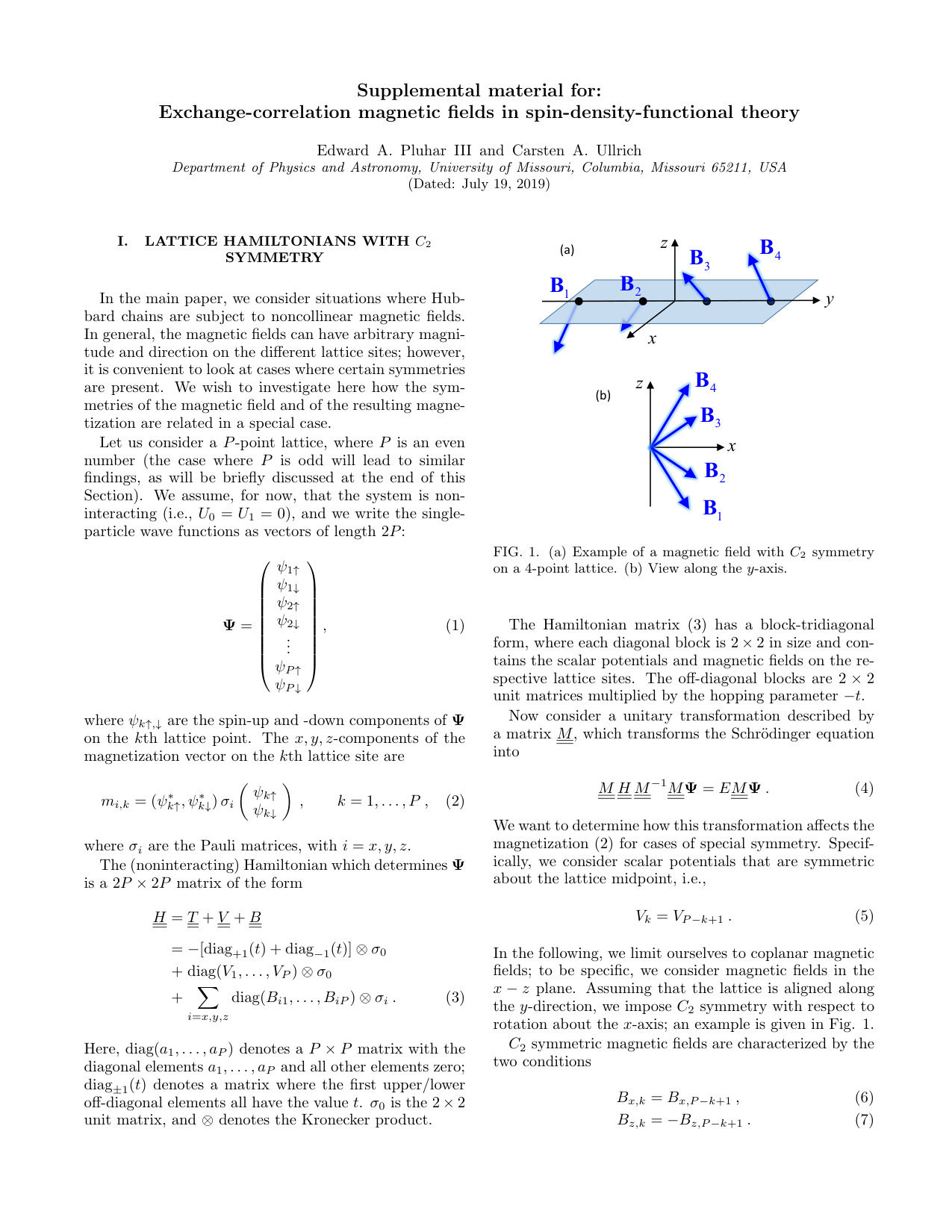 Figure 1
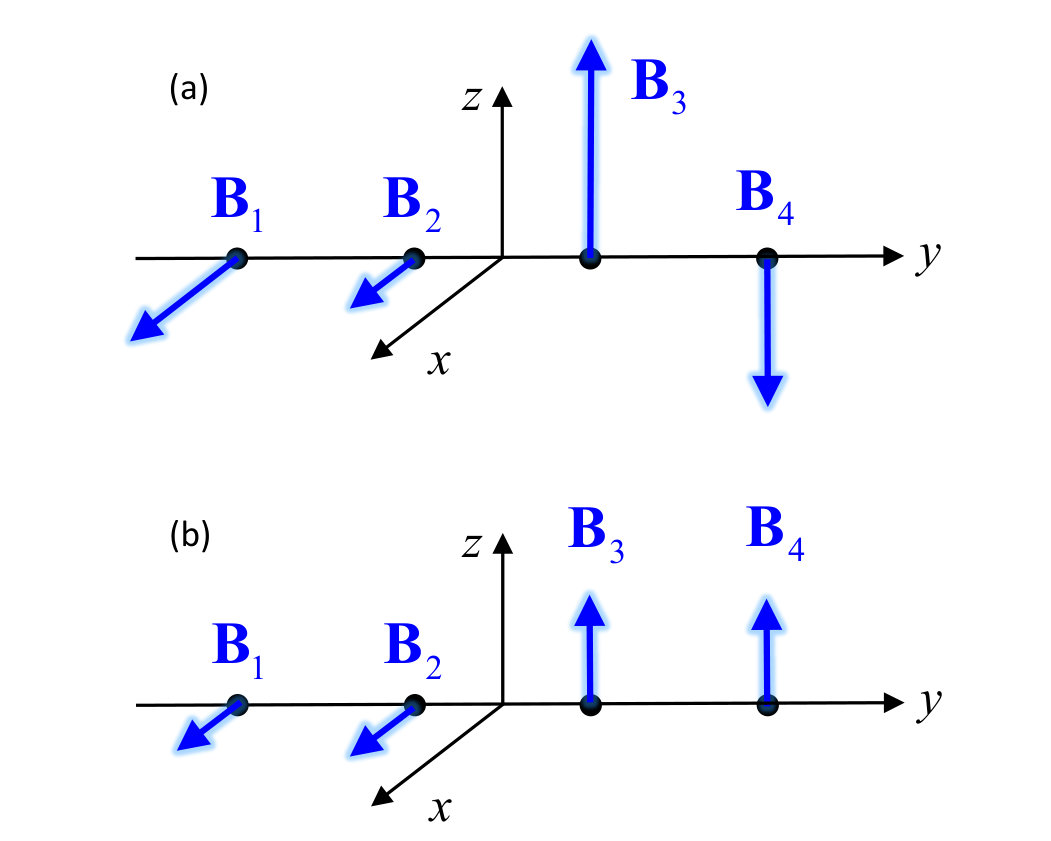 Figure 1
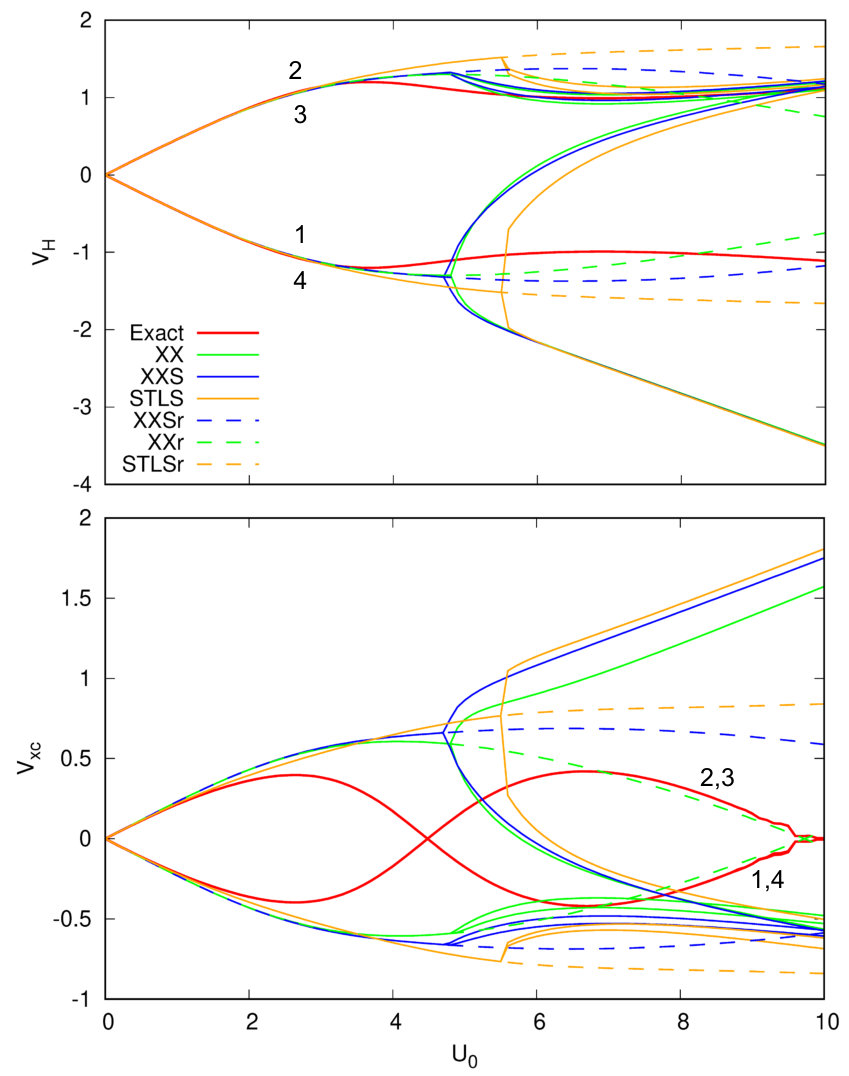 Figure 10
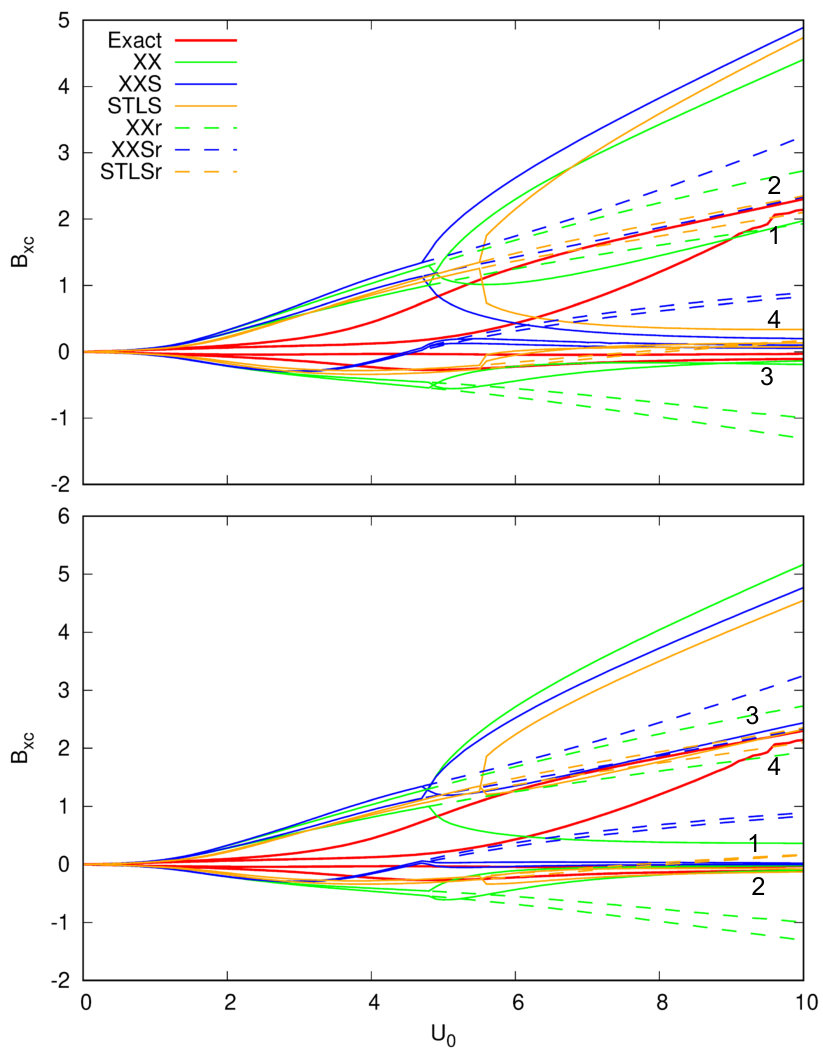 Figure 11
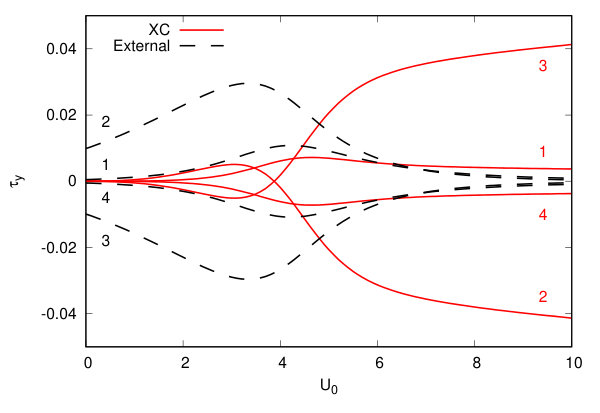 Figure 12
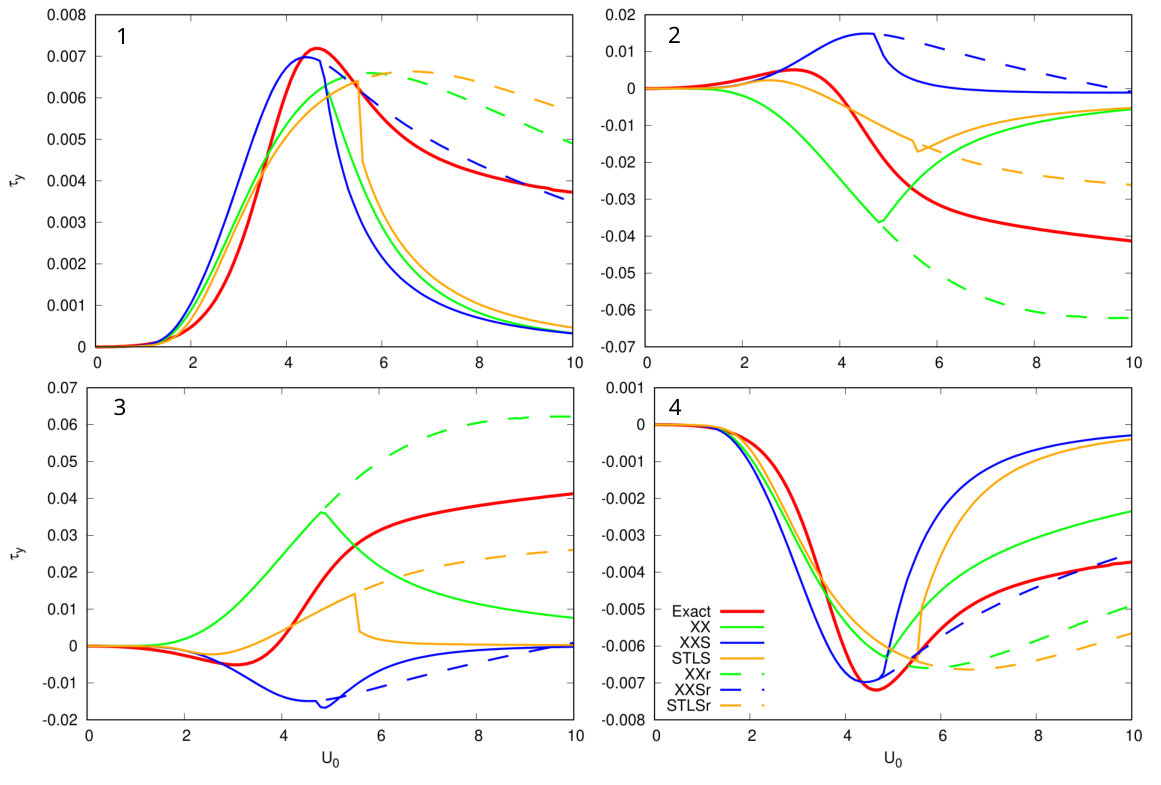 Figure 13
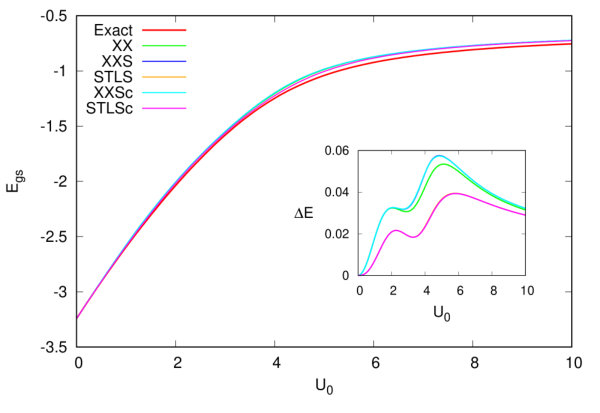 Figure 2
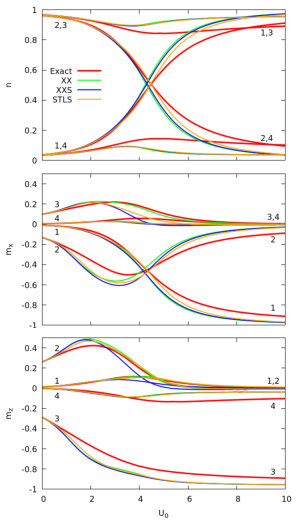 Figure 3
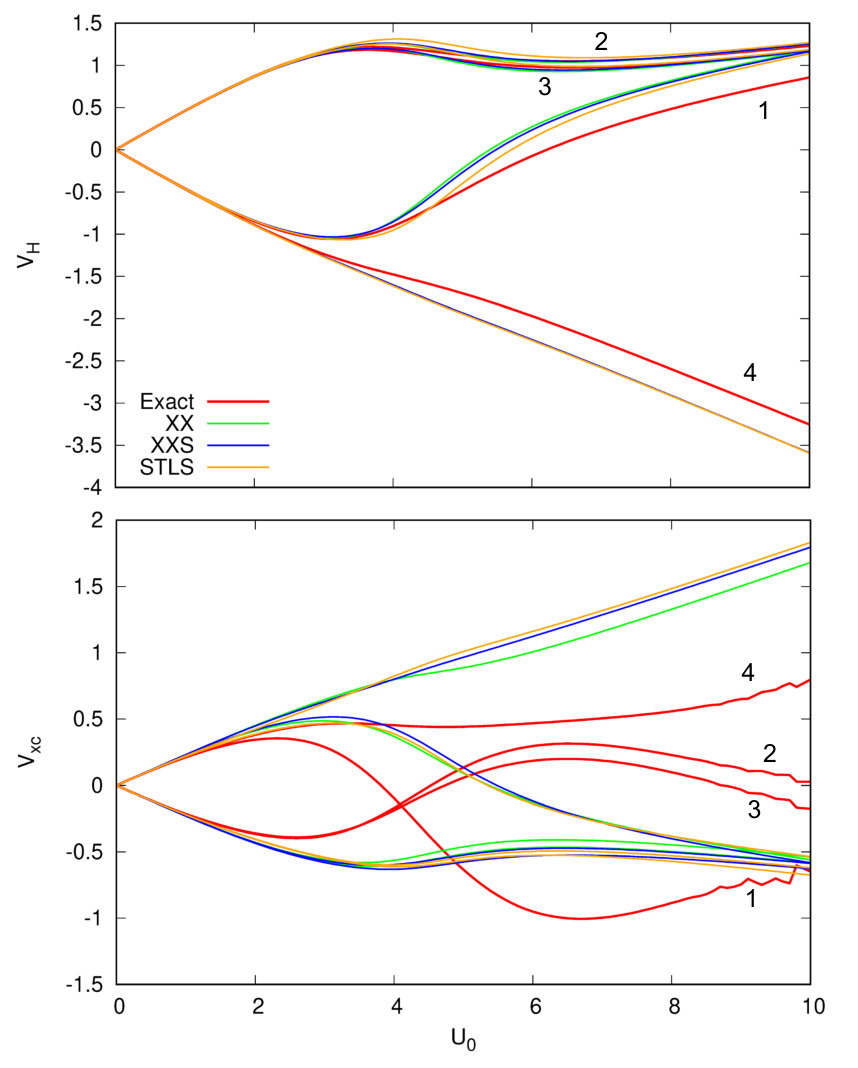 Figure 4
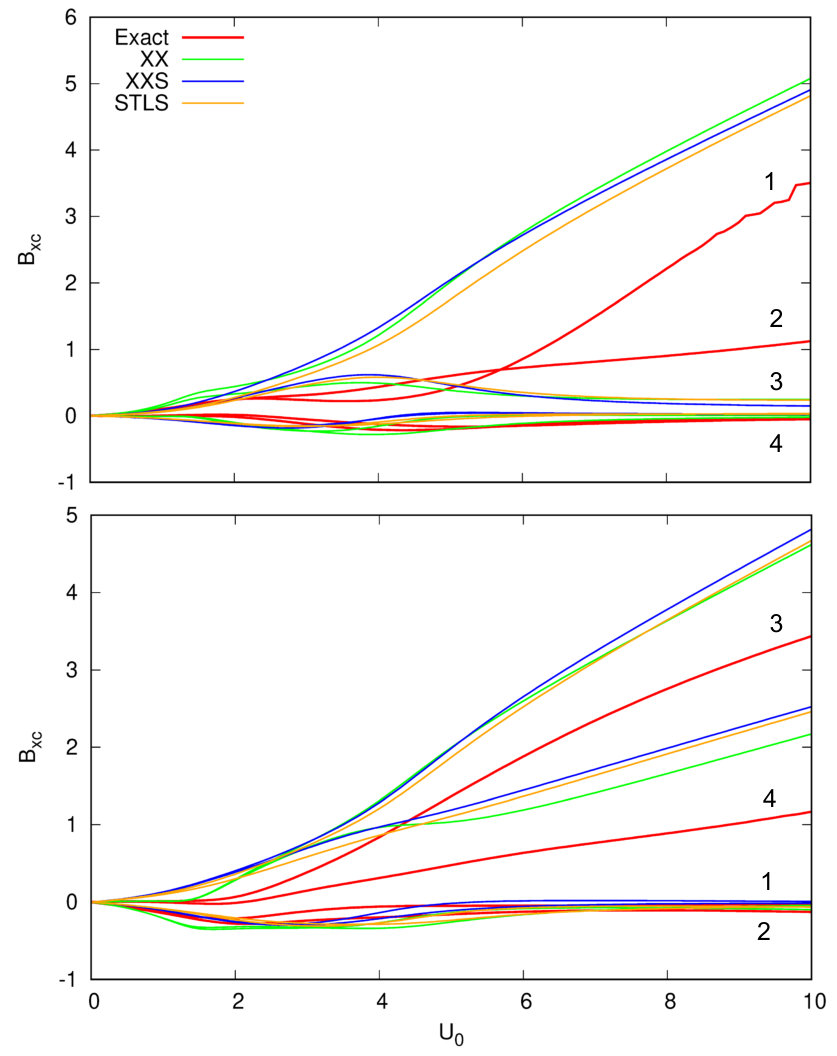 Figure 5
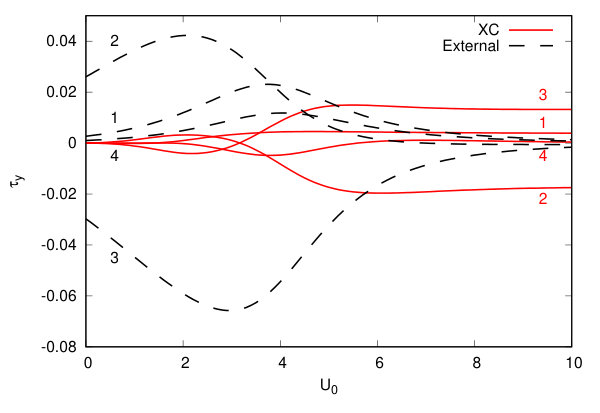 Figure 6
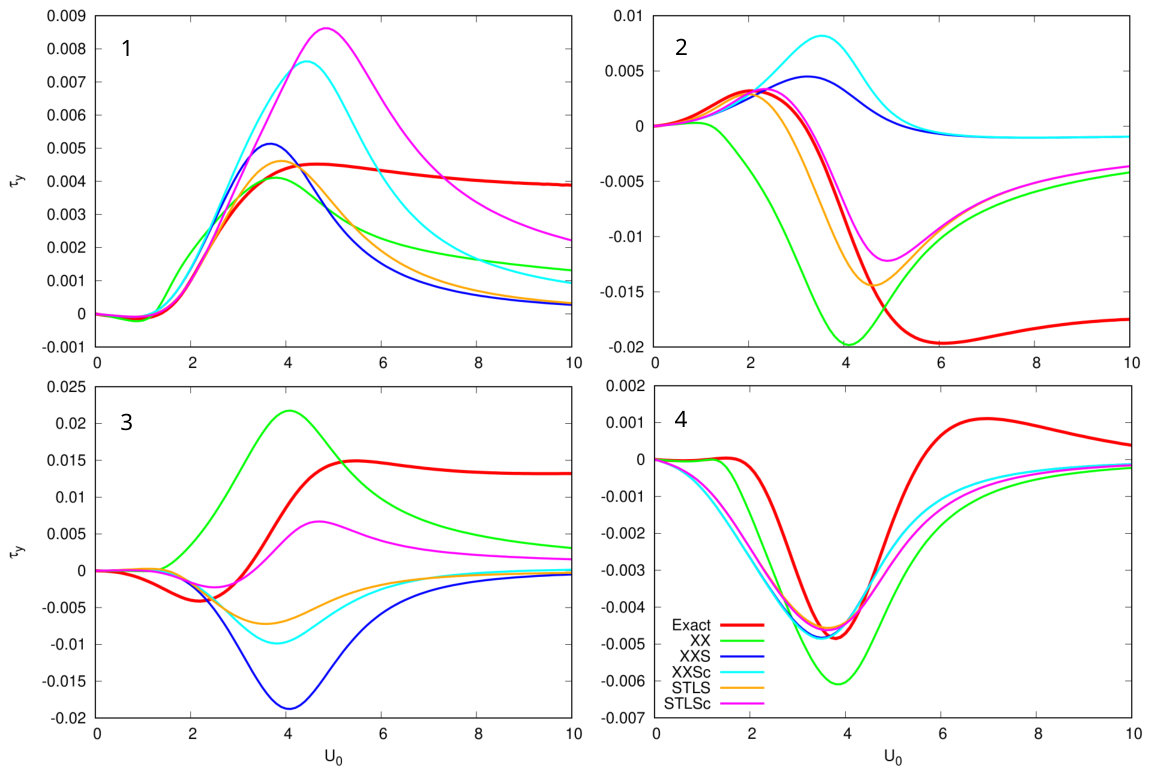 Figure 7
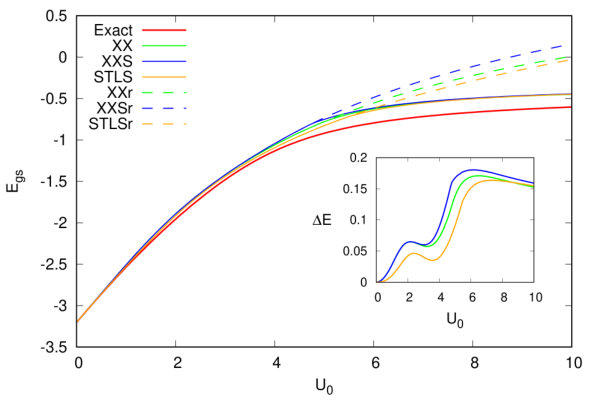 Figure 8
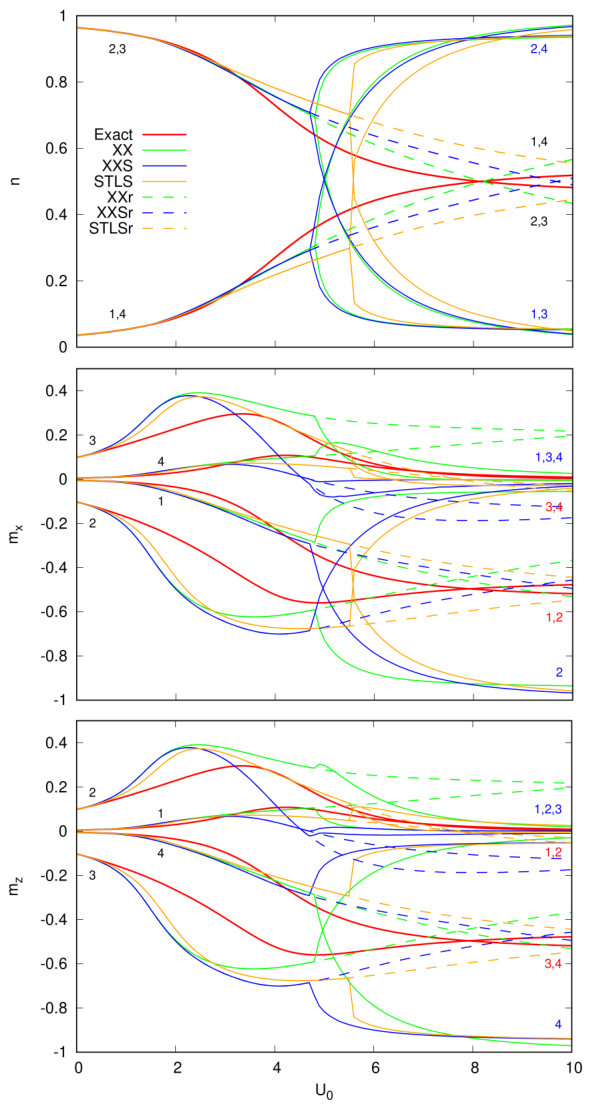 Figure 9
| nonsymmetric | -symmetric | |||||||
| 0 | 0.037 | 0.961 | 0.967 | 0.034 | 0.036 | 0.964 | 0.964 | 0.036 |
| 10 | 0.911 | 0.095 | 0.891 | 0.102 | 0.518 | 0.482 | 0.482 | 0.518 |
| 0 | 0.017 | 0.291 | 0.304 | 0.005 | 0.007 | 0.143 | 0.143 | 0.007 |
| 10 | 0.911 | 0.088 | 0.890 | 0.102 | 0.518 | 0.477 | 0.477 | 0.518 |
| 0 | -0.010 | -0.131 | 0.099 | 0.005 | -0.005 | -0.103 | 0.098 | 0.005 |
| 10 | -0.911 | -0.088 | 0.005 | 0.004 | -0.518 | -0.477 | 0.004 | 0.009 |
| 0 | 0.013 | 0.260 | -0.288 | -0.002 | 0.005 | 0.098 | -0.103 | -0.005 |
| 10 | 0.007 | -0.006 | -0.890 | -0.102 | 0.009 | 0.004 | -0.477 | -0.518 |
Peer Reviews
No public reviews on file for this paper yet. If you reviewed it on a platform where reviews are public (OpenReview, ICLR, NeurIPS, ICML), you can paste yours below so the community can read it here.
Videos
No videos yet. Explain this paper in a talk, walkthrough, or lecture? Add one.
Exchange-correlation magnetic fields in spin-density-functional theory
Edward A. Pluhar III
Carsten A. Ullrich
Department of Physics and Astronomy, University of Missouri, Columbia, Missouri 65211, USA
Abstract
In spin-density-functional theory for noncollinear magnetic materials, the Kohn-Sham system features exchange-correlation (xc) scalar potentials and magnetic fields. The significance of the xc magnetic fields is not very well explored; in particular, they can give rise to local torques on the magnetization, which are absent in standard local and semilocal approximations. We obtain exact benchmark solutions for two electrons on four-site extended Hubbard lattices over a wide range of interaction strengths, and compare exact xc potentials and magnetic fields with approximations obtained from orbital-dependent xc functionals. The xc magnetic fields turn out to play an increasingly important role as systems becomes more and more correlated and the electrons begin to localize; the effects of the xc torques, however, remain relatively minor. The approximate xc functionals perform overall quite well, but tend to favor symmetry-broken solutions for strong interactions.
I Introduction
Spin-density-functional theory (SDFT) von Barth and Hedin (1972); Gunnarsson and Lundqvist (1976); Gidopoulos (2007) is an in principle exact framework for systems of interacting electrons subject to the many-body Hamiltonian
[TABLE]
Here, is the vector of Pauli matrices acting on the spin of the th electron, is an external scalar potential, and is an external magnetic field which can be noncollinear, i.e., whose magnitude and direction can vary in space. The Bohr magneton, , has been absorbed in the definition of the magnetic field, and we use atomic units () throughout.
The corresponding noninteracting system in SDFT obeys the Kohn-Sham equation
[TABLE]
where is the unit matrix and the Kohn-Sham orbitals are two-component spinors. The scalar Kohn-Sham potential is the sum of external, Hartree, and exchange-correlation (xc) potentials, , and the Kohn-Sham magnetic field contains external and xc contributions, . In general, can be nonvanishing even if , i.e., for open-shell or spontaneously magnetized systems.
The effects of are present in a wide variety of systems, including materials with noncollinear magnetism, canted or spiral magnetization, or frustrated spins. Freeman and Nakamura (2004); Goings et al. (2018); Trushin and Görling (2018) In these examples, spin-orbit coupling often plays an important role. The SDFT formalism can be generalized to include spin-orbit coupling; Trushin and Görling (2018); Krieger et al. (2015) in this paper we ignore spin-orbit coupling to keep the discussion simple.
Formally, and are defined as functionals of the density and the magnetization foo ; in practice, and need to be approximated. Almost all approximations used in SDFT for noncollinear magnetism are based on common local and semilocal xc functionals such as the local spin-density approximation, LSDA, or the generalized gradient approximations, GGAs. The standard implementation of LSDA or GGAs assumes a local spin quantization axis which is aligned with the local ; Kübler et al. (1988); Sandratskii (1998) this produces a that is parallel to everywhere.
In general, can have components perpendicular to , which give rise to local xc torques,
[TABLE]
The zero-torque theorem Capelle et al. (2001) mandates that
[TABLE]
since a system cannot exert a net torque on itself. For the LSDA and GGAs, the local xc torque is zero everywhere, so the zero-torque theorem is trivially satisfied. As we will see, other approximations may not satisfy the zero-torque theorem a priori, but there are ways in which it can be enforced.
Several approximations for that include xc torque effects have been proposed in the literature, based on the spin-spiral state of the electron gas, Kleinman (1999); Eich and Gross (2013); Eich et al. (2013); Pittalis et al. (2017) modified GGAs, Katsnelson and Antropov (2003); Peralta et al. (2007); Scalmani and Frisch (2012); Bulik et al. (2013) the exchange-only optimized effective potential (OEP), Sharma et al. (2007) or a source-free construction. Sharma et al. (2018) These methods were applied to a variety of noncollinear spin systems; however, a rigorous assessment has been hampered by the absence of exact or at least highly accurate reference calculations.
In this paper, we perform benchmark studies for a simple model system, namely, two electrons on a linear 4-point extended Hubbard lattice ( filled Hubbard tetramer) with noncollinear magnetic fields. In Section II we will give the details of the model, and explain why it is an appropriate choice for studying xc torques.
Results will be presented for two scenarios: a lattice Hamiltonian without any symmetries (Sec. III), and a Hamiltonian with symmetry (Sec. IV). In both cases, we obtain the exact ground-state energy, densities, and magnetizations from the exact solutions, and compare with approximate Kohn-Sham results. Ullrich (2018, 2019) We reverse-engineer the exact xc potentials and magnetic fields for interaction strengths from the weakly to the strongly correlated regime, and discuss how the Kohn-Sham system mimics the behavior of the many-body system as the electrons begin to localize. We summarize our results in Section V and conclude with a general outlook.
II SDFT for the extended Hubbard model with noncollinear magnetic fields
We consider -point Hubbard chains with on-site (o.s.) and nearest-neighbor (n.n.) interactions and with external scalar potentials and magnetic fields, and , where denotes the lattice sites. The continuum Hamiltonian (1) is thus replaced by the extended Hubbard model Hamiltonian Hirsch (1984); Zhang and Callaway (1989); Laad and Ghosh (1991); Schumann and Zwicker (2010)
[TABLE]
Here, and are creation and annihilation operators for electrons with spin on site , and and are these operators arranged as two-component row and column vectors. denotes nearest-neighbor lattice sites. We fix the hopping parameter as . The o.s. interaction strength will be varied, and the n.n. interaction strength will be taken as .
We obtain the two-electron ground state of , using nonperiodic boundary conditions, by diagonalization within a complete basis of singlet states and triplet states, which yields the exact ground-state energy and the exact ground-state density and magnetization, and , on each lattice site.
The extended Hubbard model described above can be treated using SDFT; Capelle and Campo Jr. (2013) the corresponding Kohn-Sham lattice Hamiltonian follows from by setting and replacing and by the Kohn-Sham scalar potential and magnetic field and , respectively. We invert the lattice analog of the Kohn-Sham equation, Eq. (2), to obtain those and which reproduce the exact and on the -point lattice. Since the external potential and magnetic field are given, and the Hartree potential is easily obtained as
[TABLE]
(defining to account for the nonperiodic boundary conditions), this immediately yields the exact and . There exist a variety of algorithms to invert Kohn-Sham equations; Jensen and Wasserman (2017) here, we use a conjugate-gradient minimization (see Supplemental Material sup ).
Our choice to include n.n. interactions in is motivated by the fact that for the usual o.s. Hubbard model (where ) the exact exchange potential and exchange magnetic field are given by Ullrich (2018, 2019); Carrascal et al. (2015)
[TABLE]
Evidently, is parallel to the magnetization; hence, for the o.s. Hubbard model, the xc torques are a pure correlation effect which, one can expect, makes them more difficult to approximate. For exchange effects to produce torques, more general interactions than o.s. are required.
Let us first consider the half-filled Hubbard dimer (): Ullrich (2018) including n.n. interactions, one finds
[TABLE]
which, again, does not produce any torques. We therefore need more lattice points.
For the -filled Hubbard trimer Ullrich (2019) () with periodic boundary conditions and n.n. interactions, i.e., an equilateral triangle, Eq. (8) holds on all three lattice points. If one instead considers a Hubbard trimer with fixed boundaries (i.e., a short chain), one finds that the solution (8) holds on the midpoint, but there is no simple explicit solution on the first and the third point. Thus, exchange torques can arise on points 1 and 3, but not on point 2.
The simplest case where exchange torques can occur on all lattice sites is the -filled Hubbard tetramer () with o.s. and n.n. interactions. In the following, we will consider tetramers in linear configuration, see Fig. 1. Of course, correlation effects can produce torques in all the above systems, even without n.n. interactions.
A two-electron system without external magnetic field is always in a singlet ground state and hence nonmagnetic. To obtain a ground state with noncollinear magnetization, external magnetic fields are required (in the absence of spin-orbit coupling. Kaplan (1983); Ghassemi Tabrizi et al. (2019))
In the following Sections, two cases with different symmetries will be considered. In both of them, the 4-point lattice is assumed to have equidistant sites, aligned along the -direction (notice that the Hubbard lattice Hamiltonian is not necessarily tied to a specific real-space representation; however, assuming an explicit spatial geometry is conceptually helpful). The scalar potential will be taken to be nonuniform but symmetric with respect to the lattice center; we choose and in both cases.
We restrict the magnetic fields and the resulting magnetization to be coplanar, confined to the plane on each lattice point, but overall noncollinear (see Fig. 1). The resulting xc torques will lie along the -direction.
We obtain the ground-state energy, density, and magnetization on the lattice by exact diagonalization and via self-consistent Kohn-Sham. For the latter, we use three approximations: Ullrich (2018) exact exchange using the optimized effective potential approach (XX), exact exchange within the Slater approximation (XXS), and xc using the Singwi-Tosi-Land-Sjölander (STLS) scheme. Singwi et al. (1968); Giuliani and Vignale (2005) The latter is implemented within the scalar approximation, as detailed in Ref. Ullrich, 2018.
XX is fully variational and hence satisfies the zero-torque theorem; XXS and STLS, on the other hand, are not variational and can violate the zero-torque theorem. As shown in the Supplemental Material, sup the zero-torque theorem can be enforced by constrained optimization. The torque-corrected approximations defined in this way will be denoted as XXSc and STLSc, respectively.
III Nonsymmetric lattice
We begin our discussion by considering a Hubbard tetramer where no distinct spatial or spin symmetries are present. In this nonsymmetric case (see Fig. 1a), we set , , , and , with all other components zero. The external magnetic field defined in this way is coplanar in the plane, and hence all torques (external as well as xc) are along the (positive or negative) -direction.
III.1 Ground state energy
In Fig. 2 we compare the exact ground-state energy of the nonsymmetric lattice with Kohn-Sham results using XX, XXS, STLS, XXSc and STLSc. The exact energy starts out at for the noninteracting case (), reaches the value for , and approaches a limiting value of for . The crossover between the weakly and strongly correlated regimes occurs around . The agreement between the exact energy and the Kohn-Sham energies is very good for all values of . The inset shows that the largest errors of occur around , reaching around 5% for XX and XXS and slightly less for STLS.
The xc torque correction of XXS and STLS has a negligible impact on the total energy; in Fig. 2, the lines for XXS and XXSc are essentially on top of each other, as are the lines for STLS and STLSc. The reason for this is easy to see: to lowest order perturbation theory, the energy shift caused by a magnetic field is
[TABLE]
where is the magnetization of the unperturbed ground state. Thus, a transverse magnetic field [which is perpendicular to for all ] only contributes to the total energy to second and higher order. The xc torque correction, see Eq. (30) of the Supplemental Material, sup has the form of a transverse magnetic field added to the xc magnetic field to be corrected.
III.2 Density and magnetization
Figure 3 shows the density (top panel) and the - and -components of the magnetization, and (middle and bottom panels). At , the density is almost entirely concentrated on points 2 and 3 (where the scalar potential is lower). As increases, the electronic repulsion leads to a redistribution of the site occupation, so the electrons can better avoid each other (keep in mind that our model includes the n.n. interaction ); the crossover clearly occurs around . At , lattice sites 1 and 3 are almost fully occupied, whereas sites 2 and 4 are almost empty, see Table 1 for details. This behavior is somewhat exaggerated, but overall well reproduced, by the approximate Kohn-Sham calculations. Again, XXSc and STLSc give results very similar to XXS and STLS, and are not shown here.
The magnetization reveals further details which illustrate the behavior of the system as the interaction strength increases. At , the exact two-electron wave function has 95% singlet character, not and the system is only weakly magnetized (see Table 1). On the other hand, at , the exact wave function has 74% triplet character, and the magnitude of the magnetization vector on each lattice site is practically identical with the density, which indicates a fully magnetized state. In the limit , the total magnetization adds up to 2, and the singlet-triplet ratio is 1:3.
Furthermore, Table 1 tells us that at the magnetization vector is (anti)aligned with the applied magnetic field on each lattice site: on sites 1 and 2, the magnetization points almost completely in the negative -direction, and on sites 3 and 4 it points in the negative -direction. Referring back to Fig. 1a, we see that the magnetization vector is opposite to the applied magnetic field on sites 1, 2, and 3, and parallel to it on site 4. The physical meaning of this is that in the strongly correlated limit, the electrons not only localize spatially, they also align their spin quantization axis with the local magnetic field.
III.3 Hartree and xc potentials and xc magnetic fields
Figure 4 compares the exact Hartree potential, Eq. (6), and the exact xc potential, respectively, with the corresponding XX, XXS(c) and STLS(c) approximations. The - and -components of the xc magnetic fields are shown in Fig. 5.
, , and are responsible for reproducing the exact density and magnetization in the noninteracting Kohn-Sham system. As the system passes from the weakly to the strongly interacting regime with increasing , density gets shifted from site 2 to site 1, and sites 1 and 3 become almost fully magnetized. The Kohn-Sham system accomplishes this through an intricate interplay between Hartree and xc effects. For instance, comparing and , we see that the xc potential partially counteracts the Hartree potential, especially on sites 1 and 4.
The xc magnetic field displays a striking enhancement over the external magnetic field, by about an order of magnitude. These large field strengths are necessary so that the Kohn-Sham system can create the alignment of the local magnetic moments with the external field in the strongly correlated limit. Looking again at Table 1, we see that the magnetic moments are almost completely aligned along the -direction on sites 1 and 2, and along the -directions on sites 3 and 4. Correspondingly, the - and -components of are very strongly enhanced on these sites.
The approximate xc potentials and magnetic fields agree well with the exact results until about . For larger interaction strengths, considerable differences appear. For example, the xc potentials on sites 1, 2, and 3 change sign, which is not reproduced by any of the approximations, and the xc potential on site 4 has the wrong limiting behavior for large . Similar discrepancies are observed for the xc magnetic fields. This helps explain the differences between exact and approximate densities and magnetizations in Fig. 3.
III.4 Exact and approximate xc torques
Let us now examine the xc torques of the nonsymmetric tetramer. Figure 6 shows a comparison of the exact (full lines) with the torque caused by the externally applied magnetic field, (dashed lines). The latter is defined in analogy with Eq. (3), with replaced by . Both torques are along the -direction on all lattice sites. It can be seen that the xc torques on each lattice site add up to zero, as do the external torques (as they must, since the system is in equilibrium).
For weak to moderate interaction strengths, the external torque dominates over the xc torque, with maxima around to 4, depending on the lattice site. As the system localizes for , the magnetization on each lattice site aligns with the external magnetic field, as discussed in the previous subsection, so that goes to zero.
The xc torques, on the other hand, are small for weak interactions, but becomes larger than the external torque on sites 2 and 3 after the crossover into the strongly correlated regime. This means that, on these sites, the xc magnetic field does not quite align with the local magnetization. Looking at Table 1, we see that at sites 2 and 3 are almost, but not fully magnetized and aligned with the local external fields; furthermore, as Fig. 5 shows, the xc magnetic fields are very large on sites 2 and 3. Together, this results in a finite , which is necessary for the Kohn-Sham system to reproduce all subtle details of the magnetization of the interacting system.
The xc torques obtained with XX, XXS, STLS, XXSc and STLSc are presented in Fig. 7 for each lattice point. The xc torques are much smaller on sites 1 and 4 than on sites 2 and 3, which means that the performance of the approximations is more crucial on the latter sites. Compared to the exact xc torques, the approximate xc torques generally have the right order of magnitude, which is reassuring; however, there are some important details, depending on the lattice site and the level of approximation.
On site 1, all approximations perform well for small to moderate interactions, but fail to reproduce the finite xc torque for large interaction strengths; XXSc and STLSc overshoot around . On site 4, the quantitative agreement is quite good throughout, for all approximations.
On sites 2 and 3, the exact xc torque changes sign between and 4. This trend is not reproduced by XX, XXS and XXSc. STLS performs much better for small to moderate interaction strengths, including the sign change, with STLSc leading to slight improvements over STLS. However, all approximations produce a vanishing xc torque in the strongly correlated regime, instead of approaching a finite limit.
How important are the xc torques? We have already seen that they give only a very small contribution to the total energy. We have carried out self-consistent calculations with XX, XXS and STLS where we only include the longitudinal components of (see the Supplemental Material sup for details). We find that the magnetization on the individual sites does not change much for the nonsymmetric case.
IV Lattice with symmetry
We now consider a magnetic field distribution which has symmetry, as illustrated in Fig. 1b. The symmetry is with respect to rotation about an axis which lies at an angle of 45o between the and axes. Specifically, we choose . In the Supplemental Material sup we show that the resulting magnetization also has symmetry. Specifically, one finds , and a similar relation for the xc magnetic field. Hence, the zero-torque theorem will automatically be satisfied for all approximations (as long as the Kohn-Sham solution maintains the symmetry).
IV.1 Ground-state energy, density and magnetization: breaking and enforcing symmetry
Figure 8 shows the ground-state energy for the -symmetric Hubbard tetramer for interaction strengths between 0 and 10. The behavior is similar to the nonsymmetric case discussed earlier. The exact energy starts out at for the noninteracting case, reaches the value for , and approaches a limiting value of for . As before, the crossover between the weakly and strongly correlated regimes occurs around .
The agreement between the exact energy and the (unrestricted) SDFT results is generally good for weak and moderate interactions strengths, but a significant (25%) deviation appears for large . The inset to Fig. 8 shows the difference between approximate and exact ground-state energies. Overall, STLS performs the best; in the limit of large , XX merges with STLS.
Each approximation reaches a critical where it is advantageous for the system to break symmetry to reduce the total energy of the system. This does not come as a surprise: Jacob and Reiher (2012); Carrascal et al. (2015); Ullrich (2018) unrestricted Kohn-Sham calculations with approximate xc functionals have the general tendency to break symmetries (spatial and/or spin) to lower the energy. This is known as the symmetry dilemma of DFT. The dashed lines in Fig. 8 are the restricted SDFT ground-state energies, obtained by enforcing the symmetry. The restricted energies keep increasing with , in contrast with the exact and with the unrestricted (symmetry-broken) Kohn-Sham .
Figure 9 shows the density (top panel) and the - and -components of the magnetization, and (middle and bottom panels). At , the density is almost entirely concentrated at points 2 and 3, like in the nonsymmetric case (see the top panel of Fig. 3). However, as increases, differences between the symmetric and nonsymmetric tetramers start to appear: for strong correlations, the exact density becomes almost evenly distributed over the four lattice points, rather than accumulating on two points. After breaking the symmetry, the unrestricted approximate SDFT calculations dramatically over-localize the density in the strongly correlated limit: the density is almost completely concentrated on points 2 and 4. The symmetry breaking occurs at and for XXS and XX, respectively, and at for STLS.
For the exact magnetization (middle and bottom panels of Fig. 9, and right half of Table 1), the trends are very similar to the nonsymmetric case. At , the system is only very weakly magnetized, with an exact wave function that has 99% singlet character. At , the system is fully magnetized, and the exact wave function has 74% triplet character. As before, the exact magnetization vector is (anti)aligned with the applied magnetic field on each lattice site, which indicates a local spin quantization axis.
Unrestricted SDFT, on the other hand, produces a very different magnetization after the symmetry is broken. As we discussed above, the unrestricted density localizes on points 2 and 4, and we see that and approach . As for the exact case, the total magnetization adds up to 2 in the limit, in spite of the wrong overall distribution.
The dashed lines in Fig. 9 show the density and magnetization resulting from symmetry-restricted SDFT. Not surprisingly, the agreement with the exact results is much better, although there are still some deviations. However, the price to pay is a wrong behavior of the total energy, as we saw above in Fig. 8.
IV.2 xc potentials, magnetic fields, and torques
Figure 10 shows the exact Hartree potential and the exact xc potential on each lattice site, as a function of . The - and -components of the xc magnetic fields are shown in Fig. 11. The interpretation of these results is a bit more straightforward than for the nonsymmetric case discussed earlier (see Figs. 4 and 5). The Hartree potential approaches values close to 1 on sites 2 and 3 and close to on sites 1 and 4, which compensates the external potential. The xc potential is small compared to the Hartree potential (the fact that it approaches zero for seems accidental). Together, the Kohn-Sham potential is close to uniform, which explains the almost uniform density distribution in the strongly interacting limit, see Table 1. The strong xc magnetic fields, on the other hand, are responsible for almost fully magnetizing the system, similar to what we discussed earlier for the nonsymmetric case.
As before for the nonsymmetric case, the XX, XXS and STLS approximations for and deviate significantly from the exact results, especially after the symmetry breaking. The agreement within the restricted-symmetry formalism is somewhat better.
Figure 12 shows a comparison of the exact (full lines) for the -symmetric tetramer with the torques caused by the externally applied magnetic field, (dashed lines). As in the nonsymmetric case (Fig. 6), the external torque dominates over the xc torque for weak interactions. However, in the strongly correlated regime, the xc torques are now considerably larger (in magnitude as well as relative to the external torques) than in the nonsymmetric case.
The xc torques obtained with XX(r), XXS(r) and STLS(r) are presented in Fig. 13. For small to moderate the agreement with the exact xc torques is decent, especially on sites 1 and 4. The deviations on site 2 and 3 are more significant, however. As expected, the approximate xc torques fail completely for the unrestricted calculations after symmetry breaking. The restricted calculations (dashed lines) perform somewhat better in general. The excellent agreement between XXSr and the exact results on sites 1 and 4 seems, however, fortuitous. STLS is most successful at capturing the general trends in both the weakly and strongly correlated regimes.
In the Supplemental Material sup we show the xc torques for the -symmetric lattice calculated using XXS and STLS with the torque correction. Some minor differences can be observed, but the torque correction has no impact on the symmetry breaking.
Furthermore, in the Supplemental Material sup we show results for the -symmetric lattice calculated using only the longitudinal components of . As for the nonsymmetric lattice, the differences are only relatively minor, except for XX: the XX functional seems to be more sensitive to the presence of the transverse xc magnetic field, which affects the way in which the symmetry is broken. Overall, the longitudinal-only XX is closer to its XXS and STLS counterparts (and to the exact solution) than when the full is used, which would suggest that XX does not describe transverse xc effects very well. This is consistent with the behavior of the xc torques shown in Fig. 13 (and, to some extent, also in Fig. 7), which shows that the XX torques tend to be somewhat exaggerated. The behavior of XXS and STLS comes across as more robust.
V Conclusions
In this paper we have carried out a detailed computational study of a simple model system: two interacting electrons on a four-site extended Hubbard lattice, in the presence of noncollinear magnetic fields. Our goal was to find out how a Kohn-Sham system, through its xc scalar potentials and magnetic fields, manages to reproduce the exact ground-state density and magnetization of the interacting system, particularly for situations where the interaction is strong. We discovered that the xc magnetic field plays a key role in ensuring that the magnetic behavior of strongly correlated, localized electrons is determined by local spin quantization axes on each lattice site.
We compared the exact xc potentials and magnetic fields with several orbital-dependent approximations, and found that their performance is overall quite good, but depends on whether the system has any symmetries. In the case where the Hubbard lattice has -symmetry, we found that the approximate Kohn-Sham calculations tend to break this symmetry once the interaction strength becomes sufficiently large, thus lowering the energy. This, of course, is no surprise: the so-called symmetry dilemma is a well-known side effect of using approximate xc functionals in SDFT.
A main outcome of this study is that the xc torques seem to have a relatively minor importance for the ground-state energy, density and magnetization, compared to the xc potentials and longitudinal xc magnetic fields — at least for the simple model systems considered here. This suggests that the widely used standard approximations of noncollinear magnetism (which have no transverse magnetic xc contributions) should be adequate in most situations, as long as they reproduce the longitudinal xc magnetic fields sufficiently accurately.
However, our study did not include spin-orbit coupling, which is an important aspect of noncollinear magnetism in many materials. In particular, we needed to enforce the noncollinear magnetic state via applied magnetic fields, whereas effects such as canted or frustrated spins arise naturally without any applied fields. It is an open question whether xc torque effects play a more important role in such situations, but it seems not unlikely. To address this issue, Hubbard models that include spin-orbit coupling are a promising approach.
A perhaps even more important question concerns the role of xc magnetic fields for spin dynamics. While the xc torques appear less crucial in the ground state, they may become more important as the magnetic system evolves in time, following a sudden switching or a pulsed excitation. Such studies, again based on simple Hubbard-type systems, are currently in progress.
Lastly, while simple lattice models serve as important benchmarks for SDFT and can produce a wealth of new physical insight, it will be important to investigate the performance of orbital-dependent xc functionals for noncollinear magnetic systems in real space. The XXS approximation will be very well suited for this purpose due to its simplicity and reasonable accuracy. The STLS approach was found to perform well for the model systems considered here (as long as correlations are not too strong), but would be numerically much more expensive for real-space systems. Finding orbital-dependent correlation functionals for noncollinear magnetic materials, at a reasonable computational cost, remains an ongoing challenge.
Acknowledgements.
This work was supported by DOE Grant No. DE-SC0019109 and by a Research Corporation for Science Advancement Cottrell Scholar SEED Award.
The reference list from the paper itself. Each links out to its DOI / PubMed record.
- 1von Barth and Hedin (1972) U. von Barth and L. Hedin, A local exchange-correlation potential for the spin polarized case: I, J. Phys. C 5 , 1629 (1972).
- 2Gunnarsson and Lundqvist (1976) O. Gunnarsson and B. I. Lundqvist, Exchange and correlation in atoms, molecules, and solids by the spin-density-functional formalism, Phys. Rev. B 13 , 4274 (1976).
- 3Gidopoulos (2007) N. I. Gidopoulos, Potential in spin-density-functional theory of noncollinear magnetism determined by the many-electron ground state, Phys. Rev. B 75 , 134408 (2007).
- 4Freeman and Nakamura (2004) A. J. Freeman and K. Nakamura, Modern computational magnetism: role of noncollinear magnetism in complex magnetic phenomena, Phys. Stat. Sol. (b) 241 , 1399 (2004).
- 5Goings et al. (2018) J. J. Goings, F. Egidi, and X. Li, Current development of noncollinear electronic structure theory, Int. J. Quantum Chem. 118 , e 25398 (2018).
- 6Trushin and Görling (2018) E. Trushin and A. Görling, Spin-current density-functional theory for a correct treatment of spin-orbit interactions and its application to topological phase transitions, Phys. Rev. B 98 , 205137 (2018).
- 7Krieger et al. (2015) K. Krieger, J. K. Dewhurst, P. Elliott, S. Sharma, and E. K. U. Gross, Laser-induced demagnetization at ultrashort time scales: Predictions of TDDFT, J. Chem. Theory Comput. 11 , 4870 (2015).
- 8(8) The sign convention for the magnetization follows E. Engel and R. M. Dreizler, Density functional theory: An advanced course (Springer, Berlin, 2011).