A Detection of CMB-Cluster Lensing using Polarization Data from SPTpol
S. Raghunathan, S. Patil, E. Baxter, B. A. Benson, L. E. Bleem, T. M., Crawford, G. P. Holder, T. McClintock, C. L. Reichardt, T. N. Varga, N., Whitehorn, P. A. R. Ade, S. Allam, A. J. Anderson, J. E. Austermann, S., Avila, J. S. Avva, D. Bacon, J. A. Beall, A. N. Bender

TL;DR
This paper presents the first detection of galaxy cluster lensing using only CMB polarization data, employing a novel estimator and data from the SPTpol survey, achieving a significant 4.8 sigma detection.
Contribution
The study introduces a new polarization-based estimator for detecting cluster lensing and demonstrates its effectiveness with real data, aligning with other measurement methods.
Findings
Detected cluster lensing at 4.8 sigma significance
Estimated mean cluster mass consistent with other methods
Paves the way for future polarization-based cluster cosmology
Abstract
We report the first detection of gravitational lensing due to galaxy clusters using only the polarization of the cosmic microwave background (CMB). The lensing signal is obtained using a new estimator that extracts the lensing dipole signature from stacked images formed by rotating the cluster-centered Stokes map cutouts along the direction of the locally measured background CMB polarization gradient. Using data from the SPTpol 500 deg survey at the locations of roughly 18,000 clusters with richness from the Dark Energy Survey (DES) Year-3 full galaxy cluster catalog, we detect lensing at . The mean stacked mass of the selected sample is found to be which is in good agreement with optical weak lensing based estimates using DES data and CMB-lensing based estimates using SPTpol temperature data. This…
Click any figure to enlarge with its caption.
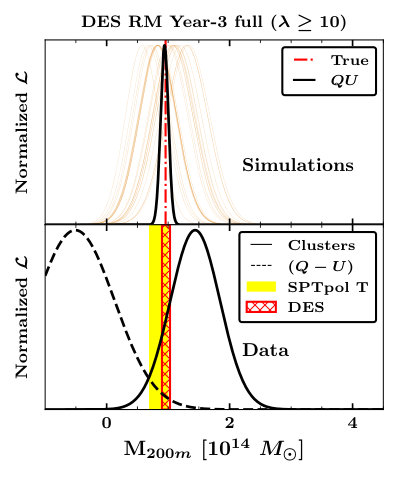 Figure 1
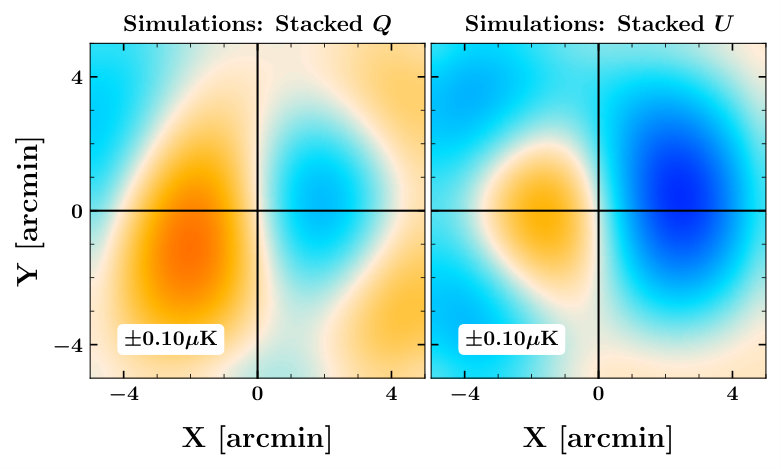 Figure 2
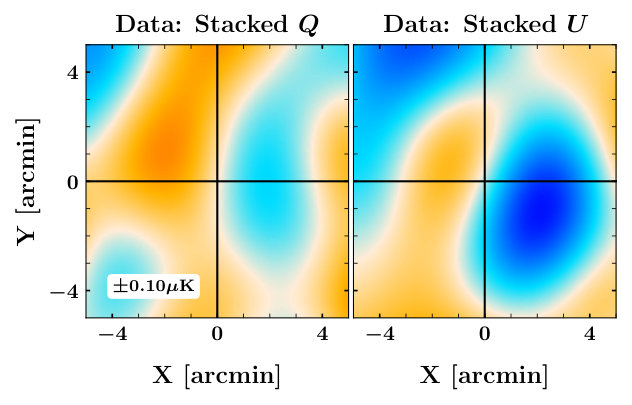 Figure 3
| Sample | Lensing mass M200m | ||
|---|---|---|---|
| This work | DES | SPTpol-T | |
Peer Reviews
No public reviews on file for this paper yet. If you reviewed it on a platform where reviews are public (OpenReview, ICLR, NeurIPS, ICML), you can paste yours below so the community can read it here.
Code & Models
Videos
No videos yet. Explain this paper in a talk, walkthrough, or lecture? Add one.
[TABLE]
A Detection of CMB-Cluster Lensing using Polarization Data from SPTpol
S. Raghunathan
Department of Physics and Astronomy, University of California, Los Angeles, CA, USA 90095
School of Physics, University of Melbourne, Parkville, VIC 3010, Australia
S. Patil
School of Physics, University of Melbourne, Parkville, VIC 3010, Australia
E. Baxter
Department of Physics and Astronomy, University of Pennsylvania, Philadelphia, PA 19104, USA
B. A. Benson
Fermi National Accelerator Laboratory, MS209, P.O. Box 500, Batavia, IL 60510
Kavli Institute for Cosmological Physics, University of Chicago, 5640 South Ellis Avenue, Chicago, IL, USA 60637
Department of Astronomy and Astrophysics, University of Chicago, 5640 South Ellis Avenue, Chicago, IL, USA 60637
L. E. Bleem
High Energy Physics Division, Argonne National Laboratory, 9700 S. Cass Avenue, Argonne, IL, USA 60439
Kavli Institute for Cosmological Physics, University of Chicago, 5640 South Ellis Avenue, Chicago, IL, USA 60637
T. M. Crawford
Kavli Institute for Cosmological Physics, University of Chicago, 5640 South Ellis Avenue, Chicago, IL, USA 60637
Department of Astronomy and Astrophysics, University of Chicago, 5640 South Ellis Avenue, Chicago, IL, USA 60637
G. P. Holder
Astronomy Department, University of Illinois at Urbana-Champaign, 1002 W. Green Street, Urbana, IL 61801, USA
Department of Physics, University of Illinois Urbana-Champaign, 1110 W. Green Street, Urbana, IL 61801, USA
Canadian Institute for Advanced Research, CIFAR Program in Gravity and the Extreme Universe, Toronto, ON, M5G 1Z8, Canada
T. McClintock
Department of Physics, University of Arizona, Tucson, AZ 85721, USA
C. L. Reichardt
School of Physics, University of Melbourne, Parkville, VIC 3010, Australia
T. N. Varga
Max Planck Institute for Extraterrestrial Physics, Giessenbachstrasse, 85748 Garching, Germany
Universitäts-Sternwarte, Fakultät für Physik, LudwigMaximilians Universität München, Scheinerstr. 1, 81679 München, Germany
N. Whitehorn
Department of Physics and Astronomy, University of California, Los Angeles, CA, USA 90095
P. A. R. Ade
Cardiff University, Cardiff CF10 3XQ, United Kingdom
S. Allam
Fermi National Accelerator Laboratory, P. O. Box 500, Batavia, IL 60510, USA
A. J. Anderson
Fermi National Accelerator Laboratory, MS209, P.O. Box 500, Batavia, IL 60510
J. E. Austermann
NIST Quantum Devices Group, 325 Broadway Mailcode 817.03, Boulder, CO, USA 80305
S. Avila
Instituto de Fisica Teorica UAM/CSIC, Universidad Autonoma de Madrid, 28049 Madrid, Spain
J. S. Avva
Department of Physics, University of California, Berkeley, CA, USA 94720
D. Bacon
Institute of Cosmology & Gravitation, University of Portsmouth, Dennis Sciama Building, Burnaby Road, Portsmouth PO1 3FX, UK
J. A. Beall
NIST Quantum Devices Group, 325 Broadway Mailcode 817.03, Boulder, CO, USA 80305
A. N. Bender
High Energy Physics Division, Argonne National Laboratory, 9700 S. Cass Avenue, Argonne, IL, USA 60439
Kavli Institute for Cosmological Physics, University of Chicago, 5640 South Ellis Avenue, Chicago, IL, USA 60637
F. Bianchini
School of Physics, University of Melbourne, Parkville, VIC 3010, Australia
S. Bocquet
Faculty of Physics, Ludwig-Maximilians-Universität, Scheinerstr. 1, 81679 Munich, Germany
High Energy Physics Division, Argonne National Laboratory, 9700 S. Cass Avenue, Argonne, IL, USA 60439
Kavli Institute for Cosmological Physics, University of Chicago, 5640 South Ellis Avenue, Chicago, IL, USA 60637
D. Brooks
Department of Physics & Astronomy, University College London, Gower Street, London, WC1E 6BT, UK
D. L. Burke
Kavli Institute for Particle Astrophysics & Cosmology, P. O. Box 2450, Stanford University, Stanford, CA 94305, USA
SLAC National Accelerator Laboratory, Menlo Park, CA 94025, USA
J. E. Carlstrom
Kavli Institute for Cosmological Physics, University of Chicago, 5640 South Ellis Avenue, Chicago, IL, USA 60637
Department of Physics, University of Chicago, 5640 South Ellis Avenue, Chicago, IL, USA 60637
High Energy Physics Division, Argonne National Laboratory, 9700 S. Cass Avenue, Argonne, IL, USA 60439
Department of Astronomy and Astrophysics, University of Chicago, 5640 South Ellis Avenue, Chicago, IL, USA 60637
Enrico Fermi Institute, University of Chicago, 5640 South Ellis Avenue, Chicago, IL, USA 60637
J. Carretero
Institut de Física d’Altes Energies (IFAE), The Barcelona Institute of Science and Technology, Campus UAB, 08193 Bellaterra (Barcelona) Spain
F. J. Castander
Institut d’Estudis Espacials de Catalunya (IEEC), 08034 Barcelona, Spain
Institute of Space Sciences (ICE, CSIC), Campus UAB, Carrer de Can Magrans, s/n, 08193 Barcelona, Spain
C. L. Chang
Kavli Institute for Cosmological Physics, University of Chicago, 5640 South Ellis Avenue, Chicago, IL, USA 60637
High Energy Physics Division, Argonne National Laboratory, 9700 S. Cass Avenue, Argonne, IL, USA 60439
Department of Astronomy and Astrophysics, University of Chicago, 5640 South Ellis Avenue, Chicago, IL, USA 60637
H. C. Chiang
School of Mathematics, Statistics & Computer Science, University of KwaZulu-Natal, Durban, South Africa
R. Citron
University of Chicago, 5640 South Ellis Avenue, Chicago, IL, USA 60637
M. Costanzi
Universitäts-Sternwarte, Fakultät für Physik, Ludwig-Maximilians Universität München, Scheinerstr. 1, 81679 München, Germany
A. T. Crites
Kavli Institute for Cosmological Physics, University of Chicago, 5640 South Ellis Avenue, Chicago, IL, USA 60637
Department of Astronomy and Astrophysics, University of Chicago, 5640 South Ellis Avenue, Chicago, IL, USA 60637
California Institute of Technology, MS 249-17, 1216 E. California Blvd., Pasadena, CA, USA 91125
L. N. da Costa
Laboratório Interinstitucional de e-Astronomia - LIneA, Rua Gal. José Cristino 77, Rio de Janeiro, RJ - 20921-400, Brazil
Observatório Nacional, Rua Gal. José Cristino 77, Rio de Janeiro, RJ - 20921-400, Brazil
S. Desai
Department of Physics, IIT Hyderabad, Kandi, Telangana 502285, India
H. T. Diehl
Fermi National Accelerator Laboratory, P. O. Box 500, Batavia, IL 60510, USA
J. P. Dietrich
Excellence Cluster Origins, Boltzmannstr. 2, 85748 Garching, Germany
Faculty of Physics, Ludwig-Maximilians-Universität, Scheinerstr. 1, 81679 Munich, Germany
M. A. Dobbs
Department of Physics, McGill University, 3600 Rue University, Montreal, Quebec H3A 2T8, Canada
Canadian Institute for Advanced Research, CIFAR Program in Gravity and the Extreme Universe, Toronto, ON, M5G 1Z8, Canada
P. Doel
Department of Physics & Astronomy, University College London, Gower Street, London, WC1E 6BT, UK
S. Everett
Santa Cruz Institute for Particle Physics, Santa Cruz, CA 95064, USA
A. E. Evrard
Department of Astronomy, University of Michigan, Ann Arbor, MI 48109, USA
Department of Physics, University of Michigan, Ann Arbor, MI 48109, USA
C. Feng
Astronomy Department, University of Illinois at Urbana-Champaign, 1002 W. Green Street, Urbana, IL 61801, USA
Department of Physics, University of Illinois Urbana-Champaign, 1110 W. Green Street, Urbana, IL 61801, USA
B. Flaugher
Fermi National Accelerator Laboratory, P. O. Box 500, Batavia, IL 60510, USA
P. Fosalba
Institut d’Estudis Espacials de Catalunya (IEEC), 08034 Barcelona, Spain
Institute of Space Sciences (ICE, CSIC), Campus UAB, Carrer de Can Magrans, s/n, 08193 Barcelona, Spain
J. Frieman
Fermi National Accelerator Laboratory, P. O. Box 500, Batavia, IL 60510, USA
Kavli Institute for Cosmological Physics, University of Chicago, Chicago, IL 60637, USA
J. Gallicchio
Kavli Institute for Cosmological Physics, University of Chicago, 5640 South Ellis Avenue, Chicago, IL, USA 60637
Harvey Mudd College, 301 Platt Blvd., Claremont, CA 91711
J. García-Bellido
Instituto de Fisica Teorica UAM/CSIC, Universidad Autonoma de Madrid, 28049 Madrid, Spain
E. Gaztanaga
Institut d’Estudis Espacials de Catalunya (IEEC), 08034 Barcelona, Spain
Institute of Space Sciences (ICE, CSIC), Campus UAB, Carrer de Can Magrans, s/n, 08193 Barcelona, Spain
E. M. George
European Southern Observatory, Karl-Schwarzschild-Str. 2, 85748 Garching bei München, Germany
Department of Physics, University of California, Berkeley, CA, USA 94720
T. Giannantonio
Institute of Astronomy, University of Cambridge, Madingley Road, Cambridge CB3 0HA, UK
Kavli Institute for Cosmology, University of Cambridge, Madingley Road, Cambridge CB3 0HA, UK
A. Gilbert
Department of Physics, McGill University, 3600 Rue University, Montreal, Quebec H3A 2T8, Canada
R. A. Gruendl
Department of Astronomy, University of Illinois at Urbana-Champaign, 1002 W. Green Street, Urbana, IL 61801, USA
National Center for Supercomputing Applications, 1205 West Clark St., Urbana, IL 61801, USA
J. Gschwend
Laboratório Interinstitucional de e-Astronomia - LIneA, Rua Gal. José Cristino 77, Rio de Janeiro, RJ - 20921-400, Brazil
Observatório Nacional, Rua Gal. José Cristino 77, Rio de Janeiro, RJ - 20921-400, Brazil
N. Gupta
School of Physics, University of Melbourne, Parkville, VIC 3010, Australia
G. Gutierrez
Fermi National Accelerator Laboratory, P. O. Box 500, Batavia, IL 60510, USA
T. de Haan
Department of Physics, University of California, Berkeley, CA, USA 94720
Physics Division, Lawrence Berkeley National Laboratory, Berkeley, CA, USA 94720
N. W. Halverson
Department of Astrophysical and Planetary Sciences, University of Colorado, Boulder, CO, USA 80309
Department of Physics, University of Colorado, Boulder, CO, USA 80309
N. Harrington
Department of Physics, University of California, Berkeley, CA, USA 94720
J. W. Henning
High Energy Physics Division, Argonne National Laboratory, 9700 S. Cass Avenue, Argonne, IL, USA 60439
Kavli Institute for Cosmological Physics, University of Chicago, 5640 South Ellis Avenue, Chicago, IL, USA 60637
G. C. Hilton
NIST Quantum Devices Group, 325 Broadway Mailcode 817.03, Boulder, CO, USA 80305
D. L. Hollowood
Santa Cruz Institute for Particle Physics, Santa Cruz, CA 95064, USA
W. L. Holzapfel
Department of Physics, University of California, Berkeley, CA, USA 94720
K. Honscheid
Center for Cosmology and Astro-Particle Physics, The Ohio State University, Columbus, OH 43210, USA
Department of Physics, The Ohio State University, Columbus, OH 43210, USA
J. D. Hrubes
University of Chicago, 5640 South Ellis Avenue, Chicago, IL, USA 60637
N. Huang
Department of Physics, University of California, Berkeley, CA, USA 94720
J. Hubmayr
NIST Quantum Devices Group, 325 Broadway Mailcode 817.03, Boulder, CO, USA 80305
K. D. Irwin
SLAC National Accelerator Laboratory, 2575 Sand Hill Road, Menlo Park, CA 94025
Dept. of Physics, Stanford University, 382 Via Pueblo Mall, Stanford, CA 94305
T. Jeltema
Santa Cruz Institute for Particle Physics, Santa Cruz, CA 95064, USA
M. Carrasco Kind
Department of Astronomy, University of Illinois at Urbana-Champaign, 1002 W. Green Street, Urbana, IL 61801, USA
National Center for Supercomputing Applications, 1205 West Clark St., Urbana, IL 61801, USA
L. Knox
Department of Physics, University of California, One Shields Avenue, Davis, CA, USA 95616
N. Kuropatkin
Fermi National Accelerator Laboratory, P. O. Box 500, Batavia, IL 60510, USA
O. Lahav
Department of Physics & Astronomy, University College London, Gower Street, London, WC1E 6BT, UK
A. T. Lee
Department of Physics, University of California, Berkeley, CA, USA 94720
Physics Division, Lawrence Berkeley National Laboratory, Berkeley, CA, USA 94720
D. Li
NIST Quantum Devices Group, 325 Broadway Mailcode 817.03, Boulder, CO, USA 80305
SLAC National Accelerator Laboratory, 2575 Sand Hill Road, Menlo Park, CA 94025
M. Lima
Departamento de Física Matemática, Instituto de Física, Universidade de São Paulo, CP 66318, São Paulo, SP, 05314-970, Brazil
Laboratório Interinstitucional de e-Astronomia - LIneA, Rua Gal. José Cristino 77, Rio de Janeiro, RJ - 20921-400, Brazil
A. Lowitz
Department of Astronomy and Astrophysics, University of Chicago, 5640 South Ellis Avenue, Chicago, IL, USA 60637
M. A. G. Maia
Laboratório Interinstitucional de e-Astronomia - LIneA, Rua Gal. José Cristino 77, Rio de Janeiro, RJ - 20921-400, Brazil
Observatório Nacional, Rua Gal. José Cristino 77, Rio de Janeiro, RJ - 20921-400, Brazil
J. L. Marshall
George P. and Cynthia Woods Mitchell Institute for Fundamental Physics and Astronomy, and Department of Physics and Astronomy, Texas A&M University, College Station, TX 77843, USA
J. J. McMahon
Department of Physics, University of Michigan, 450 Church Street, Ann Arbor, MI, USA 48109
P. Melchior
Department of Astrophysical Sciences, Princeton University, Peyton Hall, Princeton, NJ 08544, USA
F. Menanteau
Department of Astronomy, University of Illinois at Urbana-Champaign, 1002 W. Green Street, Urbana, IL 61801, USA
National Center for Supercomputing Applications, 1205 West Clark St., Urbana, IL 61801, USA
S. S. Meyer
Kavli Institute for Cosmological Physics, University of Chicago, 5640 South Ellis Avenue, Chicago, IL, USA 60637
Department of Physics, University of Chicago, 5640 South Ellis Avenue, Chicago, IL, USA 60637
Department of Astronomy and Astrophysics, University of Chicago, 5640 South Ellis Avenue, Chicago, IL, USA 60637
Enrico Fermi Institute, University of Chicago, 5640 South Ellis Avenue, Chicago, IL, USA 60637
R. Miquel
Institució Catalana de Recerca i Estudis Avançats, E-08010 Barcelona, Spain
Institut de Física d’Altes Energies (IFAE), The Barcelona Institute of Science and Technology, Campus UAB, 08193 Bellaterra (Barcelona) Spain
L. M. Mocanu
Kavli Institute for Cosmological Physics, University of Chicago, 5640 South Ellis Avenue, Chicago, IL, USA 60637
Department of Astronomy and Astrophysics, University of Chicago, 5640 South Ellis Avenue, Chicago, IL, USA 60637
J. J. Mohr
Excellence Cluster Origins, Boltzmannstr. 2, 85748 Garching, Germany
Faculty of Physics, Ludwig-Maximilians-Universität, Scheinerstr. 1, 81679 Munich, Germany
Max Planck Institute for Extraterrestrial Physics, Giessenbachstrasse, 85748 Garching, Germany
J. Montgomery
Department of Physics, McGill University, 3600 Rue University, Montreal, Quebec H3A 2T8, Canada
C. Corbett Moran
TAPIR, Walter Burke Institute for Theoretical Physics, California Institute of Technology, 1200 E California Blvd, Pasadena, CA, USA 91125
A. Nadolski
Astronomy Department, University of Illinois at Urbana-Champaign, 1002 W. Green Street, Urbana, IL 61801, USA
Department of Physics, University of Illinois Urbana-Champaign, 1110 W. Green Street, Urbana, IL 61801, USA
T. Natoli
Department of Astronomy and Astrophysics, University of Chicago, 5640 South Ellis Avenue, Chicago, IL, USA 60637
Kavli Institute for Cosmological Physics, University of Chicago, 5640 South Ellis Avenue, Chicago, IL, USA 60637
Dunlap Institute for Astronomy & Astrophysics, University of Toronto, 50 St George St, Toronto, ON, M5S 3H4, Canada
J. P. Nibarger
NIST Quantum Devices Group, 325 Broadway Mailcode 817.03, Boulder, CO, USA 80305
G. Noble
Department of Physics, McGill University, 3600 Rue University, Montreal, Quebec H3A 2T8, Canada
V. Novosad
Materials Sciences Division, Argonne National Laboratory, 9700 S. Cass Avenue, Argonne, IL, USA 60439
R. L. C. Ogando
Laboratório Interinstitucional de e-Astronomia - LIneA, Rua Gal. José Cristino 77, Rio de Janeiro, RJ - 20921-400, Brazil
Observatório Nacional, Rua Gal. José Cristino 77, Rio de Janeiro, RJ - 20921-400, Brazil
S. Padin
Kavli Institute for Cosmological Physics, University of Chicago, 5640 South Ellis Avenue, Chicago, IL, USA 60637
Department of Astronomy and Astrophysics, University of Chicago, 5640 South Ellis Avenue, Chicago, IL, USA 60637
California Institute of Technology, MS 249-17, 1216 E. California Blvd., Pasadena, CA, USA 91125
A. A. Plazas
Department of Astrophysical Sciences, Princeton University, Peyton Hall, Princeton, NJ 08544, USA
C. Pryke
School of Physics and Astronomy, University of Minnesota, 116 Church Street S.E. Minneapolis, MN, USA 55455
D. Rapetti
Department of Astrophysical and Planetary Sciences, University of Colorado, Boulder, CO, USA 80309
NASA Postdoctoral Program Senior Fellow, NASA Ames Research Center, Moffett Field, CA 94035, USA
A. K. Romer
Department of Physics and Astronomy, Pevensey Building, University of Sussex, Brighton, BN1 9QH, UK
A. Roodman
Kavli Institute for Particle Astrophysics & Cosmology, P. O. Box 2450, Stanford University, Stanford, CA 94305, USA
SLAC National Accelerator Laboratory, Menlo Park, CA 94025, USA
A. Carnero Rosell
Centro de Investigaciones Energéticas, Medioambientales y Tecnológicas (CIEMAT), Madrid, Spain
Laboratório Interinstitucional de e-Astronomia - LIneA, Rua Gal. José Cristino 77, Rio de Janeiro, RJ - 20921-400, Brazil
E. Rozo
Department of Physics, University of Arizona, Tucson, AZ 85721, USA
J. E. Ruhl
Physics Department, Center for Education and Research in Cosmology and Astrophysics, Case Western Reserve University, Cleveland, OH, USA 44106
E. S. Rykoff
Kavli Institute for Particle Astrophysics & Cosmology, P. O. Box 2450, Stanford University, Stanford, CA 94305, USA
SLAC National Accelerator Laboratory, Menlo Park, CA 94025, USA
B. R. Saliwanchik
Physics Department, Center for Education and Research in Cosmology and Astrophysics, Case Western Reserve University, Cleveland, OH, USA 44106
Department of Physics, Yale University, P.O. Box 208120, New Haven, CT 06520-8120
E. Sanchez
Centro de Investigaciones Energéticas, Medioambientales y Tecnológicas (CIEMAT), Madrid, Spain
J.T. Sayre
Department of Astrophysical and Planetary Sciences, University of Colorado, Boulder, CO, USA 80309
Department of Physics, University of Colorado, Boulder, CO, USA 80309
V. Scarpine
Fermi National Accelerator Laboratory, P. O. Box 500, Batavia, IL 60510, USA
K. K. Schaffer
Kavli Institute for Cosmological Physics, University of Chicago, 5640 South Ellis Avenue, Chicago, IL, USA 60637
Enrico Fermi Institute, University of Chicago, 5640 South Ellis Avenue, Chicago, IL, USA 60637
Liberal Arts Department, School of the Art Institute of Chicago, 112 S Michigan Ave, Chicago, IL, USA 60603
M. Schubnell
Department of Physics, University of Michigan, Ann Arbor, MI 48109, USA
S. Serrano
Institut d’Estudis Espacials de Catalunya (IEEC), 08034 Barcelona, Spain
Institute of Space Sciences (ICE, CSIC), Campus UAB, Carrer de Can Magrans, s/n, 08193 Barcelona, Spain
I. Sevilla-Noarbe
Centro de Investigaciones Energéticas, Medioambientales y Tecnológicas (CIEMAT), Madrid, Spain
C. Sievers
University of Chicago, 5640 South Ellis Avenue, Chicago, IL, USA 60637
G. Smecher
Department of Physics, McGill University, 3600 Rue University, Montreal, Quebec H3A 2T8, Canada
Three-Speed Logic, Inc., Vancouver, B.C., V6A 2J8, Canada
M. Smith
School of Physics and Astronomy, University of Southampton, Southampton, SO17 1BJ, UK
M. Soares-Santos
Brandeis University, Physics Department, 415 South Street, Waltham MA 02453
A. A. Stark
Harvard-Smithsonian Center for Astrophysics, 60 Garden Street, Cambridge, MA, USA 02138
K. T. Story
Kavli Institute for Particle Astrophysics and Cosmology, Stanford University, 452 Lomita Mall, Stanford, CA 94305
Dept. of Physics, Stanford University, 382 Via Pueblo Mall, Stanford, CA 94305
E. Suchyta
Computer Science and Mathematics Division, Oak Ridge National Laboratory, Oak Ridge, TN 37831
M. E. C. Swanson
National Center for Supercomputing Applications, 1205 West Clark St., Urbana, IL 61801, USA
G. Tarle
Department of Physics, University of Michigan, Ann Arbor, MI 48109, USA
C. Tucker
Cardiff University, Cardiff CF10 3XQ, United Kingdom
K. Vanderlinde
Dunlap Institute for Astronomy & Astrophysics, University of Toronto, 50 St George St, Toronto, ON, M5S 3H4, Canada
Department of Astronomy & Astrophysics, University of Toronto, 50 St George St, Toronto, ON, M5S 3H4, Canada
T. Veach
Department of Astronomy, University of Maryland College Park, MD, USA 20742
J. De Vicente
Centro de Investigaciones Energéticas, Medioambientales y Tecnológicas (CIEMAT), Madrid, Spain
J. D. Vieira
Astronomy Department, University of Illinois at Urbana-Champaign, 1002 W. Green Street, Urbana, IL 61801, USA
Department of Physics, University of Illinois Urbana-Champaign, 1110 W. Green Street, Urbana, IL 61801, USA
V. Vikram
Argonne National Laboratory, 9700 South Cass Avenue, Lemont, IL 60439, USA
G. Wang
High Energy Physics Division, Argonne National Laboratory, 9700 S. Cass Avenue, Argonne, IL, USA 60439
W. L. K. Wu
Kavli Institute for Cosmological Physics, University of Chicago, 5640 South Ellis Avenue, Chicago, IL, USA 60637
V. Yefremenko
High Energy Physics Division, Argonne National Laboratory, 9700 S. Cass Avenue, Argonne, IL, USA 60439
Y. Zhang
Fermi National Accelerator Laboratory, P. O. Box 500, Batavia, IL 60510, USA
(Accepted XXX. Received YYY; in original form ZZZ)
Abstract
We report the first detection of gravitational lensing due to galaxy clusters using only the polarization of the cosmic microwave background (CMB). The lensing signal is obtained using a new estimator that extracts the lensing dipole signature from stacked images formed by rotating the cluster-centered Stokes map cutouts along the direction of the locally measured background CMB polarization gradient. Using data from the SPTpol 500 deg2 survey at the locations of roughly 18,000 clusters with richness from the Dark Energy Survey (DES) Year-3 full galaxy cluster catalog, we detect lensing at 4.8. The mean stacked mass of the selected sample is found to be which is in good agreement with optical weak lensing based estimates using DES data and CMB-lensing based estimates using SPTpol temperature data. This measurement is a key first step for cluster cosmology with future low-noise CMB surveys, like CMB-S4, for which CMB polarization will be the primary channel for cluster lensing measurements.
cosmic background radiation – gravitational lensing:weak – galaxies: clusters: general
Introduction. — Galaxy clusters are the most massive gravitationally bound structures in the Universe. Measuring their abundance as a function of mass and redshift can provide tight constraints on the cosmological parameters that influence the geometry and growth of structures in the Universe (see Allen et al., 2011, for a review) that are complementary to baryon acoustic oscillations (BAO) or cosmic microwave background (CMB) datasets. The independent measurements of cluster abundance, BAO, and CMB, which have different parameter degeneracies, can be combined to obtain even stronger constraints (Wang et al., 2005; Mantz et al., 2008; Vikhlinin et al., 2009; Mantz et al., 2010; Rozo et al., 2010; Hasselfield et al., 2013; Mantz et al., 2015; Planck Collaboration et al., 2016a; de Haan et al., 2016; Salvati et al., 2018; Bocquet et al., 2019). However, the cluster abundance measurements rely on precise mass measurements, which are currently limited by uncertainties in the conversion of the survey observable to cluster mass (von der Linden et al., 2014). Upcoming large surveys are forecasted to detect tens of thousands of galaxy clusters, an order of magnitude more than current surveys (LSST Science Collaboration et al., 2009; Merloni et al., 2012; CMB-S4 Collaboration et al., 2016). Of these, CMB surveys, in which galaxy clusters are observed via redshift-independent Sunyaev-Zel’dovich (SZ) effect, will return clusters above (CMB-S4 Collaboration et al., 2016). Given such an enormous increase in the sample size compared to the current surveys, it is crucial to develop robust methods to measure cluster masses accurately.
In contrast to other cluster observables (optical richness, SZ flux, and X-ray flux), gravitational lensing of galaxies or the CMB offers an unbiased mass measurement since lensing exactly traces the underlying matter distribution. Weak lensing measurements of galaxies have high signal-to-noise () at low redshifts, but the falls steeply at high redshifts with the number of distant lensed background galaxies observed with sufficiently high to facilitate lensing.
By contrast, since the CMB originates behind all of the clusters, lensing of the CMB by clusters is a highly promising tool for measuring masses of clusters above (Lewis and King, 2006). The CMB-cluster signal can be observed with both temperature and polarization anisotropies of the CMB. As the amplitude of the lensing signal is proportional to the local CMB gradient, lensing of the brighter CMB temperature anisotropies yields a higher compared to polarization. A number of experiments have now detected the CMB-cluster lensing signal in temperature (Madhavacheril et al., 2015; Baxter et al., 2015; Planck Collaboration et al., 2016a; Geach and Peacock, 2017; Baxter et al., 2018; Raghunathan et al., 2018, 2019), yielding mass constraints at the 10% level (Geach and Peacock, 2017). However, CMB temperature data are susceptible to foregrounds that set an effective noise floor for future measurements. CMB polarization, on the other hand, is robust to foregrounds as contaminating signals from the galaxy cluster itself and other foregrounds are much lower in polarization than temperature (see Fig. 2 of Raghunathan et al., 2017). As a result, polarized CMB-cluster lensing will be crucial to the cluster mass constraints from next generation low-noise surveys (Raghunathan et al., 2017).
Several polarized CMB-cluster lensing estimators have been proposed (Lewis and King, 2006; Hu et al., 2007; Yoo et al., 2010), however none have yet been demonstrated on data. In this work we detect, for the first time, the CMB-cluster lensing signal from polarization data alone. We develop a new estimator that extracts the lensing dipole signature from the CMB maps by rotating the cluster-centered cutouts along the direction of the local background CMB polarization gradient. The method is easy to implement and computationally much less expensive compared to the traditional maximum likelihood estimator (Dodelson, 2004; Lewis and King, 2006; Baxter et al., 2015; Raghunathan et al., 2017) which models the lensing signal using a large suite of simulations. We apply this estimator to the SPTpol 500 deg2 polarization Stokes maps at the location of clusters from the Dark Energy Survey (DES) Year-3 catalog. We reject the null hypothesis of no lensing at in the combined Q/U maps. This result demonstrates the viability of achieving sub-percent level mass constraints (Raghunathan et al., 2017) from next-generation CMB surveys like CMB-S4 (CMB-S4 Collaboration et al., 2016).
Throughout this work, we use the Planck 2015 best-fit CDM cosmology (Planck Collaboration et al., 2016b) with , and assume the absence of primordial B-modes. The lensed CMB power spectra were obtained using CAMB (Lewis et al., 2000). All the halo quantities are defined with respect to a sphere within which the average mass density is 200 times the mean density of the Universe at the halo redshift.
Dataset I: The SPTpol 500 deg2 survey. — We use two datasets in this work. The first is the 150 GHz Stokes polarization maps of a 500 deg2 region (R.A. = 22h to 2h; Decl. = -65∘ to -50∘) from the SPTpol survey. The South Pole Telescope (SPT) is a 10-m telescope located at the Amundsen-Scott South Pole station (Padin et al., 2008; Carlstrom et al., 2011) and SPTpol was the second camera on the SPT. It has 1176 polarization-sensitive transition-edge-sensor bolometers (Austermann et al., 2012) and roughly a FWHM beam at 150 GHz. The white noise level of the polarization maps is . The maps used in this analysis were made in the Sanson-Flamsteed flat-sky projection with a pixel resolution of . From these Stokes maps, we remove an estimate of the temperature-to-polarization leakage () as where , , and . Unaccounted for, would introduce temperature signal from the galaxy clusters, such as the SZ effects (Sunyaev and Zel’dovich, 1972; Sunyaev and Zeldovich, 1980) or emission from radio galaxies and dusty galaxies, into the polarization maps. More details about the map making procedure can be found in Henning et al. (2018).
Dataset II: DES cluster catalog. — The second data product used in the analysis is a sample of optically selected clusters from the DES, which is an optical to near-infrared survey from the Atacama region in northern Chile. In this work, we use a cluster catalog selected by the redMaPPer (RM) algorithm (Rykoff et al., 2014) using DES Year-3 observations of deg2, specifically we use the full flux-limited catalog version: y3_gold:v6.4.22+2. We select all clusters with richness within the SPTpol survey area, where we exclude any cluster within 30′ of the survey boundary or within 10′ of a source with mJy. In total we work with 17,661 clusters, of which 3,868 have richness . The cluster redshifts are estimated photometrically with uncertainties of (Rozo et al., 2016). We neglect redshift uncertainties in this work since the impact of photo errors on CMB-lensing masses is negligible (Raghunathan et al., 2017). The redshifts span with a median value of .
The low-richness () haloes are included to improve the lensing as the goal here is only to make the first measurement of the polarized CMB-cluster lensing signal. Since these low mass objects are not well characterized by the RM algorithm, we caution the reader when using results from the low-richness objects in this work for any cosmological analysis.
Lensing estimator. — On scales corresponding to the angular size of a galaxy cluster, the primordial CMB is exponentially damped Silk (1968) and the field can be well approximated by a gradient. When a galaxy cluster lenses this CMB gradient field, it produces a dipole-like pattern Seljak and Zaldarriaga (2000); Lewis and King (2006) that is oriented along the direction of the gradient (see Fig. 1 of Lewis and King, 2006). This is the basis for the lensing estimator developed here which uses the following steps to extract the lensing dipole and constrain the cluster masses:
Extract cluster-centered or random cutouts from the Stokes maps. 2. 2.
Determine the median value of the gradient direction in every cutout. 3. 3.
Rotate cluster cutout along to obtain . 4. 4.
Determine weights (see below) for each cutout and stack the mean-subtracted cutouts to obtain the weighted stacked signal () at the cluster (random) locations. 5. 5.
Obtain the final lensing dipole signal as: .
The gradient direction determination in step 2 is limited to a region in each cutout and to reduce the noise penalty in the gradient estimation, we apply a Wiener filter of the form
[TABLE]
where is the noise spectrum and corresponds to calculated from . Note that we use Eq.(3) only for the gradient angle determination and the stack is obtained from the unfiltered, rotated cutouts. We observe no significant change in our results when we replace in Eq.(3) by the full 2D noise power spectral density.
The weight assigned to cluster while stacking in step 4 can be decomposed into two pieces: one based on the inverse noise variance at the location ; and the other using the median value of the magnitude of the local gradient . The latter serves to improve the since the lensing amplitude is proportional to the gradient amplitude.
The stack from cluster locations, however, is dominated by the mean large-scale CMB polarization gradient that we call the background. We estimate and subtract the background from a similar set of operations on random locations. The final rotated, background subtracted signal stack is constructed as
[TABLE]
where d represents the cutout at a cluster location or a random location . Along with the lensing dipole, s includes contribution from other sources: foregrounds, instrumental noise, and the residual large-scale CMB gradient.
For visualization purposes, in Fig. 1 we show the recovered lensing dipole signal stack for low-noise () simulations. The stack contains signal from clusters with (M200m, z) fixed at (). The presence of the dipole signal in the stacked maps is the evidence for lensing. In the absence of lensing, the stacks will be consistent with null signals.
Using the signal stack s, we build a likelihood function
[TABLE]
where m represents the model and the covariance matrix is estimated using a jackknife re-sampling technique by dividing the survey region into sub-fields
[TABLE]
where is the stack of all the clusters in the sub-field and is the ensemble average of all the sub-fields. properly captures all sources of noise since it is estimated from the data itself.
Lensing dipole models. — For Eq.(5) we construct a model stack, , using the above steps, except at step 1 we replace the data vector, d, with no-noise cluster-lensed simulations described below.
For each mass, , in the parameter grid we generate cluster-lensed realizations of the Stokes maps. This is done by generating convergence profiles at each of the measured DES cluster redshifts for each mass. We follow steps 2-4 to obtain the stacked model . The mean background gradient CMB in this case simply corresponds to and we remove that from models calculated at all the other masses in the parameter grid. We use a flat prior for mass in the range and divide the parameter grid linearly in bins . From the likelihood, we measure the median mass and uncertainty, defined by the 16 to 84 percent confidence range.
Note that the uncertainties in step 2 will be lower in no-noise models compared to the data. These errors lead to suboptimal stacking of the lensing dipole and will result in a bias towards low mass if not accounted for in the model. Subsequently, we add noise in the simulations similar to that of the data only when determining . This ensures that the uncertainties caused by instrumental noise in the data are also replicated in the models.
Simulations. — The simulations used to create the lensing dipoles and mock datasets follow our previous work Raghunathan et al. (2017). Briefly, the Stokes simulations are created from Gaussian realizations of the CMB - and -mode maps using flat-sky approximations and span . The convergence profile used to lens the - and -mode maps includes contributions from = + . We use Navarro-Frenk-White (NFW) Navarro et al. (1996) profile to model the one-halo term Bartelmann (1996) and follow the prescription given in Oguri and Hamana (2011) for the lensing contribution from correlated structures Seljak (2000); Cooray and Sheth (2002). We also correct to account for uncertainties in the cluster centroids as Oguri and Takada (2011)
[TABLE]
We set the fraction of mis-centered clusters to Rykoff et al. (2016) and . The amount of mis-centering , which is a fraction of the cluster radius ( Mpc) is modeled as a Rayleigh distribution with where Rykoff et al. (2016). in the above equation is the angular diameter distance at the cluster redshift .
We smooth the maps using the measured beam function for SPTpol (Henning et al., 2018) and account for the information lost during the map-making process due to the filtering applied to the data. We approximate the filtering as a 2D transfer function (Baxter et al., 2018; Raghunathan et al., 2019) given as with = 300, and = 20,000. The two terms can be understood as high-pass and low-pass filters in the scan direction respectively. To generate mock datasets for pipeline validation, we also add Gaussian realizations of the instrumental noise at the desired level. The central cutouts are extracted from the simulated maps and passed through the rest of the pipeline steps described earlier to obtain the model or the mock datasets for the pipeline validation.
Pipeline validation. — We now validate the lensing pipeline and estimate the expected lensing for the DES clusters. To the lensed simulated maps we add instrumental noise using the noise power measured from the SPTpol maps. The number of simulated clusters and their redshifts and richnesses match the real values in the DES redMaPPer Year-3 full sample. The richnesses and redshifts are converted to cluster masses using the relation: where is a normalization, and the exponents and are richness and redshift evolution parameters, respectively. We use the best-fit values for these parameters obtained from DES weak-lensing analysis (McClintock et al., 2019), namely , , and . The mean mass of the simulated sample is M200m= . We note that the DES relation has been calibrated only using clusters with and the relation cannot be fully trusted for lower richness objects. However, we employ the relation here only to obtain a rough estimate of the final lensing .
Next we extract the lensing dipole from the simulated maps by following the steps 1-5 described in the methods section. We combine the data from into a single map vector. The covariance in this case also includes the covariance between the and cutouts. The results for this estimator are presented in the top panel of Fig. 2. Each light shaded curve represents one simulation run for the DES cluster sample. The combined result from 25 runs, M200m= , plotted as the thicker black curve, is within of the input mass (red dash-dotted line). We evaluate the likelihood of the null hypothesis of no lensing using the statistic, = and obtain an average lensing of from these simulations translating to roughly 25% constraints in the stacked cluster mass.
Systematics. — Systematics in our measurement arise from the following sources: (a) assumption of a background cosmology for model generation; (b) incorrect cluster profile; and (c) the uncertainties in the DES mis-centering model. The biases are quantified using the mock datasets for more clusters, but after including the modifications described below. In all these cases, the models remain fixed to the fiducial Planck 2015 cosmology and the standard NFW profiles.
We quantify the bias due to the mis-match between the underlying and the assumed cosmology by re-running the simulations using a different within the errors of the cosmological parameters obtained by Planck (ignoring the correlations between the parameters). This change modifies the power in and also the lensing convergence profiles. To quantify the errors due to the assumption of a NFW profile for DES clusters, we replace the NFW profile in the mock dataset generation with an Einasto profile Einasto and Haud (1989). Finally, to assess the effect of uncertainties in mis-centering, we create a new mis-centering distribution by increasing the values of and by their 1 uncertainties and use the result to calculate the smeared convergence .
In all cases the shifts in the inferred lensing mass are negligible compared to the constraints on the masses that we expect. Specifically we obtain the following biases: 1.5% (), 0.5% (), and 1.1% () for the three cases with a combined error budget of 2% () for a sample that contains more clusters. Given that the sample size in this work is much smaller than for the tests considered here, we expect the effects of systematics to be minimal and our results to be dominated by statistical errors.
Polarization lensing measurement. — In this analysis, we constrain the mass of a sample of clusters selected from the DES Year-3 data set using the RM algorithm. The lensing masses for two samples, and , are given in Table 1. The table also contains the comparisons to the weak-lensing measurements from DES (McClintock et al., 2019) and SPTpol temperature results (Raghunathan et al., 2019) by converting the richness estimates into mass using the scaling relation reported in those works. The posterior distribution for the weighted mean of the cluster masses is shown as the black solid curve in the bottom panel of Fig. 2. The recovered cluster mass from polarization is within of both the results. Note that the contribution from is included in the model here. Ignoring the term moves the lensing mass higher, as expected, by 9%.
As a further systematics test, we test whether results are dominated by either or by obtaining mass estimates from and separately. We obtain and for and respectively for the sample. Furthermore, we perform a null test with by differencing the signals from and , to check if it is consistent with random fluctuations. The lensing mass of shown as the dashed curve in the bottom panel of Fig. 2 confirms the null signal. Another test performed by stacking 18,981 random locations, also returns a lensing mass of , consistent with M200m= 0.
For visual illustration, the rotated cluster stacks are presented in Fig. 3. Since the noise levels of the SPTpol maps are much higher than in Fig. 1, we apply additional filtering to remove the small-scale noise in the figure. We adopt a Wiener filter similar to Eq.(3) but after replacing by the power spectra of the lensing dipole signal corresponding to the lensing mass obtained above, scaling by in the stack, and low-pass filtering the stack below . This filter is not used in the actual analysis.
Finally, we find that the no-lensing hypothesis is disfavored at 4.8 (4.1) for the ( ) sample which is in good agreement with the expectations from simulations. This represents the first detection of the CMB-cluster lensing signal in polarization data.
Future prospects. — The estimator developed in this work can also be applied to temperature data. When using the temperature data, however, we must additionally fit for the rotationally invariant thermal SZ signal in the stacked cutouts and other possible sources of cluster correlated foregrounds. Similarly, the performance of the estimator must be compared to other lensing estimators (Hu et al., 2007; Yoo et al., 2010; Raghunathan et al., 2017) to determine the optimal method of CMB-cluster lensing reconstruction both in terms of the computational requirements and the sensitivity. We defer a detailed investigation of these to a future work.
For future experiments, CMB polarization-based results will be increasingly important for CMB-lensing based cluster mass estimates. The systematics introduced by astrophysical foregrounds, which are largely unpolarized, is much reduced in CMB polarization compared to temperature. For example, sources in CMB maps have been measured to have a fractional polarization of with random polarization angles (recently, Datta et al., 2018; Gupta et al., 2019). In Raghunathan et al. (2017), we showed that polarized point sources cause negligible bias in CMB-cluster lensing even at polarization fractions higher than this. The polarization of the SZ effect should also have negligible impact, and is expected to be two orders of magnitude smaller (Carlstrom et al., 2002; Hall and Challinor, 2014; Yasini and Pierpaoli, 2016) than the lensing signal expected from the clusters.
This measurement is the first step towards achieving precise mass constraints (Raghunathan et al., 2017) from next-generation CMB surveys like CMB-S4 (CMB-S4 Collaboration et al., 2016) and SPT-3G (Bender et al., 2018), and will be important to maximize the cosmological constraining power of future cluster surveys.
Acknowledgments. — The authors thank Andrew Ludwig, Nickolas McColl, Siavash Yasini, and the three anonymous reviewers for their valuable feedback on the manuscript.
SR acknowledges partial support from the Laby Foundation. SP acknowledges support from Melbourne International Engagement Award (MIPP) and Laby Travel Bursary. The UCLA authors acknowledge support from NSF grants AST-1716965 and CSSI-1835865. Melbourne group acknowledges support from the Australian Research Council’s Discovery Projects scheme (DP150103208). LB’s work was supported under the U.S. Department of Energy contract DE-AC02-06CH11357. We acknowledge the use of CAMB (Lewis et al., 2000) software.
This work was performed in the context of the South Pole Telescope scientific program. SPT is supported by the National Science Foundation through grant PLR-1248097. Partial support is also provided by the NSF Physics Frontier Center grant PHY-1125897 to the Kavli Institute of Cosmological Physics at the University of Chicago, the Kavli Foundation and the Gordon and Betty Moore Foundation grant GBMF 947. This research used resources of the National Energy Research Scientific Computing Center (NERSC), a DOE Office of Science User Facility supported by the Office of Science of the U.S. Department of Energy under Contract No. DE-AC02-05CH11231.
Funding for the DES Projects has been provided by the U.S. Department of Energy, the U.S. National Science Foundation, the Ministry of Science and Education of Spain, the Science and Technology Facilities Council of the United Kingdom, the Higher Education Funding Council for England, the National Center for Supercomputing Applications at the University of Illinois at Urbana-Champaign, the Kavli Institute of Cosmological Physics at the University of Chicago, the Center for Cosmology and Astro-Particle Physics at the Ohio State University, the Mitchell Institute for Fundamental Physics and Astronomy at Texas A&M University, Financiadora de Estudos e Projetos, Fundação Carlos Chagas Filho de Amparo à Pesquisa do Estado do Rio de Janeiro, Conselho Nacional de Desenvolvimento Científico e Tecnológico and the Ministério da Ciência, Tecnologia e Inovação, the Deutsche Forschungsgemeinschaft and the Collaborating Institutions in the Dark Energy Survey.
The Collaborating Institutions are Argonne National Laboratory, the University of California at Santa Cruz, the University of Cambridge, Centro de Investigaciones Energéticas,
Medioambientales y Tecnológicas-Madrid, the University of Chicago, University College London, the DES-Brazil Consortium, the University of Edinburgh, the Eidgenössische Technische Hochschule (ETH) Zürich, Fermi National Accelerator Laboratory, the University of Illinois at Urbana-Champaign, the Institut de Ciències de l’Espai (IEEC/CSIC), the Institut de Física d’Altes Energies, Lawrence Berkeley National Laboratory, the Ludwig-Maximilians Universität München and the associated Excellence Cluster Universe, the University of Michigan, the National Optical Astronomy Observatory, the University of Nottingham, The Ohio State University, the University of Pennsylvania, the University of Portsmouth, SLAC National Accelerator Laboratory, Stanford University, the University of Sussex, Texas A&M University, and the OzDES Membership Consortium.
Based in part on observations at Cerro Tololo Inter-American Observatory, National Optical Astronomy Observatory, which is operated by the Association of Universities for Research in Astronomy (AURA) under a cooperative agreement with the National Science Foundation.
The DES data management system is supported by the National Science Foundation under Grant Numbers AST-1138766 and AST-1536171. The DES participants from Spanish institutions are partially supported by MINECO under grants AYA2015-71825, ESP2015-66861, FPA2015-68048, SEV-2016-0588, SEV-2016-0597, and MDM-2015-0509, some of which include ERDF funds from the European Union. IFAE is partially funded by the CERCA program of the Generalitat de Catalunya. Research leading to these results has received funding from the European Research Council under the European Union’s Seventh Framework Program (FP7/2007-2013) including ERC grant agreements 240672, 291329, and 306478. We acknowledge support from the Australian Research Council Centre of Excellence for All-sky Astrophysics (CAASTRO), through project number CE110001020, and the Brazilian Instituto Nacional de Ciência e Tecnologia (INCT) e-Universe (CNPq grant 465376/2014-2).
This manuscript has been authored by Fermi Research Alliance, LLC under Contract No. DE-AC02-07CH11359 with the U.S. Department of Energy, Office of Science, Office of High Energy Physics. The United States Government retains and the publisher, by accepting the article for publication, acknowledges that the United States Government retains a non-exclusive, paid-up, irrevocable, world-wide license to publish or reproduce the published form of this manuscript, or allow others to do so, for United States Government purposes. This manuscript has been authored by Fermi Research Alliance, LLC under Contract No. DE-AC02-07CH11359 with the U.S. Department of Energy, Office of Science, Office of High Energy Physics. The United States Government retains and the publisher, by accepting the article for publication, acknowledges that the United States Government retains a non-exclusive, paid-up, irrevocable, world-wide license to publish or reproduce the published form of this manuscript, or allow others to do so, for United States Government purposes.
The reference list from the paper itself. Each links out to its DOI / PubMed record.
- 1Allen et al. (2011) S. W. Allen, A. E. Evrard, and A. B. Mantz, Annual Review of A&A 49 , 409 (2011) , ar Xiv:1103.4829 [astro-ph.CO] . · doi ↗
- 2Wang et al. (2005) S. Wang, Z. Haiman, W. Hu, J. Khoury, and M. May, Phys. Rev. Lett. 95 , 011302 (2005) , ar Xiv:astro-ph/0505390 [astro-ph] . · doi ↗
- 3Mantz et al. (2008) A. Mantz, S. W. Allen, H. Ebeling, and D. Rapetti, MNRAS 387 , 1179 (2008) , ar Xiv:0709.4294 . · doi ↗
- 4Vikhlinin et al. (2009) A. Vikhlinin, A. V. Kravtsov, R. A. Burenin, H. Ebeling, W. R. Forman, A. Hornstrup, C. Jones, S. S. Murray, D. Nagai, H. Quintana, and A. Voevodkin, Astrophys. J. 692 , 1060 (2009) , ar Xiv:0812.2720 . · doi ↗
- 5Mantz et al. (2010) A. Mantz, S. W. Allen, and D. Rapetti, MNRAS 406 , 1805 (2010) , ar Xiv:0911.1788 [astro-ph.CO] . · doi ↗
- 6Rozo et al. (2010) E. Rozo, R. H. Wechsler, E. S. Rykoff, J. T. Annis, M. R. Becker, A. E. Evrard, J. A. Frieman, S. M. Hansen, J. Hao, D. E. Johnston, et al. , Astrophys. J. 708 , 645 (2010) , ar Xiv:0902.3702 [astro-ph.CO] . · doi ↗
- 7Hasselfield et al. (2013) M. Hasselfield, M. Hilton, T. A. Marriage, G. E. Addison, L. F. Barrientos, N. Battaglia, E. S. Battistelli, J. R. Bond, D. Crichton, S. Das, et al. , JCAP 7 , 008 (2013) , ar Xiv:1301.0816 [astro-ph.CO] . · doi ↗
- 8Mantz et al. (2015) A. B. Mantz, A. von der Linden, S. W. Allen, D. E. Applegate, P. L. Kelly, R. G. Morris, D. A. Rapetti, R. W. Schmidt, S. Adhikari, M. T. Allen, et al. , MNRAS 446 , 2205 (2015) , ar Xiv:1407.4516 . · doi ↗