A scaling hypothesis for matrix product states
Bram Vanhecke, Jutho Haegeman, Karel Van Acoleyen, Laurens, Vanderstraeten, Frank Verstraete

TL;DR
This paper develops a scaling hypothesis for matrix product states to analyze critical spin systems and quantum field theories, enabling data collapse and precise determination of critical exponents and central charge.
Contribution
It introduces a novel scaling framework connecting transfer matrix eigenvalues, lattice spacing, and critical phenomena in matrix product states, with applications to quantum field theories.
Findings
Successful benchmarking on Ising and Potts models.
Derived scaling ansatz for correlation length and entanglement entropy.
Demonstrated double data collapse for $\
Abstract
We revisit the question of describing critical spin systems and field theories using matrix product states, and formulate a scaling hypothesis in terms of operators, eigenvalues of the transfer matrix, and lattice spacing in the case of field theories. Critical exponents and central charge are determined by optimizing the exponents such as to obtain a data collapse. We benchmark this method by studying critical Ising and Potts models, where we also obtain a scaling ansatz for the correlation length and entanglement entropy. The formulation of those scaling functions turns out to be crucial for studying critical quantum field theories on the lattice. For the case of with mass and lattice spacing , we demonstrate a double data collapse for the correlation length with …
Click any figure to enlarge with its caption.
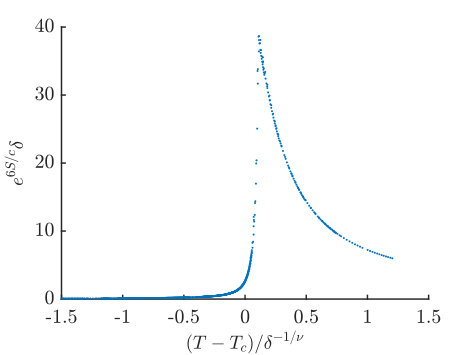 Figure 1
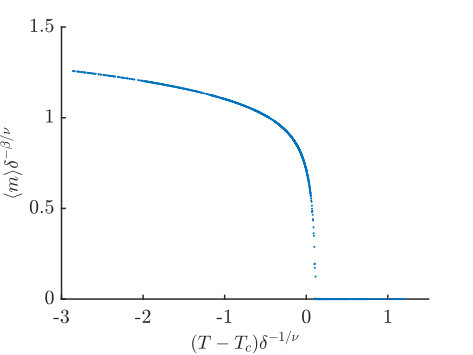 Figure 2
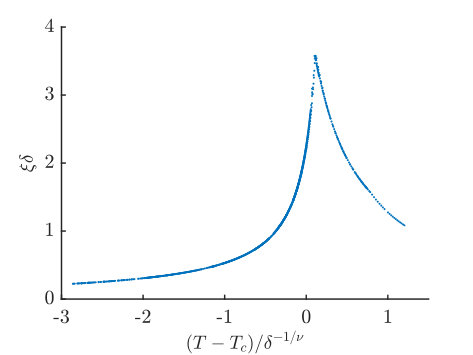 Figure 3
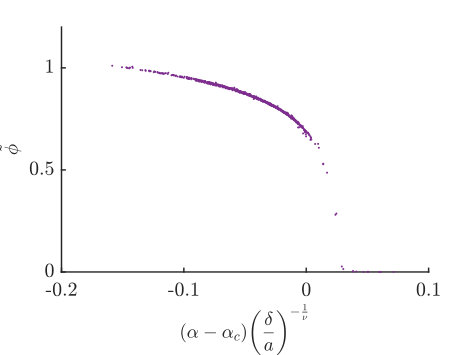 Figure 4
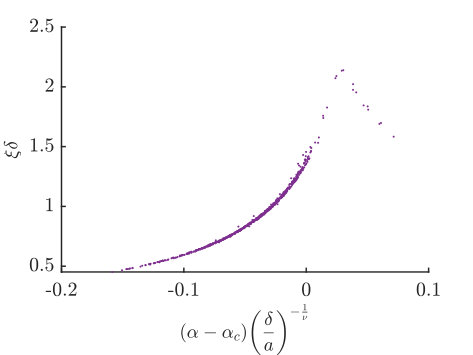 Figure 5
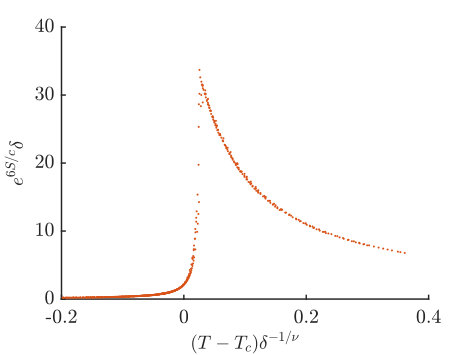 Figure 6
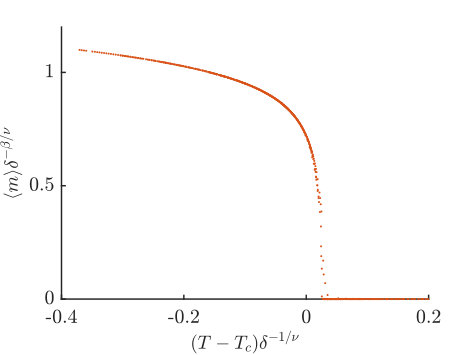 Figure 7
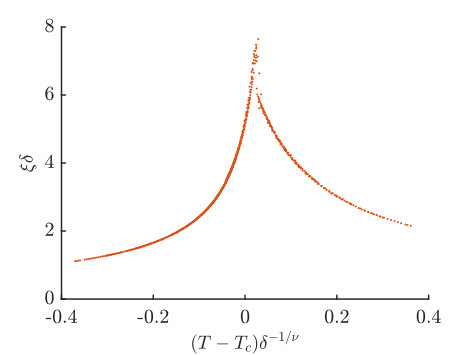 Figure 8
Peer Reviews
No public reviews on file for this paper yet. If you reviewed it on a platform where reviews are public (OpenReview, ICLR, NeurIPS, ICML), you can paste yours below so the community can read it here.
Videos
No videos yet. Explain this paper in a talk, walkthrough, or lecture? Add one.
A scaling hypothesis for matrix product states
Bram Vanhecke
Department of Physics and Astronomy, University of Ghent, Krijgslaan 281, 9000 Gent, Belgium
Jutho Haegeman
Department of Physics and Astronomy, University of Ghent, Krijgslaan 281, 9000 Gent, Belgium
Karel Van Acoleyen
Department of Physics and Astronomy, University of Ghent, Krijgslaan 281, 9000 Gent, Belgium
Laurens Vanderstraeten
Department of Physics and Astronomy, University of Ghent, Krijgslaan 281, 9000 Gent, Belgium
Frank Verstraete
Department of Physics and Astronomy, University of Ghent, Krijgslaan 281, 9000 Gent, Belgium
Abstract
We revisit the question of describing critical spin systems and field theories using matrix product states, and formulate a scaling hypothesis in terms of operators, eigenvalues of the transfer matrix, and lattice spacing in the case of field theories. Critical exponents and central charge are determined by optimizing the exponents such as to obtain a data collapse. We benchmark this method by studying critical Ising and Potts models, where we also obtain a scaling ansatz for the correlation length and entanglement entropy. The formulation of those scaling functions turns out to be crucial for studying critical quantum field theories on the lattice. For the case of with mass and lattice spacing , we demonstrate a double data collapse for the correlation length with the bond dimension, the gap between eigenvalues of the transfer matrix, and the parameter which fixes the critical quantum field theory.
Introduction. Traditional numerical techniques for simulating extensive many-body systems such as Monte-Carlo sampling and exact diagonalizations naturally come with a dimensionfull parameter that controls the level of approximation: the system size . One of the major insights that has allowed the simulation of systems at or near criticality has been the realisation that, rather than simply pushing , the numerical results at different system sizes can be combined in a much more informed way using the concept of finite-size scaling Fisher and Barber (1972); Brézin (1982); Cardy (1988). The crucial idea is that acts as a relevant perturbation away from criticality, and thus enters in the singular part of the free energy. By invoking the scaling hypothesis, the latter is a generalized homogeneous function
[TABLE]
where is the set of coupling constant corresponding to (relevant) perturbations away from criticality in the theory. This scaling hypothesis can then be used to perform a collapse of numerical data sets for different , and as such to obtain accurate estimates for critical exponents and the location of a critical point. Furthermore, in the context of quantum field theory (QFT) lattice simulations, finite-size scaling ideas have proven vital for reaching the continuum limit Luscher et al. (1991); Jansen et al. (1996).
Here we consider the application of matrix product states (MPS) methods White (1992); Verstraete et al. (2004, 2008); Schollwöck (2011) for simulating critical 1D quantum or 2D classical spin systems, including the continuum limit of lattice descriptions for QFTs. In particular we will study uniform MPS that, in contrast to the techniques that we discussed above, work directly in the thermodynamic limit . In this case the level of approximation is set by the finite bond dimension of the matrices, which is in fact a proxy for the finite amount of entanglement in the simulated state. The area law for the entanglement entropy Hastings (2007) validates this approximation and explains the success of MPS methods for parameterizing ground states of gapped systems Hastings (2007); Verstraete and Cirac (2006). Relying on this success, the traditional approach to study phase transitions, and, relatedly, continuum limits of lattice field theories, with MPS has been to extrapolate MPS predictions for one or more order parameters towards the limit of infinite bond dimension . By then studying the behaviour of throughout the phase diagram, the location of the critical point and critical exponents can be estimated. Analogous to the effect of a finite size, it has been recognized that the finite bond dimension of an MPS acts as a relevant perturbation and induces an additional length scale in the problem, that shows crossover behaviour with the finite system size Nishino et al. (1996); Pirvu et al. (2012). MPS methods can however work directly in the thermodynamic limit, such that, at criticality, only the length scale associated with the finite bond dimensions remains. This length scale was identified as the correlation length and was shown to scale as in the asymptotic limit of large Tagliacozzo et al. (2008). Here, a new critical exponent was introduced, the value of which is completely specified by the central charge of the underlying conformal field theory Pollmann et al. (2009); Pirvu et al. (2012).
In light of the success of the aforementioned finite-size scaling methods, proper finite-entanglement scaling ansätze are paramount for the further development of the tensor network framework for simulating (near) critical theories and QFTs. This holds even more for higher dimensional systems simulated with the generalization of MPS, known as projected entangled pair states (PEPS) Verstraete and Cirac (2004), for which the computational cost grows much faster with increasing bond dimension . The scaling behavior in the discrete variable only holds for sufficiently large and cannot be expected to be smooth or homogeneous for small or intermediate values of . Instead, scaling ansätze can be formulated directly in terms of the finite correlation length Corboz et al. (2018); Rader and Läuchli (2018); Czarnik and Corboz (2019); Pillay and McCulloch (2019). However, the (inverse) correlation length only correctly quantifies the strength of the relevant perturbation at criticality, when no other relevant perturbations are present, as otherwise it does not tend to zero for .
In this paper, we motivate and introduce the use for entanglement scaling of a different (inverse) length scale defined in terms of the gaps in the full spectrum of (inverse) correlation lengths, as obtained from the (negative) logarithm of the eigenvalues of the transfer matrix Zauner et al. (2015). A careful study of the nature of the MPS approximation Zauner et al. (2015); Rams et al. (2015); Bal et al. (2016) indicates that these gaps are a direct consequence of the finite bond dimension and go to zero for , regardless whether the system is gapped or not. In particular, the correlation length can itself be scaled in terms of , as was first illustrated by Rams et al for gapped systems Rams et al. (2018). Combined with other relevant perturbations, a full scaling ansatz for the correlation length itself can thus be formulated. We illustrate this for the two-dimensional classical Ising and Potts models. Understanding the resulting scaling functions is also of crucial importance to simulate continuum limits of spin systems in the form of QFT’s. The continuum limit is obtained by taking the limit of bond dimension going to infinity and lattice spacing to zero, and we demonstrate that this double scaling limit yields a double data collapse near the critical point of (2+0)-dimensional theory.
Entanglement scaling hypothesis. Throughout this paper, we use uniform MPS which depend on a single tensor to parameterize translation-invariant states directly in the thermodynamic limit. An MPS with a finite bond dimension provides a variatonal approximation for low-energy states by truncating in the entanglement spectrum, which has its repercussion on the approximation of the physical properties of the system. In particular, correlation functions are represented by a linear combination of exponentially decaying functions, where the spectrum of inverse correlation lengths is determined by the eigenvalues of the MPS transfer matrix as
[TABLE]
assuming the MPS is normalized such that . The actual correlation length of the state is then identified as . Close to a second order critical point, however, we expect correlation functions to exhibit a power-law contribution multiplied with the exponential decay, which can be understood from the Källèn-Lehmann representation of correlation functions as a linear combination of a continuum of exponentials Zauner et al. (2015). The MPS transfer matrix thus provides a discretized approximation to this continuous spectrum of correlation length, and the spacing between them is a reflection of an inverse system size just as in the case of the eigenvalue spacing in a finite spin chain . By interpreting the true state as resulting from an infinite amount of imaginary-time evolution (i.e. the path-integral representation), the discretization of the spectrum of correlation lengths can then be understood as resulting from the compression of the infinite imaginary-time interval that is inherent in the MPS approximation Rams et al. (2015); Bal et al. (2016). Hence, the gaps in the transfer-matrix spectrum can be related to a finite size in imaginary time.
Therefore we can build a finite-entanglement scaling theory by quantifying the discreteness of the spectrum of inverse correlation lengths, i.e. the gaps in the transfer-matrix spectrum. The most simple definition is , which was indeed used in Ref. Rams et al., 2018 to extrapolate the correlation length itself. However, as also remarked in Ref. Rams et al., 2018, the spectrum can consist out of different sectors (sometimes but not always appearing at different complex phases ), and it can be useful to consider a generalised definition
[TABLE]
with a finite number sufficiently smaller than , such that only the largest eigenvalues are included. For any choice of the coefficients such that , this quantity should converge to zero for . Evidently, the ’s, and thus also , transform as an inverse length under scale transformations. Therefore, we can formulate the scaling hypothesis for an order parameter as
[TABLE]
This yields the expression for a corresponding scaling function
[TABLE]
From the scaling property of , it follows that the scaling functions away from the origin exhibit a power-law behaviour with the exponent corresponding to the operator one is looking at. However, unlike in traditional finite-size scaling, where the finite size imposes smoothness on the scaling function, the behaviour of the scaling function around the origin, i.e. in the vicinity of the critical point or for large (small bond dimension), reproduces mean-field behaviour, consistent with the findings of Ref. Liu et al., 2010. As a consequence, the scaling function can still be non-analytic, but exhibits the mean-field exponents around the origin.
In a similar vein, we can formulate a scaling hypothesis for the correlation length
[TABLE]
in terms of a scaling function . Crucially, this scaling behaviour justifies prior approaches where a scaling ansatz for was formulated directly in terms of instead of . But using , which objectively quantifies the perturbation strength due to the finite bond dimension, the order-parameter scaling function takes a more natural form away from the origin. Furthermore, the ability to also scale the correlation length yields additional data points in order to fit more accurately the location of the critical point and the corresponding scaling exponents.
Finally, we can also extract the bipartite entanglement entropy from a given MPS. Using the CFT formula for the entanglement entropy Calabrese and Cardy (2004), we know that scales as a length, and that we can write down a scaling hypothesis of the form
[TABLE]
where is the central charge for the CFT describing the critical behaviour of the model. This directly yields a scaling function for the entanglement entropy.
For a given set of data points at different MPS bond dimensions, the critical properties of the model can now be determined by optimizing a data collapse in terms of . In principle, every built up from a set of ’s should give the right scaling behaviour, but in order to improve the collapse, the ’s can also be treated as parameters that can be optimized. The cost function that we optimize is the sum of the distances of all data points to a scaling function, which is itself parametrized by a set of parameters. We use standard non-linear optimization algorithms for determining these different parameters. Note that there is no consensus on an ultimate algorithm to perform finite size scaling and data collapse, and it remains an active area of research which is outside of the scope of the current paper Kawashima and Ito (1993); Bhattacharjee and Seno (2001); Houdayer and Hartmann (2004); Wenzel et al. (2008); Winter et al. (2008).
Two-dimensional Ising and Potts models. As a first illustration of our method, we consider the classical Ising model on the square lattice. Using the vumps algorithm Fishman et al. (2018); Vanderstraeten et al. (2019), we have computed a set of variational MPSs of bond dimension ranging between 10 and 200, for different temperatures around the critical point . Here, we fix the ’s by hand, defining , such that we obtain a collapse of the data. In Fig. 1 we plot the scaling functions for the order parameter, correlation length and entanglement entropy, using the known values of the critical temperature, the exponents and and the central charge . If we jointly optimize the collapse of order parameter and correlation length without prior knowledge on the critical data, we find a critical temperature of with critical exponents and . Alternatively, if we fix the exponents to their known value and , we find .
Secondly, we study the 3-state Potts model. We have used MPS with bond dimensions around the critical point . Here, we have used . Again, we plot the three scaling functions, using the known values for the critical data. If we jointly optimize the collapse of and for this model without prior knowledge on the critical data, we find , and , to be compared with the exact values and .
field theory. Finally we look at a phase transition in a QFT as a more exotic application, described by the following lagrangian density
[TABLE]
The resulting Euclidean path integral can be discretised in a standard way, e.g.: (with the lattice spacing) and converted into a tensor-network form by truncating the -fields in a suitable basis, see Ref. Kadoh et al., 2019. In order to study the second-order QFT phase transition from the unbroken phase to the broken phase Chang (1976), we computed uniform-MPS approximations of the fixed point of the path-integral transfer operator in the thermodynamic limit. In addition to the entanglement scaling , the QFT interpretation of our numerical results then requires us to also consider the continuum scaling . Rather than taking both limits separately, which up till now has been the standard procedure for MPS simulations of QFTs Bañuls et al. (2013); Milsted et al. (2013); Buyens et al. (2014); Bañuls et al. (2013), we will show how one can perform a double collapse on all the results for different lattice spacings and bond dimensions into a single scaling function.
Let us first consider the continuum scaling of the Euclidean lattice path integral. The lattice action is defined in terms of the lattice parameters and . (We use the subscript for quantities in physical units, independent of the lattice spacing .) However, in the continuum limit, the mass term receives a divergent one-loop correction, such that the bare mass of the theory is parameterized in terms of a renormalized mass parameter as
[TABLE]
where the one-loop contribution is given in e.g. Ref. Kadoh et al., 2019 and diverges as for small values of its argument. The theory being superrenomalizable, this is the only UV divergence and the the IR behaviour is then completely characterised by the finite ratio . In approaching the continuum limit, both the mass term and interaction term get additional UV-finite corrections. Rather than computing these in perturbation theory, we parameterise general corrections and determine the coefficients as part of the scaling analysis. Specifically, we consider the following parameterisation,
[TABLE]
with a free parameter that tends to in the continuum limit , and where and are multivariate polynomials. The existence of the continuum limit then requires that e.g. the lattice correlation length corresponds to a physical correlation length that is only a function of and the gap in the physical spectrum of inverse correlation lengths , giving rise to the continuum scaling hypothesis
[TABLE]
with , and parameters in lattice units.
As the continuum theory exhibits itself a phase transition at , the scaling hypothesis for the field theory requires that , now parameterized in terms of and is a generalised homogeneous function
[TABLE]
and thus . Combining the IR scaling hypothesis for the critical field theory with the continuum scaling ansatz, yields a double collapse for the quantities of the lattice theory
[TABLE]
For the double collapse equation of the order parameter the steps are very similar, except that now we consider multiplicative corrections to the wave-function renormalization:
[TABLE]
The phase transition in field theory has been studied by lattice Monte-Carlo simulations Schaich and Loinaz (2009); Bosetti et al. (2015); Bronzin et al. (2019), hamiltonian truncation Rychkov and Vitale (2015) and tensor-network methods Sugihara (2004); Kadoh et al. (2019); Milsted et al. (2013), where the most accurate estimates Milsted et al. (2013); Bronzin et al. (2019) agree on a value for the critical point . We have run the vumps algorithm for generating data points with arbitrary lattice spacing , bond dimensions ranging from 50-150, and couplings around the critical point. Our scaling approach allows to transform those 701 data points with the best guess of , and to points , plot them according to the above collapse equations and compare them to a best guess of the scaling functions. The above described cost function is optimized for , and as well as the critical coupling and of course the scaling functions. One could also choose to fit the critical exponents and even the particular choice of may be included as a fit parameter. We have chosen , and to be of order 1, 2 and 3 in and order 3, 4 and 5 in respectively.
From the first order in fit we find , and . If we fix and and fit using first, second and third order in we find respectively , and . These should be compared to , an alternative tensor network based study of Kadoh et al. (2019) and , the leading MC study Bronzin et al. (2019).
Conclusions. We formulated a finite scaling hypothesis for matrix product state based simulations of transfer matrices of critical classical spin systems. We identified a natural analogue of the inverse system size in terms of a scaling parameter which is a function of the eigenvalues of the transfer matrix of the MPS; for MPS simulations with finite bond dimension can be related to simulations on a halve infinite strip of size . We observed data collapses for correlation length, entanglement entropy and order parameter as a function of in the case of Ising, Potts and theory in dimensions. Similar results would have been obtained in the quantum Hamiltonian limit, but classical spin systems were studied because of the versatility and robustness of the variational MPS algorithm for such systems. A double data collapse was obtained for data calculated for the theory as a function of bare parameters and lattice spacing. An open question is whether a similar collapse can be obtained for the case of non-superrenormalizable field theories. Another open question arises in simulating and critical spin systems with PEPS, where similar scaling ideas lead to two inverse length scales and . This situation is similar to considering a system on a cuboid for which we can borrow the scaling hypotheses used in exact diagonalization and Monte Carlo. This will be reported elsewhere.
Acknowledgments This work was made possible through the support of the ERC grants QUTE (647905), ERQUAF (715861) and QTFLAG.
The reference list from the paper itself. Each links out to its DOI / PubMed record.
- 1Fisher and Barber (1972) Michael E. Fisher and Michael N. Barber, “Scaling theory for finite-size effects in the critical region,” Phys. Rev. Lett. 28 , 1516–1519 (1972) . · doi ↗
- 2Brézin (1982) E. Brézin, “An investigation of finite size scaling,” J. Phys. France 43 , 15 (1982) . · doi ↗
- 3Cardy (1988) J. Cardy, Finite-size scaling (Elsevier, 1988).
- 4Luscher et al. (1991) Martin Luscher, Peter Weisz, and Ulli Wolff, “A Numerical method to compute the running coupling in asymptotically free theories,” Nucl. Phys. B 359 , 221–243 (1991) . · doi ↗
- 5Jansen et al. (1996) Karl Jansen, Chuan Liu, Martin Luscher, Hubert Simma, Stefan Sint, Rainer Sommer, Peter Weisz, and Ulli Wolff, “Nonperturbative renormalization of lattice QCD at all scales,” Phys. Lett. B 372 , 275–282 (1996) , ar Xiv:hep-lat/9512009 [hep-lat] . · doi ↗
- 6White (1992) Steven R. White, “Density matrix formulation for quantum renormalization groups,” Phys. Rev. Lett. 69 , 2863–2866 (1992) . · doi ↗
- 7Verstraete et al. (2004) F. Verstraete, D. Porras, and J. I. Cirac, “Density matrix renormalization group and periodic boundary conditions: A quantum information perspective,” Phys. Rev. Lett. 93 , 227205 (2004) . · doi ↗
- 8Verstraete et al. (2008) F. Verstraete, V. Murg, and J. I. Cirac, “Matrix product states, projected entangled pair states, and variational renormalization group methods for quantum spin systems,” Advances in Physics 57 , 143–224 (2008) . · doi ↗