Primordial power spectra for curved inflating universes
Will Handley

TL;DR
This paper computes exact primordial power spectra for curved universes using Planck 2018 data, revealing features like cut-offs and oscillations that improve data fit and discussing theoretical implications for initial conditions in curved inflation.
Contribution
It provides the first detailed numerical computation of primordial spectra for curved universes and analyzes their observational and theoretical implications.
Findings
Spectra exhibit cut-offs and oscillations within observable range.
Curved universe models fit current CMB data better than flat models.
Derivations of Mukhanov-Sasaki equation for curved backgrounds are presented.
Abstract
Exact numerical primordial primordial power spectra are computed and plotted for the for the best-fit Planck 2018 curved universe parameters. It is found that the spectra have generic cut-offs and oscillations within the observable window for the level of curvature allowed by current CMB measurements and provide a better fit to current data. Derivations for the Mukhanov-Sasaki equation for curved universes are presented and analysed, and theoretical implications for the quantum and classical initial conditions for inflation are discussed within the curved regime.
Click any figure to enlarge with its caption.
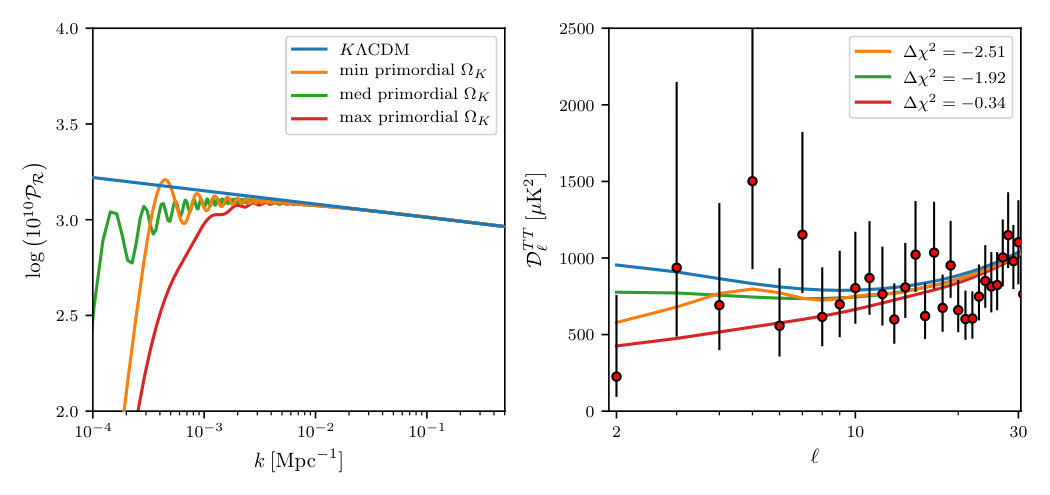 Figure 1
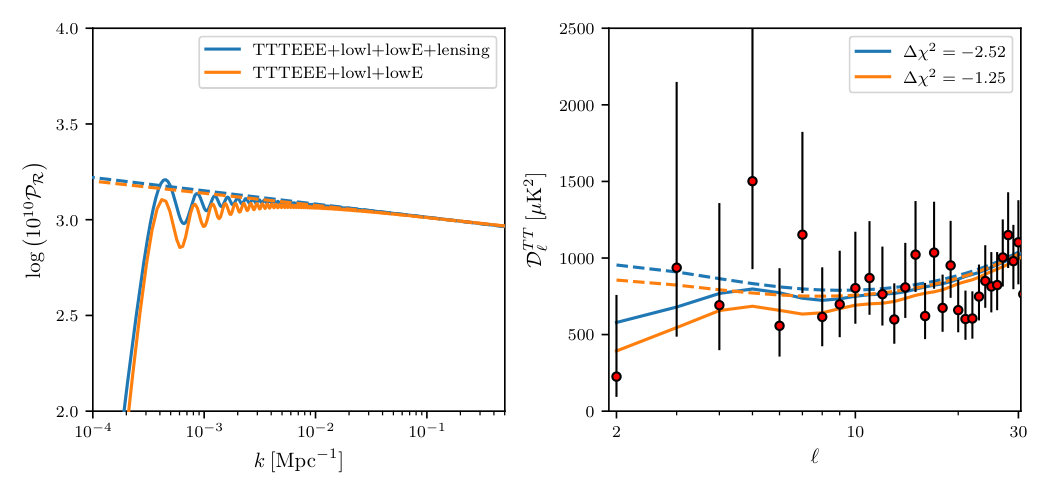 Figure 2
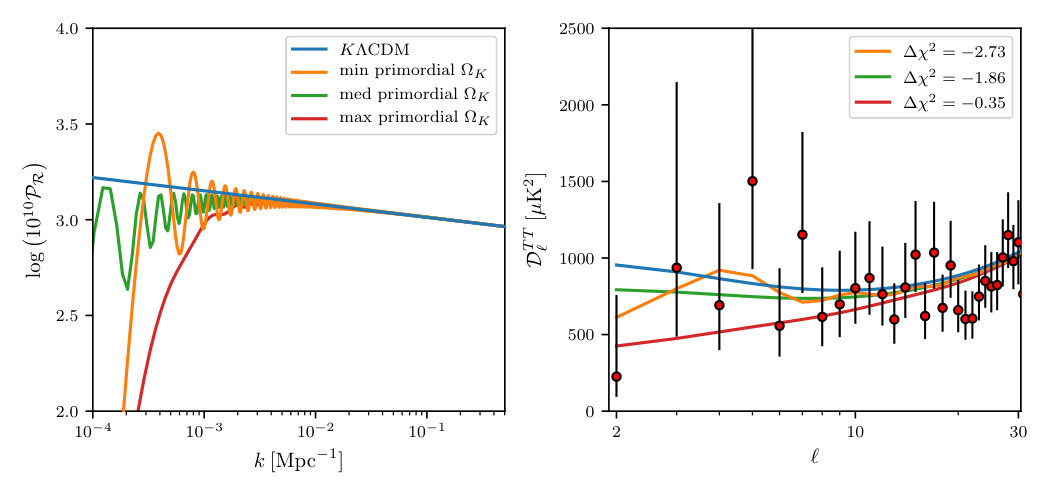 Figure 3
Peer Reviews
No public reviews on file for this paper yet. If you reviewed it on a platform where reviews are public (OpenReview, ICLR, NeurIPS, ICML), you can paste yours below so the community can read it here.
Videos
No videos yet. Explain this paper in a talk, walkthrough, or lecture? Add one.
]https://www.kicc.cam.ac.uk/directory/wh260
Primordial power spectra for curved inflating universes
Will Handley
Astrophysics Group, Cavendish Laboratory, J.J.Thomson Avenue, Cambridge, CB3 0HE, UK
Kavli Institute for Cosmology, Madingley Road, Cambridge, CB3 0HA, UK
Gonville & Caius College, Trinity Street, Cambridge, CB2 1TA, UK [
Abstract
Exact numerical primordial primordial power spectra are computed and plotted for the best-fit Planck 2018 curved universe parameters. It is found that the spectra have generic cut-offs and oscillations within the observable window for the level of curvature allowed by current cosmic microwave background measurements and provide a better fit to current data. Derivations for the Mukhanov-Sasaki equation for curved universes are presented and analysed, and theoretical implications for the quantum and classical initial conditions for inflation are discussed within the curved regime.
I Introduction
Cosmological inflation Starobinskiǐ (1979); Guth (1981); Linde (1982) is the current most popular theory for explaining the observed flatness and homogeneity of our present-day universe, while simultaneously providing a powerful framework for predicting the measured spectrum of anisotropies in the cosmic microwave background Planck Collaboration et al. (2018a, b). Nevertheless, small and unsatisfactory features in the cosmic microwave background (CMB) power spectra arguably still remain Planck Collaboration et al. (2019), and there are ever-increasing tensions observed between datasets that measure the early universe and those that measure late-time properties Riess et al. (2018); Joudaki et al. (2017); Köhlinger et al. (2017); Hildebrandt et al. (2017); Abbott et al. (2018); Handley and Lemos (2019). The hunt is on to find extensions to the concordance cosmology (cosmological constant with cold dark matter — CDM) which are capable of resolving some or all of these discrepancies.
One extension that is often considered is to reintroduce a small amount of late-time curvature, creating a CDM cosmology Uzan et al. (2003); Lasenby and Doran (2005). Planck 2018 data without the lensing likelihood Planck Collaboration et al. (2018c) give relatively strong evidence for a closed universe Planck Collaboration et al. (2018a). Adding in lensing and Baryon acoustic oscillation data Alam and et al. (2017); Beutler et al. (2011); Ross et al. (2015) reduces this evidence considerably, but it remains an open question as to why the CMB alone strongly prefers universes with positive spatial curvature (with possible implications for tension resolution). Nevertheless, at the time of writing, universe models with percent-level spatial curvature remain compatible with current datasets.
There are theoretical reasons to consider the effect of curvature on the dynamics of inflation. If one is to invoke an inflationary phase in order to explain the observed present-day flatness, one cannot assume that the universe was flat at the start of inflation, and the presence of any curvature is arguably incompatible with eternal inflation. Furthermore, the observation of any amount of present-day curvature strongly constrains the total amount of inflation, providing a powerful justification for just-enough-inflation theories Handley et al. (2014); Hergt et al. (2019a); Ramirez and Schwarz (2012); Cicoli et al. (2014); Boyanovsky et al. (2006a, b)
In the traditional curved CDM cosmology, a simple parametric form for the primordial power spectrum is usually assumed Planck Collaboration et al. (2018a, b):
[TABLE]
In this work, I examine the effect on the fit of curved cosmologies to data if an exact numerical approach is used to calculate the primordial power spectrum. In all cases an improved fit is found.
In Sec. II the Mukhanov-Sasaki equation is derived in the general case of curved universes and compared with the flat-space equivalent. In Sec. III the general Mukhanov action is calculated and discussed with regards to its quantisation and consequent setting of initial conditions. In Sec. IV the primordial and CMB power spectra are calculated for the best-fit Planck 2018 parameter values, and the fit is compared against the concordance case. Conclusions are presented in Sec. V.
II The Mukhanov-Sasaki equation
In this section for completeness I derive the Mukhanov-Sasaki equation (Eq. 12) for curved universes by a direct perturbative approach Mukhanov et al. (1992). Similar computations have been performed historically by De-Hai and Cheng-Yi (2004); Gratton et al. (2002); Ratra (2017); Bonga et al. (2016, 2017); Akama and Kobayashi (2019); Ooba et al. (2018). The analytical calculations throughout this paper were performed with the aid of computer algebra provided by MapleTM 2017 Maplesoft, a division of Waterloo Maple Inc., Waterloo, Ontario (2017); Monagan et al. (2005), making use of the Physics and DifferentialGeometry packages.
The action for a single-component scalar field minimally coupled to a curved spacetime is
[TABLE]
Extremising this action yields the Einstein field equations and a conserved stress energy tensor. Throughout this paper, in accordance with the cosmological principle, we shall assume that to zeroth order the solutions to these equations are homogeneous and isotropic. We then perturbatively expand these equations about the homogeneous solutions to first order in the Newtonian gauge, with the perturbation to the scalar field written as . In spherical polar coordinates the metric is therefore
[TABLE]
where denotes the sign of the spatial curvature, taking values of for a closed (positively curved) universe, for an open (negatively curved) universe, and for a traditional flat universe. The covariant spatial derivative associated with the metric on comoving spatial slices is denoted with a Latin index as with no factors of . The potentials and along with are scalar perturbations whilst is a divergenceless, traceless tensor perturbation with two independent polarisation degrees of freedom.
II.1 Zeroth order equations
At zeroth order, the time-time component of the Einstein field equations and the time component of the conservation of the stress-energy tensor give the evolution equations of the homogeneous background fields
[TABLE]
where the Hubble parameter , and primes denote derivatives with respect to . A further useful relation is
[TABLE]
which may be found be differentiating Eq. 4 and eliminating the potential with Eq. 5. Eqs. 4 and 5 may be used to remove all explicit potential dependency from the first order equations and Eq. 6 can be used to remove all derivatives of in place of , which is performed without comment in all of the below.
II.2 First order equations
To first order, the time-time component of the Einstein field equations gives
[TABLE]
the time-space components of the Einstein field equations all yield
[TABLE]
the time component of the conservation equation shows
[TABLE]
the off-diagonal spatial components prove that
[TABLE]
and the gauge-invariant comoving curvature perturbation is defined by the expression
[TABLE]
Using the time derivative of (8), alongside Eqs. 7, 8 and 9 we have four master equations. Substituting for and into these using Eqs. 10 and 11 allows us to eliminate and its first and second time derivatives, yielding the Mukhanov-Sasaki equation
[TABLE]
where
[TABLE]
Upon Fourier decomposition, one simply replaces the operator in Eq. 12 with its associated scalar wavevector expression Lesgourgues and Tram (2014)
[TABLE]
One may interpret the operator physically by examining the Ricci three-scalar to first order
[TABLE]
so the perturbation to comoving spatial curvature can be seen by inspection to be .
The Mukhanov-Sasaki Eq. 12 in the curved case demands some comment. First, it should be noted that for the flat case it collapses down to its usual form, albeit with an additional multiplying each term. The same observations apply for the small-scale limit . The addition of curvature considerably increases the complexity of the evolution equations at low and intermediate by adding wavevector-dependent coefficients to all three terms in front of , and . As we shall see in Sec. IV, this has consequences for the evolution of the comoving curvature perturbation and the resulting primordial power spectrum.
The tensor equivalent to Eq. 12 is derived similarly, yielding
[TABLE]
for both polarisation modes of the tensor perturbation. Here the modification provided by curvature is significantly simpler, and readers can confirm that it reduces to the flat-space equivalent in the case that and for .
III The Mukhanov action
In this section I confirm the calculation in Sec. II by arriving at Eq. 12 via the Mukhanov action. I follow the notation of Baumann (2009, Appendix B), generalising their calculation to the curved case.
The simplest approach for deriving the perturbation to the action in Eq. 2 is to write the metric in the ADM formalism Arnowitt et al. (2008); Prokopec and Weenink (2012), where spacetime is sliced into three dimensional hypersurfaces
[TABLE]
With the metric in this form, we find that the action from Eq. 2 becomes
[TABLE]
Focussing on first order scalar perturbations, we write
[TABLE]
Working in the comoving gauge where ,the spatial part of the ADM metric is defined to be
[TABLE]
The Lagrangian constraint equations are
[TABLE]
We may formally solve Eq. 23 explicitly for with the rather cryptic expression
[TABLE]
By the construction of the ADM formalism, substituting the first order solutions from Eqs. 22 and 23 into the action from Eq. 18 gives the second order action. After some effort integrating this by parts, we find
[TABLE]
Substituting Eq. 24 into the above, and integrating by parts one more time returns the unusual action
[TABLE]
Varying this action with respect to recovers the Mukhanov-Sasaki equation from Eq. 12.
The full curved action is worthy of comment. Setting recovers the flat-space action, but with non-zero the action becomes non-local due to the presence of a denominator with a derivative term.
In the flat case, the usual next step is to diagonalise the action so that it has a canonical normalisation111A canonically normalised quantum field with mass has action of the form . by transforming to conformal time and re-phrasing in terms of the Mukhanov variable . In the curved case, this is impossible. The best one can do is to define a wavevector-dependent and via:
[TABLE]
in which case, the action becomes
[TABLE]
The lack of canonical normalisation implied by the -dependent has theoretical consequences for the initial conditions for inflation, since for low to intermediate one cannot draw an analogy to the de-Sitter case in order to define initial conditions. The correct theoretical choice for initial conditions in this case is far from clear, and it may be that the only way to differentiate between competing approaches is to choose the correct initial conditions via confrontation with data.
The tensor part of the action is
[TABLE]
which even in the presence of curvature remains canonically quantisable in the traditional sense by switching to conformal time and making the variable redefinition .
IV The primordial power spectrum
To compute the exact primordial power spectrum, the Mukhanov variable is evolved via the Mukhanov-Sasaki equation Eq. 12 for a relevant range of wavevectors . The primordial power spectrum is then given by the limiting value of after horizon exit
[TABLE]
The initial conditions for the evolution of the Mukhanov variable represent the injection of quantum mechanics into this system. For simplicity, I consider two types of initial conditions: Bunch–Davies (BD) and Renormalised stress-energy tensor (RST), which are set at inflation start :
[TABLE]
BD initial conditions are theoretically only appropriate for a de-Sitter like spacetime, which at inflation start for low- modes is not true, whilst RST initial conditions are designed to be valid in all regimes Handley et al. (2016a).
The numerical integration itself is most efficiently performed using a solver that is capable of accurately navigating the many oscillations between initial conditions and horizon exit. Such solvers have undergone recent development Handley et al. (2016b); Haddadin and Handley (2018); Agocs et al. (2019); Bamber and Handley (2019) and in this work I use the latest of these provided by Agocs et al. (2019).
For the evolution of the background variables I assume a Planck 2018 TTTEEE+lowl+lowE+lensing best-fit concordance CDM curved cosmology, a monomial inflaton potential and a reheating phase modelled by continuing the inflaton evolution until intersection with late-time Friedmann horizon. Interestingly, under this background setup, chaotic and Starobinsky potentials are incompatible with the Planck best-fit cosmology when curvature is included. The full pipeline of how these background evolutions are constructed will be discussed in an upcoming paper Hergt et al. . The CDM parameters pin down all but one degree of freedom in the background evolution, leaving a single primordial parameter determining the degree of primordial curvature at the start of inflation, or equivalently the scale factor of the universe at inflation start . For the curved case, the size of the universe at the start of inflation is bounded from below by the requirement that and bounded from above by the requirement that the horizon problem is solved, i.e. that the amount of conformal time before inflation is greater than the amount of time afterwards. This amounts to a constraint that . Beyond the lower bound the primordial curvature diverges as and the universe begins in an emergent coasting state Labraña (2016); Ellis and Maartens (2004). Solutions for this case however are incompatible with the Planck best-fit parameters. The minimum amount of primordial curvature at the upper bound is , the maximum amount of curvature is , and the “medium” amount of curvature in the figures is the geometric mean of these two.
The primordial power spectrum for the BD case is plotted in Fig. 1, and for RST initial conditions in Fig. 2. Relative to the concordance CDM, which assumes the almost flat power spectrum from Eq. 1, including the exact numerical calculation introduces oscillations and a suppression of power at low , independent of initial conditions. Varying the remaining degree freedom provided by the amount of primordial curvature alters the oscillations and level of suppression in a non-monotonic manner.
In both Figs. 1 and 2 these predictions for the primordial power spectrum are followed through to the CMB Blas et al. (2011). For all allowed values of initial primordial curvature, incorporating the exact numerical solution results in an improved relative to CDM. Furthermore, the data are capable of distinguishing a preferred vacuum state, with the best fit preferring RST initial conditions over the traditional Bunch–Davies vacuum.
It should be noted that these values are not derived from a true fitting procedure. First, in the absence of a publicly available likelihood at the time of writing, the approximate value is computed from the available compressed spectra and their error bars. Second (for similar reasons) I have used the best-fit cosmological parameters derived from the CDM data with the default spectrum, rather than a full fit with the modified power spectrum. Given the degeneracies between cosmological parameters it is possible that the could be significantly enhanced under a full fitting.
This work will be followed by paper detailing a Bayesian fit Hergt et al. (2019b) for these CDM universes with exact power spectra Hergt et al. . It remains to be seen whether the improved will be strong enough to balance the Occam penalty arising from the introduction of an additional constrained primordial parameter.
To see how these results vary as the amount of late-time curvature is altered in Fig. 3 the fit from Fig. 1 is compared with the corresponding fit for the Planck data excluding CMB lensing, which has a significantly higher curvature of (as opposed to ). In this case the location of the suppression of power and the oscillations are barely changed, although as expected Lasenby and Doran (2005) the depth of the suppression is greater for the case with more negative curvature.
It should be noted that at the time of writing there is renewed interest in curved cosmologies in light of the controversial work by Di Valentino et al. (and also Handley (2019)). In these analyses it is pointed out the Planck CMB primary data are in 2.5 and 3 tension with CMB lensing and baryon acoustic oscillation (BAO) data if curvature is included as a free parameter. Such results do not prove that the universe is curved, but arguably weaken the evidence for a flat universe since inconsistent datasets should not be combined. The cause of this tension could be an improbable statistical fluctuation, or could indicate a systematic error in one or more of the datasets. For example, it has been suggested recently that whilst BAO likelihoods are curvature agnostic, the compression strategies applied to the observational data do depend on curvature O’Dwyer et al. (2019), and the default is to assume a flat cosmology for performing this compression. These kind of baked-in flatness assumptions (if present) could bias the curvature constraint provided by BAO. Similarly, the CMB lensing likelihood expands to first order about a fiducial flat cosmology, and a full cross-check expanding about the best-fit cosmology has not yet been performed.
V Conclusions
In this work, the Mukhanov-Sasaki equations and actions for curved cosmologies were derived and discussed. It was found that including an exact numerical calculation for the primordial power spectrum gives a better fit to the data, and that current datasets are capable of distinguishing between alternative definitions of the quantum vacuum. It remains to be seen whether a more complete Bayesian fitting procedure yields compelling evidence for universes with curvature, or the ability to distinguish quantum vacua.
Acknowledgements.
I am indebted to Anthony Lasenby, Mike Hobson, Lukas Hergt, Fruzsina Agocs, Denis Werth and Maxime Jabarian for their many conversations and participation in the ongoing theoretical and observational research programming stemming from this work. I thank Gonville & Caius College for their continuing support via a Research Fellowship.
The reference list from the paper itself. Each links out to its DOI / PubMed record.
- 1Starobinskiǐ [1979] A. A. Starobinskiǐ. Spectrum of relict gravitational radiation and the early state of the universe. Soviet Journal of Experimental and Theoretical Physics Letters , 30:682, December 1979.
- 2Guth [1981] A. H. Guth. Inflationary universe: A possible solution to the horizon and flatness problems. Phys. Rev. D , 23:347–356, January 1981. doi: 10.1103/Phys Rev D.23.347 .
- 3Linde [1982] A. D. Linde. A new inflationary universe scenario: A possible solution of the horizon, flatness, homogeneity, isotropy and primordial monopole problems. Phys. Lett. B , 108:389–393, February 1982. doi: 10.1016/0370-2693(82)91219-9 .
- 4Planck Collaboration et al. [2018 a] Planck Collaboration, N. Aghanim, Y. Akrami, M. Ashdown, J. Aumont, C. Baccigalupi, M. Ballardini, A. J. Banday, R. B. Barreiro, and N. Bartolo. Planck 2018 results. VI. Cosmological parameters. ar Xiv e-prints , art. ar Xiv:1807.06209, Jul 2018 a.
- 5Planck Collaboration et al. [2018 b] Planck Collaboration, Y. Akrami, F. Arroja, M. Ashdown, J. Aumont, C. Baccigalupi, M. Ballardini, A. J. Banday, R. B. Barreiro, and N. Bartolo. Planck 2018 results. X. Constraints on inflation. ar Xiv e-prints , art. ar Xiv:1807.06211, Jul 2018 b.
- 6Planck Collaboration et al. [2019] Planck Collaboration, Y. Akrami, M. Ashdown, J. Aumont, C. Baccigalupi, M. Ballardini, A. J. Band ay, R. B. Barreiro, N. Bartolo, and S. Basak. Planck 2018 results. VII. Isotropy and Statistics of the CMB. ar Xiv e-prints , art. ar Xiv:1906.02552, Jun 2019.
- 7Riess et al. [2018] Adam G. Riess, Stefano Casertano, Wenlong Yuan, Lucas Macri, Jay Anderson, John W. Mac Kenty, J. Bradley Bowers, Kelsey I. Clubb, Alexei V. Filippenko, David O. Jones, and Brad E. Tucker. New Parallaxes of Galactic Cepheids from Spatially Scanning the Hubble Space Telescope: Implications for the Hubble Constant. Ap J , 855:136, March 2018. doi: 10.3847/1538-4357/aaadb 7 .
- 8Joudaki et al. [2017] Shahab Joudaki, Chris Blake, Catherine Heymans, Ami Choi, Joachim Harnois-Deraps, Hendrik Hildebrandt, Benjamin Joachimi, Andrew Johnson, Alexander Mead, David Parkinson, Massimo Viola, and Ludovic van Waerbeke. CFHT Len S revisited: assessing concordance with Planck including astrophysical systematics. MNRAS , 465:2033–2052, February 2017. doi: 10.1093/mnras/stw 2665 .