Using Muon Rings for the Optical Throughput Calibration of the Cherenkov Telescope Array
Markus Gaug, Stephen Fegan, Alison Mitchell, Maria-Concetta Maccarone,, Teresa Mineo, Akira Okumura

TL;DR
This paper evaluates the use of muon ring images observed by Cherenkov telescopes for calibrating optical throughput and monitoring the optical point spread function, identifying systematic effects and proposing modifications for the CTA.
Contribution
It demonstrates the feasibility of using muon rings as a primary calibration method for CTA, accounting for systematic effects and suggesting hardware and analysis improvements.
Findings
Muon rings can calibrate optical throughput with high accuracy.
Systematic effects must be addressed for reliable calibration.
Muon rings also offer potential for camera pixel flat-fielding.
Abstract
Muon ring images observed with Imaging Atmospheric Cherenkov Telescopes (IACTs) provide a powerful means to calibrate the optical throughput of IACTs and monitor their optical point spread function. We investigate whether muons ring images can be used as the primary optical throughput calibration method for the telescopes of the future Cherenkov Telescope Array (CTA) and find several additional systematic effects in comparison to previous works. To ensure that the method achieves the accuracy required by CTA, these systematic effects need to be taken into account and minor modifications to the hardware and analysis are necessary. We derive analytic estimates for the expected muon data rates to be used for optical throughput calibration, monitoring of the optical point spread function, with achievable statistical and systematic uncertainties, and explore the potential of muon ring images…
Click any figure to enlarge with its caption.
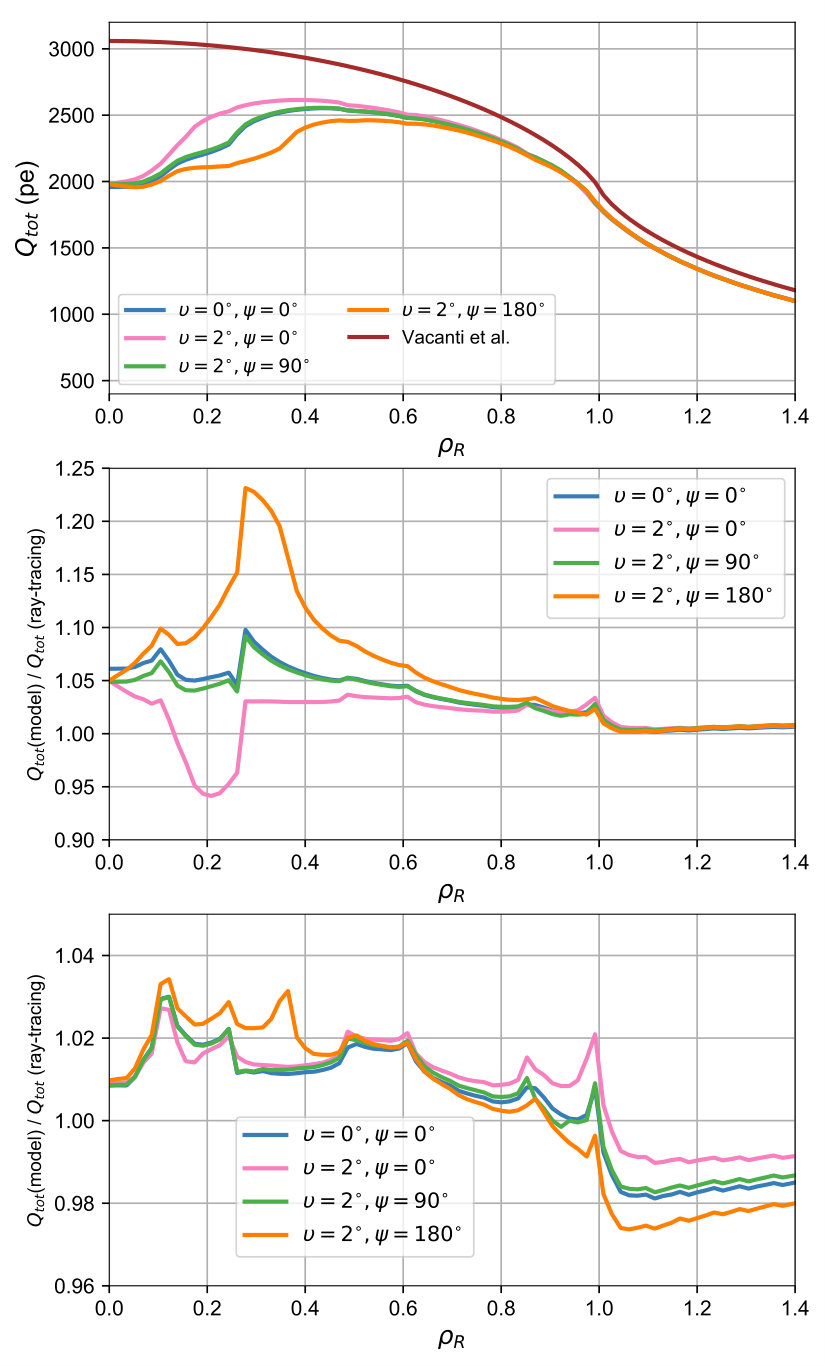 Figure 1
 Figure 2
| LST | MST | SST | ||||
|---|---|---|---|---|---|---|
| Determination of optical throughput | ||||||
| Rate (Hz) | 1.8 | 0.5 | 5 | 1.4 | 0.8 | 0.2 |
| Monitoring time | 14 s | 48 s | 5 s | 18 s | 28 min | 18 min |
| Determination of optical throughput (per pixel) | ||||||
| Rate (Hz) | 0.07 | 0.02 | 0.10 | 0.03 | 0.02 | 0.006 |
| Monitoring time | 6 min | 21 min | 4 min | 13 min | 2.3 h | 7.6 h |
| Determination of time offset (per pixel) | ||||||
| Rate (Hz) | 0.1 | 0.03 | 0.2 | 0.04 | 0.03 | 0.008 |
| Monitoring time | 10 s | 36 s | 6 s | 23 s | 36 s | 2.2 min |
| Determination of optical PSF | ||||||
| Rate (Hz) | 5 | 1.6 | 8 | 2.5 | 2.4 | 0.7 |
| Monitoring time | 9 s | 25 s | 5 s | 16 s | 17 s | 1 min |
Peer Reviews
No public reviews on file for this paper yet. If you reviewed it on a platform where reviews are public (OpenReview, ICLR, NeurIPS, ICML), you can paste yours below so the community can read it here.
Videos
No videos yet. Explain this paper in a talk, walkthrough, or lecture? Add one.
Taxonomy
TopicsAstrophysics and Cosmic Phenomena · Particle Detector Development and Performance · Dark Matter and Cosmic Phenomena
Using Muon Rings for the Optical Throughput Calibration of the Cherenkov Telescope Array
Markus Gaug,a Stephen Fegan,b ,c Maria-Concetta Maccarone,d Teresa Mineo,d and Akira Okumurae for the CTA Consortium111for consortium list see PoS(ICRC2019)1177
aUnitat de Física de les Radiacions, Departament de Física, and CERES-IEEC, Universitat Autònoma de Barcelona, E-08193 Bellaterra, Spain
bLaboratoire Leprince-Ringuet, Ecole Polytéchnique, CNRS/IN2P3, F-91128 Palaiseau, France
cPhysik Institut, Universität Zürich, Winterthurerstrasse 190, CH-8057 Zürich, Switzerland
dIstituto di Astrofisica Spaziale e Fisica Cosmica di Palermo, INAF, Via Ugo La Malfa 153, I-90146 Palermo, Italy
eInstitute for Space–Earth Environmental Research, and Kobayashi–Maskawa Institute for the Origin of Particles and the Universe, Nagoya University, Furo-cho, Chikusa-ku, Nagoya 464-8602, Japan
Abstract:
Muon ring images observed with Imaging Atmospheric Cherenkov Telescopes (IACTs) provide a powerful means to calibrate the optical throughput of IACTs and monitor their optical point spread function. We investigate whether muons ring images can be used as the primary optical throughput calibration method for the telescopes of the future Cherenkov Telescope Array (CTA) and find several additional systematic effects in comparison to previous works. To ensure that the method achieves the accuracy required by CTA, these systematic effects need to be taken into account and minor modifications to the hardware and analysis are necessary. We derive analytic estimates for the expected muon data rates to be used for optical throughput calibration, monitoring of the optical point spread function, with achievable statistical and systematic uncertainties, and explore the potential of muon ring images as a secondary method of camera pixel flat-fielding.
1 Introduction
Optical throughput calibration of Imaging Atmospheric Cherenkov Telescopes (IACTs) has been successfully carried out in the past using ring images produced by local muons [1, 2, 3, 4, 5, 6, 7, 8, 9, 10, 11, 12, 13]. Given the clear advantages of the method, such as low cost, good understanding and vast experience, important collateral benefits, CTA has established, as a baseline, optical throughput calibration and monitoring of its Large-, Medium- and Small-Sized-Telescopes (LST, MST and SST), through the thorough analysis of muon rings.
The method has been revisited in a recent paper [14] and its limitations and residual systematic uncertainties assessed. The task is severely complicated by the vast amount of innovative technologies foreseen for the CTA telescopes, like dual-mirror designs [15], telescopes of very different sizes [16], large fields-of-view and hence enormous camera sizes [17], or the use of silicon photomultipliers in certain camera projects [18, 19]. The original method developed by Vacanti et al. [3] needs hence a list of important updates in order to achieve desired accuracies.
2 Requirements for muon calibration
For the muon throughput calibration to achieve the predicted 4% accuracy [14], a series of conditions must be met, which need to be taken into account:
Muon trigger:
The telescope cameras must be able to trigger on, and flag prior to transmission of data, fully contained muon rings (see e.g. [20, 21, 22]).
Hard UV blindness:
The optical elements of the Cherenkov Telescope must jointly ensure by design that wavelengths below 290 nm in the Cherenkov light spectrum from local muons contribute less than 5% to the observed muon image amplitude. This requirement can actually be monitored with a dedicated illumination device [23].
Chromaticity of degradation:
The relative degradation of the system for different wavelengths, i.e. the chromaticity of the degradation, must be assessed externally. Typically, such effects can be monitored on yearly time-scales [23], albeit rather relaxed accuracy requirements of 10–15% are sufficient here.
Unbiased pulse integration and noise removal:
The biases introduced by pulse integration and noise removal to the muon analysis must be smaller than 1% of the estimated ring image size.
Correction for non-active pixels:
Non-active, broken or unreliable pixels must be correctly taken into accout, and their impact must account for less than 0.5% of the muon image size (see [24]).
Non-spherical reflectors:
IACT reflectors are typically not perfectly spherical, but show either an approximately hexagonal structure, or even more complicated polygons. Such structure of the reflector must be taken into account in the muon analysis, e.g. by line integration along the mirror surface as a function of azimuth angle [25].
Plate-scale calibrations:
The muon analysis must correct for biases due to optical aberrations in the correspondence of camera coordinates to incidence angles.
Finite camera focus:
The muon analysis must correct for finite camera focuses, see Sect. 2.1.
Geomagnetic field effects:
The muon analysis must be corrected for geomagnetic field effects, see Sect. 2.2.
Shadow awareness:
The muon analysis must include the effect of shadows from the camera and the typical central holes in the reflector, see Sect. 2.3.
Muon simulations:
The method must be calibrated, when starting to operate each new telescope, against dedicated muon simulations, which must correctly include all shadowing parts of the telescope, at their respective distances to the reflector. That initial “calibration of the method” is necessary to account for residual shadows (e.g. ropes) not included in the reconstruction.
Extinction of muon Cherenkov light by air molecules and aerosols:
The analysis must account for extinction of the muon Cherenkov light by air molecules and aerosols, see Sect. 2.4.
Incidence-angle dependencies:
Dependencies of the sensitivity of the camera to light from different incidence angles must be included in the muon analysis, see Sect. 2.3.
Mis-focused mirrors:
The muon analysis must be corrected for mis-aligned primary mirrors.
In the following, a small selection of important, but hitherto overlooked, details is presented.
2.1 Finite camera focuses
Large IACTs focus their cameras at the mean altitude at which air shower maxima are observed, normally chosen as 10 km distance above the telescope.
For an ideal telescope of focal length , focused at infinity, i.e. with the camera placed at , the Cherenkov angle of the emitted rays equals the radius of the imaged ring. For a telescope focused at a distance , i.e. with the camera placed at with , the rays from an on-axis muon radiating at distance will form a ring of radius:
[TABLE]
where denotes the Cherenkov angle. At its highest point, the Cherenkov light from a local muon is imaged into a smaller ring with radius smaller than , by the time the muon impacts the mirror the angle is the nominal value. This results in a systematic error if the ring radius is directly interpreted as the mean Cherenkov angle. The bias introduced on the reconstructed Cherenkov angle varies from about to %, depending on the muon energy for the MST, whereas for the LST biases can be as high as .
2.2 Geomagnetic field effects
Bending of the muon trajectory in the geomagnetic field has not been considered important so far for local muons. However, it may lead to non-negligible and asymmetric broadening of muon rings, especially for large-sized IACTs located on sites with stronger terrestrial field. A muon of momentum propagating a distance perpendicular to the field of strength will be deflected by an angle :
[TABLE]
where the magnetic field component perpendicular to the muon’s velocity. Its maximum value can be assumed as T, achieved at La Palma at a zenith angle of .
The bias for the reconstructed Cherenkov angle can reach up to 2% in the worst case of a full muon ring imaged into an LST camera, under the maximum impact distance and the azimuthal component of the parallel to the azimuth component of the impact parameter.
2.3 Non-negligible inclination angles and camera shadows
Muon inclination angles were so far limited to for field-of-view cameras , with associated effects on the throughput calibration of only . However, wide-field cameras for CTA with up to 10∘ field-of-view can regularly obtain muon images with ring centers up to from the camera center, resulting in an effect on the modulated signal along the ring of %.
The situation becomes more complicated when central shadowing objects, such as the camera, are considered. For telescopes with a focal ratio of , the shadow produced by the camera moves with inclination angle approximately as , slightly exceeding the intrinsic resolution, with which the muon impact distance can be obtained.
Furthermore, the square shape of some camera designs (like the MST and the LST) introduces dependencies of the reconstructed optical throughput on the muon inclination angle, see Fig. 1. The effect of such a quadratic shape can nevertheless be included in the analytical model, as well as the additional shadow of the central hole.
2.4 Extinction of muon Cherenkov light
A photon of energy emitted at a distance from the telescope suffers molecular and aerosol extinction. One can describe the atmospheric transmission for the photon as:
[TABLE]
where and are the volume extinction coefficients from molecular and aerosol extinction at an altitude , respectively, and the telescope itself points to the sky under a zenith angle .
Large telescopes are more prone to variations of the atmospheric extinction because they observe local muons emitting from higher altitudes. We simulated typical variations of the molecular profile at La Palma [26] and found peak-to-peak variations of the molecular transmission smaller than 0.2%. Nevertheless, aerosol transmission can be affected by dust intrusions, particularly at La Palma. In the case of strong aerosol densities, very close to the ground, a correction of % needs to be applied. This problem can be either circumvented by adequate data selection, or by applying a bias correction, which can be calculated once the aerosol profile is assessed.
3 Additional use of muon calibration
Contrary to the Cherenkov light from gamma-ray induced showers, Cherenkov light from local muons does not illuminate the reflector uniformly, but is instead concentrated at the muon impact point. Moreover, the expected fluence of Cherenkov light at each camera pixel can be predicted to good accuracy [14]. For these reasons, muon calibration delivers additional calibration information, which can be exploited for alternative calibrations and used for monitoring:
Pixel-wise charge calibration:
Flat-fielding coefficients from muon analysis can be used to monitor and improve the accuracy of the coefficients obtained through the typical camera flat-fielding.
Pixel-wise time calibration:
Time offset coefficients from muon analysis can be used to monitor and improve the accuracy of the coefficients obtained with the flat-fielding procedure.
Optical PSF monitoring:
Estimates of the optical point spread function (PSF) of each telescope from muon analysis can be used to monitor and improve its accuracy.
Degradation of individual mirrors:
Estimates of the relative reflectance of each mirror with respect to the telescope average can be obtained from muon analysis.
Table 1 lists the expected achievable rates, with which each monitoring point can be obtained to a precision comparable with the expected accuracy of the same monitoring point (see [14] for details). One can see that the needed monitoring times are typically shorter than the duration of one science observation run.
4 Conclusions
Using algorithms from Vacanti et al. [3], several authors have claimed a theoretical accuracy of as good as 2% for the optical throughput calibration of IACTs using images from local muons. To ensure that the method achieves the accuracy required by CTA, we revisited all documented algorithms and systematic effects [14] and found several effects, which have not been taken into account so far, or which appear non-negligible for large mirrors, or large square-shaped cameras, or the dual-mirror telescope designs proposed for CTA.
Most of these effects can be corrected by a careful analysis. Nevertheless, a few systematic effects will require dedicated studies or even adaptation in the design of the hardware employed for the CTA telescopes to achieve the desired accuracy. These effects are mostly related to the differences in the observed spectrum of Cherenkov light between local muons and distant gamma-ray showers.
We find that after incorporating all effects, the optical throughput of the full telescope can be determined with an accuracy of better than 4% (LST and MST) and 5% (SST).
Muon calibration allows one to monitor additionally, and without much effort the flat-fielding of the camera, and to provide the relative time offsets of each pixel. Similarly, differences in reflectance among the mirrors can be detected by plotting the retrieved optical bandwidth as a function of reconstructed impact point.
Finally, contrary to the starlight, the light from local muons gets registered within sub-nanosecond time windows, which allows one to greatly reduce residual backgrounds from the night sky and unresolved stars and monitor the optical point spread function of each telescope.
The reference list from the paper itself. Each links out to its DOI / PubMed record.
- 1[1] P. Fleury et al., Čerenkov ring images of cosmic ray muons . Proc. 22 nd ICRC, Dublin 2 595, 1991.
- 2[2] Jiang, Y., Fleury, P., Lewis, A. D., et al. Absolute Calibration of an Atmospheric Cherenkov Telescope Using Muon Ring Images . Proc. 23 rd ICRC 4 662, 1993.
- 3[3] Vacanti, G., Fleury, P., Jiang, Y., et al. Muon ring images with an atmospheric Čerenkov telescope Astrop. Phys. 2 , 1–11, 1994.
- 4[4] Rose, H. J. Cherenkov Telescope Calibration using Muon Ring Images . Proc. 24 th ICRC 3 464, 1995.
- 5[5] Rovero, A. C., Buckley, J. H., Fleury, P., et al. Calibration of the Whipple atmospheric Čherenkov telescope Astrop. Phys. 5 , 27–34, 1996.
- 6[6] Pühlhofer, G., Bolz, O., Götting, N., et al. The technical performance of the HEGRA system of imaging air Cherenkov telescopes Astrop. Phys. 20 , 267–291, 2003.
- 7[7] Leroy, N., Bolz, O., Guy, J., et al. Calibration Results for the First Two H.E.S.S. Array Telescopes Proc. 28 th ICRC 5 2895, 2003.
- 8[8] Shayduk, M., Kalekin, O., Mase, K., Pavel, N., MAGIC Collaboration Calibration of the MAGIC Telescope Using Muon Ring Images , Proc. 28 th ICRC, Tsukuba 5 2951, 2003.