Neural Cross-Domain Collaborative Filtering with Shared Entities
Vijaikumar M, Shirish Shevade, M N Murty

TL;DR
NeuCDCF is an end-to-end neural network model that combines matrix factorization and deep learning to improve cross-domain recommendation systems, effectively handling domain diversity and complex relationships.
Contribution
The paper introduces NeuCDCF, a novel wide and deep neural network model that enhances cross-domain collaborative filtering by integrating multiple representation learning techniques.
Findings
NeuCDCF outperforms existing CDCF models on four real-world datasets.
The model effectively captures complex non-linear relationships across domains.
NeuCDCF addresses diversity and data sparsity challenges in recommendation systems.
Abstract
Cross-Domain Collaborative Filtering (CDCF) provides a way to alleviate data sparsity and cold-start problems present in recommendation systems by exploiting the knowledge from related domains. Existing CDCF models are either based on matrix factorization or deep neural networks. Either of the techniques in isolation may result in suboptimal performance for the prediction task. Also, most of the existing models face challenges particularly in handling diversity between domains and learning complex non-linear relationships that exist amongst entities (users/items) within and across domains. In this work, we propose an end-to-end neural network model -- NeuCDCF, to address these challenges in a cross-domain setting. More importantly, NeuCDCF follows a wide and deep framework and it learns the representations combinedly from both matrix factorization and deep neural networks. We perform…
Click any figure to enlarge with its caption.
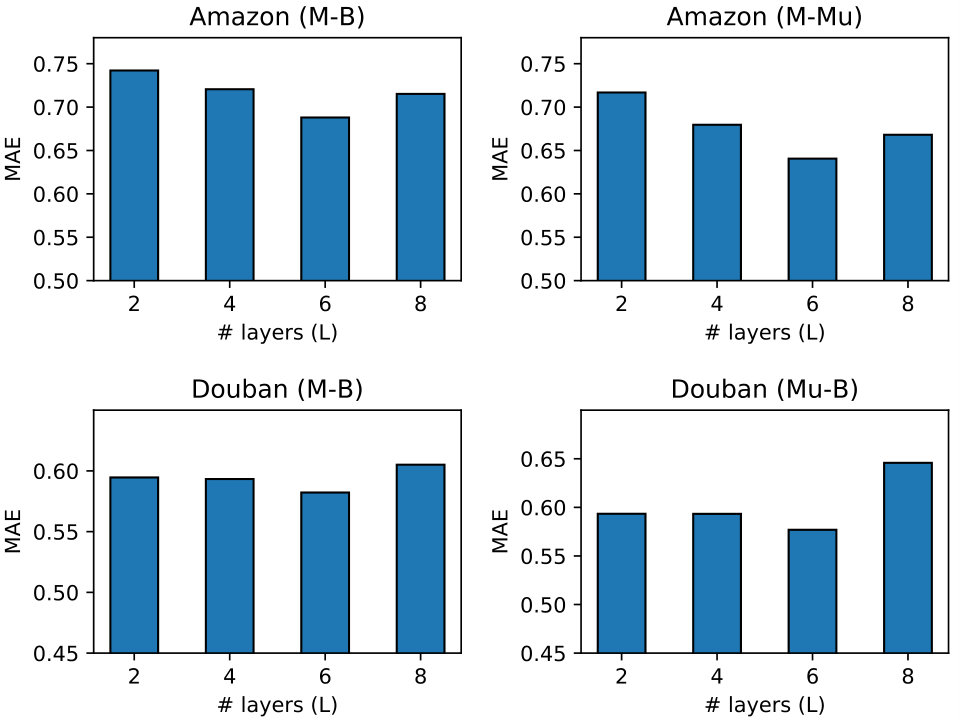 Figure 1
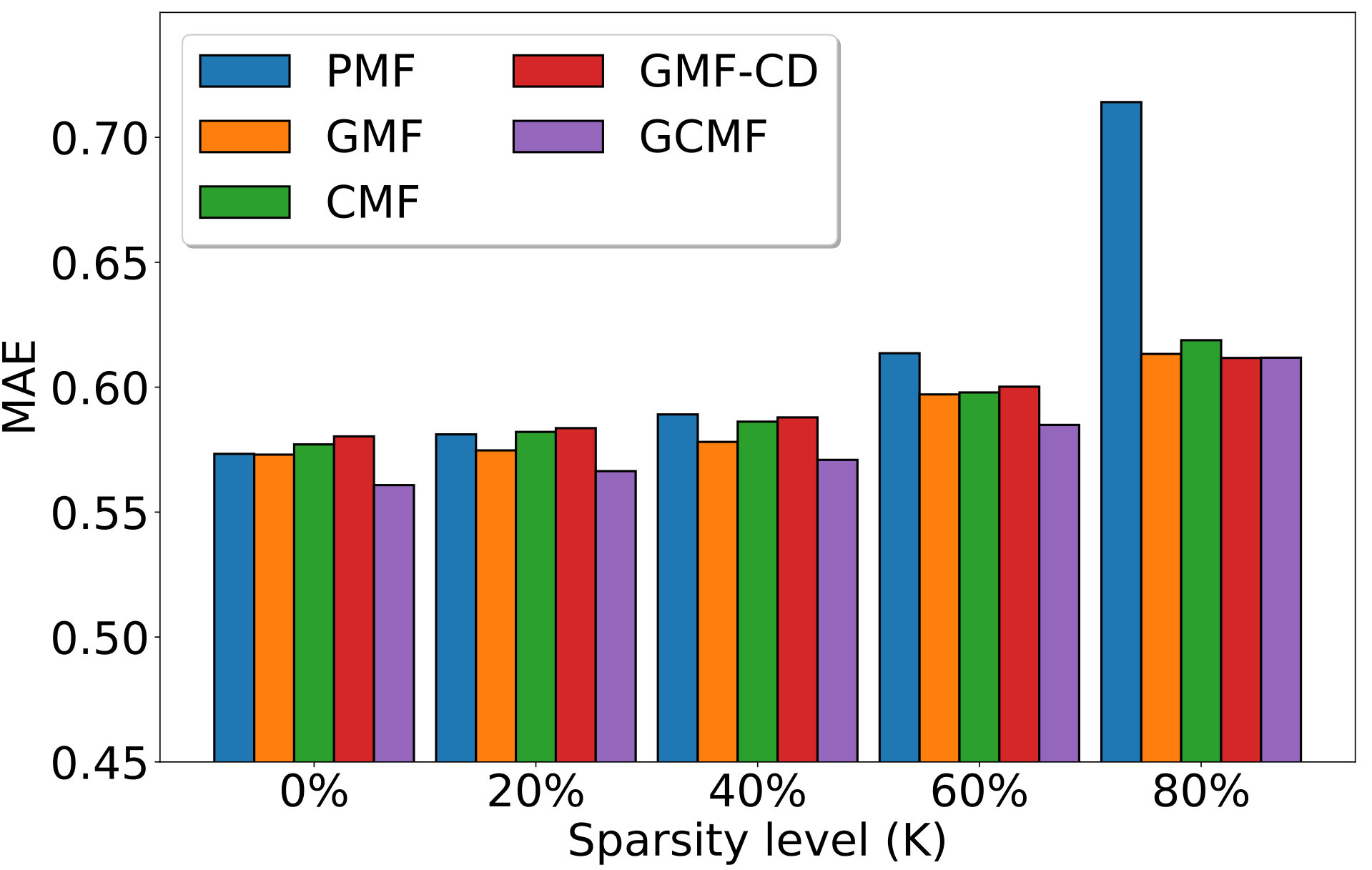 Figure 2
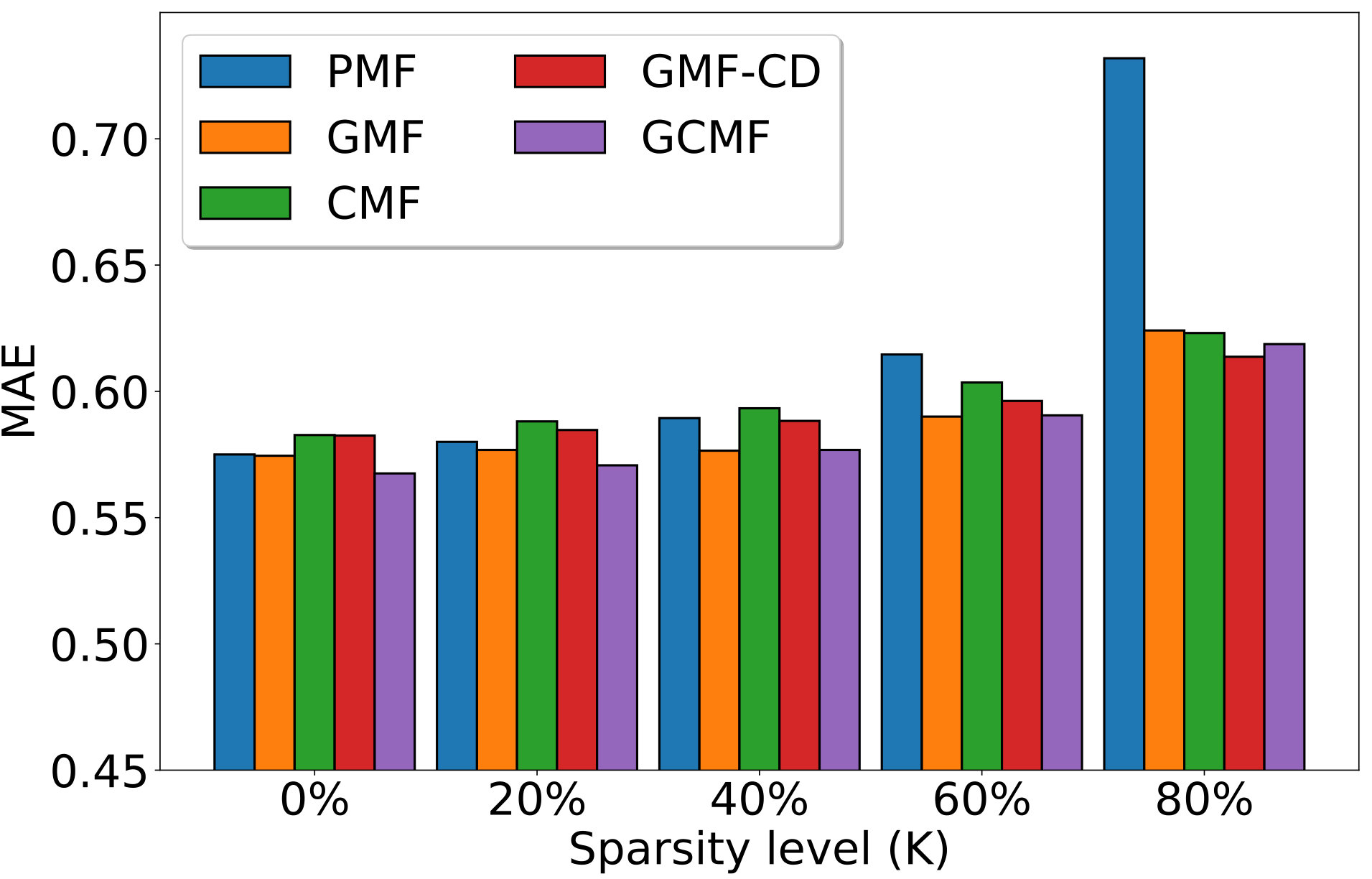 Figure 3
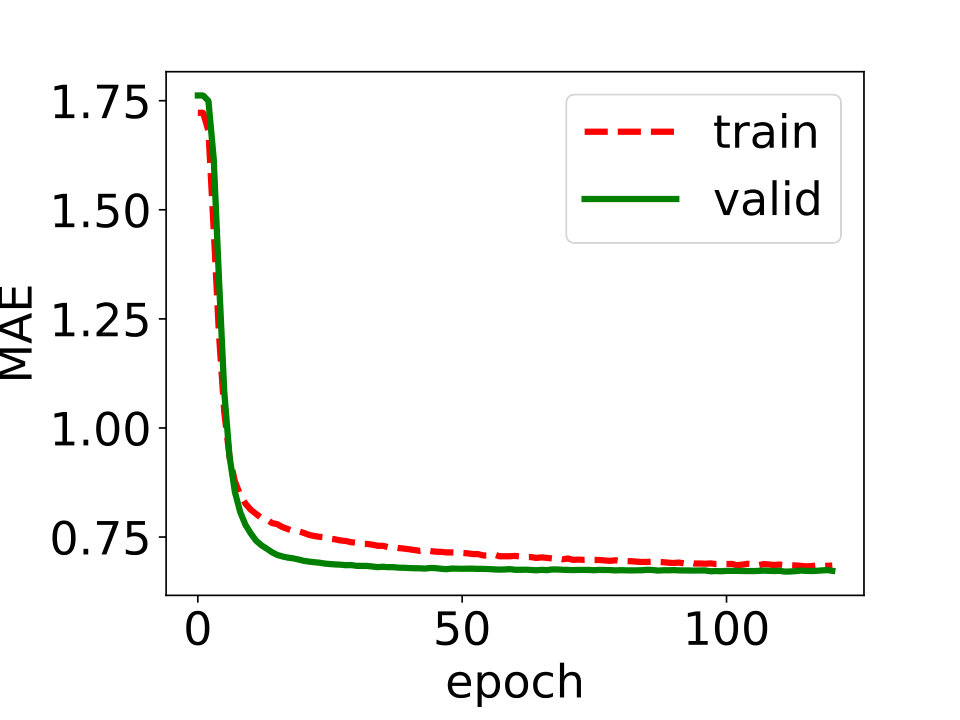 Figure 4
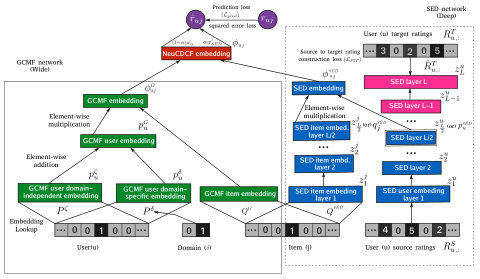 Figure 5
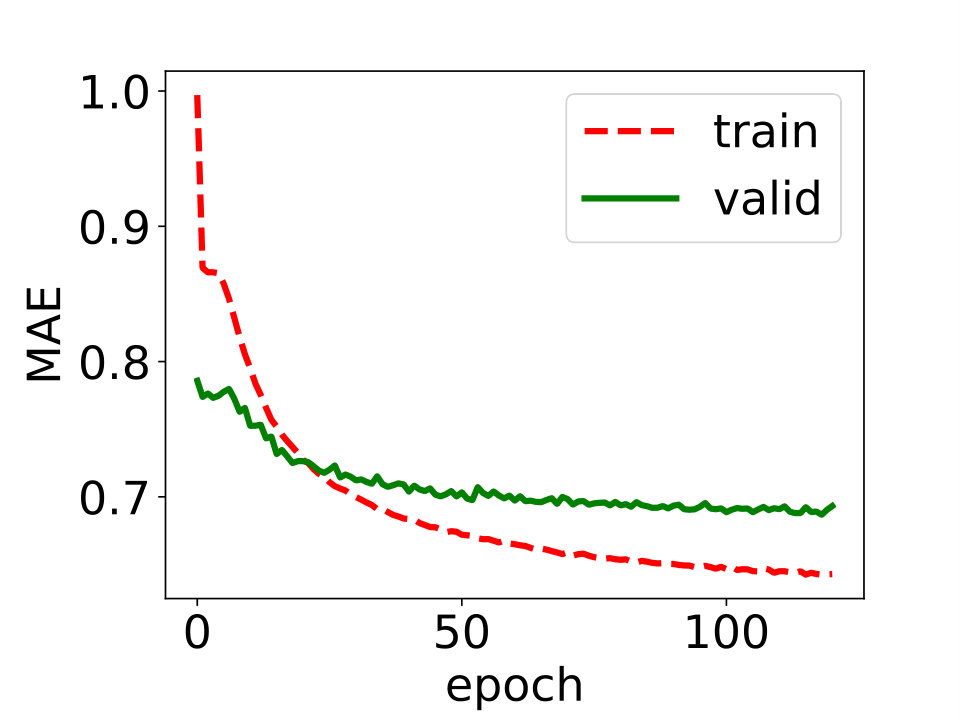 Figure 6
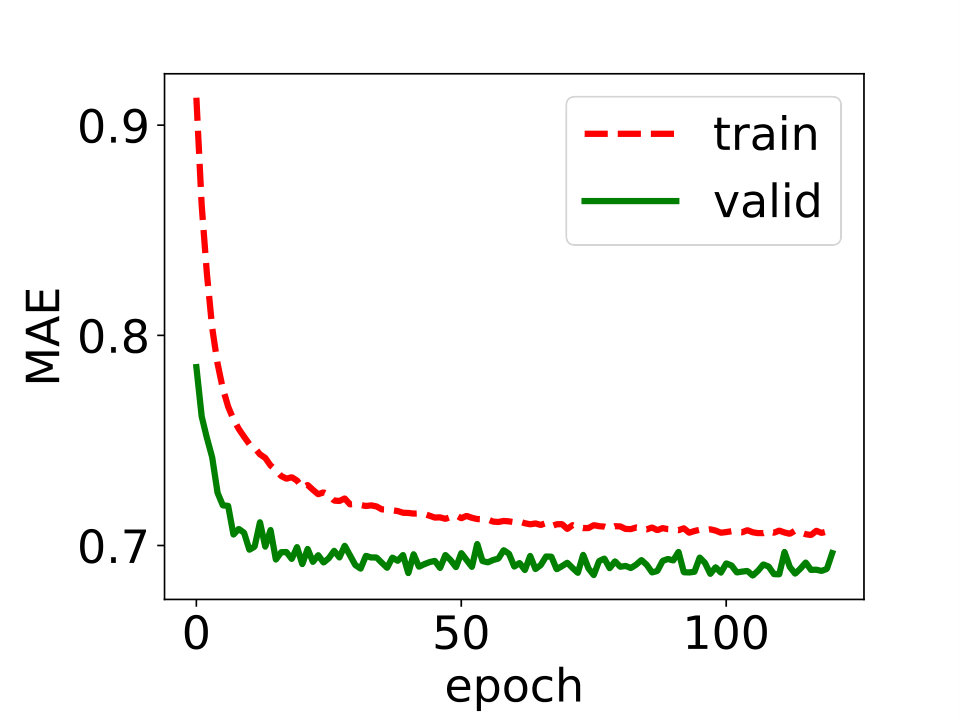 Figure 7
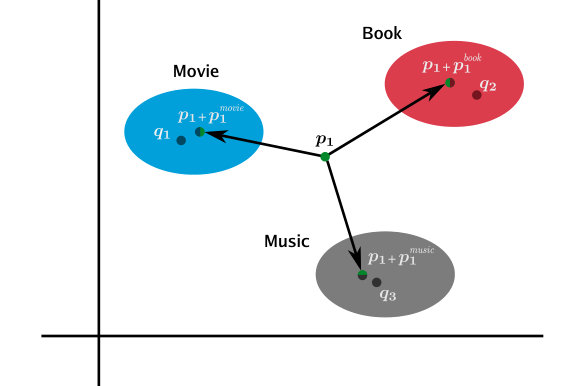 Figure 8
| Dataset | # users | # items | # ratings | density | role | |
|---|---|---|---|---|---|---|
| Amazon | Movie (M) | 3677 | 7549 | 222095 | 0.80 % | source |
| Book (B) | 3677 | 9919 | 183763 | 0.50 % | target | |
| Movie (M) | 2118 | 5099 | 223383 | 2.07 % | source | |
| Music (Mu) | 2118 | 4538 | 91766 | 0.95 % | target | |
| Douban | Movie (M) | 5674 | 11676 | 1863139 | 2.81 % | source |
| Book (B) | 5674 | 6626 | 432642 | 1.15 % | target | |
| Music (Mu) | 3628 | 8118 | 554075 | 1.88 % | source | |
| Book (B) | 3628 | 4893 | 293488 | 1.65 % | target | |
| Sparse | Cold-start | ||||||||
| Dataset | Model | =0% | =20% | =40% | =60% | =80% | =40% | =60% | =80% |
| PMF (Mnih and Salakhutdinov, 2008) | 0.7481 0.0042 | 0.7828 0.0061 | 0.8449 0.0178 | 0.9640 0.0035 | 1.2223 0.0145 | 1.1063 0.0501 | 1.1476 0.0250 | 1.5210 0.0316 | |
| GMF (He et al., 2017) | 0.7029 0.0110 | 0.7108 0.0056 | 0.7254 0.0078 | 0.7805 0.0151 | 0.8878 0.0207 | 0.9040 0.0704 | 1.0721 0.0791 | 1.0735 0.0250 | |
| GMF-CD (He et al., 2017) | 0.6961 0.0012 | 0.7085 0.0056 | 0.7186 0.0018 | 0.7552 0.0236 | 0.8009 0.0325 | 0.8086 0.0296 | 0.8220 0.0158 | 0.8792 0.0144 | |
| Amazon | CMF (Singh and Gordon, 2008) | 0.7242 0.0022 | 0.7434 0.0044 | 0.7597 0.0019 | 0.7919 0.0039 | 0.8652 0.0032 | 0.8617 0.0327 | 0.8734 0.0126 | 0.9362 0.0129 |
| (M-B) | MV-DNN (Elkahky et al., 2015) | 0.7048 0.0024 | 0.7160 0.0047 | 0.7192 0.0035 | 0.7255 0.0019 | 0.7624 0.0019 | 0.8052 0.0293 | 0.8135 0.0167 | 0.8347 0.0243 |
| GCMF (ours) | 0.6705 0.0019 | 0.6862 0.0052 | 0.7023 0.0025 | 0.7254 0.0023 | 0.7873 0.0030 | 0.8086 0.0296 | 0.8220 0.0158 | 0.8792 0.0144 | |
| SED (ours) | 0.6880 0.0033 | 0.7024 0.0060 | 0.7094 0.0030 | 0.7194 0.0023 | 0.7428 0.0024 | 0.7925 0.0301 | 0.8002 0.0157 | 0.8169 0.0118 | |
| NeuCDCF (ours) | 0.6640 0.0018 | 0.6786 0.0052 | 0.6852 0.0025 | 0.6916 0.0010 | 0.7291 0.0060 | 0.7830 0.0304 | 0.7791 0.0165 | 0.8015 0.0157 | |
| PMF (Mnih and Salakhutdinov, 2008) | 0.7135 0.0105 | 0.7366 0.0050 | 0.7926 0.0118 | 0.9324 0.0174 | 1.2080 0.0186 | 1.0552 0.0315 | 1.1734 0.0577 | 1.5235 0.0330 | |
| GMF (He et al., 2017) | 0.6583 0.0056 | 0.6731 0.0090 | 0.7008 0.0083 | 0.7268 0.0194 | 0.8331 0.0046 | 0.8425 0.0687 | 0.8490 0.0345 | 1.0013 0.0155 | |
| GMF-CD (He et al., 2017) | 0.6628 0.0025 | 0.6666 0.0047 | 0.6883 0.0175 | 0.6997 0.0061 | 0.7566 0.0277 | 0.7537 0.0262 | 0.7600 0.0252 | 0.8295 0.0147 | |
| Amazon | CMF (Singh and Gordon, 2008) | 0.6923 0.0041 | 0.7071 0.0013 | 0.7298 0.0103 | 0.7594 0.0071 | 0.8279 0.0046 | 0.8359 0.0320 | 0.8245 0.0139 | 0.8746 0.0194 |
| (M-Mu) | MV-DNN (Elkahky et al., 2015) | 0.6843 0.0017 | 0.6827 0.0046 | 0.6898 0.0077 | 0.6905 0.0037 | 0.7018 0.0031 | 0.7320 0.0253 | 0.7075 0.0313 | 0.7241 0.0157 |
| GCMF (ours) | 0.6173 0.0053 | 0.6261 0.0042 | 0.6527 0.0111 | 0.6809 0.0040 | 0.7436 0.0038 | 0.7537 0.0262 | 0.7600 0.0252 | 0.8295 0.0147 | |
| SED (ours) | 0.6406 0.0032 | 0.6430 0.0040 | 0.6597 0.0114 | 0.6770 0.0039 | 0.7006 0.0044 | 0.7281 0.0314 | 0.7176 0.0265 | 0.7437 0.0156 | |
| NeuCDCF (ours) | 0.6095 0.0043 | 0.6170 0.0044 | 0.6318 0.0101 | 0.6535 0.0050 | 0.6937 0.0061 | 0.7144 0.0232 | 0.7134 0.0267 | 0.7390 0.0161 | |
| PMF (Mnih and Salakhutdinov, 2008) | 0.5733 0.0019 | 0.5811 0.0018 | 0.5891 0.0020 | 0.6136 0.0016 | 0.7141 0.0066 | 0.8654 0.0593 | 0.7527 0.0199 | 0.8275 0.0135 | |
| GMF (He et al., 2017) | 0.5730 0.0016 | 0.5747 0.0017 | 0.5781 0.0033 | 0.5971 0.0071 | 0.6133 0.0072 | 0.6205 0.0530 | 0.7290 0.0740 | 0.6625 0.0371 | |
| GMF-CD (He et al., 2017) | 0.5803 0.0026 | 0.5836 0.0029 | 0.5879 0.0031 | 0.6002 0.0089 | 0.6117 0.0078 | 0.5495 0.0625 | 0.5983 0.0172 | 0.6220 0.0037 | |
| Douban | CMF (Singh and Gordon, 2008) | 0.5771 0.0006 | 0.5821 0.0014 | 0.5862 0.0012 | 0.5979 0.0025 | 0.6188 0.0016 | 0.5490 0.0711 | 0.5998 0.0156 | 0.6171 0.0069 |
| (M-B) | MV-DNN (Elkahky et al., 2015) | 0.5956 0.0005 | 0.6009 0.0019 | 0.6039 0.0011 | 0.6127 0.0023 | 0.6224 0.0015 | 0.5624 0.0807 | 0.6110 0.0165 | 0.6206 0.0113 |
| GCMF (ours) | 0.5608 0.0009 | 0.5664 0.0023 | 0.5709 0.0016 | 0.5849 0.0023 | 0.6118 0.0018 | 0.5495 0.0625 | 0.5983 0.0172 | 0.6220 0.0037 | |
| SED (ours) | 0.5822 0.0003 | 0.5865 0.0021 | 0.5905 0.0018 | 0.6011 0.0029 | 0.6124 0.0022 | 0.5462 0.0671 | 0.5983 0.0159 | 0.6105 0.0050 | |
| NeuCDCF (ours) | 0.5603 0.0009 | 0.5647 0.0021 | 0.5704 0.0014 | 0.5800 0.0023 | 0.5957 0.0019 | 0.5372 0.0699 | 0.5911 0.0157 | 0.6031 0.0033 | |
| PMF (Mnih and Salakhutdinov, 2008) | 0.5750 0.0022 | 0.5800 0.0016 | 0.5894 0.0033 | 0.6146 0.0037 | 0.7319 0.0099 | 0.9201 0.0951 | 0.7629 0.0237 | 0.8451 0.0161 | |
| GMF (He et al., 2017) | 0.5745 0.0033 | 0.5768 0.0036 | 0.5765 0.0018 | 0.5900 0.0051 | 0.6241 0.0153 | 0.5489 0.0594 | 0.6873 0.0731 | 0.6964 0.0634 | |
| GMF-CD (He et al., 2017) | 0.5825 0.0023 | 0.5847 0.0040 | 0.5883 0.0040 | 0.5962 0.0067 | 0.6137 0.0037 | 0.5220 0.0717 | 0.6129 0.0212 | 0.6205 0.0047 | |
| Douban | CMF (Singh and Gordon, 2008) | 0.5827 0.0017 | 0.5881 0.0015 | 0.5933 0.0024 | 0.6035 0.0017 | 0.6231 0.0019 | 0.5875 0.0543 | 0.6081 0.0208 | 0.6194 0.0060 |
| (Mu-B) | MV-DNN (Elkahky et al., 2015) | 0.5892 0.0015 | 0.5918 0.0013 | 0.5946 0.0016 | 0.6039 0.0022 | 0.6180 0.0022 | 0.5485 0.0367 | 0.6131 0.0198 | 0.6089 0.0049 |
| GCMF (ours) | 0.5675 0.0012 | 0.5707 0.0013 | 0.5768 0.0018 | 0.5905 0.0020 | 0.6187 0.0021 | 0.5220 0.0717 | 0.6129 0.0212 | 0.6205 0.0047 | |
| SED (ours) | 0.5769 0.0024 | 0.5782 0.0019 | 0.5839 0.0020 | 0.5934 0.0023 | 0.6090 0.0025 | 0.5423 0.0380 | 0.6011 0.0239 | 0.5999 0.0046 | |
| NeuCDCF (ours) | 0.5625 0.0015 | 0.5646 0.0013 | 0.5688 0.0017 | 0.5794 0.0021 | 0.5954 0.0024 | 0.5200 0.0482 | 0.5963 0.0246 | 0.5954 0.0046 | |
| Full-cold-start setting | ||||||
|---|---|---|---|---|---|---|
| Dataset | Model | =10 | =20 | =30 | =40 | =50 |
| CMF (Singh and Gordon, 2008) | 0.7870 0.0079 | 0.7856 0.0115 | 0.8017 0.0286 | 0.8214 0.0170 | 0.8590 0.0327 | |
| EMCDR (Man et al., 2017) | 0.7340 0.0042 | 0.7324 0.0089 | 0.7436 0.0195 | 0.7831 0.0167 | 0.8067 0.0211 | |
| Amazon (M-B) | MV-DNN (Elkahky et al., 2015) | 0.7401 0.0038 | 0.7366 0.0086 | 0.7328 0.0161 | 0.7415 0.0047 | 0.7483 0.0075 |
| GCMF (ours) | 0.7233 0.0076 | 0.7208 0.0080 | 0.7226 0.0177 | 0.7371 0.0081 | 0.7590 0.0034 | |
| SED (ours) | 0.7181 0.0040 | 0.7108 0.0062 | 0.7115 0.0151 | 0.7178 0.0060 | 0.7277 0.0044 | |
| NeuCDCF (ours) | 0.7096 0.0073 | 0.7012 0.0077 | 0.6983 0.0171 | 0.7091 0.0077 | 0.7215 0.0043 | |
| CMF (Singh and Gordon, 2008) | 0.7467 0.0138 | 0.7413 0.0123 | 0.7600 0.0220 | 0.7865 0.0146 | 0.8348 0.0309 | |
| EMCDR (Man et al., 2017) | 0.6781 0.0147 | 0.6910 0.0104 | 0.7349 0.0212 | 0.7682 0.0172 | 0.7917 0.0272 | |
| Amazon (M-Mu) | MV-DNN (Elkahky et al., 2015) | 0.6848 0.0270 | 0.6923 0.0170 | 0.6833 0.0274 | 0.7037 0.0116 | 0.7178 0.0135 |
| GCMF (ours) | 0.6658 0.0237 | 0.6766 0.0154 | 0.6635 0.0237 | 0.6943 0.0118 | 0.7280 0.0104 | |
| SED (ours) | 0.6523 0.0281 | 0.6544 0.0181 | 0.6452 0.0214 | 0.6693 0.0115 | 0.6864 0.0098 | |
| NeuCDCF (ours) | 0.6418 0.0257 | 0.6471 0.0183 | 0.6384 0.0222 | 0.6650 0.0107 | 0.6856 0.0095 | |
| CMF (Singh and Gordon, 2008) | 0.5919 0.0052 | 0.5987 0.0062 | 0.5970 0.0055 | 0.5983 0.0037 | 0.6004 0.0012 | |
| EMCDR (Man et al., 2017) | 0.5942 0.0069 | 0.5926 0.0071 | 0.5973 0.0064 | 0.5996 0.0032 | 0.6112 0.0031 | |
| Douban (M-B) | MV-DNN (Elkahky et al., 2015) | 0.6004 0.0071 | 0.6106 0.0069 | 0.6062 0.0062 | 0.6068 0.0025 | 0.6075 0.0032 |
| GCMF (ours) | 0.5852 0.0070 | 0.5923 0.0074 | 0.5919 0.0044 | 0.5930 0.0021 | 0.5932 0.0022 | |
| SED (ours) | 0.5897 0.0072 | 0.5998 0.0094 | 0.5955 0.0066 | 0.5965 0.0026 | 0.5978 0.0032 | |
| NeuCDCF (ours) | 0.5807 0.0065 | 0.5877 0.0072 | 0.5858 0.0048 | 0.5864 0.0019 | 0.5869 0.0020 | |
| CMF (Singh and Gordon, 2008) | 0.6063 0.0112 | 0.5971 0.0048 | 0.5995 0.0025 | 0.6000 0.0019 | 0.5997 0.0021 | |
| EMCDR (Man et al., 2017) | 0.6058 0.0072 | 0.6021 0.0046 | 0.6083 0.0034 | 0.6102 0.0033 | 0.6092 0.0042 | |
| Douban (Mu-B) | MV-DNN (Elkahky et al., 2015) | 0.6145 0.0112 | 0.6053 0.0033 | 0.6072 0.0031 | 0.6059 0.0025 | 0.6035 0.0035 |
| GCMF (ours) | 0.6142 0.0054 | 0.6044 0.0030 | 0.6115 0.0037 | 0.6082 0.0025 | 0.6078 0.0039 | |
| SED (ours) | 0.6037 0.0119 | 0.5936 0.0045 | 0.5962 0.0033 | 0.5940 0.0023 | 0.5927 0.0025 | |
| NeuCDCF (ours) | 0.5978 0.0098 | 0.5880 0.0042 | 0.5927 0.0029 | 0.5898 0.0017 | 0.5885 0.0030 | |
Peer Reviews
No public reviews on file for this paper yet. If you reviewed it on a platform where reviews are public (OpenReview, ICLR, NeurIPS, ICML), you can paste yours below so the community can read it here.
Videos
No videos yet. Explain this paper in a talk, walkthrough, or lecture? Add one.
Taxonomy
TopicsRecommender Systems and Techniques · Topic Modeling · Data Stream Mining Techniques
Neural Cross-Domain Collaborative Filtering with Shared Entities
Vijaikumar M
Indian Institute of ScienceBangaloreIndia
,
Shirish Shevade
Indian Institute of ScienceBangaloreIndia
and
M N Murty
Indian Institute of ScienceBangaloreIndia
(2018)
Abstract.
Cross-Domain Collaborative Filtering (CDCF) provides a way to alleviate data sparsity and cold-start problems present in recommendation systems by exploiting the knowledge from related domains. Existing CDCF models are either based on matrix factorization or deep neural networks. Either of the techniques in isolation may result in suboptimal performance for the prediction task. Also, most of the existing models face challenges particularly in handling diversity between domains and learning complex non-linear relationships that exist amongst entities (users/items) within and across domains. In this work, we propose an end-to-end neural network model – NeuCDCF, to address these challenges in cross-domain setting. More importantly, NeuCDCF follows wide and deep framework and it learns the representations combinedly from both matrix factorization and deep neural networks. We perform experiments on four real-world datasets and demonstrate that our model performs better than state-of-the-art CDCF models.
Cross-domain collaborative filtering, Deep learning, Neural networks, Wide and deep framework, Recommendation system
††copyright: rightsretained††conference: The 12th ACM International Conference on Web Search and Data Mining; 2019††journalyear: ;††isbn:
1. Introduction
Personalized recommendation systems play an important role in extracting relevant information for user requirements, for example, product recommendation from Amazon111www.amazon.com, event recommendation from Meetup222www.meetup.com, scholarly references recommendation from CiteULike333www.citeulike.org. Collaborative Filtering (CF) is one of the widely used techniques (Su and Khoshgoftaar, 2009) in recommendation systems that exploits the interactions between users and items for predicting unknown ratings.
Performance of the CF techniques mainly depends on the number of interactions the users and items have in the system. However, in practice, most of the users interact with very few items. For instance, even the popular and well-preprocessed datasets such as Netflix444https://www.kaggle.com/netflix-inc/netflix-prize-data and MovieLens-20M555http://files.grouplens.org/datasets/movielens have 1.18% and 0.53% available ratings, respectively. Furthermore, new users and items are added to the system continuously. Due to this, the new entities (users/items) may have a very few ratings associated with them, and oftentimes, they may not have any ratings. The former issue is called data sparsity problem and the latter is called cold-start problem (Su and Khoshgoftaar, 2009); the respective entities are called cold-start entities. When the above-mentioned issues exist, learning parameters in CF techniques becomes a daunting task.
Cross-Domain Collaborative Filtering (CDCF) (Cantador et al., 2015; Khan et al., 2017) is one of the promising techniques in such a scenario that alleviates data sparsity and cold-start problems by leveraging the knowledge extracted from user-item interactions in related domains666we follow the domain definition as in (Lian et al., 2017; Man et al., 2017; Li et al., 2009b), where information is rich, and transfers appropriately to the target domain where a relatively smaller number of ratings are known. In this work, we study the problem of Cross-Domain Recommendation (CDR) with the following assumption: users (or items) are shared across domains and no side information is available.
Most of the existing models proposed for CDR are based on Matrix Factorization (MF) techniques (He et al., 2018; Sahebi and Brusilovsky, 2015; Gao et al., 2013; Li et al., 2009a, b; Singh and Gordon, 2008). They may not handle complex non-linear relationships that exist among entities within and across domains very well. More recently, few works have been proposed for cross-domain settings to exploit the transfer learning ability of the deep networks (Elkahky et al., 2015; Lian et al., 2017; Man et al., 2017; Zhu et al., 2018). Although they have achieved performance improvement to some extent, they have the following shortcomings. First, they do not consider the diversity among the domains. That is, they learn shared representations from the source and target domain together instead of learning domain-specific and domain-independent representations separately. Second, they do not consider both the wide (MF based) and deep (deep neural networks based) representations together. We explain why addressing the aforementioned shortcomings are essential in the following:
Importance of domain-specific embeddings to handle diversity. When users (or items) are shared between different domains one can ignore the diversity among domains and treat all the items (or users) come from the same domain, and apply the single domain CF models. However, it loses important domain-specific characteristics that are explicit to different domains. For example, let us assume that we have two domains: movie and book. Suppose the movie domain is defined by the features: genre, language and visual effects; and the book domain is defined by the features: genre, language and number of pages. Though the features genre and language are shared by both the domains, visual effects and number of pages are specific to the movie and book domains, respectively.
When users and items are embedded in some latent space, learning only common preferences of users may not be sufficient to handle diversity among domain. This is illustrated in Figure 1. Suppose, user rates high on items and belonging to movie, book and music domains, respectively. Let and be embeddings for user and items and , respectively. In order to maintain higher similarity values with all the items and , the existing models (He et al., 2017; Koren et al., 2009; Mnih and Salakhutdinov, 2008; Singh and Gordon, 2008) embed for user as shown in Figure 1. This may deteriorate the performance of the prediction task for CDR. This is because we need to account for the domain-specific embeddings , and to get the appropriate preferences for movie, book and music domains, respectively.
Importance of learning non-linear relationships across domains. Learning non-linear relationships present across domains is important in transferring knowledge across domains. For example777This example is inspired from (Liu et al., 2015)., let us assume that a movie production company releases a music album in advance to promote a movie. Let one feature for ‘music’ be popularity, and the two features for ‘movie’ be visibility (reachability to the people) and review-sentiment. As the popularity of the music album increases, the visibility of the movie also increases and they are positively correlated. However, the movie may receive positive reviews due to the music popularity or it may receive negative reviews if it does not justify the affiliated music album’s popularity. So, the movie’s review-sentiment and music album’s popularity may have a non-linear relationship, and it has been argued (He et al., 2017; Rendle, 2010) that such relationships may not very well be handled by matrix factorization models. Thus, it is essential to learn non-linear relationships for the entities in cross-domain systems using deep networks.
Necessity of fusing wide and deep networks. The existing models for CDR are either based on MF techniques or neural network based techniques. However, following either approach leads to suboptimal performance. That is, deep networks are crucial to capture the complex non-linear relationships that exist between entities in the system. At the same time, we cannot ignore the complementary representations provided by wide networks such as matrix factorization (Cheng et al., 2016).
Contributions. In this work, we propose a novel end-to-end neural network model for CDR, Neural Cross-Domain Collaborative Filtering (NeuCDCF), to address the above-mentioned challenges. Our novelty lies particularly in the following places:
- •
We extend MF to CDR setting to learn the wide representations. We call this MF extension as Generalized Collective Matrix Factorization (GCMF). We propose an extra component in GCMF that learns the domain-specific embeddings. This addresses the diversity issues to a great extent.
- •
Inspired from the success of encoder-decoder architecture in machine translation (Cho et al., 2014b; Bahdanau et al., 2014; Cho et al., 2014a), we propose Stacked Encoder-Decoder (SED) to obtain the deep representations for the shared entities. These deep representations learn the complex non-linear relationships that exist among entities. This is obtained by constructing target domain ratings from source domain.
- •
More importantly, we fuse GCMF and SED to get the best of both wide and deep representations. All the parameters from both the networks are learned in end-to-end fashion. To our best knowledge, NeuCDCF is the first model that is based on wide and deep framework to CDR setting.
In addition, GCMF generalizes many well-known MF models such as PMF (Mnih and Salakhutdinov, 2008), CMF(Singh and Gordon, 2008) and GMF(He et al., 2017). Further, source-to-target rating construction part of SED acts as a regularizer for CDR setting. We conduct extensive experiments on four real-world datasets – two from Amazon and two from Douban, in various sparse and cold-start settings, and demonstrate the effectiveness of our model compared to the state-of-the-art models. Our implementation will be made available online.
2. Problem Formulation
We denote the two domains, source and target, by the superscripts and , respectively. Ratings from the source and target domains are denoted by the matrices and where , and denote user and item indices, [math] represents unavailability of rating for the pair , and and denote minimum and maximum rating values in rating matrices and , respectively. Further, and represent the number of users, the number of items in source domain and the number of items in target domain, respectively. Let, . We indicate the available ratings in source domain by and target domain by . We drop the superscripts and from and wherever the context is clear through and .
Further, and denote element-wise multiplication and dot product of two vectors and of the same size, denotes activation function, and denotes norm of a vector . Let () be row ( column) of the matrix corresponding to the user (item ).
A set of users, shared across domains, is denoted by and the sets of items for source and target domains are denoted by and , respectively. Let and .
Problem statement: Given the partially available ratings for the source and target domains , our aim is to predict target domain ratings , .
3. Proposed Model
In this section, we explain our proposed model – NeuCDCF in detail. First we explain the individual networks, GCMF and SED, followed by that we show how these two are fused to get NeuCDCF.
3.1. Generalized Collective Matrix Factorization (GCMF)
GCMF network is shown inside solid-lined box in Figure 2. Let and respectively be domain-specific and domain-independent user embedding matrices, be an item embedding matrix and be the embedding dimension. Here, encodes items from all the domains collectively such that embeddings for the items can be obtained independent of their domains. Note that, we have a single shared across the domains and separate for source and target domains. Having such separate user embedding matrix for each domain helps in handling diversity across domains. We define domain-specific embedding () and domain-independent embedding () for user as follows:
[TABLE]
where is obtained from the corresponding embedding matrix for the domain and and are one-hot encoding of user and item , respectively. Now, we find the user and item embeddings and for as follows:
[TABLE]
Here, we use two embeddings and to define in order to learn the domain-specific features separately from domain independent features. Further, we use the embedding to represent the item . During training, gets updated irrespective of its interactions with the items from different domains, whereas gets updated only with respect to its specific domain.
We have different choices in defining using and other than the one given in Equation (2). For example, instead of adding and , one can concatenate them or use the element-wise product () to obtain , and make the appropriate modifications in item embedding vector . However, intuitively we can think as an offset to to account for the domain-specific preferences (e.g. embeddings and for movie, music and book in Figure 1) that provide the resultant user representation according to the domain. This also encourages the model to flexibly learn the item embeddings suitable for the domains.
Further, we obtain the representation for the user-item interaction and the rating prediction () as follows:
[TABLE]
where denotes the representation for the user-item pair , is a weight vector, and denotes the activation function with an appropriate scaling according to the maximum rating value in the rating matrix. Here, we need to scale the output according to the activation function because, for instance, using sigmoid () as an activation function provides the output value in the range . So, we use to match the output range to the rating value range in the dataset.
Using definition for as in Equation (3), letting ,, for (for source and target respectively) and leveraging ratings from both domains lead us to the loss function for GCMF:
[TABLE]
GCMF is a wide network and it has an ability to generalize many well-known matrix factorization models such as PMF (Mnih and Salakhutdinov, 2008), CMF (Singh and Gordon, 2008) and GMF (He et al., 2017). That is, we obtain CMF by assigning to the vector of all ones and setting ; we get GMF by setting and using only single domain ratings; and we obtain PMF by assigning to the vector of all ones, setting and using only single domain ratings.
3.2. Stacked Encoder-Decoder (SED)
Inspired by the ability of constructing target language sentences from source language in neural machine translation (Cho et al., 2014b; Bahdanau et al., 2014; Cho et al., 2014a), we adopt encoder-decoder network for cross-domain recommendation tasks. The proposed SED is illustrated in Figure 2 inside dashed-lined box. For the sake of brevity, we include the feed-forward network that provides the item embedding () from the one-hot encoding vector (), and the SED embedding () layer as part of SED.
As we discussed earlier, it is essential to capture the non-linear relationships that exist among entities within and across domains. The importance of such representations has also been well argued in (He et al., 2017; Rendle, 2010; Liu et al., 2015). While constructing target domain ratings from source domain, non-linear embeddings of shared users, and items are obtained as illustrated in Figure 2.
Encoding part of the SED is a feed-forward network that takes partially observed ratings for users from the source domain, , projects them into a low dimensional () embedding space as follows:
[TABLE]
where and denote user representation, weight matrix and bias at layer , respectively. At layer , the embedding vector acts as a low-dimensional compact representation () for user . Here, contains the transferable user behavior component for user from source to target domain.
Further, decoder is also a feed-forward network that takes this low dimensional embedding () and constructs the user ratings for the target domain () as follows:
[TABLE]
where, is treated as the constructed ratings () of user for the target domain. Hence, we have the following loss function for source to target domain rating construction:
[TABLE]
where is a set of parameters that contains all the weight matrices and bias vectors, and denotes indicator function.
In addition to this, we get the item representation from SED as follows:
[TABLE]
Here denotes the item embedding matrix and represents the embedding vector for the item in SED. is further used along with to predict the target domain ratings as shown in Figure 2.
Note that, one can use the same item embedding matrix in (Equation (8)) the SED network instead of . Nevertheless, we use a separate embedding matrix for the following reasons: using the same here restricts the flexibility in using different number of activation functions at the SED layer ; we want to obtain low dimensional deep representations from SED and wide representations from GCMF, and using (GCMF item vector in Figure 2) in both places for item may deteriorate the resultant representations.
Here, () acts as a component that transfers the user behavior to the target domain. In addition, is particularly helpful to learn the representations for the users when they have less or no ratings in the target domain. Further, stacked layers help in extracting the complicated relationships present between entities.
Similar to GCMF, we learn the representations and predict rating for the user-item pair as follows:
[TABLE]
Here denotes the weight vector. The loss function of SED () contains two terms: rating prediction loss () and source to target rating construction loss (). Let . The loss function is given as follows:
[TABLE]
3.3. Fusion of GCMF and SED
We fuse GCMF and SED network to get the best of both wide and deep representations. The embedding for NeuCDCF, and the rating prediction () is obtained as follows:
[TABLE]
Here is a trade-off parameter between GCMF and SED networks and it is tuned using cross-validation. When is explicitly set to [math] and , NeuCDCF considers only GCMF network and SED network, respectively.
The objective function for NeuCDCF is the sum of three individual loss functions:
[TABLE]
Here is the prediction loss from both the source and target domains together, denotes the source to target rating construction loss between predicted ratings and the available true ratings for all the users , and is the regularization loss derived using all the parameters in the model. Here, also acts as a regularizer that helps in properly learning and .
Note that the proposed architecture can easily be adapted to implicit rating settings where only binary ratings available (e.g., clicks or likes) by changing the loss function from squared error loss to cross-entropy (He et al., 2017) or pairwise loss (Rendle et al., 2009) with appropriate negative sampling strategy (Mikolov et al., 2013).
Since the datasets we experiment with contain real-valued ratings, the choice of squared error loss is natural. In the next section, we demonstrate the effectiveness of our model on various real-world datasets.
4. Experiments
We conduct our experiments to address the following questions:
**: **
RQ1 How do GCMF, SED and NeuCDCF perform under the different sparsity and cold-start settings?
**: **
RQ2 Does fusing wide and deep representations boost the performance?
**: **
RQ3 Is adding domain-specific component helpful in improving the performance of GCMF?
**: **
RQ4 Does capturing non-linear relationship by SED provide any benefits?
We first present the experimental settings after that we answer the above questions.
4.1. Experimental Setup
4.1.1. Datasets.
We adopt four widely used datasets: two from Amazon (He and McAuley, 2016a) – an e-commerce product recommendation system, and two from Douban (Zhong et al., 2014) – a Chinese online community platform for movies, books and music recommendations. All the datasets are publicly available888http://jmcauley.ucsd.edu/data/amazon (we rename CDs-and-Vinyl as Music)999https://sites.google.com/site/erhengzhong/datasets and have the ratings from multiple domains. We do the following preprocessing similar to the one done in (Man et al., 2017; Gao et al., 2013; Xue et al., 2017): we retain (1) only those ratings associated with the users who are common between both the domains and (2) the users and items that have at least 10 and 20 ratings (different thresholds are used here to have diversity in density across datasets) for Amazon and Douban datasets, respectively. Statistics of the datasets are given in Table 1.
4.1.2. Evaluation procedure.
We randomly split the target domain ratings of the datasets into training (65%), validation (15%), and test (20%) sets. In this process, we make sure that at least one rating for every user and every item is present in the training set. For the CDCF models, we include source domain ratings to the above-mentioned training set. Each experiment is repeated five times for different random splits of the dataset and we report the average test performance and standard deviation with respect to the best validation error as the final results. We evaluate our proposed models (GCMF, SED and NeuCDCF) against baseline models under the following 3 experimental settings:
- (1)
Sparsity: In this setting, we remove % of the target domain ratings from the training set. We use different values of from {0, 20, 40, 60, 80} to get different sparsity levels. 2. (2)
Cold-start: With the above setting, we report the results obtained for only those users who have less than five ratings in the target domain of the training set. We call them cold-start users. The similar setting was defined and followed in (Guo et al., 2015). We do not include 0% and 20% sparsity levels here as the respective splits have a very few cold-start users. 3. (3)
Full-cold-start: We remove all the ratings of % of users from target domain and call them as full-cold-start users since these users have no ratings at all in the target domain of the training set. We use different values of from {10, 20, 30, 40, 50} to get different full-cold-start levels. This particular setting was followed in (Man et al., 2017).
4.1.3. Metric.
We employ Mean Absolute Error (MAE) for performance analysis (Cantador et al., 2015; Guo et al., 2015; Li et al., 2009a, b). It is defined as follows:
[TABLE]
where is a test set and smaller values of MAE indicate better prediction. We observed similar behaviours in performance in terms of root mean square error (RMSE) (Cantador et al., 2015) and due to space limitations the results in RMSE are omitted.
4.1.4. Comparison of different models.
To evaluate the performance of NeuCDCF and its individual networks (GCMF and SED) in CDR setting, we compare our models with the representative models from the following three categories:
(1) Deep neural network based CDCF models (Deep):
- •
MV-DNN (Elkahky et al., 2015): It is one of the state-of-the-art neural network models for the cross-domain recommendation. It learns the embedding of shared entities from the ratings of the source and target domains combined using deep neural networks.
- •
EMCDR (Man et al., 2017): It is one of the state-of-the-art models for the full-cold-start setting. EMCDR is a two-stage neural network model for the cross-domain setting. In the first stage, it finds the embeddings for entities by leveraging matrix factorization techniques with respect to its individual domains. In the second stage, it learns a transfer function that provides target domain embeddings for the shared entities from its source domain embeddings.
(2) Matrix factorization based single domain models (Wide):
- •
PMF (Mnih and Salakhutdinov, 2008): Probabilistic Matrix Factorization (PMF) is a standard and well-known baseline for single domain CF.
- •
GMF(He et al., 2017): Generalized Matrix Factorization (GMF) is state-of-the-art rating only single domain model proposed as part of NeuMF (He et al., 2017).
(3) Matrix factorization based CDCF models (Wide):
- •
GMF-CD(He et al., 2017): It is same as GMF model for CDR where both source and target domain ratings are used for training.
- •
CMF (Singh and Gordon, 2008): Collective Matrix Factorization (CMF) is a standard baseline for CDR when entities are shared across the domains.
4.1.5. Parameter settings and reproducibility.
We implemented our models using Tensorflow 1.12. We use squared error loss as an optimization loss across all models to have a fair comparison (He et al., 2017; Lian et al., 2017). We use regularization for matrix factorization models (PMF and CMF) and dropout for neural network models. Hyperparameters were tuned using cross-validation. In particular, different values used for different parameters are: for regularization from {0.0001, 0.0005, 0.005, 0.001, 0.05, 0.01, 0.5}, dropout from {0.1, 0.2, 0.3, 0.4, 0.5, 0.6}, embedding dimension (i.e., number of factors ) from {8, 16, 32, 48, 64, 80} and value from {0.05, 0.1, 0.2, 0.4, 0.6, 0.8, 0.9, 0.95}. We train the models for a maximum of 120 epochs with early stopping criterion. Test error corresponding to the best performing model on the validation set is reported. We randomly initialize the model parameters with normal distribution with 0 mean and 0.002 standard deviation. We adopt RMSProp (Goodfellow et al., 2016) with mini-batch optimization procedure. We tested the learning rate () of {0.0001, 0.0005, 0.001, 0.005, 0.01}, batch size of {128, 256, 512, 1024}. From the validation set performance, we set to 0.002 for PMF and CMF, 0.001 for MV-DNN, 0.005 for other models; dropout to 0.5; batch size to 512. Further, we obtain good performance in MV-DNN when we use 3 hidden layers with the number of neurons: (where is the embedding dimension) and the tanh activation function; we use the framework proposed in (Man et al., 2017) for MLP part of EMCDR, that is, number of neurons: with the tanh activation function. Further, in SED, for the encoder, we use 3 hidden layers with the number of neurons: and the sigmoid activation function, and for the decoder, we use the same as the encoder with the number of neurons interchanged, and is tuned using validation set.
4.2. Results and Discussion
Tables 2 and 3 detail the comparison results of our proposed models GCMF, SED and NeuCDCF, and baseline models at different sparsity and cold-start levels on four datasets. In addition, we conduct paired t-test and the improvements of NeuCDCF over each of the compared models passed with significance value . The findings are summarized below.
4.2.1. Sparsity and cold-start settings (RQ1)
As we see from Table 2, NeuCDCF outperforms the other models at different sparsity levels. In particular, the performance of GCMF is better when the target domain is less sparse, but, the performance of SED improves eventually when sparsity increases. This phenomenon is more obvious on the Amazon datasets. Furthermore, adding the source domain helps in recommendation performance. This is evident from the performance of GCMF as compared to its counterparts – PMF and GMF (single domain models).
We have two different settings for the cold-start analysis: cold-start and full-cold-start, and the performance of recommendation models is given in Tables 2 and 3. The overall performance of NeuCDCF, in particular SED, is better than the other comparison models. Since SED adapts and transfers the required knowledge from source domain through source domain to target domain rating construction, it helps the cold-start entities to learn better representations. This demonstrates that a network such as SED is important in learning the non-linear representation for cold-start entities. Note that, in cold-start settings, we use GCMF with only domain-independent embeddings. That is, we set to zero in Equation (2). We do this because, in full-cold-start setting, we do not have any rating for the cold-start users and the term associated with in is expected to have an appropriate learned value from the user-item interactions. Since there is no item that user has rated, its initialized value remains unchanged and this results in extra noise101010https://cs224d.stanford.edu/lecture_notes/notes2.pdf. For a similar reason, we set to zero in the cold-start setting as well.
4.2.2. GCMF and SED integration (RQ2)
NeuCDCF consistently performs better all the models that are either based on wide or deep framework including the proposed GCMF and SED networks. This result can be inferred from Tables 2 and 3. We thus observe that the individual networks – GCMF (wide) and SED (deep networks) provide different complementary knowledge about the relationships that exist among entities within and across domains.
4.2.3. Domain-specific embeddings (RQ3)
Adding source domain blindly might deteriorate the performance. This is illustrated in Figures 3(a) and 3(b) using Douban datasets. When sparsity is less, surprisingly the performance of single domain models (PMF and GMF) is better than those of cross-domain models (CMF and GMF-CD). However, GCMF performs better than the counterparts – PMF, GMF, GMF-CD and CMF in almost all the cases. These results demonstrate that GCMF provides a more principled way to understand the diversity between domains using domain-specific embeddings.
4.2.4. Deep non-linear representations (RQ4)
Having deep representations helps in improving the performance when the sparsity increases in the target domain. This is demonstrated in Table 2 by SED and supported by MV-DNN particularly on the Amazon datasets. Despite both being deep networks, SED performs better than MV-DNN. This is because MV-DNN learns the embeddings of shared users from source and target domain together, whereas in SED, the embeddings are learned appropriately to obtain the target domain ratings using source domain ratings.
We show the performance of SED for the different number of layers (L) on all the datasets in Figure 4. This shows that performance improves when we increase the number of layers () from 2 to 6. In other words, using deep representations in SED help in boosting the performance. When the performance decreases because of overfitting due to the high complexity of the model.
4.2.5. Epochs needed
Figures 5(a), 5(b) and 5(c) show the training and validation error of GCMF, SED and NeuCDCF with respect to the number of epochs on the Amazon (Movie-Book) dataset, respectively. Behavior on the other datasets is similar, hence, we omit the details.
5. Related Work
In the literature of CDR, early works (Singh and Gordon, 2008; Li et al., 2009a, b; Gao et al., 2013; Li and Lin, 2014) mainly adopt matrix factorization models. In particular, (Li et al., 2009a) constructs a cluster-level rating matrix (code-book) from user-item rating patterns and through which it establishes links to transfer the knowledge across domains. A similar approach with an extension to soft-membership was proposed in (Li et al., 2009b). Collective matrix factorization (CMF) (Singh and Gordon, 2008) was proposed for the case where the entities participate in more than one relation. However, as many studies pointed out, MF models may not handle non-linearity and complex relationships present in the system (Zhang et al., 2017; Liu et al., 2015; He et al., 2017).
On the other hand, recently, there has been a surge in methods proposed to explore deep learning networks for recommender systems (Zhang et al., 2017). Most of the models in this category focus on utilizing neural network models for extracting embeddings from side information such as reviews (Zheng et al., 2017), descriptions (Kim et al., 2016), content information (Wang et al., 2015), images (He and McAuley, 2016b) and knowledge graphs (Zhang et al., 2016). Nevertheless, many of these models are traces to matrix factorization models, that is, in the absence of side information, these models distill to either MF (Koren et al., 2009) or PMF (Mnih and Salakhutdinov, 2008).
More recently, to combine the advantages of both matrix factorization models and deep networks such as multi-layer perceptron (MLP), some models have been proposed (Cheng et al., 2016; He et al., 2017; Xue et al., 2017) for learning representations from only ratings. These models combine both the wide and deep networks together to provide better representations. Autoencoder, stacked denoising autoencoder (Sedhain et al., 2015; Strub and Mary, 2015; Wu et al., 2016; Li and She, 2017), Restricted Boltzmann machines (Salakhutdinov et al., 2007) and recurrent neural networks (Ko et al., 2016; Wu et al., 2017) have also been exploited for recommendation systems. However, the above neural network models use only the interaction between users and items from a single domain. Hence, they suffer from the aforementioned issues such as sparsity and cold-start.
Though the use of multiple related domains and neural networks for recommendations has been studied and justified in many works (Zhang et al., 2017), very few attempts have been made to make use of neural networks in cross-domain recommendation setting (Elkahky et al., 2015; Lian et al., 2017; Man et al., 2017; Zhu et al., 2018). In particular, MV-DNN (Elkahky et al., 2015) uses an MLP to learn shared representations of the entities participating in multiple domains. A factorization based multi-view neural network was proposed in CCCFNet (Lian et al., 2017), where the representations learned from multiple domains are coupled with the representations learned from content information. A two-stage approach was followed in (Man et al., 2017; Zhu et al., 2018), wherein the first stage, embeddings are learned for users, and in the second stage, a function is learned to map the user embedding in the target domain from the source domain.
While the models (Elkahky et al., 2015; Lian et al., 2017; Man et al., 2017; Zhu et al., 2018) consider learning embeddings together, they completely ignore the domain-specific representations for the shared users or items. The performance of these models (Elkahky et al., 2015; Lian et al., 2017) is heavily dependent on the relatedness of the domains. In contrast, our proposed model learns domain-specific representations that significantly improves the prediction performance. Further, (Lian et al., 2017) rely on content information to bridge the source and target domains. Besides, all of these models (Elkahky et al., 2015; Lian et al., 2017; Man et al., 2017) are either based on wide or deep networks but not both. We are also aware of the models proposed for cross-domain settings (Kanagawa et al., 2018; Xin et al., 2015; Ma et al., 2018; Lian et al., 2017). However, they differ from the research scope of ours because they bridge the source and target domains using available side information.
6. Conclusion
In this paper, we proposed a novel end-to-end neural network model, NeuCDCF which is based on wide and deep framework. NeuCDCF addresses the main challenges in CDR – diversity and learning complex non-linear relationships among entities in a more systematic way. Through extensive experiments, we showed the suitability of our model for various sparsity and cold-start settings
The proposed framework is general and can be easily extended to a multi-domain setting as well as the setting where a subset of entities is shared. Further, it is applicable to ordinal and top-N recommendation settings with the only modification in the final loss function. NeuCDCF is proposed for rating only settings when no side information is available. If side information is available, it can easily be incorporated as a basic building block in place of matrix factorization to extract effective representations from user-item interactions. Despite being simple, the proposed encoder-decoder network provides significant performance improvement. Therefore, we believe that our work will open up the idea of utilizing more complex, at the same time, scalable encoder-decoder networks in the wide and deep framework to construct target domain ratings in the cross-domain settings.
The reference list from the paper itself. Each links out to its DOI / PubMed record.
- 1(1)
- 2Bahdanau et al . (2014) Dzmitry Bahdanau, Kyunghyun Cho, and Yoshua Bengio. 2014. Neural machine translation by jointly learning to align and translate. ar Xiv preprint ar Xiv:1409.0473 (2014).
- 3Cantador et al . (2015) Iván Cantador, Ignacio Fernández-Tobías, Shlomo Berkovsky, and Paolo Cremonesi. 2015. Cross-domain recommender systems. In Recommender Systems Handbook . Springer, 919–959.
- 4Cheng et al . (2016) Heng-Tze Cheng, Levent Koc, Jeremiah Harmsen, Tal Shaked, Tushar Chandra, Hrishi Aradhye, Glen Anderson, Greg Corrado, Wei Chai, Mustafa Ispir, et al . 2016. Wide & deep learning for recommender systems. In Proceedings of the 1st Workshop on Deep Learning for Recommender Systems . ACM, 7–10.
- 5Cho et al . (2014 a) Kyunghyun Cho, Bart Van Merriënboer, Dzmitry Bahdanau, and Yoshua Bengio. 2014 a. On the properties of neural machine translation: Encoder-decoder approaches. ar Xiv preprint ar Xiv:1409.1259 (2014).
- 6Cho et al . (2014 b) Kyunghyun Cho, Bart Van Merriënboer, Caglar Gulcehre, Dzmitry Bahdanau, Fethi Bougares, Holger Schwenk, and Yoshua Bengio. 2014 b. Learning phrase representations using RNN encoder-decoder for statistical machine translation. ar Xiv preprint ar Xiv:1406.1078 (2014).
- 7Elkahky et al . (2015) Ali Mamdouh Elkahky, Yang Song, and Xiaodong He. 2015. A multi-view deep learning approach for cross domain user modeling in recommendation systems. In Proceedings of the 24th International Conference on World Wide Web . International World Wide Web Conferences Steering Committee, 278–288.
- 8Gao et al . (2013) Sheng Gao, Hao Luo, Da Chen, Shantao Li, Patrick Gallinari, and Jun Guo. 2013. Cross-domain recommendation via cluster-level latent factor model. In Joint European conference on machine learning and knowledge discovery in databases . Springer, 161–176.