Parametric study of polar configurations around binaries
Cristian Giuppone, Nicol\'as Cuello

TL;DR
This study investigates the stability and dynamics of polar circumbinary disks around binary stars using N-body simulations, revealing how resonance locations, planetary presence, and system specifics influence stability.
Contribution
It extends parametric analysis of polar configurations around binaries, identifying stability limits related to mass ratio, eccentricity, and resonance locations, with application to real systems.
Findings
Stability limits depend on mass ratio and eccentricity.
Giant planets affect the stability regions of polar orbits.
Polar configurations around HD 98800BaBb are influenced by nodal positions.
Abstract
Dynamical studies suggest that most of the circumbinary discs (CBDs) should be coplanar. However, under certain initial conditions, the CBD can evolve toward polar orientation. Here we extend the parametric study of polar configurations around detached close-in binaries through -body simulations. For polar configurations around binaries with mass ratios below , the nominal location of the mean motion resonance (MMR) predicts the limit of stability for . Alternatively, for or , the nominal location of the MMR is the closest stable region. The presence of a} giant planet increases the region of forbidden polar configurations around low mass ratio binaries with eccentricities with respect to rocky earth-like planets. For equal mass stars, the eccentricity excitation of polar orbits smoothly increases…
Click any figure to enlarge with its caption.
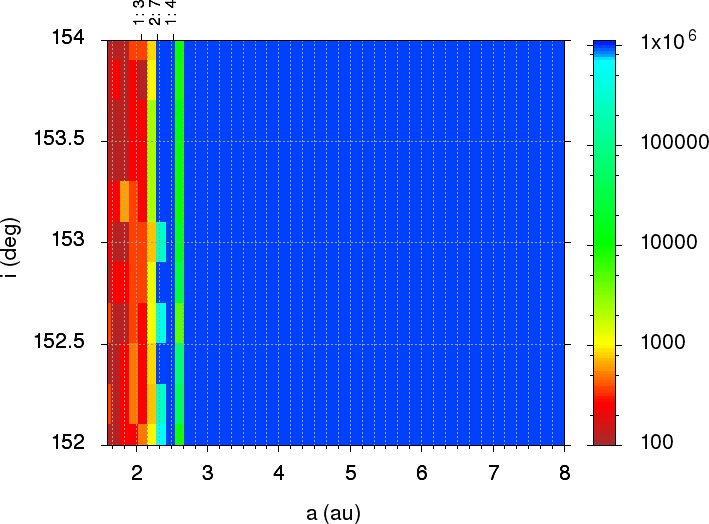 Figure 1
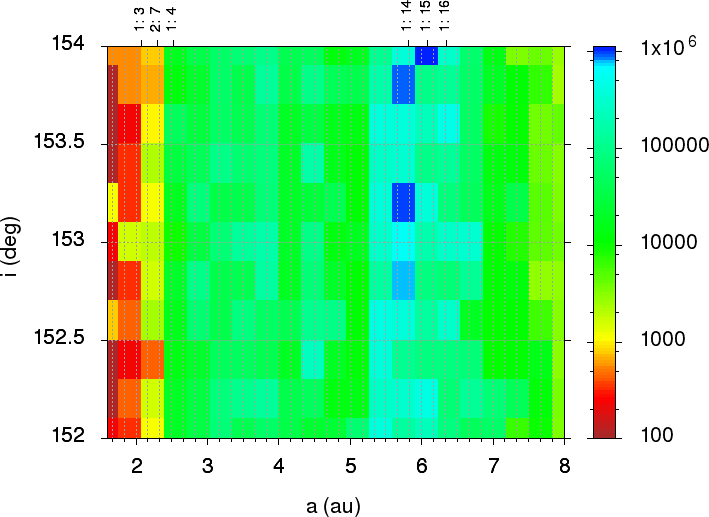 Figure 2
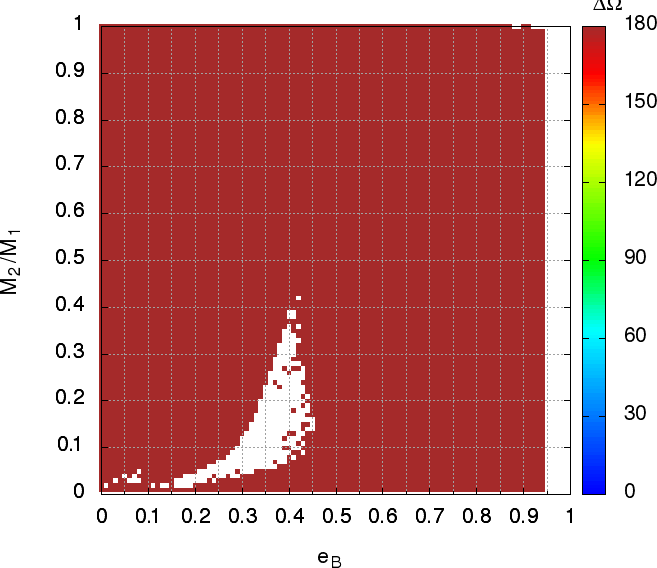 Figure 3
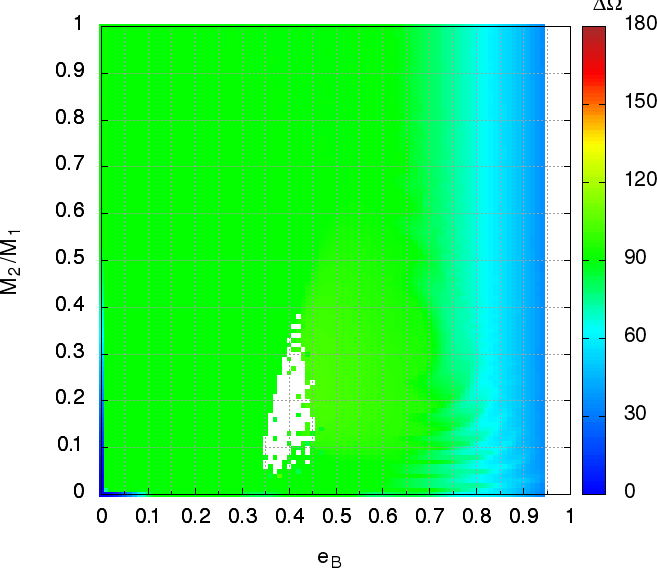 Figure 4
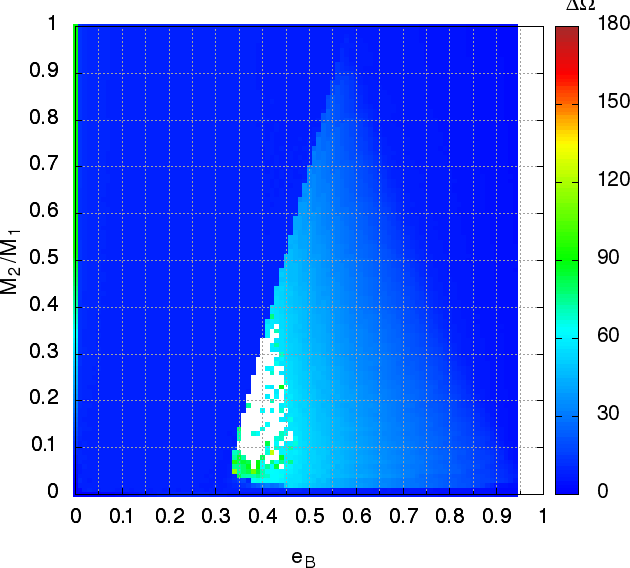 Figure 5
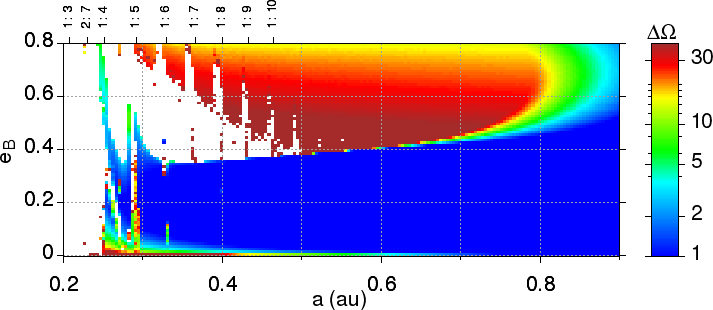 Figure 6
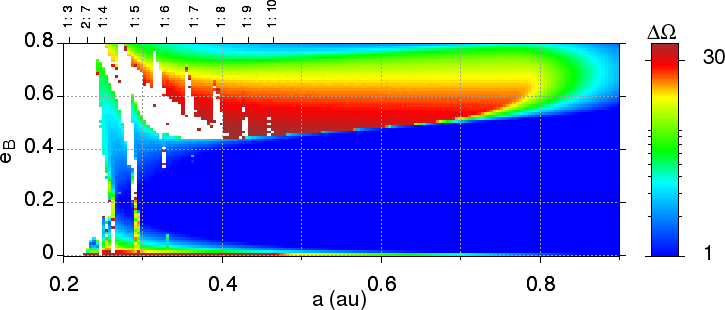 Figure 7
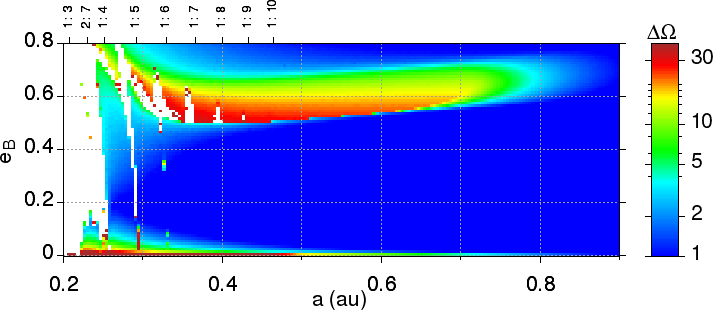 Figure 8
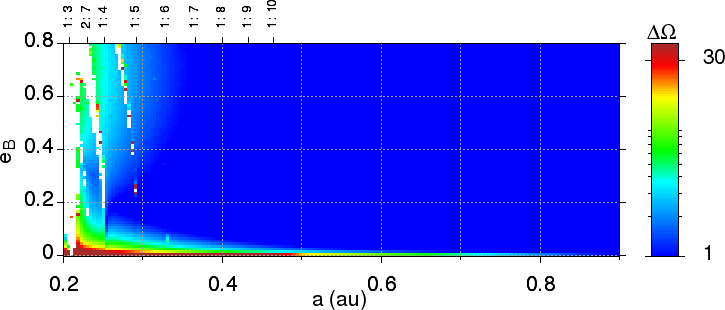 Figure 9
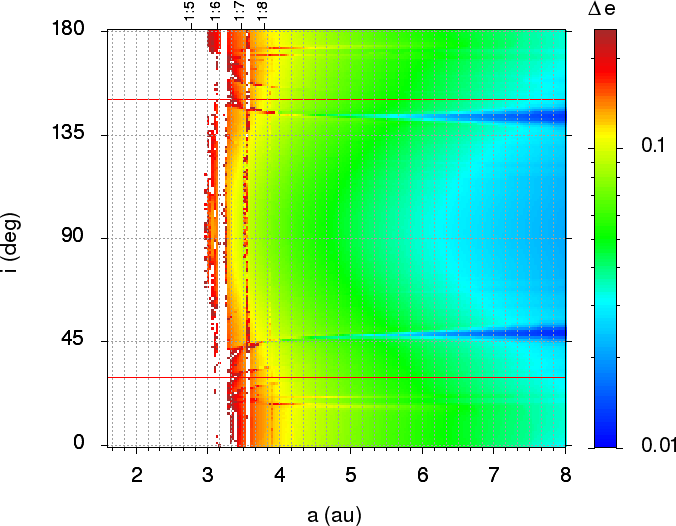 Figure 10
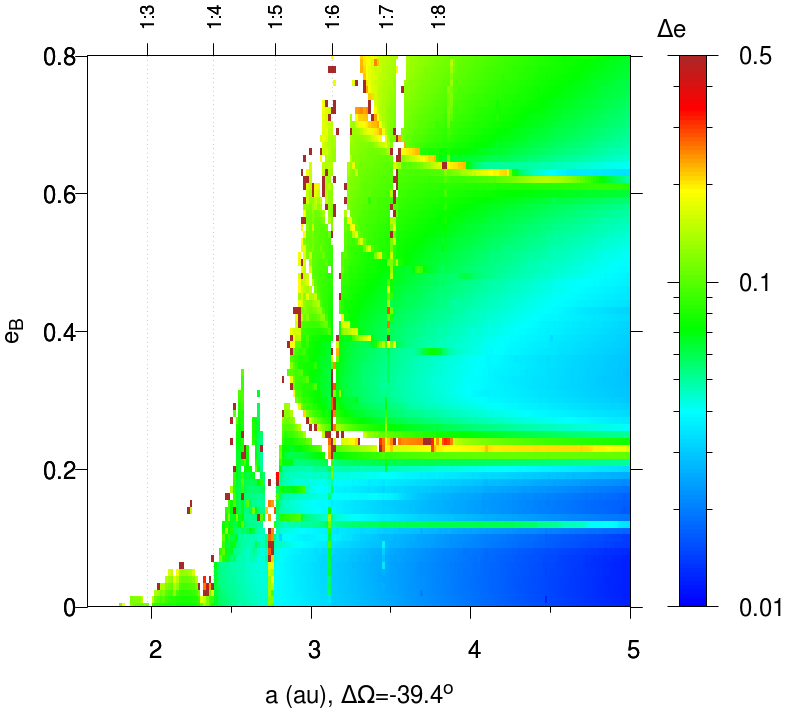 Figure 11
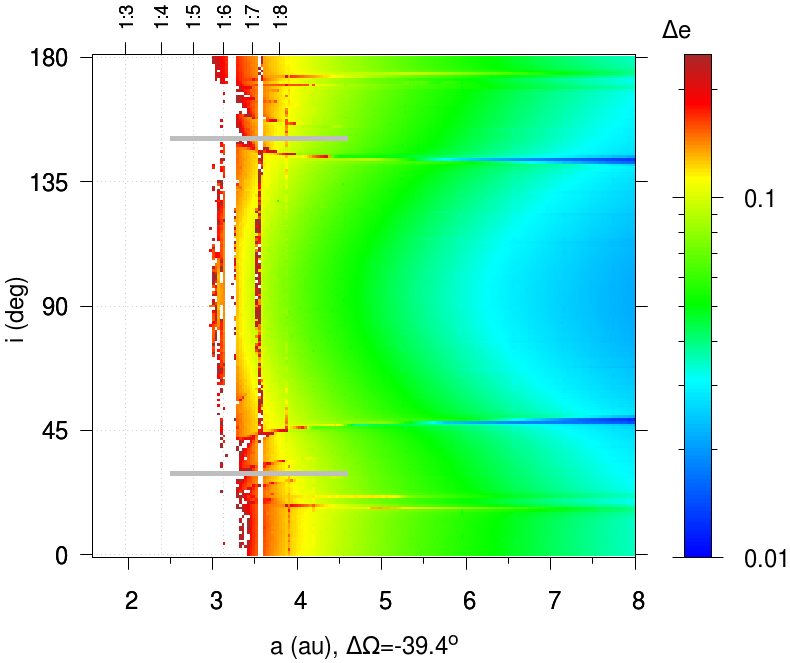 Figure 12
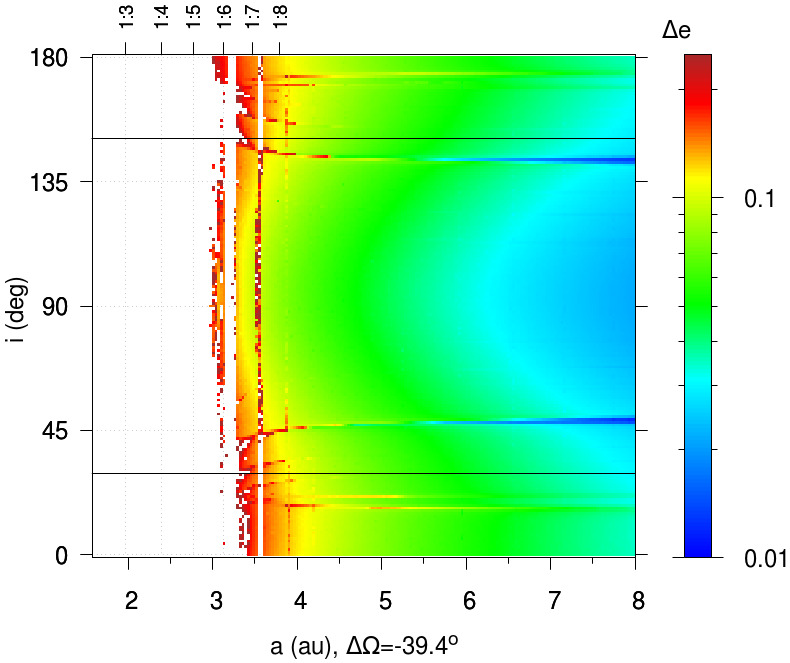 Figure 13
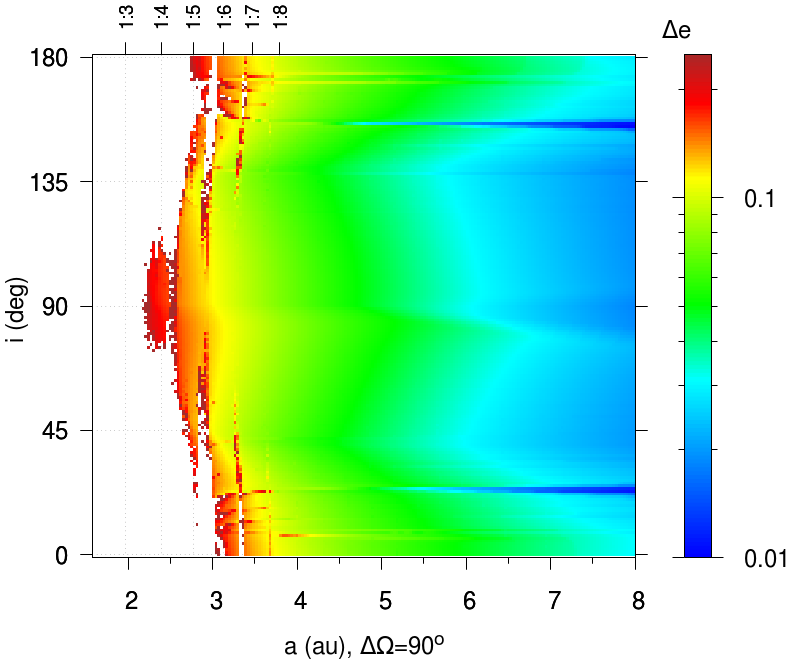 Figure 14
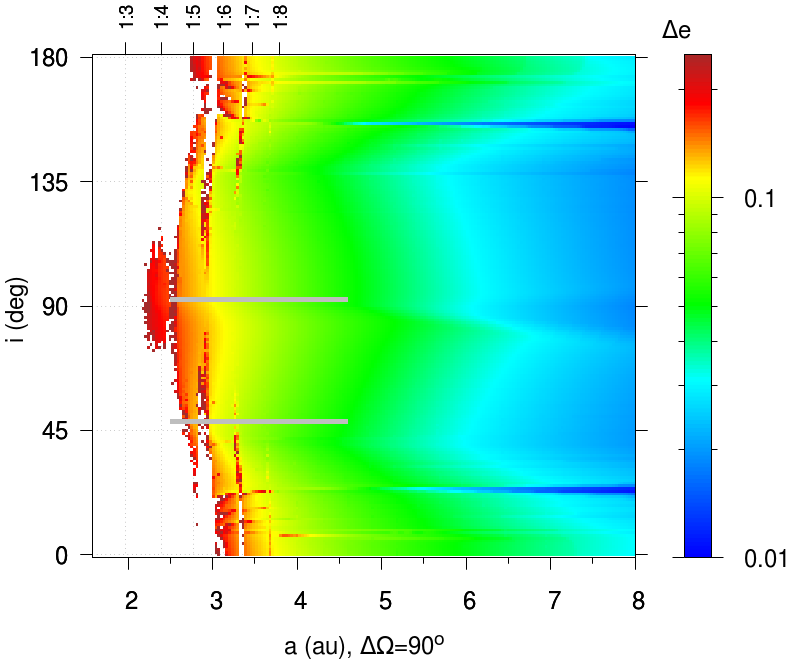 Figure 15
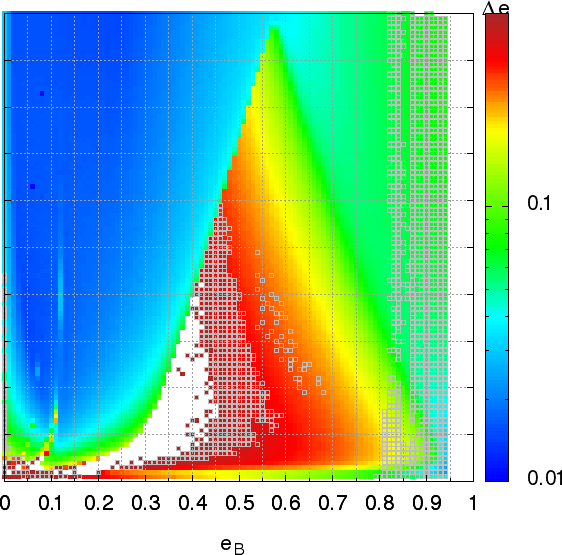 Figure 16
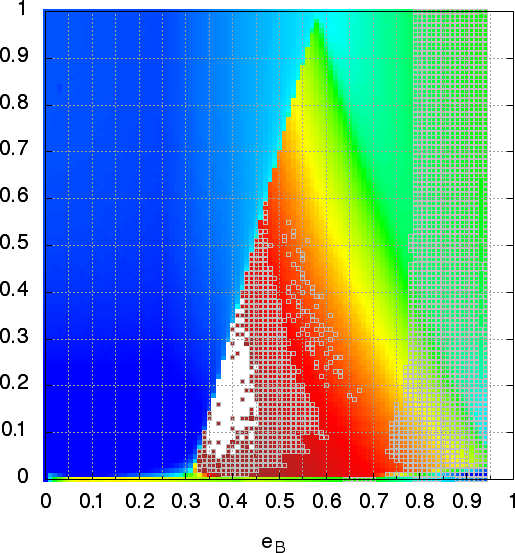 Figure 17
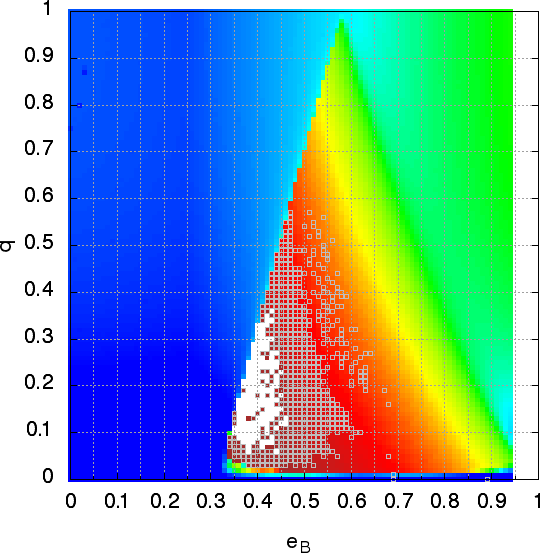 Figure 18
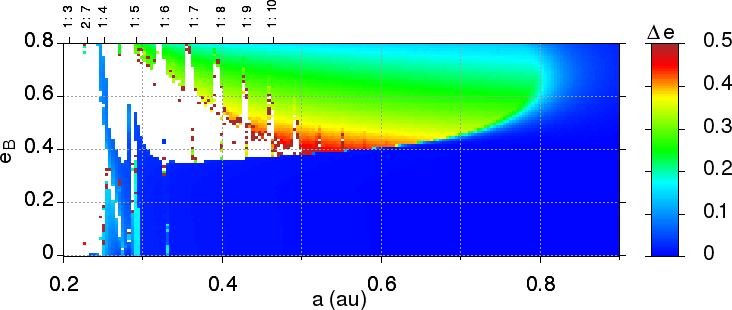 Figure 19
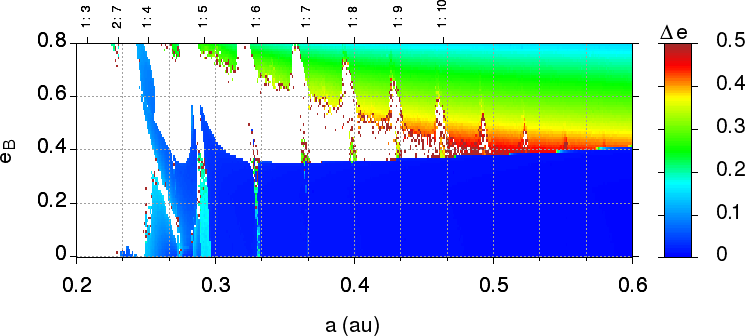 Figure 20
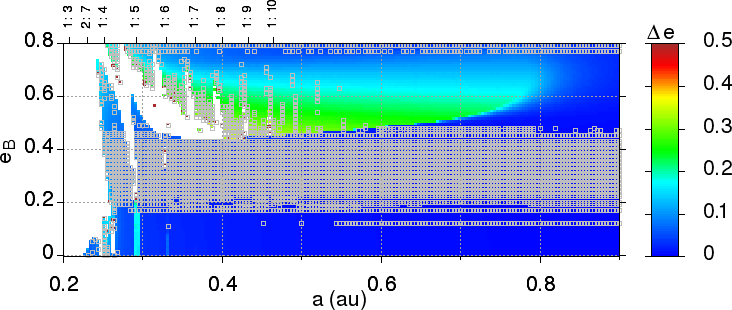 Figure 21
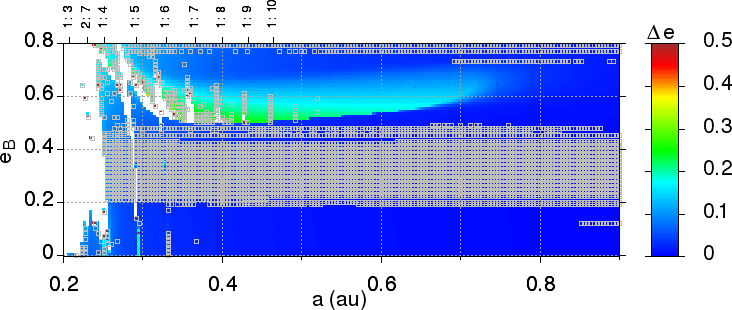 Figure 22
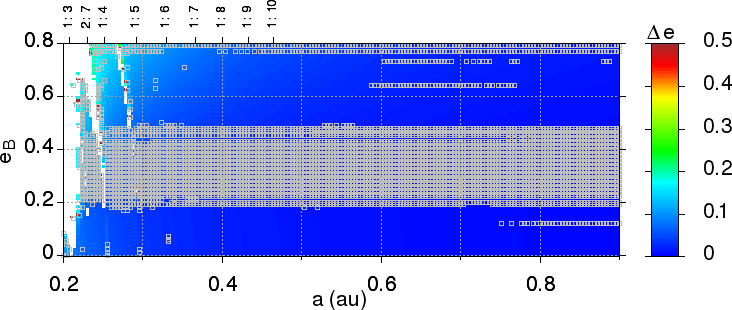 Figure 23
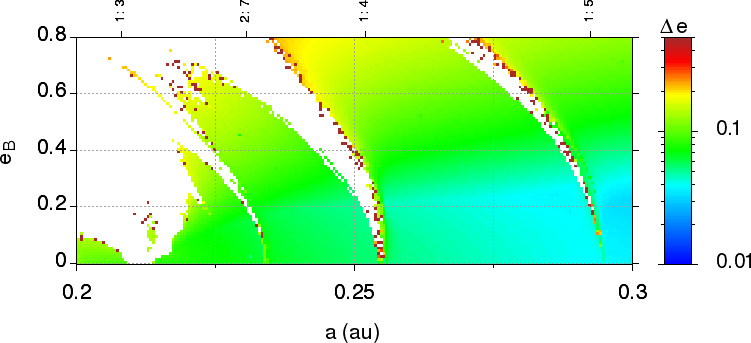 Figure 24
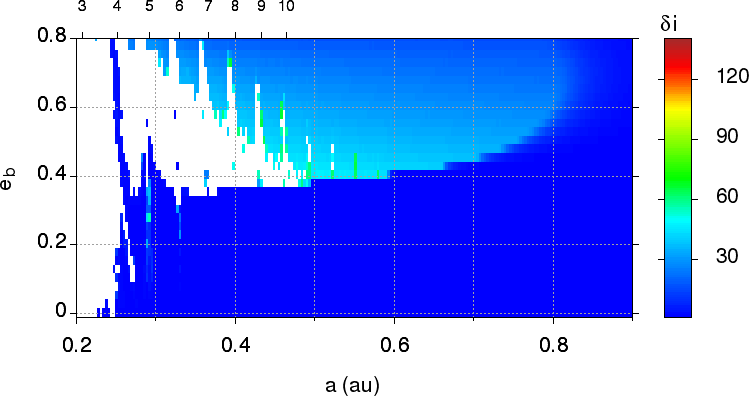 Figure 25
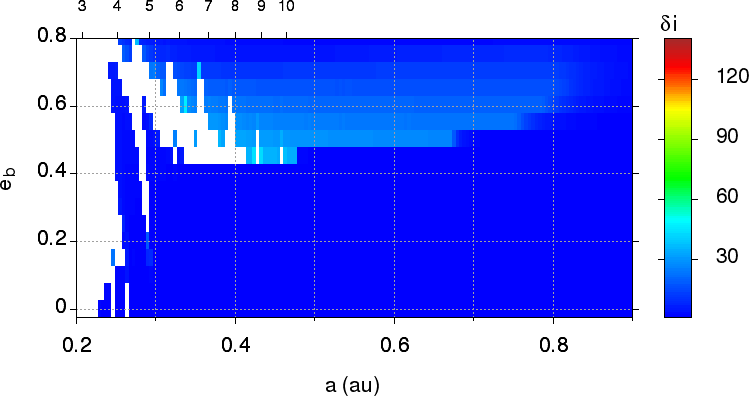 Figure 26
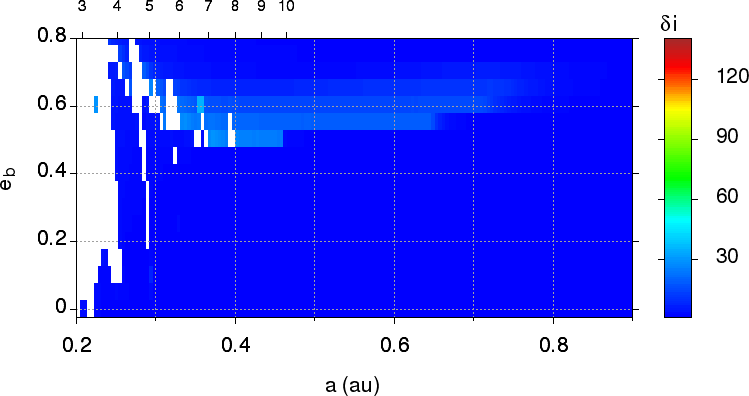 Figure 27
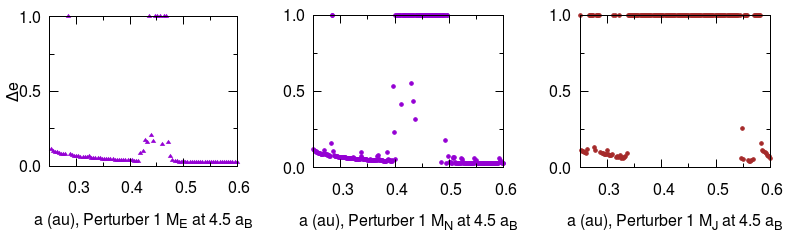 Figure 28
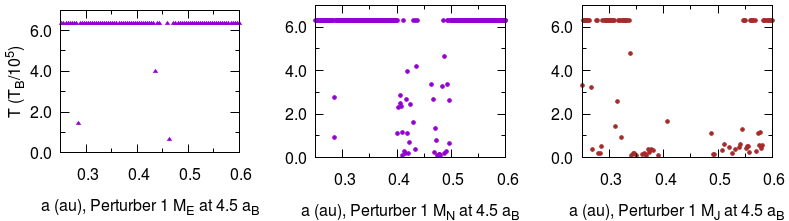 Figure 29
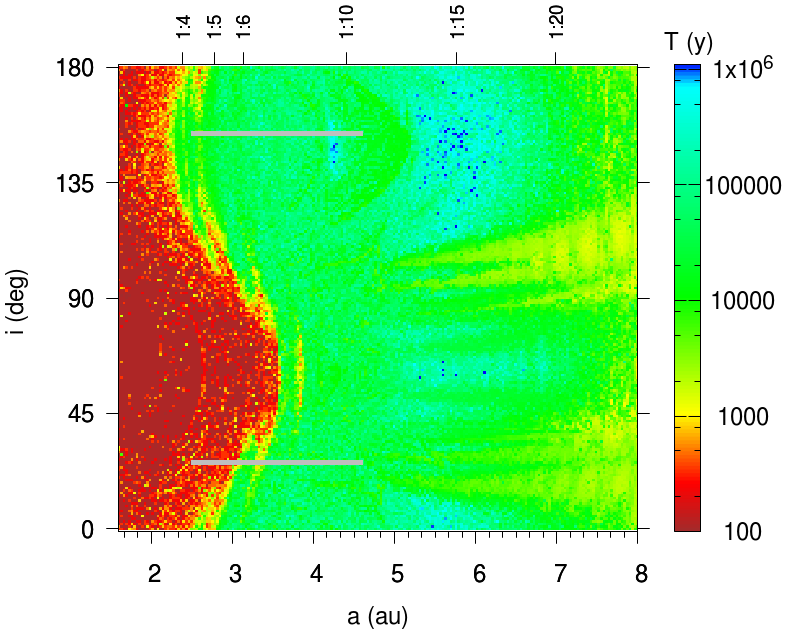 Figure 30
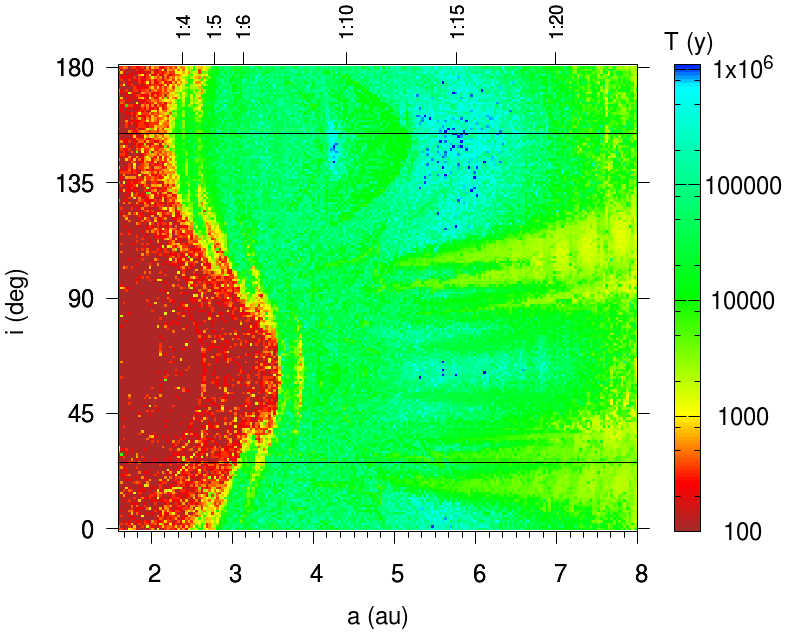 Figure 31
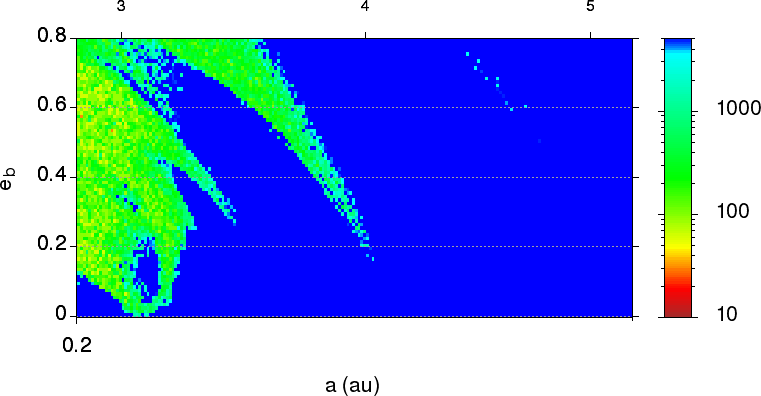 Figure 32
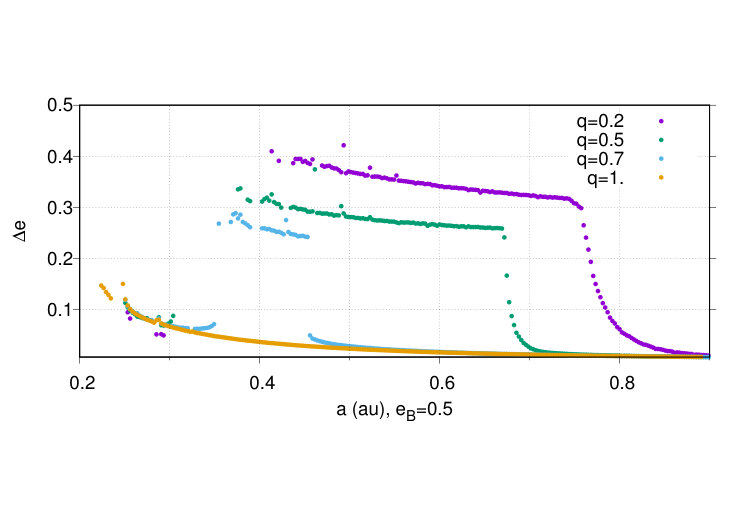 Figure 33
| \brSystem | (au) | (deg) | (deg) | (deg) | Mass () | |
|---|---|---|---|---|---|---|
| \mr | 0.982 | 0.785 | 66.8 | 109.6 | 337.6 | =0.699, = 0.582 |
| Disc | 2.6 - 4.6 | 0.0 | 26 or 154 | 0.0 | 17.0 | - - |
| 54.58 | 0.52 | 88.6 | 64. | 4.2 | +=1.3 | |
| \br |
Peer Reviews
No public reviews on file for this paper yet. If you reviewed it on a platform where reviews are public (OpenReview, ICLR, NeurIPS, ICML), you can paste yours below so the community can read it here.
Videos
No videos yet. Explain this paper in a talk, walkthrough, or lecture? Add one.
Parametric study of polar configurations around binaries
C. A. Giuppone1
N. Cuello2,3
1Universidad Nacional de Córdoba, OAC - IATE, 5000 Córdoba, Argentina
2Instituto de Astrofísica, Pontificia Universidad Católica de Chile, Santiago, Chile.
3Núcleo Milenio de Formación Planetaria (NPF), Chile [email protected]
Abstract
Dynamical studies suggest that most of the circumbinary discs (CBDs) should be coplanar. However, under certain initial conditions, the CBD can evolve toward polar orientation. Here we extend the parametric study of polar configurations around detached close-in binaries through -body simulations. For polar configurations around binaries with mass ratios below , the nominal location of the mean motion resonance (MMR) predicts the limit of stability for . Alternatively, for or , the nominal location of the MMR is the closest stable region. The presence of a giant planet increases the region of forbidden polar configurations around low mass ratio binaries with eccentricities with respect to rocky earth-like planets. For equal mass stars, the eccentricity excitation of polar orbits smoothly increases with decreasing distance to the binary. For , can reach values as high as . Finally, we studied polar configurations around and show that the region of stability is strongly affected by the relative positions of the nodes. The most stable configurations in the system correspond to polar particles, which are not expected to survive on longer time-scales due to the presence of the external perturber HD .
1 Introduction
Against all odds, the number of circumbinary planets is slowly increasing. To date, 22 circumbinary (P-type) planetary systems have been catalogued, with 11 transiting circumbinary planets detected by Kepler around nine binary star systems [1]. The binaries eccentricities range from quasi circular orbits (Kepler-47, [2]) to highly eccentric (Kepler-34, [3]). All the transiting binaries have short periods ( days). Moreover, the detected planets have almost circular coplanar orbits and semi-major axis ratios with the binary . Typical planets found around binary stellar systems have a radius of the order of Earth radii and orbital periods of about days (i.e. au) [4].
Circumbinary (P-type) planets are intrinsically difficult to observe through radial velocities, which translates in a discrimination in Doppler planet searches [5, 6]. Hence, these planets are more easily observed through transit methods — provided precise considerations on the geometry of transit are considered [7]. The occurrence rate of circumbinary planets is comparable to that of planets around single stars if the mutual inclination is always small (), while this rate may be much larger if modest inclinations () are common [8].
For circumbinary planetesimals in coplanar orbits, eccentricities evolve on a dynamical timescale, which leads to orbital crossings even in the presence of gas drag. This makes the current locations of the circumbinary Kepler planets hostile to planetesimal accretion [9, 10]. Additionally, stellar-tidal evolution models of short-period binaries show that the binary orbital period increases with time [11, 12]. This translates into a larger region of dynamical instability around the binary, which could explain the lower frequency of P-type planets compared to S-type planets.
Planets form within circumbinary discs, that are typically assumed to be aligned with the binary [13, 14]. Misaligned circumbinary discs (CBDs) were considered as unlikely or at least transient; however, the observations of highly non-coplanar systems such as 99 Herculis [15], IRS 43 [16], GG Tau [17, 18], and HD 142527 [19] suggest otherwise. More importantly, the very first confirmation of a circumbinary gas-rich disc in a polar configuration HD 98800 [20] motivates our study. Previous works based on Smoothed Particle Hydrodynamics (SPH) simulations studied specific conditions for polar alignment of the disc around binaries [21, 22]. This mechanism has been further investigated providing an analytical framework to describe the polar alignment of CBDs [23, 24]. In particular, [25] conducted an extensive numerical exploration through SPH simulations. Lastly, the symmetry breaking between prograde and retrograde CBDs reported by [26, 27] could increase the likelihood of polar alignment.
For these reasons, it is important to further understand the stability of polar configurations around binary stars. In [27] we presented the most favourable conditions for regular movement of particles and planets around binaries. Here, we extend these results for a wider variety of configurations and analyse the case of HD 98800.
2 Dynamics around binaries
The secular evolution of a planet around a binary was presented in [28] and later investigated in [29], where they reported the coupling between the inclination and the node of particles. Then, [30] studied the circumbinary elliptical restricted and general three-body problem, giving an averaged quadrupolar Hamiltonian. In their formulation, the eccentricity of the outer particle/planet remains constant (i.e. ). This is not longer valid if the octupole expansion is considered or in full -body integrations (as in [27] and this work).
An analysis of the stability of inclined massless particles was done by [31] where they consider different binary eccentricities and mass ratios between its components. Furthermore, based on the study of hierarchical triple systems, several other studies investigated the circumbinary polar orbits for the restricted problem considering the octupole Hamiltonian [32, 33, 34]. Interestingly, for near polar configurations, the inner binary can significantly excite the orbital eccentricity (up to about in some cases, as shown by [34]). Lastly, the evolution of polar orbits considering relativistic effects was studied by [35, 36]. The latter effects are beyond the scope of this work.
Here, we consider a binary system with total mass and individual masses and , with a binary mass ratio . To describe the motion of a P-type particle (planet) we use the Jacobi orbital elements semi-major axis , eccentricity , inclination (with respect to the binary orbital plane), mean longitude , longitude of pericentre (alternatively argument of pericentre ), and longitude of the ascending node . The sub-index is used when referring to the binary orbit. Without loss of generality, we set initial conditions {, , }. The angles of a given particle are measured from the direction of the binary pericentre.
For a P-type particle the phase space has two equilibrium points at {}, where both angles librate. For any given pair of it is possible to calculate the separatrix F as follows [30],
[TABLE]
Then, polar alignment is expected when
[TABLE]
Therefore, the higher the binary eccentricity and the closer the node of the particle to , the larger the region of polar orbits. In the next section, we numerically explore the stability for a wide range of in polar configurations initially placed at .
3 Stability of polar orbits
Since polar configurations are a possible outcome for the evolution of misaligned gaseous discs around sub-au binaries [23, 24, 4, 27], it is relevant to identify which are the allowed configurations once the gas is dissipated, in a similar way as in [37] for the study of the coplanar case.
As mentioned previously, the binary sample of Kepler systems ranges from and . Therefore, we choose to explore the stability of massless polar particles for different binary mass ratios .
In all our dynamical maps each orbit was integrated for at least 365 000 binary periods. If the particle either collides with one of the stars or escapes from the system, then it is coloured in white. In order to identify the dynamical regimes of movement, we calculated the Megno (Mean Exponential Growth of Nearby Orbits) value for each orbit [38], along with the maximum and the maximum values attained during the dynamical evolution. We solve the -body equations of motion numerically by means of a double-precision Bulirsch-Stoer integrator with tolerance .
In [27] we studied the behaviour of planets around a binary with , and showed that planets with masses exhibit rapid node circulation. In this case, the coupled oscillation with the eccentricity, leads the planet to describe a pulsating sphere around the binary. In Figure 1, we show the eccentricity excitation in the () plane for different planetary masses (, , ), setting . The value of is similar to the observed configurations of Kepler systems au). As expected, the chaotic orbits are correlated with high values of . Moreover, we observe that the larger the planetary mass, the more significant the instability region. More specifically, Earth-like planets remain with low and Neptune-like planets exhibit ; whereas the node of Jupiter-Like planets always circulates.
In Figure 2, we show the eccentricity amplitude of polar orbits around a binary with , for different mass ratios . This extends the region studied in [27]. The eccentricity excitation remains below only for binaries with . For different values of , the particle experiences a significant eccentricity excitation, that strongly depends on its initial semi-major axis (contrary to the analytical model prediction in [30]). Higher values of eventually trigger instability, which leads to the disruption of the system. Hence, eccentricity excitation can have dramatic dynamical effects on long time-scales.
Finally, we choose to analyse the polar orbits in the plane () for different mass ratios . In Figure 3, we observe (almost) vertical stripes associated to the mean motion resonances (MMRs), where eccentricity is efficiently excited. For polar orbits, the , , and MMRs are the most prominent features. Their nominal location is displaced closer to the binary for increasing eccentricities . In Figure 4, we show a zoomed region of these maps for and , where the limit of the stability region can be better appreciated. The latter is associated with the resonances.
The often-quoted study of [39] numerically derived a stability limit for circular coplanar particles around binaries:
[TABLE]
where .
Alternatively, we found that in polar configurations with mass ratios below (), the nominal location of the MMR predicts the limit of stability for ; while, if or , the nominal location of the MMR seems to be the innermost limit (see Fig. 3 and zoom in Fig. 4). When , the perturbations on the particles become more significant and only particles with remain unaffected by the perturbation. Then, using the MMR location, we can estimate a rule of thumb for the stability of polar orbits as:
[TABLE]
4 Inclined orbits around HD 98800 BaBb
The HD 98800 system is a hierarchical quadruple stellar system, composed by two pairs of binaries (called ‘’ and ‘’, or equally ‘’ and ‘’). The very eccentric binary is well constrained [40] and hosts a bright circumbinary disc discovered by [41]. Using new data [20] derived the orbit111We note that there are small systematic differences between the supplementary material and the main text.. The disc around ‘’ has an inner edge truncated by the binary , and the outer edge externally truncated by the companion . The orientation of the disc was initially thought to be coplanar with the inner binary, but higher-resolution observations suggest a different orientation recently confirmed by [20]. Two solutions were proposed for the disc [20]: it is inclined either by or by with respect to the sky, which corresponds to an inclination with respect to the binary222The mutual inclination is obtained through spherical trigonometry: [42].. of or (respectively). A CBD in polar configuration is hence possible (and likely) in this system. The millimetric dust is observed to be on circular orbits with . Previous -body simulations for the two possible inclinations showed that the dust is ejected in less than Myr, implying that that the dust observed with alma is embedded within a more massive gas disc that stabilises the disc against the exterior stellar perturbations of HD 98900 [20].
We study this system using initial conditions from Table 1, where the perturbing pair is modelled as a single star like in [20]. We note that accurate orbit determination for binaries without a complete period is extremely difficult. As a matter of fact, orbital fits exhibit high correlation between the period and the eccentricity [43], depending on the phase covered by the observations. This correlation can be observed in the table given at http://www.ctio.noao.edu/~atokovin/stars/stars.php?cat=HD&number=98800.
In our previous section (see Fig. 3), the systems are initially located at the equilibrium configuration (, ). The binary has a mass ratio , an eccentricity , and . Then, it is meaningful to analyse the stability of polar orbits for this kind of binary. In Figure 5, we show the stability of polar particles in the (, ) plane without considering the external perturber , setting (left frame) and with the observational measured value of (right frame). In the latter case, the stable polar regions around the MMR disappear and only particles on polar orbits beyond the MMR are stable (that corresponds to ). Our integrations show that even without the external perturber, the disc of dust is unstable for .
In Figure 6 we show the stability of polar particles around the binary HD 98800 BaBb in the (, ) plane, without considering the external perturber and setting and (i.e. ). When the binary is eccentric (), the MMR location ( au) is the closest stable region. If the binary HD 98800 BaBb eventually circularises thought tidal interaction (see e.g. [44]), then the stability of closer polar orbits would be located around the MMR ( au).
Finally, in Fig. 7 we show the dynamical map in the (, ) plane for the full four-body problem — coloured with the ejection time from the system — using the data from Table 1. The most stable conditions (i.e. with survival times of Myr) are found for almost polar configuration (), for au and au (beyond the measured location of the disc of dust). Interestingly, if new orbital determinations put the exterior perturber on a wider orbit, then the polar orbits around the binary would become stable on longer timescales.
5 Conclusions
Here we extended the previous study by [27] on polar configurations around eccentric binaries. The stability of single polar planets around binaries is weakly dependent on the planetary mass (see Fig. 1). There is however a planetary mass threshold () above which the planet exhibits rapid node circulation (as shown in [27]).
We find that the eccentricity excitation strongly depends on the distance to the binary. Then, assuming planets form in the external disc regions and then migrate inwards, this excitation eventually triggers instability. Alternatively, the eccentricity excitation remains very low for when . Generally, for massless particles, the orbits with exhibit chaotic Megno (see Fig. 2).
For polar orbits around binaries with mass ratios below , the nominal location of the mean motion resonance (MMR) predicts the limit of stability for ; while if or , the nominal location of the MMR is the closest stable region to the binary (see Fig. 3).
Finally, we analysed the HD 98800 system where there is a circumbinary disc around being currently perturbed by an outer binary . In particular, we studied the stability of the system with and without the additional binary, for any arbitrary inclination. We find that the near polar configuration for the circumbinary disc around is the more stable among the all possible disc inclinations. We also conclude that — in the absence of gas — the instability would not be due to the polar configuration itself, but rather to the gravitational perturbations of the outer binary (see Fig. 7).
\ack
This work has been supported by research grants from CONICET and Secyt-UNC. -body computations were performed at Mulatona Cluster from CCAD-UNC, which is part of SNCAD-MinCyT, Argentina. NC acknowledges financial support provided by FONDECYT grant 3170680 and from CONICYT project Basal AFB-170002. This project has received funding from the European Union’s Horizon 2020 research and innovation programme under the Marie Skłodowska-Curie grant agreement No 823823.
References
- [1]
Schwarz R, Funk B, Zechner R and Bazsó Á 2016 MNRAS 460 3598–3609 (Preprint 1608.00764)
- [2]
Orosz J A, Welsh W F, Carter J A, Fabrycky D C, Cochran W D, Endl M, Ford E B, Haghighipour N, MacQueen P J, Mazeh T, Sanchis-Ojeda R, Short D R, Torres G, Agol E, Buchhave L A, Doyle L R, Isaacson H, Lissauer J J, Marcy G W, Shporer A, Windmiller G, Barclay T, Boss A P, Clarke B D, Fortney J, Geary J C, Holman M J, Huber D, Jenkins J M, Kinemuchi K, Kruse E, Ragozzine D, Sasselov D, Still M, Tenenbaum P, Uddin K, Winn J N, Koch D G and Borucki W J 2012 Science 337 1511 (Preprint 1208.5489)
- [3]
Welsh W F, Orosz J A, Carter J A, Fabrycky D C, Ford E B, Lissauer J J, Prša A, Quinn S N, Ragozzine D, Short D R, Torres G, Winn J N, Doyle L R, Barclay T, Batalha N, Bloemen S, Brugamyer E, Buchhave L A, Caldwell C, Caldwell D A, Christiansen J L, Ciardi D R, Cochran W D, Endl M, Fortney J J, Gautier Thomas N I, Gilliland R L, Haas M R, Hall J R, Holman M J, Howard A W, Howell S B, Isaacson H, Jenkins J M, Klaus T C, Latham D W, Li J, Marcy G W, Mazeh T, Quintana E V, Robertson P, Shporer A, Steffen J H, Windmiller G, Koch D G and Borucki W J 2012 Nature 481 475–479 (Preprint 1204.3955)
- [4]
Martin D V 2018 Populations of Planets in Multiple Star Systems p 156
- [5]
Eggenberger A and Udry S 2007 arXiv e-prints arXiv:0705.3173 (Preprint 0705.3173)
- [6]
Wright J T, Marcy G W, Howard A W, Johnson J A, Morton T D and Fischer D A 2012 ApJ 753
- [7]
Martin D V and Triaud A H M J 2014 A&A 570
- [8]
Armstrong D J, Osborn H P, Brown D J A, Faedi F, Gómez Maqueo Chew Y, Martin D V, Pollacco D and Udry S 2014 MNRAS 444 1873–1883 (Preprint 1404.5617)
- [9]
Moriwaki K and Nakagawa Y 2004 ApJ 609 1065–1070
- [10]
Paardekooper S J, Leinhardt Z M, Thébault P and Baruteau C 2012 ApJ 754 L16 (Preprint 1206.3484)
- [11]
Fleming D, Barnes R, Graham D E, Luger R and Quinn T R 2018 On the Lack of Circumbinary Planets Orbiting Isolated Binary Stars American Astronomical Society, DDA meeting 49, id.202.06
- [12]
Fleming D P, Barnes R, Davenport J R A and Luger R 2019 arXiv e-prints arXiv:1903.05686 (Preprint 1903.05686)
- [13]
Foucart F and Lai D 2013 ApJ 764
- [14]
Foucart F and Lai D 2014 MNRAS 445 1731–1744 (Preprint 1406.3331)
- [15]
Kennedy G M, Wyatt M C, Sibthorpe B, Duchêne G, Kalas P, Matthews B C, Greaves J S, Su K Y L and Fitzgerald M P 2012 MNRAS 421 2264–2276
- [16]
Brinch C, Jørgensen J K, Hogerheijde M R, Nelson R P and Gressel O 2016 ApJ 830
- [17]
Cazzoletti P, Ricci L, Birnstiel T and Lodato G 2017 A&A 599 A102
- [18]
Aly H, Lodato G and Cazzoletti P 2018 MNRAS 480 4738–4745
- [19]
Avenhaus H, Quanz S P, Schmid H M, Dominik C, Stolker T, Ginski C, de Boer J, Szulágyi J, Garufi A, Zurlo A, Hagelberg J, Benisty M, Henning T, Ménard F, Meyer M R, Baruffolo A, Bazzon A, Beuzit J L, Costille A, Dohlen K, Girard J H, Gisler D, Kasper M, Mouillet D, Pragt J, Roelfsema R, Salasnich B and Sauvage J F 2017 AJ 154 33
- [20]
Kennedy G M, Matrà L, Facchini S, Milli J, Panić O, Price D, Wilner D J, Wyatt M C and Yelverton B M 2019 Nature Astronomy 189
- [21]
Aly H, Dehnen W, Nixon C and King A 2015 MNRAS 449 65–76 (Preprint 1501.04623)
- [22]
Martin R G and Lubow S H 2017 ApJ 835
- [23]
Zanazzi J J and Lai D 2018 MNRAS 473 603–615
- [24]
Lubow S H and Martin R G 2018 MNRAS 473 3733–3746
- [25]
Martin R G and Lubow S H 2018 MNRAS 1568 (Preprint 1806.08388)
- [26]
Cuello N and Giuppone C A 2018 Exotic Tatooines in misaligned circumbinary discs SF2A-2018: Proceedings of the Annual meeting of the French Society of Astronomy and Astrophysics p Di
- [27]
Cuello N and Giuppone C A 2019 arXiv e-prints arXiv:1906.10579 (Preprint 1906.10579)
- [28]
Ziglin S L 1975 Soviet Astronomy Letters 1 194
- [29]
Verrier P E and Evans N W 2009 MNRAS 394 1721–1726 (Preprint 0812.4528)
- [30]
Farago F and Laskar J 2010 MNRAS 401 1189–1198
- [31]
Doolin S and Blundell K M 2011 MNRAS 418 2656–2668 (Preprint 1108.4144)
- [32]
Ford E B, Kozinsky B and Rasio F A 2000 ApJ 535 385–401
- [33]
Naoz S, Farr W M, Lithwick Y, Rasio F A and Teyssandier J 2013 MNRAS 431 2155–2171 (Preprint 1107.2414)
- [34]
Li D, Zhou J L and Zhang H 2014 MNRAS 437 3832–3841
- [35]
Naoz S, Li G, Zanardi M, de Elía G C and Di Sisto R P 2017 AJ 154
- [36]
Zanardi M, de Elía G C, Di Sisto R P and Naoz S 2018 A&A 615 A21 (Preprint 1804.01145)
- [37]
Quarles B, Satyal S, Kostov V, Kaib N and Haghighipour N 2018 ApJ 856 150 (Preprint 1802.08868)
- [38]
Cincotta P M and Simó C 2000 Astronomy & Astrophysics Supplement 147 205–228
- [39]
Holman M J and Wiegert P A 1999 AJ 117 621–628 (Preprint astro-ph/9809315)
- [40]
Boden A F, Sargent A I, Akeson R L, Carpenter J M, Torres G, Latham D W, Soderblom D R, Nelan E, Franz O G and Wasserman L H 2005 ApJ 635 442–451 (Preprint astro-ph/0508331)
- [41]
Walker H J and Wolstencroft R D 1988 PASP 100 1509
- [42]
Giuppone C A, Morais M H M, Boué G and Correia A C M 2012 A&A 541 A151 (Preprint 1203.5249)
- [43]
Giuppone C A, Leiva A M, Correa-Otto J and Beaugé C 2011 A&A 530 A103 (Preprint 1105.0243)
- [44]
Hut P 1981 A&A 99 126–140
The reference list from the paper itself. Each links out to its DOI / PubMed record.
- 1[1] Schwarz R, Funk B, Zechner R and Bazsó Á 2016 MNRAS 460 3598–3609 ( Preprint 1608.00764 )
- 2[2] Orosz J A, Welsh W F, Carter J A, Fabrycky D C, Cochran W D, Endl M, Ford E B, Haghighipour N, Mac Queen P J, Mazeh T, Sanchis-Ojeda R, Short D R, Torres G, Agol E, Buchhave L A, Doyle L R, Isaacson H, Lissauer J J, Marcy G W, Shporer A, Windmiller G, Barclay T, Boss A P, Clarke B D, Fortney J, Geary J C, Holman M J, Huber D, Jenkins J M, Kinemuchi K, Kruse E, Ragozzine D, Sasselov D, Still M, Tenenbaum P, Uddin K, Winn J N, Koch D G and Borucki W J 2012 Science 337 1511 ( Preprint 1
- 3[3] Welsh W F, Orosz J A, Carter J A, Fabrycky D C, Ford E B, Lissauer J J, Prša A, Quinn S N, Ragozzine D, Short D R, Torres G, Winn J N, Doyle L R, Barclay T, Batalha N, Bloemen S, Brugamyer E, Buchhave L A, Caldwell C, Caldwell D A, Christiansen J L, Ciardi D R, Cochran W D, Endl M, Fortney J J, Gautier Thomas N I, Gilliland R L, Haas M R, Hall J R, Holman M J, Howard A W, Howell S B, Isaacson H, Jenkins J M, Klaus T C, Latham D W, Li J, Marcy G W, Mazeh T, Quintana E V, Robertson P, Shpor
- 4[4] Martin D V 2018 Populations of Planets in Multiple Star Systems p 156
- 5[5] Eggenberger A and Udry S 2007 ar Xiv e-prints ar Xiv:0705.3173 ( Preprint 0705.3173 )
- 6[6] Wright J T, Marcy G W, Howard A W, Johnson J A, Morton T D and Fischer D A 2012 Ap J 753
- 7[7] Martin D V and Triaud A H M J 2014 A&A 570
- 8[8] Armstrong D J, Osborn H P, Brown D J A, Faedi F, Gómez Maqueo Chew Y, Martin D V, Pollacco D and Udry S 2014 MNRAS 444 1873–1883 ( Preprint 1404.5617 )