ADF22: Blind detections of [CII] line emitters shown to be spurious
Natsuki H. Hayatsu, Rob J. Ivison, Paola Andreani, Hideki Umehata,, Yuichi Matsuda, Naoki Yoshida, Kotaro Kohno, Bunyo Hatsukade, Akio K. Inoue,, Yoichi Tamura, Tutomu T. Takeuchi, Seiji Fujimoto, Minju M. Lee, Tohru Nagao,, and Yiping Ao

TL;DR
This study re-examines two candidate [CII] emitters at high redshift using deeper ALMA observations, finds neither candidate, and reveals a higher-than-expected rate of spurious detections in previous blind surveys.
Contribution
It provides evidence that blind [CII] emitter detections at z ~ 6 may be unreliable, highlighting the need for follow-up observations to confirm high-redshift galaxy candidates.
Findings
Neither candidate was confirmed in deeper observations.
The contamination rate of initial detections is higher than previously estimated.
The cause of spurious detections remains under investigation.
Abstract
We report Atacama Large Millimetre/submillimeter Array (ALMA) Cycle-5 follow-up observations of two candidate [CII] emitters at z ~ 6 in the ALMA deep field in SSA22 (ADF22). The candidates were detected blindly in a Cycle-2 ALMA survey covering ~ 5 square arcmins, with a single tuning, along with two CO lines associated with galaxies at lower redshifts. Various tests suggested at least one of the two > 6-sigma [CII] candidates should be robust (Hayatsu et al. 2017). Nevertheless, our new, deeper observations recover neither candidate, demonstrating a higher contamination rate than expected. The cause of the spurious detections is under investigation but at present it remains unclarified.
Click any figure to enlarge with its caption.
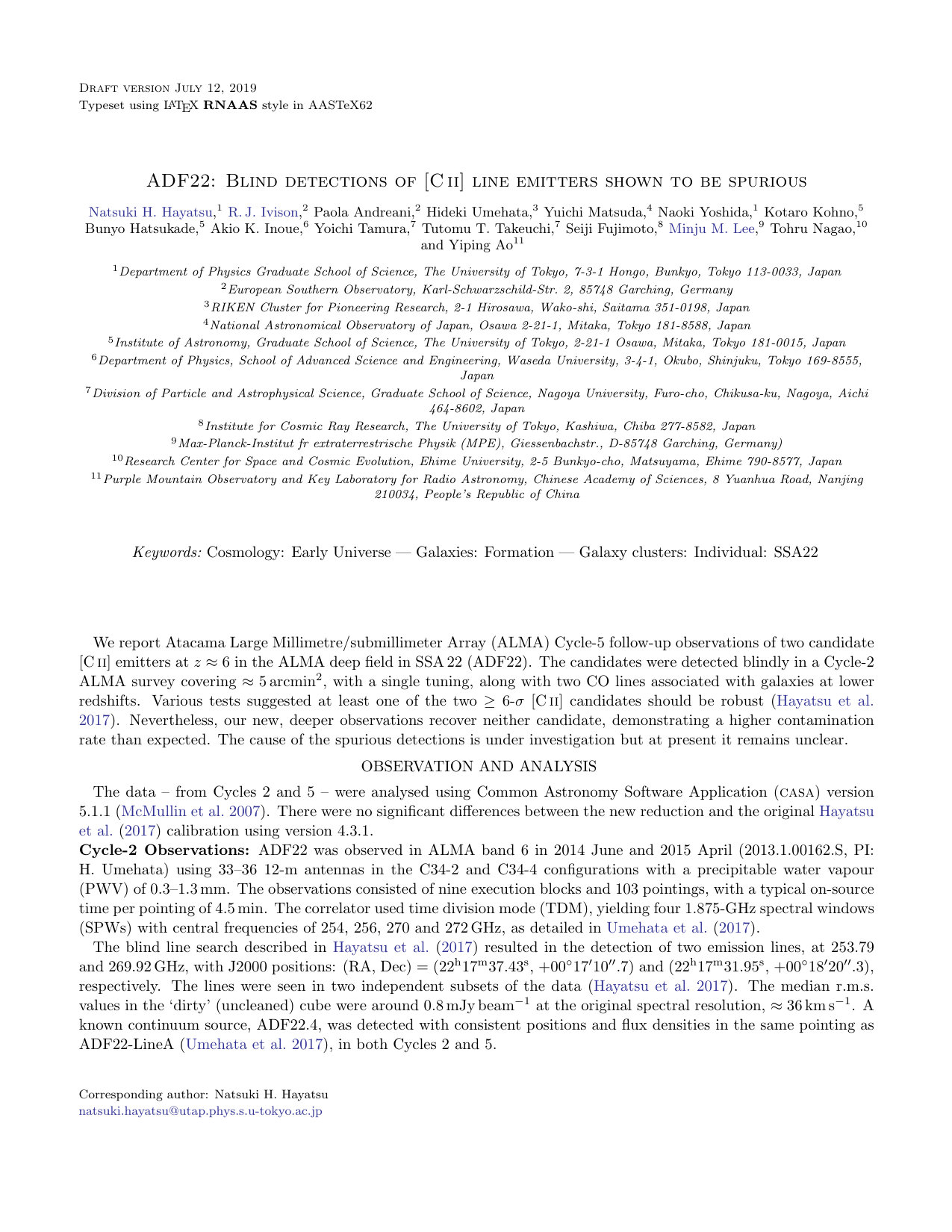 Figure 1
 Figure 1
Peer Reviews
No public reviews on file for this paper yet. If you reviewed it on a platform where reviews are public (OpenReview, ICLR, NeurIPS, ICML), you can paste yours below so the community can read it here.
Videos
No videos yet. Explain this paper in a talk, walkthrough, or lecture? Add one.
Taxonomy
TopicsGalaxies: Formation, Evolution, Phenomena · Astrophysics and Star Formation Studies · Astronomy and Astrophysical Research
ADF22: Blind detections of [C ii] line emitters shown to be spurious
Department of Physics Graduate School of Science, The University of Tokyo, 7-3-1 Hongo, Bunkyo, Tokyo 113-0033, Japan
Paola Andreani
European Southern Observatory, Karl-Schwarzschild-Str. 2, 85748 Garching, Germany
Hideki Umehata
RIKEN Cluster for Pioneering Research, 2-1 Hirosawa, Wako-shi, Saitama 351-0198, Japan
Yuichi Matsuda
National Astronomical Observatory of Japan, Osawa 2-21-1, Mitaka, Tokyo 181-8588, Japan
Naoki Yoshida
Department of Physics Graduate School of Science, The University of Tokyo, 7-3-1 Hongo, Bunkyo, Tokyo 113-0033, Japan
Kotaro Kohno
Bunyo Hatsukade
Institute of Astronomy, Graduate School of Science, The University of Tokyo, 2-21-1 Osawa, Mitaka, Tokyo 181-0015, Japan
Akio K. Inoue
Department of Physics, School of Advanced Science and Engineering, Waseda University, 3-4-1, Okubo, Shinjuku, Tokyo 169-8555, Japan
Yoichi Tamura
Tutomu T. Takeuchi
Division of Particle and Astrophysical Science, Graduate School of Science, Nagoya University, Furo-cho, Chikusa-ku, Nagoya, Aichi 464-8602, Japan
Seiji Fujimoto
Institute for Cosmic Ray Research, The University of Tokyo, Kashiwa, Chiba 277-8582, Japan
Max-Planck-Institut für extraterrestrische Physik (MPE), Giessenbachstr., D-85748 Garching, Germany)
Tohru Nagao
Research Center for Space and Cosmic Evolution, Ehime University, 2-5 Bunkyo-cho, Matsuyama, Ehime 790-8577, Japan
Yiping Ao
Purple Mountain Observatory and Key Laboratory for Radio Astronomy, Chinese Academy of Sciences, 8 Yuanhua Road, Nanjing 210034, People’s Republic of China
Cosmology: Early Universe — Galaxies: Formation — Galaxy clusters: Individual: SSA22
1
We report Atacama Large Millimetre/submillimeter Array (ALMA) Cycle-5 follow-up observations of two candidate [C ii] emitters at in the ALMA deep field in SSA 22 (ADF22). The candidates were detected blindly in a Cycle-2 ALMA survey covering arcmin2, with a single tuning, along with two CO lines associated with galaxies at lower redshifts. Various tests suggested at least one of the two - [C ii] candidates should be robust (Hayatsu et al., 2017). Nevertheless, our new, deeper observations recover neither candidate, demonstrating a higher contamination rate than expected. The cause of the spurious detections is under investigation but at present it remains unclear.
2 Observation and Analysis
The data – from Cycles 2 and 5 – were analysed using Common Astronomy Software Application (casa) version 5.1.1 (McMullin et al., 2007). There were no significant differences between the new reduction and the original Hayatsu et al. (2017) calibration using version 4.3.1.
Cycle-2 Observations: ADF22 was observed in ALMA band 6 in 2014 June and 2015 April (2013.1.00162.S, PI: H. Umehata) using 33–36 12-m antennas in the C34-2 and C34-4 configurations with a precipitable water vapour (PWV) of 0.3–1.3 mm. The observations consisted of nine execution blocks and 103 pointings, with a typical on-source time per pointing of 4.5 min. The correlator used time division mode (TDM), yielding four 1.875-GHz spectral windows (SPWs) with central frequencies of 254, 256, 270 and 272 GHz, as detailed in Umehata et al. (2017).
The blind line search described in Hayatsu et al. (2017) resulted in the detection of two emission lines, at 253.79 and 269.92 GHz, with J2000 positions: (RA, Dec) = (, ) and (, ), respectively. The lines were seen in two independent subsets of the data (Hayatsu et al., 2017). The median r.m.s. values in the ‘dirty’ (uncleaned) cube were around 0.8 mJy beam*-1* at the original spectral resolution, km s*-1*. A known continuum source, ADF22.4, was detected with consistent positions and flux densities in the same pointing as ADF22-LineA (Umehata et al., 2017), in both Cycles 2 and 5.
Cycle-5 Observations: Observations to confirm the blind detections of the two [C ii] emission-line candidates were undertaken in 2017 April (2017.1.00602.S, PI: N. H. Hayatsu) in array configuration, C43-3, where the PWV was 1.4 mm. On-source integration times were min, and using frequency division mode (FDM), with dual-polarisation channels over a bandwidth of 7.5 GHz, with four 1.875-GHz SPWs. Single fields centred on the targets were observed at frequencies of 251.284 and 261.183 GHz for ADF22-LineA and ADF22-LineB, respectively.
The median noise value is mJy beam*-1* at km s*-1* spectral resolution for both datasets, similar to the Cycle-2 data; the angular resolution was around .
3 Results and Discussion
3.1 Comparison of data from Cycles 2 and 5
Fig. 1 shows the Cycle-2 and 5 spectra of the line candidates, with a velocity resolution of 36 km s*-1*. We also plot atmospheric transmission and r.m.s. noise. Within the -km s*-1* velocity range around the line centres, the emission-line features seen in Cycle-2 are not reproduced in our Cycle-5 observations.
From our Cycle-5 data we conclude that the emission-line candidates reported by Hayatsu et al. (2017) were spurious; we cannot fully rule out the possibility of a transient line emitter, although the consistent detections in subsets of the data from 2014 and 2015 make a transient line emitter unlikely. Likely the smoothing used in our earlier work enhanced non-Gaussian noise and caused an under-estimate of the contamination rate. Further discussion regarding the false detection rate and completeness in ALMA data, using mock observational data, will be described in Hayatsu et al. (in prep). The Cycle-2 data are undergoing a stage-3 quality-assurance process (QA3) to search for technical issues with the data.
3.2 Implications for the [C ii] luminosity function
Our failure to recover either of the [C ii] candidates allows us to set upper limits on the [C ii] luminosities, , of L⊙.
The resulting limit on the [C ii] luminosity function (LF), together with the lower limit from Swinbank et al. (2012) and the estimate for the local Universe from Hemmati et al. (2017), means the LF can evolve by 2– from –6; it cannot evolve by more than 10.
4 Acknowledgements
This note makes use of the following ALMA data: ADS/JAO.ALMA#2013.1.00162.S and ADS/JAO.ALMA#2017.1.
00602.S. ALMA is a partnership of ESO (representing its member states), NSF (USA) and NINS (Japan), together with NRC (Canada) and NSC and ASIAA (Taiwan) and KASI (Republic of Korea), in cooperation with the Republic of Chile. The Joint ALMA Observatory is operated by ESO, AUI/NRAO and NAOJ.
The reference list from the paper itself. Each links out to its DOI / PubMed record.
- 1Carilli, & Walter (2013) Carilli, C. L., & Walter, F. 2013, ARA&A, 51, 105
- 2Hayatsu et al. (2017) Hayatsu, N. H., Matsuda, Y., Umehata, H., et al. 2017, PASJ, 69, 45
- 3Hemmati et al. (2017) Hemmati, S., Yan, L., Diaz-Santos, T., et al. 2017, Ap J, 834, 36
- 4Mc Mullin et al. (2007) Mc Mullin J. P., Waters B., Schiebel D., Young W., Golap K., 2007, ASPC, 376, 127
- 5Swinbank et al. (2012) Swinbank A. M., et al., 2012, MNRAS, 427, 1066
- 6Umehata et al. (2017) Umehata, H., Tamura, Y., Kohno, K., et al. 2017, Ap J, 835, 98
- 7Williams, de Geus, & Blitz (1994) Williams J. P., de Geus E. J., Blitz L., 1994, Ap J, 428, 693