Deuteron wave function for Reid93 potential and polarization observables in elastic lepton-deuteron scattering
V.I. Zhaba

TL;DR
This paper calculates polarization observables in elastic lepton-deuteron scattering using the Reid93 potential, providing detailed angular-momentum dependence and aiding understanding of scattering laws.
Contribution
It introduces a numerical approach to evaluate polarization observables in lepton-deuteron scattering with the Reid93 potential, emphasizing angular-momentum dependence.
Findings
Polarization observables depend on scattering angles and energies.
Numerical values of spin correlation coefficients and tensor asymmetries are provided.
Results improve understanding of elastic lepton-deuteron scattering laws.
Abstract
Elastic lepton-deuteron scattering was considered within the limit of zero lepton mass. The deuteron wave function in the coordinate representation for the Reid93 potential was applied to numerical calculations. The angular-momentum dependence of values spin correlation coefficients , and tensor asymmetries , , have been evaluated in 3D format for Reid93 potential. These polarization observables are analyzed for different energies and scattering angles. Application of the obtained values allows better explanation and illustration of the laws of elastic lepton-deuteron scattering.
Click any figure to enlarge with its caption.
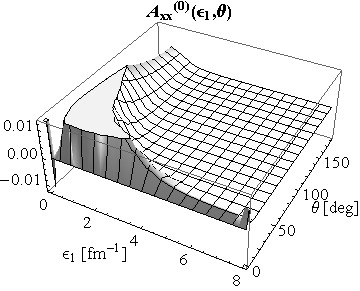 Figure 1
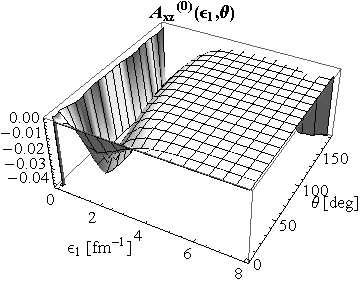 Figure 2
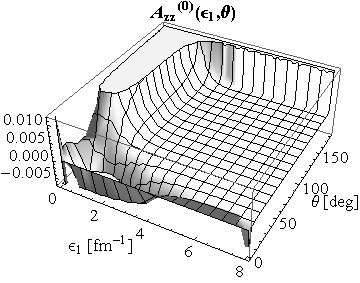 Figure 3
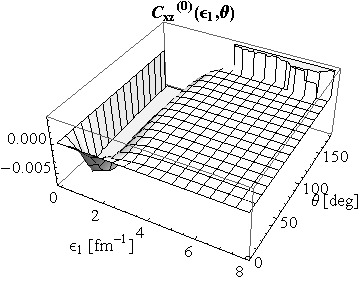 Figure 4
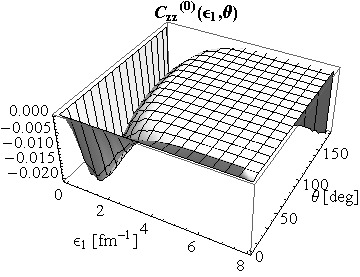 Figure 5
Peer Reviews
No public reviews on file for this paper yet. If you reviewed it on a platform where reviews are public (OpenReview, ICLR, NeurIPS, ICML), you can paste yours below so the community can read it here.
Videos
No videos yet. Explain this paper in a talk, walkthrough, or lecture? Add one.
Deuteron wave function for Reid93 potential and polarization observables in elastic lepton-deuteron scattering
V. I. Zhaba
Uzhgorod National University, Department of Theoretical Physics,
54, Voloshyna St., Uzhgorod, UA-88000, Ukraine
E-mail: [email protected]
Abstract
Elastic lepton-deuteron scattering was considered within the limit of zero lepton mass. The deuteron wave function in the coordinate representation for the Reid93 potential was applied to numerical calculations. The angular-momentum dependence of values spin correlation coefficients , and tensor asymmetries , , have been evaluated in 3D format for Reid93 potential. These polarization observables are analyzed for different energies and scattering angles. Application of the obtained values allows better explanation and illustration of the laws of elastic lepton-deuteron scattering.
Keywords: deuteron, wave function, polarization observables, lepton-deuteron scattering, spin correlation coefficients, tensor asymmetries.
PACS: 13.40.Gp, 13.88.+e, 21.45.Bc, 03.65.Nk
1. Introduction
The interaction of three generations of leptons with deuterons has been researched repeatedly and aroused considerable interest in experimenters and theorists. For example, the elastic scattering of polarized leptons (namely muons or electrons) on polarized deuterons was investigated in [1]. The differential cross-section in terms of four form factors and the initial and final polarizations of leptons and deuterons was described by one-photon-exchange approximation. One of the four form factors for describing the electromagnetic vertex of a deuteron violates T- invariance.
Radiative Corrections to Neutrino-Deuteron Scattering are reviewed in [2]. The problem about radiative corrections to the SNO (i.e. Sudbury Neutrino Observatory) neutral current induced process +d+p+n is reexamined. This research is related to the determination of the axial-vector coupling constant gA, which receives radiative corrections of a constant term.
Shadowing in inelastic lepton-deuteron scattering is analysed in [3] using the double interaction formalism, where shading is associated with inclusive diffraction processes. Different shading mechanisms are discussed in detail. The shadow effects were very small and less than 2%, according to the precise measurements of the New Muon Collaboration.
The authors of the paper [4] found that the data for inelastic electron-deuteron scattering include some unusual secondary peaks in the plots of deuteron inelastic structure function vW2 as a function of Bjorken . They explained this effect as interference between the three-quark and the six-quark cluster contributions to the inclusive datas.
Elastic electroweak lepton-deuteron scattering as a method to extract information about vector and axial-vector isoscalar currents, and thus the strange and heavier quark content in the deuteron was considered in paper [5].
In paper [6] was appreciated the contribution of quasifree nucleon knockout and of inelastic lepton-nucleon scattering in inclusive electron-deuteron reactions at large momentum transfer. The degree of quantitative agreement with deuteron wave functions for the Reid soft-core and Bonn potentials was investigated. In the range of data’s is contained strong sensitivity to the tensor correlations, which are visibly different in these two deuteron models. Here the deuteron wave function for Reid soft-core potential describes the data better than for the Bonn potential. A good description of all data with both these nucleon-nucleon interactions was obtained by the inclusion of a six-quark cluster component, whose relative contribution is based on the overlapping criterion.
The energy and angular distributions of slow nucleons in semi-inclusive inelastic lepton scattering off the deuteron are investigated in paper [7]. The spectator scaling property for semi-inclusive cross-section within the spectator mechanism is an interesting instrument to obtain model-independent information on the neutron structure function in the deep-inelastic regime and in the regions of nucleon-resonance productions.
For the x-rescaling model [8] in deep inelastic lepton scattering on bound nucleons has been applied the operator product expansion method within the effective meson-nucleon theory. Demonstrated that with the such contributions as Fermi motion and mesonic corrections, the x-rescaling idea is exactly reproduced.
An analysis of polarization observables [9] in two such processes, as the deep-inelastic scattering of polarized leptons off polarized deuterons and the polarized deuteron break-up, indicates a relation between the deep-inelastic structure functions and the tensor analyzing power .
In paper [10] it is shown that the Bethe-Salpeter approach with the use of the separable interaction for the deuteron allows a covariant description of different electromagnetic reactions such as the lepton-deuteron scattering, deuteron electro-disintegration, deep inelastic scattering of leptons on light nuclei.
Model independent expressions for polarization observables in elastic lepton scattering on the proton are obtained in [11], taking into account the lepton mass and the two-photon exchange contribution. General information about the influence of the two-photon-exchange expressions on the differential cross-section and on polarization observables are given. Polarization effects have also been investigated for the case of a longitudinally polarized lepton beam and polarized nucleon in the final state.
The authors of paper [12] evaluated the contribution to the polarizability of the nucleus to hyperfine structure of muonic hydrogen within the framework of unitary isobar model and on the basis of experimental data’s on the structure functions of deep inelastic lepton-proton and lepton-deuteron scatterings. The calculations of virtual absorption cross-sections of transversely and longitudinally polarized photons by nucleons in the resonance area were made in the program MAID.
The differential cross-section including quantum electrodynamics (QED) radiative corrections to the leptonic part of the interaction, in the case of a coincidence experimental setup is derived in paper [13].
In this paper we use the analytic forms of DWF in coordinate space for theoretical calculations of three main sets of polarization observables in elastic lepton-deuteron scattering taking into account the limits of zero lepton mass. Nucleon-nucleon realistic phenomenological potential of Nijmegen group Reid93 are used for numerical calculations.
2. Deuteron wave function
The deuteron wave function (DWF) in coordinate space can be presented as a table: through respective two arrays of values of radial wave functions and . It is heavy to apply such arrays for practical numerical calculations. That is why use simple formulas for analytical forms of DWF representation [14].
The known numerical values of DWFs in coordinate space can be approximated using expansions in the convenient analytical form:
- for Paris potential [15]
[TABLE]
where ; , =0.9 fm*-1*; – nucleon mass; – binding energy of the deuteron;
[TABLE]
[TABLE]
The analytical form (1) was also applied to OBEPC [19] and CD-Bonn [20] potentials and fss2 [21] and MT [22] models. Advantage of analytical form (3) consists in that calculated DWFs do not contain superfluous knots.
- Elastic lepton-deuteron scattering
The expressions for the unpolarized differential cross-section and polarization observables were studied in the application of the lepton mass in elastic lepton-deuteron scattering by [23]. The asymmetries conditioned to the tensor polarization of the deuteron target and the spin correlation coefficients conditioned to the lepton beam polarization and vector polarization of the deuteron target has been studied.
The lepton-deuteron reaction is written down in a form
[TABLE]
Such reaction in the laboratory system is characterized by 4- moments for a deuteron (lepton) in initial and final states of and ( and with the corresponding components
[TABLE]
where is the deuteron mass.
Comparison of formulas for cross-sections in [23]
[TABLE]
and in [24]
[TABLE]
allows you to determine the value .
According to [24], the factor in the cross-section is presented as
[TABLE]
That’s why in [23] . The relation between momentum and energy is given by the expression
[TABLE]
Thus, the following relations can be written for momentum and energy
[TABLE]
[TABLE]
That is, the value in the dimensions [fm*-1*] or [GeV/c].
If known DWFs are in the coordinate representation, then numerically we can calculate the polarization observed in the elastic lepton-deuteron scattering. What types of polarization observables can be calculated? Let’s consider three basic sets of polarization characteristics in elastic lepton-deuteron scattering.
We first consider the vector-polarized deuteron target. The differential cross-section for the reaction (4) describes the scattering of polarized lepton beam on the vector-polarized deuteron target
[TABLE]
where and is the unit polarization vectors in the rest frame of the lepton beam and deuteron target respectively. The expression (5) describes only to the spin-dependent part of the cross-section which is determined by the spin correlation coefficients.
Here coefficients characterize the scattering of the longitudinally polarized lepton beam, and coefficients , , correspond to the transverse components of the spin vector .
The spin correlation coefficients in the limit of zero lepton mass have the such form in terms of the deuteron electromagnetic form factors [23]:
[TABLE]
[TABLE]
[TABLE]
where is factor, which is determined by the structure functions and ; the charge , quadrupole and magnetic form factors contain information about the electromagnetic properties of the deuteron; .
The connection between and is written as
[TABLE]
For the description of the elastic lepton-deuteron scattering it is possible to use other system of coordinates with such axes: the Z and Y axes is directed along the virtual photon momentum and along the vector respectively; axis X is chosen for formation of the left-handed coordinate system. The reaction scattering plane is characterized by a angle between the direction of the lepton beam and the virtual photon momentum
[TABLE]
Formulas for spin correlation coefficients in the new coordinate system can be obtained in terms for coefficients (6)-(7)
[TABLE]
[TABLE]
In such representation of coordinates are present only two nonzero spin correlation coefficients in the limit of zero lepton mass
[TABLE]
[TABLE]
It should be noted that the values , are the same quantities , as in [25]. The spin correlation coefficients (9)-(10) correspond to the longitudinal polarization of the lepton beam.
We will also consider the tensor-polarized deuteron target. The differential cross-section for the reaction (4) describes the scattering of unpolarized lepton beam on such tensor-polarized deuteron target
[TABLE]
where it is used conditions that . Here - the asymmetries induced by the tensor polarization of the deuteron target. The asymmetries in the limit of zero lepton mass is written in terms of the deuteron electromagnetic form factors [23]:
[TABLE]
[TABLE]
[TABLE]
If the axis is directed along the virtual photon momentum, then the asymmetries due to the tensor polarization of the deuteron target have such a form [23]
[TABLE]
Here =ZZ, XX, XZ and =zz, xx, xz - the indices of the rotation matrix. The rotation matrix write as
[TABLE]
The transformation for the tensor of the quadrupole polarization describes the tensor polarization of the deuteron target
[TABLE]
[TABLE]
[TABLE]
Consequently, within the limits of zero lepton mass we considered three main sets of polarization characteristics in elastic lepton-deuteron scattering:
All of the aforementioned formulas for an unpolarized differential cross-section and polarization observables with consideration the lepton mass for elastic lepton-deuteron scattering are cited from paper [23]. There are described expressions for asymmetries owing to the tensor polarization of the deuteron target and the spin correlation coefficients owing to the lepton beam polarization and vector polarization of the deuteron target. Explicit, ostensive and understandable formulas for these quantities have been demonstrated in two coordinate systems: in the first one system the z- axis is directed along the lepton beam momentum and in the second one system the z- axis is directed along the virtual photon momentum (or the transferred momentum). Such coordinate systems are necessary and relevant for experimental research.
4. Calculations and conclusions
We will analyze numerical results for two-dimensional plots with function of the muon beam energy and the muon scattering angle, that determine the kinematics for a binary process.
The values of spin correlation coefficients , and tensor asymmetries , , (the formulas (6), (7) and (11)-(13) respectively) for elastic lepton-deuteron scattering in the limit of zero lepton mass are calculated. The results of numerical calculations are presented in 3D format in Figs. 1-5. Nucleon-nucleon realistic phenomenological potential Reid93 was used for calculations. A complete set of coefficients for DWF (3) for Reid93 potential is given in paper [14].
\pdfximage
width 90mm Cxz0-R93.jpg\pdfrefximage
Fig. 1. Spin correlation coefficient
\pdfximage
width 90mm Czz0-R93.jpg\pdfrefximage
Fig. 2. Spin correlation coefficient
\pdfximage
width 90mm Axx0-R93.jpg\pdfrefximage
Fig. 3. Tensor asymmetry
\pdfximage
width 90mm Axz0-R93.jpg\pdfrefximage
Fig. 4. Tensor asymmetry
\pdfximage
width 90mm Azz0-R93.jpg\pdfrefximage
Fig. 5. Tensor asymmetry
Figs. 1 and 2 illustrates the polarization observables , , which are induced by a polarized lepton beam on a vector-polarized deuteron target. These spin correlation coefficients vanish at zero angle scattering and at small energies. They become negative and forms a kind of “tray” as values of the angle and energy increase.
The values , for Reid93 potential were calculated in the paper [26], where they are labeled as , .
The tensor asymmetries , , induced by a unpolarized lepton beam on tensor-polarized deuteron target are illustrated in Fig. 3-5 respectively. For tensor asymmetries the characteristic plane at energy increase above 4 fm*-1*. As seen in Figs. 3 and 5 for tensor asymmetries and there is a hump (peak) near 2 fm*-1* in the range of angles 0-180 degrees. For the tensor asymmetry (see. Fig. 4), on the contrary, there is a pit.
Perspectives are the following numeric calculations of the unpolarized cross-section, spin correlation coefficients and tensor asymmetries taking into account the lepton mass. Then it is possible to compare them with the results within the limit of zero lepton mass which are obtained in this paper.
It is interesting to use different parametrizations of the deuteron form factors, the form of which in fact determines the behavior of the spin correlation coefficients and tensor asymmetries. As indicated in the paper [23], the chosen model for deuteron form factors should accurately reproduce the existing experimental data, and the effect of the finite lepton mass is sizable at low incident energies and large scattering angles.
Considering and neglecting the lepton mass will better describe proton-antiproton annihilation into massive leptons and polarization phenomena [27].
The reference list from the paper itself. Each links out to its DOI / PubMed record.
- 1[1] K.Y. Lin, Nucl. Phys. B 18 , 162 (1970).
- 2[2] T. Kubota, Nucl. Phys. B (Proc. Suppl.) 157 , 111(2006).
- 3[3] B. Badelek, J. Kwiecinski, Nucl. Phys. B 370 , 278 (1992).
- 4[4] G.D. Yen and J. P. Vary, Phys. Rev. C 40 , R 16 (1989).
- 5[5] S.J. Pollock, Phys. Rev. D 42 , 3010 (1990).
- 6[6] G. Yen et al., Phys. Rev. C 42 , 1665 (1990).
- 7[7] S. Simula, Nucl. Phys. A 631 , 602c (1998).
- 8[8] L.P. Kaptari, K.Yu. Kazakov, A.Yu. Umnikov, Phys. Lett. B 293 , 219 (1992).