Saliency Maps Generation for Automatic Text Summarization
David Tuckey, Krysia Broda, Alessandra Russo

TL;DR
This paper investigates the effectiveness of saliency map techniques, specifically Layer-Wise Relevance Propagation, in explaining complex text summarization models, highlighting the need for quantitative validation of these explanations.
Contribution
It applies LRP to a sequence-to-sequence model for text summarization and proposes a protocol for validating the accuracy of saliency maps as explanations.
Findings
Saliency maps sometimes reflect true model input usage
Saliency maps can be misleading without validation
A protocol for testing explanation validity is proposed
Abstract
Saliency map generation techniques are at the forefront of explainable AI literature for a broad range of machine learning applications. Our goal is to question the limits of these approaches on more complex tasks. In this paper we apply Layer-Wise Relevance Propagation (LRP) to a sequence-to-sequence attention model trained on a text summarization dataset. We obtain unexpected saliency maps and discuss the rightfulness of these "explanations". We argue that we need a quantitative way of testing the counterfactual case to judge the truthfulness of the saliency maps. We suggest a protocol to check the validity of the importance attributed to the input and show that the saliency maps obtained sometimes capture the real use of the input features by the network, and sometimes do not. We use this example to discuss how careful we need to be when accepting them as explanation.
Click any figure to enlarge with its caption.
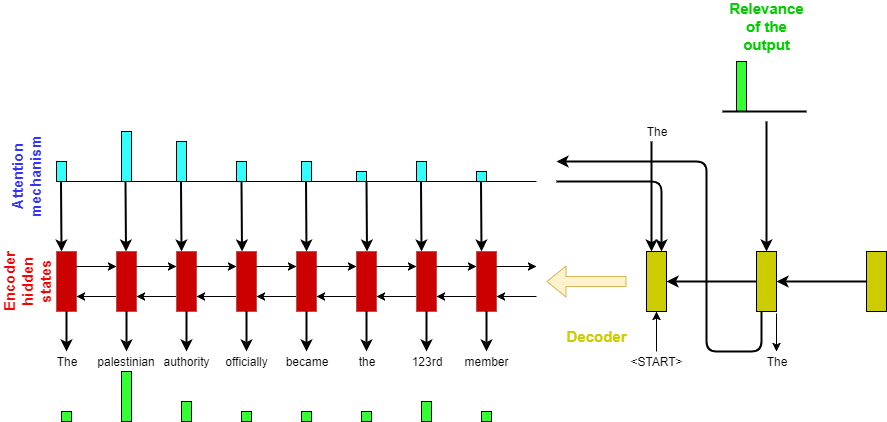 Figure 1
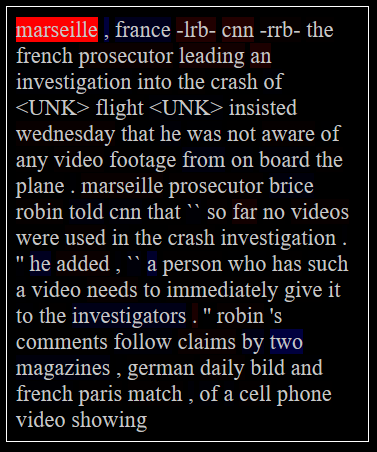 Figure 2
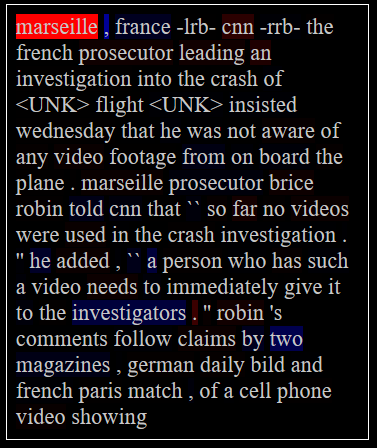 Figure 3
Peer Reviews
No public reviews on file for this paper yet. If you reviewed it on a platform where reviews are public (OpenReview, ICLR, NeurIPS, ICML), you can paste yours below so the community can read it here.
Videos
No videos yet. Explain this paper in a talk, walkthrough, or lecture? Add one.
Taxonomy
TopicsTopic Modeling · Explainable Artificial Intelligence (XAI) · Natural Language Processing Techniques
Saliency Maps Generation for Automatic Text Summarization
David Tuckey
Krysia Broda
Alessandra Russo Department of Computing, Imperial College London
{david.tuckey17, k.broda, a.russo}@imperial.ac.uk
Abstract
Saliency map generation techniques are at the forefront of explainable AI literature for a broad range of machine learning applications. Our goal is to question the limits of these approaches on more complex tasks. In this paper we apply Layer-Wise Relevance Propagation (LRP) to a sequence-to-sequence attention model trained on a text summarization dataset. We obtain unexpected saliency maps and discuss the rightfulness of these “explanations”. We argue that we need a quantitative way of testing the counterfactual case to judge the truthfulness of the saliency maps. We suggest a protocol to check the validity of the importance attributed to the input and show that the saliency maps obtained sometimes capture the real use of the input features by the network, and sometimes do not. We use this example to discuss how careful we need to be when accepting them as explanation.
1 Introduction
Ever since the LIME algorithm Ribeiro et al. (2016), ”explanation” techniques focusing on finding the importance of input features in regard of a specific prediction have soared and we now have many ways of finding saliency maps (also called heat-maps because of the way we like to visualize them). We are interested in this paper by the use of such a technique in an extreme task that highlights questions about the validity and evaluation of the approach. We would like to first set the vocabulary we will use. We agree that saliency maps are not explanations in themselves and that they are more similar to attribution, which is only one part of the human explanation process Miller (2019). We will prefer to call this importance mapping of the input an attribution rather than an explanation. We will talk about the importance of the input relevance score in regard to the model’s computation and not make allusion to any human understanding of the model as a result.
There exist multiple ways to generate saliency maps over the input for non-linear classifiers Bach et al. (2015); Montavon et al. (2017); Samek et al. (2017). We refer the reader to Adadi and Berrada (2018) for a survey of explainable AI in general. We use in this paper Layer-Wise Relevance Propagation (LRP) Bach et al. (2015) which aims at redistributing the value of the classifying function on the input to obtain the importance attribution. It was first created to “explain” the classification of neural networks on image recognition tasks. It was later successfully applied to text using convolutional neural networks (CNN) Arras et al. (2017a) and then Long-Short Term Memory (LSTM) networks for sentiment analysis Arras et al. (2017b).
Our goal in this paper is to test the limits of the use of such a technique for more complex tasks, where the notion of input importance might not be as simple as in topic classification or sentiment analysis. We changed from a classification task to a generative task and chose a more complex one than text translation (in which we can easily find a word to word correspondence/importance between input and output). We chose text summarization. We consider abstractive and informative text summarization, meaning that we write a summary “in our own words” and retain the important information of the original text. We refer the reader to Radev et al. (2002) for more details on the task and the different variants that exist. Since the success of deep sequence-to-sequence models for text translation Bahdanau et al. (2014), the same approaches have been applied to text summarization tasks Rush et al. (2015); See et al. (2017); Nallapati et al. (2016) which use architectures on which we can apply LRP.
We obtain one saliency map for each word in the generated summaries, supposed to represent the use of the input features for each element of the output sequence. We observe that all the saliency maps for a text are nearly identical and decorrelated with the attention distribution. We propose a way to check their validity by creating what could be seen as a counterfactual experiment from a synthesis of the saliency maps, using the same technique as in Arras et al. Arras et al. (2017b). We show that in some but not all cases they help identify the important input features and that we need to rigorously check importance attributions before trusting them, regardless of whether or not the mapping “makes sense” to us. We finally argue that in the process of identifying the important input features, verifying the saliency maps is as important as the generation step, if not more.
2 The Task and the Model
We present in this section the baseline model from See et al. See et al. (2017) trained on the CNN/Daily Mail dataset. We reproduce the results from See et al. See et al. (2017) to then apply LRP on it.
2.1 Dataset and Training Task
The CNN/Daily mail dataset Nallapati et al. (2016) is a text summarization dataset adapted from the Deepmind question-answering dataset Hermann et al. (2015). It contains around three hundred thousand news articles coupled with summaries of about three sentences. These summaries are in fact “highlights” of the articles provided by the media themselves. Articles have an average length of 780 words and the summaries of 50 words. We had 287 000 training pairs and 11 500 test pairs. Similarly to See et al. See et al. (2017), we limit during training and prediction the input text to 400 words and generate summaries of 200 words. We pad the shorter texts using an UNKNOWN token and truncate the longer texts. We embed the texts and summaries using a vocabulary of size 50 000, thus recreating the same parameters as See et al. See et al. (2017).
2.2 The Model
The baseline model is a deep sequence-to-sequence encoder/decoder model with attention. The encoder is a bidirectional Long-Short Term Memory(LSTM) cell Hochreiter and Schmidhuber (1997) and the decoder a single LSTM cell with attention mechanism. The attention mechanism is computed as in Bahdanau et al. (2014) and we use a greedy search for decoding. We train end-to-end including the words embeddings. The embedding size used is of 128 and the hidden state size of the LSTM cells is of 254.
2.3 Obtained Summaries
We train the 21 350 992 parameters of the network for about 60 epochs until we achieve results that are qualitatively equivalent to the results of See et al. See et al. (2017). We obtain summaries that are broadly relevant to the text but do not match the target summaries very well. We observe the same problems such as wrong reproduction of factual details, replacing rare words with more common alternatives or repeating non-sense after the third sentence. We can see in Figure 1 an example of summary obtained compared to the target one.
The “summaries” we generate are far from being valid summaries of the information in the texts but are sufficient to look at the attribution that LRP will give us. They pick up the general subject of the original text.
3 Layer-Wise Relevance Propagation
We present in this section the Layer-Wise Relevance Propagation (LRP) Bach et al. (2015) technique that we used to attribute importance to the input features, together with how we adapted it to our model and how we generated the saliency maps. LRP redistributes the output of the model from the output layer to the input by transmitting information backwards through the layers. We call this propagated backwards importance the relevance. LRP has the particularity to attribute negative and positive relevance: a positive relevance is supposed to represent evidence that led to the classifier’s result while negative relevance represents evidence that participated negatively in the prediction.
3.1 Mathematical Description
We initialize the relevance of the output layer to the value of the predicted class before softmax and we then describe locally the propagation backwards of the relevance from layer to layer. For normal neural network layers we use the form of LRP with epsilon stabilizer Bach et al. (2015). We write down the relevance received by the neuron of layer from the neuron of layer :
[TABLE]
where is the network’s weight parameter set during training, is the bias for neuron of layer , is the activation of neuron on layer , is the stabilizing term set to 0.00001 and is the dimension of the -th layer.
The relevance of a neuron is then computed as the sum of the relevance he received from the above layer(s).
For LSTM cells we use the method from Arras et al.Arras et al. (2017b) to solve the problem posed by the element-wise multiplications of vectors. Arras et al. noted that when such computation happened inside an LSTM cell, it always involved a “gate” vector and another vector containing information. The gate vector containing only value between 0 and 1 is essentially filtering the second vector to allow the passing of “relevant” information. Considering this, when we propagate relevance through an element-wise multiplication operation, we give all the upper-layer’s relevance to the “information” vector and none to the “gate” vector.
3.2 Generation of the Saliency Maps
We use the same method to transmit relevance through the attention mechanism back to the encoder because Bahdanau’s attention Bahdanau et al. (2014) uses element-wise multiplications as well. We depict in Figure 2 the transmission end-to-end from the output layer to the input through the decoder, attention mechanism and then the bidirectional encoder. We then sum up the relevance on the word embedding to get the token’s relevance as Arras et al. Arras et al. (2017b).
The way we generate saliency maps differs a bit from the usual context in which LRP is used as we essentially don’t have one classification, but 200 (one for each word in the summary). We generate a relevance attribution for the 50 first words of the generated summary as after this point they often repeat themselves.
This means that for each text we obtain 50 different saliency maps, each one supposed to represent the relevance of the input for a specific generated word in the summary.
4 Experimental results
In this section, we present our results from extracting attributions from the sequence-to-sequence model trained for abstractive text summarization. We first have to discuss the difference between the 50 different saliency maps we obtain and then we propose a protocol to validate the mappings.
4.1 First Observations
The first observation that is made is that for one text, the 50 saliency maps are almost identical. Indeed each mapping highlights mainly the same input words with only slight variations of importance. We can see in Figure 3 an example of two nearly identical attributions for two distant and unrelated words of the summary. The saliency map generated using LRP is also uncorrelated with the attention distribution that participated in the generation of the output word. The attention distribution changes drastically between the words in the generated summary while not impacting significantly the attribution over the input text. We deleted in an experiment the relevance propagated through the attention mechanism to the encoder and didn’t observe much changes in the saliency map.
It can be seen as evidence that using the attention distribution as an “explanation” of the prediction can be misleading. It is not the only information received by the decoder and the importance it “allocates” to this attention state might be very low. What seems to happen in this application is that most of the information used is transmitted from the encoder to the decoder and the attention mechanism at each decoding step just changes marginally how it is used. Quantifying the difference between attention distribution and saliency map across multiple tasks is a possible future work.
The second observation we can make is that the saliency map doesn’t seem to highlight the right things in the input for the summary it generates. The saliency maps on Figure 3 correspond to the summary from Figure 1, and we don’t see the word “video” highlighted in the input text, which seems to be important for the output.
This allows us to question how good the saliency maps are in the sense that we question how well they actually represent the network’s use of the input features. We will call that truthfulness of the attribution in regard to the computation, meaning that an attribution is truthful in regard to the computation if it actually highlights the important input features that the network attended to during prediction. We proceed to measure the truthfulness of the attributions by validating them quantitatively.
4.2 Validating the Attributions
We propose to validate the saliency maps in a similar way as Arras et al. Arras et al. (2017b) by incrementally deleting “important” words from the input text and observe the change in the resulting generated summaries.
We first define what “important” (and “unimportant”) input words mean across the 50 saliency maps per texts. Relevance transmitted by LRP being positive or negative, we average the absolute value of the relevance across the saliency maps to obtain one ranking of the most “relevant” words. The idea is that input words with negative relevance have an impact on the resulting generated word, even if it is not participating positively, while a word with a relevance close to zero should not be important at all. We did however also try with different methods, like averaging the raw relevance or averaging a scaled absolute value where negative relevance is scaled down by a constant factor. The absolute value average seemed to deliver the best results.
We delete incrementally the important words (words with the highest average) in the input and compared it to the control experiment that consists of deleting the least important word and compare the degradation of the resulting summaries. We obtain mitigated results: for some texts, we observe a quick degradation when deleting important words which are not observed when deleting unimportant words (see Figure 4), but for other test examples we don’t observe a significant difference between the two settings (see Figure 5).
One might argue that the second summary in Figure 5 is better than the first one as it makes better sentences but as the model generates inaccurate summaries, we do not wish to make such a statement.
This however allows us to say that the attribution generated for the text at the origin of the summaries in Figure 4 are truthful in regard to the network’s computation and we may use it for further studies of the example, whereas for the text at the origin of Figure 5 we shouldn’t draw any further conclusions from the attribution generated.
One interesting point is that one saliency map didn’t look “better” than the other, meaning that there is no apparent way of determining their truthfulness in regard of the computation without doing a quantitative validation. This brings us to believe that even in simpler tasks, the saliency maps might make sense to us (for example highlighting the animal in an image classification task), without actually representing what the network really attended too, or in what way.
We defined without saying it the counterfactual case in our experiment: “Would the important words in the input be deleted, we would have a different summary”. Such counterfactuals are however more difficult to define for image classification for example, where it could be applying a mask over an image, or just filtering a colour or a pattern. We believe that defining a counterfactual and testing it allows us to measure and evaluate the truthfulness of the attributions and thus weight how much we can trust them.
5 Conclusion
In this work, we have implemented and applied LRP to a sequence-to-sequence model trained on a more complex task than usual: text summarization. We used previous work to solve the difficulties posed by LRP in LSTM cells and adapted the same technique for Bahdanau et al. Bahdanau et al. (2014) attention mechanism.
We observed a peculiar behaviour of the saliency maps for the words in the output summary: they are almost all identical and seem uncorrelated with the attention distribution. We then proceeded to validate our attributions by averaging the absolute value of the relevance across the saliency maps. We obtain a ranking of the word from the most important to the least important and proceeded to delete one or another.
We showed that in some cases the saliency maps are truthful to the network’s computation, meaning that they do highlight the input features that the network focused on. But we also showed that in some cases the saliency maps seem to not capture the important input features. This brought us to discuss the fact that these attributions are not sufficient by themselves, and that we need to define the counter-factual case and test it to measure how truthful the saliency maps are.
Future work would look into the saliency maps generated by applying LRP to pointer-generator networks and compare to our current results as well as mathematically justifying the average that we did when validating our saliency maps. Some additional work is also needed on the validation of the saliency maps with counterfactual tests. The exploitation and evaluation of saliency map are a very important step and should not be overlooked.
The reference list from the paper itself. Each links out to its DOI / PubMed record.
- 1Adadi and Berrada [2018] Amina Adadi and Mohammed Berrada. Peeking Inside the Black-Box: A Survey on Explainable Artificial Intelligence (XAI). IEEE Access , 6:52138–52160, 2018.
- 2Arras et al. [2017 a] Leila Arras, Franziska Horn, Grégoire Montavon, Klaus Robert Müller, and Wojciech Samek. ”What is relevant in a text document?”: An interpretable machine learning approach. P Lo S ONE , 12(8):1–19, 2017.
- 3Arras et al. [2017 b] Leila Arras, Grégoire Montavon, Klaus-Robert Müller, and Wojciech Samek. Explaining Recurrent Neural Network Predictions in Sentiment Analysis. 2017.
- 4Bach et al. [2015] Sebastian Bach, Alexander Binder, Grégoire Montavon, Frederick Klauschen, Klaus Robert Müller, and Wojciech Samek. On pixel-wise explanations for non-linear classifier decisions by layer-wise relevance propagation. P Lo S ONE , 10(7):1–46, 2015.
- 5Bahdanau et al. [2014] Dzmitry Bahdanau, Kyunghyun Cho, and Yoshua Bengio. Neural Machine Translation by Jointly Learning to Align and Translate. ar Xiv preprint ar Xiv:1409.0473 , 2014.
- 6Hermann et al. [2015] Karl Moritz Hermann, Tomáš Kočiský, Edward Grefenstette, Lasse Espeholt, Will Kay, Mustafa Suleyman, and Phil Blunsom. Teaching Machines to Read and Comprehend. pages 1–14, 2015.
- 7Hochreiter and Schmidhuber [1997] Sepp Hochreiter and Jürgen Schmidhuber. Long short-term memory. Neural computation , 9(8):1735–1780, 1997.
- 8Miller [2019] Tim Miller. Explanation in artificial intelligence: Insights from the social sciences. Artificial Intelligence , 267:1–38, 2019.