Macroscopic Thermodynamic Reversibility in Quantum Many-Body Systems
Philippe Faist, Takahiro Sagawa, Kohtaro Kato, Hiroshi Nagaoka,, Fernando G. S. L. Brand\~ao

TL;DR
This paper demonstrates that in translation-invariant quantum lattice systems, a large class of states can be reversibly transformed into thermal states using thermal operations, establishing a robust link between thermodynamic resource theory and physical systems.
Contribution
It identifies translation-invariant ergodic states as reversibly convertible to thermal states with minimal coherence, bridging abstract resource theory and physical lattice systems.
Findings
Large set of translation-invariant states are reversibly convertible to thermal states.
Reversible interconversion is characterized by the min- and max-relative entropy.
Results connect thermodynamic resource theory with realistic quantum many-body systems.
Abstract
The resource theory of thermal operations, an established model for small-scale thermodynamics, provides an extension of equilibrium thermodynamics to nonequilibrium situations. On a lattice of any dimension with any translation-invariant local Hamiltonian, we identify a large set of translation-invariant states that can be reversibly converted to and from the thermal state with thermal operations and a small amount of coherence. These are the spatially ergodic states, i.e., states that have sharp statistics for any translation-invariant observable, and mixtures of such states with the same thermodynamic potential. As an intermediate result, we show for a general state that if the min- and the max-relative entropy to the thermal state coincide approximately, this implies the approximately reversible interconvertibility to and from the thermal state with thermal operations and a small…
Click any figure to enlarge with its caption.
 Figure 1
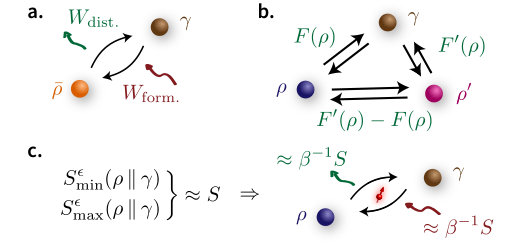 Figure 2
Peer Reviews
No public reviews on file for this paper yet. If you reviewed it on a platform where reviews are public (OpenReview, ICLR, NeurIPS, ICML), you can paste yours below so the community can read it here.
Videos
No videos yet. Explain this paper in a talk, walkthrough, or lecture? Add one.
Macroscopic Thermodynamic Reversibility in Quantum Many-Body Systems
Philippe Faist
Institute for Quantum Information and Matter, California Institute of Technology, Pasadena, CA 91125, USA
Institute for Theoretical Physics, ETH Zurich, 8093 Switzerland
Takahiro Sagawa
Department of Applied Physics, The University of Tokyo, Tokyo 113-8656, Japan
Kohtaro Kato
Institute for Quantum Information and Matter, California Institute of Technology, Pasadena, CA 91125, USA
Hiroshi Nagaoka
The University of Electro-Communications, Tokyo, 182-8585, Japan
Fernando G. S. L. Brandão
Institute for Quantum Information and Matter, California Institute of Technology, Pasadena, CA 91125, USA
Google Inc., Venice, CA 90291, USA
Abstract
The resource theory of thermal operations, an established model for small-scale thermodynamics, provides an extension of equilibrium thermodynamics to nonequilibrium situations. On a lattice of any dimension with any translation-invariant local Hamiltonian, we identify a large set of translation-invariant states that can be reversibly converted to and from the thermal state with thermal operations and a small amount of coherence. These are the spatially ergodic states, i.e., states that have sharp statistics for any translation-invariant observable, and mixtures of such states with the same thermodynamic potential. As an intermediate result, we show for a general state that if the min- and the max-relative entropy to the thermal state coincide approximately, this implies the approximately reversible interconvertibility to and from the thermal state with thermal operations and a small source of coherence. Our results provide a strong link between the abstract resource theory of thermodynamics and more realistic physical systems, as we achieve a robust and operational characterization of the emergence of a thermodynamic potential in translation-invariant lattice systems.
Introduction
The quantum information approach to thermodynamics has allowed thermodynamic concepts, such as work, to be successfully extended into regimes of small-scale systems that store and process quantum information Goold et al. (2016). Notably, formulating thermodynamics as a resource theory Janzing et al. (2000); Horodecki et al. (2003); Brandão et al. (2013); Chitambar2018arXiv_resource allows for a precise characterization of the resources that are required in single-instance state transformations, for instance thermodynamic work Dahlsten et al. (2011); Åberg (2013); Horodecki and Oppenheim (2013) and quantum coherence Lostaglio et al. (2015); Korzekwa et al. (2016); Gour2017arXiv_entropic; Marvian (2018). This is done by establishing a set of natural rules such as energy conservation, characterizing which possible evolutions a quantum state can undergo under these rules, and studying which external resources allows the system to undergo otherwise forbidden state transformations. A simple such framework is the resource theory of thermal operations, where one allows any energy-conserving unitary interaction with a heat bath at a fixed background temperature Brandão et al. (2013); Horodecki and Oppenheim (2013); Brandão et al. (2015), and can be extended to more general types of reservoirs Yunger Halpern and Renes (2016); Guryanova et al. (2016); Yunger Halpern et al. (2016); HindsMingo2018arXiv_multiple. This approach has strong connections with information-theoretic entropy measures and quantum Shannon theory Faist et al. (2015); Chubb2017arXiv_beyond. More generally, information-theoretic approaches have provided new descriptions of nonequilibrium states and dynamics in statistical mechanics and thermodynamics, both in the classical and quantum regimes Esposito2009; Sagawa2012; Seifert2012; Parrondo2015; Tajima et al. (2016). The resource theory connects to standard macroscopic thermodynamics in several ways. This approach is equivalent Weilenmann et al. (2016); Weilenmann (2017); Weilenmann2018arXiv_smooth to an established abstract and axiomatic formulation of thermodynamics by Lieb and Yngvason Lieb and Yngvason (1999, 2004, 2013, 2014). Second, one recovers the usual laws of thermodynamics in regimes of many identically and independently distributed (i.i.d.) copies of a state, such as for an ideal gas, or if the states considered are quantum statistical ensembles Brandão et al. (2013); Horodecki and Oppenheim (2013); Matsumoto (2010); Jiao et al. (2018); Faist and Renner (2018).
The resource theory of thermodynamics extends equilibrium thermodynamics to non-equilibrium situations. In standard macroscopic thermodynamics, a system is defined to be in thermodynamic equilibrium if it no longer presents macroscopic changes or currents, and if it has lost memory of its initial, possibly non-equilibrium state Callen (1985). The purpose of this definition is to ensure that the thermodynamic behavior of the system is entirely specified by a thermodynamic potential: The optimal work required to transform one equilibrium state into another by a reversible thermodynamic process is given by the difference of the potentials for the initial and final states, and does not depend on any further details of the process. In the resource theory, this can be verified directly: Is the amount of work required to transform a state into a state equal to the amount of work that can be extracted in the reverse process? If so, the resource theory is said to be reversible. Crucially, reversibility of a resource theory—i.e., the emergence of a thermodynamic potential—can happen for states that are not necessarily in thermodynamic equilibrium, as we show in this paper.
A natural question is whether the notion of resource-theoretic reversibility can be leveraged to show the emergence of a thermodynamic potential for new classes of states that are physically relevant, such as interacting particles on a lattice, which go beyond idealized macroscopic settings such as i.i.d. states.
Here, we show that on a translation-invariant lattice of any spatial dimension with a local Hamiltonian, all ergodic states—i.e., states for which macroscopic quantities have sharply peaked statistics—can be reversibly converted to and from the thermal state. Furthermore, mixtures of ergodic states with the same thermodynamic potential also have this property. This ensures the emergence of a thermodynamic potential for this class of states even if some of these states are far out of equilibrium.
In the following, we first introduce the resource theory of thermodynamics and show that for general states, an equipartition property implies the emergence of a thermodynamic potential. We then consider translation-invariant lattices and explain our main result illustrated with an example of a 1-D Ising spin chain, before concluding with a discussion.
Resource theory of thermal operations
In this resource theory, one is allowed to (i) bring in any ancilla systems in their thermal state, (ii) to carry out any energy-conserving unitaries, and (iii) to trace out any systems. We may then quantify the amount of work required to transform into another state by including an explicit battery system, initialized in a pure energy eigenstate and which we require to transition into another energy eigenstate at the end of the process. That is, if the transformation is possible with the operations (i)–(iii), then we define this process as consuming work Horodecki and Oppenheim (2013); Skrzypczyk et al. (2014); Faist and Renner (2018) (negative work consumption corresponds to work extraction).
We refer to the class of states which are block-diagonal in the energy eigenspaces as semiclassical states. For these states, transformations under thermal operations are fully characterized by thermo-majorization Horodecki and Oppenheim (2013), a generalized notion of matrix majorization Ruch et al. (1978); Bhatia (1997); Marshall et al. (2010). Let’s consider two natural tasks associated with a semiclassical state : state formation and work distillation (Fig. 1a).
State formation consists in preparing the state starting from the thermal state of the system, . The optimal amount of work that needs to be invested, if we allow an inaccuracy in the final state and if is semiclassical, is Åberg (2013); Horodecki and Oppenheim (2013)
[TABLE]
with the max-relative entropy defined as S_{\mathrm{max}}^{\epsilon}(\rho\mathclose{}\,\|\,\mathopen{}\sigma)=\min_{\tilde{\rho}\approx_{\epsilon}\rho}\ln\,\big{\lVert}{\sigma^{-1/2}\,\tilde{\rho}\,\sigma^{-1/2}}\big{\rVert}_{\infty} with the optimization ranging over all states that are -close to in trace distance Datta (2009). On the other hand, work distillation consists in extracting as much work as possible from a given state , resulting in the thermal state on the system. The optimal amount of work that can be extracted from a semiclassical state is Åberg (2013); Horodecki and Oppenheim (2013)
[TABLE]
with the min-relative entropy defined as S_{\mathrm{min}}^{\epsilon}(\rho\mathclose{}\,\|\,\mathopen{}\sigma)=\max_{\tilde{\rho}\approx_{\epsilon}\rho}\left\{-\ln\,\operatorname{tr}\bigl{(}\Pi^{\tilde{\rho}}\,\sigma\bigr{)}\right\} where is the projector onto the support of Datta (2009). The min- and max-relative entropies are special cases of the Rényi relative entropies Rényi (1960); Tomamichel (2012, 2016).
There are no known necessary and sufficient conditions for transformations of arbitrary states under thermal operations. The reason is that thermal operations cannot generate any coherent superposition of energy levels, underscoring the role of time asymmetry in thermodynamics Åberg (2014); Marvian and Spekkens (2014a, b); Lostaglio et al. (2015); Korzekwa et al. (2016); Gour2017arXiv_entropic; Marvian (2018); Lostaglio and Mueller (2018). It is thus necessary to account for coherence as a separate resource that enable operations that cannot be performed with thermal operations alone Baumgratz et al. (2014); Winter and Yang (2016); Ben Dana et al. (2017); Díaz et al. (2018); Popescu2018arXiv_applications.
We resort to a very rudimentary way of accounting for coherence. We allow a system with a bounded range of energy, which can be prepared in any pure state of our choosing and which we must dispose of in any state that is close to a pure state. This energy range is what we refer to as amount of coherence when such a system is used in a thermodynamic process. This crude approach is sufficient for our purposes, since our protocols only require such a system with an energy range that is negligibly small compared to the overall work cost of the transformation, thus forbidding any noticeable embezzling of work Brandão et al. (2015).
Emergence of a thermodynamic potential
A resource theory is reversible for a class of states if the optimal work cost of any transition between two such states is equal to the optimal work extracted in the corresponding reverse process. This class of states then has a total order, and we can assign a “thermodynamic value” to each state—this is the thermodynamic potential. A sufficient condition for reversibility is to check whether the work required for state formation can fully be recovered in the reverse task of work distillation Horodecki and Oppenheim (2013); any transformation between two such states is then reversible (Fig. 1b). In well-behaved cases, such as in the i.i.d. regime Brandão et al. (2013) or for statistical ensembles Weilenmann2018arXiv_smooth, the thermodynamic potential is given by the Kullback-Leibler divergence or Umegaki relative entropy , defined as
[TABLE]
Equipartition implies reversibility with thermal operations
We first present an intermediate result: If the min- and max-relative entropies coincide approximately, a condition which can be interpreted as a form of equipartition, then the state can approximately be reversibly converted to and from the thermal state (Fig. 1c). Our physical explanations are complemented by a fully rigorous proof that will be published elsewhere Sagawa et al. (2019).
Theorem I**.**
For any and for , suppose that
[TABLE]
for some . Then can be approximately converted to and from the thermal state at a work cost (resp. work yield) of approximately (resp. ), with an amount of coherence of approximately , and with arbitrarily good precision as .
For a system of particles, if we have as , then the extractable work per system and the work of formation per system both converge to , and the amount of coherence used per copy goes to zero. In this case becomes the thermodynamic potential in the thermodynamic limit .
To prove I, we first show that a state for which the min-entropy and the max-entropy differ by at most have off-diagonal elements that are exponentially suppressed in if . In this sense, such a state may not harbor a large amount of coherence. I is then proven by exhibiting protocols for work distillation and state formation with the claimed properties. For both protocols, we first replace the Hamiltonian by one where the energy levels are integer multiples of some elementary spacing , which can be done by investing an amount of coherence of order . The work distillation protocol is then executed as follows. One dephases in the new energy basis. Then we apply the known protocol for work extraction of semiclassical states. Because has little coherence, the work that was wasted by the dephasing is small and the min-entropy does not change by much, so we can still recover work. For the second protocol, we use the notion of an internal reference frame: The state is equivalently described by a completely incoherent state , where is a special state called a reference frame, and where is the joint dephasing operation on the system and the reference frame Bartlett et al. (2006, 2007). Because has only little coherence, a small reference frame suffices to achieve an accurate description of . Our protocol consists in first preparing the incoherent state using the known protocol for semiclassical states, and then “shifting” the coherence from to , a process known as “externalizing” the reference frame Bartlett et al. (2007).
Ergodic states on a lattice
We now consider a -dimensional square lattice with a local Hamiltonian that is translation-invariant:
[TABLE]
where each term is a lattice-translated version of a term that acts on a constant number of sites neighboring the origin. Each site is a quantum system of some finite dimension. Our calculations will be performed for finite lattice sizes, where the total number of sites is denoted by . For finite , the Hamiltonian is truncated at the boundary by ignoring any terms that have support outside of the finite region considered.
In statistical mechanics, thermodynamic behavior is often captured in the notion of ergodicity (Fig. 2).
Ergodic states are defined on the infinite lattice in two equivalent ways Ruelle (1999); Bratteli and Robinson (1987, 1981); Bjelakovic and Siegmund-Schultze (2004); Bjelaković et al. (2004). First, they are exactly those states that self-average over space translations. I.e., an ergodic state satisfies the following property: For any local observable , we have \operatorname{Var}_{\rho}\bigl{(}\frac{1}{n}\sum a_{\boldsymbol{z}}\bigr{)}\to 0 as . Equivalently, ergodic states are the extremal points of the set of states that are translation-invariant on the infinite lattice. Consequently, any translation-invariant state can be written as a mixture of ergodic states.
Ergodic states are the natural quantum analogue of classically ergodic probability distributions Cover and Thomas (2006); Israel (2015) for spatial translations instead of time evolution. Examples of ergodic states include Gibbs states of a local Hamiltonian at sufficiently high temperature, where the correlation functions of local observables decay exponentially in space (see for example Ref. Tasaki2018 and references therein). Also, any i.i.d. state is ergodic, being the Gibbs state of a noninteracting Hamiltonian. In contrast, a mixed state of macroscopically different sectors (e.g., different magnetization sectors in a symmetry-broken phase) is not ergodic, as spatial fluctuations do not vanish.
Ergodicity and reversibility under thermal operations
Our main contribution is to prove that on a lattice of any dimension with a translation-invariant local Hamiltonian, all ergodic states fall into the setting of I and are thus reversibly interconvertible:
Theorem II**.**
In the thermodynamic limit , any two ergodic states can be reversibly converted into one another using thermal operations and a sublinear amount of coherence, and the corresponding reversible work cost rate is given by the thermodynamic potential
[TABLE]
where is the reduced state of on a finite sublattice of size and is the Gibbs state with the truncated Hamiltonian on the sublattice.
The proof of II proceeds via the hypothesis testing relative entropy Buscemi and Datta (2010); Brandão and Datta (2011); Wang and Renner (2012); Matthews and Wehner (2014); Tomamichel and Hayashi (2013); Dupuis et al. (2013), which interpolates between the min- and max-relative entropies Dupuis et al. (2013) and can be formulated as a semidefinite program Watrous (2009). Inspired by the proof techniques of Bjelakovic and Siegmund-Schultze (2003); Bjelakovic2003arXiv_compression; Bjelakovic and Siegmund-Schultze (2004); Bjelaković et al. (2004); Ogata (2013), we construct a quantum relative typical projector for an ergodic state relative to a Gibbs state associated with a truncated local Hamiltonian. This allows us to prove a generalized version of Stein’s lemma for hypothesis testing Hiai and Petz (1991); Nagaoka and Ogawa (2000); Bjelakovic and Siegmund-Schultze (2003, 2004); Brandão and Plenio (2010) from which it follows that the min- and max-relative entropies must coincide up to sublinear terms in , and where the limiting value converges to . We are then in the setting of I: Any ergodic state can be reversibly converted to and from the thermal state with the reversible work deriving from the thermodynamic potential . A rigorous proof will be published elsewhere Sagawa et al. (2019).
Translation-invariant states and reversibility
We can further ask, is there a larger class of translation-invariant states on a lattice that can be reversibly converted to and from the thermal state? We provide an answer to this question as follows:
Theorem III**.**
A translation-invariant state that is a mixture of a finite number of ergodic states is reversibly convertible to and from the thermal state if and only if all ergodic states in the mixture are of equal potential, i.e., with .
To prove the above theorem, we note the following property of the min- and max-relative entropy for a mixture :
[TABLE]
with the approximation holding up to terms that do not scale with and up to an adjustment of the smoothing parameter that does not depend on . If all the in the decomposition have the same potential, , then with equality in the thermodynamic limit, and we can apply I. Conversely, if the do not all have the same potential, then the min- and max-relative entropies differ even in the thermodynamic limit. This implies that cannot be reversibly convertible to and from the thermal state, because the min- and max-relative entropies are monotones under thermal operations.
Example: 1D Ising spin chain
This toy example illustrates how a thermodynamic potential can emerge for states that are not in thermodynamic equilibrium. Consider a 1D chain of spin-1/2 particles with an Ising nearest-neighbor (n.n.) coupling and an external field :
[TABLE]
where . Since i.i.d. states are ergodic, our results imply that two pure states of the form can be converted into one another with thermal operations and an asymptotically negligible source of coherence at a reversible work cost of per copy, where the thermodynamic potential is , which is the free energy per site up to an unimportant additive constant. The thermodynamic potential is well defined on an operational level even for states that are not in macroscopic equilibrium. Consider for instance the state . For , the state presents macroscopic changes in the total spin along the axis under time evolution according to , but this does not prevent it from being reversibly convertible to and from another state .
Discussion
Our results provide a direct link between the abstract theory of thermodynamics at the small scale formulated in terms of a resource theory, and realistic many-body systems that are commonly studied in statistical mechanics. In statistical mechanics, an ergodic state physically corresponds to a definite macroscopic state; it describes a pure thermodynamic phase without phase coexistence Ruelle1999. We endow these ergodic states with a stronger notion of thermodynamic behavior: The notion of reversibility associated with the resource theory—which extends the concept in equilibrium thermodynamics to nonequilibrium situations—is tightly related to the notion of ergodicity. Furthermore, our analysis underscores how reversibility in the resource theory does not imply equilibrium. Indeed, spatially ergodic states, as considered here, can evolve nontrivially in time as illustrated in the toy example above.
Our rigorous proof Sagawa et al. (2019) makes use of advanced information-theoretic techniques, including the information spectrum Han (2003, 2000); Nagaoka and Hayashi (2007); Datta and Renner (2009); Bowen and Datta (2006a, b); Schoenmakers et al. (2007), hypothesis testing and quantum Stein’s lemma Hiai and Petz (1991); Nagaoka and Ogawa (2000); Tomamichel and Hayashi (2013); Dupuis et al. (2013), as well as quantum typical projectors Wilde (2013); Bjelakovic and Siegmund-Schultze (2003); Bjelaković et al. (2004); Bjelakovic and Siegmund-Schultze (2004). Our results can be seen as an extension of the ergodic theorems of Refs. Bjelakovic and Siegmund-Schultze (2004); Bjelaković et al. (2004). We also use Ref. Lenci and Rey-Bellet (2005) to show that if we consider the reduced state of the infinite-dimensional Gibbs state instead of truncating the Hamiltonian for finite sublattices, then our results persist for sufficiently high temperatures where there is a unique KMS state.
Curiously, it is possible to construct toy situations in which the thermodynamic potential is not given by the Kullback-Leibler divergence Sagawa et al. (2019). While this does not happen in the setting considered in the present paper, it shows that the Kullback-Leibler divergence is not universally the correct expression of the emergent thermodynamic potential as defined via I when the min- and max-relative entropies converge to the same value. Whether this observation is relevant in physically interesting systems is an open question.
It seems plausible that our results could be robust to slight violations of translation invariance. For example, slight spatial inhomoginuity in a hydrodynamic mode could be allowed. Also, ergodic states exhibit some similarities with states obeying the eigenstate thermalization hypothesis Srednicki (1994); Rigol et al. (2008); D’Alessio et al. (2016), such as exponential decay of off-diagonal entries of the density matrix Sagawa et al. (2019), suggesting that our techniques could be extended to such settings. Furthermore, a characterization of infinite or continuous mixtures of ergodic states is lacking, as opposed to the finite mixture considered in III. Finally, one might hope that our methods can be extended to models exhibiting disorder, where a gap between the min- and max-relative entropies would characterize the irreversibility of conversions between many-body-localized states.
Acknowledgements.
The authors are grateful to Matteo Lostaglio, Keiji Matsumoto, Yoshiko Ogata, and Hiroyasu Tajima for valuable discussions. TS is supported by JSPS KAKENHI Grant Number JP16H02211 and JP19H05796. PhF is supported by the Institute for Quantum Information and Matter (IQIM) at Caltech which is a National Science Foundation (NSF) Physics Frontiers Center (NSF Grant PHY-1733907), by the Department of Energy Award DE-SC0018407, and by the Swiss National Science Foundation (SNSF) via the NCCR QSIT as well as project No. 200020_165843. KK acknowledge funding provided by the Institute for Quantum Information and Matter, an NSF Physics Frontiers Center (NSF Grant PHY-1733907). FB is is supported by the NSF.
The reference list from the paper itself. Each links out to its DOI / PubMed record.
- 1Goold et al. (2016) J. Goold, M. Huber, A. Riera, L. del Rio, and P. Skrzypczyk, “The role of quantum information in thermodynamics—a topical review,” Journal of Physics A: Mathematical and Theoretical 49 , 143001 (2016) , ar Xiv:1505.07835 . · doi ↗
- 2Janzing et al. (2000) D. Janzing, P. Wocjan, R. Zeier, R. Geiss, and T. Beth, “Thermodynamic cost of reliability and low temperatures: Tightening Landauer’s principle and the second law,” International Journal of Theoretical Physics 39 , 2717–2753 (2000) , ar Xiv:quant-ph/0002048 . · doi ↗
- 3Horodecki et al. (2003) M. Horodecki, P. Horodecki, and J. Oppenheim, “Reversible transformations from pure to mixed states and the unique measure of information,” Physical Review A 67 , 062104 (2003) , ar Xiv:quant-ph/0212019 . · doi ↗
- 4Brandão et al. (2013) F. G. S. L. Brandão, M. Horodecki, J. Oppenheim, J. M. Renes, and R. W. Spekkens, “Resource theory of quantum states out of thermal equilibrium,” Physical Review Letters 111 , 250404 (2013) , ar Xiv:1111.3882 . · doi ↗
- 5Chitambar and Gour (2019) E. Chitambar and G. Gour, “Quantum resource theories,” Reviews of Modern Physics 91 , 025001 (2019) , ar Xiv:1806.06107 . · doi ↗
- 6Dahlsten et al. (2011) O. C. O. Dahlsten, R. Renner, E. Rieper, and V. Vedral, “Inadequacy of von Neumann entropy for characterizing extractable work,” New Journal of Physics 13 , 53015 (2011) , ar Xiv:0908.0424 . · doi ↗
- 7Åberg (2013) J. Åberg, “Truly work-like work extraction via a single-shot analysis,” Nature Communications 4 , 1925 (2013) , ar Xiv:1110.6121 . · doi ↗
- 8Horodecki and Oppenheim (2013) M. Horodecki and J. Oppenheim, “Fundamental limitations for quantum and nanoscale thermodynamics,” Nature Communications 4 , 2059 (2013) , ar Xiv:1111.3834 . · doi ↗