One-way quantum repeater based on near-deterministic photon-emitter interfaces
Johannes Borregaard, Hannes Pichler, Tim Sch\"oder, Mikhail D. Lukin,, Peter Lodahl, and Anders S. S{\o}rensen

TL;DR
This paper introduces a one-way quantum repeater architecture using photonic tree-cluster states that enhances long-distance quantum communication by protecting information from loss and enabling high transmission rates with minimal hardware.
Contribution
The authors propose a novel one-way quantum repeater design based on photonic tree-cluster states, requiring only two stationary qubits and one quantum emitter per station, improving feasibility.
Findings
Achieves high communication rates limited by local processing time
Requires minimal hardware per repeater station
Potential implementations with diamond defect centers and quantum dots
Abstract
We propose a novel one-way quantum repeater architecture based on photonic tree-cluster states. Encoding a qubit in a photonic tree-cluster protects the information from transmission loss and enables long-range quantum communication through a chain of repeater stations. As opposed to conventional approaches that are limited by the two-way communication time, the overall transmission rate of the current quantum repeater protocol is determined by the local processing time enabling very high communication rates. We further show that such a repeater can be constructed with as little as two stationary qubits and one quantum emitter per repeater station, which significantly increases the experimental feasibility. We discuss potential implementations with diamond defect centers and semiconductor quantum dots efficiently coupled to photonic nanostructures and outline how such systems may be…
Click any figure to enlarge with its caption.
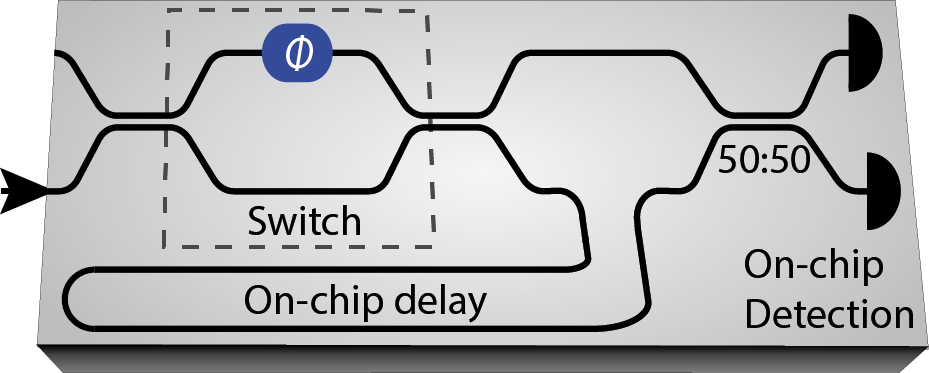 Figure 1
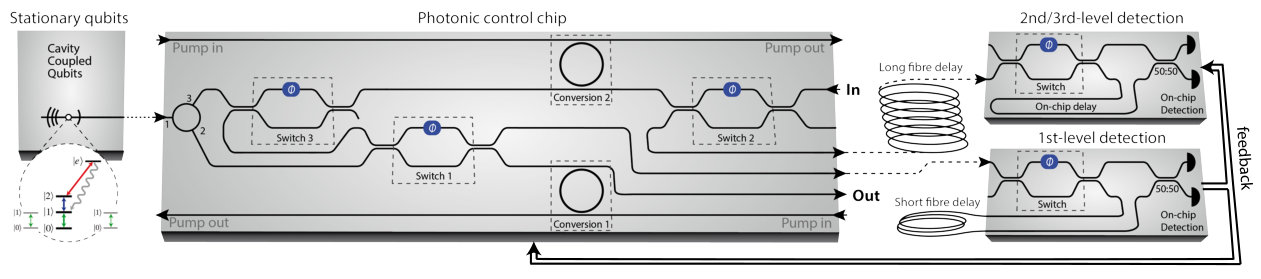 Figure 2
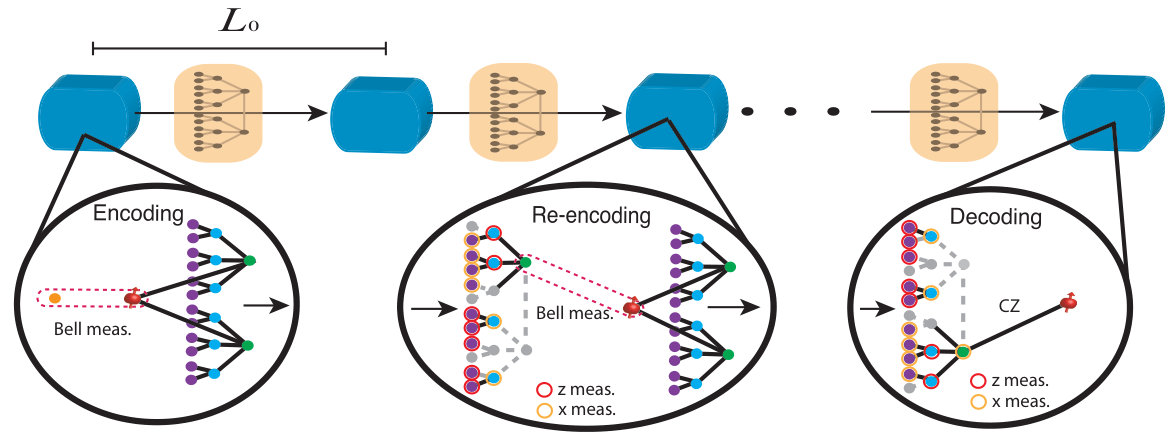 Figure 1
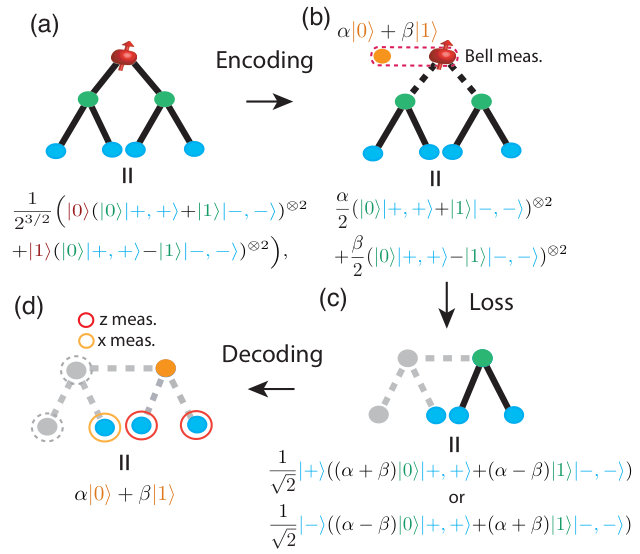 Figure 2
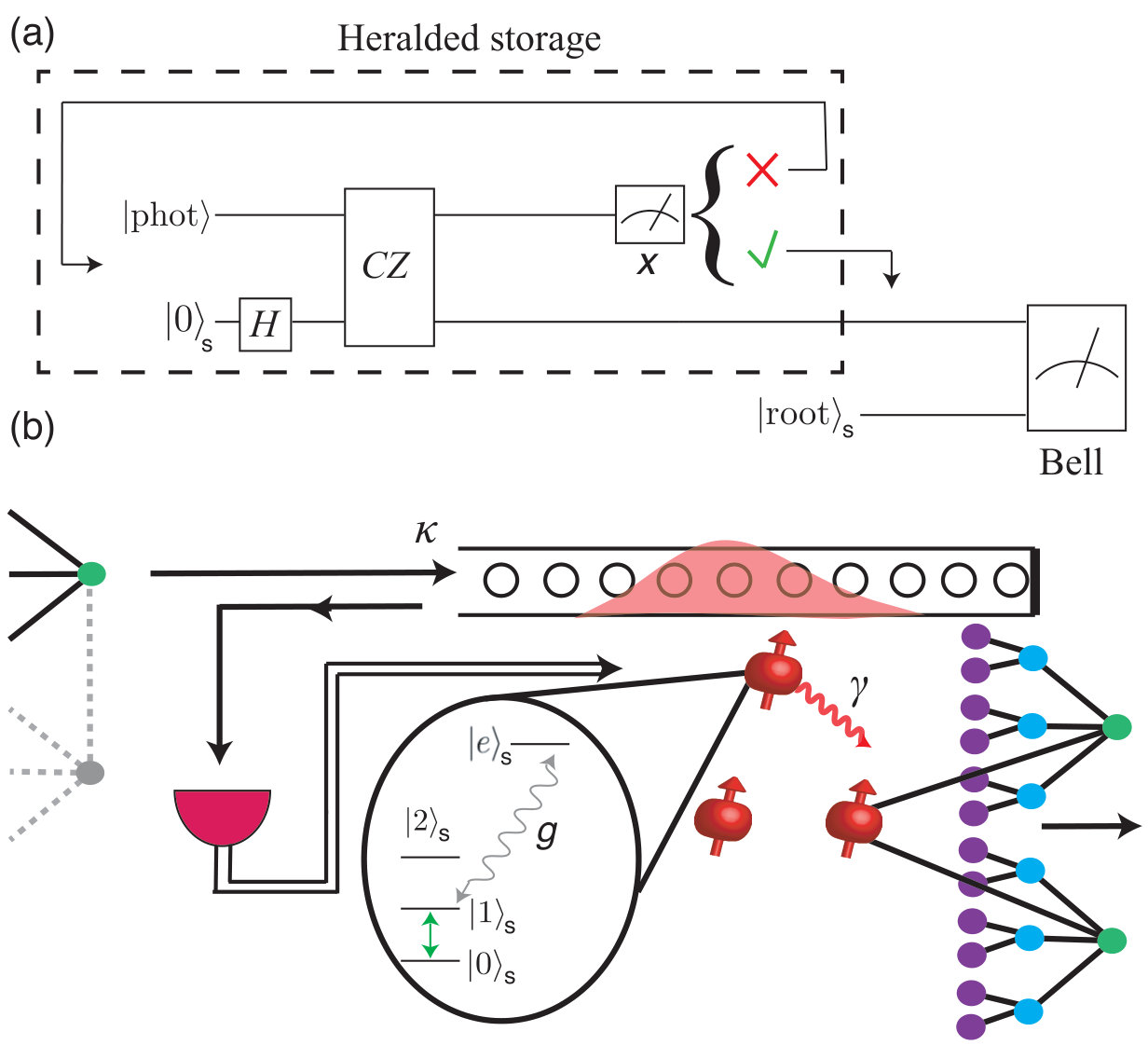 Figure 3
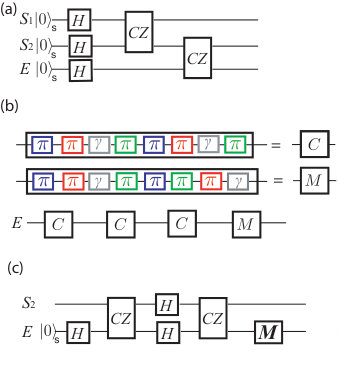 Figure 4
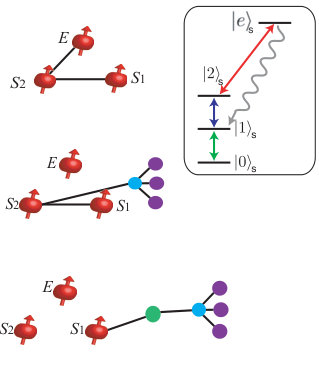 Figure 4
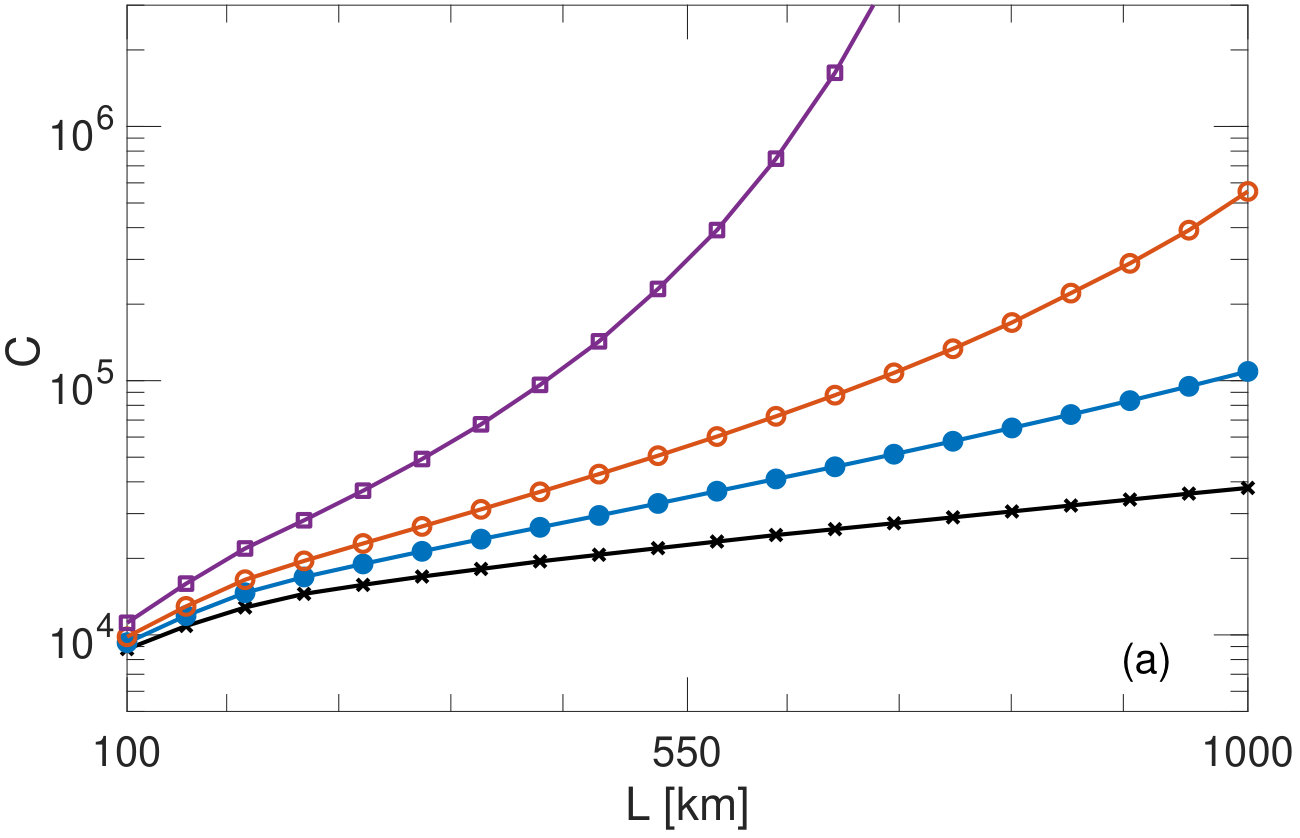 Figure 5
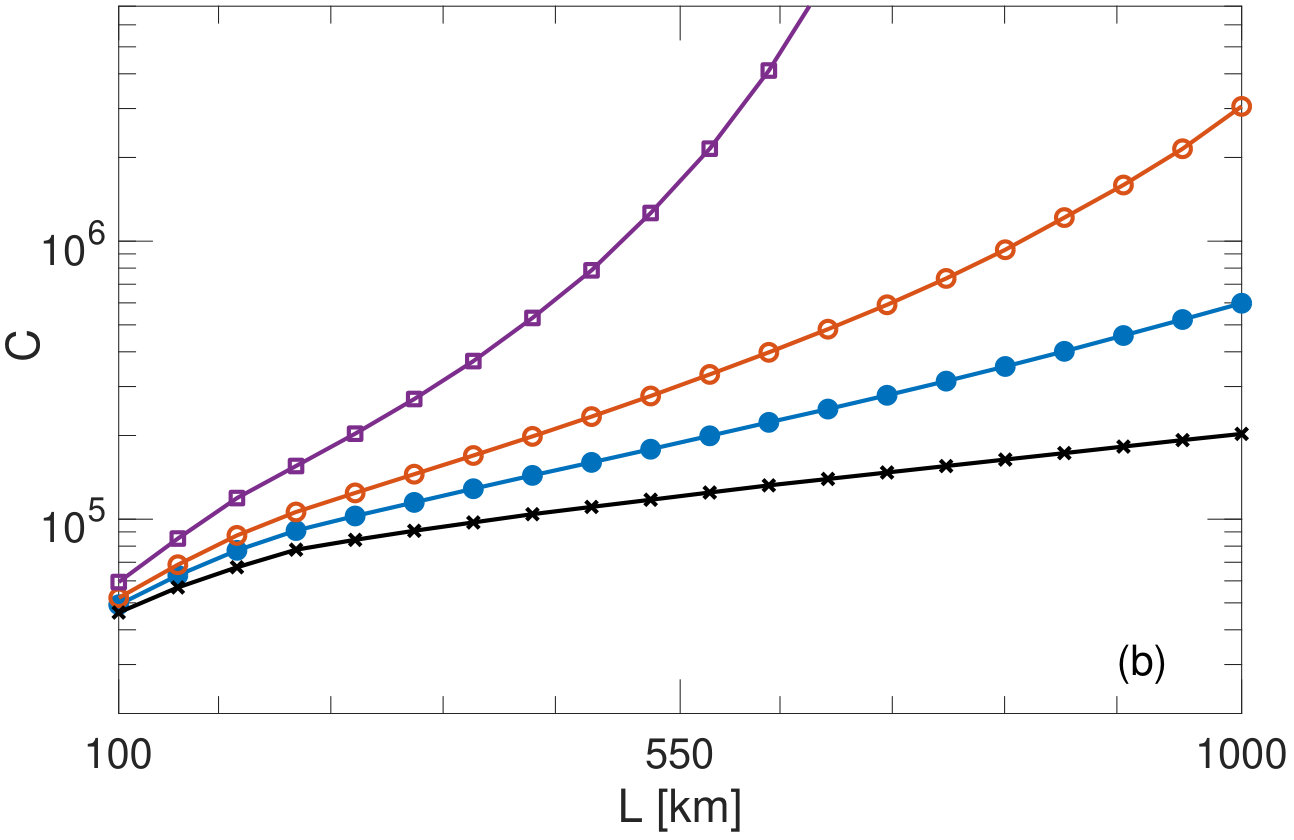 Figure 5
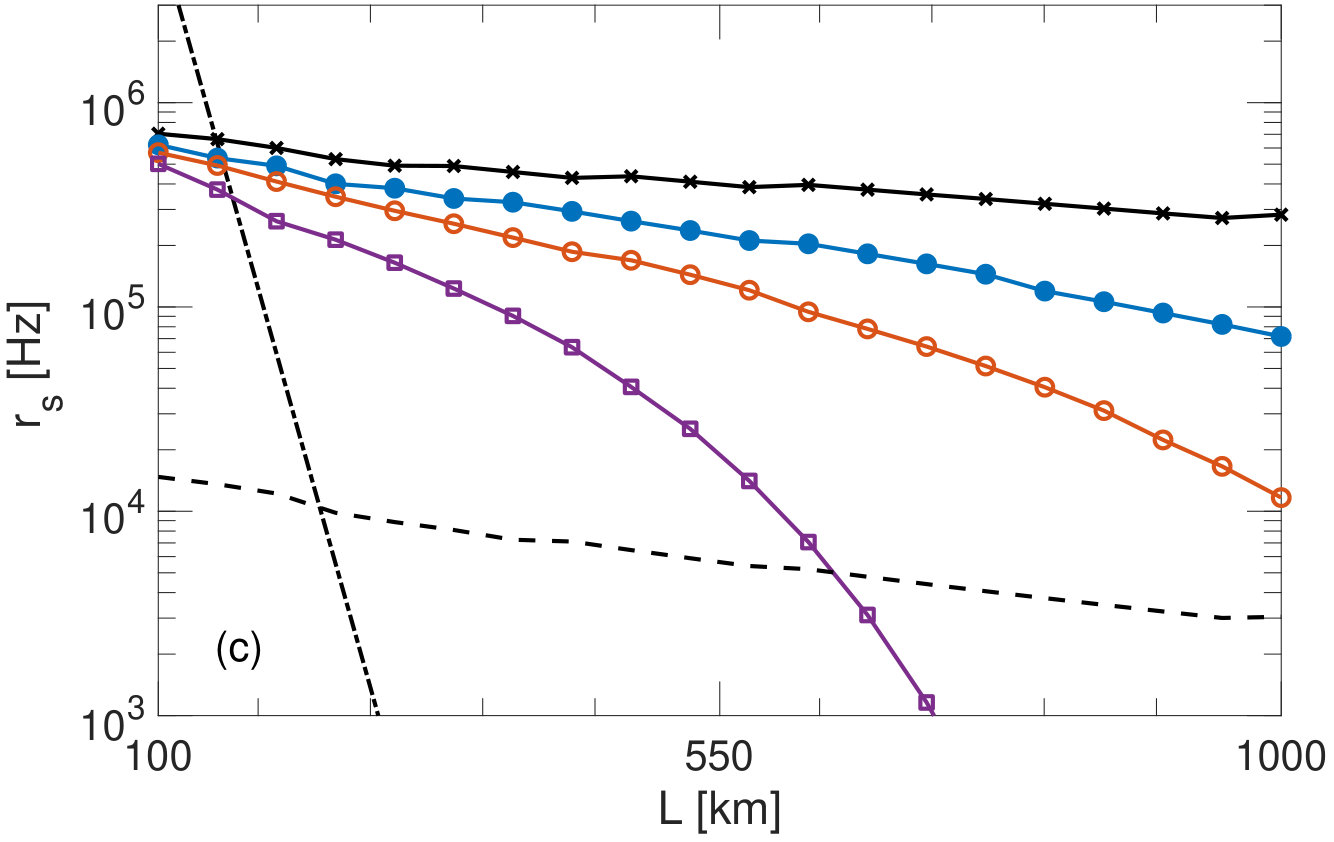 Figure 5
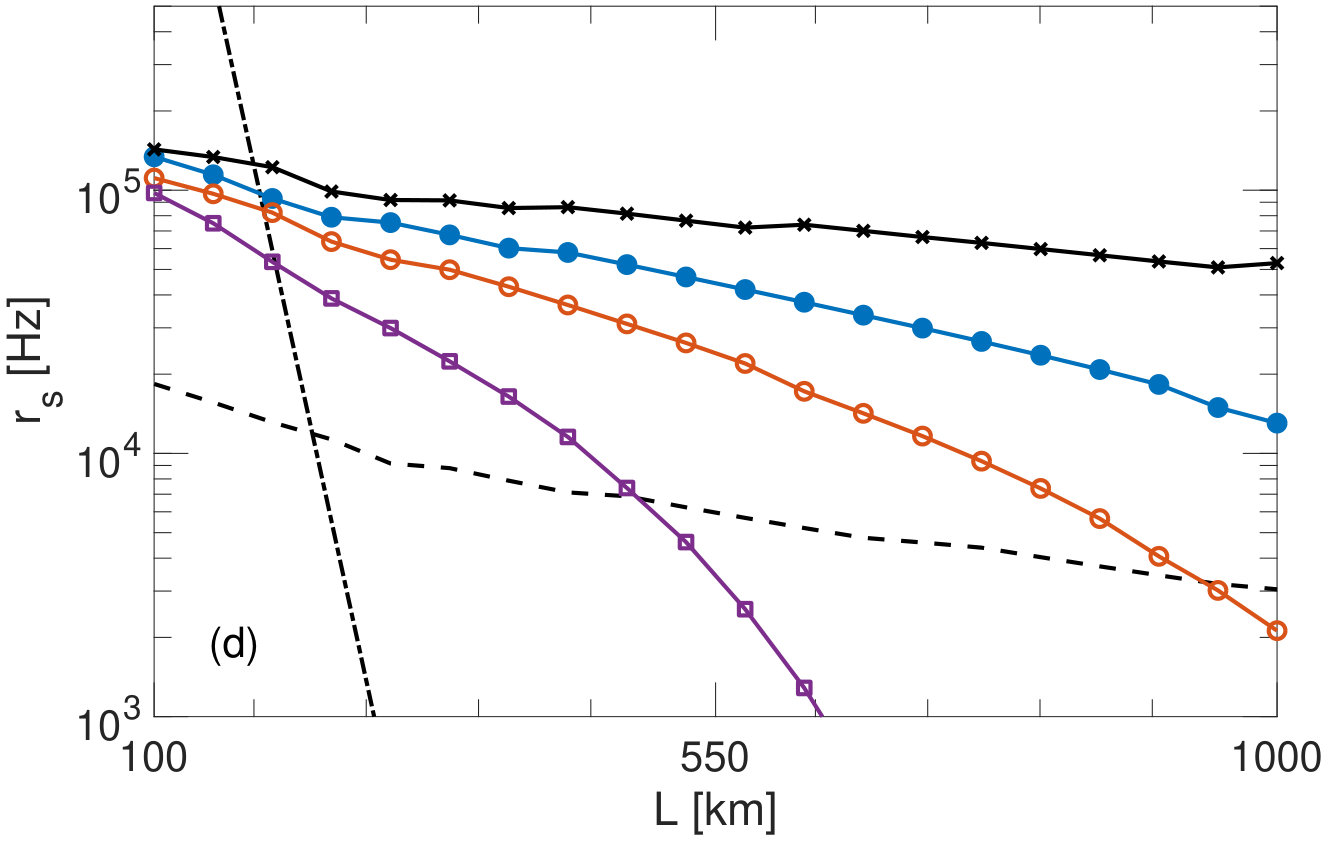 Figure 5
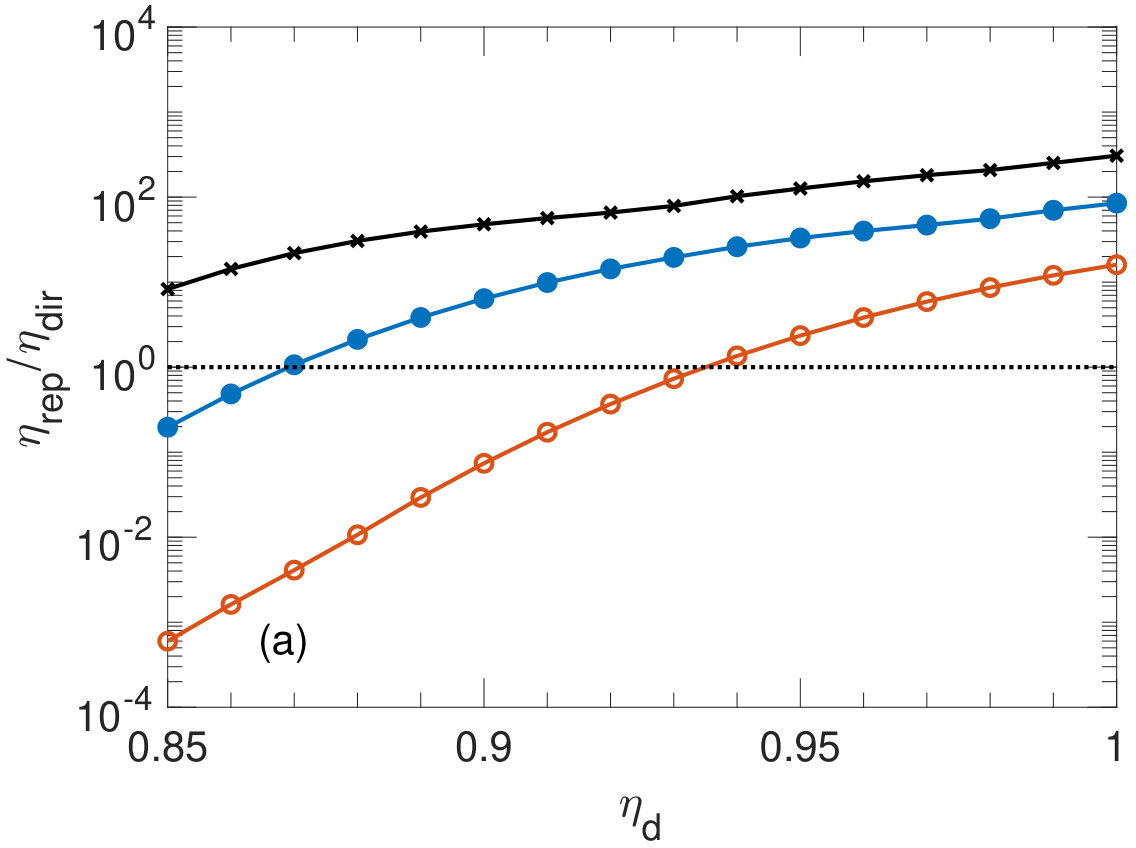 Figure 12
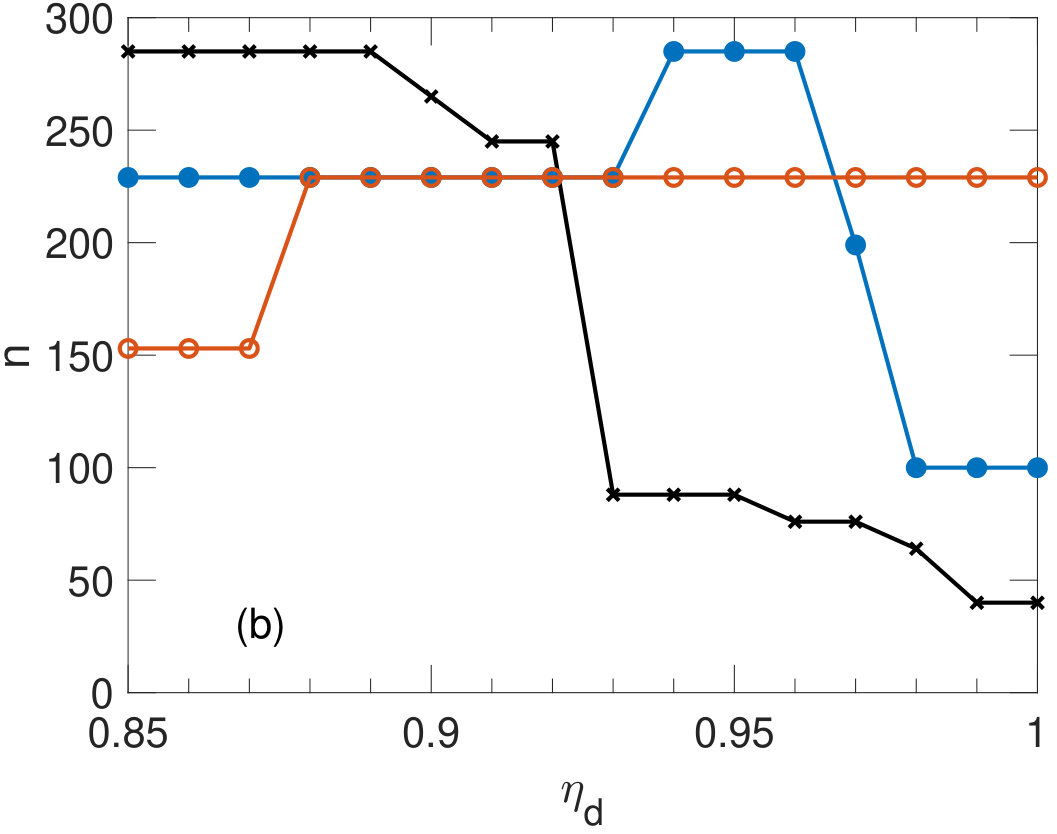 Figure 13
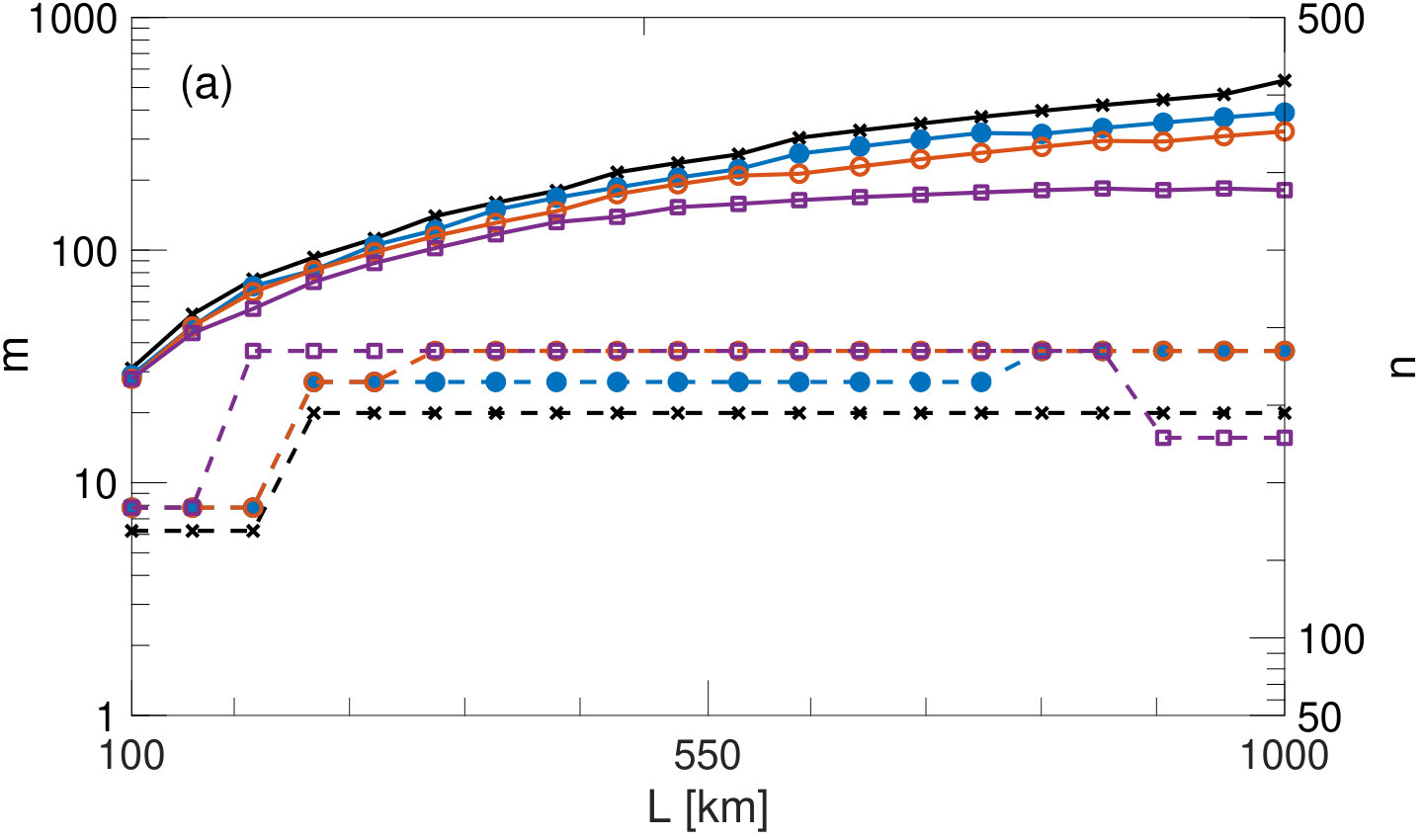 Figure 14
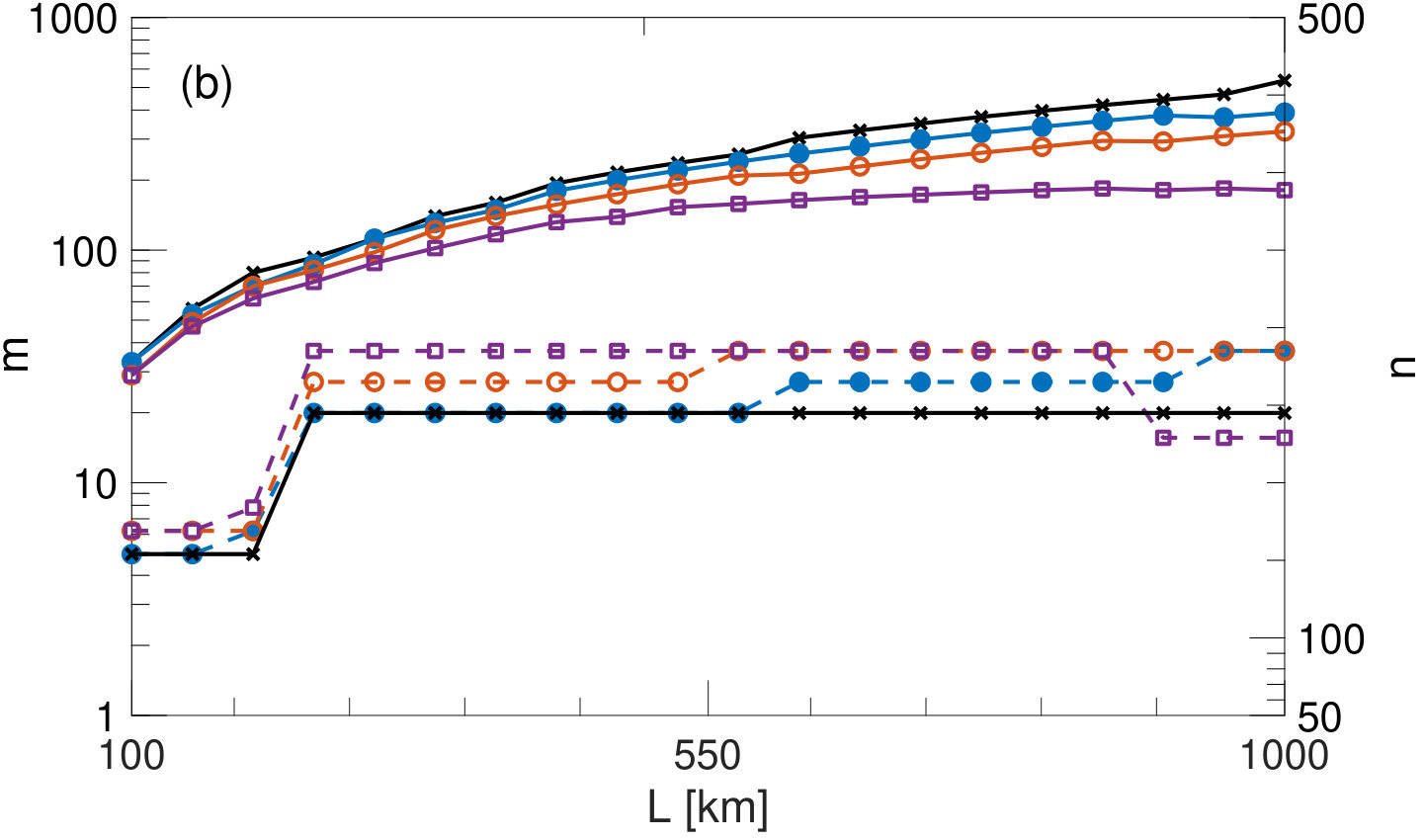 Figure 15
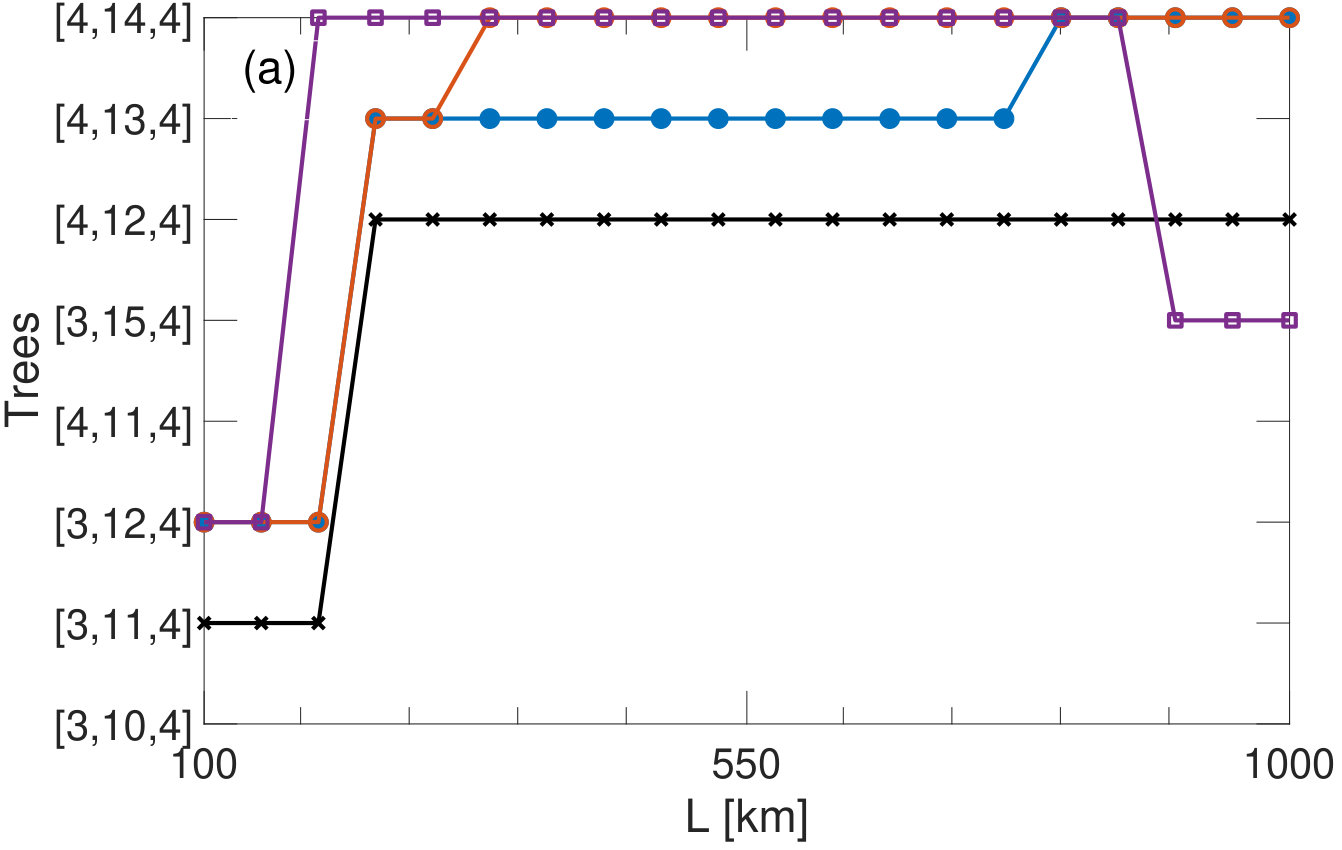 Figure 16
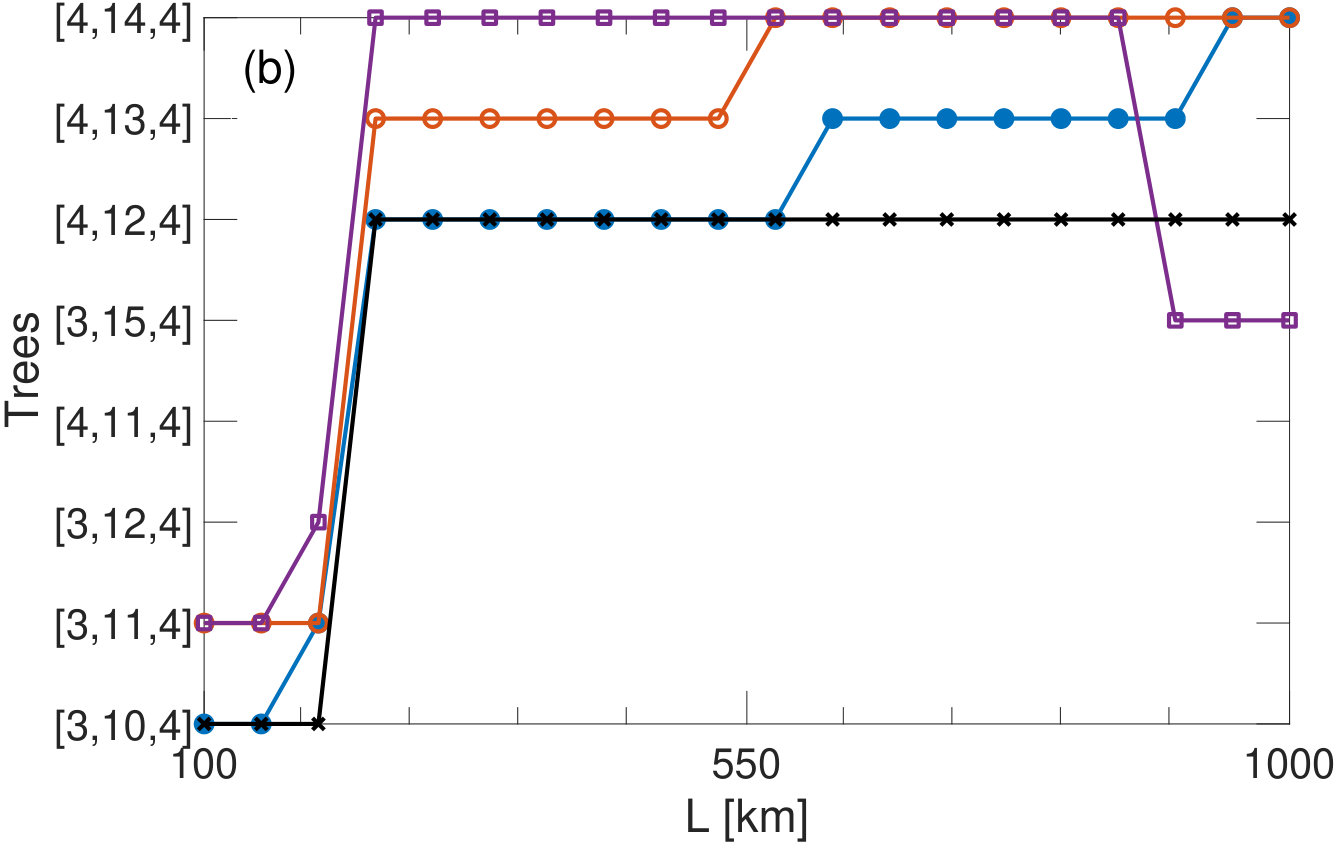 Figure 17
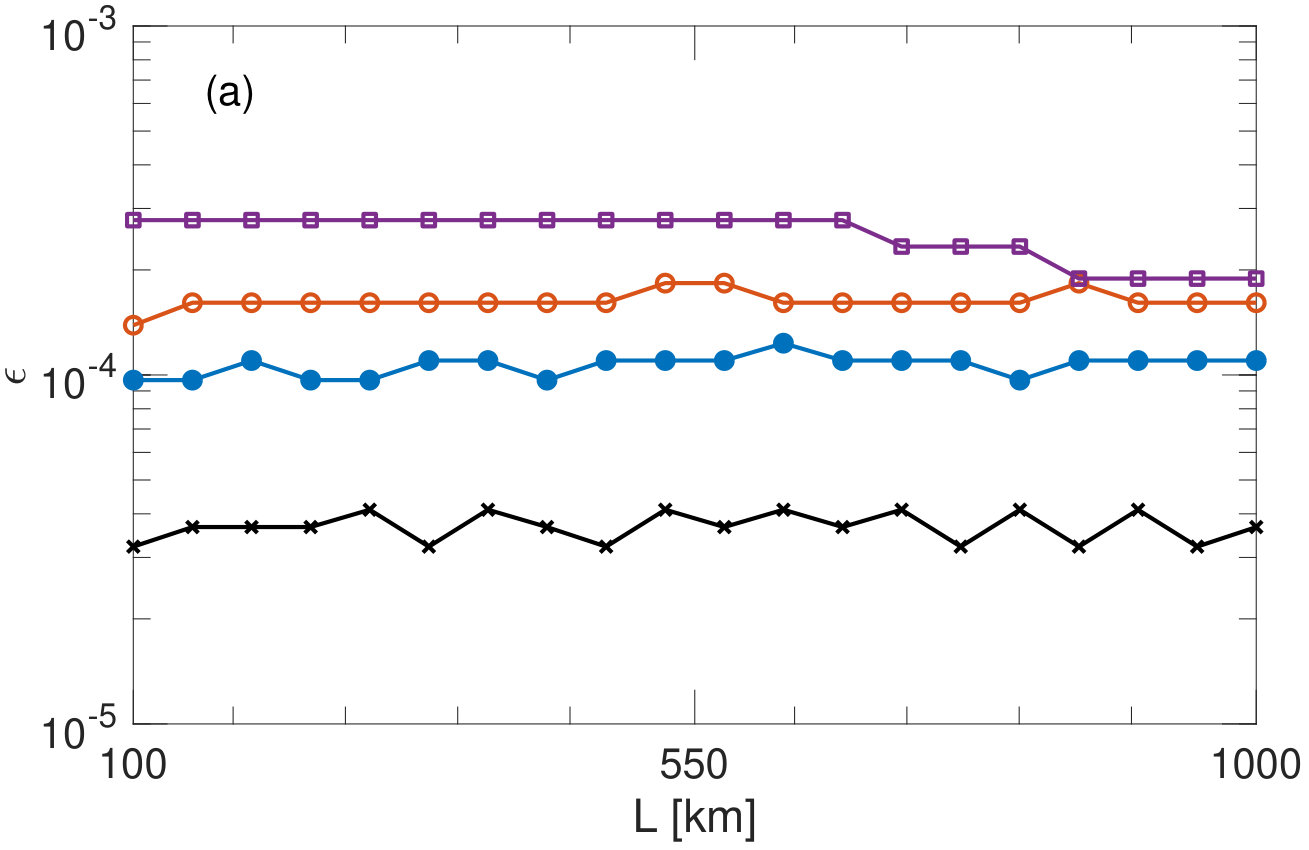 Figure 18
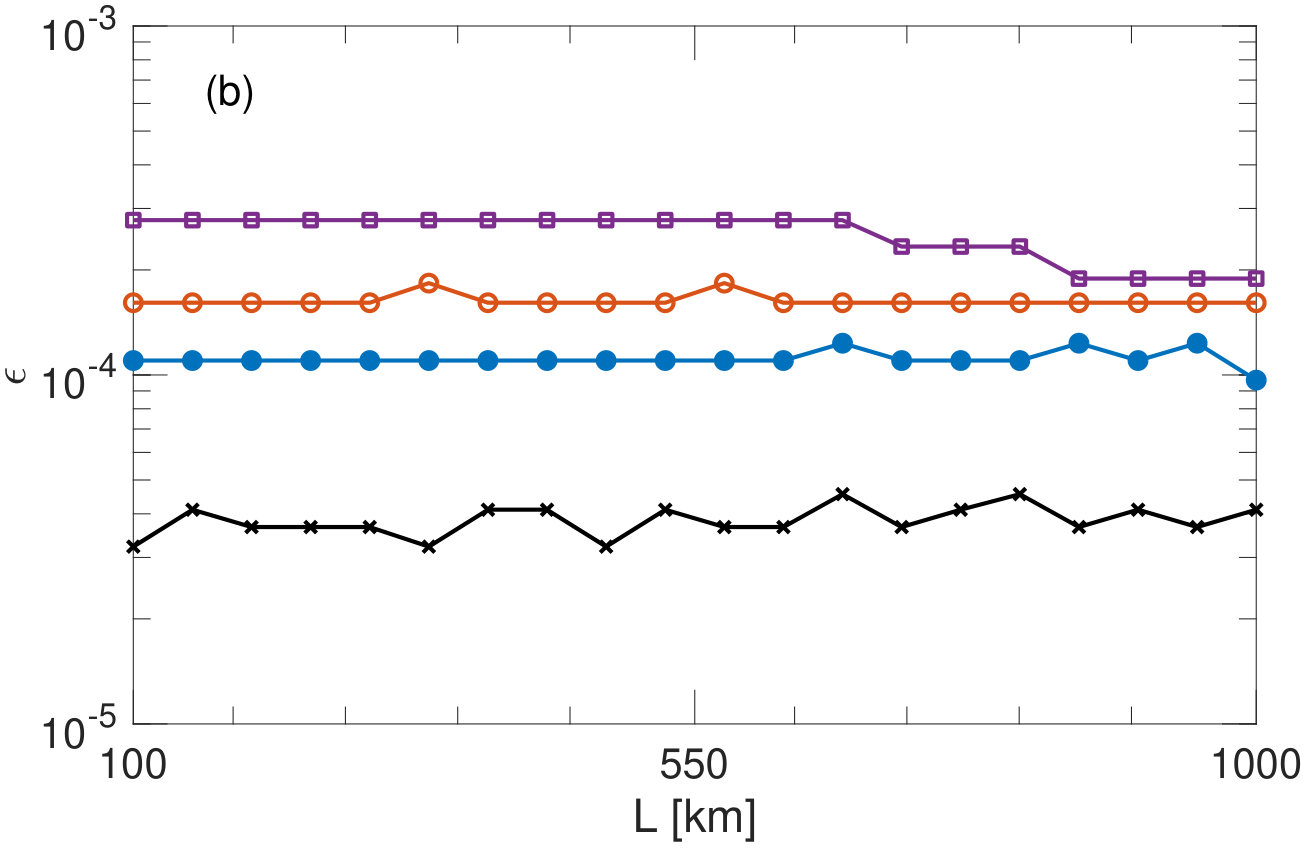 Figure 19
| Scheme | Characteristics | Performance | Physical/logical qubits |
|---|---|---|---|
| Current repeater | One-way repeater employing tree-encoding to battle transmission loss. Re-encoding requires a single succesful Bell measurement independent of the encoding size. Requires a small amount of feedforward. | Rate at km: for km, and km. | 285 photons per logical qubit. One quantum emitter and 2 auxiliary spin qubits per repeater station. |
| Ref. Muralidharan et al. (2014) | Based on the quantum parity code and teleportation based error correction with matter qubits. Number of matter qubits and CNOT gates used for re-encoding scales linearly with encoding size. | Optimal rate at km: for km, and km. | 126 photons per logical qubit and 252 matter qubits per repeater station. |
| Ref. Azuma et al. (2015) | Based on tree-clusters as photonic memories. Multiple tree-encoded qubits are generated at repeater nodes with linear optics requiring feedforward. | Rate at km: for km, and km. Optimally, cluster states of 19 logical qubits per repeater station are generated corresponding to a total of photonic qubits. | Cluster state of 4864 photons per repeater station requiring single photon sources per station Pant et al. (2017) . |
| Ref. Ewert and van Loock (2017) | Based on the quantum parity code with linear optics implementation. Number of Bell measurements for re-encoding scales linearly with size of the encoding. Generation of encoded states envisioned both with linear optics and optical nonlinearities. No feedforward required | Rate at km: for km, and km. | 737 photons per logical qubit requiring 1473 optical nonlinearities or single photon sources per repeater station. |
| Ref. Lee et al. (2018) | Based on the quantum parity code but considers linear optics implementation. Number of Bell measurements for re-encoding scales linearly with size of the encoding. Generation of encoded states is envisioned with linear optics but detailed resource analysis is not provided. Requires feedforward. | Rate at km: for km, and km. | 464 photons per logical qubit. |
| Ref. Glaudell et al. (2016) | Considers CSS codes and operation in a sequential manner. Implementation with minimum number of matter qudits considered. | Estimated near MHz rates for km assuming m and loss in telecom fibers (not further specified). Photon emission rates of GHz were considered. | 7 photons per logical qubit and matter qudits per repeater station. |
Peer Reviews
No public reviews on file for this paper yet. If you reviewed it on a platform where reviews are public (OpenReview, ICLR, NeurIPS, ICML), you can paste yours below so the community can read it here.
Videos
No videos yet. Explain this paper in a talk, walkthrough, or lecture? Add one.
Taxonomy
TopicsSemiconductor Quantum Structures and Devices · Photonic and Optical Devices · Neural Networks and Reservoir Computing
One-way quantum repeater based on near-deterministic photon-emitter interfaces
Johannes Borregaard
QuTech and Kavli Institute of Nanoscience, Delft University of Technology, 2628 CJ Delft, The Netherlands
QMATH, Department of Mathematical Sciences, University of Copenhagen, DK-2100 Copenhagen Ø, Denmark
Hannes Pichler
ITAMP, Harvard-Smithsonian Center for Astrophysics, Cambridge, MA 02138, USA
Department of Physics, Harvard University, Cambridge, MA 02138, USA
Tim Schröder
Department of Physics, Humboldt-Universität, 12489 Berlin, Germany
Center for Hybrid Quantum Networks (Hy-Q), The Niels Bohr Institute, University of Copenhagen, DK-2100 Copenhagen Ø, Denmark
Mikhail D. Lukin
Department of Physics, Harvard University, Cambridge, MA 02138, USA
Peter Lodahl
Center for Hybrid Quantum Networks (Hy-Q), The Niels Bohr Institute, University of Copenhagen, DK-2100 Copenhagen Ø, Denmark
Anders S. Sørensen
Center for Hybrid Quantum Networks (Hy-Q), The Niels Bohr Institute, University of Copenhagen, DK-2100 Copenhagen Ø, Denmark
Abstract
We propose a novel one-way quantum repeater architecture based on photonic tree-cluster states. Encoding a qubit in a photonic tree-cluster protects the information from transmission loss and enables long-range quantum communication through a chain of repeater stations. As opposed to conventional approaches that are limited by the two-way communication time, the overall transmission rate of the current quantum repeater protocol is determined by the local processing time enabling very high communication rates. We further show that such a repeater can be constructed with as little as two stationary qubits and one quantum emitter per repeater station, which significantly increases the experimental feasibility. We discuss potential implementations with diamond defect centers and semiconductor quantum dots efficiently coupled to photonic nanostructures and outline how such systems may be integrated into repeater stations.
I Introduction
Encoding information in quantum systems is the fundamental principle of quantum information technologies, ranging from quantum computers Ladd et al. (2010) to unconditionally secure communication Gisin et al. (2002). Quantum networks constitute an important element for implementing such technologies in a scalable fashion Kimble (2008). The exact requirements and applications of large-scale quantum networks constitute an active research area Wehner et al. (2018). One of the key challenges for constructing large scale quantum networks is to faithfully transmit quantum information over long distances which is challenging due to transmission loss.
Quantum repeaters have been proposed as a means to overcome transmission loss by exploiting quantum correlations to extend the transmission length of quantum information Briegel et al. (1998); Munro et al. (2015); Muralidharan et al. (2016). The conventional quantum repeater architecture relies on heralded quantum entanglement distribution, which necessitates long-lived quantum memories and two-way communication between sender and receiver Munro et al. (2015). The need for heralding limits the communication rate at which quantum information can be distributed and requires long-lived quantum memories with efficient light-matter coupling Seri et al. (2017); Borregaard et al. (2019). To overcome these limitations, one-way and all-photonic quantum repeaters have been proposed Fowler et al. (2010); Munro et al. (2012); Muralidharan et al. (2014); Glaudell et al. (2016); Azuma et al. (2015); Ewert et al. (2016); Lee et al. (2018). One-way repeaters use multi-photon encoding and quantum error-correcting codes to protect the quantum information from both loss and operational errors. In this way, quantum information can be transmitted from one repeater station to the next without the need for pre-established entangled links. For these reasons, in principle, one-way repeaters can significantly boost the distribution rate Muralidharan et al. (2016) without the need for a long-lived quantum memory for key applications such as long-distance quantum key distribution Scarani et al. (2009). An outstanding challenge involving the physical implementation of one-way quantum repeaters is how to efficiently generate the multi-qubit error-correcting codes and how to perform error correction. This usually requires many high-fidelity two-qubit operations and considerable amounts of auxiliary qubits at each repeater station Muralidharan et al. (2014); Lee et al. (2018); Ewert et al. (2016); Ewert and van Loock (2017).
In this Article, we propose a novel one-way quantum repeater architecture that can be implemented with as little as two memory qubits and one quantum emitter per repeater station. Our approach is based on photonic tree-cluster states Varnava et al. (2006), which are used to encode a message qubit to be transmitted to the next repeater station (see Fig. 1). Photonic tree-clusters have previously been considered as photonic memories to ensure efficient entanglement swapping in all-optical quantum repeaters Azuma et al. (2015); Pant et al. (2017). Such all-optical approaches generate multiple photonic tree-clusters at each repeater station potentially requiring kilometer long delay lines and millions of single-photon sources per station Pant et al. (2017). Our approach circumvents this significant overhead by using strongly coupled quantum emitters with build-in nonlinearity. Specifically, in our approach, the photonic tree-clusters required for the repeater can be generated with two memory qubits and one single photon emitter per repeater station using repeated photon emissions Buterakos et al. (2017). In addition, correction of losses only require a single Bell measurement independent of the size of the tree-encoding. This constitutes a significant reduction in overhead as compared to, e.g., one-way quantum repeaters based on the quantum parity encoding Munro et al. (2012); Muralidharan et al. (2014); Ewert et al. (2016), which requires a number of two-qubit operations that scales linearly with the size of the encoding corresponding to hundreds of memory qubits per repeater station Muralidharan et al. (2016). In comparison, the current approach can be implementated with only two spin systems per repeater station as we outline below. We also discuss possible experimental implementations of our protocol based on state-of-the-art solid-state quantum emitters in nanophotonic structures in order to lay out a realistic path towards high bit-rate, long-range quantum communication. Importantly, many of the required parameters for our protocol are not far from current state-of-the art performances, which together with the significant resource reduction compared to previous one-way protocols cements the experimental feasibility of our approach.
II Quantum repeater protocol
The basic operation of the repeater is shown in Fig. 1. At each node, a multi-photon entangled state is generated and used to encode and transmit a message qubit to the next repeater station. Crucially, even if some of the photons are lost, the repeater can decode the logical qubit and re-encode it, thereby correcting for photon loss before transmitting the message to the next station.
II.1 Tree-cluster states
In this work, we consider one way quantum repeaters based on using tree-cluster states as error correcting codes. Such tree-cluster states are illustrated in Fig. 2. We characterize the tree by a branching vector , which specifies the connectivity of the tree as one moves from the root vertex (top node in Fig. 2(a)) through the levels of the tree. Tree-cluster states are obtained by associating a qubit with each vertex (see Fig. 1). Moreover, one further associates a stabilizer operator , that acts nontrivially on the vertex and its neighbors . The tree-cluster state is the unique eigenstate with eigenvalue +1 of all stabilizer operators .
As a specific, illustrative example, let us consider a [2,2]-tree cluster state (see Fig. 2(a)). One can easily check that this 7-qubit state is given by
[TABLE]
Here, we have defined the states , with and being the basis states of the qubits. Below we consider an implementation where the root qubit is represented by a stationary two-level spin system (spin qubits are denoted with subscript s) while the rest of the tree cluster state is represented by photons.
II.2 Encoding the logical qubit
Consider the situation, where the message qubit, , is initially prepared in a second stationary qubit. To send this message qubit from the first station to the next repeater, one has to encode it into the state of the photons. This can be achieved by a simple teleportation process, which can be realized by a 2-qubit Bell measurement of the stationary qubits, i.e. the spin that stored the message qubit and the stationary root qubit of the tree-cluster state (see Fig. 2(b))
For the above example of a -tree this prepares the state of the photons in
[TABLE]
where and , depending on the four possible outcomes of the Bell measurement. The values of and are not important since they can eventually be corrected in the decoding step. In Fig. 2, we assume for concreteness that we have obtained the values . Note that the quantum information of the message qubit is stored in a non-local form in the photonic degrees of freedom, and can not be retrieved by observing, e.g., only a single photon.
II.3 Photon loss and recovery of the message qubit
After this encoding step, the photons are transmitted to the next repeater station. The specific encoding protects against transmission loss such that the effective transmission probability of the message qubit is significantly increased compared to the bare transmission of a single photon.
To illustrate the basic mechanism, we again consider the example of the [2,2] encoding in Eq. (2). Already in this simple encoding, one can tolerate the loss of up to two photons in one of the two branches (see Fig. 2(c)). To see this, it is instructive to consider how the state can be recovered and the quantum information retrieved. As a first step in the recovering process, one measures all the qubits in one of the two branches (in Fig. 2, we assume that the left branch is to be measured). Specifically, the first level qubit is measured in the basis and the second level qubits are measured in the basis. Note that the corresponding measurement outcomes are perfectly correlated, such that only two sets of outcomes for the three measurements are possible. This is crucial, as it allows to infer the outcome from each of the three measurements, even if two of those qubits are lost. This measurements projects the state of the qubits in the remaining branch (right branch in Fig 2(c)) into the state
[TABLE]
where , depending on the measurement outcome. This branch now contains the entire encoded quantum information. It can be retrieved by measuring the two second level qubits in the basis (see Fig. 2(d)). Simple algebra shows that this prepares the remaining first level qubit in the state (up to known Pauli corrections that only depend on the obtained measurement outcomes, ). This simple analysis shows that the retrieval of the message qubit from a [2,2]-tree is possible as long as one branch is not corrupted and not more than two qubits of the other branch are lost, illustrating the basic principle allowing for correction of photon loss. Increasing the tree depth (length of ) and the number of branches increases the robustness of the encoding by the same principle Varnava et al. (2006).
II.4 Re-encoding and repetition
The goal of the repeater station is to re-encode the retrieved qubit in a new tree. This can be achieved in complete analogy to the encoding of the message qubit at the sending station: first a new tree-cluster of photons is generated, with a stationary spin serving as the root qubit (see Sec. III.1), followed by a Bell measurement between the message qubit and the root qubit.
Above we described how to recover the qubit into photonic qubit in the highest level of the tree. In the re-encoding procedure the goal is instead to perform a Bell measurement between the encoded qubit and the root qubit of a new tree. In analogy with the procedure above this re-encoding simply requires a Bell measurement between one of the 1st level photons of the encoded tree-cluster and the root qubit along with measurement of all other qubits in the same bases as above. Note that the order of the measurements is not important in the above recovery scheme. In practice, this allows us to re-encode the quantum information at each repeater station without prior knowledge about which qubit was lost. Specifically, one can first attempt a Bell measurement between one of the first level qubits and the root qubit of the new tree. If this measurement is successful, one can teleport the encoded quantum information into the new tree by measuring all connected qubits in the basis. Some of these measurements may turn out to be unsuccessful because the qubits were lost in transmission. In these cases, the corresponding measurement outcome is inferred through measurements on qubits in the next level of the corresponding branch, in complete analogy to the example above. If the first Bell measurement is unsuccessful itself (because the corresponding photon was lost in transmission), then the value of a measurement can be inferred instead (via measurement of the next level qubits), and a Bell measurement can be attempted with another first level qubit. In order not to perturb the root qubit of the new tree in a failed attempt of a Bell measurement, special care must be given to the implementation of the measurement, as described below. Specifically, the message qubit should first be transferred to an auxiliary spin qubit by means of a spin-photon controlled-phase gate (CZ-gate) and then encoded into the new tree-cluster with a deterministic Bell measurement between the auxiliary spin qubit and the root spin qubit (see Fig. 4 below).
The re-encoding and transmission continues down the repeater chain until the encoded message qubit arrives at the end node. There the message qubit can be either transferred to a stationary spin in a similar fashion as in the repetition step (see Fig. 1), or directly measured (without first transferring the information to a receiving spin qubit) by appropriate measurements of the photons of the encoded tree.
III Experimental implementation
The key requirements for an implementation of the above protocol are the ability to generate tree-cluster states of photons, realize Bell-measurements between stationary spins and photonic qubits, and perform measurements of the photons in the and basis.
III.1 Photonic tree generation
We propose to generate the photonic tree cluster states using a light matter interface illustrated in Fig. 4. It consists of stationary memory spins and one spin which is coupled to the light field. The latter is used to generate photons by selectively coupling a ground state to an excited via the optical field in a one-sided cavity. We are considering a time-bin representation of the photonic qubits. In this representation, the presence of a single photon in one of two non-overlapping spatiotemporal modes represents the two qubit states and . The main reason for using this time-bin representation is that it allows to detect errors stemming from photon loss. This could also be obtained with a polarization representation but the time-bin representation is better suited for transmittance through optical fibers, which typically disturb the polarization state.
Recent work Buterakos et al. (2017) showed that sequential excitation of the quantum emitter, together with controlled phase gates between the emitter and the memory spins allows to deterministically generate an arbitrary photonic tree-cluster state. In particular, a tree-cluster state of depth only requires memory spin systems while the number of necessary spin-spin CZ-gates scales polynomially with the number of branches at each level Buterakos et al. (2017). In what follows, we show that tree-cluster states of depth 3 are sufficient for transmission distances up to 1000 km (assuming telecom frequencies) and consequently only two memory spin systems and a single quantum emitter are necessary for the generation of such states.
The generation of a tree-cluster state with depth 3 is sketched in Fig. 3. In the first step (a), CZ-gates are applied between the two memory spins and between the emitter and one memory spin. The spin of the quantum emitter acts as a second level qubit in the tree and all third level photonic qubits of the subbranch are emitted through repeated excitation followed by spontaneous emission as shown in Fig. 3(b). The second level qubit is then mapped to a photonic qubit using the auxiliary level of the emitter, which also detaches the emitter from the preliminary tree-cluster state. This step is repeated until all 2nd and 3rd level photons of the branch have been emitted. The spin of the second memory qubit is then first swapped to the spin of the emitter by means of two CZ gates and subsequently swapped to a photonic qubit (Fig. 3(c)). This completes the emission of one branch of the photonic tree-cluster state and the procedure can then be repeated to output the entire state. We note that this generation procedure, in principle, require additional Hadamard gates on the 3rd level photons to fit the stabilizer description introduced earlier. This is, however, not necessary since it is sufficient to simply rotate the measurement basis of these photons in the re-encoding and decoding steps.
A drawback of this generation scheme is that the photons will be emitted such that the 1st-level qubit of a branch is emitted last. As previously described, the presence/absence of a 1st-level photon determines the measurement basis of the corresponding branch at a repeater station. It is therefore necessary to delay the photons of each branch to enable measuring the 1st-level qubit first. The length of this delay will depend on the emission rate of the emitters and the number of photons per branch, but is generally modest and implementable in optical fiber delays. We will discuss this issue in more detail below.
III.2 Bell measurement
As described above, the re-encoding at the repeater stations requires a successful Bell measurement between one of the 1st level qubits in the encoded tree-cluster and the root qubit of the new tree-cluster. It is crucial, that this Bell measurement is designed with a built-in error detection: if a Bell measurement is attempted with a lost 1st level qubit, the measurement should abort without perturbing the root qubit. Otherwise, a new tree-cluster has to be generated after each failed attempt.
The setup required to generate the tree-cluster states (Fig. 3) conveniently also allows for such an operation. While one of the stationary memory qubits represents the root qubit, the spin coupled to a one-sided cavity is used for heralded storage of the message qubit through a spin-photon CZ-gate (see below) Reiserer et al. (2014); Tiecke et al. (2014); Kalb et al. (2015); Sun et al. (2018). Importantly, the success of the storage is conditioned on subsequently detecting the photon in the -basis (see Fig. 4). When a storage attempt is unsuccessful due to the loss of the photonic qubit, the auxiliary spin qubit is simply re-initialized and a new attempt is made with another first level qubit. The root spin qubit of the new tree-cluster is completely unaffected by this. Once the storage is successful, a Bell measurement between the auxiliary spin-system and the spin-system containing the root qubit of the new tree is performed using deterministic entangling gates between the two spin systems, concluding the re-encoding step.
To perform the cavity mediated spin-photon CZ-gate, we assume the auxiliary spin to initially be prepared in ground state . For a time-bin encoded photonic qubit, the early half of the wave packet corresponding to qubit state is first reflected off the cavity. In the ideal limit, the photon will be reflected with a -phase shift from the cavity. Now the transformation is performed on the emitter before the late half of the photon wave packet, corresponding to qubit state , is reflected off the cavity. If the auxiliary spin system is in state (), the photon gets reflected without (with) a phase shift in the limit of strong light-matter interaction , characterized by the cooperativity . Here is the single photon Rabi frequency of the cavity mediated transition, is the decay rate of the cavity and is the free space spontaneous emission rate of the excited level. Up to a global phase, this amounts to a CZ-gate between the photonic time-bin qubit and a qubit in the ground states of the auxiliary spin system initially prepared in . The details of the gate interaction and main errors are described in the supplemental material SM . The success of the gate is conditioned on subsequently detecting the photon in the -basis, which boosts the fidelity. We find that if the intra-cavity losses are tuned to be on the order of then a spin-photon cooperativity of is sufficient to ensure an error and a success probability , where is the efficiency of the photon detection.
In the above estimate, we have assumed that reflection of photons into the detector from e.g., imperfect mode-matching is negligible. Such events directly translate into an error since they correspond to operation without any spin-photon interaction. Careful engineering of the mode profile and additional filtering of, e.g., uncoupled polarization modes must therefore be employed to suppress such reflections to the desired error-level. We note, however, that a mode-matching efficiency of 99% is sufficient to ensure an error of SM . Furthermore, we have assumed that the frequency width of the 1st level photons is narrow enough to neglect errors from the finite bandwidth of the Purcell enhanced emitter. For , this would require the 1st level photons to have a frequency width to have errors SM . Weak driving from an auxiliary level to (see inset in Fig. 3) allows to tune the emission time of the first level photons to achieve this Pichler et al. (2017) (operation in Fig. 4).
We note that depending on the success of the spin-photon Bell measurement, the measurement basis of the qubits in the corresponding branch of the encoded tree-cluster states must be adjusted. If a 1st-level qubit is lost (detected), the qubits in the corresponding branch should be measured in the () basis for the tree-cluster states generated as described above.
III.3 Photon measurement
With the considered time-bin encoding, measurements of photons in the -basis require only time-resolved detection. Measurements in the -basis on the other hand are more demanding. In particular, a deterministic -basis measurement requires fast optical switching and delay lines. Our analysis shows that GHz optical switching rates will be required to ensure tree-generation rates in the MHz regime (see below). Such switching rates can be exceeded with schemes based on sub-nanosecond phase-control in Mach-Zehnder interferometers (MZI) via electro-optic (EO) modulation. Such integrated devices have been demonstrated for a variety of material platforms Reed et al. (2010); Sun et al. (2015); Ogiso et al. (2017); Koeber et al. (2015); Krasnokutska et al. (2018); Wang et al. (2018). Towards a scalable, small footprint implementation we therefore propose an on-chip photonic circuit based on switching via EO modulation in cascaded Mach-Zehnder interferometers as shown in Fig. 5 and discussed in the supplemental material where we also outline an integrated on-chip setup for the repeater stations SM .
III.4 Other experimental requirements
So far we have discussed the optical interface required to achieve the successful operation of the repeater. In order to be able to make realistic estimate of the achievable communication rate, we will now discuss concrete requirement for two specific physical systems, quantum dots and color centers in diamond. One of the practical requirements in reducing the photon loss is a highly efficient coupling for the cavity to an optical fiber, e.g. using tapered optical fibers Tiecke et al. (2015); Patel et al. (2016); Daveau et al. (2017). The collection efficiency (-factor) of the emitted photons to a cavity or alternatively a waveguide needs to be high. Quantum dots in waveguides have already demonstrated collection efficiencies of Arcari et al. (2014), which is compatible with the efficiency assumed in our resource analysis below (see Fig. 6). In addition, coupling to photonic nanostructures may also decrease the photon emission time through the Purcell enhancement and photon emission times of ps are feasible with solid state emitters such as quantum dots Liu et al. (2018) and diamond color centres Zhang et al. (2018).
Finally, spin-spin CZ gates are required both for the tree-generation and the re-encoding operation. Fast spin-spin gates ( ns) could be performed in stacked quantum dots Kim et al. (2010); Evans et al. (2018) while somewhat slower gates can be performed between electron and nuclear spins for Nitrogen-vacancy (NV) or Silicon-vacancy (SiV) centers in diamond through magnetic dipolar interaction Kalb et al. (2017). For the latter, gate times on the order of ns are feasible with SiV systems using nearby nuclei with strong (1 MHz) hyperfine interactions. Alternatively, fast gates could also be implemented using photon mediated gates between different emitters Mahmoodian et al. (2016a). This involves two auxiliary spin qubits for parity measurements and can be made error-proof against photon loss errors at the expense of a slight decrease in success probability. For the gate in question Mahmoodian et al. (2016a), a -factor of would give a success probability of and a heralded error of . Such probabilisitic spin-spin gates will, however, decrease the rate of the repeater when used in the re-encoding step at the repeater stations. The reason being that the re-encoding involves the (unprotected) root qubit of the new tree. Considering a distance of 1000 km where repeater stations are needed (see optimization below), a success probability of % would result in a rate that is % of the rate for a deterministic gate. Using probabilistic gates in the tree generation steps is of less concern since heralding techniques can be employed and the majority of the necessary gates will involve the redundant qubits of the tree-encoding, which are somewhat loss-tolerant.
The details of the time budget for the generation of the tree-cluster states and length of the necessary delay line is detailed in the supplemental material SM . We find that the photonic tree-cluster states can be emitted within s ( s) assuming Purcell-enhanced photon emission lifetime of about 100 ps Liu et al. (2018); Zhang et al. (2018) and spin-spin CZ gate times of ns ( ns). The spin qubits need to stay highly coherent for these time scales, which for SiV and NV systems can be achieved using nearby nuclear spins Maurer et al. (2012) or operating at low temperatures Sukachev et al. (2017). For quantum dots, dynamical decoupling Bluhm et al. (2010) or coupling to a nuclear spin memory Gangloff et al. (2019) may be employed to increase coherence times motivating further development of such techniques. For the above generation times, delay lines of maximum length m ( m) at the repeater stations are required ensure the right detection order of the photons (see Sec. III.1). At telecom frequencies such a delay line would have a transmission above (), which can be integrated into the overall detection efficiency .
IV Repeater performance
The above analysis outlined all necessary operations and general hardware considerations of the repeater. Importantly, we have shown that only a single successful Bell measurement is needed at the re-encoding step and that this can be implemented in a loss-tolerant manner using two spin systems. Furthermore, we have outlined how the photonic tree-clusters may be generated requiring in total only two qubit spin systems per repeater station in addition to the quantum emitter. We now proceed by estimating the performance of the repeater in terms of the maximum quantum bit rate for given distances.
The transmission probability of a message qubit through the entire repeater chain will be
[TABLE]
where is the number of equally spaced repeater stations between the start and end stations, and is the transmission probability of the encoded quantum information between repeater stations. The encoded transmission probability depends on the specific tree-encoding, the bare transmission probability of a single photon between repeater stations, and the detection efficiency of the photon detectors . Note that in/out coupling efficiency and any frequency conversion efficiency that may be required to transduce to the telecom band can be directly included in .
For a tree-cluster encoding with branching vector , is given by the recursive formula Varnava et al. (2006)
[TABLE]
where
[TABLE]
with and . Here, is the probability of having a successful indirect measurement of any given qubit in the ’th level of the tree. Consequently, the total probability of a successful measurement of a ’th level qubit (direct or indirect) is . For a fiber-based implementation, the bare transmission will be , where is the distance between the repeater stations and km is the attenuation length of the optical fiber assuming that efficient frequency conversion to the telecom band is implemented.
The relative simplicity of the encoding in tree-cluster states comes with the penalty that it is not able to correct arbitrary errors as opposed to other codes considered for one-way repeaters. It is clear that an error on the qubits participating in the re-encoding Bell-measurement will map into an error on the encoded message qubit. However, there is some robustness against errors due to the large redundancy of information encoded in the tree Azuma et al. (2015). As discussed below this leads to an error rate of the encoded qubits, which is only a few times the error rate of the individual qubits.
To quantify the performance of the tree repeater in the presence of operational errors, we consider the secret bit fraction of the transmitted qubits, which can be estimated in the asymptotic limit of infinitely long keys assuming perfect classical error correction. Assuming QKD is performed using a six-state variant of the BB84 protocol we have that Scarani et al. (2009)
[TABLE]
where is the qubit error rate of the transmitted bits and is the binary entropy. We have assumed a (worst-case) scenario where the noise on the transmitted bits are described by a single qubit depolarizing channel of the form
[TABLE]
where is the density matrix of the (pure) message qubit and are the Pauli matrices. The final error probability of the transmitted message qubit is . For a repeater with repeater stations, it is estimated as for where is the error probability of the re-encoding step at the repeater stations. Note that is negative for % reflecting that it is no longer possible to extract any secret bits from the transmitted qubits since they are too noisy for privacy amplification. Since the tree-encoding is not able to correct the errors, this will eventually limit the distance to .
IV.1 Optimization of repeater performance
In order to asses the performance of the repeater, we perform a numerical optimization of the number of repeater stations () and the encoding tree () for a given distance and error () to find the highest possible secret bit rate. We assume that the local repetition rate, , is set by the emission time of the photonic tree-cluster states. For realistic parameters (see below), this will be determined by the emission time of a photonic qubit () and the gate time () of spin-spin gates. For a specific tree-encoding () we estimate the generation time as
[TABLE]
Note that we assume the emission time of the first level photons to be to have errors in the scattering gate of the re-encoding step (see above). In addition, three spin-spin entangling gates are needed for the creation of the first level qubits. We then seek to minimize the (dimensionless) cost parameter
[TABLE]
where the first factor is the inverse secret key while the second factor includes the extra cost of adding repeater station. The inverse cost parameter can be viewed as the secret key rate per repeater station per attenuation length for a given total distance . In the optimization, we enforce a maximum of the number of photons in the encoding of and require that the repeater stations are never placed closer than 1 km apart. The results of the optimizations are shown in Fig. 6.
It is clear that as the operational errors increase, the repeater performs worse since the tree-encoding is not fault-tolerant with respect to depolarizing errors. Nonetheless, for , it is still possible to reach high secret bit rates since the repetition rate is determined by the local repetition rate, which can be in the MHz regime. Specifically, with a photon emission time of ns and gate time of ns, a secret bit rate of kHz over 1000 km is possible with a repeater station spacing of 2.6 km, a detection efficiency of , a re-encoding error of , and using -trees of 285 photons. For more modest gate times of ns, a secret bit rate of kHz over 1000 km for the same parameters can be achieved (see above and supplemental material SM for a justification of these numbers for a concrete physical realization).
IV.2 Logical errors
We have assumed a generic re-encoding error in our optimization above. This encoding error will, in general, be determined by errors from both the generation of the photonic tree-clusters and the re-encoding step. In the optimization, we assumed a fixed and optimized the tree-encoding for the given distances (see supplemental material SM ). One could imagine that will depend on the size of the encoding. To investigate this, we consider single qubit depolarizing channels of the form in Eq. (21) acting on all qubits in the encoding. We can then estimate the single qubit error probability that will result in a given re-encoding error-probability, for a specific tree-encoding as detailed in the supplemental material SM . The tree encodings are remarkably robust to errors even in the presence of loss and we find that for tree-encodings and loss corresponding to the optimization in Fig. 6 except for the high error () optimization where we find that . Notably, we do not find any significant dependence of on the different tree-encodings. This is consistent with the errors of the two qubits (1st level qubit and root qubit) participating in the Bell measurement dominating the re-encoding error.
IV.3 Comparison to other approaches
The proposed repeater compares favorably to previously proposed one-way repeater protocols Muralidharan et al. (2014); Azuma et al. (2015); Ewert and van Loock (2017); Lee et al. (2018); Glaudell et al. (2016) (see Tab.1 in the supplemental material SM ). It enables similar secret key rates for roughly the same error parameters and detection efficiencies. The key advantage of this repeater, however, is that it requires substantially less resources per repeater station than any of the previous protocols. In particular, the number of spin qubits per repeater stations is two orders of magnitude lower than the matter based protocol in Ref. Muralidharan et al. (2014) and the large overhead of single photon sources for linear optics protocols Azuma et al. (2015) is circumvented. The resources for the latter may be reduced by generating the photon cluster states as proposed in Ref. Buterakos et al. (2017). Nonetheless, the size of the encoding is still more than an order of magnitude larger than for our protocol. We obtain this reduction by directly encoding the message qubit in a tree-cluster state and using the spin-photon interface for near-deterministic re-encoding operations as opposed to swapping entanglement with probabilistic linear optics Bell measurements. Compared to other one-way repeaters, the proposed repeater is, however, not fault tolerant and the tolerable error level therefore decreases with the distance. This is simply a consequence of the buildup of error with each re-encoding operation and an order of magnitude decrease in error, thus roughly corresponds to an order of magnitude increase in achievable distance (e.g distances in the range km would be achievable with an error rate of and tree-cluster states of depth 3). It might be possible to remedy this effect by incorporating error correcting for logical errors at the expense of a few additional spins at each station. A full investigation of this is, however, beyond the scope of this article.
We have also compared the repeater to a two-way quantum repeater allowing for parallel entanglement generation attempts using the same total number of spin qubits as our one-way repeater (see supplemental material SM ). We have assumed deterministic noise-free entanglement swapping and noise-free entanglement generation using a two-photon interference scheme Duan and Kimble (2003). This provides a crude comparison with standard two-way repeaters. As shown in Fig. 6b, our one-way repeater reaches key rates orders of magitude higher than the two-way repeater due to the higher local repetition rate. Furthermore this advantage is achieved without the need for long coherence times. For the two-way repeater, orders of magnitude larger coherence times (miliseconds to seconds) are required. Note that Ref. Muralidharan et al. (2016) contains an extended comparison between one-way and two-way repeaters also showing the advantage of the former in the low noise limit. The comparison performed so far has been made in terms of communication rate per qubit by requiring the two repeater approaches to have the same total number of qubits. In practice other factors may also be relevant for the comparison. In particular, the number of repeater stations is about an order of magnitude larger for the one-way repeater and the initial cost of establishing a quantum repeater chain is thus likely to be higher with the present approach. This is, however, compensated by a much higher communication rate resulting in a better rate per qubit.
V Conclusion and Discussion
We have proposed a novel one-way quantum repeater based on photonic tree-cluster states. The repeater enables secret bit rates kHz ( 13 kHz) over a distance of 1000 km assuming GHz single photon emission rates and spin-spin entangling gate times of ns (100 ns). We have demonstrated how both the error correction and the generation of the tree-cluster states at the repeater stations can be performed with a minimum number of spin systems. Specifically, we have outlined a repeater setup that requires only a single quantum emitter and two memory spin qubits per station. As compared to the daunting requirement for realizing previously proposed one-way quantum repeaters, this places our proposal within experimental reach of current technologies.
Solid state systems such as quantum dots and diamond defects are promising hardware candidates. Single photon emission rates exceeding GHz have already been achieved Liu et al. (2018); Zhang et al. (2018) together with efficient coupling to nanophotonic waveguides and cavities Sipahigil et al. (2016); Kalb et al. (2017); Delteil et al. (2015); De Santis et al. (2017); Javadi et al. (2018). The spin-spin gates required for the repeater may be mediated through tunneling in quantum dots Bayer et al. (2001); Kim et al. (2010); Tian et al. (2014) or nuclear-electron spin coupling for diamond defects Kalb et al. (2017). While many of the key elements necessary for this proposal have already been demonstrated, additional engineering of the platforms will be required in order to reach the required photon collection efficiencies and error level of the gates. Importantly, the proposed implementations based on state-of-the-art solid state emitters appear capable of reaching those demanding metrics. Notably both high cooperativity and combined detection and in/out coupling efficiencies above 90% have recently been reported with a SiV defect center coupled to a nanophotonic cavity Bhaskar et al. (2020). For quantum dots, chip-to-fiber coupling efficiencies exceeding 80% have been reported Daveau et al. (2017), which could readily be improved further. High cooperativity has also recently been demonstrated by coupling a quantum dot to a microcavity Najer et al. (2019). The current state-of-the-art is thus not far from the required performance of this protocol. In addition, our protocol outperforms direct transmission already at overall detection efficiencies of and for slightly higher efficiencies, error levels can be tolerated as shown in the supplemental material SM . Efficient frequency conversion to the telecom C-band where low loss optical fibers exist and fast optical switching will be necessary to achieve long communication distances. While this remains a challenge, there has been impressive progress on high-efficiency frequency conversion Kambs et al. (2016); Dréau et al. (2018); Bock et al. (2018) and fast optical switching Vedovato et al. (2018) with clear routes towards further improving the performance. An alternative strategy is to develop quantum dots emitting directly in the telecom C-band Nawrath et al. (2019), which relies on the continuous development of material growth technology. It thus seems feasible that our proposal provides a promising experimental route towards high-rate quantum key distribution with potential for proof-of-principle experiments with current technology.
Acknowledgements.
We would like to thank Dirk Englund, Matthias Christandl, Martin Hayhurst Appel, Ralf Riedinger, and Mihir Bhaskar for many valuable discussions. PL and AS gratefully acknowledges financial support from the Danish National Research Foundation (Center of Excellence ‘Hy-Q’, grant number DNRF139), the European Research Council (ERC Advanced Grant ‘SCALE’), and the European Union’s Horizon 2020 research and innovation programme under grant agreement No 820445 and project name Quantum Internet Alliance. JB acknowledges financial support from VILLUM FONDEN via the QMATH Centre of Excellence (Grant No. 10059). T.S. was supported by the European Union’s Horizon 2020 research and innovation program under the Marie Skodowska Curie grant agreement no. 753067 (OPHOCS) and the Federal Ministry of Education and Research of Germany (BMBF, project DiNOQuant13N14921). Work at Harvard was supported by NSF, CUA, NSF EFRI, ARL and Vannevar Bush Fellowship.
Supplemental Material: One-way quantum repeater based on near-deterministic photon-emitter interfaces
In this supplemental material, we present a detailed error analysis of the spin-photon CZ-gate used in the re-encoding step of the repeater (Sec. I) and the details of the numerical optimization (Sec. II). Furthermore, we outline the experimental architecture of the repeater stations (Sec. III), present a comparison with previously proposed one-way repeater schemes and a generic two-way repeater (Sec. IV), and finally discuss the minimal requirements for beating direct transmission (Sec. V).
I Bell measurement
In this section, we describe the details behind the photon-spin interaction used for the re-encoding step at the repeater stations. As detailed in the main article, we consider an emitter with ground states and . The state is coupled to an excited state through the cavity field. In a frame rotating with the cavity resonance frequency, the interaction between the emitter and the cavity field is described by the Hamiltonian
[TABLE]
where is the annihilation operator of the cavity field, is the single photon Rabi frequency and we have assumed the transition to be resonant with the cavity frequency. We assume that spontaneous emission from the excited level is described by a Lindblad operator . The input-output relations of the cavity field are
[TABLE]
where () are the annihilation operators for the input and output light of the cavity and we assume the input light to be resonant with the cavity. The total decay rate of the cavity field is . The transmission of the input mirror is described by while is the intra-cavity loss rate associated with vacuum noise operator . Note that also includes loss due to imperfect mode-matching of an incoming photon to the cavity mode. In the single photon limit, the above equations can be solved using the Fourier transform assuming the emitter is initially in the ground state manifold. This gives the following expression for the output field Sørensen and Mølmer (2003)
[TABLE]
where is the cooperativity of the system and . We have collected the vacuum noise terms originating from intra-cavity loss and spontaneous emission in the term (+ noise). The quantity is the projector onto state . Thus, if the emitter is prepared in state and for . If the atom is prepared in state , we have that and for negligible cavity loss (). Consequently, the field experiences a -phase shift depending on the atomic state.
To quantify the performance of the above two-qubit operation, we consider the state transfer of a photonic input qubit in the time-bin encoding to a spin system initialized in as needed for the re-encoding step in the repeater protocol. As described in the main article, the photonic qubit state is first scattered off the cavity. Subsequently a rotation () is performed on the spin system (assumed to have negligible error) before the photonic state is scattered off the cavity. This leads to the following transformation
[TABLE]
The state transfer is conditioned on detecting the photon (in the -basis), which projects out the vacuum component resulting from intra-cavity loss and spontaneous emission from the emitter. We can therefore consider the heralded state
[TABLE]
where is the success probability of the operation assuming photon detection efficiency of . We can quantify the performance of the operation by calculating the fidelity between and the state resulting from the perfect operation, i.e. , where
[TABLE]
In the limit and , we can expand the fidelity to get
[TABLE]
while the success probability will be
[TABLE]
It is seen that having is enough to ensure that and .
So far, we have assumed that the frequency width of the photon () is narrow enough to neglect errors from the finite bandwidth () of the Purcell enhanced emitter. The error due to finite bandwidth will be suppressed at least as Mahmoodian et al. (2016b); Witthaut et al. (2012). Consequently, having and is enough to ensure errors on the order of . Finally, reflection of photons into the detector due to e.g. imperfect mode-matching or from another optical component in the setup can also lead to errors. Such reflections correspond to an operation with no spin-dependent phase accumulation. Consequently, the probability of a faulty reflection directly maps into the error probability of the operation. Careful engineering of the mode profile and additional filtering of undesired modes (e.g. in polarization) can be employed to suppress back reflections to the desired level. Modelling imperfect mode-matching as a fictitious beam splitter before the resonator, however, reveals that the probability of back reflections only appears as the mode-matching inefficiency squared. Thus, a mode-matching efficiency of 99% is sufficient to ensure an error of . Note that we are referring to the mode-matching efficiency of the full system. Reflections from any component in the system other than the bare cavity basically correspond to an effective cavity with slightly different resonance conditions.
II Numerical optimization
In this section, we present the details of the numerical optimization of the repeater including the simulation of how single qubit depolarizing errors add to a total re-encoding error.
The number of repeater stations () and total number of photons () in the encodings that correspond to the optimized performance in Fig. 6 of the main text is shown in Fig. 7. The corresponding tree cluster states are shown in Fig. 8. Note that the optimization is allowed to use more encoding levels, but always find optimal tree encodings of depth 3.
II.1 Single qubit errors
We wish to investigate how depolarizing errors on individual qubits of the tree-cluster encoding adds to a total re-encoding error, . To this end, we consider single qubit depolarizing channels of the form
[TABLE]
acting on the ’th qubit of the encoding. Here describes a multi-qubit tree-cluster state and are the Pauli matrices. While the error-parameters might be different in general, we will consider them to be equal ( for all ) for simplicity. Assuming the above depolarizing channels, we can investigate how the single qubit depolarizing errors () adds to a total re-encoding error-probability, for a specific tree-encoding.
We determine through numerical simulations where Pauli matrices are randomly applied to every qubit of the encoded tree and the root qubit of the new tree as dictated by Eq. (21). All qubits of the encoded tree-cluster that are not lost are measured and a majority vote is performed to determine the correct value of the necessary -measurements for the re-encoding step. For example, if three qubits are measured that should all correspond to the same inferred value of a -measurement on a fourth qubit, a correct measurement occurs if at most one of these have an error. The result of such simulations are shown in Fig. 9.
III Experimental implementation
In this section, we outline the requirements for photonic tree-cluster state generation and outline the design of repeater stations.
The time budget for the generation of the tree states is determined by the time of photonic qubit generation and the time needed to perform spin-spin gates. In the generation scheme, each branch of the tree is emitted sequentially. For a tree with branching vector , the time it takes to emit one branch is estimated as
[TABLE]
where is the generation time of a photonic time-bin qubit and is the time of spin-spin CZ-gates. Here we have assumed that the first level photon has a generation time of in order to sufficiently suppress errors in the re-encoding operation due to finite bandwidth of the emitter (see Sec. I). Furthermore, the creation of the first level photon requires 2 CZ gates, as outlined in the main text, and one CZ gate is required to entangle with the root qubit resulting in the factor of 3 in the expression. The total time it takes to generate a tree will be . Since the photons are emitted from the bottom up, a delay line is needed to ensure that the 1st-level qubits are measured first at the re-encoding step. This delay line has to be of length , where is the speed of light in the delay fibre. To route the higher-level qubits into the delay line, fast optical switching has to be employed. Assuming a Purcell-enhanced photon emission lifetime time of about 100 ps Liu et al. (2018); Zhang et al. (2018), and a total delay time of 500 ps for each emission event during which the excitation has decayed with more than 99% probability, gives a total generation time of ns for the two subsequent excitation events required to generate a time-bin qubit. Thus, optical switching rates of more than 2 GHz are required.
For the spin-spin gate, we consider both fast timescales on the order of ns Kim et al. (2010); Evans et al. (2018) and more modest gate times of ns. For these example parameters, the largest -tree found in the optimization (see Fig. 7b) can be emitted in time s ( ns) assuming ns or s ( ns) assuming ns. Consequently, assuming m/s, delay lines of length m or m are needed for the bottom level qubits of the tree to ensure the right detection order.
To achieve the required optical switching rates of more than 2 GHz we propose, similarly to the detection unit, an electro-optic photonic circuit. Hybrid integration schemes can be applied to efficiently couple photonic elements in the host material of the matter qubits to on-chip photonic circuits in optical modulation compatible materials Mouradian et al. (2015); Murray et al. (2015); Davanco et al. (2017). For a repeater station, we propose such a hybrid photonic platform that consists of several individual photonic chips to tailor each photonic integrated cirtcuit to the specific requirements of a the station. More specifically, the proposed architecture consists of a chip that hosts the stationary qubits required for the cluster state generation; a chip to enable photonic routing, switching and frequency conversion; a chip for the detection of 1st-level cluster state qubits; and a chip for the detection of 2nd/3rd-level qubits. A sketch of a repeater station is shown in Fig. 10.
IV Comparison with other quantum repeater schemes
IV.1 One-way quantum repeaters
We have compared our proposed one-way quantum repeater protocol with a number of previously proposed one-way schemes Muralidharan et al. (2014); Azuma et al. (2015); Ewert and van Loock (2017); Lee et al. (2018); Glaudell et al. (2016). While the architectures are very different, Table 1 provides a high-level comparison of rates for specific error levels and outlines the general requirements of the different architectures. However, we stress that the overall feasibility of e.g. all-optical and matter based architectures cannot readily be compared due to the pronounced differences of the hardware.
As noted in the main article, the current repeater enables similar secret key rates as the previous protocols but requires substantially less resources per repeater station. Specifically, Ref. Muralidharan et al. (2014) requires two orders of magnitude more spin systems per repeater station while Ref. Azuma et al. (2015) requires more than an order of magnitude larger encoding than our protocol due to the probabilistic operation of linear optics Bell measurements for entanglement swapping. Importantly, the encoding considered in Refs. Ewert and van Loock (2017); Lee et al. (2018) allows for efficient linear optics Bell measurements on the encoded level. While this circumvents the bottleneck of linear optics Bell measurements in the re-encoding process, the probabilistic operation remains a challenge for the generation of the logical states. Ref. Lee et al. (2018) does not provide any estimate of the resources needed for state generation while Ref. Ewert and van Loock (2017) considers the possibility of generating the photonic states with optical nonlinearities arriving at 3 orders of magnitude more optical nonlinearities compared to the number of spin systems in our proposal. The type of nonlinearity considered in Ref. Ewert and van Loock (2017) does not make use of the repeated emission possible with a quantum emitter. It is, however, an open question how to generate the parity encoding with repeated emission from quantum emitters and it is beyond the scope of this work to address this question. One immediate issue is that in order to be compatible with linear optics Bell measurements, simultaneous arrival of photons is required. The protocol in Ref. Glaudell et al. (2016) has very small repeater station spacing resulting in almost two orders of magnitude more repeater stations and requires quantum qudits.
IV.2 A generic two-way repeater
To benchmark the proposed one-way quantum repeater against two-way quantum repeaters, we consider a generic two-way protocol. We assume perfect entanglement swapping and error-free entanglement generation in the elementary links using a two-photon interference protocol Duan and Kimble (2003) with a middle station. As a result, no entanglement purification is needed, which boosts the rate. The tree-clusters in the tree-repeater are generated using 2 memory spins and one quantum emitter per repeater station so the total number of spin qubits used in the tree repeater for a given distance is . We allow these resources (qubits) to be equally distributed between the repeater stations in the two-way repeater for parallel entanglement attempts where is an odd number. The secret key rate of the two-way repeater is then estimated as
[TABLE]
where accounts for the number of tries to generate entanglement in pairs where each pair succeeds with probability Bernardes et al. (2011). The success probability of entanglement generation in a link is estimated as Borregaard et al. (2015).
[TABLE]
which is the probability that at least one entangled pair is generated using parallel attempts. We use the ceiling function to get an upper bound. In the comparison, we use the number of repeater stations from the tree-repeater with re-encoding error . The secret key rate is optimized over the number of repeater stations to take into account the trade-off between having faster entanglement generation due to short separation between repeater stations and due to multiple parallel channels. The result of the optimization is included in Fig. 5 of the main text, and is significantly below the rate of our proposed one-way repeater.
Another notable difference between two-way repeaters and one-way repeaters is the difference in repeater node spacing. Two-way repeaters operate, in general, with an order of magnitude longer repeater node spacing than one-way repeaters, which may be more compatible with existing infrastructure. Nonetheless, parameters such as the total cost of repeater nodes may be lower for the present approach if the same performance is required. As the above comparison shows, many more qubits per repeater node are needed for a two-way repeater to reach comparable rates to the one-way repeater. Consequently, e.g. the number of cryostats per repeater node will be substantially higher for a two-way repeater which may be more costly than the higher number of potentially cheaper repeater stations in the one-way repeater.
V Beating direct transmission
As detailed in the main text, errors on the order of and detection efficiencies around are required for fast long distance quantum communication with one-way repeaters. It is, however, possible to outperform direct transmission with the proposed quantum repeater protocol for significantly relaxed parameters.
We consider direct transmission as a scenario where single photons are used to transmit a qubit directly from the start station to the end station. If single photons are emitted, at least one of them has to arrive at the end station to have a succesful transmission. The probability for this is
[TABLE]
where is the detection efficiency, is the total distance, and km is the attenuation length of optical fibers as in the main text.
We can compare this transmission probability to the transmission of a tree-repeater. For a fair comparison, we fix the number of photons in the direct transmission to the number of photons in the tree-encoding i.e. the size of the encoding. As detailed in the main text, the transmission probability of the tree-repeater is where is the number of repeater stations between the start and end station and is the effective transmission of the encoded qubit information between repeater stations. We include the possibility of re-encoding errors at the repeater stations with probability and require that the total error probability of the transmitted qubit () is at most 10%. To compare the tree-repeater with direct transmission, we find the number of repeater stations and the tree-encoding that maximize for given and over a distance of km. The result of this optimization is shown in Fig. 11. It is seen that the tree-repeater outperforms direct transmission already for and a re-encoding error of using an encoding of photons and repeater stations for optimal performance. Increasing the detection efficiency both increase the rate of the tree-repeater and decreases the encoding size to below 100 photons for . Higher detection efficiency also enables the tree-repeater to beat direct transmission for larger re-encoding errors of and where respectively, and repeater stations are used for optimal performance. The optimal tree-encodings all have depth 3.
The reference list from the paper itself. Each links out to its DOI / PubMed record.
- 1Ladd et al. (2010) T. D. Ladd, F. Jelezko, R. Laflamme, Y. Nakamura, C. Monroe, and J. L. O’Brien, Nature 464 , 45 (2010) . · doi ↗
- 2Gisin et al. (2002) N. Gisin, G. Ribordy, W. Tittel, and H. Zbinden, Rev. Mod. Phys. 74 , 145 (2002) . · doi ↗
- 3Kimble (2008) H. J. Kimble, Nature 453 , 1023 (2008) . · doi ↗
- 4Wehner et al. (2018) S. Wehner, D. Elkouss, and R. Hanson, Science 362 (2018), 10.1126/science.aam 9288 . · doi ↗
- 5Briegel et al. (1998) H.-J. Briegel, W. Dür, J. I. Cirac, and P. Zoller, Phys. Rev. Lett. 81 , 5932 (1998) . · doi ↗
- 6Munro et al. (2015) W. J. Munro, K. Azuma, K. Tamaki, and K. Nemoto, IEEE Journal of Selected Topics in Quantum Electronics 21 , 78 (2015) . · doi ↗
- 7Muralidharan et al. (2016) S. Muralidharan, L. Li, J. Kim, N. Lütkenhaus, M. D. Lukin, and L. Jiang, Scientific Reports 6 , 20463 (2016) . · doi ↗
- 8Seri et al. (2017) A. Seri, A. Lenhard, D. Rieländer, M. Gündoğan, P. M. Ledingham, M. Mazzera, and H. de Riedmatten, Phys. Rev. X 7 , 021028 (2017) . · doi ↗