Strong Cosmic Censorship for a Scalar Field in a Born-Infeld-de Sitter Black Hole
Qingyu Gan, Guangzhou Guo, Peng Wang, Houwen Wu

TL;DR
This paper explores how nonlinear electrodynamics effects in Born-Infeld-de Sitter black holes influence the validity of Strong Cosmic Censorship, showing that these effects can restore SCC in near-extremal conditions.
Contribution
It demonstrates that nonlinear electrodynamics effects in Born-Infeld-de Sitter black holes can prevent SCC violations observed in other black hole models.
Findings
SCC violation region decreases as the Born-Infeld parameter b decreases.
For sufficiently small b, SCC is restored in near-extremal black holes.
Nonlinear electrodynamics effects are crucial in determining SCC validity.
Abstract
It has been shown that the Strong Cosmic Censorship (SCC) can be violated by a scalar field in a near-extremal Reissner-Nordstrom-de Sitter black hole. In this paper, we investigate the Strong Cosmic Censorship in a Born-Infeld-de Sitter black hole by a scalar perturbation field with/without a charge. When the Born-Infeld parameter b becomes small, the nonlinear electrodynamics effect starts to play an important role and tends to rescue SCC. Specifically, we find that the SCC violation region decreases in size with decreasing b. Moreover, for a sufficiently small b, SCC can always be restored in a near-extremal Born-Infeld-de Sitter black hole with a fixed charge ratio.
Click any figure to enlarge with its caption.
 Figure 1
 Figure 2
 Figure 3
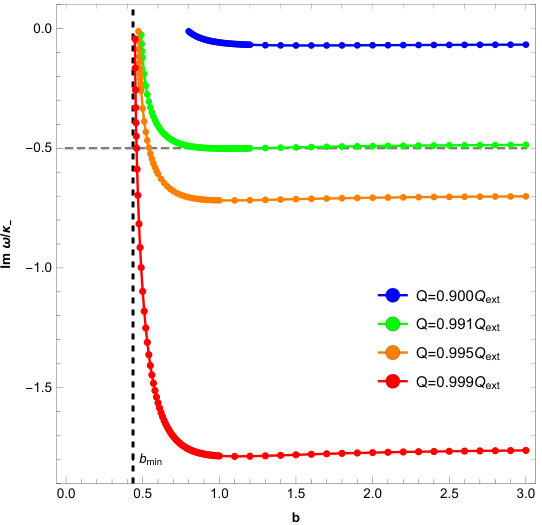 Figure 4
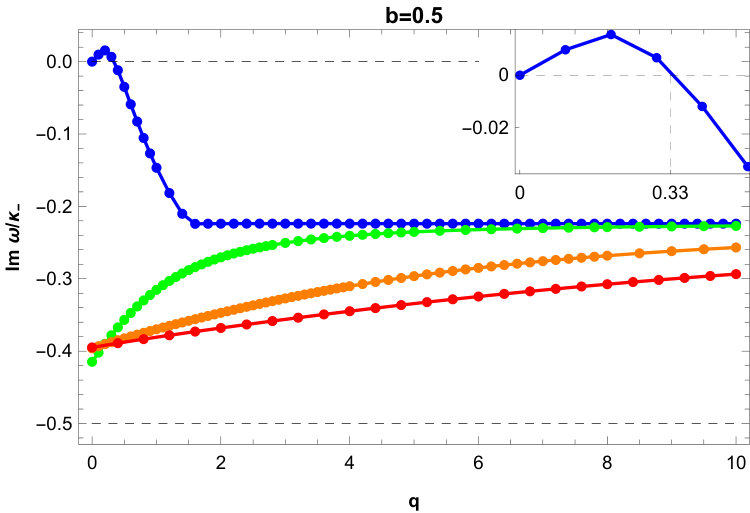 Figure 5
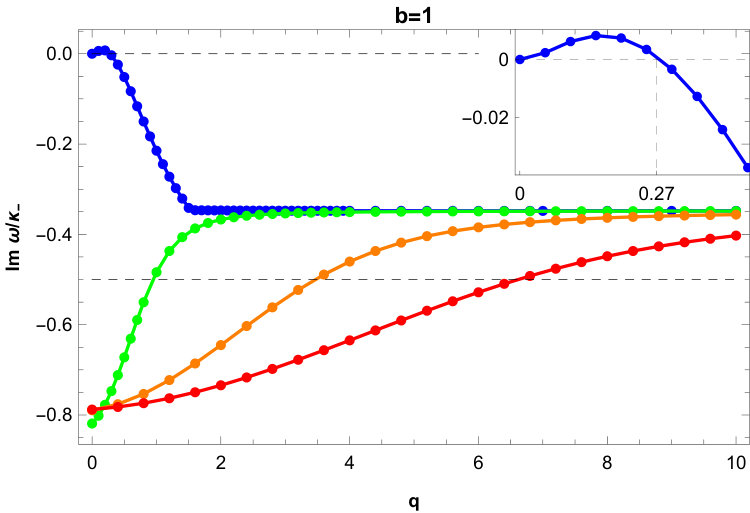 Figure 6
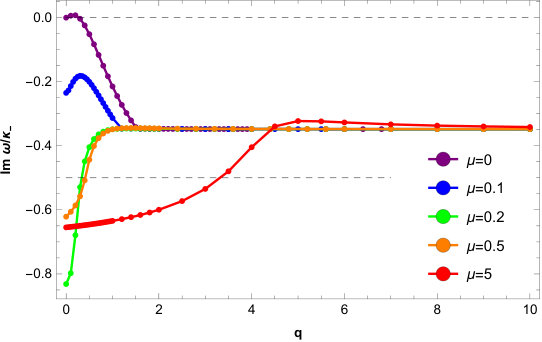 Figure 7
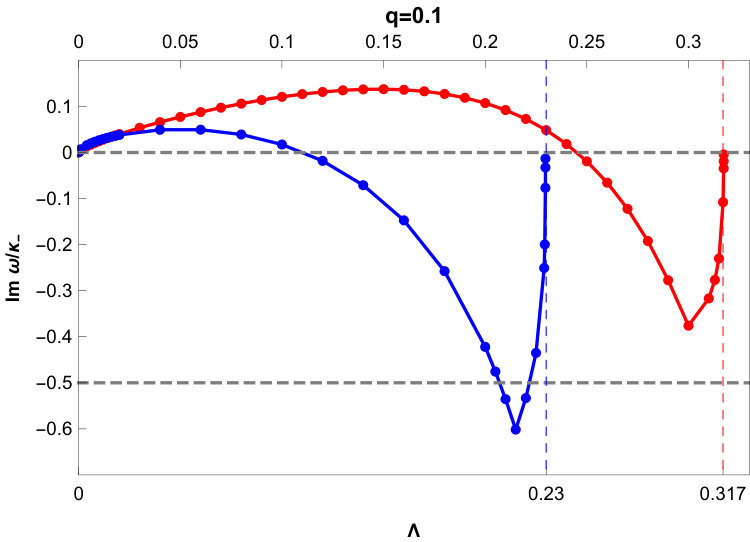 Figure 8
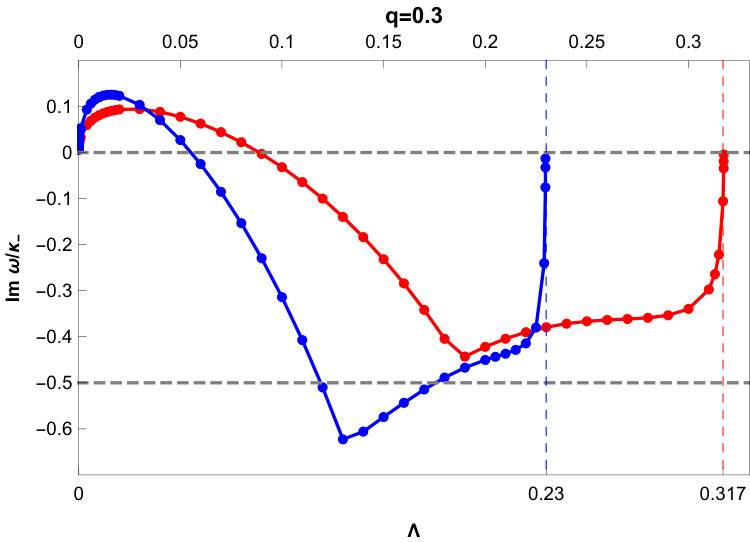 Figure 9
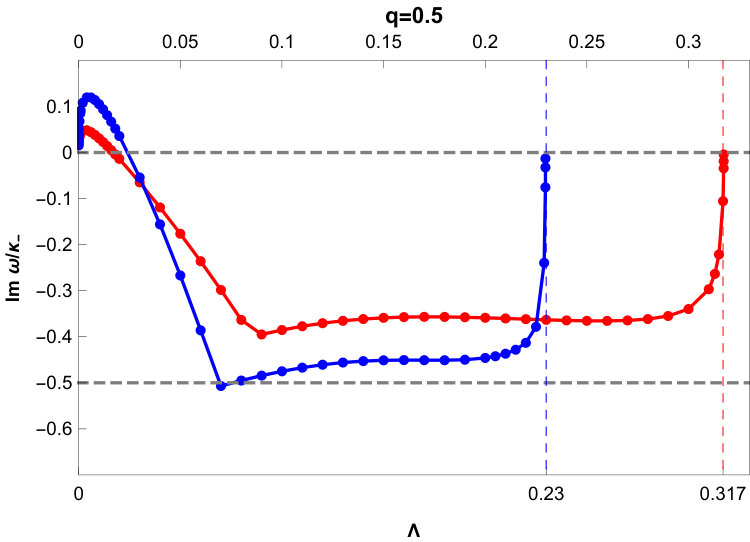 Figure 10
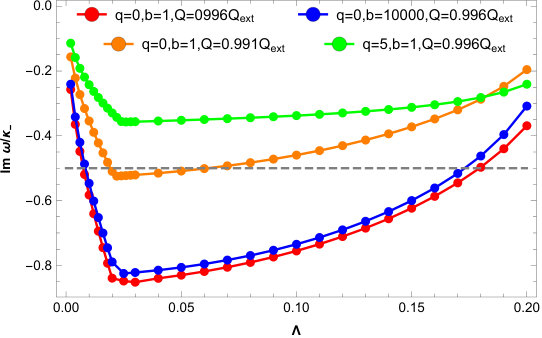 Figure 11
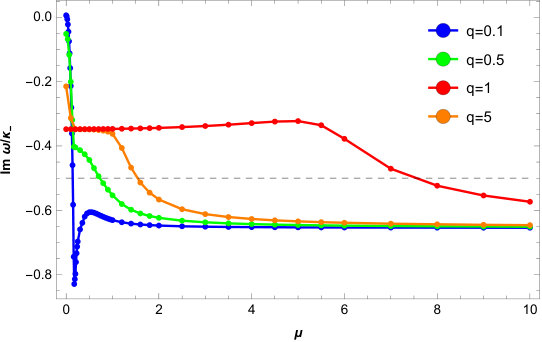 Figure 12
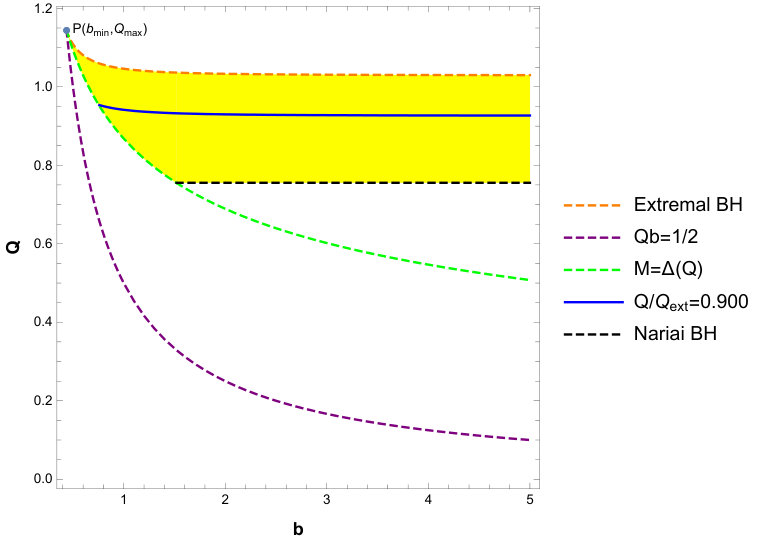 Figure 13
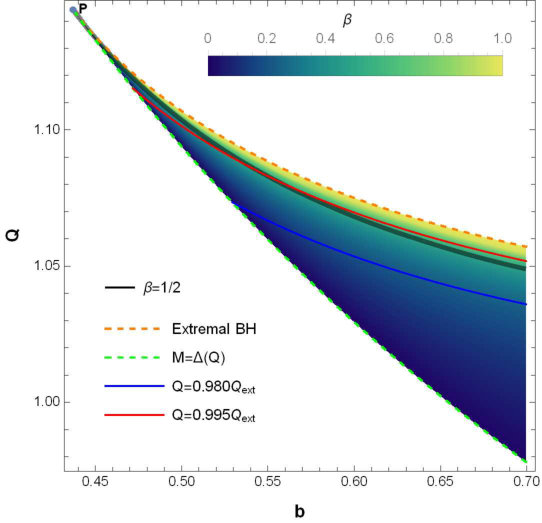 Figure 14
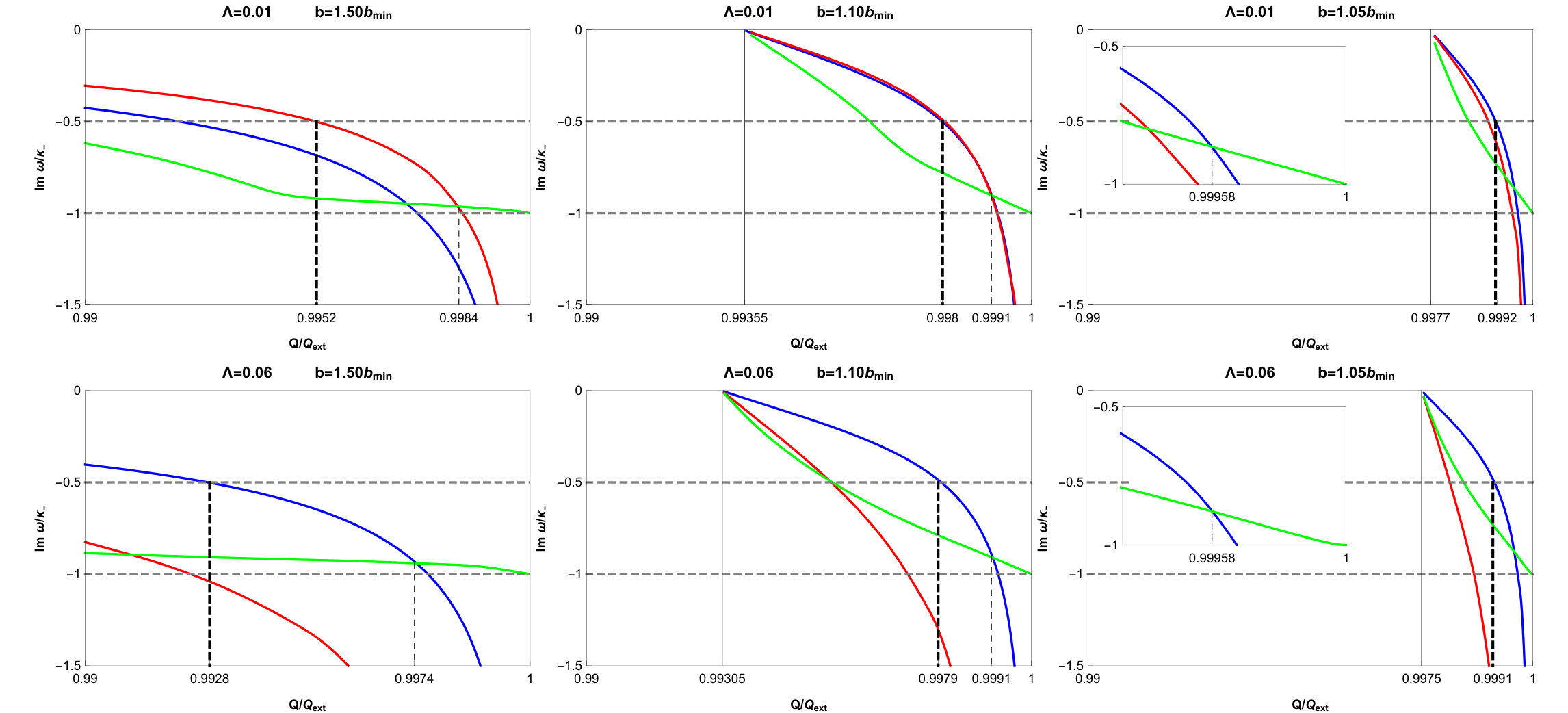 Figure 15
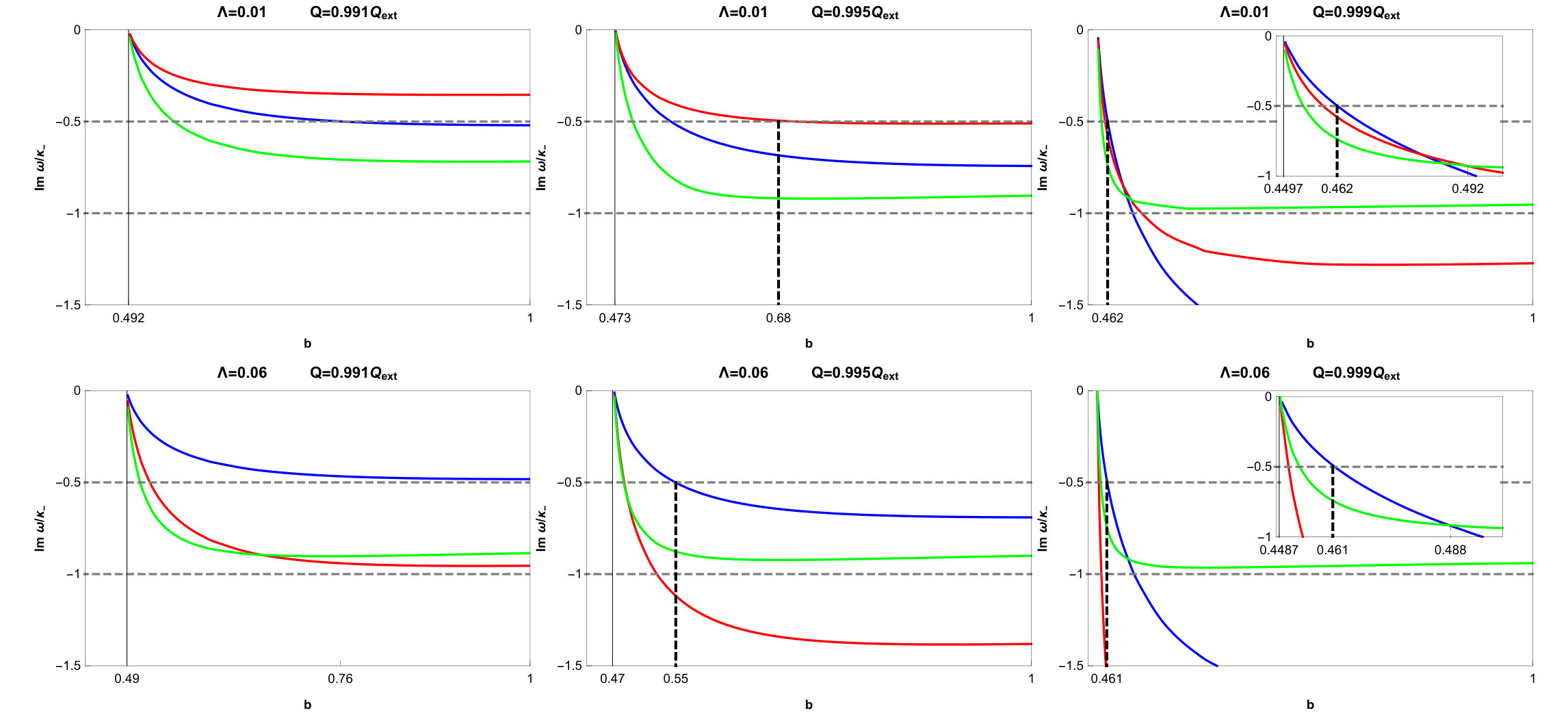 Figure 16
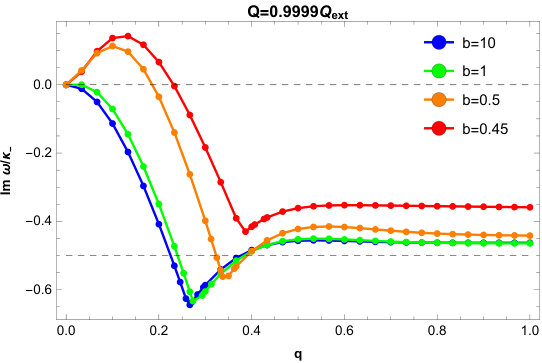 Figure 17
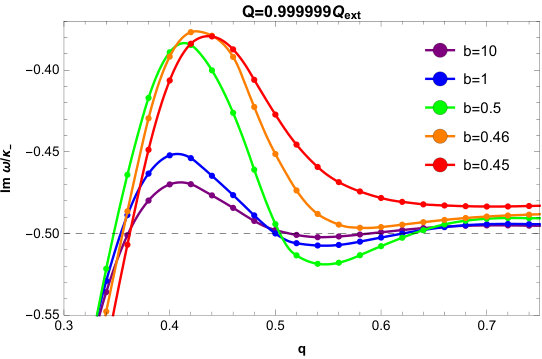 Figure 18
Peer Reviews
No public reviews on file for this paper yet. If you reviewed it on a platform where reviews are public (OpenReview, ICLR, NeurIPS, ICML), you can paste yours below so the community can read it here.
Videos
No videos yet. Explain this paper in a talk, walkthrough, or lecture? Add one.
CTP-SCU/2019012
Strong Cosmic Censorship for a Scalar Field in
a Born-Infeld-de Sitter Black Hole
Qingyu Gan, Guangzhou Guo, Peng Wang and Houwen Wu
Center for Theoretical Physics, College of Physics
Sichuan University
Chengdu, 610064, PR China
[email protected], [email protected], [email protected], [email protected]
Abstract
It has been shown that the Strong Cosmic Censorship (SCC) can be violated by a scalar field in a near-extremal Reissner-Nordstrom-de Sitter black hole. In this paper, we investigate the Strong Cosmic Censorship in a Born-Infeld-de Sitter black hole by a scalar perturbation field with/without a charge. When the Born-Infeld parameter becomes small, the nonlinear electrodynamics effect starts to play an important role and tends to rescue SCC. Specifically, we find that the SCC violation region decreases in size with decreasing . Moreover, for a sufficiently small , SCC can always be restored in a near-extremal Born-Infeld-de Sitter black hole with a fixed charge ratio.
Contents
1 Introduction
A black hole formed from gravitational collapse could possess a curvature singularity. If a time-like singularity is formed, the undetermined initial data on it would cause the breakdown of determinism of general relativity. On the other hand, it is well known that there exist some solutions of the Einstein field equations admitting the presence of time-like singularities, e.g., Kerr-Newman black holes, Reissner-Nordstrom black holes. To rescue the predictability of general relativity, Penrose proposed a conjecture, namely the Strong Cosmic Censorship (SCC), asserting that the maximal Cauchy development of physically acceptable initial conditions is locally inextendible as a regular manifold [1, 2, 3]. Consequently, when the initial data is perturbed outside of a black hole, whether SCC holds true crucially depends on the extendibility of the perturbation (e.g., the metric and other fields) at the Cauchy horizon, which encloses the time-like singularity.
Nevertheless, there are some subtleties of describing the extension of the perturbation at the Cauchy horizon, and hence several formulation versions of SCC have been proposed. For example, the perturbation can not be smooth at the Cauchy horizon in the version of SCC [4, 5]. However, since weak solutions can have many important physical applications in which smooth solutions are not available, a more appropriate way to characterize the extendibility is whether the perturbation being inextendible as a weak solution of the equations of motion. This observation then leads to the Christodoulou version of SCC [6]. In other words, if SCC is violated in the Christodoulou version, the perturbation belongs to the Sobolev space , where the first derivative of the perturbation is locally square integrable and, roughly speaking, has finite energy at the Cauchy horizon.
The possible singular behavior of a perturbation at the Cauchy horizon comes from the mass-inflation mechanism, associated with the exponential amplification due to the blue shift effect [7, 8, 9, 10, 11, 12]. However, there is another mechanism competing with the mass-inflation mechanism to invalidate SCC: the time-dependent remnant perturbation decaying outside of the black hole. When the perturbation decays slowly enough, SCC could be valid. In fact, a perturbation in an asymptotically flat black hole satisfies an inverse power law decay [13, 14, 15], which ensures the mass-inflation mechanism is strong enough to render the Cauchy horizon unstable upon perturbation [8, 16]. On the other hand, it was observed that a remnant perturbation can exponentially decay in a black hole in asymptotically dS space-time [17, 18, 19, 20, 21, 22, 23, 24], which implies that the perturbation might have chance to decay fast enough to violate SCC. More precisely, it showed that, for an asymptotically dS black hole, the competition between the the mass inflation and remnant decaying can be characterized by [25, 26, 27, 28, 29, 30]
[TABLE]
where denotes the surface gravity at the Cauchy horizon, and is the spectral gap representing the distance from the real axis to the lowest-lying Quasi-Normal Mode (QNM) on the lower half complex plane of frequency. Note that can lead to a potential violation of the Christodoulou version of SCC.
Recently, the validity of the Christodoulou version of SCC has been explored in asymptotically dS black holes by computing for various perturbation fields [30, 31, 32, 33, 34, 35, 36, 37, 38, 39, 40, 41, 42, 43]. In particular, a massless neutral scalar perturbation field in a Reissner-Nordstrom-de Sitter (RN-dS) black hole was considered in [30], and it was proven that SCC is violated in the near-extremal regime. Since the charge matter is necessary for the formation of a charged black hole by gravitational collapse, the analysis was then extended to a charged scalar field in a RN-dS black hole [33, 31, 32], which showed that, in the highly extremal limit, there always exists a region in parameter space where SCC is violated. Although it was claimed in [34] that SCC would be saved for sufficiently large scalar field mass and charge, the existence of arbitrarily small oscillations of around was observed in a sufficiently near-extremal black hole [32]. These oscillations were dubbed as “wiggles”, which result from non-perturbative effects and can lead to a violation of SCC for an arbitrary large scalar field charge . Later, SCC in a RN-dS black hole was also discussed in the context of the Dirac perturbation field [35, 36] and higher space-time dimensions [37, 38], where there still exists some room for the violation of SCC. Considering smooth initial data, the violation of SCC becomes more severe for the coupled linearized electromagnetic and gravitational perturbations in a RN-dS black hole [39]. In [40], the authors proved that nonlinear effects could not save SCC from being violated for a near-extremal RN-dS black hole. On the other hand, SCC is always respected for the massless scalar field and linearized gravitational perturbations in a Kerr-dS black hole [37, 41].
Taking quantum contributions into account, nonlinear corrections are usually added to the Maxwell Lagrangian, which gives the nonlinear electrodynamics (NLED). Among various NLED, Born-Infeld (BI) electrodynamics, which was first introduced to smooth divergences of the electrostatic self-energy of point charges, has attracted considerable attention in the literature. Furthermore, BI electrodynamics can come from the low energy limit of string theory and encodes the low-energy dynamics of D-branes [44]. The BI black hole solution in (A)dS space was first obtained in [45, 46]. Since then, various aspects of BI black holes have been extensively investigated, e.g., the thermodynamics and phase structure [47, 48, 49, 50, 51, 52], the holographic models [53, 54, 55, 56, 57, 58, 59, 60]. Specifically, the Weak Cosmic Censorship (WCC) has recently been studied in a BI black hole [61, 62], where it was found that there may exist some counterexamples to WCC.
Until now, the charge sector of testing the Christodoulou version of SCC has been confined to Maxwell’s theory of electrodynamics. Little is known about the NLED effect on the validity of SCC. In this paper, we investigate the Christodoulou version of SCC for a scalar perturbation field propagating in a BI-dS black hole. Our results show that the NLED effect tends to alleviate the violation of SCC in the near-extremal regime. Especially, for a near-extremal BI-dS black hole with a fixed charge ratio, SCC can always be saved as long as the NLED effect is strong enough. Furthermore, the parameter region where SCC is violated decreases in size when the NLED effect becomes stronger.
The rest of the paper is organized as follows. In Section 2, we briefly review the BI-dS black hole solution and obtain the parameter region where the Cauchy horizon exists. In Section 3, we show how to compute the QNMs for a charged and massive scalar field in a BI-dS black hole. In Section 4, we present and discuss the numerical results in various parameter regions. We summarize our results in the last section. For simplicity, we set in this paper.
2 BI-dS Black Hole
In this section, we first review the BI-dS black hole solution and then give the “allowed” region in the parameter space, in which the Cauchy horizon exists. Consider a -dimensional Einstein-Born-Infeld action in the presence of the positive cosmological constant , which is given by
[TABLE]
where is the Ricci scalar curvature, is the electromagnetic tensor field of a BI electromagnetic field , and the Born-Infeld parameter is related to the string tension as [44]. It is noteworthy that BI electrodynamics would reduce to Maxwell electrodynamics in the limit of . So the NLED effect in BI electrodynamics will become stronger for a smaller value of . For the action (2.2), a static spherically symmetric black hole solution was obtained in [46, 45]:
[TABLE]
with the blackening factor
[TABLE]
Here, is the hypergeometric function, and and are the mass and electric charge of the BI-dS black hole, respectively. In the limit of , eqns. (2.3) and (2.4) recover the RN-dS black hole solution as expected.
A BI-dS black hole can possess one, two or three horizons depending on the parameters , , and . The topology of BI-dS black holes has been discussed in [63, 64]. In this paper, we investigate SCC and hence focus on the BI-dS black holes possessing three horizons, namely the Cauchy horizon , the event horizon and the cosmological horizon . To determine the number of roots of , we instead consider , which has the same positive roots as , and find that
[TABLE]
In order for to have three positive roots, the parameters must satisfy the following conditions:
- •
and : Since the BI-dS black hole solution is asymptotically dS, one has in Thus, must have a local minimum at and a local maximum at , which has . The existence of two extrema for requires that has two positive roots, which gives and .
- •
: At , must be greater than zero. As
[TABLE]
with , which leads to .
- •
: The local minimum value of at must be negative. When , we have the extremal black hole solution with . For later use, denotes the charge of the extremal black hole.
- •
: The local maximum value of at must be positive. When , we have the Nariai black hole solution with , which could only be calculated numerically [64].
The above conditions together give the allowed region in the parameter space, in which a BI-dS black hole has three horizons. We also find that there exist a lower bound on and an upper bound on in the allowed region. In fact, it can show that the boundaries , and can intersect at one point in the - plane, which gives
[TABLE]
We plot the allowed region and their boundaries in the - parameter space in Fig. 1, where and .
3 Quasi-Normal Mode
In this section, we discuss the QNMs for a charged and massive scalar field in a BI-dS black hole. We first consider a scalar perturbation of mass and charge governed by the Klein-Gordon equation
[TABLE]
where denotes the covariant derivative . To facilitate our numerical calculation, we will use Eddington-Finkelstein ingoing coordinates with , where is the tortoise coordinate defined as . In addition, we choose an appropriate gauge transformation such that . Since the BI-dS black hole solution is static and spherically symmetry, a mode solution of eqn. (3.8) can have the separable form
[TABLE]
where is the harmonic function of the unit -sphere. Plugging eqn. (3.9) into eqn. (3.8), we obtain the radial equation
[TABLE]
where denotes . One can perform the Frobenius method to obtain the solutions near the event and cosmological horizons, respectively. In fact, we define a new coordinate . Near the event horizon, i.e., , has the ingoing and outgoing boundary solutions:
[TABLE]
And near the cosmological horizon, i.e., , also has the ingoing and outgoing boundary solutions:
[TABLE]
Here with is the surface gravity at each horizon.
Imposing the ingoing boundary condition at the event horizon and the outgoing boundary condition at the cosmological horizon on eqn. (3.10) selects a set of discrete frequencies , called QNMs [22]. There are many analytic and numerical ways to extract QNMs [22, 23]. Here we we employ the Chebyshev collocation scheme and the associated Mathematica package developed in [65, 66, 67]. We redefine field adapted to our numerical scheme:
[TABLE]
where the new field becomes regular at both the event and cosmological horizons. After the radial equation for is obtained, we can use the Mathematica package to find a series of QNMs, . The spectral gap in eqn. (1.1) is then given by .
4 Numerical Results
In this section, we present the numerical results about the low-lying QNMs for a scalar field and check the validity of SCC. The results shown in this sections are obtained with the Mathematica package of [65, 66, 67] and checked with some QNMs given in [68], where the WKB approximation was used. Since SCC may be violated near extremality in a RN-dS black hole, we here focus on the near-extremal parameter space of a BI-dS black hole.
In Table 1, we show the lowest-lying QNMs of some representative points in the relevant parameter region. Note that some results in [30, 31] are recovered in the large limit as expected. Besides, when the scalar field is charged, the symmetry between left and right modes is broken due to the presence of scalar charge, which was also observed in [31, 32]. Similar to the RN-dS black hole case, we find that the violation of SCC occurs when the black hole lies close enough to extremality (e.g., ). Interestingly, it shows that a smaller value of tends to decrease the absolute value of , which can alleviate the violation of SCC and even save SCC. Note that we set without loss of generality in this section.
4.1 Neutral Scalar Field
Recently, the authors of [30] found three qualitatively different families of QNMs for a RN-dS black hole: the photon sphere (PS) family, which can be traced back to the photon sphere, the de Sitter (dS) family, which is deformation of the pure de Sitter modes, and the near-extremal (NE) family, which only appears for near-extremal black holes. Similarly, we also observe these three distinct families for a neutral massless scalar field in a near-extremal BI-dS black hole. In Fig. 2, we plot the dominant modes of each of the families divided by . Specifically, \textrm{Im(}\omega)/\kappa_{-}\text{ is plotted against }$$Q/Q_{\textrm{ext}} for various values of and in Fig. 2a. As shown in Fig. 1, for a fixed value of not far from , the line puts a lower bound on , which is depicted as the solid vertical lines in Fig. 2a. It is noteworthy that all go to zero as approaches its lower bound. Indeed, in the limit of , the Cauchy horizon radius goes to zero, and hence the surface gravity at the Cauchy horizon becomes
[TABLE]
where we use eqn. (2.6). Since QNMs are still finite in this limit, we find that when (i.e., solid vertical lines in Fig. 2 and dashed green lines in Figs. 1 and 3). Moreover, Fig. 2a shows that, when increases towards the extremal limit, for the three families’ dominant modes all decreases. In the extremal limit, the PS and dS families become divergent while the NE family approaches from below and hence takes over to make . Thus with fixed values of and the presence of NE mode can invalidate SCC as long as the black hole lies close enough to extremality. Moreover, the dS family is more sensitive to than the PS and NE families and can become dominant for “small” black holes (small ). Moreover, it shows that the range of , where SCC is violated, shrinks with decreasing value of ( decreases from the left column to the right column in Fig. 2a). To better illustrate the dependence of on , we plot \textrm{Im}(\omega)/\kappa_{-}\text{ against b }for various values of and in Fig. 2b. It is expected that SCC is easier to be violated when the black hole is closer to extremality. In fact, increasing towards extremality from the left column to the right column in Fig. 2b, we find that the SCC violation ranges of , which are on the left of the dashed vertical lines, increase in size. Note that there is no SCC violation in the case. In Fig. 1, it shows that the -constant line (e.g., the blue line with ) always has a lower bound on b\text{, which is also imposed by the }$$M=\varDelta(Q) line. The solid vertical lines in Fig. 2b represent on which and thus . So with fixed values of and , one can always have when is close enough to . In the and cases, SCC is violated for large enough values of . Nevertheless, we can recover SCC by making close enough to .
Finally, we depict the density plot of in the small region in Fig. 3, where the solid black line represents the threshold . So SCC is violated in the region between the extremal line (dashed orange) and (solid black). The line is displayed as a red line, which also shows that SCC can be recovered for a small enough value of . For a near-extremal BI-dS black hole with a constant charge , it also shows in Fig. 3 that SCC is respected when is close enough to the dashed green line. Furthermore, Fig. 3 displays that SCC can be recovered for a highly extremal BI-dS black hole as long as the Born-Infeld parameter is sufficiently close to (the point ).
4.2 Charged Scalar Field
We now turn on the charge of a scalar field and investigate the validity of SCC. In Fig. 4, we first plot the lowest-lying QNMs as a function of the scalar charge for a massless charged scalar field in a BI-dS black hole, which behave rather similarly to the RN-dS black hole case. The blue lines represent the zero mode, which reduces to a trivial mode in the limit . In particular, we observe the presence of superradiant instability in the small scalar charge regime. This linear instability suggests that the perturbations will be severely unstable even in the exterior of the black hole, and thus one can not infer anything about SCC when superradiance occurs. Note that the non-smoothness of the blue lines around is caused by the competition between the PS and NE modes. The case is shown in the left panel of Fig. 4, which shows that SCC is violated for since the zero trivial mode is discarded. However for a nonzero , SCC is saved out due to the nontrivial zero mode. The right panel of Fig. 4 displays that, for a smaller value of , the higher -modes are also above the threshold line , and the superradiant regime increases in size, which means that small tends to make the black hole more unstable. From Fig. 4, we see that is determined by the dominant mode for a charged scalar field.
Further increasing the black hole charge towards extremality, we plot the dominant mode as a function of the scalar charge for a massless charged scalar field in a BI-dS black hole in Fig. 5. The dependence of the dominant mode on is plotted in the left panel of Fig. 5, where . The curve with is almost identical to the RN-dS case, which was shown in Fig.11 of [31]. It shows that the SCC violation occurs for and in some scalar charge regime. Nevertheless, these violation regions decrease in size as decreases. Interestingly, SCC is always respected when In the right panel of Fig. 5, we plot the dominant mode for a more extremal BI-dS black hole with and display that the “wiggles”, i.e., small oscillations around , appear in the cases. It is noteworthy that the wiggles disappear, and SCC is restored when .
Next we turn to the dependence of the dominant mode on in Fig. 6, where the dominant mode is plotted as a function of for various values of and . Note that is bounded above by a maximum value due to the Nariai limit of a BI-dS black hole. In the Nariai limit, approaches zero while stays finite, which explains at the maximum value of shown in Fig. 6. Again, the non-smoothness in Fig. 6 results from the competition between the PS and NE modes. When , SCC can be violated in some parameter region of and . For a smaller , these violation regions all disappear.
Finally, we investigate the dependence of the dominant mode on the scalar mass in Fig. 7. As shown in the left panel in Fig. 7, the superradiant instability is highly sensitive to the scalar mass. For a sufficiently large value of , superradiant instability no longer exists. Moreover, the of the dominant mode can be smaller than for large enough . It also displays, in the right panel of Fig.7, that the dominant mode for various values of all go below the threshold line when the scalar field is sufficiently massive. So Fig. 7 shows that SCC tends to be violated for a larger scalar mass. On the other hand, it also shows that SCC tends to be saved for a larger scalar charge.
5 Conclusion
In this paper, we investigated the validity of SCC in a BI-dS black hole perturbed by a scalar field with/without a charge. After the parameter region, where a BI-dS black hole can possess the Cauchy horizon, was obtained in Section 2, we presented the numerical results for a neutral scalar field in Section 4.1 and a charged scalar in Section 4.2.
For the Born-Infeld parameter , the behavior of SCC in a BI-dS black hole is quite similar to that in a RN-dS black hole. In fact, we observed that SCC is always violated when a BI-dS black hole is sufficiently close to extremality in the neutral case, and the SCC violation region, especially the wiggles, can appear in the charged case. On the other hand, for a smaller value of , the NLED effect can play an important role and tends to alleviate the violation of SCC. Specifically, we found that
- •
For a massless neutral scalar field, Fig. 2 showed that the SCC violation region decreases in size with deceasing .
- •
For a massless neutral scalar field, Fig. 3 showed that SCC can always be restored for a near-extremal BI-dS black hole with a fixed charge ratio or a charge when is sufficiently small.
- •
For a massless charged scalar, Figs. 5 and 6 showed that the SCC violation region also decreases in size with deceasing . Moreover, the violation region can disappear for a sufficiently small value of .
The dependence of SCC on the scalar mass and charge was discussed in Fig. 7 for a massive charged scalar, which showed that the smaller the scalar mass is (or the larger the scalar charge is), the easier it becomes to restore SCC. Our results indicate that the quantum effects could play a crucial role in rescuing SCC. Therefore, it is inspiring to check the validity of SCC in modified gravity theories, even a quantum gravity model.
Acknowledgements We are deeply grateful to Hongbao Zhang for his excellent presentations and valuable comments. We also thank Haitang Yang for his helpful discussions and suggestions. This work is supported in part by NSFC (Grant No. 11005016, 11875196 and 11375121).
The reference list from the paper itself. Each links out to its DOI / PubMed record.
- 1[1] R. Penrose. Gravitational collapse: The role of general relativity. Riv. Nuovo Cim. , 1:252–276, 1969. [Gen. Rel. Grav.34,1141(2002)].
- 2[2] S. W. Hawking and R. Penrose. The Singularities of gravitational collapse and cosmology. Proc. Roy. Soc. Lond. , A 314:529–548, 1970. doi:10.1098/rspa.1970.0021 . · doi ↗
- 3[3] Roger Penrose. Gravitational collapse and space-time singularities. Phys. Rev. Lett. , 14:57–59, 1965. doi:10.1103/Phys Rev Lett.14.57 . · doi ↗
- 4[4] Jonathan Luk and Sung-Jin Oh. Strong cosmic censorship in spherical symmetry for two-ended asymptotically flat initial data I. The interior of the black hole region. 2017. ar Xiv:1702.05715 .
- 5[5] Jonathan Luk and Sung-Jin Oh. Strong cosmic censorship in spherical symmetry for two-ended asymptotically flat initial data II. The exterior of the black hole region. 2017. ar Xiv:1702.05716 .
- 6[6] Demetrios Christodoulou. The Formation of Black Holes in General Relativity. In On recent developments in theoretical and experimental general relativity, astrophysics and relativistic field theories. Proceedings, 12th Marcel Grossmann Meeting on General Relativity, Paris, France, July 12-18, 2009. Vol. 1-3 , pages 24–34, 2008. ar Xiv:0805.3880 , doi:10.1142/9789814374552_0002 . · doi ↗
- 7[7] Chris M. Chambers. The Cauchy horizon in black hole de sitter space-times. Annals Israel Phys. Soc. , 13:33, 1997. [,33(1997)]. ar Xiv:gr-qc/9709025 .
- 8[8] Mihalis Dafermos. The Interior of charged black holes and the problem of uniqueness in general relativity. Commun. Pure Appl. Math. , 58:0445–0504, 2005. ar Xiv:gr-qc/0307013 .