Atomistic structural mechanism for the glass transition: Entropic contribution
Dong Han, Dan Wei, Jie Yang, Hui-Ling Li, Min-Qiang Jiang, Yun-Jiang, Wang, Lan-Hong Dai, Alessio Zaccone

TL;DR
This study uses atomistic simulations to reveal that the proliferation of rigid, centrosymmetric atomic structures causes the entropy kink and dynamical freezing at the glass transition, confirming the Adam-Gibbs scenario.
Contribution
It provides an atomistic structural explanation for the glass transition, linking entropy changes to the emergence of rigid atomic structures and their role in dynamical arrest.
Findings
Confirmation of the Adam-Gibbs entropy scenario.
Identification of increased centrosymmetric structures at the transition.
Structural proliferation explains the entropy kink and freezing-in of dynamics.
Abstract
A popular Adam--Gibbs scenario has suggested that the excess entropy of glass and liquid over crystal dominates the dynamical arrest at the glass transition with exclusive contribution from configurational entropy over vibrational entropy. However, an intuitive structural rationale for the emergence of frozen dynamics in relation to entropy is still lacking. Here we study these issues by atomistically simulating the vibrational, configurational, as well as total entropy of a model glass former over their crystalline counterparts for the entire temperature range spanning from glass to liquid. Besides confirming the Adam--Gibbs entropy scenario, the concept of Shannon information entropy is introduced to characterize the diversity of atomic-level structures, which undergoes a striking variation across the glass transition, and explains the change found in the excess configurational…
Click any figure to enlarge with its caption.
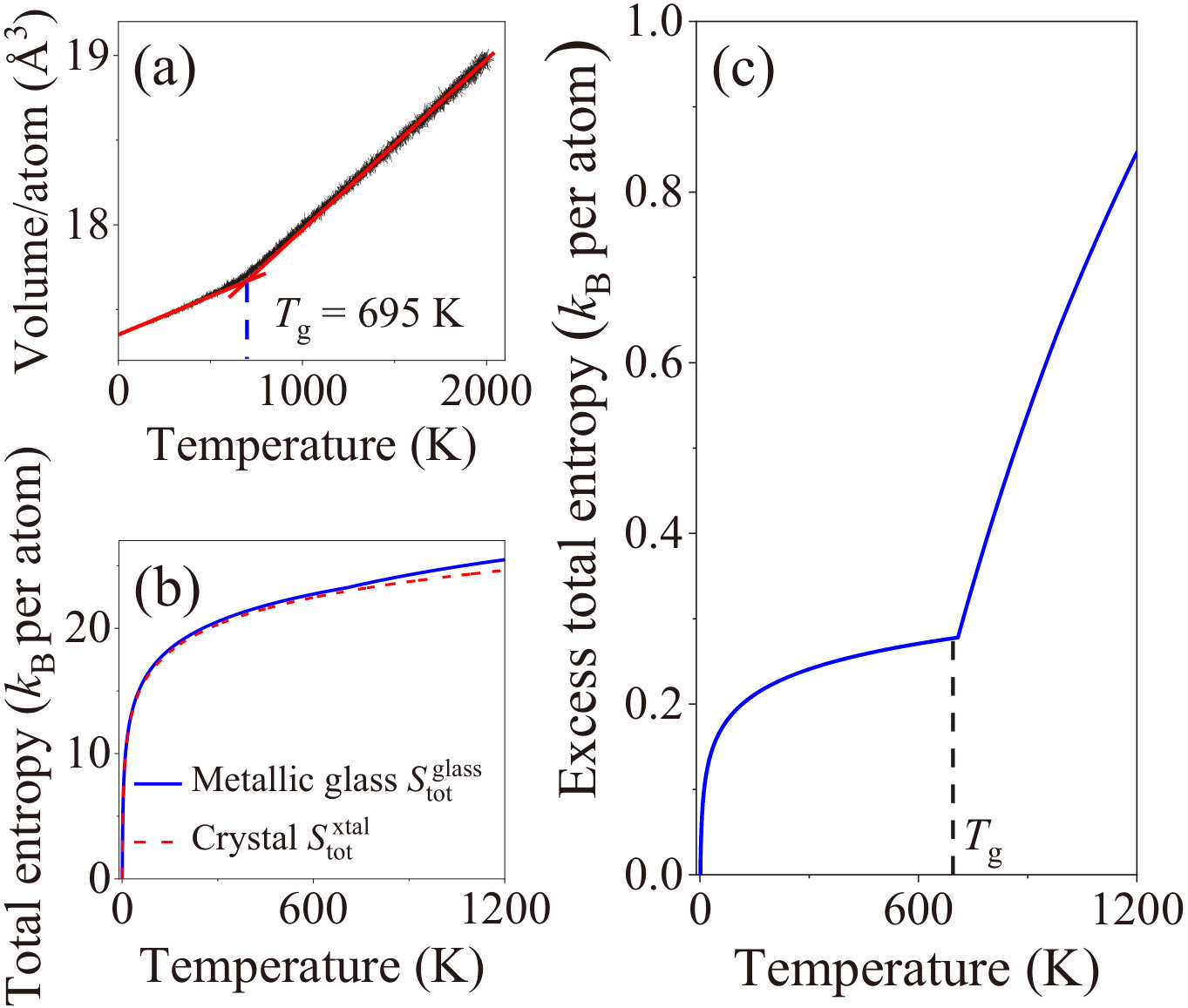 Figure 1
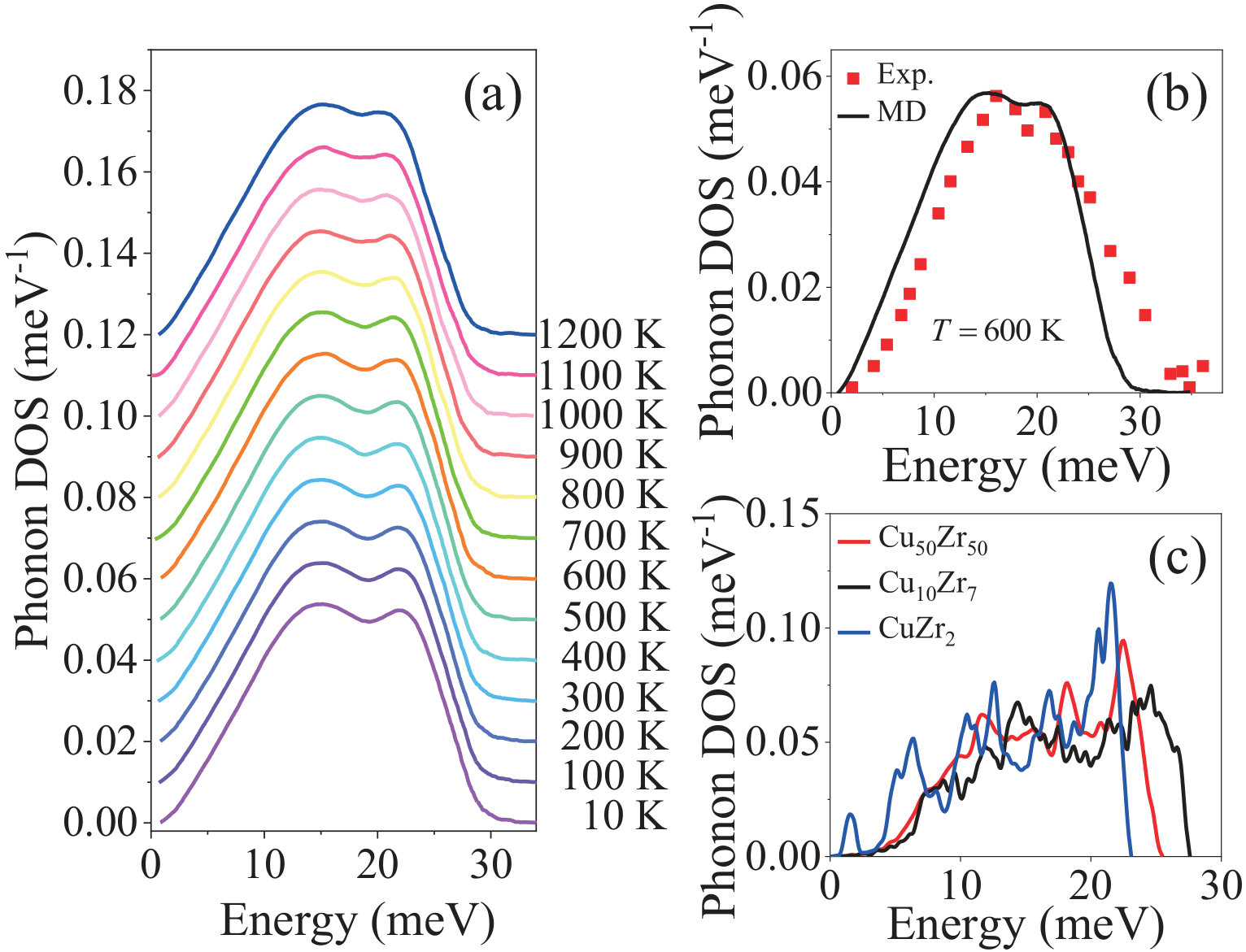 Figure 2
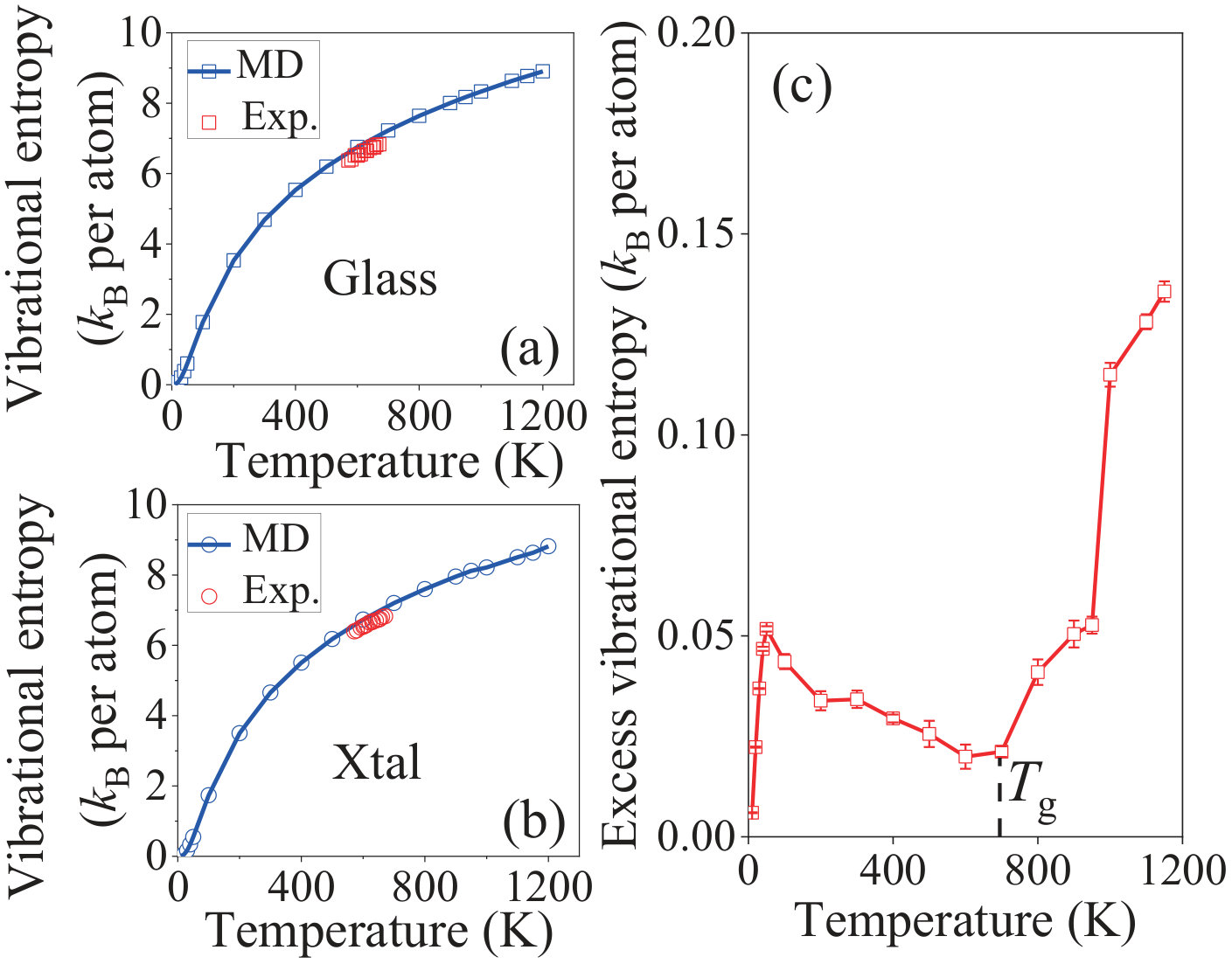 Figure 3
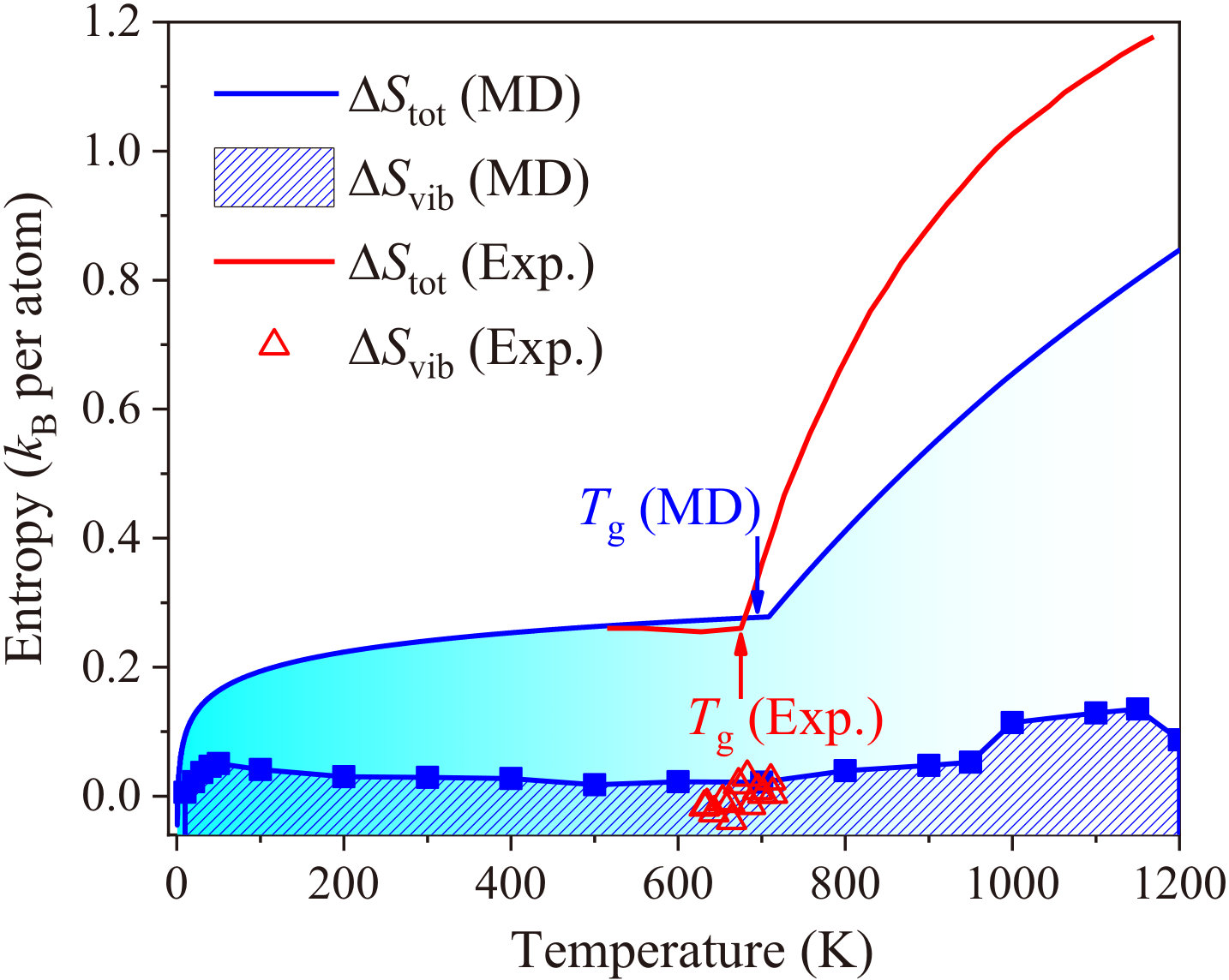 Figure 4
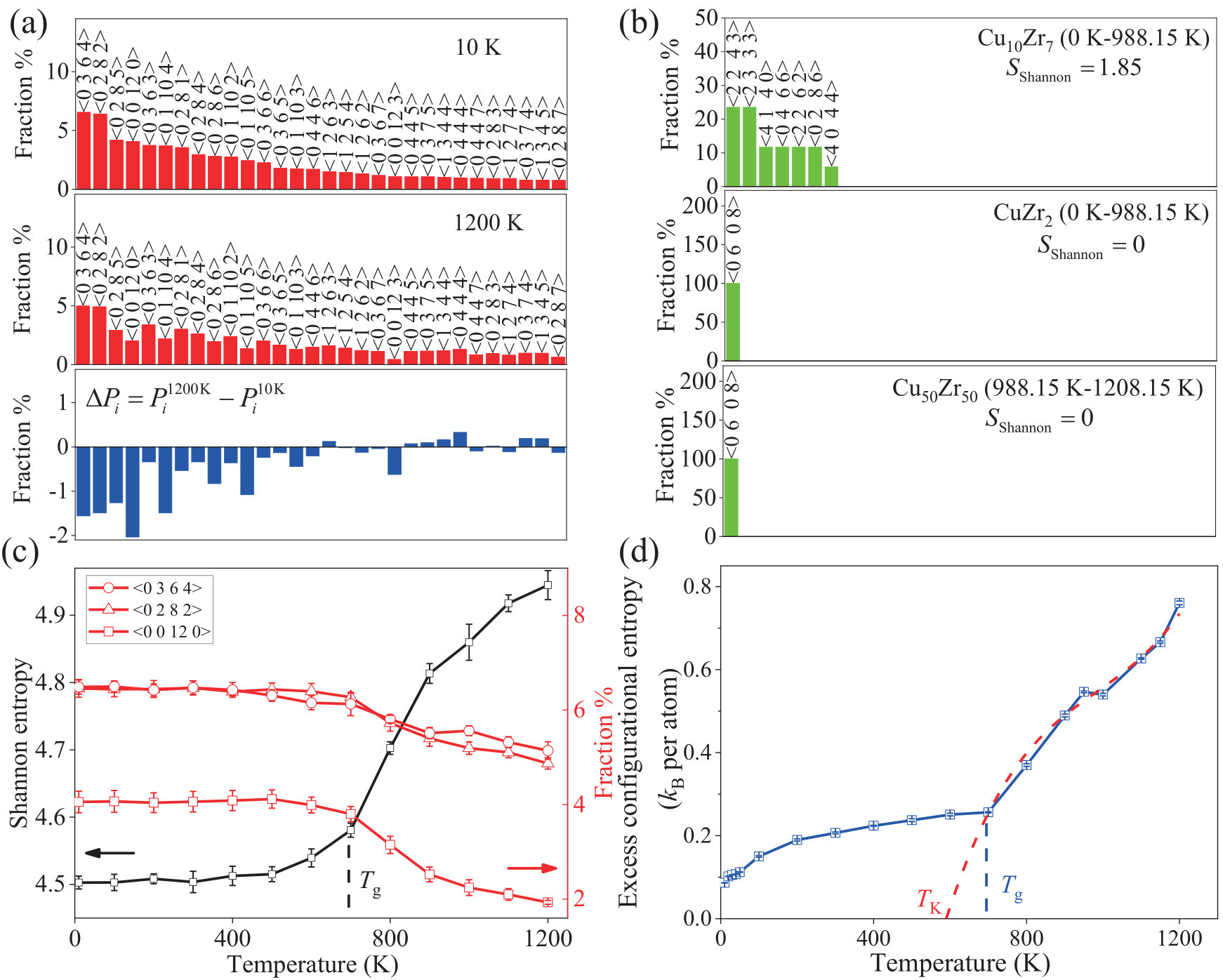 Figure 5
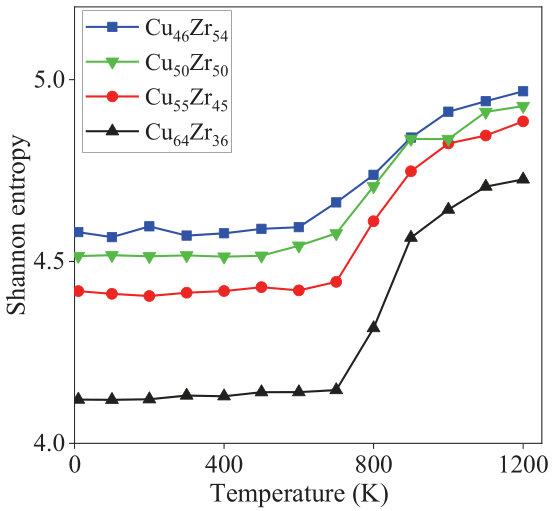 Figure 6
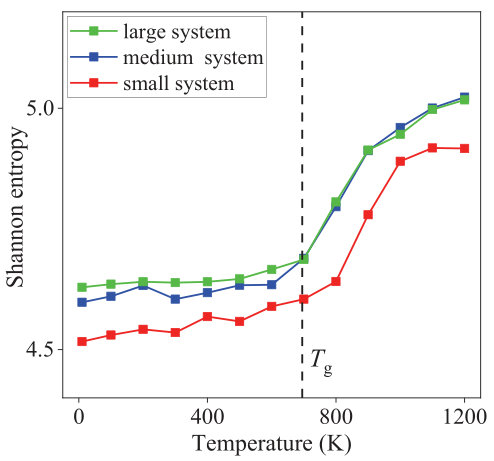 Figure 7
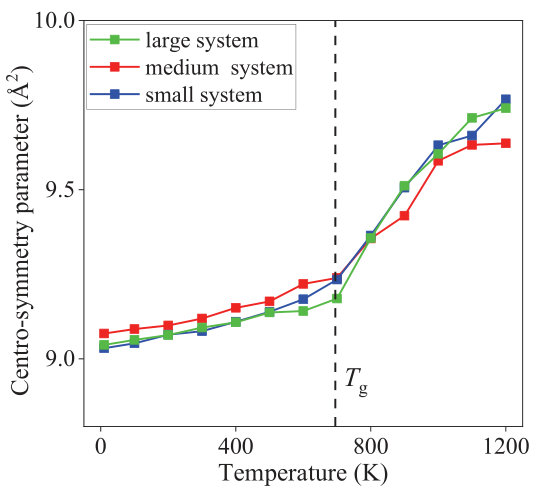 Figure 8
Peer Reviews
No public reviews on file for this paper yet. If you reviewed it on a platform where reviews are public (OpenReview, ICLR, NeurIPS, ICML), you can paste yours below so the community can read it here.
Videos
No videos yet. Explain this paper in a talk, walkthrough, or lecture? Add one.
Atomistic structural mechanism for the glass transition: Entropic contribution
Dong Han
State Key Laboratory of Nonlinear Mechanics, Institute of Mechanics, Chinese Academy of Sciences, Beijing 100190, China
School of Engineering Science, University of Chinese Academy of Sciences, Beijing 100049, China
Dan Wei
State Key Laboratory of Nonlinear Mechanics, Institute of Mechanics, Chinese Academy of Sciences, Beijing 100190, China
School of Engineering Science, University of Chinese Academy of Sciences, Beijing 100049, China
Jie Yang
State Key Laboratory of Nonlinear Mechanics, Institute of Mechanics, Chinese Academy of Sciences, Beijing 100190, China
School of Engineering Science, University of Chinese Academy of Sciences, Beijing 100049, China
Hui-Ling Li
State Key Laboratory of Nonlinear Mechanics, Institute of Mechanics, Chinese Academy of Sciences, Beijing 100190, China
School of Engineering Science, University of Chinese Academy of Sciences, Beijing 100049, China
Min-Qiang Jiang
State Key Laboratory of Nonlinear Mechanics, Institute of Mechanics, Chinese Academy of Sciences, Beijing 100190, China
School of Engineering Science, University of Chinese Academy of Sciences, Beijing 100049, China
Yun-Jiang Wang
State Key Laboratory of Nonlinear Mechanics, Institute of Mechanics, Chinese Academy of Sciences, Beijing 100190, China
School of Engineering Science, University of Chinese Academy of Sciences, Beijing 100049, China
Lan-Hong Dai
State Key Laboratory of Nonlinear Mechanics, Institute of Mechanics, Chinese Academy of Sciences, Beijing 100190, China
School of Engineering Science, University of Chinese Academy of Sciences, Beijing 100049, China
Alessio Zaccone
Department of Physics ¡°A. Pontremoli¡±, University of Milan, via Celoria 16, 20133 Milan, Italy
Cavendish Laboratory, University of Cambridge, JJ Thomson Avenue, Cambridge, CB3 0HE United Kingdom
Statistical Physics Group, Department of Chemical Engineering and Biotechnology, University of Cambridge, Cambridge, CB3 0AS, United Kingdom
Abstract
A popular Adam–Gibbs scenario has suggested that the excess entropy of glass and liquid over crystal dominates the dynamical arrest at the glass transition with exclusive contribution from configurational entropy over vibrational entropy. However, an intuitive structural rationale for the emergence of frozen dynamics in relation to entropy is still lacking. Here we study these issues by atomistically simulating the vibrational, configurational, as well as total entropy of a model glass former over their crystalline counterparts for the entire temperature range spanning from glass to liquid. Besides confirming the Adam–Gibbs entropy scenario, the concept of Shannon information entropy is introduced to characterize the diversity of atomic-level structures, which undergoes a striking variation across the glass transition, and explains the change found in the excess configurational entropy. Hence, the hidden structural mechanism underlying the entropic kink at the transition is revealed in terms of proliferation of certain atomic structures with a higher degree of centrosymmetry, which are more rigid and possess less nonaffine softening modes. In turn, the proliferation of these centrosymmetric (rigid) structures leads to the freezing-in of the dynamics beyond which further structural rearrangements become highly unfavourable, thus explaining the kink in the configurational entropy at the transition.
I Introduction
The glass transition is generally regarded as the phenomenon in which a viscous liquid circumvents crystallization and evolves continuously into a disordered solid state directly during fast cooling Angell (1995); Debenedetti and Stillinger (2001); Dyre (2006); Langer (2014); Royall and Williams (2015). It is a typical example of the falling-out-of-equilibrium phenomenon that occurs for almost any system the relaxation time of which surpasses laboratory time scales Dyre (2008). Gibbs and DiMarzio Gibbs and DiMarzio (1958) suggested that the excess entropy of glass and liquid over crystal originates entirely from the configurational entropy which governs the relaxation timescale. This formulation lays a robust foundation for the Adam–Gibbs relationship, which provides a connection between dynamics and thermodynamics of glass transition, i.e., time and entropy Adam and Gibbs (1965); Martinez and Angell (2001); Dyre et al. (2009); Dyre (2018).
Also in the Potential Energy Landscape (PEL) picture Debenedetti and Stillinger (2001); Sastry et al. (1998); Fan et al. (2017), it is assumed that the vibrational entropy is in a relation of linear response with temperature Goldstein (1976) and plays a minor role compared to configurational entropy. A recent simulation also revealed that the ideal glass state is not only vibrational Ozawa et al. (2018a). To validate the entropic scenario, configurational and vibrational contributions to the excess entropy have been evaluated for molecular and network glasses Gujrati and Goldstein (1980); Johari (2000), as well as computer Lennard-Jones liquids Sciortino et al. (1999); Ozawa et al. (2018b); however, there are only very few reports on metallic glass-forming systems available in the literature.
It is the lack of thermodynamic stability of supercooled liquids against crystallization in experiments that hinders separating the vibrational and configurational entropy across the glass transition. Recently, Smith et al. have successfully obtained the phonon density of states (DOS) thanks to the advances in neutron flux and instrument efficiency for inelastic neutron scattering (INS), which enables capturing of vibrational states in a very short time window feasible above Smith et al. (2017). These experiments suggest that vibrational entropy is indeed trivial, or featureless, against its configurational counterpart.
Nevertheless, an entropic picture including atomistic information in the entire temperature space is missing. As a result, a question naturally arises about which atomic-level structures change the most across the transition Royall and Williams (2015); Tong and Tanaka (2018); Tanaka et al. (2019). While there exist some hints which may be recognized as structural signatures of glass transition Shen et al. (2009); Ding et al. (2012); Hu et al. (2015); Schoenholz et al. (2016), an explicit link between structural mechanism and configurational entropy for the dynamical arrest is missing Patrick Royall et al. (2008); Royall and Williams (2015); Tong and Tanaka (2018); Tanaka et al. (2019).
Here we fill this gap by disentangling the specific contributions of vibrational and configurational entropy across the glass transition and by relating the configurational entropy to the distribution of atomic-level structures. Upon introducing a Shannon information entropy measure of local structural diversity, we rationalize the structural mechanism for the glass transition which is responsible for the variation in configurational entropy. The resulting scenario also offers the unprecedented perspective of linking entropy, structure and mechanical properties into a single unifying framework.
II Simulation details
The molecular dynamics (MD) simulations are performed by LAMMPS Plimpton (1995) on a prototypical Cu50Zr50 glass-forming liquid which has been widely studied in simulations. The force field is described by a Finnis-Sinclair type embedded-atom method (EAM) potential Mendelev et al. (2009). A model simulation box containing 10,976 atoms with dimensions 60 60 60 is used for estimating the phonon density of states. A bigger simulation box with 31,250 atoms is adopted for studying the structural motifs and their statistical occurrence. The glass sample is prepared by quenching an equilibrium liquid at 2000 K to 0 K with a cooling rate of 1010 K/s. A constant temperature, pressure and atom number ensemble is used for both cooling and heating. The phonon is obtained by diagonalization of the Hessian matrix. Through Intel Math Kernel Library and LAPACK, we diagonalize the Hessian matrix based on the EAM formulation to obtain the vibrational normal modes Widmer-Cooper et al. (2008); Shintani and Tanaka (2008); Ding et al. (2016). Then the phonon DOS is obtained in a standard way as , with being the number of atoms, the number of vibrational modes, and the eigenfrequency. Finally, the local structure motifs of inherent structures are categorized by the Voronoi tessellation. A standard four digit descriptor is used to label a Voronoi polyhedron, where is the number of facets with edges around a central atom Sheng et al. (2006); Cheng and Ma (2010).
III Results and discussion
To quantitatively decouple the specific roles of vibrational entropy and of configurational entropy across the glass transition, we treat the total entropy as , which can be obtained by thermodynamic integration after heating a glass to liquid, i.e.,
[TABLE]
Here is temperature, is the absorption heat, is internal energy, and is pressure.
Figure 1 shows the variation of thermodynamic quantities as temperature involves. In Fig. 1(a), the glass transition is clearly signaled at K by a kink of the volume-temperature curve. The total entropy of glass and crystal over their 0 K reference is displayed in Fig. 1(b) from 0 K to 1200 K. One may notice that the total entropy diverges around glass transition. To further quantify this feature, we plot the excess total entropy, , of glass and liquid over crystal in Fig. 1(c). is defined as
[TABLE]
Here, the multiple crystalline phases are considered as references for the noncrystalline counterparts, i.e., the weighted mean of orthorhombic Cu10Zr7 and Laves CuZr2 phases at 0 K-988.15 K, and a B2 Cu50Zr50 phase at 988.15 K-1208.15 K according to Cu-Zr binary phase diagram Arias and Abriata (1990). In the following, the symbol denotes the difference between glass (liquid) and crystal in a specific physical quantity. It is noted in Fig. 1(c) that the excess total entropy exhibits two kinks in the whole temperature range. The first one at low temperature is due to a change in vibrational entropy, which will be explained later in detail. With respect to the second kink at higher T, it coincides with the glass transition temperature where the excess entropy experiences a significant increase, consistent with the Adam–Gibbs entropic scenario Adam and Gibbs (1965).
As for the vibrational entropy, we calculate the phonon DOS of both glass (liquid) and crystals as shown in Fig. 2. The phonon DOSs are calculated over a wide temperature range spanning from far below to far above the glass transition. The data are displayed in Fig. 2(a) for selected temperatures from 10 K to 1200 K. To calibrate the simulations, we also compare the numerical data with INS experimental measurement of phonon at 600 K, as shown in Fig. 2(b). Although MD overestimates the soft modes and underestimates the high-frequency vibration, the simulations are overall comparable to the experiment. The extra soft modes in simulations are from the model preparation with an extremely high cooling rate due to the notoriously limited timescale in MD. For crystals, the vibrational DOSs of Cu50Zr50, Cu10Zr7 and CuZr2 are all shown in Fig. 2(c), accounting for the different thermodynamically stable crystalline phases at different temperatures.
Considering the bosonic nature of phonon, the vibrational entropy can be calculated from DOS via Fultz (2010); Smith et al. (2017)
[TABLE]
Here is the Bose-Einstein occupation number with the Boltzmann constant. is the normalized phonon DOS and is the phonon energy. The calculated vibrational entropy versus temperature is shown in Fig. 3(a-b) for both glass and crystals. It is seen that our calculations agree quantitatively with experiments. The vibrational entropies evolve continuously from glass to liquid without any noticeable discontinuity. The excess vibrational entropy of glass (liquid) over crystal is further plotted in Fig. 3(c), which exhibits two kinks in analogy with the excess total entropy; see Fig. 1(c).
Once one has the excess total entropy and the excess vibrational entropy , the exact role of configurational entropy
[TABLE]
played in glass transition can be examined by subtracting the vibrational part from the total entropy. The excess entropy of glass (liquid) over crystal is summarized in Fig. 4 over the entire temperature range, which includes the temperature observation window of the experiments. The excess vibrational entropy is trivial in most of the temperature range compared with configurational entropy. The striking variation in excess entropy near the glass transition is mainly from the change in configurational entropy, whereas the vibrational entropy varies moderately at the transition. The bare configurational entropy is further shown in Fig. 5(d) to clearly confirm its critical role in the glass transition. Such data unambiguously support the Adam–Gibbs entropy scenario and are consistent with experimental observations Smith et al. (2017).
However, as a special case, the relative contribution of configurational entropy and vibrational entropy to the excess total entropy may be comparable, if only at extremely low temperature near 0 K. In this condition, the vibrational entropy is more sensitive to temperature and should increase markedly from zero to a finite value at the very beginning of heating from 0 K; see Fig. 3(c). Physically, the entropy from dynamical sources increases as temperature goes up because the system explores a larger volume in the phase space with stronger excitations of dynamical degrees of freedom Fultz (2010). Finally, we note that in simulations is a bit higher than that found in experiments. The slight difference is understandable since the MD model is being quenched much faster, which makes the inherent structure remain on higher positions in the PEL.
Now that we have tested the validity of the Adam–Gibbs scenario, the remaining unsolved issue is whether there is any unambiguous structural variation that is linked with the evolution of the configurational entropy. This link is crucial to explain the variation in linear response to external fields such as shear, which is deeply rooted in the microstructure Cubuk et al. (2017). However, if one cares only about the structure at the level of two-body correlation, or the fraction of a specific local structure, usually there is no dramatic change accounting for the dynamical arrest. To figure out the hidden variables, the Voronoi tessellation scheme is adopted to analyze the inherent structures Sheng et al. (2006); Cheng and Ma (2010).
The distributions of the 30 most frequent Voronoi polyhedra are displayed in Fig. 5(a) for both glass and liquid. Although the geometries of the clusters do not change much from liquid to glass, their distribution does change as evidenced by the difference, , of fractions at 1200 K and 10 K, respectively. The geometric structures that are most frequent in the deep glass state become less populated in the liquid state upon crossing the glass transition. Consequently, the local structures in the liquid are more evenly distributed, which in turn increases the diversity of structures and the corresponding configurational entropy. In order to compare with disordered states, we also list the local structures of the three crystalline phases in Fig. 5(b). Only very few local structures are present in crystals, indicating very low configurational entropy.
In order to further quantify the diversity of structures and the configurational entropy, we introduce the concept of Shannon information entropy Shannon (1948); Briscoe et al. (2008); Yoon et al. (2019a) associated with the incidence of local Voronoi structures (polyhedra) in disordered liquid and glass states Wei et al. (2019), which reads
[TABLE]
here is the normalized probability density of a Voronoi polyhedron . The Shannon entropy provides a “solid and quantitative basis for the interpretation of the thermodynamic entropy” Ben-Naim (2017), and here we use it as a qualitative measure for the evolution of the configurational entropy in the physical system.
The computed the Shannon entropy of glass-forming systems is shown in Fig. 5(c). It is seen that the Shannon entropy rises abruptly at the glass transition temperature, which is signaled by a kink. As Fig. 5(d) demonstrates, the variation of excess configurational entropy (Eq. (4)) is in very good qualitative agreement with the change in Shannon entropy . This is not a coincidence but a strong evidence that the change of diversity in local atomic structures yields an abrupt rise of configurational entropy as suggested in the Adam–Gibbs entropic scenario. It is clear that Shannon entropy is a universal composition-independent metric to capture the glass transition, as shown in Fig. 6.
However, if one examines the temperature dependence of specific local structures, such as , and , as shown in Fig. 5(c), only changes pronouncedly across glass transition temperature. Note that none of the Voronoi structures has a fraction larger than 5%, which means there is no dominating structures in the glass former; thus the change in any specific structure may not be able to reflect complete structural information about configurational variation Cheng et al. (2008). Therefore, Shannon entropy presents more relevant statistical information about the whole scenario of structural evolution across the glass transition. Thus, we do find a hidden structural change across the glass transition from a statistical perspective, which has been puzzling for decades. For a first approximation, we deduce the Kauzmann temperature as K by extrapolating the excess configurational entropy to zero, which is supported by the experimental data, such as K in Ref. Wang et al. (2014), and K in Ref. Smith et al. (2017). Finally, we note that a larger model with 31,250 atoms is applied for the Voronoi structure analysis. As seen in Fig. 7, such model size yields nearly converged diversity of local Voronoi structures.
We further propose to use a centrosymmetry parameter to characterize the feature of local atomic environment in glass and liquid, since the parameter can be an effective measure of the degree of local disorder around an atom. It is usually used to recognize versatile structural defect in crystals. For each atom, it is defined as follows:
[TABLE]
where and are the vectors or bonds representing the pairs of opposite nearest neighbors of the atom. By adding each pair of vectors together, the sum of the squares of the resulting vectors, i.e., the centrosymmetry parameter is derived. It is a scalar. The magnitude of the centrosymmetry parameter provides a metric of the departure from centrosymmetry in the immediate vicinity of any atom considered. The higher the centrosymmetry parameter is, the stronger the structural disorder and the more non-centrosymmetric the local atomic environment.
It is evident that the increase of the fraction of certain geometrically favoured local structures upon lowering the temperature is linked to the reduced degree of local centrosymmetry Milkus and Zaccone (2016), as demonstrated by the evolution of the average non-centro-symmetry parameter, as shown in Fig. 8. This fact reflects the fact that certain structures (Voronoi polyhedral) which are centrosymmetric (e.g. dodecahedra with ) become more frequent as temperature decreases. This brings along an increase of rigidity, because centrosymmetric structures do not possess nonaffine softening modes, as demonstrated in Milkus and Zaccone (2016). The proliferation of these centrosymmetric structures is fast with decreasing in the liquid phase, until a situation is reached where rigidity is such that further structural adjustments become energetically unfavorable and the system gets frozen-in at the glass transition. Upon further decreasing T in the solid glass the configuration entropy thus flattens out due to high penalty for structural rearrangements caused by rigidity. This mechanism provides an explanation for the kink which signals the glass transition in the configurational entropy. Hence the configurationally favored structures give higher rigidity and lower boson peak (lower soft modes) Milkus and Zaccone (2016); Yang et al. (2019). In terms of both Voronoi polyhedra and entropies, a natural link between entropy and rigidity/elasticity of glass-forming systems can thus be established. Therefore, the present results may lead to a unification of apparently different concepts of glass transition, i.e., entropy in the Adam–Gibbs sense Adam and Gibbs (1965), the shear modulus in the shoving-model Dyre (2006, 2008); Dyre et al. (2009); Krausser et al. (2015) and Frenkel’s viscoelastic crossover Trachenko and Brazhkin (2013, 2016); Yoon et al. (2019b).
IV Conclusion
Our results provide microscopic insights into the Adam–Gibbs entropic scenario of the glass transition in a model atomic glass former via quantification of temperature-dependent total, vibrational, and configurational entropies. The change of entropy that dominates the glass transition is confirmed to be originated mostly from configurational entropy, while the vibrational entropy is featureless at the transition. The findings are in agreement with recent INS experiments Smith et al. (2017), and independent simulations Alvarez-Donado and Antonelli (2019) and provide additional atomistic details. The hidden emergence of atomic-level structures leading to dynamical arrest is unambiguously revealed by studying the distributions of local Voronoi polyhedra in terms of Shannon information entropy. In particular, upon decreasing in the liquid it is seen that a limited number of Voronoi polyhedra become more frequent with respect to all the others, which makes the distribution of Voronoi polyhedra more uneven and thus reduces the configurational and Shannon entropies. Since the favoured polyhedra are associated with a higher degree of local centrosymmetry, hence with mechanical rigidity (they have less nonaffine softening modes Milkus and Zaccone (2016)), this eventually leads to a rigidification process at the glass transition, after which further structural rearrangements become energetically unfavourable due to the rigid environment, and the configurational entropy then decreases much less with further decreasing in the solid glass.
The emerging scenario may pave the way for constructing a complete framework eventually connecting structure, entropy and viscoelasticity at the glass transition of liquids.
Acknowledgement
The idea of using Shannon information entropy in analyzing the diversity of local structures is stimulated by the discussions with Jeppe Dyre and Peter Harrowell. Useful discussions with Stefano Martiniani are also gratefully acknowledged. This work is supported by the National Key Research and Development Program of China (No. 2017YFB0701502 and No. 2017YFB0702003), and the NSFC (No. 11672299 and No. 11790292). The Key Research Program of Frontier Sciences (No. QYZDJSSW-JSC011) and the Youth Innovation Promotion Association of Chinese Academy of Sciences (No. 2017025) are also acknowledged.
The reference list from the paper itself. Each links out to its DOI / PubMed record.
- 1Angell (1995) C. A. Angell, Formation of glasses from liquids and biopolymers, Science 267 , 1924 (1995) . · doi ↗
- 2Debenedetti and Stillinger (2001) P. G. Debenedetti and F. H. Stillinger, Supercooled liquids and the glass transition, Nature 410 , 259 (2001) .
- 3Dyre (2006) J. C. Dyre, Colloquium: The glass transition and elastic models of glass-forming liquids, Rev. Mod. Phys. 78 , 953 (2006) . · doi ↗
- 4Langer (2014) J. S. Langer, Theories of glass formation and the glass transition, Reports Prog. Phys. 77 , 042501 (2014) . · doi ↗
- 5Royall and Williams (2015) C. P. Royall and S. R. Williams, The role of local structure in dynamical arrest, Phys. Rep. 560 , 1 (2015) . · doi ↗
- 6Dyre (2008) J. C. Dyre, Mysteries of the Glass Transition, Phys. Today 61 , 15 (2008) . · doi ↗
- 7Gibbs and Di Marzio (1958) J. H. Gibbs and E. A. Di Marzio, Nature of the glass transition and the glassy state, J. Chem. Phys. 28 , 373 (1958) .
- 8Adam and Gibbs (1965) G. Adam and J. H. Gibbs, On the temperature dependence of cooperative relaxation properties in glass-forming liquids, J. Chem. Phys. 43 , 139 (1965) .